Friday, December 31, 2021

Ruth Scurr, "John Aubrey: My Own Life"

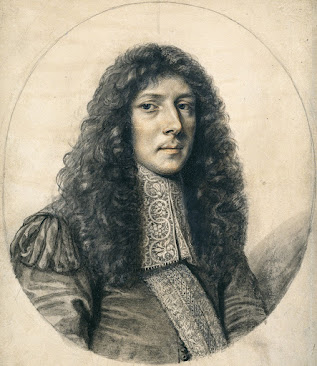
John Aubrey (1626-1697) was an ordinary sort of English gentleman with more breeding than money. He was no genius, and not really a great scholar, but he was intelligent and energetic enough to be welcomed in the society of his age's best minds. He was friends with people like Cristopher Wren, Thomas Hobbes, William Harvey, and Robert Boyle. He was a member of the Royal Society in its glory days, when Boyle, Hooke, Newton and others were making great advances in science and even greater advances in methods of publishing and verifying scientific discoveries from across Europe. His age was one of civil war and generally great political turmoil. Aubrey mostly tried to stay out of the fray, but he saw many of his friends ruined for their parts in England's conflicts, and a few killed in battles.

We remember John Aubrey as an antiquary and one of England's first historic preservationists. To me the most striking thing about Ruth Scurr's 2015 biography was how she brings out the frantic struggle Aubrey and some of his friends waged to keep the remains of England's past from being destroyed. Aubrey was the first intellectual to take note of the great megalithic monument at Avebury, which was being quarried for stone even as he tried to measure its dimensions. He eventually got King Charles II to issue an order preserving the site from quarrying, probably Aubrey's single most important achievement. But this was only one site among thousands that Aubrey worried about. He made the first accurate survey of Stonehenge, and one of the monument's features is still called the Aubrey Holes after him. England's monasteries had been dissolved a century earlier, and in Aubrey's time monastic ruins were fast disappearing under the assaults of time and looting. He studied and drew many now-vanished buildings, and his studies allowed to him to develop the first scheme for dating ecclesiastical buildings from the shape of their windows. (The forerunner of our Saxon-Norman/Romanesque-Gothic model.) The books and manuscripts from those monasteries had been scattered to the winds, and Aubrey repeatedly found pages of rare manuscripts being used by butchers to wrap meat or soldiers to stuff their canons. I sometimes find my contemporaries a little batty in their efforts to preserve everything, but their anxiety about loss is a small thing compared to Aubrey's.

Aubrey and his friends were all collectors, and they worried a great deal about what would happen to their collections when they died. Valuable artifacts had traditionally been preserved in the treasuries of royal and noble families, but in the 17th century many of Europe's greatest families were ruined, and their possessions dispersed. The solution Aubrey's circle hit on was to build some of the first modern museums. These were endowed institutions modeled on the colleges of Oxford and Cambridge where precious manuscripts, books, and artifacts could have a permanent home. Aubrey helped to found the Ashmolean Museum at Oxford, and some of the rarities he collected ended up there. I mention this because modern museums are suffering from a crisis of conscience and wonder what they are for, and what their part is in perpetuating injustices; but imagine how much would have been lost if those great museums had not been built and funded to save what could be saved from the destructive march of history.

Aubrey was equally involved in preserving folklore, and he assembled (but never published) a compendium of sayings, tales and rituals that he thought were remnants of pre-Christian Britain. You will often read that the rise of science was accompanied by great contempt toward the wisdom of ordinary people, especially ordinary women, and certainly that happened; early modern doctors in particular spent a lot of time railing against village hags and their supposed cures. But the age also birthed men like Aubrey who delighted in nothing more than listening to old people describe the ways they celebrated Christmas in their youth, or tell their local ghost stories. Aubrey eagerly discussed the properties of herbs with unlettered women, and on more than one occasion he recommended to one of this friends a treatment he learned of in this way.
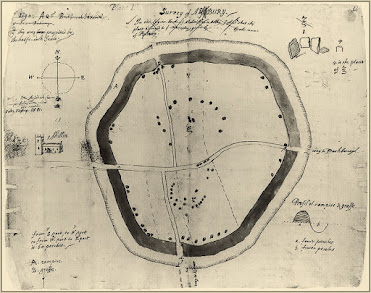
John Aubrey's Plan of Avebury

Let me mention two more things about Aubrey's life that especially struck me. First, the weirdness of money under the Old Regime. Noble families were all wealthy, at least compared to everyone else. But on the other hand they were very often bankrupt. Aubrey was a case in point; the houses and lands he inherited from his father were so encumbered by debts that he eventually lost everything. He spent years hiding from bailiffs who wanted to clap him in debtor's prison. This was partly because he was, as a friend put it, "Shiftless, roving and magotie-headed," more interested in drawing monastic ruins than estate management. But it was a constant theme of life in the period; Aubrey spent a great deal of time persuading his friends to donate their books to Oxford or Cambridge before they died, since many of their estates were also so debt-ridden that their possessions would probably have to be sold.

But of course even when broke Aubrey remained a member of the gentry. He continued to rent rooms in London, frequent coffee houses, attend the Royal Society, travel extensively. With no income, how did he do it? Scurr was able to figure a little of this out, using memoranda in which Aubrey recorded money lent to him by friends, and also sales of the books he had inherited or bought while young. But the sums we can account for don't add up to a living, and the memoranda also note that some of his debts were eventually repaid. How? One meets similar people in 19th-century novels from both England and Russia, noble characters who traipse through a glittering life while complaining that they have not a penny to their names. Some of it seems to be outright fraud, especially perpetrated against tailors, dressmakers, and innkeepers. (Thackeray's Vanity Fair has much of this). Some of it is simply camping for extended periods with your wealthy relatives; Aubrey spent much of his old age as the house guest of his cousin Sir John Aubrey. And then there was the way other members of the elite offered their friends opportunities; Aubrey was at various times offered the chance to take up land in both Barbados and Pennsylvania, but he didn't want to cross the ocean and lacked the acumen to profit from these grants from afar. One of  Thackeray's or Tolstoy's rogues would have found a way to turn those distant lands into cash.

And yet some people did have great wealth. This was absolutely not simply from owning land; as Europe commercialized, rents from average farm land declined steeply. Some land, such as that on the outskirts of growing cities, or with good coal fields or quarries, did provide a good income, but the average gentry family was simply getting by. Real money came from investments, for example in new housing developments on the edges of cities, or, especially, from holding office. Investments had the problem that they could go bad and ruin their investors; several English noble families were ruined by their attempts to build canals. Holding office was the real route to riches. Some of the viciousness of politics in this era came from the simple fact that the holders of great royal offices were enriched to a staggering degree, even compared to their aristocratic peers, while those who lost out often faded into obscurity and (comparative) penury.

But even knowing as much about the economics of life in this period as I do, I still find the operations of money mysterious, and wonder how people – especially naifs like John Aubrey – managed to survive. And that's before we get into questions like how factory workers survived when the mills sometimes shut down for months at a time, or how peasants got by in years when the harvest failed. Some just died, but most did not, and none of it makes much sense to me. I have to imagine that it was possible to live without money because much less of the economy was handled by cash. Much work was done for food, or food and shelter. Goods were often exchanged by barter, and used items retained much more of their value than they do now, so households could subsist by trading (say) blankets for food. A gentry household could raise much of its own food, brew its own beer, and so on. And yet the sources don't really show us this; how people got along in tough times is one of the things nobody thought to write down.
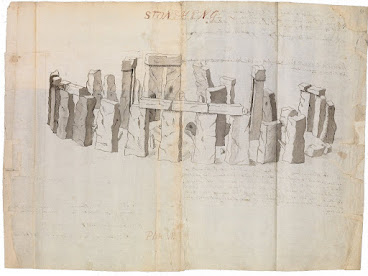
Stonehenge, drawing by John Aubrey

Second, the porous boundaries of science in its early stages. As I said, Aubrey was a member of the Royal Society when its leading members were discovering the properties of air and the equations of gravity. Yet most of the papers he presented concerned the properties of England's healing spring waters. He collected samples of water and evaporated them, displaying the resulting mineral residues so the assembled scholars could discuss the smell of each and speculate about what diseases each would treat best. These accounts read like scenes from the comedic plays that mocked the pretensions of intellectuals; you can readily imagine an actor dramatically sniffing a retort and saying, "I detect sulfur with undertones of lime, so this should be superb for treating gout or calming shrewish wives," while the audience hoots. 

From our perspective much of it is ridiculous. They were trying, but they were starting from such a small and error-ridden base of knowledge that their efforts were mostly vain. One of the many excellent little notices of intellectual life in Scurr's book is this one:

I visited Sir Christopher Wren again with Mr. Hook and Mr. Hill. We talked about petrifications of bodies, about plaisters, about framing glass, staining marble, filligreen sodering with bran, about printing stuffs and gilding stuffs, and about ghosts and spirits. (258)

The most important thing that happened in science before around 1850 was not any particular scientific discovery, but the discovery of what science is.

Ruth Scurr's book takes the form of a largely imaginary diary. I was not impressed by this experiment, which was tedious to read, although maybe in the end it did help immerse me in the 17th century. But John Aubrey was a very interesting citizen of a time I find fascinating, so I enjoyed My Life even while thinking a more standard biography would have worked better.

Science Used to Progress Very Slowly

Dr. Harvey tells me that after his book on the circulation of the blood, De Motu Cordis, came out in 1628, his medical practice declined mightily, since the vulgar thought him crack-brained and all the physicians were against him and envied him. Many wrote against him, but after about twenty or thirty years his doctrine was received in all the universities of the world. In his book De Corpore, Mr. Hobbes says that Dr. Harvey is perhaps the only man 'that ever lived to see his own doctrine established in his lifetime.'

–Ruth Scurr, John Aubrey: My Own Life (2015, p. 106)

Links 31 December 2021

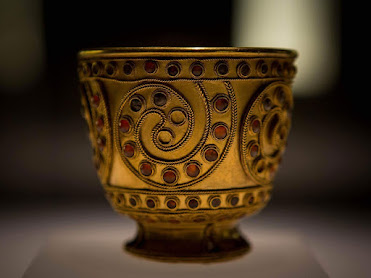
Gold goblet from a burial mound in Georgia, c. 1800 BC

Drawing bought for $30 at an estate sale might be by Albrecht Durer and therefore worth millions.

The folks behind The Missing Princes Project say that one of Richard III's nephews survived and lived under an assumed name in Devon. I think they've seen too many Dan Brown movies.

Fatal police shootings of unarmed suspects plummeted in 2021, from 60 to 25. Especially impressive since other homicides went up.

Poeple are pinning a lot of hopes on the James Webb Space Telescope, which I think is a sign of how frustrated astrophysicists are with their inability to understand or agree about dark matter, dark energy, cosmic inflation, etc. Given its complexity, if the telescope works at all that will be quite an engineering achievement (article, 31-minute video)

Certain very diffuse galaxies seem to contain no dark matter, and new observations confirm this result. But this isn't really evidence against the theory of dark matter, because the observations don't fit any of the major alternatives to General Relativity, either. 

More musings on Thomas Mann's "Reflections of a Non-Political Man," arguing that art is supposed to show us the great cost of always being moral, and the oppression of always doing the proper thing for a citizen.

List of the most exciting archaeological discoveries of 2021.

Wakusha and the ambiguous sexuality of adolescent males in old Japan. Interesting but I don't find it useful to consider youth as a third gender.

Green banks use money from philanthropists and governments to seed energy projects. (Washington Post)

Vox says the popular culture of the Obama years (Harry Potter, Hamilton, Parks and Recreation) celebrated earnest attempts to make the world better, and that is now totally cringe.

Interviewer Tyler Cowen's tips on how to ask good questions.

Kevin Drum reports that school bullying has decreased a lot over the past 20 years.

Russian archaeologists find a birchbark letter in Novgorod dated 1144, another piece of ordinary business from the 12th century.

In Baltic Russia, archaeologists explore the graves of Iron Age "amber elites."

How to build trust across political divides: the key is not to seek uniformity but to accept real viewpoint difference. This won one of David Brooks' Sidney Awards for 2021.

Wednesday, December 29, 2021

Democracy is Getting Harder

Richard Pildes in the NY Times:

The European democracies are experiencing the unraveling of the traditionally dominant center-left and center-right major parties and coalitions that have governed since World War II. Support for these parties has splintered into new parties of the right and left, along with others with less-easily defined ideological elements. From 2015 to 2017, over 30 new political parties entered European parliaments. Across European democracies, the percentage of people who identify strongly with a political party or are members of one has declined precipitously.

The effects on the ability to govern have been dramatic. In Germany, the stable anchor of Europe since the 1950s, the two major parties regularly used to receive over 90 percent of the vote combined; in this fall’s elections, that plummeted to less than 50 percent. Support has hemorrhaged to green, anti-immigrant, free-market and other parties. After its 2017 elections, with support fragmented among many parties, it took Germany six months to cobble together a governing coalition, the longest time in the country’s history. The Netherlands, after its 2017 elections, needed a record 225 days to form a government.

The coalitional governments assembled amid this cacophony of parties are also more fragile. Spain, for example, was forced to hold four national elections between 2015 and 2019 to find a stable governing coalition. Spain had effectively been a two-party democracy until 2015, but mass protest movements spawned a proliferation of new parties that made forging stable governments difficult. In Sweden, the prime minister lost a vote of no confidence this summer — a first in the country’s modern political history. Digital pop-up parties, including anti-party parties, arise out of nowhere and radically disrupt politics, as the Brexit Party did in Britain and the Five Star Movement did in Italy.

All of this is driven by dissatisfaction; by a sense that older parties are corrupt, stodgy, and not delivering on their promises. Immigration is an intensely polarizing issue; the urgency many Europeans feel about climate change is another factor. But I have the sense that people just find contemporary life intensely frustrating and are looking for someone to do something about it. Since nobody has any clue how the misery might be eased, or what is causing it, things are only going to get worse.

Tuesday, December 28, 2021

Joan Didion's America, and Mine

Like a lot of Americans, I read Joan Didion as a teenager and was captivated. I devoured her essays, felt I had encountered a writer of extraordinary gifts, her keen insights conveyed in brilliant prose. She showed to me a side of America I had never seen but knew existed out there somewhere. Her famous essay "Slouching towards Bethlehem" begins like this:

The center was not holding. It was a country of bankruptcy notices and public-auction announcements and commonplace reports of casual killings and misplaced children and abandoned homes and vandals who misspelled even the four-letter words they scrawled. It was a country in which families routinely disappeared, trailing bad checks and repossession papers. Adolescents drifted from city to torn city, sloughing off both the past and the future as snakes shed their skins, children who were never taught and would never now learn the games that had held the society together. People were missing. Children were missing. Parents were missing. Those who were left behind filed desultory missing-persons reports, then moved on themselves.

For me at 17, this was revelatory. All I knew (outside of books) was middle class suburban and small town life among what I saw as thoughtless people leading meaningless lives. Didion set up for me another pole of America: on the one hand was the tedium of a highly structured and tightly constrained bourgeois existence, on the other the collapsing fringe where life dissolved into drugs, promiscuity, and despair. 

So when I rebelled against the tedious miasma of high school, I also seethed with disgust against those who sought to escape it with drugs, free love, Maoist nonsense, and tie-dye. 

At 17, my answer was to get beyond all this mediocrity and soar on wings of intellect. My joys were science, history, and ethnography, and my greatest love was for the long ago and far away. My idols were the thinkers who penetrated the veil of existence; but I also had another class of heroes, the skeptics who doubted everything, both the common wisdom and the uncommon nonsense found in the social fringe. I believed myself better than all of this: I thought I understood what others did not, and recognized the folly of senseless, self-destructive rebellion.

It worked, for a while anyway.

But back to our subject. 

For many people, including Didion, revulsion against the doings of hippies and outcasts was a conservative impulse. At the time she was a Goldwater Republican and behind her reaction to drugs, casual sex, and social breakdown, one could sense a longing for some sort of structured normality. But Didion always had admirers all over the political spectrum; to some leftists she was describing the inevitable collapse of capitalism, and the blame for all of this lay with the Man. She never suggested solutions to the problems she documented, nor did she get very deeply into causes. She simply described what she saw, and connected it to her own personal sense that everything was bad and wrong.

If anything defined Didion's career, it was a sense that everything is going to hell. A reviewer once asked, "Can no one cheer this woman up?" No, was the answer. After exhausting national collapse as a theme, in old age she turned her attention to personal losses, chronicling at length the deaths of her husband and daughter and her reactions to them. I've never read those books but many people admire their cold-eyed clarity; after all Didion lived her whole life expecting the worst, so she was ready when it came. I don't mean to dismiss that; there is a value to having death and loss described for us in the clearest words and most powerful sentences. Yet something about Didion always rubbed me wrong.

Look closely at Didion's writing and you see an intense devotion to fragmentation. If she receives good advice, she frames it as "Someone said to me that. . . ." The identity of this wise person, and her relationship with that person, are hidden, leaving Didion as lonely and adrift as possible. It was just something she heard, another voice in the chaos. The narrative leaps around in time and space with no transitions or explanations, and the quotations are carefully chosen to make the speakers seem confused and out of place. Wandering around San Francisco talking to hippies she meets one man determined to get rich as a music promoter. He lectures her about the disposable income of the young, tells her things he read in business magazines. But in Didion's telling he pops up in between one strung-out hippie and the next, so different from them that he seems, not a representative from a saner, more self-sustaining America, but another jagged fragment of a reality that makes no sense. I wanted to ask, ok, if you despise hippies, why do you also despise people trying to keep their heads clear and make a living? But in Didion's America businessmen were always sharks out for a fast buck, just another part of the chaos and cruelty. Wherever sanity, order, and moral strength were to be found, it was not among either capitalists or would-be revolutionaries. 

As the sixties settled down, Didion turned her attention to other crises. Her politics drifted left, and she devoted attention to racism. She opposed the "tough on crime" movement of the 1980s, penned a stirring defense of the Central Park Five. She came to believe that the drifters she chronicled had not just dropped out of civilization, but had been driven out by a callous system. She despised the idealized American past she had been raised on, believed it was a lie and a fraud, and also that it was silly to imagine the 1890s had meaningful lessons for how we should live now. 

But she never fit in on the left either, never found a movement she could join. She once described herself as 

a woman who for some time now has felt radically separated from most of the ideas that seem to interest other people.

There is a view of contemporary life, to which I partially subscribe, that goes like this: You can walk the narrow path of bourgeois rectitude, carefully placing one foot in front of another, getting up every morning to brush your teeth, go to work, and do all the other required acts, or you can fall off into who knows what. You can believe that this is wrong and evil, or that it is just how life has to be, but that doesn't matter to you. All you face is the choice. Didion shot to fame as the chronicler of the who knows what, the cleverest answerer of the question, "what if we really threw it all over and just walked away?" Her characters are either trapped and desperate to escape, or on the road fleeing from everything, free because they have nothing left to lose.

When I read that Joan Didion had died, I almost immediately had two thoughts. One, she got famous because she believed American life is awful and wrote about it with style and cleverness; two, she got famous because she was at least partly right.

Saturday, December 25, 2021

Links 24 December 2021

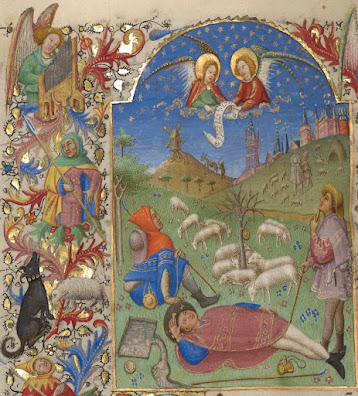
The Annunciation to the Shepherds from a French manuscript of c. 1420

Mentalfloss page linking to 12 great museums you can tour online.

British metal detectorist finds hoard of 332 fake coins buried in 1801 by notorious forger George Fearns.

The water crisis in Iran. Population growth, industrialization and oil extraction have stretched the country's water sources to the limit, adding another serious problem for a country that already has too many.

More on the Galloway Hoard, including a remarkable little gold and rock crustal jar.

The pandemic has accelerated a trend that has been under way for decades, the shift of children from physical sports to e-sports. You may not know that there are local leagues for e-sports with the same sort of coaching by dads infrastructure that has long supported football, baseball, soccer, and so on. (NY Times)

The savage war waged by monkeys against the dogs of an Indian village.

According to this study, words related to thinking rose vs. words related to feeling and belief in English and Spanish texts from 1850 to 1977, then began to decline.

538's Best Charts of 2021.

In Colchis at the east end of the Black Sea, gold vessels and ornaments were very much in fashion from 2500 to 1500 BC, and then again after 800 BC, but so far as archaeologists can tell very much out of fashion between 1500 and 800 BC; the society looks as rich as it had been except for very little gold.

An anonymous donor sent a box containing $180,000 in cash to the physics department at CCNY, asking that it be used to help impoverished physics students. (NY Times)

Searching for 520-million-year reefs, built by archaeocyaths, in the Nevada desert.

In its early decades the SPCA worried a lot about the conditions of urban working horses, pulling carts on pavements all day, confined to tiny stables at night. So they held Christmas parties for them, partly to give the horses treats and partly to raise awareness about the bad conditions some faced.

A 2019 document from Uber reported 6,000 cases of sexual assault by its drivers in 2017-2018. Perhaps they are applying a very broad definition of "assault," but this is from a company with a record of minimizing its problems, so it looks bad to me. (NY Times)

US population projected to have grown only 0.1% in 2021, the slowest growth since the nation was founded. Births are down, deaths are up, and immigration is down a lot.

Just when it looked like Ethiopia's government might be defeated and overthrown by Tigrayan rebels, a fleet of drones supplied by Arab states turned the tide and send the rebels fleeing back toward their bases. (NY Times; al Jazeera)

Thursday, December 23, 2021

A Family Tree 5,700 Years old

Paleogeneticists have applied their methods to 35 skeletons from the Hazleton North long cairn in Gloucester, England, which dates to around 3,700 BC. The reconstructed tree shows that 27 of these people were descended from one man and four women; the general assumption is that the women were the man's wives. The people of the next generation were all sons, which implies exogamy, with the daughters being married off elsewhere. In fact most of the people in the tomb were men, and all the relationships seem patrilineal. The descendants of two of the wives were all buried on the same side of the tomb, so I guess they formed sub-families of a sort. 

This paints a very hierarchal and patriarchal picture of society in Neolithic Britain.

Livescience, original article.

Wednesday, December 22, 2021

British Paleogenetics: More Migrations

Here is what paleogenetics seems to tell us about ancient Britain:

Neolithic farmers reached the island around 4000 BC and dominated the Mesolithic inhabitants; in 3000 BC the genes of Britain's people were around 80% from migrant farmers, 20% from the Mesolithic inhabitants.

Then around 2500 BC people with the Bell Beaker culture and a lot of Steppes genes reached the island, replacing about 90% of the natives. As we have discussed, they probably brought the Plague with them, which accounts for their population dominance.

New data, published this week, says that in 1400 to 1000 BC a new wave of invaders arrived. This cultural influx is clearly visible in the archaeological record in the form of artifacts and stylistic influence from the continent. These new invaders seem to have made up at least 24% and maybe 50% of the population. As a guess, these may be the speakers of Celtic languages. They also seem to have brought genes for lactose tolerance, which greatly increased in the 1200-800 BC period.

And of course we have data showing that the Anglo-Saxon invaders contributed around 30-40% of the genes in medieval Britain.

The more data we have, the more movement of people we see in the past.

Which means that the old Irish stories recording repeated invasion of the island, and repeated replacements of the population, seem remarkably accurate despite their magical weirdness.

BBC Story; article.

Tuesday, December 21, 2021

Kiyoshi Yamashita

Kiyoshi Yamashita (1922-1971) was born in Tokyo. According to wikipedia,

At the age of three, he suffered an acute abdominal disorder which, although not life-threatening, left him with a mild speech impediment and some neurological damage.

At elementary school, Yamashita was the victim of bullying and on one occasion wounded a classmate with a knife. Because of this, his parents decided to move him to the Yahata institution for the mentally handicapped in Ichikawa, Chiba. His IQ was measured at 68. It was here he started to experiment using torn pieces of paper to create pictures. His talent was recognized by mental health expert Ryuzaburo Shikiba, who organized an exhibition of Yamashita's work in Osaka which received wide praise.

Tiring of life at the institution, and in order to avoid the mandatory physical examination for recruitment into the Imperial Japanese Army, Yamashita ran away in 1940 to start his wandering around Japan, which would last until 1954.

At the age of 21, staff from the institution found him helping in a restaurant and forced him to take the recruitment exam. Eventually he was considered exempt from service. The events from this time were recorded in his “Wandering Diary” of 1956, and the most popular image of Yamashita travelling alone through the country with his rucksack comes from this period. 

Picture of Yamashita in his rucksack days. That he got somewhat famous for his wandering life as an escaped mental patient confirms something I figured out after reading a lot of Haruki Murakami. While most Japanese live in careful conformity with social expectations, many of them are fascinated by people who throw it all over and become vagabonds or hermits.


Yamashita used a technique called in Japan chigiri-e, which is gluing together pieces of colored paper together. The examples I have seen are mostly landscapes and fireworks displays. The only large image I found was the one I reproduce above, with details to show the method.

You're not a real Japanese artist without at least one rendering of Mt. Fuji. Or at least that used to be true, and the point when it ceased to be so probably marks some kind of major turning point.


I think these are nice, and I find both Yamashita and his status within Japanese culture interesting, so I happily share here the work of this true outsider artist.

Pushing the Panic Button

At Vox, Anna North writes a magnificently unhinged cry of pain titled "The world as we know it is ending. Why are we still at work?" Some samples:

For a moment in early 2020, it seemed like we might get a break from capitalism. A novel coronavirus was sweeping the globe, and leaders and experts recommended that the US pay millions of people to stay home until the immediate crisis was over. These people wouldn’t work. They’d hunker down, take care of their families, and isolate themselves to keep everyone safe. With almost the whole economy on pause, the virus would stop spreading, and Americans could soon go back to normalcy with relatively little loss of life.

Obviously, that didn’t happen.

Instead, white-collar workers shifted over to Zoom (often with kids in the background), and everybody else was forced to keep showing up to their jobs in the face of a deadly virus. Hundreds of thousands died, countless numbers descended into depression and burnout, and a grim new standard was set: Americans keep working, even during the apocalypse.

Now it’s been nearly two years since the beginning of the pandemic — a time that has also encompassed an attempted coup, innumerable extreme weather events likely tied to climate change, and ongoing police violence against Black Americans — and we’ve been expected to show up to work through all of it. . . .

What do people like North think would happen if we stopped going to work?  Well, for starters, nobody would grow food, or ship food, or sell food, so we would soon all be going hungry. With nobody working in the waterworks and the sewage treatment plants and the power plants, our basic infrastructure would quickly crumble. Without people working, we simply can't survive.

The thing is, I get the impression that people like Anna North want something like that to happen. They want the world to be a s bad as they feel it is. They feel that we are, as North writes, "in the end times," and they want apocalypse in the streets. 

I don't, so I keep working.

People like Anna North also make the strange error of thinking that we have to go to work because of capitalism, and a "break from capitalism" would mean we don't have to work any more. But it isn't capitalism that forces us to work; we have to work because it is fundamental to animal life in this universe. We tried socialism and one thing we learned from that experiment is that people still had to go to their jobs every day.

Between the pandemic, the attempted coup, and the climate crisis, misery abounds:

Making these kinds of calculations all the time is exhausting and takes a toll on mental health. The “constant, low-level stress” of slow-moving disasters like the melting polar ice caps can make everything more difficult, including work, Remes said. “It makes it harder for people to be productive, because they’re worrying about their basement flooding.”

If these things are problems, doesn't that mean that we should be working all the harder to solve them? My readers know that I think greenhouse gases are a solvable problem, but we certainly won't make much progress if we all stay home and cocoon because we're too anxious to work. Plenty of people on the left justified the George Floyd protests with the argument that political change can't wait for the pandemic to end. Pulling your blankets over your head will not help anybody, not even you.

This kind of rant would be incomplete without the (usually white) authors tossing in the assertion that things are even worse for minorities:

Seventy percent of respondents in one September survey said they were anxious or stressed about work, and 81 percent said they were more burnt out than at the start of the pandemic. Among Americans of color, who have experienced many of the pandemic’s interlocking crises most acutely, “depression and anxiety and stress are spiking in ways that are disproportionate to their peers,” Anderson said.

But mental health is one part of American life where people of color do not have it worse; despite numerous attempts to show otherwise by people convinced that the root of our misery is oppression, white Americans suffer more from all the major forms of mental illness than other groups.

The world has serious problems. It always has. But it is not ending. As Freddie de Boer put it, in a response to North's essay,

The person who wrote this wrote it on a functioning computer, passed it off to her superiors as part of a more-or-less unaltered business operation, and it was uploaded to the internet, where it can be accessed by billions of people through the use of technologies that require an exquisite amount of collaboration across vast distances of geography and circumstance. In other words, the world as we know it is apparently ending in such a gentle way that the most basic economic, technological, and communicative infrastructures of our civilization are puttering along nicely.

I find apocalypticism mysterious and fascinating. I think it is often born from a personal sense that life day-to-day is so unendurably bad that anything would be better, even the collapse of civilization, mass starvation, and civil war.

Anna North is clearly on the left, but we could easily find equally unhinged screeds from people on the right. For reasons that I find mysterious, this era when human life is by most numerical measures better than ever before has spawned a very widespread sense that everything is going to hell. I don't really understand why, but I think all this doom-mongering has become a problem of its own as big those it is supposed to be based on.

Monday, December 20, 2021

The Tomb of Emperor Wen of Han

Much later (Sung Dynasty) painting of Emperor Wen, shown as a Taoist sage

Chinese archaeologists have announced the discovery of the tomb of Emperor Wen of Han, who reigned from 180 to 157 BC. Emperor Wen was credited with restoring stability to the empire after the quasi-rule of the Empress Dowager Lu, but then dowager empresses always got bad press from Chinese historians, so who knows? The sources are far from perfect. Anyway Wen's reign was remembered as a comparatively peaceful and prosperous time, when the annual property tax was usually 1/60 and never rose above 1/30. (In both Chinese and European lore, low taxes = a good reign.)

His tomb was only recently discovered because people believed for 2,000 years that it was somewhere else, under a hill known as the Phoenix's Mouth just outside Xian City. Archaeologists exploring that area found ten stone tablets honoring Emperor's Wen burial place, all installed in much later periods. Eventually, though, archaeologists figured out that the Phoenix's Mouth is a natural hill, not a tomb at all:

What would prove to be Emperor’s Wen’s actual tomb was discovered a mile or so away from the mountain in 2017 during an emergency excavation to counter looting activity. It may have originally been a pyramid as was typical of imperial tombs of the era, but if so, the mound was flattened over the millennia. It’s also possible the Emperor ordered a less prominent tomb, as he was famed and respected for his frugal approach to leadership. It wasn’t recognized as an imperial tomb until excavations revealed its shape and monumental size (230 feet long, 100 feet wide).

The central tomb has not yet been excavated; all that you see here comes from eight of the estimated 110 subsidiary graves and offering pits that surround it. These gold ornaments come from the tomb of Empress Dowager Lu. So I guess however bad she was a ruler, she still merited a tomb next to the emperor's.


Ceramic figures of servants and attendants, also from the tomb of the Empress Dowager.

A horse burial. The emperor's favorite mount? The empress's?

Figures of prisoners, from a pit full of them. The History Blog has many huge images of the tomb.

The astonishing imperial tombs of classical China represent, I think, the convergence of two trends: first, the use of the deceased emperor's burial as a means of proving the legitimacy of his heir. You see this around the world, the funeral rites of the deceased ruler doubling as the real proof that the successor is firmly in control. This is most common when the transfer of power was not yet regularized; for example the spectacular royal tombs of Anglo-Saxon England all date to the first two or three generations of the royal dynasties. In the Chin and early Han periods imperial rule in China was still fairly new, and the successor's claim to rule the whole empire was disputed from many quarters.

Second, the Taoist obsession with immortality, which convinced some people that the correct rites could guarantee a glorious afterlife. 

(Note that many people who practiced grand funerals with rooms full of grave goods did not think this would help the deceased; it is naïve and often  incorrect to assume that people put weapons or pots full of food into graves because they thought the dead could use them. Funerals have always been for the living. But there were some cases, notably classical China and ancient Egypt, where people do seem to have believed that the rites helped the dead, and that more gifts might lead to a better afterlife.)

Anyway how astonishing that these tombs exist, and how wonderful that we can see these old and haunted things.

Sunday, December 19, 2021

A Walk in Rome

The walk I regularly take in the woods by my house covers about a mile and a half, or 2.4 km. It's a pleasant walk and I regularly see woodpeckers and deer. But I wonder, how much could I see if I took a walk of the same length in Rome? 

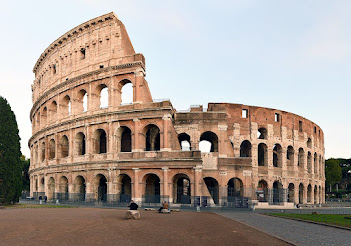
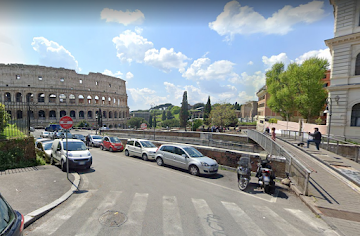
Our walk will start at the Colosseum Metro Station. We're just going to skirt the exterior of this famous monument, since I'm not in the mood to have a tour guide tell me questionable stories about gladiators.

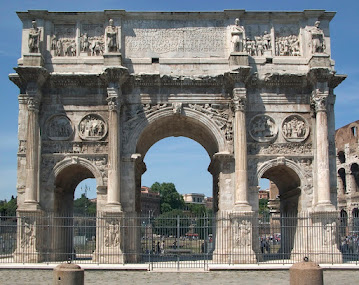
Instead we will walk past the Arch of Constantine

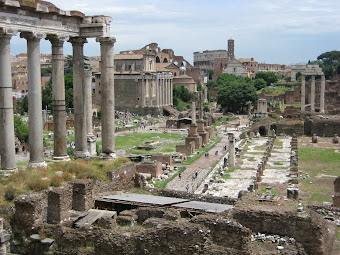
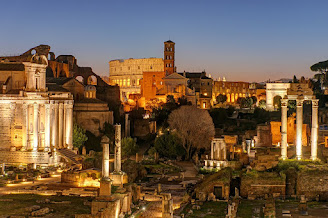
And into the Roman Forum.

Now it has to be said that the Forum is now a mess of ruins and Christian churches, overrun with tourists. And yet. This is the place where so much happened. Going back nearly 2500 years, we can name men who spoke here, and reargue their debates. If you went here with me you would have to listen to me recite all of Cicero's Pro Milone that I can remember. Not that I have any special love for Cicero, and Milo was a thug, but I learned those words, from a man who spoke here a hundred times, more than 2,000 years ago. It chills me so much to be where so much happened so long ago that I am probably going to get choked up, and you're going to have to bear with me for a while.

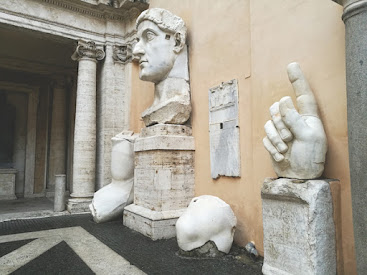
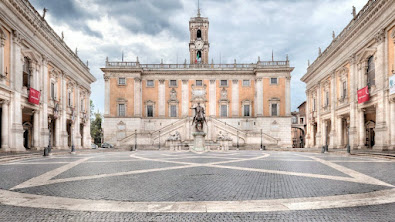
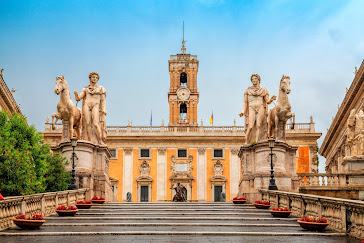
At the far end of the Forum is the Capitoline Museum, one of the world's great collections of broken Roman things. And also plenty of more or less intact ones.

And here's the thing about Rome: the density of famous monuments of so great that you can hardly tell where one ends and the next begins. Because the plaza in front of the Capitoline Museum was designed by Michelangelo. 

This is actually the farthest point we reach from our base; now we turn and make our way back by a different route.

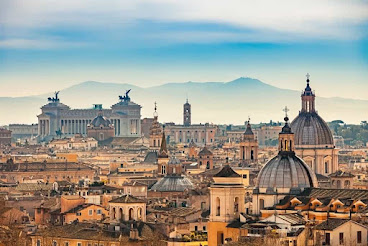
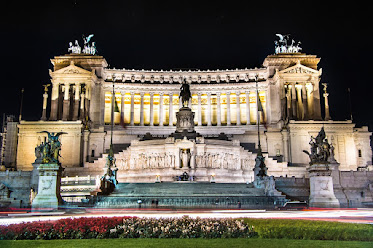
We're going to pass one of Rome's least beloved monuments, the Fascist Altar of the Fatherland,

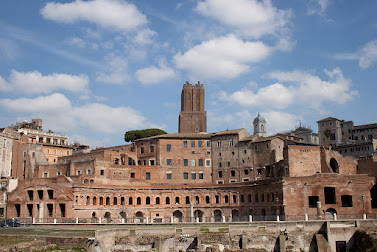
One our way to the Market of Trajan, a standing commercial building 1900 years old, often called the world's oldest shopping mall.

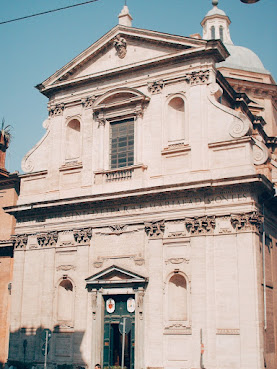
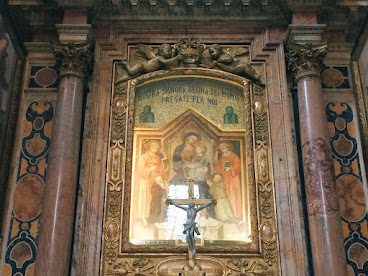
From there it's just two short blocks to a delightful little sixteenth-century church, Santa Maria ai Monti. This foundation stone of this church was laid in 1580. It seems there had been a medieval nunnery here, but it had been abandoned and had fallen into ruins. Then one day some workers removing stone came across a painting of the Virgin that had miraculously remained intact and bright despite centuries of neglect. People came from all over Rome to see the miracle, and the Pope ordered that a new church be built to house it. This fascinates me because there must be a hundred churches in Europe with this exact same foundation story, about a miraculous image found in a ruin, a field, a cave, or really just about anywhere. Which makes me wonder: who believed this? Did the Pope believe it?

That miraculous painting is still in the church, behind the altar; art historians says it looks like it dates to around 1580. If you're in a generous mood you can say there was a painting but it was faded so they painted it over. I think the whole thing is a nice story, but if you disagree I won't argue.

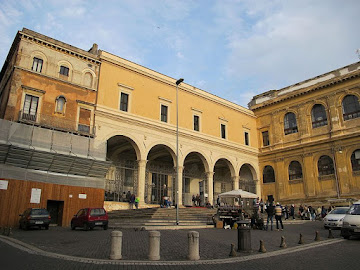
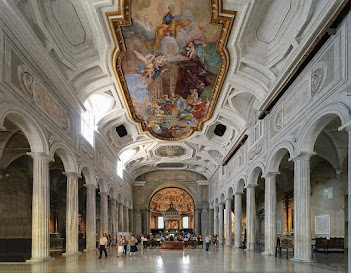
From there we're going to walk a few hundred more feet and visit a much more famous church, the Basilica of St. Peter in Vincula, or St. Peter's Chains. A church here was consecrated in 440 AD to house the chains that (so they said) bound St. Peter when he was imprisoned in Rome. The chain installed in the church was given to Pope Leo I by Empress Eudoxia, wife of Emperor Valentinian III. Most of what you can see dates to the 1400s and 1500s, but elements of the original church are still present, including most of the foundation. In medieval England (at least) they celebrated the feast day of St. Peter ad Vincula by pardoning some prisoners and taking cakes to the rest, something that always fascinated me, which is why I am drawn to this church. 

Not much to look like on the outside, but the inside is a bit more spectacular.


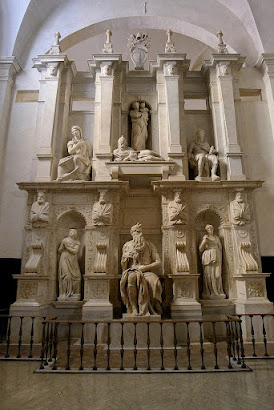
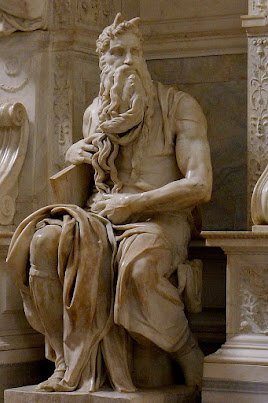
These days the church is most famous for the tomb Michelangelo designed for Pope Julius II, which includes his statue of Moses.

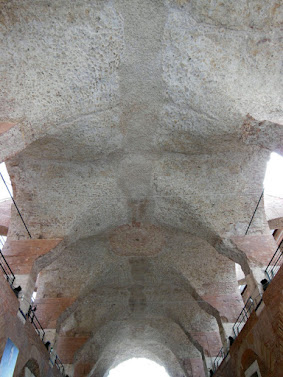
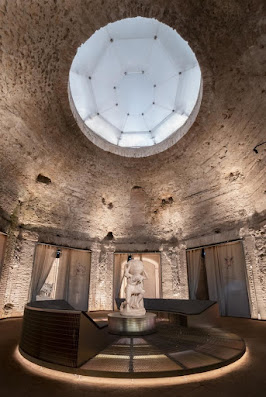
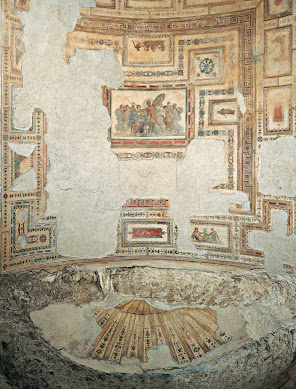
From there we'll make our way about 300 feet (100m) to the Domus Aurea, the remains of Nero's famous palace. The site has recently re-opened after a major restoration, so let's go inside and explore. 

The palace and its gardens once covered hundreds of acres. Quite a lot remains, and the new exhibits use projections to bring more of it back to life.

And from there it's just 300 feet back to the Metro station where we began, having walked almost exactly a mile and a half.

Friday, December 17, 2021

"No Evidence" = Terrible Communication

Scott Siskind has a terrific post pointing out that the phrase "no evidence" is used in two contradictory senses in a way that muddies understanding of science and knowledge.

For example, early in the pandemic you might have read articles with titles like "No evidence for airborne transmission of novel coronavirus" or "no evidence linking Covid to indoor dining." Which did not mean those things were not true, just that nobody had yet done a real study about them. Once people started studying them they were quickly shown to be correct. But

On the other hand, here is a recent headline: No Evidence That 45,000 People Died Of Vaccine-Related Complications. Here’s another: No Evidence Vaccines Cause Miscarriage. I don’t think the scientists and journalists involved in these stories meant to shrug and say that no study has ever been done so we can’t be sure either way. I think they meant to express strong confidence this is false.

You can see the problem. Science communicators are using the same term - “no evidence” - to mean:
  1. This thing is super plausible, and honestly very likely true, but we haven’t checked yet, so we can’t be sure.
  2. We have hard-and-fast evidence that this is false, stop repeating this easily debunked lie.
This is utterly corrosive to anybody trusting science journalism.

I agree completely. I think one of the reasons people don't trust science is that science journalism does not explain to what extent things are known and accepted; the results of the latest cutting edge experiment are presented the same way as something like orbital mechanics that we can calculate to five decimal places. 

It is not enough to say that studies show something, or that scientists accept something, without at least attempting to convey the strength of the evidence and the degree of the agreement. Unfortunately science journalists are under huge pressure to offer yes-or-no, true-or-false takes on every question, because that is all a big portion of the public will accept. But they could do a lot better.
Links 17 December 2021

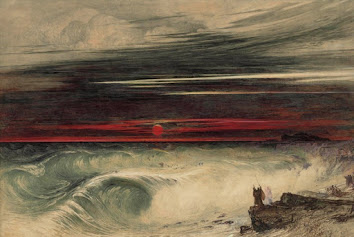
John Martin, The Destruction of Pharaoh’s Host, 1836

Louis Menand is for me the best contemporary writer on American intellectual history. In this wonderful New Yorker essay he reviews two books by Great Books teachers bemoaning the state of higher education and shows with clarity what the sound and fury is all about.

Spectacular images of the northern lights at My Modern Met.

After a talk, David Brooks was once handed a question card from someone in the audience that read, "What do you do when you’ve spent your life wanting to be dead?" He didn't answer at the time but has been wondering ever since about what sort of answer he might have given. (NY Times)

Does anyone read the syllabus? To find out, an instructor hid a $50 bill in a university locker and put the locker number and combination in the syllabus. Nobody claimed it. Of course this might not be true, but I find it believable.

The cabarets of bohemian Paris, 1890s, where you could visit establishments themed to represent heaven, hell, death, and sundry other realms. 

The absurdist satire of the Birds Aren't Real movement (NY Times). The originators say claiming that birds are really government drones that recharge on power lines is a way of mocking crazy conspiracy theories. I suspect, though, that the long-term impact of this sort of absurdity will just be further muddying the waters; all sorts of stuff circulates online that shades the boundary between serious claim and joke, so making more jokes in the guise of serious claims won't help.

One downside of being a famous, much-beloved author is the maniacal attention people will pay to everything you ever did; consider all the writing and speculation about Borges' brief visit to St. Andrews in Scotland.

Earring from the medieval Middle East found in a Danish field. Interesting about Vikings but also about the staying power of earring design.

Why do Kenyan students keep setting their schools on fire?

Fights over egg bans in Indian cities: some Hindus find the public sale of meat offensive, and under the Modi regime some cities have banned food carts selling all meat products. But the patrons of the very common food carts selling egg dishes are also mostly Hindu; it seems to be a dispute about caste and class as much as religion. Interesting that while Hindu nationalists in the government are pushing egg bans other parts of the government are pushing egg production for economic and health reasons. (NY Times)

Carla Rhodes set up an automatic camera on the ground beneath her bird feeder.
Trying to unionize a Dollar General store in Connecticut. (Washington Post)

Study says using psychedelics really can change your metaphysical beliefs, almost always away from materialism.

Scuba diving YouTuber Jeremy Sides solves another cold case. (Washington Post) Sides looks for cases of people who went missing in their cars and explores local waterways until they turn up. Another interesting look at what people can do for work in the post-industrial age.

BBC report on Black Axe, a Nigerian student fraternity that became a deadly criminal gang. The main source of their revenue is internet scams.

Mormon fertility in the US has been plummeting since around 2004, and is now just above replacement.

Why Twitter is both fun and dangerous: insider knowledge, the theory of jokes, and "context collapse."

This is Colossal's picks for the best short videos of 2021.

Neal Moore, who has spent the past two years paddling a canoe across the United States from Astoria, Oregon to New York City, reached the Statue of Liberty on December 15 and concluded his journey. This was very much a late 1800s thing to do, a memory of a time when people got famous for stunts like crossing the Atlantic by rowboat or canoeing the length of the Mississippi. As a child I was always puzzled by the fame acquired by Lindberg for flying solo across the Atlantic, not understanding that this was the tail end of the great Era of Exploration, when filling in the map and connecting the world's people's had devolved into a series of media stunts. Cool that Moore did this, though, in an age when it won't make him rich or famous.

Wednesday, December 15, 2021

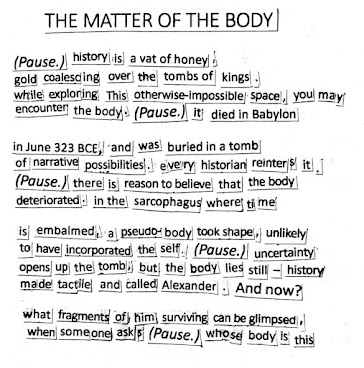
Ella Standage, "The Matter of the Body"

Poem made from the handout for a lecture on the fragmentary historical sources and missing tomb of Alexander the Great.

I posted another one of Ella Standage's poems here; I just love what she does with cut up texts.

And see here for a passage of the Iliad translated using a National Geographic article about whales.

Tuesday, December 14, 2021

Penn Access and American Infrastructure


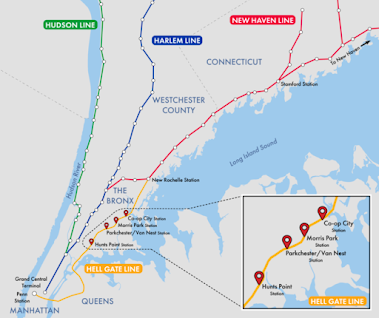
With money from Biden's infrastructure bill apparently on the way, New York officials have just struck a deal to spend a big part of theirs on two long-mooted projects: a new terminal at Kennedy Airport, and something called Penn Access. (NY Times; Penn Access web site)

Penn Access is an old and simple idea: instead of sending all the commuter trains from Metro North to Grand Central Station, creating a miserable crush of commuters at rush hour and requiring many of them to make annoying multiple transfers to get to some parts of the city, why not send some of them along Amtrak's Hell Gate track to Penn Station? After all the necessary track already exists, carrying trains every day, and the two lines cross each other. This would also allow you to add some new stations in the East Bronx, for example at Co-op City, making the commute to Manhattan much simpler for those folks. So surely it would just be a matter of creating a sort of ramp so commuter trains could switch to the Amtrak track? Maybe a few new signals? Wouldn't this be pretty cheap?
Ha ha, right. Amtrak, because of its governing laws, can't refuse to carry commuter trains on its tracks. But it can give its own trains priority, and it can limit traffic to what it thinks its lines can safely carry. And Amtrak has long maintained that the Hell Gate tracks are so old, the bridges so stressed, and (especially) the two tunnels under the East River so decayed, that no more traffic could be carried without major upgrades. New stations would also require the laying of new track, so that express trains would not have to wait behind stopped commuter trains.

So there things have sat for about the past thirty years. But the new deal provides $2.87 billion to make Penn Access a reality, plus an additional $1.3 billion to repair the East River tunnels. They plan to get to work right away, since the Environmental Impact Statement already exists and the initial start-up costs can be paid out of state and MTA funds without waiting for final passage in Washington.

One of the things I have learned from playing my own small part in infrastructure projects is that all the ones that really end up being built have been around in some form for decades, and in some cases have been planned in detail since before many of the workers who will build them were even born.

Monday, December 13, 2021

Mentoring, Small Group Theory, and Me

Tyler Cowen recently offered two pieces of advice on how to achieve anything:

1. When working on any kind of problem, task or question, embed yourself in a small group of peers with broadly similar concerns.

2. Get mentors.

These are extremely common pieces of wisdom tossed around in our age, and on a personal level I find them both very mysterious.

I have learned a lot from older people, but I am not sure that anyone was my "mentor." I suppose this is partly because of the zig-zagging nature of my career. As an undergraduate I studied mostly modern history, switched to medieval and early modern Europe in graduate school, and now I make my living studying North America. I keep having to pick up new subjects on the fly. Anyway I think that since I graduated from college I have learned more from peers and books than from teachers.

Lately I have been trying to publish novels, and so far as I know I have never met a single person who has written the kind of book I am trying to write. I have gotten a lot of help on my books from my friends but they are not novelists themselves so I don't think they can really be called mentors. 

As for small groups, I don't think I have ever been part of a group working together on a problem. I have a few times stumbled across an area of scholarship that seems to have been mainly generated by a small group who knew each other, for example studies of colonial probate inventories; but though I drew on the research I never interacted with any of the people who produced it. All archaeological projects are team endeavors, but mostly these are the sort of teams where each person does his or her job, not the kind where people make a collective effort to answer one question. It does happen sometimes but it is not central to what I do.

Here is more Cowen on small groups, in response to the question of what to read about them:

I suggest reading about musical groups and sports teams and revolutions in the visual arts, as I have mentioned before, taking care you are familiar with and indeed care passionately about the underlying area in question. . . .

I have a few observations on what I call “small group theory”:

1. If you are seeking to understand a person you meet, or might be hiring, ask what was the dominant small group that shaped the thinking and ideas of that person, typically (but not always) at a young age. . . .

2. If you are seeking to foment change, take care to bring together people who have a relatively good chance of forming a small group together. Perhaps small groups of this kind are the fundamental units of social change. . . .

3. Small groups (potentially) have the speed and power to learn from members and to iterate quickly and improve their ideas and base all of those processes upon trust. These groups also have low overhead and low communications overhead. Small groups also insulate their members sufficiently from a possibly stifling mainstream consensus, while the multiplicity of group members simultaneously boosts the chances of drawing in potential ideas and corrections from the broader social milieu.

4. The bizarre and the offensive have a chance to flourish in small groups. . . . 

9. What does your small group have to say about this?

This makes me feel strange and lonely. I have heard other people bewail the lack of mentoring in their lives, and I imagine that some people, reading this, would think, "Where can I find a small group to join, one where we learn from each other and bring about change?" But this is so foreign to me that I cannot even imagine what it would be like. 

I don't mean to say that I am alone or lonely, but as it happens my friends mostly don't work in my field, and even the ones in my field are mostly doing their own things. Honestly the mix of things I do in my job is quite strange and idiosyncratic – archaeology of everything in Eastern North America, colonial history, Civil War history, African American history, project management, coping with mergers and corporate reorganizations, cultural resource management, National Park Service policy, etc., that I would find it really weird to meet anyone who does the same thing. I suppose one could belong to a bunch of different groups focusing on each one of those things, but on the other hand each of them is such a small part of my work that I don't think it would add up to what Cowen envisages.

So I am wondering, is my rather lonely, self-directed path through my career the more normal kind, and the sort of connectivity Cowen describes unusual? Or the reverse?

The Roos Carr Figures

Hull Museums:

In 1836 some labourers cleaning a ditch at Roos Carr, near Withernsea in East Yorkshire made a surprising discovery. About two metres below the surface they came across a collection of well-preserved wooden objects including several 'warrior' figures with stone eyes, a wooden box, a serpent-headed boat, and various other wooden articles 'too much decayed to remove'.

Four of the figures; together with the boat and various other attachments which seemed to be arms, paddles and shields; were given to the Hull Literary and Philosophical Society and eventually became part of the collections of Hull Museums. A fifth figure was acquired by the museum in 1902. One of the men present at the time of the discovery had apparently given the 'ancient doll' to his daughter to play with!
The figures have been radiocarbon dated to around 600 BC