Showing posts with label Europe. Show all posts

Saturday, January 10, 2026

Is Ground News a CIA Operation?

Ground News is a news aggregator that sponsors several of the YouTubers I follow: Perun, William Spaniel, Kraut, and others. All of these are moderate, rational, pro-western, anti-Russia voices.

The folks at Ground News tout themselves as helping you avoid media bias by providing information on who owns each news source, a rating for the site's reliability, and an estimate of the site's ideological bias. (They give savagely low reliability ratings to Russian government sources.) You can also get a "blindspot feed" that will show you stuff that your usual news diet misses.

One day while listening to a YouTuber tout Ground News for the hundredth time I suddenly wondered: who is paying for all of this? How can these people possibly be making enough money for all these sponsorships?

So I looked it up and found this:

Ground News is a Canadian news comparison platform that aims to reduce media bias by showing readers multiple perspectives on current events. Founded in 2018 by Harleen Kaur and Sukh Singh, the company is based in Kitchener, Canada. . . . Ground News is independently funded through subscriptions and a small group of investors, avoiding backing from major media, tech firms, or governments.
Google's AI adds that Ground News has never been profitable.

So I am thinking, is this "small group of investors" really a front for the CIA? During the Cold War the CIA did this all the time, often secretly; I remember reading about several anti-Soviet groups or publications who were rather startled to discover that the funding they thought came from NGOs or obscure arms of the French or German governments really came from the CIA. Some of them were not particularly pro-American, seeking some sort of middle political ground, but the CIA didn't care as long as they opposed the Soviets and called out communist crimes.

And note that while much of the Trump administration has gone waffly on Russia, the CIA is still doing all they can to combat them, most recently providing Ukraine with information on the exact locations of Russian air defenses so they can route their missiles and drones safely to targets deep in Russia.

And, hey, if the CIA is not involved, maybe they should be; my view is that Russian policy is so wicked, and so unjustifible, that any attempt to present a truthful point of view is bad for them.

Monday, January 5, 2026

Jerzy Giedroyć and the Rebirth of Poland

Giedroyć in 1987

Jerzy Giedroyć (1906-2000) was a Polish intellectual. In the 1930s he devoted much energy to promoting peace among the Poles, Ukrainians, and Lithuanians who found themselves within the post-Versailles borders of Poland. He avoided the Polish catastrophe of 1939 because he was serving in the Polish embassy to Romania. From there he eventually made his way to British Palestine, where he joined the Carpathian Rifles and fought with the British at Tobruk. After that he worked as a diplomat and propogandist for the Polish government in exile.

After the war, Giedroyć moved to Rome and founded the first in a series of emigre Polish cultural institutions, a publishing house. He soon moved on to Paris, where he co-founded a journal called Kultura that became hugely influential among Poles both within and outside Poland.

In Kultura Giedroyć laid the foundations for a post-communist Polish foreign policy. Giedroyć asserted, first, that Soviet communism would collapse within his lifetime, and second, that Russia would remain a militaristic, expansionist state. Poles, he wrote, must prepare for a post-Soviet world in which their main foreign policy challenge would be asserting their independence in the face of Russian imperialism.

Giedroyć posited two pillars for such a policy. First, Poland must have good relations with all of its neighbors. It must, therefore, recognize its post-1939 borders and accept the loss of huge territories to Ukraine, Belarus, and Lithuania. In the 1950s this was heresy among Polish exiles, for whom restoration of Poland as it existed in the 1930s was a key goal. Giedroyć argued that this was nationalist, myth-besotted folly. Poland needed friends more than it needed territories now occupied by non-Poles. But Giedroyć did not just advocate for friendship with Poland's neighbors. He wrote that Poland must become a friend and advocate for all nations resisting Soviet or Russian imperialism.

The second pillar must be friendship with America. European allies were great and Poland must seek them, but WW II had convinced Giedroyć that France, Germany and Britain were not reliable defense partners. Only US friendship could secure Poland's independence. Poland must, therefore, seek membership in NATO.

All these things that Giedroyć wrote of in the 1950s to 1970s have come to pass. Soviet communism collapsed, but Russia remained the greatest threat to Poland. The post-communist Polish government adopted Giedroyć's policy of accepting its borders and pursuing friendship with its neighbors. They very much pursued friendship with the US, for example supporting our dubious invasion of Iraq. They are members of NATO. And the have consistently spoken up for all nations under attack by Russia, most prominently Ukraine.

And to think that I never heard of Giedroyć until yesterday.

wikipedia, longer article at culture.pl, 13-minute video from Kraut.

Wednesday, June 11, 2025

A Russian Bemoans the State of Russian Power

This, via Natalka on Twitter/X, is supposed to be an essay by a Russian named Igor Dimitriev. I have not been able to find the source, since there seem to be about a thousand people named Igor Dimitriev, but this is certainly interesting despite the machine translation. Dimitriev notes that in January 2022 Russia seemed to be rising in power and influence, using the CTSO (Collective Security Treaty Organization) to dominate much of the old Soviet Union. Now, not so much:

Even the memory of that brief euphoria that accompanied the entry of the CSTO [forces] into Kazakhstan in January 2022 is gradually fading. Then it seemed that Russia was the guarantor of stability, the arbitrator, the center of power. Now there is nothing left of that feeling.

Kazakhstan is confidently following its own path, forming its own security strategy. It signed a military cooperation plan with Great Britain, including the training of officers in British military academies. It is building a plant with its Singapore partners to produce 155 mm ammunition, NATO standard. It is introducing a territorial reserve system based on Western models. (There was even a scandal there recently with the local analogue of the Territorial Center of Recruitment). All this in a paradigm where Russia is seen not as an ally, but as a potential threat.

Azerbaijan has finally liquidated Armenian Artsakh [Nagorno-Karabakh] without regard for the CSTO and killed Russian peacekeepers. After the downed plane in December 2024, it publicly demanded an apology and compensation from Moscow, closed the offices of Russian government agencies. Aliyev acts openly - he is increasing cooperation with Ukraine, supplying humanitarian aid, and avoiding even formal neutrality.

Armenia - in the past, the main ally in the Caucasus - has effectively left the Russian orbit. Pashinyan has repeatedly announced his withdrawal from the CSTO, the country recalled its permanent representative to the organization, and closed Russian propaganda channels.

Uzbekistan has ignored the CSTO since 2012 and is actively developing partnership with Europe through summits and sectoral agreements.

Last year, there was tension between Moscow and Tashkent in connection with the assassination attempt on one of the government officials and the alleged "Chechen trace".

Instead of neutral Finland, there is now a 1,300 km border with NATO. Sweden, which remained neutral even during the Second World War, participates in NATO military exercises and supplies weapons to Ukraine. The entire north of Europe is reorganizing its armed forces for joint exercises in the Arctic and the Baltic.

All of Europe is turning into a single anti-Russian coalition. Germany is reorienting its production capacities to military orders. The EU's defense spending is aimed at 5% of GDP. For the first time, a single European military budget has appeared.

Syria, which recently played the role of a showcase for Russian geopolitical influence, is now a platform for the mass execution of pro-Russian elements. The Russian bases in Syria are the most vulnerable issue for [Russia’s] African initiatives.

Over the past three years, the security architecture in Eurasia has changed radically. Russia is no longer a regional leader, a political center, or a guarantor of stability. Geopolitical weight is not just decreasing — it is being reset. In fact, the entire scale of Russia's foreign policy today is tactical battles in the Donetsk and Sumy regions.

What was intended as a quick regime change in Kyiv has turned into a protracted meat grinder, devouring the country's geopolitical capital. The entire military machine is focused on storming Ukrainian villages. All resources are squeezed out for the sake of a front that is barely moving.

Where everything is heading was clear back in 2022. Nevertheless, the leadership of the Russian Federation has been hammering away at the Ukrainian defense with maniacal persistence.

Apparently, the Kremlin believes that if they manage to destroy Ukraine, all the problems will dissolve on their own and 2021 will return. However, by the time Ukraine collapses - if it collapses at all - the world around will be completely different. Well, yes, we haven't even touched on the issue of sanctions, loss of markets, total dependence on China.

What does Russia get in return? Compliments from an inadequate American president and visits from African leaders. Oh, and regular calls and visits from world leaders with an offer to... end the war.

Previously, Russia was surrounded by a buffer zone of formal neutrality; now it is surrounded by a system of defensive alliances, where Moscow often has neither allies nor intermediaries.

Such tectonic shifts are irreversible. This very fact suggests that the geopolitical “special operation” has led to the exact opposite of its goals.

Thursday, February 20, 2025

Marriage and Inequality in Denmark

Economic historian Gregory Clarke has been studying social mobility over the long term. He believes that it is very stable over time and across nations: "if we even go back to medieval England, rates of social mobility were just as high as they are now." 

One of the things he talked about in his interview with Tyler Cowen was assortative mating, that is, the tendency of people to marry those of their own social and educational status. He notes that in the US and Europe, husbands and wives resemble each other as much as siblings do. 

But it does produce more inequality, so if you’re worried about inequality in society, you don’t want assortative mating. The one way to correct a lot of inequality would just be to have much more random matching.

One of the remarkable things about Denmark is, education is essentially free until you’re age 24. They give you subsidies for your living expenses, for childcare provision — it’s all available. They’ve compressed the income distribution quite sharply.

There is this periodic survey of how well students do, the PISA measures. Nordic countries have not reduced the inequality of PISA measures compared to much more unequal societies like the United States. Again, it’s just interesting that a high degree of inequality is still found within these societies. It turns out that in Nordic societies, people are mating again very strongly assortatively even now. That is the thing that you would worry more about, that there is going to be this trade-off between assortative mating and the degree of inequality in a society. 

The major disagreement between Clarke and Cowen is about how much this matters. Cowen thinks relative inequality is less important than everybody's rising income, but Clarke thinks people mainly care about relative differences:

People are just as divided in terms of the types of groups that they meet with as they would be 500 years ago. So, I really want to stick with this idea that in a society like England, we have not in any way improved rates of social mobility in the last 300 years.

Which is an interesting question: could it be that Americans think the economy is terrible because they are comparing themselves to the rich, so we would be happier if we were all poorer but more equal? Does social media increase our dissatisfaction by constantly showing people happier and more beautiful than we are?

Saturday, December 7, 2024

We Are Not Taken in By Your Lies

Polish Foreign Minister Radoslaw Sikorski at the OSCE meeting on December 5:

Elina has just reminded us of the origin of this organization. The Helsinki process was basically a grand bargain between the then communist bloc, which sought the confirmation of borders in Europe, and the then west, which wanted respect for human rights in the Soviet bloc. Today Russia respects neither borders nor human rights. There are no free media in Russia, there are no honest elections, and there are more political prisoners than in the Soviet Union under Leonid Brezhnev at the time of Helsinki. When the Soviet Union collapsed, we encouraged Russia to become a normal democratic nation state. But they failed. It proved too difficult to emerge from their own political culture. Russia's rulers chose the path of aggressive, repressive kleptocracy.  

My message to the Russian delegation is the following: We are not taken in by your lies. We know what you're doing. You're trying to rebuild the Russian empire and we will not let you. We will resist you every inch of the way. And the Russian war criminal at this table must know: Ukraine will win this war and justice will prevail.

Thursday, August 1, 2024

Victor Sebesteyn, "1989: The Fall of the Soviet Empire"

British-Hungarian journalist Victor Sebesteyn covered the revolutions of 1989, and twenty years later he published this book. Even if you followed those events closely as they happened it is still worth revisiting them now, since much information that was then kept secret has now come out – some because of official commissions of inquiry launched by post-communist governments – and many of the participants have written memoirs explaining their own parts. 1989 is a good book, easy to read, covering a lot of ground in 400 pages. I'm mainly going to focus here on how Sebesteyn's account differs from others, such as Tony Judt's in Postwar.

To Sebesteyn, the fall of communism was all about money. In his account, Gorbachev and his cronies decided to abandon the Warsaw Pact states to their fates because they thought the Soviet Union couldn't afford to support them any longer. The Soviet economy had been buoyed in 1973-1985 by high prices for oil and natural gas, but once those prices fell they were staring at national bankruptcy. They pursued arms control and ratcheting down the Cold War because they desperately wanted to reduce defense spending. The memos have now been published showing that Gorbachev ordered Soviet troops to stay in their barracks throughout the turmoil of 1989, because he did not want to risk any incident that would jeapordize relations with the West. As a secret Foreign Ministry memo put it, "the satellite states were not worth keeping." (232)

Meanwhile the eastern European states were in even worse financial shape. Most of them had fallen deeply into debt to western nations. East Germany for a while paid its interest on those loans by selling dissidents to the west. The West Germans realized the power this gave them and began to use it; they helped to force the hardline Hungarian party boss Kadar from power by offering the men plotting his overthrow a one billion Deutschmark line of credit should they succeed.

So Sebesteyn's basic theory of the revolution is that bankrupt nations entered negotiations with opponents hoping for some way out of their morass, or at least to shift the blame onto someone else, but that really just showed their weakness, leading to their quick overthrow.

But of course the starring role in these events goes here to Gorbachev, as in all the accounts I have read. The key event of 1989 was the one that did not happen, a Soviet invasion. 

Sebesteyn's Gorbachev comes across as basically bored by the Warsaw Pact. He did not care about Romania or Bulgaria, did not want to waste his time on their problems, and did not want to spend a single ruble shoring up their regimes. He wanted to be a globe-bestriding, history-making figure, and he much prefered going to Berlin or London where people cheered him to grim meetings with party bosses in Warsaw or Bucharest. And he genuinely believed, in 1989, that his style of reform communism was a viable route to a better future.

Events in Russia since 1991, I think, should disabuse us of any notion that freedom for the Warsaw Pact states was inevitable. In some places, notably Romania, the economic situation has hardly improved since 1989, and many people across the region tell pollsters that things were better under communism. So from my vantage point I see 1989 as the intersection of long-term trends – economic decline and the fading of Stalinist ideology – with a short-term financial crisis and the ascension of a clique of Soviet leaders who chose not to intervene when people in Poland, Hungary and Czechoslovakia rose up against their leaders and East Germans voted with their feet in favor of the west.

Tuesday, July 25, 2023

Meloni Defends Aid to Ukraine

In the Italian parliament last week a spolesman for the Five Star Movement, a populist party, introduced a motion to end military aid to Ukraine. PM Georgia Meloni answered like this.

At one point, in reference to the position of the Five Star Movement, on the topic of Ukraine, he says, "Look, it's better to live under a dictatorship than to die."

And so the mask comes off.

We have in these words a massacre of centuries of history in which freedom, democracy and all the values of our civilization were built with the sacrifice of those who were ready die for them. We have a massacre of the choices made by Paolo Borsellino, Giovanni Falcone and all those who fought against the Mafia.

I don't think it is better to live under a dictatorship than to die. I think we must work so that people can live free. That is the difference between what we are doing and what you propose.

Magnificent.

Wednesday, June 7, 2023

Georgi Gospudonov, "Time Shelter"

Time Shelter just won the International Booker Prize, given to the best novel that has been translated into English. It didn't deserve it. The people who gave it the award seem to have believed that it strikes a blow against reactionary populism, which it absolutely does not. In fact it might be the strongest argument in favor of reactionary populism I have ever read. Otherwise the novel is okay, sometimes interesting and sometimes not.

Georgi Gospudonov is a veteran novelist and poet from Bulgaria. As with the Romanian novel I recently reviewed, it struck me that having grown up in the Eastern Bloc is an advantage for a contemporary writer. If things get slow you can always just toss in a few outlandish memories from your youth, all those things about communism that satirize themselves: the chanting of absurd slogans, the bitter jokes, the mandatory school visits to see the preserved body of the founding dictator, the way secret police files fill up with pointless trivia from the lives of those under suspicion.

To me the most interesting part of Time Shelter was the relationship between the narrator and a man named Gaustine. Sometimes Gaustine appears as a fully functioning person with a peculiar habit of wandering around in time, but other times the narrator admits that he invented Gaustine and has full control over what he does. When he thinks up a shocking aphorism, he attributes it to one of Gaustine's publications, or to his notebooks. Some of the aphorisms are indeed quite striking, and Gaustine has a weird outsider perspective on Europe and its history. This made me ponder where our ideas come from and whether the range of our thought is limited by our fear of saying outrageous things that might somehow be held against us. Would having a secret mouthpiece who would never be associated with us do anything to unlock our minds? In the relationship between the author and his alger ego was the seed of an actually interesting book, which sadly never gets the chance to grow.

The plot of Time Shelter, such as it is, concerns attempts to recreate the past. This takes off from a scheme by Gaustine, appearing in the guise of a geriatric psychiatrist, to create clinics in which people with Alzheimer's are treated by surrounding them with the world of their youth. And for many, this seems to work, soothing them and making their last months or weeks more pleasant. At first Gaustine sets up single rooms decorated to a particular decade, then wings, then whole small villages where everything looks like 1955 or 1967.

And then, in a way that goes completely unexplained, this mania for recreating the past escapes the clinics and spreads across Europe. You see crowds of people on the street, dressed in the clothes of past epochs, listening to old music; political parties are formed with the aim of bringing back particular decades. Eventually a convulsed Europe stages a great referendum, each nation voting on which decade it wants to go back to.

The longest and most detailed section of the book describes the narrator's return to Bulgaria on the eve of the referendum. In Bulgaria the vote will be a choice between two eras, each backed by an organized political party. On one side are the nostalgists for communism who want to go back to the 1960s, when the state took care of everyone and people believed in the future. On the other are Bulgarian nationalists who want to return to the years around 1900 and recreate the national wars of independence against the Ottomans. They grow huge mustaches, wear embroidered vests, carry scimitars and pistols. The narrator attends the rallies held in Sophia by both parties on the day before the vote, observing the passion and absurdity of it all.

And indeed it is all absurd. Both nationalism and communism have been tried as solutions to the problems of human life and found wanting, and their trappings are simply ludicrous to anyone who has not surrendered to their ideological mind control.

But as a criticism of that kind of politics, Time Shelter falls on its face in the mud. Because you have to ask yourself: what, exactly, is the narrator, as he observes all of this? Where does he stand, and what does he believe in?

He is nowhere. He believes nothing. He is nothing.

He is divorced, childless, with no close friends other than the one he invented, living abroad (rather than in any particular foreign place), earning his living as a consultant to dubious psychiatric clinics. He never gives voice to a single sentiment about politics or society beyond a visceral reaction against nostaligia. Ok, fine, as a political practice, nostaligia is stupid. But what is the alternative? In the Europe of Time Shelter, the alternative is nothingness. To be nobody, to believe nothing, to wander around from place to place and decade to decade in search of fleeting pleasures. In one of the few moving scenes, the narrator muses on returning to the Italy of the 1950s, exploring an Italian town, emerging from a narrow street into a small square where his friends are gathered around an outdoor table, drinking and laughing. Asked where paradise is, he points to his friends.

That is an important kind of happiness, and one can imagine a novel in which this is effectively juxtaposed to absurd ideological programs. But by bringing elections and politics into the novel, Gospudonov forces us to ask other sorts of questions. Like, what is the alternative to reactionary politics? Because you have to have an alternative. You can't simply say, that's bad. What is good? If our narrator actually has any faith in future life under the EU, with a mixed economy and contentious politics, he never says so. 

Is our rootless cosmopolitan narrator any happier than the people marching under reactionary banners? So far as I can tell, he is less happy, and he is certainly more alone. In fact he spends the last section of the book hiding out in a monastery, cut off from everything. He is a walking advertisement for throwing yourself into some kind of absurd political movement, so you would belong to something and have some people to call your own. So you would have something, anything, to believe in.

Sunday, April 24, 2022

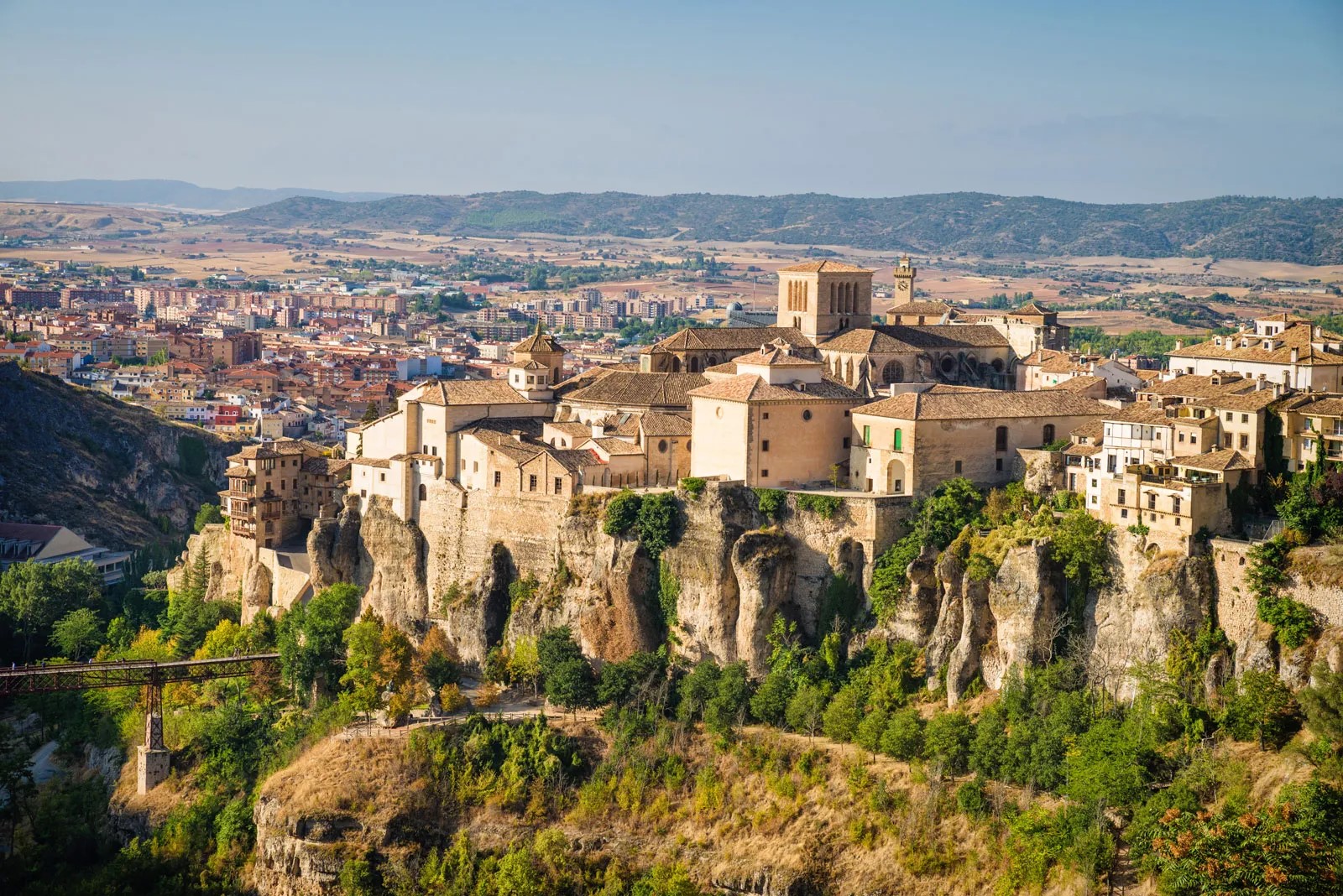
Cuenca, Spain

Today's place to daydream about is Cuenca in central Spain. It sits on a high, rocky peninsula between two rivers, an amazing site.

Archaeology has produced hints of ancient occupation, but the modern town seems to have originated as a fortress built in the eighth century by Muslim invaders, called a Kunka. 

It was besieged in 1076 by Sancho Ramirez of Aragon, who failed to take it. Then in 1080 the Muslim Taifa of Toledo fell apart into civil strife, and one faction ceded it to Castile in exchange for military aid. Then in 1108 the Almoravids took it back, and Muslims held it until 1177, when it fell to a siege by a Christian coalition and became part of Castile.

After the great Christian victory of Las Navas de Tolosa in 1212 the town lost its function as a fortress, but it prospered modestly for centuries as an administrative and cloth-manufacturing center. After the cloth business disappeared in the 19th century the town struggled and shrank until it was reborn as a tourist center in recent decades. 


The rock under the town is limestone, and it boasts both strange natural rock formations and caverns that have been heavily modified into a network of tunnels, cellars and cisterns beneath the streets.

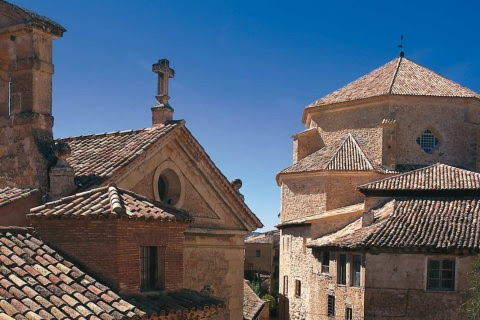
At the highest point in the town is a Carmelite convent, mostly built in the 1600s.

The cathedral was heavily damaged by an earthquake in the early 20th century and the facade was rebuilt, but parts of it date to the 14th century.

This image shows one of the "hanging houses" that overlook the gorge and the footbridge from which millions of images of the town have been taken.

Seems like it would be a wonderful place to explore today.


Tuesday, April 12, 2022

In France, Ongoing Political Realignment

Results from the first round of presidential balloting in France:

Emmanuel Macron (Centrist)                          28%
Marie le Pen (Far Right)                                   23%
Jean-Luc Mélenchon (Far Left)                       22%
Éric Zemmour (Cranky Intellectual Right)      8%
Valérie Pécresse (Gaullist)                                  5%
Janick Jadot (Green)                                           5%
Jean Lassalle (Shepherds)                                  2%
Fabien Roussel (Communist)                             2%
Nicolas Dupont-Aignan (Genuine Gaullist)     2%
Anne Hidalgo (Socialist)                                      2%

So we have Macron vs. le Pen, again. Neither one of the parties that dominated French politics from 1960 to 2000, the Gaullists and the Socialists, even made the 5% threshold to get partial government funding; the Socialist candidate lost to the shepherd who ran as the candidate of the Mountain People's Party.

The incumbent Macron came out ahead but I think that is simply from process of elimination. Even though I am a centrist I despise him. He presents himself as the only one who can save France from ruin under the crazies of the left or the right, which, ok, might be true, but "I am normal" isn't really much of a platform. His rhetoric promises "bold solutions" but his policies are bland neo-liberalism. He didn't really campaign for this round because, he said, he was too busy trying to resolve the crisis in Ukraine, and you see how well that is going. I think he's a slimy narcissist who lucked into a situation where he could pose as the only sane man in French politics, and it is quite possible that his awful personality and weak policies will bring him down.

That le Pen still leads the right despite her continued strong support for Vladimir Putin is deeply disturbing. I hope this will cause many French voters to decide that Macron is the less bad option, but you never know. Millions of people around the world are fed up with their own situations and in no mood to care about anyone else, and if they think things are so bad we desperately need a change, le Pen might win.

Tuesday, March 29, 2022

Refugees and the Difficulty with Having a Country

The New York Times brought some of their people together to talk about Ukraine, and the interesting thing that came out of it for me was their consensus that the Russians are intentionally creating millions of refugees as a way to put pressure on Europe:

Lulu Garcia-Navarro: I want to turn to the refugee crisis, because as you have mentioned — all three of you — this is the third front of this war, where people are being killed and displaced by Russia in order to change the course of the war. It’s estimated that nearly a quarter of Ukraine’s population has been displaced by the invasion, including half of all Ukrainian children, and three and a half million of those people have left the country entirely. And we know that in recent years immigration has been a really fraught topic in Europe.

Tom, you have talked about the pressure this influx of refugees will put on European countries and how it might be part of Putin’s strategy to fracture NATO’s response to the invasion. Do you think that Europe can continue to absorb these numbers? The United States has said that they are going to be admitting 100,000 Ukrainian refugees, but that’s a drop in the bucket.

Thomas L. Friedman: It’s a real problem. We live in an age where it’s just harder and harder to be a country, to hold together as a country. And we see the stresses and strains on weak and frail states now and in places like the Middle East. I point to Lebanon, which has received a huge influx of refugees from the Syrian war, which the Russians were also involved in. These kinds of pressures on countries at a time of climate change, at a time of economic stress, they make it very hard just to be a country in general. Then add on that suddenly the pressure of having to absorb not 100,000 but several million refugees all at once, many of them women, children and elderly — not working males, because they’ve stayed behind in Ukraine. And you have just enormous pressure.

Lulu Garcia-Navarro: At the same time, though, there is massive public support of Ukrainian refugees right now. Farah, what was the sense you got from your recent trip to Poland about the continuing appetite to support them? Do you sense that there’s a sell-by date?

Farah Stockman: I saw a huge outpouring that was in many ways unexpected. A lot of Ukrainians living in Poland have experienced discrimination. They tend to work low-wage jobs. And they said Polish people tended to look down on them.

But all of a sudden, as soon as Russia invades, they were welcomed. And they were seeing Ukrainian flags flying from the Warsaw city hall. C.E.O.s and software developers were taking off work and going to the border and offering people rides and putting people up in their homes. So there has been this extraordinary outpouring, partly out of gratitude. I think Polish people know what it’s like to be invaded by Russians. And they were happy that the Ukrainians were putting up such a fight.

But I do think there could be a sell-by date. The mayor of Warsaw told me that he’d been getting calls from people who said, I put these Ukrainians up for a couple of days. Where should I take them now? What should I do with them now? So it’s going to require a huge effort. And in Poland, it’s very polarized there, just like it is here. The city of Warsaw is liberal, and the government itself has historically been very anti-immigrant and more far right.

So it’s going to be a challenge for Poland to navigate this. Right now they’re holding it together and putting on a united front to face the crisis. But a year from now, or two years from now, I wonder what it’s going to look like.

Thursday, February 3, 2022

No War in Ukraine

Some Americans think Russia might actually invade Ukraine, but most Europeans disagree. Ivan Krastev in the NY Times:

For the United States and President Biden, who on Wednesday formally approved a deployment of American troops to Eastern Europe, a Russian invasion led by President Vladimir Putin is a “distinct possibility.” For Europe, not so much. A senior German diplomat summed up the divergence. “The U.S. thinks Putin will do a full-blown war,” he said. “Europeans think he’s bluffing.”

Perhaps that’s to be expected. After all, full-scale war is generally as unimaginable for a Western European public as an alien invasion. The many decades of peace in Western Europe, combined with the continent’s deep dependence on Russia’s oil and gas, incline officials to assume aggressive Russian moves must be a ruse.

But the European tendency to accommodate Russia doesn’t explain why Ukrainian officials, after initial alarm, now seem to share the same view. Ukraine’s president, Volodymyr Zelensky, last week played down the immediate threat of war, suggesting the situation was “dangerous, but ambiguous.” For a country menaced by 130,000 Russian troops at its border, it’s a striking assessment. What lies behind it?

The answer is surprising, even paradoxical. Europeans and Ukrainians are skeptical of a major Russian invasion in Ukraine not because they have a more benign view of Mr. Putin than their American counterparts. On the contrary, it’s because they see him as more malicious. War, they reason, is not the Kremlin’s game. Instead, it’s an extensive suite of tactics designed to destabilize the West. For Europe, the threat of war could turn out to be more destructive than war itself.

I agree with the Europeans here. I think war is too risky for Putin. There has never been a real trial of Russian planes and missiles against western planes and missiles, and there is a chance such a trial might be humiliating for Russia. It has taken 30 years of hard work to rebuild the sad post-Soviet military into a dangerous-seeming fighting force, and seeing that force damaged or thwarted would be a real blow to Russian power. Better to let the threat of war keep everyone on edge and watch the west continue to unravel.

Wednesday, December 29, 2021

Democracy is Getting Harder

Richard Pildes in the NY Times:

The European democracies are experiencing the unraveling of the traditionally dominant center-left and center-right major parties and coalitions that have governed since World War II. Support for these parties has splintered into new parties of the right and left, along with others with less-easily defined ideological elements. From 2015 to 2017, over 30 new political parties entered European parliaments. Across European democracies, the percentage of people who identify strongly with a political party or are members of one has declined precipitously.

The effects on the ability to govern have been dramatic. In Germany, the stable anchor of Europe since the 1950s, the two major parties regularly used to receive over 90 percent of the vote combined; in this fall’s elections, that plummeted to less than 50 percent. Support has hemorrhaged to green, anti-immigrant, free-market and other parties. After its 2017 elections, with support fragmented among many parties, it took Germany six months to cobble together a governing coalition, the longest time in the country’s history. The Netherlands, after its 2017 elections, needed a record 225 days to form a government.

The coalitional governments assembled amid this cacophony of parties are also more fragile. Spain, for example, was forced to hold four national elections between 2015 and 2019 to find a stable governing coalition. Spain had effectively been a two-party democracy until 2015, but mass protest movements spawned a proliferation of new parties that made forging stable governments difficult. In Sweden, the prime minister lost a vote of no confidence this summer — a first in the country’s modern political history. Digital pop-up parties, including anti-party parties, arise out of nowhere and radically disrupt politics, as the Brexit Party did in Britain and the Five Star Movement did in Italy.

All of this is driven by dissatisfaction; by a sense that older parties are corrupt, stodgy, and not delivering on their promises. Immigration is an intensely polarizing issue; the urgency many Europeans feel about climate change is another factor. But I have the sense that people just find contemporary life intensely frustrating and are looking for someone to do something about it. Since nobody has any clue how the misery might be eased, or what is causing it, things are only going to get worse.

Friday, November 12, 2021

Why Western Conservatives Admire Viktor Orban

Hungarian Prime Minister Viktor Orban is a very controversial figure, widely considered a dictator by many leftists but admired by many on the right. Orban's party wins elections, and seems to be genuinely popular, but on the other hand he has taken control of the nation's media, refashioned the constitution to increase his power, and sacked many bureaucrats (down to the level of school principals) and replaced them with cronies and allies. 

A few weeks ago Scott Siskind posted a review of two biographies of Orban that leaned toward the "Orban is a dictator" view. Now he has posted a round-up of the comments his received. The comments force one to confront a very hard question: what is democracy, and how much of it do we really want? 

Siskind says that the conservative commenters didn't really praise Orban's policies; they praise him for winning and holding power as a conservative. In a world where so many institutions are controlled by liberals, maybe acting at least a little authoritarian is the only way a conservative can accomplish anything:

The idea is something like: there are a few ways to govern. One is to be Angela Merkel. Be more or less an elite, who only likes things other elites like. Then you can do things like have an independent judiciary (because the elites in the judiciary will mostly be nice to you), have an independent media (because the elites in the media will mostly cover you positively), have independent academic experts (because they will say the evidence supports you), etc.

Another is to be Donald Trump. Go against elite opinion, have all of the elites hate you, and - realistically - don’t accomplish very much. When you try to accomplish something, the courts will declare it unconstitutional, the media will attack it, and academic experts will say the evidence is against it. You can ram the government really hard against all these other institutions and try to break past by sheer inertia, but it’s a tough battle.

Another is to be Viktor Orban. Go against elite opinion, and when the elites try to stop you, crush them. Crush the judiciary and replace it with your college friends. Crush the media and replace it with your college friends. Crush the intelligentsia and replace them with your college friends. Then do whatever you want, and the judiciary, media, and intelligentsia will take your side!

Siskind goes on to say (and I agree) that this is wrong in putting too much emphasis on right vs. left. In fact it is hard to get anything done in a mature democracy, as you are seeing with Democratic efforts to pass spending bills. Realistically, maybe any kind of major change requires authoritarian tactics:

So regardless of your politics there’s a tiny Overton Window of things you can actually get done, things that you can sneak past the gauntlet of various liberal and conservative elites trying to frustrate you at every turn. You can either do some minimal thing within this window - Trump’s tax cut, Biden’s spending-bill-lite - or you can crush all those people.

I believe something like this is true. Changing the world through politics is just really hard, and democracy doesn't make it much easier because so many people hate and fear change.

On the other hand, the world does change. Perhaps not as fast as some of us would like, but only a few odd young anti-racists want to deny that the past century has seen extraordinary changes. The question becomes, do we want change so badly that we want to force it politically, which means dismantling the complex system of multiple power centers that so effectively prevents it? Do we really want pure rule by the people?

Remember that to many Enlightenment figures, including the US founding fathers, democracy was pretty much identical with the election of authoritarian demagogues. They very much had people like Orban in mind when they wrote the Constitution.

My general feeling is that these obstructionist systems have served us pretty well for 200 years, and I am not much interested in casting them aside. Obviously there could come a point where politics becomes impossible, as it did in 1861, but I don't think we are there yet. 

I suppose my root feeling is that I don't trust any faction to govern without limits, and if that means I don't get all of what I from from politics, I think that is probably still for the best.

Wednesday, March 24, 2021

Libera Terra

For decades the Italian government has been confiscating land from the Mafia and other organized crime groups. But for a long time they didn't know what to do with it, since they couldn't sell it and didn't want to get into farming themselves. Much of it just languished. Then anti-Mafia Sicilians pushed for a law that would allow for the land to be leased to cooperatives that would support local people. This law was passed in 1995, and by 2001 some cooperative farms were up and running in Sicily and Calabria.

The most prominent group involved is Libera Terra, an offshoot of the anti-Mafia organization Libera. Libera Terra runs nine co-ops in Sicily, all raising organic crops with sustainable methods. Their products are sold to high-end restaurants and gourmet shops through Alce Nero, a major organic food marketer. This is pretty small-scale in economic terms – Libera Terra employs about 170 people and its revenue is about $8 million a year – but you have to applaud any effort to take from the Mafia and return to the people.

The crooks of course hate this, and there have been numerous arson attacks and the like against these operations. Interviewed in New York a few years ago, a Libera Terra spokesman said,

Yes, despite all they still get threats. I have spoken with many of these guys working the fields and the stories are endless. Machines are stolen, lands are set on fire…I was talking to one worker from Sicily who told me that in order to see what was happening at night he started sleeping in his car, parked by the field…every morning he would then find a single bullet on top of the car. At first he didn’t react but collected all the bullets. Later he made a necklace out of these bullets and started walking around town wearing it, just to show that he was not intimidated.
The Mafia after all originated as a way for Sicily's landlords to control their estates and put down unrest among the peasants, so it makes sense that the fight against them should include returning power over the land to the people who work it.

Thursday, March 4, 2021

Germany's Crazy Monarchists

 At Bloomberg, the sad and crazy story of Germany's self-proclaimed king:

Presented with a recorder, Peter talks and talks. He talks about how he healed an ex-girlfriend who was abused as a child by Satanists, using only his hands. About how a cabal of shadowy elites, including Rockefellers and Orthodox Jews, spread Covid-19 to boost drug profits and compel Germans to accept implanted biosensor chips. How a sniper once shot his car on the autobahn, but divine intervention caused the bullet to only nick the windshield. (He knows what you’re thinking, but a policeman friend told him there’s no way it was a rock.)

King Peter’s subjects are adherents of the Reichsbürger movement, whose members believe Germany doesn’t exist. The republic, they contend, is a limited liability company controlled by the Allied victors of World War II—and, according to the more anti-Semitic, the Rothschild family. Reichsbürgers print their own passports, often refuse to pay taxes, and clog courts with paperwork, along the same lines as the U.S. “sovereign citizen” movement.

And like their other American kin, QAnon, the far-right conspiracy theory alleging a “deep state” plot against Donald Trump—they’re products of the digital age of unreason. Reichsbürgers are indoctrinated by low-budget YouTube talk shows hosted by the likes of Jo Conrad, who says Freemasons, lizard people, and child-murdering cults have overrun Germany. Converts protest outside the Reichstag, which some say is guarded by a laser cannon. For fun, they stream Reichsbürger hip-hop. In 2018, Germany’s domestic intelligence agency identified about 19,000 Reichsbürgers, nearly double its estimate of two years earlier. The true number, officials say, is likely far greater.

So the weird notion that the government is actually a corporation has crossed the Atlantic; do you suppose they copied that from American crazies, or is it somehow just an obvious notion in our world?

Monday, December 14, 2020

Factory Jobs and Contemporary Politics: Russell Brand on the Brexit Vote

When I was sitting ten feet away from some friends last week, outside, next to a kerosene heater, I offered this proposition for debate: American democracy died when we let the factories close. I see that the same question has been on the mind of Russell Brand, as he tries to explain the Brexit vote:

While, on its face, the Brexit referendum offered voters a simple binary choice of either leaving or remaining within the European Union, in reality it came to be seen as something much more: an opportunity to either vote for the establishment or give it two fingers.

This rather unsophisticated reading of the troubling referendum was made easier by the prior dismantling of real political representation for ordinary British people, notably through the repositioning of the Labour Party in the 1990s as a kind of neoliberal, establishment-lite party under Tony Blair. During this time the purpose of the British left migrated from the pursuit of economic equality for the working class to a kind of performative, hollow optimism that masked an ideological capitulation to economic conservatism.

My belief is that, in the wake of this betrayal, a nostalgic yearning for fairness among working people led to a resurgent nationalism — and ultimately support for Brexit. The parties founded to represent working people were inviting them to discard the flags and icons of Britishness that had been historically mobilized (however cynically) to inspire their sacrifice, which is in part why the Remain campaign failed. Labour’s focus on cultural rather than economic equality meant there was nowhere for the working class to go but into the arms of the Brexiteers.

As a product of blue-collar Britain myself, I don’t believe these people are bigoted or backward, as they’re commonly rendered by the institutions that demonize them. I feel they just know that they’ve been stabbed in the back.

I am personally not sure that "stabbed in the back by the establishment" is a fair description of what happened to factory workers in the US and Europe, but I do believe that it is how many people see the economic changes of the past 30 years. It is also important to note that the Brexit vote was very close and that people of every socio-economic and ethnic group voted on both sides. (As in the two elections involving Donald Trump.) It is, therefore, not quite right to say that "the British working class" voted against the EU.


But I do believe that the collapse of well-paid work that men could get with limited education underlies every bad thing happening in the politics of the US, the UK, France, and probably many other places. You can see from wikipedia's graph of manufacturing employment in the US that while the decline in manufacturing jobs as a percentage of the total has been steady since WW II, the first sustained decline in real terms happened in the early 2000s, coinciding with NAFTA and the entry of China in the WTO. This got worse in the Great Recession; from 2000 to 2010, 6 million American factory workers lost their jobs.

I think this is a crisis, and anyone who thought it could happen without seriously roiling the nation was a fool. There remains, however, the question of what could be done about it. Trump's flailing has shown that caring about the problem is not the same as being able to solve it, and the current British government hasn't done anything about manufacturing at all. I wrote before about the dire things that happened when Chicago's steel mills closed in the 1970s, but those mills really were dinosaurs, incapable of achieving the efficiency needed to remain viable with any amount of investment. They were also environmental disasters. In Germany the decline would have been managed, and the government and the unions would have made great efforts to move the steel workers into other, similar jobs, but those mills were going to close, period.

Any serious attempt to bring back manufacturing would have to involve steep tariffs on imports, carefully thought out and imposed in a very broad-based way. That would be a big lift in either the US or the UK, and I am not at all sure the votes could ever be found to achieve it. After all manufacturing workers are a small minority of the population, and tariffs would mean higher prices for everyone else.

And manufacturing, of course, is just the beginning; self-driving trucks are on the horizon, and who knows what other innovations that will wipe out even more traditionally masculine jobs. So the crisis will continue, and our politics will never settle down.

Sunday, February 23, 2020

European Emigration, 1880-1914

These days European politics have been turned upside down by immigration, but a century ago the continent had the opposite problem. Consider that Germany has been convulsed by Angela Merkel's commitment to take in a million immigrants, a number dwarfed by the flow out of Europe around 1900. Below are the numbers of emigrants to the United States from selected nations, 1880-1914:

Italy:                       4,033,000
Ireland:                   1,591,000
Scandinavia:          1,789,000
German Empire:    2,527,000
Austria-Hungary:  4,005,000
Russia:                    3,241,000
Greece:                   358,000

Remember this is only part of the total flow, since many emigrants went to other parts of the New World.

Some of these people came back, but probably only one out of ten; the rest never returned. Not only are these numbers enormous, they came primarily from certain districts. Much of the total for the German Empire, Austria Hungary, and Russia was made up by 3,800,000 Poles, and most Italian emigrants came from the south. The impact on those districts was profound:
Emigration to the New World sometimes had a dramatic effect on Europe itself and bizarre political hopes were fostered by the links that grew out of it. During the 1930s officials in the Polish foreign ministry fantasized about the prospect that emigrants from their country might found a colony in Latin America, while in 1945 some Sicilians proposed that their island might become a part of the United States. More seriously, central European nationalism was cultivated. During the First World War, a legion of Polish volunteers was raised among emigrants in the United States, and the influence of emigrants on eastern European politics was to persist for the whole of the twentieth century. In 1990, Franja Tudjman's campaign to become president of Croatia was said to have raised around $5 million from emigre supporters. In the same year, Stanislaw Tyminski, who had made his fortune in Canada, returned to Poland to run for president.

Emigration had less obvious effects on parts of Europe. It increased literacy, because families needed to keep in contact by letter. It also created imbalances of gender and age as young men left: between 1905 and 1916, 4.86 million Italian men emigrated, but only 1.14 million women accompanied them; in early twentieth-century Calabria, there were three young women for every two young men. Sexual imbalance may have produced a self-perpetuating cycle. Carlo Levi suggested that extra-marital sexual relations in parts of the Italian south were common because there were not enough men to provide all women with husbands. Illegitimate children in turn were particular prone to emigrate – in one well-studied village, three quarters of them did so.

Migration increased prosperity in home countries as money was sent back or as emigrants returned to buy cherished plots of land. The economic impact of emigration was particularly great in Italy, where links between emigrants and their places of origin remained close – it was said that Italy gained $100 million from emigrants who returned between 1897 and 1902. An enquiry of 1931 showed showed that 2 million hectares of land were bought by Italians returning from America. . . .

Emigration was often linked to political conservatism. Generally the areas that sent emigrants abroad during the early twentieth century remained on the political right for the rest of the century.
– Richard Vinen, A History in Fragments: Europe in the Twentieth Century (2000), pp. 17, 20.

According to Vinen's numbers, Italy lost 6 million emigrants in eleven years, from a population of around 32 million. According to wikipedia the total outflow of people from Europe over the period 1810 to 1932 was at least 60 million, and most of that happened after 1880.

Saturday, October 19, 2019

Against Revolution

Famous Swedish Political Leaders

Bernie Sanders likes to say that we need a "political revolution" so we can become more like the social democracies of Scandinavia. But this, I think, misjudges both the nature of revolution and the history of Scandinavia. There was no Swedish or Norwegian or Danish Revolution. I believe that they ended up with their enviably stable and equitable systems precisely because they never had a revolution, because revolutions are usually disastrous for the people and nations who experience them.

Here's a question for you: can you name a single event that happened in Scandinavia between the Napoleonic wars and World War II? I can't, or couldn't until I started working on this post, and I have a Ph.D. in European history. Yet somehow the Scandinavian countries evolved from poor societies led by reactionary aristocrats to wealthy beacons of social democracy. How did they achieve that?

Not, let me tell you, in a way that makes for exciting reading. I spent some time last night and this morning reading about the history of these countries at wikipedia and other encyclopedia sites, and I recommend those articles only as a sleep aid. It's a dreary litany of reform bill after reform bill, the gradual extension of the vote, the gradual constriction of royal power, the occasional Parliamentary dust-up. One of the sub-categories in wikipedia's piece on nineteenth-century Sweden is The Barley Question.

But that, if you ask me, is how politics ought to be. If what you want is to make life better for your fellow citizens, that is the way to proceed: One change at a time. One compromise at a time. One election at a time. One regulation at a time. "Politics," Max Weber famously wrote, "is a strong and slow boring of hard boards. It takes both passion and perspective." Political change does not happen unless people fight for it, but if you fight too hard, if you abandon perspective and start throwing bombs, then any good you do accomplish will likely be balanced by an equal or greater amount of destruction and misery.

Consider that the Social Democrats who created the modern Swedish welfare state did not think that socialism was the most important part of their program. That would be Folkhemmet, "The People's Home", which imagined the nation as a family to which everyone contributed something, and where all decisions were made collectively. This was an explicitly moderate position, more influenced by John Maynard Keynes than by Marx, and with large roles for businessmen and the church.

For a quick look at the opposite, revolutionary sort of mind, I recommend this piece on V.I. Lenin. Not the silly comparison of Lenin with the leftists of contemporary American campuses, just the description of Lenin himself, for whom violence and terror were not means to an end, but ends in themselves:
When we are reproached with cruelty, we wonder how people can forget the most elementary Marxism. . . . By the dictatorship of the proletariat we mean nothing other than power which is totally unlimited by any laws, totally unrestrained by absolutely any rules, and based directly on force. . . . The law should not limit terror, it should enshrine terror.
As for compromise with others, even other socialists,
Every solution that offers a middle path is a deception . . . or an expression of the dull-wittedness of the petty-bourgeois democrats.
These are the sort of men who make most revolutions, and the states and societies that result are just what you would expect from such thinking.

Obviously not all revolutions are like this; the word has many meanings. When a new or conquered nation casts off the rule of an empire, that is a different situation, with a better historical record. Yet many national heroes have succumbed to the temptations of violence and radicalism, which is why the independence of so many nations has been followed by Civil War rather than peaceful cooperation. Violent change is always dangerous.

I do recognize that sometimes gradual, progressive change is not an option, because those in power refuse to accept it. This happened for example in Russia, where the Tsar's men put an end to the reformist politics of 1905 and re-imposed a reactionary imperium. In such cases violent revolution is likely, because there is no other path forward. But if that happens in your country, you are, historically, screwed. The outcome is rarely good. (See Russia, China, Iran, etc.)

Sometimes compromise and slow change work, and sometimes they just don't, leading to violent explosions. But if the history of the past few centuries teaches anything, it is that gradual reformism is always better, if you can get it.

Why am I writing about this now, when there seems to be no chance that any major nation will have a revolution? What I really want to oppose is a way of thinking that I think is all too common in our time: a demand for change now, coupled with a hatred of our opponents and refusal to even consider talking to them. I think this is tactically terrible, almost certain to lead to four more years of Donald Trump. But it is even worse philosophically. We cannot get to a good world by "destroying" our enemies, either metaphorically or as Lenin would have. Whatever happens, we will end up living with them.

To build a better world, we must work together with as many as will join in.

Sunday, September 8, 2019

Football and the New Europe

One of the stars of German football (soccer) this year is a 19-year-old Englishman named Jadon (pronounced Jayden) Sancho, child of immigrants from Trinidad. He is a representative of the new world in soccer, which is so much like other parts of the new economic world that I can't resist pointing out the parallels.

In each of the big European countries top level football is dominated by a few super teams that can afford to assemble a roster of international stars. The top team in Britain so far this year is Liverpool, which has an amazing front line featuring one Egyptian, one Brazilian, and one Senegalese. Most of the other teams in their leagues offer no competition to these super teams. Instead they compete against each other in a new international tournament called the UEFA Champions' League, where you can see the top teams in the English Premier League square off against the best teams from Germany, France, Italy, Spain, and the Netherlands, plus a few teams from other countries that never win. Many aficionados think these games are better than World Cup games between national teams, because the super teams play together all year round, and because they have been carefully assembled from the world's best talent to compete in a certain style. The winning team last time (Liverpool) netted $90 million in prize money.

The money involved in European football is staggering; clubs regularly sell players to each other for amounts of more than $100 million. In 2011 a group of investors led by the Sultan of Qatar purchased Paris Saint-Germain and made the club into a super team by shelling out more than $600 million for a roster of international stars. (That's just the transfer fees; the salaries are equally exorbitant.) They have since won six French championships in a row, but keep spending to sign top players because they have yet to win the Champions' League. The current roster has players from 13 countries.

The overall result is swelling inequality. At the top the players make tons of money and fans enjoy a superb product, likely the bast football ever played. Everywhere else falls farther and farther behind. Leagues from Argentina to South Korea have been stripped of their top talent, since all those players are in Europe. In Europe most teams are out of contention before the season begins and never expect to be in it; in the past decade only two teams have won the German, French, or Italian Leagues, and in England people joke about the "Everton Cup," that is, first place among all the teams other than the six with the resources to compete internationally.

And that, my friends, is the New World Order: at the top, great wealth, extraordinary talent, a product that hundreds of millions love. Everywhere else, stagnation and a struggle to keep afloat.