Friday, December 17, 2021

"No Evidence" = Terrible Communication

Scott Siskind has a terrific post pointing out that the phrase "no evidence" is used in two contradictory senses in a way that muddies understanding of science and knowledge.

For example, early in the pandemic you might have read articles with titles like "No evidence for airborne transmission of novel coronavirus" or "no evidence linking Covid to indoor dining." Which did not mean those things were not true, just that nobody had yet done a real study about them. Once people started studying them they were quickly shown to be correct. But

On the other hand, here is a recent headline: No Evidence That 45,000 People Died Of Vaccine-Related Complications. Here’s another: No Evidence Vaccines Cause Miscarriage. I don’t think the scientists and journalists involved in these stories meant to shrug and say that no study has ever been done so we can’t be sure either way. I think they meant to express strong confidence this is false.

You can see the problem. Science communicators are using the same term - “no evidence” - to mean:
  1. This thing is super plausible, and honestly very likely true, but we haven’t checked yet, so we can’t be sure.
  2. We have hard-and-fast evidence that this is false, stop repeating this easily debunked lie.
This is utterly corrosive to anybody trusting science journalism.

I agree completely. I think one of the reasons people don't trust science is that science journalism does not explain to what extent things are known and accepted; the results of the latest cutting edge experiment are presented the same way as something like orbital mechanics that we can calculate to five decimal places. 

It is not enough to say that studies show something, or that scientists accept something, without at least attempting to convey the strength of the evidence and the degree of the agreement. Unfortunately science journalists are under huge pressure to offer yes-or-no, true-or-false takes on every question, because that is all a big portion of the public will accept. But they could do a lot better.

Links 17 December 2021

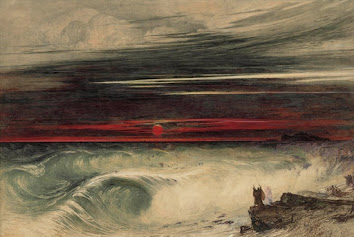
John Martin, The Destruction of Pharaoh’s Host, 1836

Louis Menand is for me the best contemporary writer on American intellectual history. In this wonderful New Yorker essay he reviews two books by Great Books teachers bemoaning the state of higher education and shows with clarity what the sound and fury is all about.

Spectacular images of the northern lights at My Modern Met.

After a talk, David Brooks was once handed a question card from someone in the audience that read, "What do you do when you’ve spent your life wanting to be dead?" He didn't answer at the time but has been wondering ever since about what sort of answer he might have given. (NY Times)

Does anyone read the syllabus? To find out, an instructor hid a $50 bill in a university locker and put the locker number and combination in the syllabus. Nobody claimed it. Of course this might not be true, but I find it believable.

The cabarets of bohemian Paris, 1890s, where you could visit establishments themed to represent heaven, hell, death, and sundry other realms. 

The absurdist satire of the Birds Aren't Real movement (NY Times). The originators say claiming that birds are really government drones that recharge on power lines is a way of mocking crazy conspiracy theories. I suspect, though, that the long-term impact of this sort of absurdity will just be further muddying the waters; all sorts of stuff circulates online that shades the boundary between serious claim and joke, so making more jokes in the guise of serious claims won't help.

One downside of being a famous, much-beloved author is the maniacal attention people will pay to everything you ever did; consider all the writing and speculation about Borges' brief visit to St. Andrews in Scotland.

Earring from the medieval Middle East found in a Danish field. Interesting about Vikings but also about the staying power of earring design.

Why do Kenyan students keep setting their schools on fire?

Fights over egg bans in Indian cities: some Hindus find the public sale of meat offensive, and under the Modi regime some cities have banned food carts selling all meat products. But the patrons of the very common food carts selling egg dishes are also mostly Hindu; it seems to be a dispute about caste and class as much as religion. Interesting that while Hindu nationalists in the government are pushing egg bans other parts of the government are pushing egg production for economic and health reasons. (NY Times)

Carla Rhodes set up an automatic camera on the ground beneath her bird feeder.

Trying to unionize a Dollar General store in Connecticut. (Washington Post)

Study says using psychedelics really can change your metaphysical beliefs, almost always away from materialism.

Scuba diving YouTuber Jeremy Sides solves another cold case. (Washington Post) Sides looks for cases of people who went missing in their cars and explores local waterways until they turn up. Another interesting look at what people can do for work in the post-industrial age.

BBC report on Black Axe, a Nigerian student fraternity that became a deadly criminal gang. The main source of their revenue is internet scams.

Mormon fertility in the US has been plummeting since around 2004, and is now just above replacement.

Why Twitter is both fun and dangerous: insider knowledge, the theory of jokes, and "context collapse."

This is Colossal's picks for the best short videos of 2021.

Neal Moore, who has spent the past two years paddling a canoe across the United States from Astoria, Oregon to New York City, reached the Statue of Liberty on December 15 and concluded his journey. This was very much a late 1800s thing to do, a memory of a time when people got famous for stunts like crossing the Atlantic by rowboat or canoeing the length of the Mississippi. As a child I was always puzzled by the fame acquired by Lindberg for flying solo across the Atlantic, not understanding that this was the tail end of the great Era of Exploration, when filling in the map and connecting the world's people's had devolved into a series of media stunts. Cool that Moore did this, though, in an age when it won't make him rich or famous.

Wednesday, December 15, 2021

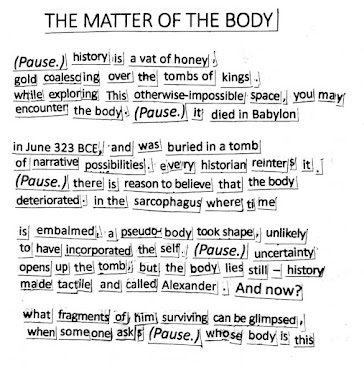
Ella Standage, "The Matter of the Body"

Poem made from the handout for a lecture on the fragmentary historical sources and missing tomb of Alexander the Great.

I posted another one of Ella Standage's poems here; I just love what she does with cut up texts.

And see here for a passage of the Iliad translated using a National Geographic article about whales.

Tuesday, December 14, 2021

Penn Access and American Infrastructure


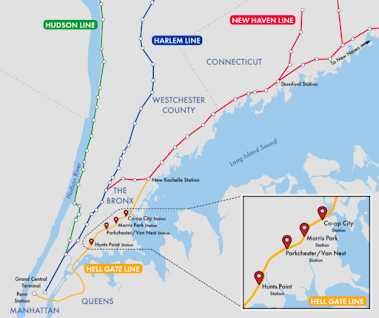
With money from Biden's infrastructure bill apparently on the way, New York officials have just struck a deal to spend a big part of theirs on two long-mooted projects: a new terminal at Kennedy Airport, and something called Penn Access. (NY Times; Penn Access web site)

Penn Access is an old and simple idea: instead of sending all the commuter trains from Metro North to Grand Central Station, creating a miserable crush of commuters at rush hour and requiring many of them to make annoying multiple transfers to get to some parts of the city, why not send some of them along Amtrak's Hell Gate track to Penn Station? After all the necessary track already exists, carrying trains every day, and the two lines cross each other. This would also allow you to add some new stations in the East Bronx, for example at Co-op City, making the commute to Manhattan much simpler for those folks. So surely it would just be a matter of creating a sort of ramp so commuter trains could switch to the Amtrak track? Maybe a few new signals? Wouldn't this be pretty cheap?

Ha ha, right. Amtrak, because of its governing laws, can't refuse to carry commuter trains on its tracks. But it can give its own trains priority, and it can limit traffic to what it thinks its lines can safely carry. And Amtrak has long maintained that the Hell Gate tracks are so old, the bridges so stressed, and (especially) the two tunnels under the East River so decayed, that no more traffic could be carried without major upgrades. New stations would also require the laying of new track, so that express trains would not have to wait behind stopped commuter trains.

So there things have sat for about the past thirty years. But the new deal provides $2.87 billion to make Penn Access a reality, plus an additional $1.3 billion to repair the East River tunnels. They plan to get to work right away, since the Environmental Impact Statement already exists and the initial start-up costs can be paid out of state and MTA funds without waiting for final passage in Washington.

One of the things I have learned from playing my own small part in infrastructure projects is that all the ones that really end up being built have been around in some form for decades, and in some cases have been planned in detail since before many of the workers who will build them were even born.

Monday, December 13, 2021

Mentoring, Small Group Theory, and Me

Tyler Cowen recently offered two pieces of advice on how to achieve anything:

1. When working on any kind of problem, task or question, embed yourself in a small group of peers with broadly similar concerns.

2. Get mentors.

These are extremely common pieces of wisdom tossed around in our age, and on a personal level I find them both very mysterious.

I have learned a lot from older people, but I am not sure that anyone was my "mentor." I suppose this is partly because of the zig-zagging nature of my career. As an undergraduate I studied mostly modern history, switched to medieval and early modern Europe in graduate school, and now I make my living studying North America. I keep having to pick up new subjects on the fly. Anyway I think that since I graduated from college I have learned more from peers and books than from teachers.

Lately I have been trying to publish novels, and so far as I know I have never met a single person who has written the kind of book I am trying to write. I have gotten a lot of help on my books from my friends but they are not novelists themselves so I don't think they can really be called mentors. 

As for small groups, I don't think I have ever been part of a group working together on a problem. I have a few times stumbled across an area of scholarship that seems to have been mainly generated by a small group who knew each other, for example studies of colonial probate inventories; but though I drew on the research I never interacted with any of the people who produced it. All archaeological projects are team endeavors, but mostly these are the sort of teams where each person does his or her job, not the kind where people make a collective effort to answer one question. It does happen sometimes but it is not central to what I do.

Here is more Cowen on small groups, in response to the question of what to read about them:

I suggest reading about musical groups and sports teams and revolutions in the visual arts, as I have mentioned before, taking care you are familiar with and indeed care passionately about the underlying area in question. . . .

I have a few observations on what I call “small group theory”:

1. If you are seeking to understand a person you meet, or might be hiring, ask what was the dominant small group that shaped the thinking and ideas of that person, typically (but not always) at a young age. . . .

2. If you are seeking to foment change, take care to bring together people who have a relatively good chance of forming a small group together. Perhaps small groups of this kind are the fundamental units of social change. . . .

3. Small groups (potentially) have the speed and power to learn from members and to iterate quickly and improve their ideas and base all of those processes upon trust. These groups also have low overhead and low communications overhead. Small groups also insulate their members sufficiently from a possibly stifling mainstream consensus, while the multiplicity of group members simultaneously boosts the chances of drawing in potential ideas and corrections from the broader social milieu.

4. The bizarre and the offensive have a chance to flourish in small groups. . . . 

9. What does your small group have to say about this?

This makes me feel strange and lonely. I have heard other people bewail the lack of mentoring in their lives, and I imagine that some people, reading this, would think, "Where can I find a small group to join, one where we learn from each other and bring about change?" But this is so foreign to me that I cannot even imagine what it would be like. 

I don't mean to say that I am alone or lonely, but as it happens my friends mostly don't work in my field, and even the ones in my field are mostly doing their own things. Honestly the mix of things I do in my job is quite strange and idiosyncratic – archaeology of everything in Eastern North America, colonial history, Civil War history, African American history, project management, coping with mergers and corporate reorganizations, cultural resource management, National Park Service policy, etc., that I would find it really weird to meet anyone who does the same thing. I suppose one could belong to a bunch of different groups focusing on each one of those things, but on the other hand each of them is such a small part of my work that I don't think it would add up to what Cowen envisages.

So I am wondering, is my rather lonely, self-directed path through my career the more normal kind, and the sort of connectivity Cowen describes unusual? Or the reverse?

The Roos Carr Figures

Hull Museums:

In 1836 some labourers cleaning a ditch at Roos Carr, near Withernsea in East Yorkshire made a surprising discovery. About two metres below the surface they came across a collection of well-preserved wooden objects including several 'warrior' figures with stone eyes, a wooden box, a serpent-headed boat, and various other wooden articles 'too much decayed to remove'.

Four of the figures; together with the boat and various other attachments which seemed to be arms, paddles and shields; were given to the Hull Literary and Philosophical Society and eventually became part of the collections of Hull Museums. A fifth figure was acquired by the museum in 1902. One of the men present at the time of the discovery had apparently given the 'ancient doll' to his daughter to play with!
The figures have been radiocarbon dated to around 600 BC


Sunday, December 12, 2021

Leather Scale Armor from Western China may be Assyrian

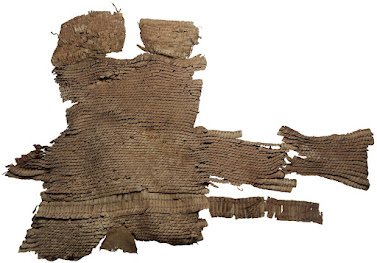
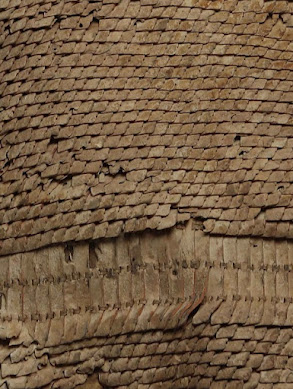
Back in 2013, Chinese archaeologists excavated the grave of a mounted warrior near Turfan in the desert northwest of the country. The warrior was buried with scale body armor made of hardened leather. A thorn found embedded in one of the scales produced a very vague radiocarbon date of 786 to 543 BC. 

The armor eventually ended up in Switzerland to be studied by a team of experts. They have now announced that it was made in the Assyrian empire. Their argument is that it looks exactly like the armor shown in Assyrian carvings, and furthermore it seems to have been mass-produced and adjustable to fit a range of body sizes. If it was not made in the empire, they say, it must have been an exact copy of an Assyrian piece. They suggest that the armor might have belonged to a mercenary from the steppes who took it home with him – the Assyrians employed many mercenaries, including steppes horsemen – or perhaps it was captured by one of the empire's enemies.

I think all of this is a bit speculative, but it does add another thread to the connections between east and west Asia in antiquity, fascinating glimpses into hidden ties between civilizations.

Friday, December 10, 2021

Links 10 December 2021

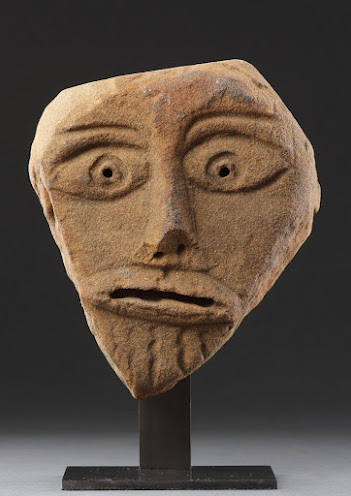
Romano-Celtic Sandstone Head, 17 cm tall (6.5 inches). Or so Finch & Co. claimed a few years ago when they sold this, but they seem to be reputable as antiquities dealers go.

The fascinating complications of the placebo response. Among other things, it seems to be getting more powerful in US drug trials.

It's not just you getting older; is really is getting harder to understand the dialog in movies. There are a lot of reasons for this, some of them related to money, others to streaming platforms. But I have personally noticed a major shift in acting, from theatrical, look-at-the-audience-and-enunciate speech to looking away and muttering, and I am glad to see that Hollywood insiders agree: "in the old days, you could count on an actor's theatricality to deliver a line to the back seats. But acting styles have changed so dramatically over the years that it has become much more difficult to capture great sound on the set."

Commonwealth Fusion Systems is a company founded by MIT physicists and funded by people like Bill Gates and George Soros. They say that new superconducting magnet technology will allow them to make a commercial fusion reactor by 2030. Not holding my breath.

The religious power of music, exemplified in the Saint John Coltrane Church in San Francisco. (NY Times)

Kevin Drum says the debate about Critical Race Theory, the 1619 Project, etc. is really about patriotism: do you love America despite its flaws, or hate it because of them?

In New York, and many other places, any complaint you make against a prosecutor disappears under a veil of judicial secrecy, and outsiders never find out what happens to most of them. But we know it isn't much, since prosecutors are hardly ever fired for misconduct. The rule that people will behave horribly when they can keep it secret applies here as everywhere. (NY Times)

These demographers predict that the world's total fertility will fall below replacement rate by 2040. I might live to see one of the most profound changes in human history, our escape from the iron scissors of Malthus.

What do all the horned helmets from the European Bronze Age mean? Interesting 25-minute video. The much simplified answer is they started out as a sign of divinity, then of semi-divine heroes, then were adopted by some human warriors.

How one reporter's tweetstorm got the port of Long Beach to change its rules and allow stacking of containers more than two high, helping to unsnarl traffic at the port.

Two-minute clip from the new Beatles documentary shows Paul composing a new song while he waits for John to show up for a recording session.

The Hubble Space Telescope, offline for a month over the summer because of computer problems, failed again on October 25, but it is now back online for "full science operations." It is 31 years old, a long time for such a complex satellite to function, so I think it can't last much longer. Fortunately its replacement is due to launch before the end of the month.

One-minute video of a giant phantom jelly (Stygiomedusa gigantea) recorded 3000 feet down off the coast of California. And the weirdness of the barreleye fish.

Soda shops, where you can order custom mixes of name-brand sodas adulterated with all manner of fruit juices and flavors, have been big in heavily Mormon areas for years and are now expanding across the country. "Happiness in a cup" for people who don't drink coffee. (NY Times)

Volunteer at a Massachusetts center for "farm based therapy" dies of cardiac arrest after being repeatedly rammed by a sheep.

At the Met, an amazing zoomable image of a 17th-century tapestry depicting the labors of the months. A nice reminder that while the world was beginning to change rapidly in that era, much of the civilization remained medieval.

Dirtbag Catullus, delightfully raunchy contemporary renderings of Latin poetry.

David Foster Wallace's 2005 Kenyon College commencement address is very famous, and I think deservedly so. Amazing.

David Brooks on contemporary conservatism: "The rich philosophical perspective that dazzled me then has been reduced to Fox News and voter suppression." (The Atlantic)

Thursday, December 9, 2021

The Steinhardt Collection of Looted Artifacts

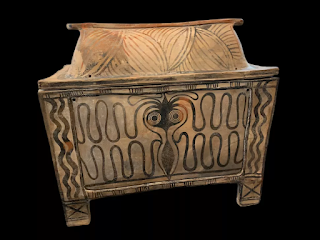
Larnax from Crete, c 1400-1200 BC

Michael and Judith Steinhardt have long been among the world's top collectors of ancient artifacts. They also have a long history of run-ins with the law, as various objects in their collection have been traced back to looting from archaeological sites.

This gold phiale was seized from Michael Steinhardt by US customs agents back in 1995, and although Steinhardt tried to fight the case all the way to the Supreme Court he lost and it went back to Sicily.

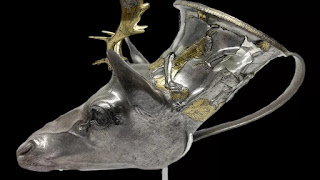
Silver rhyton from Turkey, c. 400 BC

Now the Manhattan DA's office has seized a pile of 180 artifacts from Michael Steinhardt's home and office, said to be worth $70 million. They also got him to sign an agreement promising never to acquire any ancient artifacts again. I've seen some complaining online about how Steinhardt can be involved in thefts worth millions and do no jail time when poor people can be sent up for stealing food. There is something to that, but on the other hand it is almost impossible to prove that a collector like Steinhardt knew the objects were looted, and anyway there is a medieval saying that fits the case: poor man hanged by the neck, rich man by the purse.

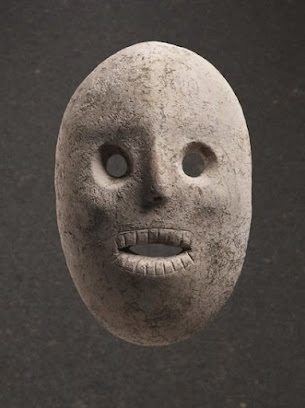
wrote about the Steinhardts' collection of Neolithic stone masks back in 2014, noting that they were probably looted; they are among the objects seized by the Manhattan DA.

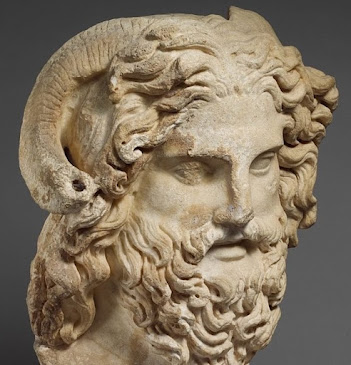
Marble head of Zeus-Ammon

Bronze Griffon, c. 625 BC

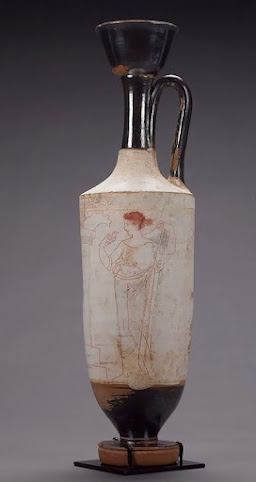
White ground lekythos, c. 420; this is my favorite kind of classical pottery.

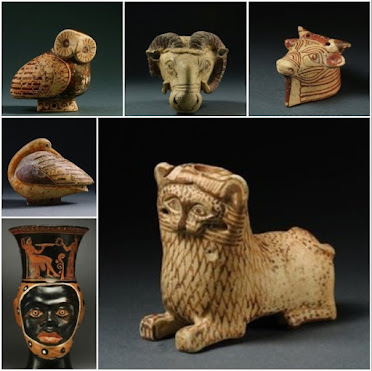
More bits of classical pottery. The Steinhardts are crooks, but they have very good taste.

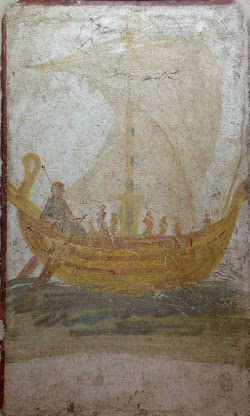
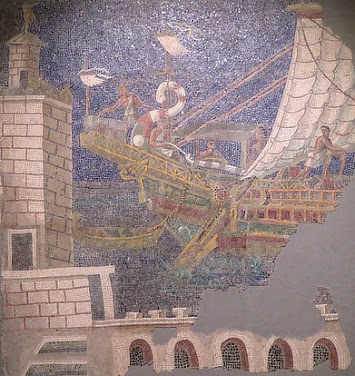
Roman Ships


Tuesday, December 7, 2021

China's Ambassador Defends his Government, or, Is Democracy a Good Thing?

Fascinating op-ed at The National Interest, co signed by the Ambassadors to the US of China and Russia:

Peace, development, fairness, justice, democracy, and freedom are common values of humanity. Democracy is not a prerogative of a certain country or a group of countries, but a universal right of all peoples. It can be realized in multiple ways, and no model can fit all countries. Whether a country’s path works depends on whether it meets the country’s realities, follows the trend of the times, and brings about economic development, social stability and progress, and better lives for the people. Ultimately, it relies on the support of the people and will be proven by its contribution to human progress.

Therefore, a basic criterion of democracy should be about the people, i.e. whether the people have the right to govern their country, whether their needs are met, and whether they have a sense of fulfillment and happiness. If the people are only awakened when casting their votes and sent back to hibernation when the voting is over, if they are served with sweet-sounding slogans in campaigns but have no say after the election, if they are wooed during canvassing but left out in the cold after that, this is not a genuine democracy.

What China has is an extensive, whole-process socialist democracy. It reflects the people’s will, suits the country’s realities, and enjoys strong support from the people. In China, the people have the right to elections, and they can get deeply involved in national governance, exercising their power through the People's Congresses at the national and other levels. China has eight non-Communist parties participating in governance, as well as a unique system and corresponding institutions of political consultation. On matters concerning people's keen interests, there are broad-based and sufficient consultations and discussions before any decision is made. Policies and measures can only be introduced when there is a consensus that they are what the people want and will serve the people’s needs. It has been proved that the whole-process democracy works in China, and works very well. China calls for building a community with a shared future for mankind. As residents of the same global village, we should handle international affairs through consultation.

It has to be said that elections are not the end-all and be-all of life, and that many if not most people care more about jobs and social order. The ongoing debate we have in the US, about whether our old racist, sexist democracy should be celebrated, raises another issue: democracy really can lead to intensified ethnic conflict and the oppression of minorities. But I think it remains true that even with all its flaws a properly functioning democracy is still better than any other system, with more scope for self-correction and more freedom for dissenters. Some anarchists would love a sort of soviet system in which local committees elect representatives to higher level committees and so on, but the experience of Russia and China shows that this leads to capture of the system by insiders, not people power.

And then this:

There has seen no shortage of wars and turmoil worldwide to prove that spreading “democracy,” its political system, and values against other countries’ will severely undermine regional and international peace, security, and stability. Bombings of Yugoslavia, military intervention in Iraq, Afghanistan, and Libya, and “democratic transformation” do nothing but harm. Countries should focus on running their own affairs well, not condescendingly criticizing others.

I agree with this completely; the on-again, off-again US project of promoting democracy by force has not gone very well, and I suspect it is true that democracy is just not an option for some places. But without democracy, how does anybody know what a "nation's will" is? Dictatorial regimes love to equate their own desire's with the nation's and their own power with that of the whole people, but I don't believe them. Even if it is true that for some nations in some periods dictatorship is the best option, democracy is still the best system and the world's oppressed people long for it with good reason.

Monday, December 6, 2021

Omicron and Anime

The Omicron variant was already spreading in the US before it even had a name; public health officials have confirmed multiple cases contracted in November. At least two of them may be associated with a big convention called Anime NYC, attended by 53,000 people November 19-21. This isn't confirmed, but New York is trying to call or email everyone who attended, urging them to get tested.

The urge to resume pre-pandemic life is overwhelming, but it looks like the virus is not through with us yet.

The Uncountable Towers of Medieval Bologna

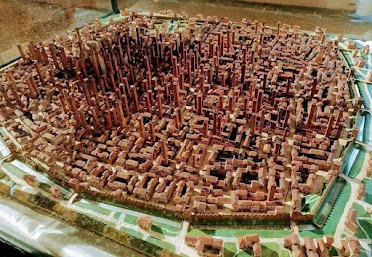
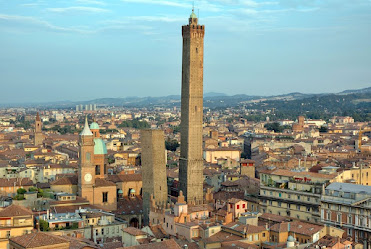
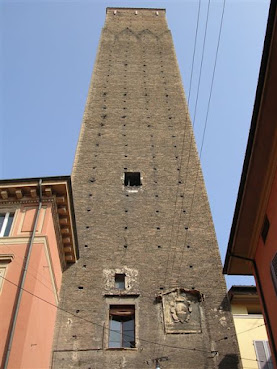
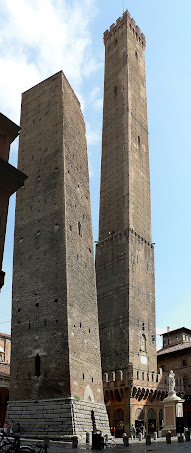
Some web site or other offered me a teaser link to an article on the "The 180 Towers of Medieval Bologna". The picture wasn't this one, which I got from wikipedia, but it looked much like it.

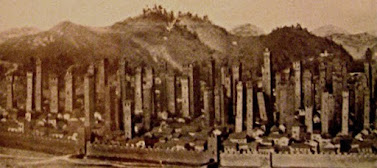
Here is another.

My reaction was disbelief. I mean, there were certainly towers in medieval Bologna, because some of them survive. Dante mentioned one of them in Canto XXXI of the Inferno. They were built by noble families in the twelfth and thirteenth centuries, a period of near constant struggle between the Guelph and Ghibelline factions. The tallest one still standing is 200 feet (61m) high.

What they were for is an interesting question. People like to say that they were "defensive," but against what is a tower like this a defense? They have very few windows for archers, and the top is too high for the effective dropping of boiling oil. I suspect there was a strong element of prestige in having a tower taller than your neighbors'. The whole thing seems like a gigantic waste to me, but perhaps no more of a waste than staging festivals or wearing sumptuous clothes or some other aristocratic habit. Plenty of work for stone masons.

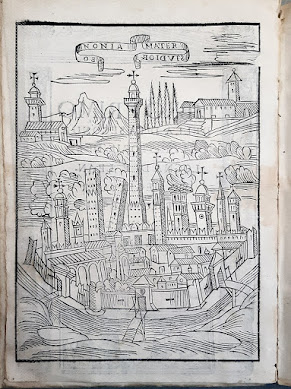
But how many towers were there? The number of 180 comes from a certain Count Giovanni Gozzadini (1810-1887), a senator of the Italian kingdom and fervent Bolognese patriot. He worked from city records, because building a tower required a permit from the commune. But, this assumes that all those that were licensed were built, which is dubious; wikipedia says that more recent scholars favor a total of 80 to 100. Reconstructions like the one at the top also assume that they all stood at the same time. But they were built over a period of around 200 years, and chronicles tell us that some of them fell down before they were even finished. The number that were standing at any given moment would have been less and possibly much less. I think the above image of the town in 1590 might give a better idea of what the medieval town looked like.

Still, how weird that the politics of one Italian commune gave rise to the construction of dozens of tall stone towers, making Bologna the first skyscraper city.

Sunday, December 5, 2021

Jorge Luis Borges, "A Poem about Gifts"

May no one slight, with tears or a reproach,
This declaration of God’s mastery,
That, with sublime irony,
Gave me at once books and the night.

He vested those lightless eyes
With guardianship of the city of books,
Even though they can read
But senseless passages in the library of dreams,

Where sunrises give way to zeal. The day
Lavishes them in vain with infinite books,
Toilsome like the manuscripts
That perished in Alexandria.

Of hunger and of thirst (or so goes the Greek legend)
A king once died amidst fountains and gardens;
Aimless and unrelenting I tire the confines
Of this blind vault of a slender library.

Encyclopedias, atlases, the East
And West, centuries, dynasties,
Symbols, the cosmos and cosmogonies,
Afford us the walls, albeit uselessly.

Slow by my shadow, I explore the
Hollow penumbra with a tottering crosier,
I, who imagined Paradise
Under the figment of a library.

Something unnamed, certainly not
Random fate, governs all this;
Somebody else has already received in hazy
Evenings the many books, and their shadow.

As I rove through the slow galleries,
I happen to feel with sacred horror that
I am the other, the dead one, who must have
Ambled his days past, in a similar vein.

Who between the two writes this poem of
A plural me albeit of just one shadow?
Who cares about the word convoking me
If the anathema is one and indivisible?

Groussac or Borges, I behold this dear
World both distorting and dying down
Into a pale, vague ash, all too
Similar to both slumber and oblivion.

1957

The Arrival of Indo-Europeans in Southern Iberia

I recently threw myself back into reading about the very impressive Copper Age culture of southern Portugal and southern Spain, dating to between 3000 and 2500 BC. This required me to sort out the complications of the tombs at Valencina de la Concepción, because so much online writing about the site is garbled. Above is the Tomb of the Crystal Prince, otherwise "Structure 10.042-10.049 of the PP-4 Valerio Sector."

Crystal dagger from the tomb above.


Another great site is at Perdigões in Portugal, a complex of circular earthworks, burials, and buildings.

Anyway I undertook this exercise because of more news from paleogenetics concerning the population history of this region. What the new studies show is that the people of this Copper Age culture were all natives of Neolithic Europe, their genes mostly those of farmers who migrated from Anatolia, who interbred with the Mesolithic inhabitants of the regions where they settled.

El Almoyola, a famous Site of the El Argar culture

As I said, the culture of the Iberian Copper Age throve down to around 2500 BC. Then it started to fall apart; many sites were abandoned, others shrank, and the distinctive cultural expressions fade out. When we again see impressive monuments in this region, after 2200 BC, they are part of quite different cultures of the Bronze Age; for example we see many more fortified towns full of buildings with stone foundations. In Southeastern Spain the early Bronze Age culture is called El Argar. The genetics of these people are quite different. They show considerable steppes ancestry, the genetic signature of the Indo-European invaders. As usual, the change is even more profound on the male side; the available male skeletons are 100% Indo-European in the Y-chromosome line. These skeletons are mostly or entirely from the elite. So we see that the elite men of Bronze Age Spain were entirely descended from invaders in the male line. The men were often buried with swords, so these were the sword-wielding aristocrats who would dominate Europe for the next 4,000 years.


Rich burial from El Almoyola, and gold ear spools found in it

An interesting detail is that the paleogenetics also turned up signs of people from the eastern Mediterranean, a thousand years before the first known Phoenician settlements in the region. Trade goods from Italy and perhaps Syria have also been identified. The Mediterranean was to some extent a connected world even before the first real sailing ships.

What Will the Metaverse Be?

I don't get it, but then I'm about to turn 60 and VR makes my stomach heave. But I think it is worth pondering what will happen as the technology spreads and gets better. Zoe Weinberg in the NY Times:

Today, glimpses of the metaverse are everywhere. Virtual concerts attract record audiences; high-end designers sell virtual fashion; and gaming has become a livelihood for people around the world. Many of the closest corollaries to a full-fledged metaverse are immersive games like Fortnite, Minecraft and Roblox, where players can socialize, shop and attend events in a virtual world.

I find this puzzling, and I doubt online socializing will replace much of the material world. That is largely because of personal experience. In 1999 I threw myself online in hopes that I could find there what had eluded me in the material world since I left college, a community of people interested in the things that interest me. I never found anything close. I found that the internet seems to promote fractal splintering, with the focus on narrow special interests. General intellectual conversation is nowhere to be found. And if a lively intellectual conversation does spring up, for example on Scott Siskind's comments section, it rapidly swells to hundreds of people making thousands of posts, something I don't have the time for.

Which is how I ended up just starting my own blog. But anyway I am dubious of the notion that the online world is much of a substitute for this one.

Weinberg is very interested in the political side of the multiverse:

There’s already evidence that online multiplayer games can enable the spread of disinformation and conspiracy theories. Players can use in-game communication tools to disseminate rumors or “fake news,” targeting others in difficult-to-track ways.

The metaverse could allow motivated regimes or extremist groups to go a step farther. Immersive layers of text, voice and visuals in virtual environments would provide new, convincing ways to broadcast misleading or extremist content.

Virtual environments have also shown promise for activists resisting digital authoritarianism. On Minecraft, Reporters Without Borders has sponsored an Uncensored Library where users could see content by dissident writers that had been censored in countries like Saudi Arabia, Russia and Vietnam. It’s possible that the metaverse may bring new promise for freedom and transparency across borders.

But the metaverse’s consequences may be even more radical.

If it becomes as all-encompassing as some predict, the metaverse may foster virtual communities, networks and economies that transcend borders and national identities. Individuals might one day identify primarily with metaverse-based decentralized autonomous organizations with their own quasi-foreign policies. Such a transition could mandate the reconceptualization of geopolitical affairs from the ground up.

I find this intriguing. Suppose you are a young person profoundly frustrated by the politics of your own nation, either because they are just really bad (Egypt, Venezuela, Bulgaria, etc.) or because your own views are such a minority that they have no chance of being enacted. Might you turn to the metaverse in search of a way to be meaningfully involved? Might we see grand political experiments in the metaverse, like anarcho-communist states or an Islamic Caliphate? A truly borderless Europe? A nation of the African Diaspora? And if one of those states was successful, might we see serious attempts to recreate it in the material world? 

One thing to note is that language barriers are if anything more important online, although improvements in translation technology have already eased that and may one day make it a mere annoyance.

As I said, I am skeptical of all of this, but I recognize that my skepticism is related to my age and my membership in a generally flourishing nation. For young people who have grown up online it may be very different, especially if they live in places where material life just isn't very appealing,

Friday, December 3, 2021

Ruth Scurr on the Enlightenment, the French Revolution, and Cancel Culture

From her interview with Tyler Cowen:

COWEN: A very broad question, but if we look at the Enlightenment as a whole and not just the French Enlightenment, but what is the underlying principle that gives it a unified flavor? What is enlightenment, to paraphrase Kant?

SCURR: For me, it’s liberty. It’s the evaluation of liberty above all else. I see this most in Tocqueville, because he is, obviously, the first generation who has no personal memories of the Revolution. But when he looks back on the Revolution and he tries to explain what has happened and, in fact, to explain not just the beginnings of democracy in France but also, of course, in America, he sees a fundamental conflict between liberty and equality. And he is always prioritizing, if he can, liberty while expecting that equality will win out as the stronger value.

COWEN: Was Hayek correct that the French Enlightenment theorists were too rationalistic, assigned too strong a power to human reason, and thus inevitably were led down a kind of slippery slope where their liberty was self-undercutting — and that the British empiricist tradition is far superior? Agree or disagree?

SCURR: I disagree with that, actually. I don’t think you can be too rational. In that regard, I’m a real signed-up Enlightenment person. . . .

COWEN: Are the origins of today’s woke and cancel culture found in the French Revolution?

SCURR: I don’t think the origins of it are. I think there are resonances, and I think that’s a very important difference. I think you can definitely look at the revolutionary rhetoric, the prescription of certain views, and the radical attempt in the French Revolution to cancel the past. This was absolutely explicit, right down to changing the calendar. They said, “We do not want to continue with this oppressive framework that we have inherited from the church, and therefore, we are going to have a new calendar based upon the natural world, etc.” That’s just one example of the determined attempt to cancel what was, by the revolutionaries, perceived as an inextricably oppressive past.

Of course, it’s very interesting to use the Revolution as a prism. You can look at it, you can see what happened as a result of that. You can think about the resonances. But I don’t think what we see today is directly related or in any sense caused by that.

Links 3 December 2021

James Mills, Fairytale Path

India's total fertility has dropped below replacement. Last year it was 2.0 overall and only 1.6 in the cities. (Washington Post)

The virtues of a carbon tax, which sadly we are never going to get.

Big Roman mosaic showing Achilles and Hector unearthed at a villa in Rutland, England.

Sailcargo, Inc. is building a sailing ship that they hope will be the first of a fleet of emissions-free cargo transports. So one day your local co-op will be selling organic, fair trade, rain forest friendly coffee that has crossed the ocean by sailing ship. More seriously, high-tech sails that can supplement the power of big cargo ships may really be on the horizon.

Jack London's photographs of London, very interesting.

9,000-year-old necklace made of 2,580 beads.

"Plunge party": some evangelical churches are staging baptisms of teenagers as spectacles, with rock bands and customized t-shirts; one church rents a water park.

People like to pretend that Machu Picchu is mysterious, but there really isn't any mystery about it. If you want an Inca mystery check out the Stone Depressions of Moray, very strange terraced pits that look a little like amphitheaters. The best guess now is that they were a sort of agricultural test station. (Atlas Obscura, wikipedia)

The 59 stone penises of Hadrian's Wall.

Something I always wondered about: for the most part, recipes are not protected by copyright law, and you can't get in trouble for copying them without credit. (NY Times)

A French dictionary included the non-binary pronoun "iel" in its online edition and furor ensued over American "wokeism."

The intensifying military space race (Washington Post).

Elizabeth Samet thinks the mythology of World War II as "the good war" has made it easier for American leaders to drag us into bad ones, and she is on a mission to remind everyone of how complicated and sometimes bad the war was. Here's a review of her new book at the NY Times. Someone else could equally well argue that Samet's de-glorification of WW II is just a transparent attempt to keep the US from fighting any more wars, no matter how necessary they might be. I think that US and Soviet leaders knew perfectly well how bad the war was, and that this memory helped them avoid fighting each other.

Plans have been announced for a floating city off Busan, South Korea; designer Oceanix thinks this is how we will replace coastal cities drowned by sea level rise.

Historian Richard White argues that the transcontinental railroads were a corrupt, government-financed boondoggle, not any kind of triumph for anybody.

Teenage British metal detectorist finds hoard of 65 bronze axe heads. She should quit now.

A camera the size of a grain of salt.

The 3.66-million-year-old Laetoli A footprints are likely from an unknown hominin, not a bear.

Why do people with mental health problems suffer worse from Covid-19?

Calves in earmuffs.

The islands with two much power: 5-minute video about the Orkneys, where constant winds, big tides and a small population mean they generate far more renewable electricity than they can use. As a result they are switching rapidly to electric vehicles etc.

The Phoebus Cartel, an association of the world's five biggest lightbulb makers, conspired to reduce the lifespan of lightbulbs and therefore increase sales; it lasted from 1925 to 1939 and reduced average lightbulb lifespan from nearly 2500 hours to under 1200. (wikipedia, 17-minute video)

Newly discovered exoplanet is about half the size of earth and appears to be all iron. (NY Times)

Thursday, December 2, 2021

Two Notes about the Coming Fall of Roe v. Wade

First, on the subject of adoption: Amy Coney Barrett said that no woman really needs to have an abortion because she could put the child up for adoption instead. But I think genetic technology has made that a lot more complicated. Consider a case that Rod Dreher reported on a few years ago. A young woman was raped by a family member, exactly the situation for which a large majority of Americans support abortion. She had the child and gave him up for adoption, everything was hushed up, and she went on to lead what looks like a fairly normal life. But then her child, using matches in an online DNA database, found his birth family and brought the whole thing out into the open, leading to a lot of pain and angst. I think this is the future that any young mother has to consider, because there can no longer be any hope for secrecy.

And then this:

The case that could lead to the end of Roe v. Wade includes a novel argument: that the right to an abortion is no longer necessary because it has become much easier for women to combine work and family.

In Roe, the Supreme Court said that an unwanted pregnancy could lead women to “a distressful life and future,” and in a 1992 case, Casey v. Planned Parenthood, that abortion rights were necessary for “women to participate equally in the economic and social life of the nation.”

On Wednesday, the court is hearing a case from Mississippi regarding a law banning most abortions after 15 weeks. In a brief to the court, lawyers for the state argued that those ideas about women’s lives had been obviated by “the march of progress.”

“In these last 50 years,” Mississippi’s attorney general, Lynn Fitch, said in a statement, “women have carved their own ways to achieving a better balance for success in their professional and personal lives.”

This isn't really true, and an unplanned birth is still an economic catastrophe for single women. (Mississippi in particular does almost nothing to require paid leave for childbearing or to support poor mothers.) But I would say that this argument shows one of the problems with the way Roe v. Wade was originally argued and decided. The court has said repeatedly that part of the government's interest in abortion is economic, in that abortion keeps women in the work force. I think that is a lousy argument and it shows that the court was basically floundering around to find a constitutional justification for their belief that abortion is a woman's right. The result is, I think, a very weak legal argument that has stood so long for purely political reasons.

I have always thought that although I consider Roe v. Wade a bad decision without any real constitutional justification, it was probably better for the nation to have it settled by the Supreme Court rather than becoming an even more toxic political issue that will only add to our already disturbing partisanship. I think we are soon going to find out if that is so.

"Wuthering Heights" and "Sense and Sensibility"

Tyler Cowen interviews Ruth Scurr:

COWEN: You also wrote, and I quote, “When I was an adolescent, Wuthering Heights appealed to me much more than Sense and Sensibility, but now the reverse is true.” How did that happen?

SCURR: Age.

COWEN: Why does age flip you away from Wuthering Heights?

SCURR: Wuthering Heights is the —

COWEN: It’s over the top, right?

SCURR: — high passion; Heathcliff, Cathy out on the moors. I thought that was it: I thought that was what it meant to love someone, to the extent where they’d be visiting you after their death and trying to get in through the window.

Actually, I completely changed my understanding of what’s involved in loving another person and actually being gentle with another person, whoever they are — my children, my relationships with my parents, and other significant relationships in my life. I think the Wuthering Heights model has not weathered well.

This resonated with me because I think my ideas about love have changed more since I was 19 than any of my other core ideas.

Wednesday, December 1, 2021

The Course of One American's Life

This amusing chart has been wandering around the Internet; you're probably going to have to enlarge it to read it. I have no idea where it came from. When I first read it I was tempted to make a similar chart for myself but I quickly realized that mine would be very boring. I've always been an agnostic and a romantic, and my politics have never veered very far from the center.

Biden Quietly Winds Down the Drone War

Ryan Cooper:

Where Trump oversaw more than 1,600 air and artillery strikes in Iraq and Syria during his first 11 months in office, Airwars reports just four during Biden's term so far. Strikes in Somalia fell from roughly 75 last year to fewer than 10 this year, with no civilian casualties. And in Yemen, the annual total dropped from about 18 to maybe four, with fewer than 10 casualties of any kind. 

Which I think is great. But notice that Biden has said exactly nothing about this in public. I suppose he thinks talking about this would just make him look weak.

Tuesday, November 30, 2021

Real and Fake

The "Alfred Jewel," depicting Alfred the Great of England, now in the Ashmolean Museum. The inscription says AELFRED MEC HEHT GEWYRCAN – 'Alfred ordered me to be made’, and the consensus is that this is an authentic artifact of the reign of Alfred (871-899 AD).

Then there is this "Alfred Jewel," which the Metropolitan Museum in New York used to display as an authentic artifact of Alfred's reign but now believes is a nineteenth-century fake. Not a bad copy!

Monday, November 29, 2021

QAnon and Politics

It is hard for a rationalist like me to evaluate something like QAnon. How much does this fountain of nonsense matter? It seems just too crazy to me to have any impact on the real world, and yet polls show that millions of Americans give some credence to the pronouncements of QAnon prophets.

But one thing we know about movements like this is that crazy people don't get along with each other very well, making it hard for them to organize or stay unified. Rolling Stone reports that QAnon stalwart Lin Wood has attacked the "Stop the Steal" fundraising organization created by some of Trump's friends:

Right-wing darling Kyle Rittenhouse, the teen acquitted of murder for killing two people at a racial justice protest, sent the QAnon world into a tailspin when he said in interviews that Lin Wood, a leading QAnon believer and Trump attorney who briefly represented Rittenhouse, was “insane” and had “taken advantage” of him.

That prompted right-wing Trump allies — including Rep. Marjorie Taylor Greene, alt-right activist Jack Posobiec and former Trump White House aide Sebastian Gorka — to come out against Wood. In response, Wood has been posting through it, making wild claims without evidence. Over the past few days, he has shared increasingly outrageous claims on his Telegram and turned on pro-Trumpers who used to be his allies, including Sidney Powell, Sebastian Gorka and Michael Flynn.

“After doing the research and connecting the dots, I have reached the conclusion that the Stop the Steal organization is a Deep State organization to raise money for purposes other than to FIX 2020. … WATCH OUT for anyone affiliated with Stop the Steal. Every lie will be revealed,” Wood posted on Friday. . . .

The posting continued on Saturday after he took a six hour overnight break. Wood accused Trump-endorsed Vernon Jones, who is running Georgia’s lieutenant governor, of being a “career Democrat, racist [and] sexual predator.”

Wood also promised, “More Deep State players will be revealed to you.”

Saturday, November 27, 2021

Patrick O'Brian, "Master and Commander"

I didn't hear about Patrick O'Brian's series of sea novels until about 15 years ago, maybe because of the 2003 movie. I checked in my library but all I found was one volume, maybe the 15th in the long series. It was boring. I mentioned this to a friend who is a fan and he said, "Yeah, he should have stopped writing long before the end. You should read one of the first few."

Last week I noticed that my library had purchased new copies of the first ten book in the series, so I took the first one home: Master and Commander, published in 1969. I just finished it and I liked it, but I don't think I will rush out and get another.

The story opens in 1800 in Minorca, one of the chief bases of the British Mediterranean fleet. The two central characters are Jack Aubrey, a naval officer, and Stephen Maturin, an Irish physician who is broke and needs a job badly enough to sign on as a ship's surgeon. Aubrey receives his first command, a sloop called the Sophie, and sets off cruising the Spanish coast in search of trouble.

The sloop HMS Speedy, on which the Sophie was based,
capturing a Spanish warship, a battle which is recreated in
"Master and Commander"

There are two remarkable things about the book, and, I gather, the others in the series. First is O'Brian's astonishing knowledge of Napoleonic seafaring and naval warfare. This is actually what attracted me to these stories. I have long been fascinated by the lore that sailors and shipwrights built up through the centuries of European expansion, allowing them to build vast fleets of wooden ships and sail them across all the oceans of the world. Not that I have room in my brain for much of that knowledge, but it intrigues me that it existed and has since been lost. Anyway Patrick O'Brian knew the rigging of such a ship as well as anyone in the twentieth century, and he immerses you in world where the wind and the power to harness it determine everything. The battle scenes are also as accurate as O'Brian could make them, since he copied them all straight out of admiralty reports, figuring that only by strict fidelity could he convince readers that such insane things really happened.

More interesting to me was O'Brian's recreation of the mental world of his protagonists. The British navy of that period was a fascinating monster. Engaged in a brutal struggle for world domination, it practiced a savage level of violence and held its officers and men to a standard of courage which seems to me downright insane. And yet it was much more than just a fighting force. It was a vast social world with its own politics, its own rituals, its own language. It was a gigantic career ladder that many men were ferociously determined to climb. I think O'Brian's Captain Aubrey splendidly captures the mindset of a man who thinks about battles half in terms of how to win or at least survive them, and half in terms of how fighting or not fighting them will impact his career.

I was even more impressed by the mind of Stephen Maturin. He strikes me as a spot-on recreation of a physician of the period, half practical knowledge and half Galenic theory; one of my favorite bits in the book is when he starts adding foul-tasting herbs to his medicines because the sailors think potent medicine should taste bad. His naturalizing is also terrific; he is boundlessly curious about everything from the distribution of plants to the anatomy of porpoises, but it all seems like random knowledge, with no meaningful theory or structure. I loved him.

The writing is pedestrian, and the plot is more a series of events than a story. But if you want to spend a few hours in the world of wooden ships and the violent men who sailed them, I know of no better way.

Friday, November 26, 2021

Poisoned Women and Beaded Dresses from Copper Age Spain

I wrote a few years ago about the amazing archaeology of Valencina de la Concepción in southern Spain, which was an important ritual site between about 3300 and 2200 BC. An astonishing find was made there in 2007, an unlooted tholos tomb dating to around 2850 BC known as the Montelirio Tholos.

(Actually, and it took me a long time to figure this out, they excavated two tombs at this site in 2007-2010, both from the same period: the Montelirio Tholos and this tomb. This second tomb goes by the splendid name of "Structure 10.042-10.049 of the PP4-Montelirio Sector." It is hard to imagine why you would make such an amazing find and then give it an absurdly bureaucratic name; I suppose Spanish archaeologists are sick of Germans looking down their noses at sloppy Iberian science and decided to show that they can be as technically precise as anybody. But I think the lack of a decent name for this feature confuses everyone, so that even normally reliable sources like the Metropolitan Museum can't keep straight which artifacts came from which tomb. The crystal dagger you see in every other article about the Montelirio Tholos actually came from this tomb.)

But to get back to the Montelirio Tholos. The tomb was very complex to excavate, because it was not filled all at once, and later on much of it was disturbed. Another source of confusion about these finds is that it took the excavators a long time to sort all of this out, and early news accounts are full of statements that I think are now rejected.

Here is a several times recopied plan of the main chamber; the gray is "disturbed," so you can see that quite a lot was lost. The vaguely linear thing running from top to bottom along the right side is a Roman period wall, which you can also see in the photo at the top.


A great many fabulous artifacts were recovered, with lots of exotic stuff like elephant ivory, ostrich egg shells, amber, and so on. Here are a bone comb and a set of stone "arrow heads" that are too finely made to have been any use.

Pigs and acorns appear together in the iconography more than once, and acorns carved from ivory were found, so it seems that the fall fattening of pigs in oak woods was of economic and ritual importance.

Near as can be told the chamber held the bodies of twenty women grouped around a stela roughly a meter tall. They were not put in all at once, since some were clearly moved to make room for later arrivals. On the other hand the bodies seem to have been moved before they completely fell to pieces, and the radiocarbon dates for all of them are essentially identical, so the process took years or decades rather than centuries. The contents of the small, adjacent chamber were thoroughly wrecked, and the bones smashed to small fragments, so no clue yet who those people were.

The women buried in the main chamber were remarkable people. They wore dresses made of thousands of shell beads; the total count of beads in this room is in the millions. The darker objects clustered around the neck are large amber beads that were incorporated into the pattern. Each of these dresses probably weighed about 20 pounds (8 to 10 kilos).

Reconstruction of the garb of one of these women; notice the red face paint

Most of the women were middle aged for the time, a median estimate of 31. But though they were dressed in such expensive clothes, they were not in good health. They suffered from arthritis and had signs of overwork in their hands and also in their legs; the analysts can't decide if the leg deformations are the sort you get from spending a lot of time squatting or if they were perhaps causes by years of acrobatic dancing. These women are back in the news this week because analysis has showed that they suffered from mercury poisoning.

This is not exactly surprising. Notice that in this reconstruction the walls of the tomb are red; in fact the whole tholos seems to have been painted red from the entrance on in. The paint used was cinnabar, mercury sulfide, which is highly toxic. Alas for them the Copper Age people of Iberia loved to paint everything red with cinnabar, and this is not the first time high levels of mercury have been noted in human bones of this period. The concentrations are so high that Spanish archaeologists think they must also have been painting their bodies with cinnabar, as the excavators chose to show in the reconstruction I reproduced above. 

According to the authors of the new study, the levels of mercury in these women's bones "would cause serious motor and cognitive dysfunctions." Which raises all sorts of interesting questions. Who were these women? The Spanish press has dubbed them "priestesses," which is as good a guess as any. (That drawing of the priestess originates with the excavation team but I found it in a news article called "Mother Goddess Temple of the Poisoned Priestesses." So somebody in Spain knows how to name things.) 

Whoever they were, they must have spent too much time around cinnabar, grinding it, making it into paint, putting the paint on themselves and anything else within reach. Did people notice that priestesses all eventually went mad? When they started to tremble and lose motor control, did people think they were in the grip of a divine disease? Did they think it was caused by too much contact with the spirit realm, or with the dead, or with objects others were forbidden to touch? Were these women surrounded by strange taboos?

And how did twenty of these women end up buried in one tomb? I have been imagining that this one school of priestesses got so crazy and made such terrifying prophesies that the people eventually walled them up in a special house and kept them all there until they died, at which point they were all deposited in the tomb, their line ending when the last red-painted corpse was carried in and the passage blocked with stone.

But of course I have no idea, and maybe the same ritual painting with cinnabar went on for centuries, sickening hundreds or thousands more people. This is what I love about archaeology, they way it inspires imagination about the past rather than filling in the whole story.