Tuesday, September 29, 2015

The Art of Ancient Sumer

They called themselves ùĝ saĝ gíg-ga, the black-headed ones. Their semitic-speaking neighbors called their land Shumer or Sumer, and this is the name that comes down to us. They were living in southern Mesopotamic by 4100 BCE, but when they actually arrived there and where they came from are hard questions and the subject of much scholastic sound and fury. Their language has no known relatives, and their own stories about wandering the earth and being led by the gods to their later home are too much like many other such stories for cynical moderns to accept them. (Ebih II, superintendant of Mari, c. 2400 BCE)

Wherever they came from, once they settled in Sumer they embarked on a remarkable reinvention of human life. Controlling the flow of rivers with complex irrigation systems, they grew enough food to support large numbers of non farmers. They gathered together in towns that grew into small cities, surrounded by brick walls. (Bronze and silver bull, origin unknown, c. 2900 to 2600 BCE)

Their rulers invented a new status for themselves; no longer war chiefs or elders, they became kings and sat on thrones in lavish throne rooms, surrounded by officials and armed guards. (An unknown ruler c. 2400-2200 BCE, from the Louvre)


As they grew wealthier, they invested much of their surplus in religion. Over the centuries their temples grew into towns in themselves, and the platforms that held their shrines rose into little mountains. (Group of votive idols from the Tell Asmar Hoard, c. 2900-2600 BCE).

Enlil, the great god of earth.


Male and female worshipers, now in the the Louvre, c. 2100 BCE

To keep track of their wealth the temples developed ever more elaborate aids to memory -- different shapes and numbers of clay counters, sealed in clay envelopes; little pictures and numbers scratched on clay; and finally written lists with symbols that could be read aloud as words. If they were not the inventors of writing, they were among its first practitioners. (Tablet of Ur-Nammu, c. 2100 BCE).

Because they wrote, we know their names. This is the famous ruler Gudea of Lagash (c. 2150-2100 BCE), holding a vessel overflowing with water that symbolizes mastery of the rivers and canals.

One of Gudea's female relations.

Vase from Warka, c. 2200 BCE.

Among the human activities the Sumerians pioneered may have been warfare. Of course people have always fought, but our first evidence for armies who stood shoulder to shoulder and fought pitched battles comes from Sumer. (Spearmen from the Stele of Vultures, set up to celebrate a victory by Lagash over its neighbor Umma, c. 2500 BCE.)

They loved art, and filled their temples, palaces and tombs with beautiful things. (Steatite lion with inlay)

Ostrich egg cups from Ur, c. 2600 BCE.

Much of the most beautiful art from Sumer comes from the Royal Tombs of Ur, excavated by British, American and Iraqi archaeologists between 1922 and 1934. The tombs date to between 2600 and 2400 BCE. Part of their fame derives from the amazing objects found in them, but part also from the evidence that dozens of servants or slaves were sacrificed to accompany the kings and queens to the afterlife. (Base of a gold bowl from Ur)


The famous Standard of Ur, from the royal tombs.


Jewelry.

The Ram in the Thicket.


Lion's head from a throne.


Golden vessels.


Inlay and bull's head from the famous lyre.

The lyre as reconstructed.

And my personal favorite, a copper goat's head with a divine triangle on its forehead. I love these things, so old, and so evocative of a strange and distant world.

Monday, September 28, 2015

The CIA's Torture Rebuttal

Seven senior CIA men -- George Tenet, Michael Hayden, Porter Goss, John McLaughlin, Michael Morell, Jose Rodriguez, John Rizzo, and Philip Mudd -- have produced a response to the Senate Committee's report on torture. Retired CIA officer Philip Giraldi read it, and he is not impressed:
The CIA rebuttal narrative goes something like this: the Senate report on torture was written by Democrats who were out to get the Agency and is therefore little more than a partisan hatchet job that targeted some senior officers. The book includes multiple assertions that the senators and their staffers willfully ignored things like “context,” which means that everyone was terrified that a bunch of bearded guys in caves were about to overthrow our Republic, justifying extreme measures.

And those Democrats, who ought to have known better, refused to accept that torturing people produced valuable information that saved “hundreds and even thousands of lives,” even arguing instead, perversely, that the sought-after intelligence was or could have been obtained without the physical coercion. Per the authors’ rebuttal that’s because information is like money—you can never have too much of it, an argument they label “corroboration.” Also, according to the authors, all of the CIA’s conduct was completely legal (even when someone was getting banged around before being hung from a wall and forced to listen to nonstop Michael Jackson tapes) because of authorization provided by Justice Department and White House lawyers, all of whom were indisputably men of great honor who would not lie or conform to political pressure under any circumstances. . . .

I also tried to find proof that the book’s contributors saved the claimed thousands of lives, but all I came up with were generic assurances based on “what if” terrorist plots, suggesting to the completely gullible that if the CIA had not been torturing terrible things might have happened somewhere and at some time. The rebuttal also did not address directly any of the scores of fully documented cases of incompetence and egregious brutality that are recorded in the Senate Intelligence Committee report.
These men belong in prison for war crimes, but instead they have cushy retirements and get to publish a book justifying those same crimes. Makes me ill.

Are Democracies More Stable than Dictatorships?

At the U.N. today, Obama said:
I believe in my core that repression cannot forge the social cohesion for nations to succeed. The history of the last two decades proves that in today’s world, dictatorships are unstable. The strongmen of today become the spark of revolution tomorrow.
This got me wondering; are democracies really more stable than dictatorships? It is true that some of the oldest regimes in the world (the UK, the US) are democracies. But on the other hand it seems that in much of the world democracies are routinely overthrown, leading in some countries (Thailand, Pakistan) to a revolving door of elected and military regimes. So what is the actual story?
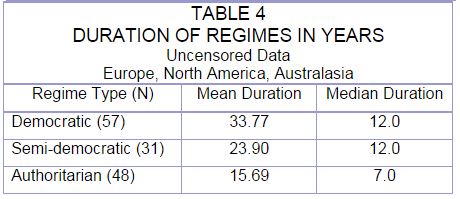
Here is some data, from a serious-looking academic paper:


Leaving aside the question of how one assigns regimes to one category or another, you can see that democracy is no guarantee of stability. The very long-lived democratic regimes of the U.K., the U.S., Canada, and Scandinavia raise the mean duration of democratic regimes in Europe, but even within the western world they are not the norm. In the rest of the world, there is little difference between the different types of regimes, and much instability no matter the system.

I wonder what these tables would look like if we added "monarchy + aristocracy" as a regime type and extended the time line back to the classical world?

Putin vs. Obama on Syria

Obama:
In accordance with this logic, we should support tyrants like Bashar al-Assad who drop barrel bombs to massacre innocent civilians because the alternative is surely worse. . . . Let’s remember how this started. Assad reacted to peaceful protest by escalating repression and killing and in turn created the environment for the current strife.
Putin:
We think it’s an enormous mistake to refuse to cooperate with the Syrian government and its armed forces who are valiantly fighting terrorism face to face.

There is no other solution to the Syrian crisis than strengthening the effective government structures and rendering them help in fighting terrorism.
I do understand the reluctance to cooperate with Assad -- he is a vicious thug, plus our allies in Saudi Arabia, Jordan, Turkey and Israel all really hate him and would be furious if we gave him even verbal assistance.

But so far as I can see, he is the only alternative to the Islamic State; our wishing for a moderate government in Syria won't make it happen. I worry that the longer we indulge this fantasy of a moderate Syria, the more likely it is that Hillary or Marco Rubio will end up ordering in American troops in a doomed attempt to make a democratic phoenix rise from Syria's ashes.

Plus, while we fret about Assad, the government we created in Iraq -- who are actually threatened by the Islamic State, and can't just sit around wishing for better options-- just signed a deal to cooperate with Assad, Putin and Iran against the jihadists.

Sunday, September 27, 2015

Varlam Shalamov, the Poet of Kolyma

Kolyma was the heart of Stalin's Gulag, a vast Siberian territory governed by the NKVD, populated mainly by thousands of prisoners who mined gold and cut down trees. One of its many inmates was Varlam Shalamov (1907-1982), sent there in 1937 for his opposition to Stalin's rule. Shalamov is now well-known as the author of Kolyma Tales, a thousand-page collection of short stories, many of them very short, widely considered to be the most accurate account of life in Kolyma. Kolyma Tales was not published until 1989, seven years after Shalamov's death.

Shalamov seems to have considered himself more of a poet than a memoirist. His poetry, however, is not widely read either in Russia or elsewhere. Robert Chandler recently wrote an appreciation of Shalamov's verse that you can find online here. Chandler reads the poetry side-by-side with the prison narrative, and admires the way Shalamov remained a poet and a lover of poetry throughout his 12-year imprisonment. Some of his poems, as Chandler translates them, seem to be about this act of clinging to life and hope through poetry:

From a frost-chilled
line of poetry
my anguish will drop
like a ripe berry.

Rosehip juice will dye
fine crystals of snow –
and a stranger will smile
on his lonely way.

Blending dirty sweat
with the purity of a tear,
he will carefully collect
the tinted crystals.

He sucks tart sweetness,
this purple honey,
and his dried mouth
twists in happiness.

Or:

Alive not by bread alone,
I dip a crust of sky,
in the morning chill,
in the stream flowing by.

Something like this, from a long poem titled Roncesvalles, reads completely differently when you imagine it being written by a man laboring in the Kolyma gold mines:

And it may have been Roland’s horn
that called me, like Charlemagne,
to a silent pass where the boldest
of many bold fighters lay slain.

I saw a sword lying shattered
after long combat with stone –
a witness to forgotten battles
recorded by stone alone.

And those bitter splinters of steel
have dazzled me many a time.
That tale of helpless defeat
can’t help but overwhelm.

I have held that horn to my lips
and tried more than once to blow
but I cannot call up the power
of that ballad from long ago.

There may be some skill I’m lacking –
or else I’m not bold enough
to blow in my shy anguish
on Roland’s rust-eaten horn.

For years Shalamov had nothing to write with at all, but could only compose his poems in his head and try to remember them. Later, after he became a medical orderly and acquired some very minor privileges, he could find pencil stubs and scraps of paper. It was enough:

Our tools are primitive
and simple:
a rouble's worth of paper,
a hurrying pencil.

That’s all we require
to build a castle –
high in the air –
above the world’s bustle.

Dante needed nothing else
to build the gates
of icy Hell.

The Pearly Kings and Queens

A London tradition dating back to 1875, still going strong:
The tradition began more than a century ago as a way to raise money and add a dash of cheer and cheekiness to ordinary London life. Pearly Kings and Queens have become icons of working class culture with 'royal families' now in every borough in the capital. Henry Croft, the original Pearly King and founder of the movement, was an orphan who later became a street sweeper. He got the idea for the decoration of Pearly outfits after working alongside apple sellers who festooned their suits with buttons down the sides of the legs and on the waistcoat and cap. He designed his own bright outfit with pearl buttons he found during his job as a street sweeper.

He became a local attraction and used his popularity to collect money for his old orphanage. His success meant other charities called on him to help raise funds for them, and so he asked the market traders to help him - and the Pearly Kings and Queens were born.

 More at the Daily Mail and This Spitalfields Life.


London's "Walkie Talkie" Wins this Year's Carbuncle Cup

This truly ghastly building, 20 Fenchurch Street by Rafael Viñoly, has won this year's Carbuncle Cup for the ugliest new building in Britain. The Guardian called it a "thuggish comedy villain of a building." Critic Owen Hatherley compared it to an equally horrible building in Paris:
What do the Tour Montparnasse in Paris, designed and built in the early 1970s by a large, anonymous committee headed by Eugene Beaudouin, and 20 Fenchurch Street – also known as the Walkie Talkie – by (and very much by) Rafael Viñoly have in common?

The most obvious answer would be "they're both massive, horrible and unavoidable", but they're also cousins in causing people to wish for their destruction almost immediately after construction.
One member of the committee that awarded the Carbuncle Cup, Ike Ijeh, called the Walkie Talkie "a gratuitous glass gargoyle graffitied onto the skyline of London," and concluded, "It should never have been built." Another, Eleanor Jolliffe, described it as a "Bond villain tower, as it could melt your car with a solar beam from space".

That last bit is a reference to an unexpected effect created by the building's curved facade:
Claims surfaced over the weekend that the glare from the curvaceous glass facade of the 37-storey tower - currently under construction at 20 Fenchurch Street - have caused vehicle paintwork to melt and bodywork to distort.

Engineer Eddie Cannon, who parked his Vauxhall Vevaro beneath the building, told local newspaper City AM: "The van looks a total mess – every bit of plastic on the left hand side and everything on the dashboard has melted, including a bottle of Lucozade that looks like it has been baked."
This led to the addition of fins designed to break up the light beam to the facade, and this seems to have made the problem more manageable.

But now there are claims that the building creates particularly strong wind gusts, which are a common problem around very tall buildings, but in this case are said to be knocking people down.

So, it's ugly and a menace on multiple levels. The Guardian:
Responsible for a catalogue of catastrophes, it is hard to imagine a building causing more damage if it tried. It stands at 20 Fenchurch Street, way outside the city’s planned “cluster” of high-rise towers, on a site never intended for a tall building. It looms thuggishly over its low-rise neighbours like a broad-shouldered banker in a cheap pinstriped suit. And it gets fatter as it rises, to make bigger floors at the more lucrative upper levels, forming a literal diagram of greed.
And yet it was built, and now London is stuck with it.

Some Strange New Data on European Genetic History

A new article in Current Biology by George Busby et al. purports to show a lot of comparatively recent genetic mixing among the populations of Europe and West Asia. (This is a completely different phenomenon from the great ancient invasions I have written about before.) Some of the data they present makes sense; for example, you can see a minor flow of genes from northwestern Europe (Franks) into the Basque population around the year 1000, and a significant flow of genes from central Asia into Turkey between 1000 and 1500. They identify the entry of Slavs into southeastern Europe via two clusters of genes, one similar to modern Lithuanians and the other to modern Germans, that entered between 700 and 1200. Everybody invaded the west Caucasus.

But what is one to make of the supposed flow of "southern Italian-like" genes into Britain between 500 and 1000 AD? Or of genes from "Armenian-like sources" into Orkney? Or Mordovian (relatives of the Hungarians) genes into Norway? Of "Cypriot-like" genes into northern Italy?

I think there is something wrong with their statistics, but I don't really understand their methods well enough to say what. One issue is that they rely on randomly sampled modern populations to generate their base lines, rather than trying to identify people who have resided in a particular area for generations. Another is that particular historical events may confuse the notion of where genes "originate." Surely the "southern Italian-like" genes they identify in Britain and Orkney are more likely to be Viking genes carried to southern Italy by Normans in the 11th century and later; I wouldn't have thought that the Norman conquest of southern Italy and Sicily involved enough people to leave a clear genetic signature, but who knows? I can't think of any other explanation.

What I really believe is that there has been so much mixing of populations across west Asia over the past 2000 years that it will be all but impossible to tease out the actual percentages of genes that Group A contributed to Region B at any particular time. But the data do show lots of mixing; there is no population in Europe or West Asia, not even the Basques or Norwegians, that seems to have remained "pure" since classical times.

Saturday, September 26, 2015

The Scribes of Enuma Anu Enlil

Shelves of the library of the 'Scribes of Enuma Anu Enlil' at Sippar in southern Iraq. This archive was constructed in the 6th century BCE. The tablets stored here were mainly astronomical texts and treatises on the interpretation of omens. More at the British Museum.

The Seed Man


This strange little object was made in Italy around 1600 and is now in the Walters Museum. According to them, these "seed men" were a common sort of novelty among rich Italians of the time; the curators relate them to the fruit and vegetable portraits painted by artists like Giuseppe Arcimboldo.

The Neurologist and his Mother

Andrew Scull:
In 1951, when Oliver Sacks was eighteen and about to go up to Oxford, his father, a general practitioner beloved by his patients, decided to have a conversation with him about his sexuality. Oliver had no apparent liking for the opposite sex, and on being quizzed about this, confessed that he preferred boys, but added "I have never 'done' anything". As he recounts in his memoir, the next morning his mother confronted him: "You are an abomination. I wish you had never been born". She then proceeded to ignore him for days, and during the rest of her long life, never again alluded to the matter. Sacks tries to excuse her as a child of her time and culture. She was born and raised an Orthodox Jew, and for nearly two decades more, homosexual relations remained a criminal offence under English law. . . . Sacks writes: "My mother did not mean to be cruel, to wish me dead . . . and she probably regretted her words". Sadly, one cannot be sure. Such is the power of prejudice. And I suspect that at his very core, Sacks is not sure either, and that his whole life has been shadowed by this knowledge, the hatred he felt directed at him by someone he deeply loved and whose approval he desperately needed but could not have. Indeed, he immediately says as much: "her words", he informs us, "haunted me for much of my life."

It is not just that such an intimate condemnation of something that was central to his identity "played a major part in inhibiting and injecting with guilt what should have been a free and joyous expression of sexuality". Perhaps it also lies behind the decade and more of self-destructive behavior that on many occasions came close to killing him (and might well have brought about the demise of patients entrusted to him as a fledgling physician, since much of the time he was addicted to and high on a variety of drugs and hallucinogens).
From the June 5 TLS.

This makes me wonder again about the part played by trauma and misery in shaping the careers of hugely successful people. Oliver Sacks may have endured decades of lonely, guilt-ridden celibacy, self-treated with dangerous drugs, but his books have given vast pleasure and glimpses of deep understanding to me and millions of others. Would a happy, well-adjusted man have written them? Richard Feynman thought that the best physicists were people who had experienced some awful loss that made them turn away from the world and live mainly in their own heads for years afterward. The miserably mad artist has become a cliche -- this same issue of the TLS includes a review of a collection of scholarly articles about David Foster Wallace, whose suicide seems to have solidified his reputation as the most serious American writer of my generation.

Joyce: Joy and woe are woven fine.

What Might Have Happened in Washington

Gail Collins on the resignation of House Speaker John Boehner:
Boehner’s leave-taking is a bit more of a mixed bag. The surprise announcement came the day after he sat proudly in the background while Pope Francis gave his address to Congress. You will not be stunned to hear that crying occurred, none of it involving Francis.

And there was a private meeting, in which reliable sources said the pope admired Boehner’s tie. But there is no indication he grabbed the speaker by the shoulders and cried: “You’re surrounded by crazy people! Get out while you can, my son!”

Not that it couldn’t have happened. The pope is infallible.

Friday, September 25, 2015

Warlimpirrnga Tjapaltjarri

Warlimpirrnga Tjapaltjarri is an aboriginal artist from a very remote part of Australia:
Until he was in his 20s, he and his family, part of the Pintupi Aboriginal group, lived in a part of the Western Australian desert so remote that even after other Pintupi were forcibly relocated into settlements in the 1950s and 1960s, his family remained out of view, hunting lizards and wearing no clothes except for human-hair belts, as their ancestors had for tens of thousands of years. When they were encountered by chance in 1984 and persuaded to move to a Pintupi community, they instantly became famous, known in newspaper accounts as the Pintupi Nine and described as the last “lost tribe.”
Tjapaltjarri has been painting on canvas since the 1980s, and this month he has his first solo show in New York. How about that for a personal journey, from the last lost tribe to Salon 94? Tjapaltjarri is a healer and story-teller among his people, and also a political leader of sorts, given his extensive connections with outsiders and (comparative) wealth.


Tjapaltjarri's painting on canvas is based on the designs his people traditionally painted on their spears, or their own bodies. They are composed of dots arranged in lines, as you can see in the detail directly above.

Randy Kennedy:
The lines and switchbacks, painted on linen canvas while it is flat on the ground, correspond to mythical stories about the Pintupi and the formation of the desert world in which they live. Some of the stories, which are told in song, can be painted for public consumption, but others are too sacred or powerful to be revealed to outsiders. “My land, my country,” said Mr. Tjapaltjarri, the only English words he uttered during an interview, pointing at a painting with a circle made out of dots. He said it represented a group of ancestral women who appear only at night in the desert around Lake Mackay, a vast saltwater flat that is the primary focus of his paintings.

The way that the lines and curves tell the stories remains mostly a mystery. “I’ve been asking that question for 40 years, and I’ve never really gotten the same answer twice — it’s very inside knowledge,” said Fred R. Myers, an anthropologist at New York University who has studied the Pintupi and their art since the early 1970s and as a doctoral student helped bring attention to the Papunya Tula Artists cooperative, which is owned and directed by Aboriginal people from the Western Desert. “The paintings operate more like mnemonic devices than like representations of a narrative.”

 Tjapaltarri's recent work is all untitled, but some of his older pieces have names; this is Tingari Men's Travels to Tjuntulpul, 1999.


I find these strange but quite wonderful. The hypnotic effect of the large canvases must be very impressive.

Fewer Americans Living with Partners, Except among the Elderly

Based on the latest data from the Census Bureau. Note the dramatic decline in the marriage/partnering rate for people 20 to 24, from 39% to 14% since 1980.

Thursday, September 24, 2015

Ben Carson, Islam, and Democracy

Ben Carson is getting a lot of flack for saying that he thinks a Muslim should not be President of the United States, because Islam is not compatible with the Constitution. In the sort of news outlets I read this is treated as a gross bit of bigotry, but I think I agree with him. Islam has a very strong tradition of theocracy. Many Muslims believe that the only just political power is an explicitly religious one, and that the only true law is Sharia, the law of God as interpreted by the mullahs. Theocracy, even in a soft form, is anathema to me and absolutely incompatible with the American system.

Don't get me wrong, I understand that many Muslims don't take the Islamic legal tradition any more seriously than most American Catholics take their own. But Islam as practiced and taught in places like Saudi Arabia, Egypt and Iran is absolutely incompatible with democracy, and indeed with any sort of secular society. Islam has a vast body of traditional law -- Sharia -- built up by centuries of interpreting the Koran and other early Islamic texts. The Islamic tradition teaches that all law should be developed in this way, by judges interpreting religious texts. The system has only a very limited place for a legislature, because the general view is that law is a divine thing, not a human creation; it is our job to find God's law in the relevant texts, not reason our for ourselves what would be best.

Over the past decade I have seen many surveys of Arab and Iranian opinion, and a majority in every poll wants their society and government to be explicitly Islamic. Right there you have a major conflict with the U.S. Constitution, which forbids the "establishment" of religion. Whatever most Americans say about it, we do not live in a Christian country, and this is very, very important to me. You can see from the recent experiences of Iran, Turkey, and Egypt that working out how to have a state that is both Islamic and democratic is very hard. Judaism has some of the same problems, and even in Israel (a state founded by secular socialists) the government assigns a large official role to the Orthodox rabbinate; among other things they decide who is a Jew. Catholicism used to create similar problems; until the 1980s Ireland assigned the church a very large role in education, health care, and other parts of the state, and on matters like marriage and divorce Ireland let the pope dictate their law. But Islam has the biggest and most fully developed system of traditional law, and the most prestigious, and so in general this is a bigger problem in Islam than for the rest of us. In Iran or Saudi Arabia a judge faced with a thorny problem turns to religious texts for the answer and frames his ruling in terms of the Sharia tradition; in the U.S., we forbid our judges from relying on religious texts. There is a real, fundamental, important divide here, the divide created by the Enlightenment. For religious leaders to dictate the law is abhorrent to me, and that is the Islamic tradition.

I know there are Muslim countries, such as Indonesia, where Sharia has limited influence on the law. But I'm sure a mullah from Saudi Arabia or Iran would be quick to tell the Indonesian government that they are bad Muslims. I also suspect that any American Muslim in a position to run for Congress would be a very liberal one, and he or she would have to swear off any interest in Sharia. So an American who is a Muslim in the same sense that Bill Clinton or Barack Obama is a Christian would probably be ok with me. But an orthodox Muslim would have a very hard time convincing me that his or her beliefs can be made to fit with the Constitution or the American political tradition.

To get back to Ben Carson, he is too much of a fundamentalist Christian for me to want him as my president; I don't think I could ever vote for a doctor who doesn't believe in evolution. But to me this only proves that the question he raised is a perfectly legitimate one. The sort of religion a candidate espouses is absolutely relevant to his or her fitness to be President, and the main tradition of Islam creates particular problems.

Mask Made from Fungus, Nepal


From the Cavin-Morris Gallery

The Latest Triumph of Our Syrian Policy

The Telegraph:
Pentagon-trained rebels in Syria are reported to have betrayed their American backers and handed their weapons over to al-Qaeda in Syria immediately after re-entering the country. Fighters with Division 30, the “moderate” rebel division favoured by the United States, surrendered to the al-Qaeda-affiliated Jabhat al-Nusra, a raft of sources claimed on Monday night.
Daniel Larison:
This is entirely unsurprising, and it drives home how irresponsible demands to “arm the rebels” in Syria have always been. Of course these weapons are ending up in the hands of jihadists. Jihadists and their allies make up the forces fighting against the Syrian regime, and any other anti-regime group is going to cooperate with them or be attacked and have their weapons plundered by them. . . . Syria hawks have promoted the fantasy that there are “moderates” that can be turned into an effective U.S. proxy in order to get the U.S. sucked into a conflict in which it had and still has no stake and no allies worth having.
I suppose part of the problem is that Obama agreed to go along with the scheme while obviously believing that it has no chance of success, which is hardly a recipe for victory. But that does not mean that an administration with more "resolve" would do any better; likely a Rubio or Fiorina administration would only send more arms that would just as quickly end up in the hands of our enemies, and perhaps start dropping bombs that would kill lots of Syrians without fixing anything.

Wednesday, September 23, 2015

What is the Happiest Political System?

Social Democracy:
Looking across countries, the more generous and universal the welfare state, the greater the level of human happiness, net of other factors.