Showing posts with label Syria. Show all posts

Sunday, December 8, 2024

Middle Eastern Dominos

It strikes me that October 7 is turning out to be the most consequential regional event in a long time, certainly since the Arab spring of 2011 and maybe since the US invasion of Iraq. American officials are cheering the failure of Iranian ambitions along the arc through Iraq and Syria to Hezbollah in Lebanon, and some Arabs thinking the same way:

A new Middle East is taking shape, with the Iran-led axis facing a significant setback. The Lebanon ceasefire marked a pivotal moment, signaling the end of an era and the onset of a political upheaval for the Iran-backed Axis of Resistance.

Here's a tweet with some good background on HTS and their leader. He calls himself "Abu Muhammad al-Jolani," a nom de guerre that references his desire to retake the Golan Heights from Israel. The sources I have found are very much divided on al-Jolani, some thinking he has changed his tone and beliefs, others thinking he is a violent jihadist in sheep's clothing.

Syrian:

I hope now people will stop asking us if we regret launching the revolution. We regret nothing. We dared to dream, and we will not regret the struggle for our dignity.

How many refugees will return? Some are already crossing the border from refugee camps, but what about the ones in Europe? Some are tweeting about how excited they are to return, but much depends on what happens in Syria over the next month.

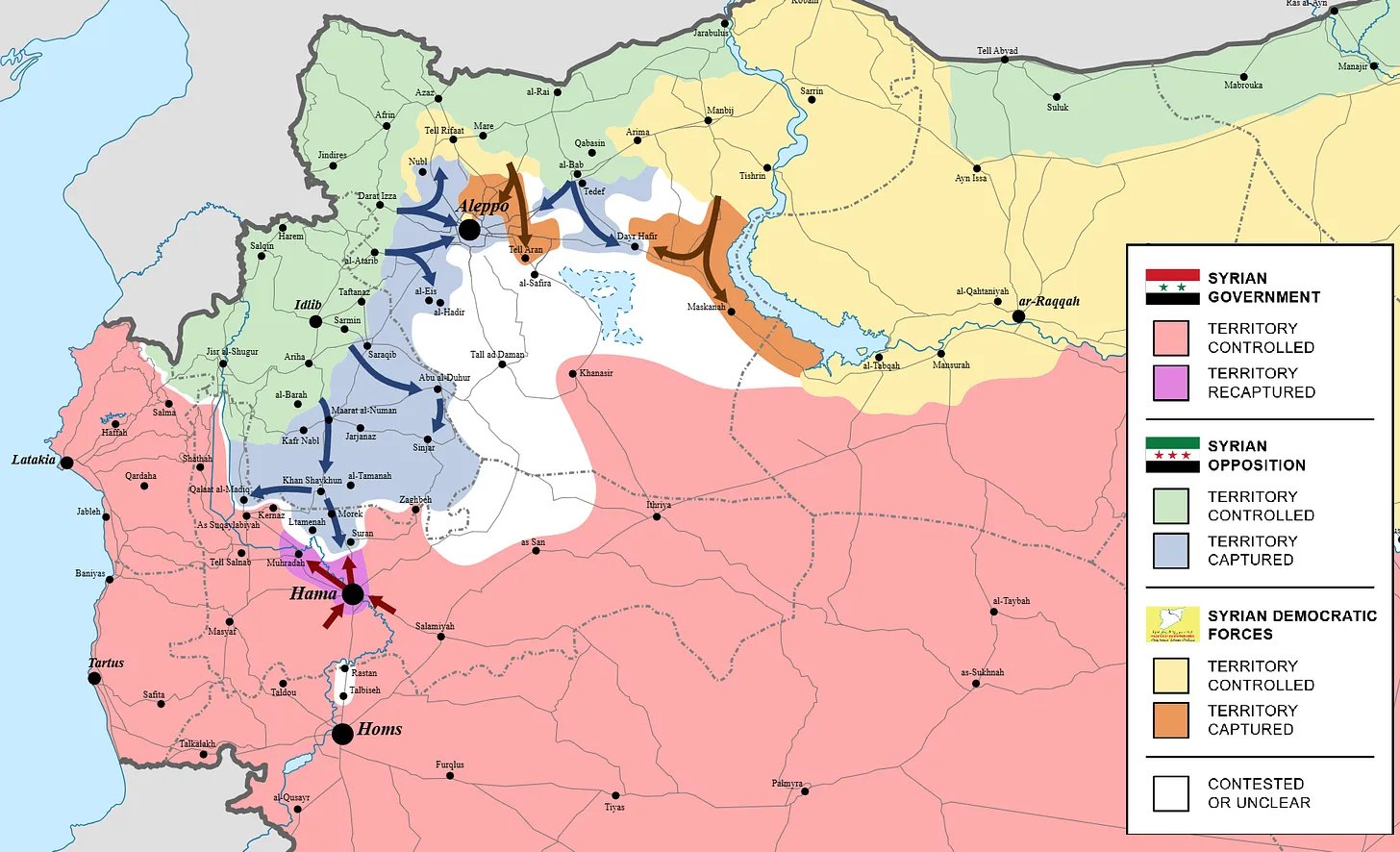
It was only 11 days from the launching of the rebel offensive to the fall of Assad.

Assad is Gone

Astonishing scenes of jubilation in Syria, wonderful to see.

Now comes the hard part.

Thursday, December 5, 2024

The Fall of Hama and the Hopes of Syrians

Syrian rebels have taken Hama, a city of one million people and the site of some important recent history: the massacre of 1982, and the protests of 2011. Huge crowds came out into the street to cheer the rebel victory, and to welcome released prisoners, some of whom were protesters of 2011 who had been behind bars ever since. And the rebels are not stopping: "The Battle for Hama is over, the Battle for Homs now begins." 

The fall of Hama seems significant to me because there was no surprise here; the Syrian army drove out the first wave of rebels, brought up significant reinforcements, and had time to establish a defense before the main rebel force arrived. Russian fighter bombers attacked the rebels. But it didn't matter, and the government's defenses crumbled within four days. They are just getting beaten, plain and simple.

Video of the Assad statue in Hama toppling.

It is amazing to read online how some Syrians are reacting to these events. Like this:

I’m crying. I can’t describe how happy I am. My dad was only 5 years old when Baathists stole the country and he only survived the Assad massacre in 1982 by a miracle. He died 8 years ago in exile with his heart aching for Syria. I love you dad. I wish you could see this. 

Or this:

After 10 years in exile. I am finally going back home! Syria is being freed!

Or this:

Stunning images are emerging from Hama, as reports confirm the release of thousands of prisoners from Assad's dungeons. Many were presumed dead, their survival unimaginable, yet now against all odds, they're free.

Or this:

Assadists in total meltdown. Revolutionaries celebrating in the streets. A series of events many wrote off as impossible taking place before our very eyes.

Oz Katerji, the Lebanese journalist we discussed here a few days ago, has this to say to western pragmatists who supported Assad to bring "stability" to Syria and fear what revolution will bring:

What is happening in Syria today is happening in spite of those foreign policy decisions, and in spite of those who presented Assad’s victory as the only possible resolution to the Syrian civil war. I can’t stress this enough, these people genuinely believed that the same corrupt murderous gangster regime that triggered a revolution against it would eventually stabilise Syria - did they think he’d suddenly stop stealing food from the mouths of his people? 

Assad forcibly displaced 3 million people into Idlib and the world just moved on. Now those people are taking back their homes, in spite of their abandonment, and the foreign policy establishment is concerned again. Now the conflict is no longer in the hands of the western powers. That ship has sailed. These are the consequences of their failures. If the regime falls, it will be despite their attempts to keep it on life support, and by the hands of Syrians that owe NOTHING to the USA.This is what the world looks like without your involvement. Deal with it.

Wednesday, December 4, 2024

Meanwhile in Syria

Fighting continues around Hama, with the rebels attempting to surround the town rather than directly assault it,

Background to the rapid fall of Aleppo to the rebels. And more here, emphasizing the years of careful organizing and planning. 

Troops from the Syrian army's 25th Division, supposed to be one of their tougher units, just surrendered a base full of tanks and other gear with hardly a fight. People are starting to wonder if much of the army has effectively gone over to the other side.

Mass surrender of regime troops at al Safira. And the rebels call on the rest of the government army to surrender, saying the battle is already over.

Among the hundreds of military vehicles the rebels have captured are multiple Smerch rocket launchers with a range of 120 km, which means all of Russia's air and naval bases in Syria are within rebel range. Assuming they can find someone who can operate them, but I suspect Ukraine would be happy to lend them a couple of techs. And we do know that Ukraine has ties of some kind with the rebels, since Kyiv sometimes reports on battlefield events before anybody else. In related news, all the Russian warships have left port in Syria for "exercises."

Learning from the old US playbook, Kurdish forces announce they are advancing into regime-controlled territory to fight terrorism.

Monday, December 2, 2024

And Now in Syria, US Involvement

Osint guys on Twitter/X (and here) are reporting US air attacks on Iran-supported Iraqi militiamen in Syria:

Over 50 Iranian-Backed Militants were killed, and at least a dozen Military Trucks and Technicals were destroyed yesterday in the Deir ez-Zor Governorate of Eastern Syria, after a Convoy entering from Iraq was targeted by several A-10 “Warthog” Close-Air Support Attack Aircraft of the U.S. Air Force. In addition, several Iranian Sites near the Town of al-Mayadin were also targeted by Coalition Aircraft, resulting in the destruction of a Command Center and Barracks. These Strikes were likely carried out in support of the Syrian Democratic Forces (SDF) [Kurds], who have begun to advanced into Assad Regime and Iranian-Backed Territory along the Euphrates River; in preparation for a possible Large-Scale Offensive in Eastern Syria, similar to the one ongoing now in the West of the Country.

But I can't find any official US statement about this. Not that this is really anything new; if you do a quick search for "US air attack Syria" you will see that we launch one every month or so, in response to the regular drone attacks on our troops there: November 12, October 30, September 29, etc.

Some US military types are laughing, saying that since those militias attack US forces all the time, when the Air Foce saw that column strung out along a road they just yelled "yee-ha" and dove in.

So I can't tell if this is just the same-old same-old, or if it really is a US attempt to aid this rebel offensive. Any reinforcements moving from Iraq to Damascus would have to cross areas of eastern Syria where the US and our Kurdish allies are active, so this might be a statement that large-scale movement of Iranian-backed forces into Syria will not be ignored.

But what a bizarre place Syria is, with American and Russian troops both present, trying to help their respective clients without fighting each other, so many active armed groups that you need a glossary to keep all the acronyms straight, a government everyone despises that stays in power only because of foreign support and the fact that some Syrians fear the opposition even more.

*     *     *

The Institute for the Study of War has started issuing regular updates on this fighting.

Some links on Twitter/X:

Summary of recent fighting.

Staggering material losses of the Syrian government army.

Very interesting Russian post on how messed up the Syrian government is.

And meanwhile the Russian air forces responds to the rebel advance according to their own traditions, by bombing hospitals.

Sunday, December 1, 2024

Syrian Civil War, 1 December

The big news is that government forces regrouped and retook Hama from the rebels. The rebels had only a small force in the town and withdrew without serious fighting when government forces approached, so it was not much of a battle, but this shows that Assad regime forces have recovered some of their organization and nerve. The rebels have continued to advance in other areas but nothing like the blitzkrieg of the previous few days.

HTS, the Turkish-backed, Sunni Muslim group leading the offensive, has seized land from Kurdish groups and its soldiers have looted Kurdish homes. Doesn't bode well for unity among anti-regime forces. More here.

A claim about captured equipment: "The amount of captured Assad regime weapons, ammunition, tanks, IFVs, and trucks is sufficient to rearm an entire rebel army." More pictures here from Special Kherson Cat, one of the most reliable Ukrainian bloggers. The captured stuff includes a couple of aircraft, a helicopter, and Pantsir SAM systems.

Russia has sacked the commander of their forces in Syria and replaced him with one of their top generals. Ukrainian intelligence reports that Russian forces in Syria have taken serious losses, but nobody else has confirmed this. Putin promised aid to Syria but nobody has yet reported on Russian forces or equipment arriving.

As I was saying about the anti-Assad, anti-Putin community, who believe all the evil in the world is run from Moscow: 

What’s happening in Ukraine, Georgia, Syria all shows we need a global plan to counter Russia and its “allies.”

More on the political background from Ruth Sherlock, notes that in recent weeks Israel has been bombing Iran-backed militias in Syria.

And this, from Oz Katerji: 

Nobody knows what will happen tomorrow and anybody who says so is lying. The truth is nobody, not even the most analytical minds with the best contacts, foresaw any of this, and the experts are sitting around as dumbfounded as you are, hitting refresh on their Telegram feeds just like you are. There are two types of Syria analyst right now, the type saying “man I have no idea what’s going on”, and liars. You aren’t going to find any answers.

Friday, November 29, 2024

The Syrian Civil War Re-Ignites

I had thought that the Syrian civil war was pretty much over, a frozen conflict that left the Assad government ruling most of the country. But suddenly that has changed, as rebel forces have retaken most of Aleppo and the surrounding district in what it is fair to call a "lightning campaign." There are videos online of rebels seizing  Aleppo police headquarters, dancing in the main square, and occupying a notorious prison, releasing all the prisoners. (More videos here, here, here.) To summarize,

It took the Assad regime 4+ years to conquer Aleppo, with the assistance of Iranian, Iraqi and Lebanese Shia militias, and Russian aerial domination. If this offensive continues at this pace, Assad could well lose Aleppo in 4 days.

Actually it only took three days.

As to how much farther they might go,

If you want to know where we are right now, nearly all the Syria analysts I know are trying to remain conservative on how far they think this offensive will go, because they're in a state of disbelief at how quickly regime lines are collapsing.
The context for this advance has to be that all the groups that aided the Assad regime before are now crippled (Hezbollah) or distracted (Russia, Iran). Russia withdrew most of its aircraft and air defense assets last year, along with all its regular army infantry. Russia's remaining airplanes have been active but their base is under drone attack and they don't seem to have had much impact; online Russian sources are worried about the rebels taking their naval base at Tartus.

Various people on Twitter/X, notably British/Lebanese journalist Oj Kateri, say that this offensive had been planned for quite a while:
Preparations for the battle began two years ago when Hay'at Tahrir al-Sham began raiding along the front lines. Then all the factions formed training camps where serious preparations were made. Military manufacturing developed to the level of drones with a range of at least 120 km, based on those used in the Ukrainian war, and the factions calmed down their differences and Tahrir al-Sham, as the largest and most organized faction, sought to accommodate everyone.
One of the discoveries I made when I began following the Ukraine war on Twitter/X is that there is a loose online alliance of people worldwide who believe they stand for freedom against tyranny. They seem to have formed around the Syrian civil war. Their enemies are the Assad regime and those who supported it: Iran, Russia, Venezuela, Hezbollah, Hamas. So they see those fighting against that Axis of Evil as their allies: the Syrian rebels, Ukraine, Israel. They cheered the destruction of Hamas and Hezbollah and root for the fall of Russia and Iran; their bitterest insults were launched at Obama for declining to intervene in the Syrian war. This new Syrian rebel offensive has them cheering again, and posting like mad. Here is an example of their thinking:

The Syrian Civil War, which began in 2011, played a pivotal role in shaping modern Russian foreign policy and military doctrine, marking the resurgence of Russia as a global power in conflict zones. For Russia, Syria was a testing ground for new strategies and military technologies, such as precision airstrikes, electronic warfare, and the integration of hybrid warfare tactics. Moscow’s intervention, which officially began in 2015, was framed as a response to the perceived instability caused by Western involvement in the Middle East, particularly U.S. and NATO actions. The war allowed Russia to assert itself as a key player in the region, bolstering its influence in the Middle East and challenging the U.S.-led order. Through its support for the Assad regime, Russia not only preserved a strategic ally but also demonstrated its ability to project military power far from its borders. This marked the beginning of a more assertive Russian doctrine, focusing on exploiting regional conflicts to reassert influence, undermine Western alliances, and promote its vision of a multipolar world order. . . .

Following its intervention in Syria, Russia's military and diplomatic strategies expanded to other conflict zones, notably Libya and Ukraine, further solidifying its doctrine of using hybrid warfare and military influence to assert power on the global stage. In Libya, Russia has supported General Khalifa Haftar's Libyan National Army in a bid to challenge the UN-backed Government of National Unity, using mercenaries, arms shipments, and covert support. . . . 

Russia's ongoing support for separatist movements in Eastern Ukraine, along with its full-scale invasion in 2022, demonstrated its commitment to challenging the post-Cold War European security order and reasserting its influence over former Soviet states. . . . These interventions across multiple fronts have reinforced Russia's doctrine of employing military force, proxy wars, and strategic alliances to assert its dominance and challenge the West's global influence, marking a significant shift in its foreign policy since the end of the Cold War. Thus, what is happening today in Syria with the rebels taking over large areas of land is directly undermining Russia’s future plans in the Middle East.

I am not sure what to make of this. On one level one has to agree with US representative Joe Wilson (Rep-SC):

Millions of Syrians have suffered unthinkable atrocities under a regime that survived only because of war criminal Putin and terrorist Khamenei. They do not want to be refugees, they want their homes and communities that butcher Assad has stolen. May God be with them.

But on the other, the Syrian opposition includes a dozen different armed groups with very different agendas, including the remnants of ISIS and Kurds who want to leave the country altogether. When a similar coalition overthrew the Gaddafi regime in Libya, the results were not pretty.

At the moment I do not think this offensive is a serious threat to the Assad regime; the rebels seem to have astonished themselves just by taking the closest city, and it's a long way to Damascus. I am interested to see where the lines stabilize, and to see what sort of government is set up in Aleppo.

But it may turn out that October 7 has reshaped regional politics in very big and far-reaching ways.

UPDATE 1

The rebel offensive is led by Hayat Tahrir al-Sham (HTS). HTS was once an arm of al Qaeda but turned against them, allied with Turkey, and defeated ISIS and another al Qaeda faction in tough battles. Here's a 2021 article on the group. From the abstract:

In pursuit of local dominance and ultimately survival, HTS has broken one jihadi taboo after another, including turning against al-Qa`ida and the Islamic State and dealing crippling defeats to both in Syria’s northwest. The implications and consequences of these developments are manifold. On the one hand, not only does HTS no longer represent the international terrorism threat that its predecessor once had, it has also almost entirely squashed the global threat posed by its more extreme rivals and played a role in maintaining the longest ceasefire in a decade of war in Syria. On the other hand, however, HTS’ de facto rule of northwestern Syria threatens to ‘mainstream’ a local jihadi model that looks set to experience a substantial boost by the Taliban’s surge to power in Afghanistan. Should conditions dramatically change, it could also come to represent a strategically significant terrorist safe haven once again—on Europe’s doorstep.

Statement from HTS here saying they don't really want to fight Russia, just overthrow Assad. 

UPDATE 8 PM EST

Reports that the Syrian government and its forces have abandoned  Aleppo and withdrawn to al Safrah 10 miles to the southeast.

UPDATE 8 AM EST

The statue of Bassel el-Assad, the dictator's brother, is toppled in Aleppo.

Revolt has broken out in Daraa in Syria's southwest, at the other end of the country from Aleppo. Seems disorganized and chaotic for now; observers are waiting to see if former rebels who accepted Assad's rule back in 2018 will join this revolt. Defense analyst Michael Horowitz says, "In southern Syria, a low-level insurgency never disappeared, and could escalate."

Online sources say the rebels have taken Maarat, 50 miles southwest of Aleppo, another place that was fought over for years but now may have changed hands in hours. Here is the announcement from the rebels. And several smaller places in this area.

Shashank Joshi of the Economist has more on HTS, drawn from this article.

Russian sources (Rybar, Rusich) are scathing about the Syrian army, calling them cowards, etc. They say this about the fighting:


Everyone noted the sudden panic that overtook the Syrian army, so there may be something to this. If so, all well-organized armies attacking less effective forces should take note and make good use of social media to create and spread panic.

On the subject on possible dissension among the rebels, this:

While we are ultimately happy to see Assad go, we also don't want Jolani's radicalism, or any faction that does not look out for the rights of Syrians. The real test is now; no revenge, no corruption, no religious ideologies being imposed overs others. Our mandate is freedom.

The same source says Erdogan is not Syria's friend and his power must be resisted.

UPDATE Noon EST

You can follow the fighting at the Live Syria Map.

Additional places said to have fallen to the rebels: Hama and the nearby air base, Halfaya, Aleppo International Airport.

Rebels claim to have shot down a Russian or Syrian jet over Aleppo. They were earlier seen posing with recently captured MANPADS systems.

Reports that Syrian officers have started evacuating their families from Homs to Damascus.

The Syrians abandoned lots of valuable equipment like tanks and air defense systems along their retreat routes, apparently because they ran out of gas. It's a sign of complete panic when soldiers flee without first gassing up their vehicles.

Video of crowds celebrating the liberation of Hama.

Sunday, August 6, 2023

Barack Obama's Girlfriends and the Red Line in Syria

Remember this?

In August of 2013, a rebel-held suburb of Damascus was attacked with sarin gas — a nerve agent that causes lung muscle paralysis and results in death from suffocation.

The attack killed 1,400 men, women and children, and at the White House, officials asserted “with high confidence” that the government of Bashar al-Assad was responsible.

One year earlier, President Barack Obama had described Assad’s potential use of chemical weapons as “a red line” that would have “enormous consequences” and “change my calculus” on American military intervention in Syria’s civil war.

When Assad appeared to cross that line, Obama ordered the Pentagon to prepare to attack.

But of course Obama changed his mind, and instead of a massive air strike we got a deal whereby Assad handed a bunch of chemical weapons over to the Russians, and the mess in Syria ground on without much US intervention.

This event still looms large for many people: anti-government Syrians and their allies, many US military and foreign policy types, some Europeans who think it was US weakness in Syria that made Putin think we wouldn’t help Ukraine – I’ve seen this stated several times on Ukraine war Twitter – and the sort of people who think the best way to understand history is by psychoanalyzing world leaders.

Within that last category we find David Samuels. Samuels, a long-time Jewish journalist, uses an actually rather interesting interview with Obama biographer David Garrow to develop his theory that everything wrong with the Middle East is Obama’s fault. (Besides inequality, tech monopolies, and Lord knows what else.) Samuels traces Obama’s failure to stand up for Syria back to his false version of his break-up with one of his white girlfriends, Sheila Miyoshi Jager. 

Biographer Garrow tracked Jager down and got her version of their break-up, which Obama had described in Dreams from My Father. In both versions this had something to do with Obama’s turn toward blackness. But in Obama's version this was a “a passionate disagreement following a play by African American playwright August Wilson, in which the young protagonist defends his incipient embrace of Black racial consciousness against his girlfriend’s white-identified liberal universalism.” But it Jager's version the fight was about Obama’s  

refusal to condemn a Black mayoral aide named Steve Cokely who, in a series of lectures organized by Louis Farrakhan’s Nation of Islam, accused Jewish doctors in Chicago of infecting Black babies with AIDS as part of a genocidal plot against African Americans. . . . It was not Obama’s Blackness that bothered her, but that he would not condemn antisemitism.
Samuels claims that the invisibility of Jager and her account of the relationship was some sort of conspiracy among Obama-loving journalists, which to me sounds like a weird description of his time in office; was there anything that some conservative did not accuse him of? But this all goes much deeper:

I have never seen any evidence that Barack Obama has the slightest personal animus toward Jews as individuals. But from his denial of American exceptionalism, and his sourness toward Israel, going all the way back to Sheila Miyoshi Jager’s account of their breakup, there does seem to be an awareness of the underlying problem posed to his politics by Jews—that is, the problem posed by Jewish group survival and their continuing insistence on Jewish historical particularity.

It’s all about the Jews! 

Because, see, the Progressive narrative is all about the noble suffering of oppressed groups and the perfidiousness of their oppressors, the White Race. Jews screw this up by being both oppressed (in the general historical sense, and in the Holocaust) and oppressors (as wealthy people in the US who own buildings in black neighborhoods).

How can Jews be “privileged white people” if they are clearly among history’s victims? And if Jews aren’t white people, then perhaps lots of other white people are also victims and therefore aren’t “white,” in the theological sense in which that term gains its significance in progressive ideology. Maybe “Black people” aren’t always or primarily Black. Maybe the whole progressive race-based theology is, historically and ideologically speaking, a load of crap. Which is why the Jews are and will remain a problem.

So, I guess, in order to maintain the narrative that history is about oppressors and the oppressed, Jews have to be wished out of existence. And that, plus a generalized Progressivism, explains why Obama worked so hard to avoid war with the “antisemitic state” of Iran. Samuels thinks that Obama refused to bomb Syria because he wanted the Iran deal (the JCPOA) so badly, and he wanted the Iran deal so badly because he hated “American exceptionalism,” the Vietnam War, colonialism, and Israel, and was at best ambivalent about Jews.

The sheer amount of political capital and focus Obama put into achieving the JCPOA during his second term, to the near-exclusion of other goals, suggests that the deal was central to his politics. It also carries more than a whiff of the kind of politics in which the American Empire is seen not just as unexceptional, but also, in some ways, as actively evil. It was a politics born out of the confluence of the Vietnam War and the civil rights movement, which saw a racist war abroad being used to protect a racist power structure at home. That old alliance of civil rights, anti-imperialism, and identity politics made the Democratic Party that Obama positioned himself to lead—college-educated, corporate-controlled—seem cool, allowing it to use post-1960s radical ideology as a language to sell stuff.

This kind of history simply befuddles me. If only Obama had recognized antisemitism and not lied to himself about why he ditched Jager, we could have had a peaceful, democratic Syria! Besides less inequality and tech monopolies!

But it was not just Obama who did not want to intervene in Syria, it was the vast majority of Americans, including such Obama haters as Sarah Palin. One day of bombing was not going to change the war; to have any real impact we would have had to send in a massive force and remove the Assad regime. That was not going to happen, especially under a President whose whole campaign was focused on avoiding more Middle East wars.

As for war with Iran, I think that would have been a catastrophe on par with what Russia is experiencing in Ukraine.

I think the stuff Garrow dug up about Obama is interesting, and I agree that he is a strange person who has written two dishonest memoirs. But the history of the world doesn’t really depend on the psychological quirks of term-limited Presidents.

Monday, June 1, 2020

Serjilla: Dead City

In northwestern Syria are more than a hundred ghost town collectively known as the Dead Cities. They date to between 400 and 700 AD. The best preserved is Serjilla.

These seem to have been ordinary farming towns where some folks got rich after the fall of Carthage to the Vandals cut off supplies of olive oil from the western Mediterranean, leading to an olive oil boom in Syria.

That explains their rise, but their fall is more mysterious. There are no signs of violence, nor any record that the conquering Arabs did much damage. Some speak of changes in trade routes, but these towns were within two day's journey of Aleppo, which remained a great city throughout the Middle Ages, so I am not sure why that would be relevant. Did changes in the weather render the land less valuable?

I have no idea, and so far as I can tell, nobody else really knows either. So a little mystery, a whole rural district that prospered for two centuries and then faded away, leaving these splendid ruins.

Town plan.

Some authorities identify this as a tavern others an an Andron, a meeting place for men.

The town had public baths, which were a lot less common in 500 AD than they had been 200 years earlier, so the elite were a traditional bunch.

But they were of course Christian; this is the church.

So far as I can tell, this place has so far survived Syria's Civil War unscathed. May it long endure.

Friday, December 28, 2018

Trump's Frustration with "the Blob" Boils Over

Toward the end of his second term, President Obama and his closest advisers took to calling the foreign policy establishment/military industrial complex "the Blob." They were deeply frustrated that the "experts" refused to offer them any options to meaningfully reduce US involvement in foreign wars. Hence Obama's great satisfaction the one time he stood up to the Blobsters, refusing to order attacks after Assad crossed his "red line" in Syria.

And now Trump, it seems, shares his predecessor's frustrations. I of course think that withdrawing US troops from Syria and Afghanistan is a great idea. I do understand that it is better to work with one's generals in arranging these things rather than just announcing them over twitter, but sources are telling the Times that Trump tried to get the military to give him withdrawal timetables and they simply refused.
Some former Trump advisers attributed the sudden nature of the announcement to Mr. Trump’s frustration with generals who resisted him at every turn when he tried to set a timetable for getting out of Syria and Afghanistan — something, his supporters point out, that he had promised to do during the 2016 campaign.

“The apparatus slow-rolled him until he just said enough and did it himself,” said Stephen K. Bannon, who clashed with the generals over Afghanistan when he served as the president’s chief strategist in 2017. “Not pretty, but at least done.”
So there's one thing for Trump; he thinks that the President should set our military policy, not a lot of generals and ambassadors, and is willing to act on his convictions in a way that a more cautious and mainstream leader probably would not.

Wednesday, August 8, 2018

Refugees and the Syrian End Game

The civil war in Syria is winding down across much of the country, because the government has won. As you can see from the map above, the government (red) now controls all the inhabited areas in the south and center of the country and is slowly constricting the remaining rebels in the north. What remains of Aleppo is in government hands. The yellow area is under the control of Kurdish militias and their American advisers, and so far the Kurds have remained mostly at peace with the government.

So especially in the south those communities that have been hosting thousands of Syrian refugees are eager to see them go home:
Seven years of war in Syria has displaced more than half the country’s population, leaving millions of refugees shipwrecked between the wasteland of home and the void of exile. Among the many Lebanese and Jordanian towns that received them was Arsal, where rented rooms and tent cities overflowed at one point with 120,000 Syrians — quadruple its Lebanese population.

But with the Syrian government closing in on victory, President Bashar al-Assad declaring the country safe for Syrians again and their reluctant Lebanese hosts pressing them to leave, the Syrian refugees are now beginning to set out on the fraught road home.

Over the past month, convoys carrying nearly 2,000 Syrians have crossed the border, returning families to the homes they had abandoned years ago — though few knew whether those homes had survived the bombs and shells.
I consider this great news. On the other hand certain other news shows why so many Syrians hate the Assad regime so much, and why western governments keep saying that the problem can't be solved so long as Assad remains in power:
But many may be stuck in Lebanon. Thousands of Syrians in Arsal have applied to return, only to be rejected by Mr. Assad’s government. Many more say they believe that if Mr. Assad remains in power, the outcome tacitly accepted by the global powers haggling over Syria’s future, they have only arrest, torture, death or forced conscription to return to.

“Here, I’m a refugee,” said a former Syrian soldier who asked to be identified by his nom de guerre, Abu Fares. “In Syria, I’m a traitor.”
So at least for the next few years, many refugees will be unable to return even if they want to. I suspect that European countries in particular will put pressure on the regime to change this policy as the central plank in any peace settlement, but for notorious regime opponents there won't be anything they can do.

The other big question to be resolved in any peace settlement will be the Kurdish areas. The government can't conquer them so long as thousands of Americans remain in place, nor will the US support outright independence for the Kurds. So I suspect a stalemate like the one in Iraq is inevitable. Since right now the Kurds and Americans control big areas where the people are all Arabs, maybe a deal can be worked out in which the Kurds withdraw from the Arab areas in return for recognition of their autonomy in the areas where they are the majority. I hope so.

Tuesday, January 23, 2018

The Syrian Mess

In Syria, our NATO allies the Turks are, with Russian help, attacking our other allies the Syrian Kurds, who did much of the hard fighting against the Islamic State around its old capital. We are paralyzed, caught in a web of our own making: we can't fight the Turks, because they are in NATO and we depend on our Turkish air base to keep our Middle Eastern wars going; we can't fight the Russians because we agreed to their setting in up Syria, and anyway we don't want a war with Russia, and on what basis could we complain about their helping our Turkish allies? We can't abandon the Kurds because they are our only really reliable friends in the whole godforsaken region, plus we would feel like cads for ditching them after working so closely with them for so long, not to mention the whole "losing face", "not following through on our commitments" thing that matters so much to so many American foreign policy types. And, we can't broker a peace deal in Syria because that would mean recognizing the Syrian government, which we have been saying for years is an illegitimate tyranny.

Near as I can tell, our Syrian policy is to keep muddling along until a democratic, human-rights-respecting, pro-America, pro-Israel, anti-Iran, anti-terrorist government miraculously appears in Damascus. Meanwhile, people continue to be blown up on a regular basis, and the whole region from Manchester to Amman is in crisis over what to do about refugees thrown up by this and other wars. There's no use blaming Trump's people for this, because Obama's had no idea what to do, either, and ended up focusing on the Islamic State because that was one problem we felt like we could solve. They seem to be pretty much beaten. But Syria's ordeal seems likely to stretch on for decades.

Sigh.

On the map above, territory controlled by the Syrian government is in red, Kurdish territory in yellow, other rebels in green, and the remnants of the Islamic State in gray.

Tuesday, August 8, 2017

Rumblings of a Bigger War in Syria

What would we do if our Turkish "allies" launched a major military attack on our Syrian Kurdish "allies"?
ISTANBUL (Reuters) - Days after a reshuffle of Turkey's top military commanders, President Tayyip Erdogan has revived warnings of military action against Kurdish fighters in Syria that could set back the U.S.-led battle against Islamic State.

Kurdish militia are spearheading an assault against the hardline militants in their Syrian stronghold Raqqa, from where Islamic State has planned attacks around the world for the past three years.

But U.S. backing for the Kurdish YPG fighters in Syria has infuriated Turkey, which views their growing battlefield strength as a security threat due to a decades-old insurgency by the Kurdish PKK within in its borders.

There have been regular exchanges of rocket and artillery fire in recent weeks between Turkish forces and YPG fighters who control part of Syria's northwestern border.

Turkey, which has the second largest army in NATO after the United States, reinforced that section of the border at the weekend with artillery and tanks and Erdogan said Turkey was ready to take action.

"We will not leave the separatist organization in peace in both Iraq and Syria," Erdogan said in a speech on Saturday in the eastern town of Malatya, referring to the YPG in Syria and PKK bases in Iraq. "We know that if we do not drain the swamp, we cannot get rid of flies."
There are hundreds of Americans working in Syria with the YPG, including artillery batteries currently engaged against the Islamic State in Raqqa. Is Erdogan mad enough to attack the Kurds anyway?

Can you imagine Trump doing nothing if an American were killed?

This seems quite dangerous to me.

Friday, July 7, 2017

The Arab Spring, Failed Hopes, and Self Doubt

The Arab Spring, a great movement for democracy, human rights, and hope, has crashed and burned. Outside Tunisia it has led only to some combination of civil war and renewed repression. Algerian writer and activist Kamel Daoud wrote a moving essay about these events for a French newspaper that has now been translated and published in the Times. It makes me wonder.

Daoud admits that the dreams of the protesters and the rebels are dead or dying, but he does not attribute this to any sort of natural disease. He believes that those dreams were murdered. They were murdered by dictators like Assad with their airplanes and poison gas, by cynical foreign governments, by lies. The liars claim that attempts to establish Arab democracy only empower radicals like the Islamic state and lead to chaos and foreign intervention:
For President Abdelaziz Bouteflika of Algeria, the Arab springs were “devastating conspiracies.” According to a private Egyptian television channel, even ‘‘The Simpsons’’ contained proof of untoward foreign designs in Syria. The political chaos in Libya has fanned distrust as well.

The foreign-intervention theory is used as a weapon against local dissenters. In 2016 Bouteflika, ailing and immobilized, announced that he would seek yet another term, after having the Constitution amended so that he could stay in office for the rest of his life. When his opponents countered his proposals by invoking democratic values, government media accused them of being traitors, Western agents or Zionists.

The case of Syria — subject to alliances with Iran or Russia and playing against Saudi Arabia, Qatar or the United States — gives weight to such propaganda. It seems to demonstrate that any demand for democracy eventually translates into chaos, and chaos invites the return of colonialism. The same goes for Libya. Better then to submit to one’s dictators than compromise oneself with foreigners.
I want to agree with Daoud that the dream of Arab democracy remains alive, and that things might have gone differently. But I am not sure. I am not much of a believer in luck or genius. I think most of what happens in history is driven by vast, long-term forces that we only partially understand and can rarely control. It seems to me that people who point out what happened in Libya when the dictator was overthrown are onto something. The situation did not degenerate into chaos for no reason at all; it degenerated because Libyans are deeply divided among themselves by region, tribe, class, attitudes toward Europe, and their interpretations of Islam, so much so that once the heavy hand of dictatorship was removed the situation spontaneously combusted. Can democracy flourish in such circumstances? Assad has held onto power in Syria not just because he has airplanes and poison gas, but because he has the support of many Syrians. Foreign powers meddle in Arab conflicts not just for their own nefarious purposes but because various Arab factions are always begging them to.

Consider events in Iraq and Egypt. In Iraq the US removed the dictator and his whole apparatus, and so far the result has been corruption, conflict, terrorism, the rise of the Islamic state, a devastating civil war, and the effective secession of Kurdistan. Consider the still smoldering ruins of Mosul, once one of the Arab world's great cities, as collateral damage from this experiment. In Egypt democracy was established and an election held, but the winner was from the Muslim Brotherhood. The secular, western-oriented people who began the protests and launched the revolution recoiled in horror from what their countrymen had chosen and allied with the military to overthrow the Morsi government and return Egypt to dictatorship. The hard, rational part of my brain says this all proves that most of the Arab world is simply not suitable for democracy.

But even as I reach that conclusion I doubt it. Americans always used to say that Latin America was unsuitable for democracy and pointed to the numerous failures, but right now most of the region is democratic, and some of those democratic nations are thriving. Am I just being smug and indifferent when I write off the dreams of Daoud and millions of others? Is my resignation just an excuse for the west's clumsy combination of military meddling and moral indifference? For my refusal to endorse spending American dollars and soldiers overthrowing Assad? I don't know.

I would never tell Daoud or an other citizen of a dictatorship to give up hope; hope is a precious thing in any circumstances. But I am not myself optimistic that things will get better in the Middle East any time soon.

Friday, April 7, 2017

Trump's Normalization Continues with Cruise Missile Barrage

The President:
Tonight, I ordered a targeted military strike on the airfield in Syria from where the chemical attack was launched. It is in the vital national security interest of the United States to prevent and deter the spread of chemical weapons.
I'm having a hard time feeling anything about this at all, because it seems so normal. It's what American presidents have been doing since Bill Clinton's time. I'm glad this was defended as a specific response to the use of chemical weapons – a resurrection of the "red line" that Obama invented and then ignored – rather than as a grand scheme to restore civilization in Syria.

To me the most important thing about the decision is its very normality. It is exactly what any ordinary Republican president would do, or many moderate Democrats; both Hillary Clinton and Marco Rubio praised the attack.

The attack was not praised by either the libertarian wing of the Republican Party, people like Rand Paul and Justin  Amash, or by many on the Alt-Right. "Trump joins the neocons" was a typical reaction from that quarter. After all this was an attack on a close ally of Vladimir Putin.

This reinforces the sense for me that Trump, without the ideas, energy, or know-how to chart his own political path, is drifting toward being an ordinary Republican. Except for the short attention span and atmosphere of chaos, everything that made him distinctive is falling away: the talk of more generous healthcare, the trillion dollar infrastructure plan, the nods toward raising taxes on hedge fund billionaires, etc. All that remains is Bushism or Ryanism with a wagonload of scandals.

Tuesday, November 29, 2016

What Happens if Assad Wins?

The Times finally discusses Syria in terms that make sense to me, admitting that Assad is likely to win the civil war:
With the Syrian government making large territorial gains in Aleppo on Monday, routing rebel fighters and sending thousands of people fleeing for their lives, President Bashar al-Assad is starting to look as if he may survive the uprising, even in the estimation of some of his staunchest opponents.
But should he win, it is not likely to be a very glorious victory:
Yet, Mr. Assad’s victory, if he should achieve it, may well be Pyrrhic: He would rule over an economic wasteland hampered by a low-level insurgency with no end in sight, diplomats and experts in the Middle East and elsewhere say.
Post-civil war Syria was described by former U.S. Ambassador Robert Ford as "a half-dead corpse. . . a gaping wound that stretches as far as the eye can see." Assad has offended the U.S. and the E.U. too deeply to be able to get any rebuilding aid from them or the World Bank, and his friends in Iran and Russia don't have much money to give him. So the Syrian government will be broke, its industry ruined, its largest city rubble, with ISIS and al Qaeda still on the loose.

Syria's suffering is likely to go on for at least another decade.

Thursday, September 15, 2016

Taking "Risks" for Peace in Syria

As I write, the cease-fire in Syria is mostly holding, and people living in besieged areas of Aleppo have reported going outside to walk around for the first time in months. No war as complex and emotional as this one was ever settled so easily, but meanwhile there is at least a day of peace, and that counts for something.

So I offer congratulations to the people who made this possible, especially Secretary of State John Kerry and Russian Foreign Minister Sergey Lavrov.

But I also want to comment on the weird way this deal has been presented in much of the American press. The Times:
The new arrangement on Syria, set to begin Monday, was greeted with skepticism by Syrians on all sides and carries many risks of failure, which the Pentagon and Mr. Kerry acknowledged. . . .

The accord was reached after sharp divisions inside the Obama administration over the wisdom of sharing targeting information with Russia, and accusations that the Russians have used the negotiating period to help Mr. Assad regain control in Aleppo and strike at American-backed opposition groups.

For Mr. Obama, who asked Mr. Kerry to keep working on the negotiation after the president failed to reach an accord with Mr. Putin during the Group of 20 summit meeting in China last weekend, the new accord poses considerable risks.
Risk? What risk, exactly, are Kerry, Obama et al. taking? Or any other American? We are talking about a war in which half a million people may have died, and that has spawned Europe's greatest refugee crisis since World War II. Compared to the risks millions of Syrians and others are facing every day, who has time for the possible damage to the reputations of diplomats, or the ins and outs of Russian-US military posturing?

Sure, if this fails, as it is very likely to, Kerry may end up looking foolish and Obama may end up looking weak, blah blah blah. Those are the risks we pay our leaders to take. I am glad they have taken them. But I am also bewildered by the thicket of bristling suspicion that surrounds this and most other peacemaking efforts. Sometimes there is nothing to be said but do the right thing or go home and let someone else do it.

Friday, August 26, 2016

Civil War and Foreign Intervention, or, Why Syria's Nightmare Drags On

Historians who study civil wars say that foreign intervention tends to make them last much longer:
Most civil wars end when one side loses. Either it is defeated militarily, or it exhausts its weapons or loses popular support and has to give up. About a quarter of civil wars end in a peace deal, often because both sides are exhausted.

That might have happened in Syria: the core combatants — the government and the insurgents who began fighting it in 2011 — are both quite weak and, on their own, cannot sustain the fight for long.

But they are not on their own. Each side is backed by foreign powers — including the United States, Russia, Iran, Saudi Arabia and now Turkey — whose interventions have made Syria an ecosystem with no entropy. In other words, the forces that would normally impede the conflict’s inertia are absent, allowing it to continue far longer than it otherwise would.

Government and rebel forces are supplied from abroad, which means their arms never run out. They also both draw political support from foreign governments who do not feel the war’s costs firsthand, rather than from locals who might otherwise push for peace to end their pain. These material and human costs are easy for the far richer foreign powers to bear.

This is why, according to James D. Fearon, a Stanford professor who studies civil wars, multiple studies have found that “if you have outside intervention on both sides, duration is significantly greater.”
There is much more in that article, including evidence that foreign intervention leads to more atrocities against civilians. In the Syrian case foreign support seems to make it impossible for the war to ever end, since whenever one side starts losing the other side's sponsors step up their support until the stalemate is re-established.

Wednesday, July 13, 2016

The End of the Caliphate

Various signals coming from the Islamic State indicate that it is preparing for the loss of all its cities and most of its territory, converting itself back into a rootless terrorist network:
A remarkable editorial last month in al-Naba, the Islamic State's weekly Arabic newsletter, offered a gloomy assessment of the caliphate's prospects, acknowledging the possibility that all its territorial holdings could ultimately be lost. Just two years ago, jihadist leaders heralded the start of a glorious new epoch in the world's history with the establishment of their Islamic "caliphate," which at the time encompassed most of eastern Syria and a vast swath of northern and western Iraq, a combined territory roughly the size of Great Britain.

The editorial, titled, "The Crusaders' Illusions in the Age of the Caliphate," sought to rally the group's followers by insisting that the Islamic State would continue to survive, even if all its cities fell to the advancing "crusaders" - the separate Western- and Russian-backed forces arrayed against them.

"The crusaders and their apostate clients are under the illusion that . . . they will be able to eliminate all of the Islamic State's provinces at once, such that it will be completely wiped out and no trace of it will be left," the article states. In reality, the group's foes "will not be able to eliminate it by destroying one of its cities or besieging another of them, or by killing a soldier, an emir or an imam," it says. . . .

The editorial asserts that the "whole world . . . has changed" with the creation of a theocratic enclave that has "shown all of mankind what the true Islamic state is like."

"If they want to achieve true victory - they will not, God willing - they will have to wait a long time: until an entire generation of Muslims that was witness to the establishment of the Islamic State and the return of the caliphate . . . is wiped out."
Recent advances by the Iraqi government and Syrian Kurds have cost ISIS 12 percent of their territory, and it seems the Iraqis are on the verge of a major effort to retake Mosul, the largest city under ISIS control.

But of course even the loss of all its cities will not end the Daesh's ability to make trouble. Most experts have interpreted the recent spate of terrorist bombings around the world as a shift in strategy from holding territory back to terrorism. As one Islamic State operative told a western journalist,
We do have, every day, people reaching out and telling us they want to come to the caliphate. But we tell them to stay in their countries and rather wait to do something there.
Terrorism is bad, of course, but not so bad as having ISIS armies on the march, enslaving women and carrying out genocide. So I would be happy to trade the elimination of the Islamic State for a short-term increase in bombings.

Wednesday, March 30, 2016

When the Islamic State is defeated, things may get worse

Today's cheerful reminder from Tom Friedman:
Let’s go back to the future of Iraq. “The problem in Iraq is not ISIS,” Najmaldin Karim, the wise governor of Kirkuk Province, which is partly occupied by ISIS, remarked to me. “ISIS is the symptom of mismanagement and sectarianism.” So even if ISIS is evicted from its stronghold in Mosul, he noted, if the infighting and mismanagement in Baghdad and sectarian tensions between Shiites and Sunnis are not diffused, “the situation in Iraq could be even worse after” ISIS is toppled.

Why? Because there will just be another huge scramble among Iraqi Sunnis, Kurds, Turkmens, Shiite militias, Turkey and Iran over who controls these territories now held by ISIS. There is simply no consensus here on how power will be shared in the Sunni areas that ISIS has seized. So if one day you hear that we’ve eliminated the ISIS caliph Abu Bakr al-Baghdadi and lowered the ISIS flag over Mosul, hold your applause.
This is why I think Obama is right not to make a major American commitment to defeat the Islamic State with another blitzkrieg armored advance on Raqqa, no matter how many people they kill in Europe and America. As things stand, that would only lead to more chaos, and to more intense fighting among all the other factions. We would be spending tens of billions of dollars and losing hundreds of lives to achieve nothing.

I am not sure if it is even possible to find a diplomatic, political solution to the mess in Syria and Iraq, but I believe that achieving a stable political climate is the only way to control terrorism. Shock and awe will not suffice.