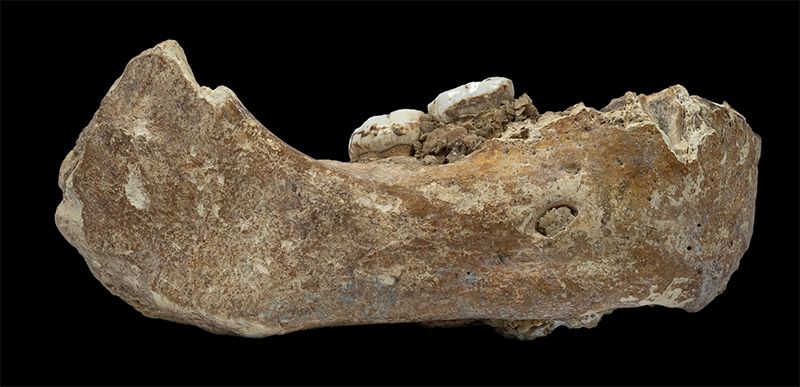
But Qiaomei Fu, a geneticist who played a part in identifying Homo denisova, had his suspicions that this was really a Denisovan. He eventually got the chance to study the skull. First attempts did not identify any DNA but they did produce some protein sequences that matched Denisovan sequences from the famous finger bone. Then, anayzing some dental calculus, they found mitochondrial DNA that closely matches Denisovan DNA.
There are a lot of caveats to be made here, in particular that we're talking about DNA snippets rather than long strands, and we already know that there was human diversity and interbreeding in East Asia in that period. But this looks pretty good to me, so the digital model you see in these two images may well be the cranium of a Denisovan.Saturday, June 21, 2025
The "Dragon Man" Skull was Probably a Denisovan
Monday, September 16, 2024
How are We Evolving?
Ali Akbari et al on BioArxiv:
We present a method for detecting evidence of natural selection in ancient DNA time-series data that leverages an opportunity not utilized in previous scans: testing for a consistent trend in allele frequency change over time. By applying this to 8433 West Eurasians who lived over the past 14000 years and 6510 contemporary people, we find an order of magnitude more genome-wide significant signals than previous studies: 347 independent loci with >99% probability of selection. Previous work showed that classic hard sweeps driving advantageous mutations to fixation have been rare over the broad span of human evolution, but in the last ten millennia, many hundreds of alleles have been affected by strong directional selection.
This only confirms what people have thought from other evidence, that our evolution has speeded up rather than slowed down: In what directions have we been evolving?
Discoveries include an increase from ~0% to ~20% in 4000 years for the major risk factor for celiac disease at HLA-DQB1; a rise from ~0% to ~8% in 6000 years of blood type B; and fluctuating selection at the TYK2 tuberculosis risk allele rising from ~2% to ~9% from ~5500 to ~3000 years ago before dropping to ~3%. We identify instances of coordinated selection on alleles affecting the same trait, with the polygenic score today predictive of body fat percentage decreasing by around a standard deviation over ten millennia, consistent with the Thrifty Gene hypothesis that a genetic predisposition to store energy during food scarcity became disadvantageous after farming. We also identify selection for combinations of alleles that are today associated with lighter skin color, lower risk for schizophrenia and bipolar disease, slower health decline, and increased measures related to cognitive performance (scores on intelligence tests, household income, and years of schooling). These traits are measured in modern industrialized societies, so what phenotypes were adaptive in the past is unclear. We estimate selection coefficients at 9.9 million variants, enabling study of how Darwinian forces couple to allelic effects and shape the genetic architecture of complex traits.
Lighter skin is a really obvious one; peope in the north need sunlight for vitamin D more than they need protection from the tropical sun. I just mentioned our declining ability to store fat, which is related to the spread of agriculture, and rising intelligence seems pretty useful. But some of these raise questions: if schizophrenia and bipolar disorder are being selected against, how did they ever become common in the first place? Why on earth would celiac disease rise in a region where wheat is the staple food?
They also find that the risk of Multiple Schlerosis is rising due to selection, which is really bizarre, but that male-pattern baldness is decreasing, raising again the question of how it ever got to be common.
Stay tuned to this; we are going to learn a lot more about genetics and how we are evolving over the next decade.
Friday, August 30, 2024
David Reich Speculates
The most interesting theme concerns the role that comparatively small groups have played in human evolution. On the one hand, it seems that modern Eurasians and Native Americans are mostly descended from 1,000 to 10,000 people who left Africa around 55,000 to 60,000 years ago. These people, the model says, outcompeted not only the Neanderthals and the Denisovans but other groups of fully modern humans who had been in Eurasia for 50,000 years. On the other hand, 21st century humans have Neanderthal and Denisovan DNA, and DNA from other groups of modern humans, and, as Reich says about twenty times, the story of our past is always the story of movement and mixing. So what does it mean that we are "descended" from some group or other? Reich makes it clear that he does not understand this at all. The interviewer asks if we know where the group from which we mainly descend was at any point in time, and Reich basically answers no. Nobody knows how to model a past in which we always lived in small groups but somehow shared genes around the world.
He even says at one point that from one perspective you might say that nobody from outside Africa is really a fully modern human. Instead, he says, you could model our past as Neanderthals who are genetically overwhelmed by one wave of modern humans after another, gradually evolving to the point that they became 98% modern human without ever ceasing to be Neanderthals. In support of this view he mentions that while our genome is only 2% Neanderthal, if you go back 50,000 years ago our ancestors are 10-20% Neanderthal. It turned out, though, that Neanderthals had built up a lot of bad mutations over 500,000 years of living in small groups and those variants were quickly selected out.
Reich clearly feels that we do not understand human evolution.
Some other points:
Over the past 10,000 years, our genetic changes have been mostly related to disease resistance and metabolism. Lactose tolerance would be a great example of a metabolic change, but Reich uses another one: we have gotten less efficient at storing fat. This is presumably because farmers have diets that vary less over the course of the year. This was in response to a question about the argument that farming was a big mistake that has made life worse, and Reich basically says there is no evidence for increased dietary stress. In the course of this Reich mentions that there is very little evidence for any recent genetic changes related to cognition; people of 50,000 years ago seem to have had modern brains.
The relationship between culture and genetics is very complex. Reich describes cases in which cultures have been taken over genetically by people from outside, who can be detected only genetically, not because of any cultural or linguistic changes. One is the Polynesians. They came from Taiwan and were genetically East Asian. Then the Melanesian islands they settled were infiltrated by people from New Guinea, who took up Polynesian sailing and so on, leaving a massive genetic imprint on what remained a Polynesian culture.
The evidence seems to show that at the end of the Neolithic, around the time of the steppes invasion, plague was causing more than a quarter of all deaths in Europe. Reich says nobody will say this out loud because it seems so crazy, but it is what the data says.
In India, as in Europe, the population was changed by the steppes invaders who brought Indo-European languages and left a strong genetic signature. But whereas in Europe that percentage is about the same in every modern person, in India there are huge variations, based on caste, because the resistance to marriages between people of different castes has been strong enough to block most interbreeding for 2,000 years.
It is very weird that farming appeared all over the world within about 4,000 years of the end of the last Ice Age, and nobody can explain this. One theory is that the current interglacial era is a uniquely beneficial environment, which to me implies that we are riding a climate lucky streak that can't last too much longer.
There is no chance that there were Sumer-level civilizations before the end of the last Ice Age.
But the weirdest thing concerned attempts to study past epigenetics. Genomes are in practice always being modified by other molecules that shut down some genes and pump up others. Reich says there is some evidence of epigenetics from very old genomes, and the biggest difference anyone has noted is that in us, the genes for language are much more active. It seems that DNA evolution has not been fast enough to give us the language skills we need for our lives, so our bodies have resorted to other tricks
Tuesday, July 30, 2024
David Reich on Indo-European Genetics
Some updates on what the science is telling us, from this lecture, on YouTube. First, Yamnaya – the Ukrainian people who spread Indo-European languages across Eurasia – took form around 4000 BC. They mainly migrated from the east, from the Don River basin and the northern Caucasus, but interbred with local hunter-gatherers. They were not numerous, only a few thousand people. They lived around the lower reaches of the Dnipro River.
Then around 3600-3400 BC they exploded in numbers, a "classic founder event." (Founder events are when a few people reach a new environment where they multiply enormously, like the New England Puritans or the first French Canadians.) Around 3500 BC is when we first get good evidence for wheels, and Yamnaya skeletons show evidence that they rode horses. So it looks like the Yamnaya had by 3500 BC perfected both horse riding and cart-building and launched themselves onto the steppes as nomadic herders. They were very successful and soon there were hundreds of thousands of them.
Then around 3200 BC they launched themselves into the world so rapidly that their expansion "broke the connection between geography and genetics." All the samples shown on the map above are just Yamnaya, genetically from the same population.One of the big remaining questions in all of this is where the first Indo-European languages arose. Reich points to the North Caucasus as the likely homeland.
Thursday, April 11, 2024
OJ Simpson and the Question of "Misogyny"
The death of OJ Simpson reminds me of something I've been thinking about for a long time: what his murder case says about the generalized notion of "misogyny." It used to be very common for feminists to attribute crimes like rape and spouse abuse to "misogyny" as if the problem were just that men hate women. I heard more than one person say that the murder of Nicole Brown Simpson was "misogyny." But OJ Simpson seemed to me like the perfect case of a man who actually loved women and ended up brutally killing one partly because he had loved her very much.
Anyone who ever watched OJ on "Wide World of Sports" saw his comfort with women on regular display. He was friends with all the black female runners and some of the white women as well. He could talk about women's issues like training after pregnancy and childbirth that left his fellow male reporters sitting in embarassed silence. Watching him one never got any sort of impression that he disliked women.
I think OJ killed Nicole because of a particular problem, the homicidal jealous rage that afflicts so many men.
What may be the oldest claim in the field we now call evolutionary psychology is an explanation of precisely this problem. Chimps don't have families in our sense. They have mother-child bonds, and bonds between female friends, and coalitions among males, but there are no relationships between males and females. No male chimp knows or cares if a baby is his. The argument goes that one of the crucial early steps in hominid evolution was the formation of the nuclear family, in which the father invests very heavily in the support of his offspring. He will only do this if he has good reason to believe the child is his. Hence, the jealous rage, and the thousands of years of men trying to control female sexuality.
This theory is a century old now but still hangs around because 1) we honestly have no clue how humans came to practice permanent pair-bonding and involved fatherhood, both of which are a lot more common in birds than mammals; 2) male jealous homicidal rage is such an ancient worldwide problem that it presumably has some explanation in terms of human fundamentals; and 3) the theory puts the nuclear family, which so many humans worship, at the center of our identity.
Whether it is true or not I won't hazard a guess; I don't think we know much about the events of two million years ago. I just mention this to point out that OJ Simpson-style murderous rage is a problem that humans have been pondering for a long time.
Changing directions: what is misogyny, anyway? There are men who just seem to despise women. This was always my idea of misogyny, the kind of guys who think women are crazy emotional wrecks you're better off staying far away from.
But maybe I'm wrong. Feminists have used the word in a lot of other contexts, for example, men who seduce lots of women. This one used to puzzle me; wouldn't men who hate women prefer to avoid them rather than spend a lot of time in bed with them? Or OJ-style murderers.
So maybe an alternative definition of "misogyny" might be, "a desire to control women and a refusal to treat them as free, equal people." This fits the problematic cases I have mentioned, and I think it probably gets closer to what most feminists have in mind than just disliking women.
The thing is, this is an awful explanation of male behavior. It takes a particular, emotionally intense situation and generalizes it to a species-wide problem of belief. "You killed a woman in a fit of rage, therefore you have a generalized view that women are inferior" is a terrible syllogism. After all, men kill each other even more than they kill women, and they presumably do not do this because of some general view that men are inferior.
I maintain that there is no necessary connection at all between what a man believes and what he will do in a fit of violent rage. I think it is simply false to assert that what people will do in an extreme emotional situation is any kind of guide to what they are like the rest of the time.
I want to push this generalization hard. These days the complaint, "I'm lonely and can't find a girlfriend" is likely to be met with, "you think women owe men sex." But the statement "I am lonely" is not in any way a statement about how women ought to act. It is a statement about a particular person in a particular situation and cannot be generalized into anything.
I want to fight this generalizing habit. I want to fight the notion that people who did one bad thing, even one terrible think like murdering your ex wife, are bad in every way. I think that nobody is bad in every way, or good in every way. I violently resist this way of understanding humans. That a man killed one woman says absolutely nothing about how he feels or acts toward other women.
I want to fight any kind of thinking that goes, "You did X, therefore you are Y."
I would have sent OJ to prison, but not because he is a misogynist, whatever that means.
Friday, March 29, 2024
New Genetic Findings from India
- As with previous studies, the authors find that people in India divide roughly into two groups, known as North Indian and South Indian.
- People in India derive 1-2% of their genes from Neanderthals or Denisovans.
- Most people in India descend mainly from a single migration out of Africa that took place roughly 55,000 years ago; only 0-3% of genes might descend from an earlier migration of Homo sapiens sapiens out of Africa that the authors date to about 74,000 years ago. (This is important for other debates but not so important about the population of India; basically, there is an archaeological problem because genetic studies keep finding that Europeans and Asians mostly descent from people who left African 55,000 to 60,000 years ago, but there were Homo sapiens sapiens in Eurasia a lot earlier than that.)
- Essentially all people in India have genes that descend from Iranian farmers who migrated to India in the Neolithic; to get a sample of south Asian hunter-gatherers without Iranian mixture the authors used Andaman Islanders. Look at the graph at the top and you see that in North India, Iranian farmer (Sarazm) is the largest component, at about 47%. This is what you would expect; farmers had larger populations than hunter-gatherers and genetically dominated wherever they went. The dominance is less extreme in India than in Europe because hunter-gatherer populations were denser in the tropics, and maybe because Indian hunter-gatherers took up farming faster.
- Most (but not all) people in India have genes from Bronze Age Steppes invaders. As you would expect, this ancestry is stronger in the north, but it is also present in the south. Most archaeologists think these people brought Indo-European languages and the civilization of the ancient Vedas to India.
Like everyone else, modern Indians are a mixture of many different ancient populations, which were in turn mixtures of populations who came before them. There are no pure races, or pure civilizations.
Monday, March 4, 2024
Denisovans in Southeast Asia
Major paper in Nature this week summarizing what we have learned about ancient Denisovans from a pathetic pile of fossils and extensive genetic research. (NY Times; good summary article about Denisovans at Britannica)
The first discoveries, made at Denisova Cave in Siberia, showed that Denisovans had been around from, at minimum, 150,000 to 75,000 years ago; that they interbred with Neanderthals; and that some of their genes seemed to be present in modern East Asian humans. Other likely Denisovan bone fragments have now been found in Tibet and Laos.
More recent genetic studies suggest further intermixing with modern humans in Southeast Asia, perhaps as recently as 25,000 years ago. The Denisovan signature seems to be particularly strong in some groups in New Guinea and the Philippines. This may mean that they were able to thrive in both Siberia and tropical southeast Asia, giving them one over Neanderthals, who have not been found outside Ice Age climes.
I caution that all of this is very new and rather speculative; I am especially skeptical of DNA found in soil rather than bones. But it truly is remarkable that modern genetics has allowed us to conjure up a lost branch of humanity from a few shards of bone.
Thursday, May 18, 2023
Evolution in General and Human Evolution in Particular
There's a major new genetic study out that says modern humans don't have a single point of origin:
Scientists have revealed a surprisingly complex origin of our species, rejecting the long-held argument that modern humans arose from one place in Africa during one period in time.
By analyzing the genomes of 290 living people, researchers concluded that modern humans descended from at least two populations that coexisted in Africa for a million years before merging in several independent events across the continent. (NY Times, Nature)
If you think that sounds really weird, that's because of the way the origin of new species has been thought about and taught for most of the past 150 years. The first model came from Darwin himself, after he studied the finches of the Galapagos. His idea what that groups of finches became isolated from each other, either geographically (on different islands) or behaviorally (relying on different foods) and so gradually evolved in distinct directions. The basic idea was isolation ►speciation. Part of the reason this became dogma was that in the absence of Mendelian genetics Darwin and his allies could not explain how a new, favorable trait could spread through a large population, rather than being swamped by existing variants.
That isn't gone from the science; geographical and behavioral separation probably play a role in the formation of many species. But lately a lot more attention has been payed to whole large populations evolving in common ways. Consider Homo erectus, which existed for more than a million years across vast areas of Africa and Eurasia but gradually evolved toward larger brains and more dexterous mouths. Modern genetic studies have also taught us how common inter-species breeding is, and how readily species can incorporate genes they bring in from outside.
So working under the old model, people thought that fully modern humans evolved from some small population that had gotten separated from the mass of African hominids. The new model suggests that modern humans emerged from at least two distinct populations, Stem 1 and Stem 2, that were not entirely separated from each other, and that the transition took place over a few hundred thousand years.
This study is based on modern genomes so it is not definitive; it will need to be confirmed with ancient DNA and fossils. But this is definitely the way evolutionary science is trending.
Monday, August 1, 2022
Robert L. Kelly, "The Foraging Spectrum: Diversity in Hunter-Gatherer Lifeways"
From my old web site:
Now that evolutionary psychology has become both a serious intellectual pursuit and one of our favorite parlor games, everybody wants to know what human life was like while we were evolving into our present forms. Since archaeology tells us precious little of such distant times beyond what sort of tools people used, we naturally turn to the most primitive documented societies to learn what our ancestors might have been like. One thing we know is that our distant ancestors did not farm or raise animals; they were hunters and gatherers. We therefore look to modern hunting and gathering groups for insights into our own distant past.
What are hunter-gatherers like? Are they peaceful or violent? Do they carefully tend the wild resources on which they depend or use whatever they can take? Are men and women equal in status among them? To ask these questions sets us trembling, as before the revelation of some great religious mystery: tell us about ourselves, O Anthropologist. What is our nature?
To ask these questions also assumes that they have answers. We can't say what hunter-gatherers are like unless they are like something in particular. But are they? Not according to Robert Kelly. In The Foraging Spectrum (1995) Kelly argues that hunter-gatherers are so diverse in their behavior that the words do not even denote a meaningful category for analysis. Of course, Kelly managed to write a 446-page book about this non-category, so the words must mean something, but Kelly has a point. Hunter-gatherer societies differ from each other on every point of interest to moderns trying to understand their own origins: some are violent, some peaceful; some are egalitarian, some have chiefs and slaves; in some men and women are equal in most ways, but in others women are denigrated and oppressed.
Before even starting to investigate these matters, we must acknowledge some serious problems with the evidence. Everything we know about hunter-gatherer peoples concerns, by definition, hunter-gatherers who have come into contact with agricultural peoples. Much of our most detailed data has been collected since 1960, and in our age the groups we call hunter-gatherers are all connected in various ways to the New World Order. One very thoroughly studied Australian group actually gets up to half their food from government warehouses. The Ju/'hoansi (the ones who used to be called !Kung), who long passed for the most perfectly preserved of ancient societies, have had trading relations with farmers for a thousand years and may in the past have lived as herders themselves. There are no pure, uncontaminated ancient societies for us to look at. No one knows quite to make of this, and except for some predictable political froth—for example, the a priori assertion that colonialism has made hunter-gatherers more violent and patriarchal—we have no theories and little data on how these contacts have changed the peoples we study.
Also, modern hunter-gatherers tend to live in places farmers do not want, which often means deserts and similarly impoverished environments. Those documented hunter-gatherers who lived in rich environments, like the Indians of the northwest coast of North America, tend to be considered "atypical" because they build villages, erect monumental art, fight wars, and do others things that "typical" hunter-gatherers generally do not; but who knows what was typical when hunter-gatherers occupied all the world's environments? Surely there is nothing "typical" about the Ice Age art of Europe, or the extraordinarily rich myths of the Australian aborigines, and there is really no reason to assume that our distant human ancestors were any less extraordinary than we are today.
These caveats taken on board, what are hunter-gatherers like? Let's start with something simple and measurable, like what they eat. We immediately enter contested terrain, because we have been treated to a long argument about whether men's hunting or women's gathering provides more of the food primitive peoples eat. Your traditional explorer of the Indiana Jones school favors men's hunting and writes books arguing that male hunting in groups is the key to human evolution, but the leftish, feminist sort of anthropologist tends to favor gathering by women. The data? Kelly prints a table showing that the percentage of calories provided by men's hunting and fishing varies from nearly 100 percent among some Arctic groups to 20 percent among some tropical forest dwellers. Of course, there are also groups among which men gather and women hunt, further complicating the picture. When women hunt they usually take small game, or else participate in large communal animal drives like those of the central African net hunters. Since we are discussing people, there is one group that completely violates the rule; among the Agta of the Philippines women hunt large game alone just as men do.
The main reason women do not hunt more, it seems, has nothing to do with physical strength. Hunting generally requires more stealth than strength, and, as Kelly points out, digging roots is often far more laborious. Hunting is men's work because it can't be done with a baby. This points to one of the few regularities in human society: women do most of the baby care, and their work is shaped around their parenting tasks much more than men's work is. But what are hunter-gatherer parents like? The famously kind and indulgent parenting of the Ju/'hoansi serves as a model for some, but Kelly cites other groups who force their offspring to forage for themselves at a very early age and are given to beating the slackers.
Child rearing practices among hunter-gatherers can be divided, in a rough way, into two patterns. In one, mothers generally do most of the care, supported by their husbands and other immediate family members. In the other, all the young children of a band are raised together and much of their care is provided by the older children. There is some evidence that the difference is very important, and that people raised by their own parents are more independent of thought, less violent, and less competitive than those raised in common. But which is the "natural" human way? We don't know, because both are common around the world.
Are hunter-gatherers territorial? Depends. How violent are they? Depends. How big is the group with which they identify? It varies, from the family to a tribal conglomeration big enough to encompass almost anyone with whom they might come into contact. How nomadic are they? Some move 50 or 100 times a year, some only twice. What is their attitude toward the natural world? Some worship nature and beg forgiveness for taking game, and some have little religion at all and do pretty much whatever they want. Magic? Some fill the world with spells and taboos, some are relatively indifferent. And so it goes.
Your sophisticated evolutionist, recognizing that hunter-gatherers do act differently from one another, falls back on a statistical approach. Thus one commonly comes across sentences like, "In a world-wide comparative study of hunter-gatherer societies, 80% of groups practice x...." When I read these sentences I always think, but what about the other 20 percent? Why are they less important? Since modern hunter-gatherer groups live in a non-random subset of the earth's environments, and those that have been carefully studied represent a non-random sample of the non-random sample, and all the groups have been altered in unknown ways by contact with farmers and UN aid workers, what do the numbers mean? Precious little, it seems to me.
I don't mean to completely dismiss comparative ethnography as a way of studying humanity. It seems to me that we can learn some things about human nature from studying hunter-gatherers. We can learn that women care more for babies, that young men are everywhere the most violent group, that even in productive environments people regularly go through seasons where food is short and stored fat reserves can make the difference between life and death. We can also observe some regularities in the differences between groups; for example, groups that live in environments with highly variable productivity share their food more readily, probably because they know their next time it may be they who come home empty handed. In what may be one of the most important regularities, it seems that where men often travel far from women and children in all male hunting or war parties they think less of women and are more likely to actively oppress the ones around them.
The most important lesson of anthropology, though, is not what people have in common but how greatly they differ. The most striking and unique thing about humankind is our diversity; the number of different ways we have found to live sets us apart from every other species. We adapt ourselves to almost any environment and any situation, developing technology and social forms to ensure our survival. Hunter-gatherers include warlike Comanche buffalo hunters and peaceful Ju/'hoansi, status-crazed, potlatch-holding, slave-owning Kwakiutl and fiercely egalitarian bushmen.
The adaptive power of humanity sometimes overwhelms our attempts to understand ourselves, because our inventiveness makes it hard to categorize our behavior. Consider one of the most central and important of human institutions, marriage. Most societies have ideas about who should marry whom, who should choose the mates, who should give whom property to seal the deal, and so on. But, as Kelly documents in some detail, the anthropologist who tries to find out whether these norms are actually practiced runs into a thicket of linguistic obstacles and other run-arounds. For example, many groups believe that the ideal marriage is between cousins. But "cousin" has the same metaphorical use to many hunter-gatherers that "sister" or "brother" has to us, and whether people are considered cousins may depend as much on how their parents get along as on how they are related. One particularly determined researcher figured out that among the G/wi bushmen only 11 percent of marriages actually conformed to the stated norm. Whether the anthropologist's numbers would have made any sense to the bushmen, and whether we should take his interpretation of the rules any more seriously than theirs, is open to question. To be human is to be free, to some extent, to name and define the world.
Yes, we are all human. We have the same bodies, the same minds. We all recognize greed and generosity, lust and restraint, pride and shame, hate and love. We all know both invention and respect for tradition. Yet we must also recognize that change and variation are not peripheral to human nature, but part of its core.
February 6, 2002
Saturday, January 22, 2022
Debating E.O. Wilson's Legacy
Biologist E.O. Wilson died on December 26. Many of his obituaries had a somewhat guarded tone, because while he was an eminent scientist his career was controversial. On the one hand he was a noted environmentalist and helped introduce the concept of biodiversity into the environmental lexicon. On the other, his 1975 book Sociobiology waded into questions of how much about human societies, sex differences, and so on is genetic, applying the methods he honed studying ant societies to those of humans. Late in life he added a new focus for controversy when he publicly renounced kin selection as the source of altruism in animals in favor of group selection, a model that has become in some hands a justification for militarism.
The question of how much human behavior is genetic is of course an old one, and it has always been political. Defenders of aristocracy long defended the superiority of noble blood lines; one of the founders of modern liberalism, John Locke, advanced the tabula rasa (blank slate) theory that we in fact inherit nothing. Locke had no evidence for his view, he was simply proposing on the philosophical plane arguments that helped his support his views on politics. Anyway it is not just recent "woke" people who get upset over the political implications of research on human genetics, and it has long been the case that the Left wanted to deny inheritance while the Right talked it up.
Wilson's story took a turn last week when Scientific American ran an essay about him by Monica McLemore, subtitled "We must reckon with his and other scientists’ racist ideas if we want an equitable future."
His influential text Sociobiology: The New Synthesis contributed to the false dichotomy of nature versus nurture and spawned an entire field of behavioral psychology grounded in the notion that differences among humans could be explained by genetics, inheritance and other biological mechanisms.
E.O. Wilson never supported any "dichotomy," false or otherwise, but he certainly believed that some differences between humans are rooted in genetics. Others did use his work to make simplistic arguments about heredity, but I'm not sure that's his fault. Honestly I found this essay mostly just kind of lame, without any of the fire I expected from others' reaction to it. One passage that made some scientists howl was this one:
First, the so-called normal distribution of statistics assumes that there are default humans who serve as the standard that the rest of us can be accurately measured against. The fact that we don’t adequately take into account differences between experimental and reference group determinants of risk and resilience, particularly in the health sciences, has been a hallmark of inadequate scientific methods based on theoretical underpinnings of a superior subject and an inferior one.
A "normal distribution" is just a kind of curve in the dataset that in fact describes a huge number of natural and human phenomenon; it has nothing to do with the question of human diversity and whether different groups will respond differently to different drugs or whatever. But I get what McLemore was trying to say, and I think it is true that many Big Picture scientific studies sweep a lot of diversity under the rug. As my readers know, I regularly complain about this when it relates to anthropology. Anyway a bunch of scientists were incensed by McLemore's article, mainly because it calls Wilson "racist" without offering any evidence that he believed in meaningful differences between human races. In fact he explicitly denied believing any such thing on multiple occasions. A long list of biologists wrote a rebuttal letter to Scientific American, which refused to print it. So it has been posted online.
The argument over Wilson interests me because much of it hinges on the definition of "racist." To Wilson, and that whole side of science, asking questions about the genetic roots of human behavior is important and interesting, so we should do it. That's what sciences is for. That's what science is. Besides, they often throw in, so far science says nothing material about behavioral differences between races anyway. (It does, of course, have a lot to say about differences between the sexes.)
The scientists who signed the letter believe that science, done properly, cannot possibly be racist. Its goal is to discover the truth about the world, whatever its moral and political implications. It is up to us to adjust our morality and politics to fit reality, and it is emphatically not the job of scientists to alter their findings to fit our morals or our politics.
To their opponents, all talk about human genetic traits is inherently dangerous. The very idea of approaching questions of genetic difference without ideological preconceptions disturbs them. To them, anyone without a strong ideological preconception against racism is suspect; anyone who thinks there could be a neutral approach to questions of the differences between races is a racist. For many of them, the notion that the truth should be our highest goal is just plain wrong. Our highest goal should be justice, and anyone who disagrees needs to be called out.
Under this definition, Wilson was a racist because he studied human genetic differences without a strong and loudly proclaimed commitment to racial justice. He thus, whatever his intentions, became a tool of racists, and anything that serves racism is itself racist. To a lot of scientists, and many other liberals, this is the most dangerous possible kind of thinking: to them, allowing our politics to dictate what we believe about reality is the definition of totalitarianism.
Wherever science intersects with morality and politics, there will be conflict. Certain scientists will be shocked that anyone attacks their scientific work on political grounds, but of course they should know better. Topics like human genetic differences, human-induced climate change, welfare economics, and so on are inherently political, and it is foolish to think they could ever be discussed without political consequences. Complaining about wokeness, as many contemporary scientists like to do, hardly scratches the surface of this dynamic, especially when the topic has been controversial for centuries. The letter written on behalf of Wilson makes no attempt to address any of this, and its authors come across as baffled that anyone could see any problem with Wilson's work. Honestly their piece did not impress me any more than McLemore's did.
I believe in the truth, and I don't think it was racist of E.O. Wilson to pursue it. Maybe Wilson's defenders are right to pitch a fit when the word "racist" is applied to him; maybe such charges have to be answered. But if they don't understand where their opponents are coming from, they are unlikely to make much headway against them.
Wednesday, November 24, 2021
150,000-Year-Old Jewelry
This is important because for a long time archaeologists thought evidence of symbolic behavior in humans (jewelry, art, funeral ritual) began around 60,000-70,000 years ago. This date held firm for decades, and people started to speculate that some sort of dramatic event must have taken place to launch the change. One version was the invention of language, and another was some sort of macro-mutation affecting brain function.
That never made any sense to me (and plenty of others), because physically Homo sapiens is around 200,000 years old, and there also wasn't any genetic evidence of a major mutation around 70,000. The evidence of symbolic activity after that date also included sites apparently inhabited by Neanderthals, an even older species. So I always thought that older evidence of symbolic activity would turn up eventually. And it has. Shell beads from other African sites have been dated to between 80,000 and 120,000 years ago, although some of them were less convincing than these. There have also been claims of simple art (scratched starburst designs) more than 100,000 years old. So it looks like symbolic activity, and likely language, go back at least to the origins of Homo sapiens.
Friday, August 21, 2020
Human Teeth, Civilization, and Incels
From an utterly weird article by William Brennan on incels and orthodontics, I extract this bit about the history of our teeth:
On a Friday in August, I met with an anthropologist named Janet Monge in a ground-floor classroom at the Penn Museum in Philadelphia. Monge is a warm and voluble person, with a mane of gray-white hair and an easy smile. Since the early 1990s, she has been the keeper of one of the world’s largest and most geographically diverse collections of ancient skulls, housed at the University of Pennsylvania. The specimens had originally been gathered by the physician Samuel Morton in the 19th century. Monge noted that Morton collected the skulls for racist purposes, measuring the projection of his specimens’ jaws in an attempt to assess their level of civilizational enlightenment. The same large, forward-grown jaws the Mews prize as signs of health and beauty, Morton disdained as markers of inherent cultural and biological inferiority.
The Morton specimens sat in cases all around, peering out at us with enormous, empty sockets and gleaming teeth. In a plastic container, Monge had placed skulls from the Middle East, West Africa, Eastern Europe and beyond. When I asked her if she’d ever seen an ancient specimen with crooked teeth, she didn’t hesitate: “No, not one. Ever.” Most of the skulls in the Penn collection date from a 40,000-year period starting late in the Stone Age and ending around 300 years ago, yet “they all have an edge-to-edge bite,” “robust” jaws and “perfect” occlusion, Monge said.
But then, in specimens from people who lived two centuries ago or less, Monge noted a striking change: The edge-to-edge bite completely disappears, and malocclusion suddenly runs rampant. She pointed to a skull on a nearby shelf — that of a woman who lived in 19th-century North America. Unlike the ancient skulls, this postindustrial woman’s maxilla was crinkled and small; the teeth that remained sat crammed together. “I always told my students, ‘Something happened 200 years ago and nobody has an edge-to-edge bite anymore — and I have no freaking idea why,’” Monge said. She took the skull of a preindustrial Siberian man out of her container and clicked the mandible into place. The bone was thick; the teeth met so neatly that they appeared pulled from an Invisalign ad. Monge laughed, her open mouth revealing a pair of missing molars. She cradled the skull in her hand. “Isn’t that just perfect?”
Both Brennan and Monge seem not to have done enough research to learn that many people have wondered about exactly this change in our teeth, including me.
In 2013 when I last wrote about the impact of modern diets on our teeth I mused, "Perhaps when the Undomesticated Men finally make their appearance in the mountains of Idaho, they will raise their children without forks and make them gnaw their meat off the bone, so their teeth don't go soft and over-civilized." I had no idea that many men were already doing this, and that within five years "mewing" –trying to force your teeth back into a Paleolithic posture – would be a fad endorsed by various YouTube personalities and particularly common among "incels" who think women won't have them because their faces are too weak and unmasculine.
Friday, April 3, 2020
Homo erectus
Homo erectus survived for around 1.5 million years, fading from the scene around 500,000 years ago. They are almost certainly the ancestors of us and all our close relatives (Neanderthals, Denisovans). They were first discovered in East Asia (Java Man, Peking Man) and only later in Africa, and while most anthropologists think they evolved in Africa that is not certain. They roamed very widely, from France to Indonesia to South Africa. They were not tied to any particular environment but could, like modern humans (or crows) adapt themselves to whatever place they found themselves in: jungles, plains, mountains, cold, hot, inland, on the shore. This was surely due to the vastly greater size of their brains, compared to hominins before them: the biggest Homo erectus brains measured around 1100 cc, about the same size as the smallest brains of normal modern humans. Their brains seem to have grown slowly over time, the average size increasing from around 850 in early specimens to 1000 in the later ones.
They walked much as we walk, leaving their hands free to carry tools. They shaped crude tools from stone, and presumably from other materials, although nothing but stone survives.
And they endured for 1.5 million years. Compared to the span of our civilizations it is a vast stretch of time, 60,000 generations when beings something like us slowly, slowly developed the ways of life that still survive among hunter gatherers. All that time they were changing physically and surely in other ways as well. The crazy nomenclature that surrounds them (Homo ergaster, Homo georgicus, Homo yuanmaoensis) springs from attempts to understand the diversity of their kind, and some splitters still think we should be talking about several different species.
We do not know if they had language, but some anthropologists think their skulls show they could make a range of sounds as wide as ours. Recently genetic studies have suggested that the FOXP2 gene, which we know to be essential for language in us, probably evolved by a million years ago. So the early stirrings of our kind's astonishing invention probably took place among them. Since the bones of large animals have been found around their camps, they probably hunted in coordinated groups, and language would come in handy for that. After all they were not bigger or stronger than us, but on the contrary a little smaller and weaker, less able to strong-arm their way through life. Another advantage they may have had: studies of their shoulders suggest they were first species that could throw a spear with deadly effect.
We also do not know if they could control fire, but there is pretty good evidence that they were doing so by 750,000 years ago. That would make them pioneers of another great human advance.
They developed the way of life that defines us, using their big brains and clever hands to negotiate the world. They were smart and adaptable enough to survive through Ice Ages and hot times, across vast areas populated by beasts much larger and stronger than themselves.
Unfortunately their imaginations are closed to us, so we do not know, and probably never will, if they had stories and names. They lived too long ago for us to ever really understand them. We can only look at their bones, and wonder.
Monday, June 3, 2019
Chimps Eating Crabs
The significance of aquatic food resources for hominins is poorly understood, despite evidence of consumption as early as 1.95 million years ago. Here we present the first evidence of a non-human ape habitually catching and consuming aquatic crabs. Chimpanzees (Pan troglodytes verus) in the rainforest of the Nimba Mountains (Guinea) consumed freshwater crabs year-round, irrespective of rainfall or ripe fruit availability. Parties of females and offspring fished for crabs more than predicted and for longer durations than adult males. Across months, crab-fishing was negatively correlated with ant-dipping, suggesting a similar nutritional role. These findings contribute to our understanding of aquatic faunivory among hominins. First, aquatic faunivory can occur in closed forests in addition to open wetlands. Second, aquatic fauna could have been a staple part of some hominin diets, rather than merely a fallback food. Third, the habitual consumption of aquatic fauna could have been especially important for females and their immature offspring. In addition to providing small amounts of essential fatty acids, crabs might also be eaten for their micronutrients such as sodium and calcium, especially by females and young individuals who may have limited access to meat.Video here. Notice that the chimps are grubbing under rocks in a very small stream, so this is not what many people would expect under the category of "fishing."
Wednesday, May 1, 2019
Denisovan Jawbone Found in Tibet
It's quite odd, really, that we have discovered (or possibly imagined) so much about these people with no fossil record beyond a toe bone and some fragments. This one jaw increases our knowledge of Denisovan bones tenfold. It was found in Tibet back in 1980 and has been sitting on a museum shelf ever since, paleontologists occasionally wondering what it might be but not coming to any conclusions. It dates to about 160,000 years ago.
As to why Chinese paleontologists think this jawbone is Denisovan, well, that is a tale. Pondering this ancient jaw, which doesn't seem to belong to any known species but isn't all that old as these things go, they at first tried to extract DNA. No luck. So they tried again with proteins, eventually extracting and isolating collagen proteins that could be sequenced. The sequence is clearly not from a modern human, and it matches more closely to those from Denisovan bones than those from Neanderthals.
It's impressive work but this is a new technology and far from certain. Still, that jawbone has to be something, and if it isn't Denisovan then there was yet another human species wondering around out there.
And then there's this:
The altitude of the new Denisovan’s home — 3,280 metres above sea level — surprised researchers, and helps to solve a mystery about Denisovans’ genetic contribution to modern Tibetans. Some Tibetans have a variant of a gene called EPAS1 that reduces the amount of the oxygen-carrying protein haemoglobin in their blood, enabling them to live at high altitudes with low oxygen levels. Researchers had thought that this adaptation came from Denisovans, but this was difficult to reconcile with Denisova Cave’s relatively low altitude of 700 metres. The latest study suggests that Denisovans evolved the adaptation on the Tibetan Plateau and passed it to Homo sapiens when the species arrived around 30,000–40,000 years ago.Don't ask my why having less haemoglobin helps you survive with less oxygen, but wikipedia's article about EPAS1 says the same thing, so there it is.
Saturday, April 13, 2019
Tiny Hominids in the Ancient Philippines
This discovery inspired them to keep digging in the cave, and they eventually found more hominid bones, including these teeth. These are adult hominid teeth but they are tiny, which makes the excavators think this person was less than 4 feet tall (1.2 m).
It's a very cool discovery because it adds to the growing picture of very diverse hominids living in the geologically very recent past, perhaps recent enough to have fed old folktales about goblins, bigfoot, and other semi-human creatures. But a few bones and teeth is not a lot to hang a news species on.
Thursday, August 23, 2018
Hybrid Humans
That remarkable discovery inspired archaeologists to redouble their efforts in the cave, and the result has been a haul of several thousand bone fragments, most too small for even the species to be identified from the shape. More than 2,000 fragments were sent to the Max Planck Institute in Germany, one of the top three ancient DNA labs, but even they were unable to find usable material in most of the bones. The did identify one 120,000-year-old toe bone as Neanderthal. Then they got to work on a sliver of arm or leg bone that showed traces of hominid collagen:
Viviane Slon, then a graduate student at the institute, led a search for DNA in the fragment. She began by hunting for a special set of genes found in the fuel-generating factories of the cell, called mitochondria.Astonishing: so many thousands of years later, to catch interspecies mating almost in the act. This young woman had a Denisovan father and a Neanderthal mother. The DNA showed that her father was from the local Denisovan clan, related to the other Denisovan specimens that have been identified. Her mother, though, was not closely related to other Neanderthals from the Altai, but to specimens found in Croatia.
Mitochondria carry a set of genes distinct from those of the cell’s nucleus; these genes, unlike those in the nucleus, are inherited solely from the mother.
In 2016, Dr. Slon and her colleagues reported that they had gotten mitochondrial DNA from the mysterious bone fragment, and that it closely matched genetic material from Neanderthals.
The researchers called that individual Denisova 11, and they began searching the bone for nuclear DNA. Fragment by fragment, they began reconstructing the entire genome.
Strangely, only some of the fragments of nuclear DNA matched Neanderthal genes. There was just as much Denisovan DNA in the bone.
“I was wondering, ‘What did I do wrong?’” recalled Dr. Slon, now a postdoctoral researcher at the institute.
In each pair of chromosomes, one came from a Neanderthal, the other from a Denisovan. This individual, she and her colleagues concluded, was a hybrid.
In so many ways, the last Ice Age was a fascinating time. Giant mammoths and other strange beasts roamed the icy plains, hunted by saber-toothed cats and dire wolves. Among them wandered small bands of humans of at least three different species, all of them far-travelers who criss-crossed Eurasia as the climate shifted and the herds migrated. On their travels, they must have regularly encountered other kinds of humans. I suspect that our ancient legends of beast men may got back to those times, preserving memories of those meetings. Sometimes, it seems, sex was part of those encounters. What sort we have no idea; perhaps it was all rape. But perhaps some took place when small bands, living at the edge of survival in a decade frigid even by Ice Age standards, or a time of rapid change that ruined their hunting routines, came together to help each other survive.
I foresee a novel about modern human and Denisovan lovers, each the only survivor of his or her band, no language in common, meeting up in a cave refuge and helping each other through winter, slowly learning to trust each other until desire breaks through.
Thursday, July 12, 2018
The Ethology of Politics
We are in the middle of an unprecedented political and cultural gender war. On one side of this war, we have Trump, alpha males and the women who love them. On the other side are beta males and the women who want to be them. . . . [the Trump side] flies the flag of manliness and strength which it sees as necessary to hold the world together and keep it from continuing to unravel in uncertain and perilous times. It is fighting to preserve not just manly strength but gender itself, the cultural differences between male and female. The other side is seeking to overthrow the patriarchal hierarchy that has run the world since we lived in caves. It seeks to create a sexually egalitarian world by extinguishing gender and its differences.Pinker:
Trump is the last hope of those, like me, who would preserve the old patriarchal hierarchy. That’s why white college educated suburban women hate him: he is the political embodiment of the regressive threat to the evolution of postmodern female identity. Simply put, Trump’s alpha dog manliness and strength are a threat to the evolving independence and power of women. He “would take women back.” He represents the world as it was, where women were kept “in their place.”
Trump is almost a caricature of a contestant to be Alpha baboon: aggressive, hypersensitive to perceived threats to his dominance, boastful of his status and physical attributes (including his genitals), even the physical display of colorful big hair and a phallic red tie. Men may identify with such displays. . . .Edsall concludes:
The latest battle of the sexes has the media, educational, and workplace establishments sympathizing with women and demonizing men. Much of this is justified and long overdue, given how women are exploited and discriminated against, but it may leave some men feeling defensive, belittled, and eager for a champion. This may especially affect lower-status men. High-status women may justifiably protest their treatment at the hands of high-status men, but lower-status men may feel less sympathy for them, particularly if they feel demeaned and disenfranchised.
Men’s commitment to protecting their status — their dominant position in the social order — cannot be counted out in 2018 or 2020. Elections have become a sexualized battlefield, and men have repeatedly demonstrated their determination to win no matter the social cost. The outcome of the next two elections will show whether women are equally determined to fight tooth and nail.I would add that one does not have to see this as naked self-interest in men; many Trump voters have equal marriages on the modern model and they may be perfectly happy with that. What drives much of our politics is a desire to make the world feel right. Trump taps into a sense that the world runs better with aggressive manly men in charge; he fits a mental template of the strong leader that goes far back in mammalian evolution. People who have no clue about foreign policy admire Trump's approach because it is all about projecting strength, after interminable, unwinnable wars have sapped our sense that America is strong.
One of the deep problems with the modern world is that most of us feel powerless and ignored. Trump, by acting out ancient images of power, gives his followers a vicarious sense of strength; and by speaking directly to them in language they relate to, he makes them feel that someone understands. Those are powerful political weapons, and it remains to be seen if the Democrats have anything to offer with the same appeal.
Tuesday, May 29, 2018
Why did We Evolve such Big Brains?
To our surprise, we found that the intuitively appealing social hypotheses did not materialize in the model. Social cooperation and competition, possibly involving cognitive arms races, failed to lead to stable, human-sized brain sizes and may actually decrease brain size. The reasons are that (1) cooperation enables individuals to rely on social partners’ brains and to reduce their allocation to costly brain production, and (2) that competition leads to arms races where outcompeting social partners requires an exceedingly large brain and so it becomes a better strategy to reproduce early in life. In contrast, we found that the human brain size could evolve with a combination of ecological and social challenges, where ecological challenges are the drivers of brain expansion. Additionally, we found indirect evidence that for this to occur, ecological challenges must be coupled with what seems to be culture, suggesting an explanation for why ecological challenges may have failed to lead to brain expansion in other taxa.Of course this is just one modeling exercise, but it makes sense to me that big brains would be connected to culture at a fundamental level. After all we don't rely on our own brains to solve problems; we use our brains to access the stored wisdom of our people, that is, our culture. Hence our obsession with genealogy, with storytelling, with using cultural clues to distinguish between friends and others. And with language, which we use to manipulate each other but which we use at the most sophisticated level to engage with our cultures.
Monday, April 23, 2018
David Reich, "Who We Are and How We Got Here: Ancient DNA and the New Science of the Human Past"
There is not much original in this book, which summarizes the results of ancient DNA studies over the past decade. Reich has been in the thick of those discoveries, first as part of the team that showed Neanderthals and modern humans had interbred, then as the leader of a lab that has read and analyzed a huge amount of DNA. His writing is not great but it is good. You may find some of his technical explanations hard to follow; I did, and have been reading about this stuff for years. My advice is that if you get bogged down in a particular passage, just skip it and go on. If you do that, you should be able to get a huge amount of information out of this book however minimal your background in genetics or statistics.
I have been writing here all along about the big discoveries, which I would say are these:
- Modern humans interbred with Neanderthals, and outside of Africa human genomes are on average 1 to 2 percent Neanderthal.
- Modern humans in East Asia also interbred with another lineage of archaic humans we call Denisovans, although as Reich shows in this book the identity of Denisoavans is a complex story.
- Our modern races are not ancient branches of the human tree, but the result of mixing that has taken place since the origin of agriculture; 20,000 years ago Eurasia was home to a different assortment of races, and the first farmers of Syria were as different, genetically, from those of Iran as Chinese and Welsh are today.
- There are in the Eurasian family tree groups with no clear obvious descendants today, such as "ancestral West Eurasians"; we call these "ghost populations".
- Modern Europeans are descended from three quite different ancient groups: the Paleolithic hunter-gathers of old Europe, the farmers who migrated from the Middle East beginning around 9,000 years ago; and invaders who came in from the Steppes during the Bronze Age.
- The people of India are a mix of an ancient population ("Ancestral South Asians"), farmers who migrated from Iran during the Neolithic, and West Eurasians; the West Eurasian invaders seem to have come in multiple waves beginning in the Bronze Age. As you would expect by looking at people in India, the mixture of West Eurasian ancestry is much greater in the north, but there is some admixture even in the far south. This mixture skews male, indicating that the invaders were majority male, or else that they did their most successful breeding with local women.
- East Asians are a mixture of an ancient Yangtze Valley ghost population, which spread after the invention of agriculture, with numerous other ghost populations, in particular one in the Yellow River Valley; modern Han Chinese originated within the past 5,000 years from a mixture of those two and possibly other groups.
One of the anti-racist points Reich makes in both his book and his Op-Ed is that modern races are all mixtures of ancient races. There are no pure racial types; miscegenation is our legacy and our origin. It is true that some groups have remained relatively pure for the past 3,000 years or so, but compared to the vast sweep of human evolutionary history that just isn't very long.
In other words, the vast movements and upheavals of modern times – migrations, conquests, the rise and fall of empires, the disappearance of old peoples and the appearance of new ones – are not an aberration. The medieval world seems to have experienced a few thousand years or so of comparative stasis and endogamy, leaving us a legacy of people who think they belong to a pure race (Koreans, Japanese, Han Chinese, Germans, Jews, Celts). But that only goes back a certain distance, and we now have the tools to peer back much farther. In that long view, migration and mixing are the human norm.