Ana Murguia remembers the day the man she had regarded as a hero called her house and summoned her to see him. She walked along a dirt trail, entered the rundown building, passed his secretary and stepped into his office.
He locked the door, as he always did when he called her, and told her how lonely he had been. He brought her onto the yoga mat that he often used in his office for meditation, kissed her and pulled her pants down. “Don’t tell anyone,” he told her afterward. “They’d get jealous.”
The man, Cesar Chavez, one of the most revered figures in the Latino civil rights movement, was 45. She was 13. . . .
The two women have not shared their stories publicly before, and an investigation by The New York Times has uncovered extensive evidence to support their accusations and those raised by several other women against Mr. Chavez, the United Farm Workers co-founder who died in 1993 at the age of 66.
Thursday, March 19, 2026
Cesar Chavez and the Problem of Good and Evil
Wednesday, November 19, 2025
Thomas Friedman Against "Moral Cowardice"
In the NY Times, Friedman bemoans an "epidemic of moral cowardice":
Three examples preoccupy me personally: The Republican Party today has a neo-Nazi problem that it refuses to confront. The progressive left today has a pro-Hamas problem that it refuses to confront. And the Jewish people and Israel have a radical Jewish settler problem that they refuse to confront.
While this may seem an odd grouping, its elements have more in common than you might think. The neo-Nazis in the Republican camp want a white Christian America from sea to shining sea — empty of as much diversity as possible. The radical settlers in the West Bank want a Jewish state from the Jordan River to the Mediterranean Sea — empty of as many Palestinian Arabs as possible. And Hamas jihadists also want an Islamic state in Palestine from the same river to the same sea — empty of as many Israeli Jews as possible.
Those three examples have other things in common. One is they just don’t care anymore about hiding their excesses or their agendas. It’s all out there online or on YouTube. They are not embarrassed. . . .
But what really makes me sick is the third thing they have in common — how much their behavior is now excused or normalized by adjacent members of their own political communities.
The root problem is, as it always has been, dividing the world into US and THEM and insisting that we are better. The only solution is Enlightenment liberal internationalism.
Wednesday, July 9, 2025
Bah to All Theories of Moral Decline
David Brooks wants to know why Americans don't see Donald Trump as a moral monster totally unsuited to leadership. Ok, fine, good question. But Brooks' answer, given in this Atlantic essay, is a nonsensical evocation of the good old days that makes me gag.
Brooks has been reading Alasdair MacIntyre, a philosopher who blamed all our problems on the Englightenment:
Crudely put, the Enlightenment took away the primacy of the community and replaced it with the primacy of the autonomous individual. It created neutral public systems such as democracy, law, and free speech to give individuals a spacious civil order within which they could figure their own life. Common morality, if it existed at all, was based on reason, not religious dogmatism, and devotion to that common order was voluntary. Utilitarianism was one such attempt at creating this kind of rational moral system—do the thing that will give people pleasure; don’t do the thing that will cause others pain. . . .The result is a world in which nobody knows right from wrong:
Today, we live in a world in which many, or even most, people no longer have a sense that there is a permanent moral order to the universe. More than that, many have come to regard the traditions of moral practice that were so central to the ancient worldview as too inhibiting—they get in the way of maximum individual freedom.
I do not see how anyone who has spent even ten minutes thinking about history can believe this.
I grant that many past societies were more communitarian and less individualistic than ours. I grant that some of them gave people a firmer model of what it meant to be a good man or woman than our system does. But I submit there is zero evidence that people used to be more moral than we are, or that they held their leaders to a higher moral standard. I submit that, in general, past people were more violent than we are, more cruel, and more disposed to ignore the moral faults of people in their own tribes than we are. I would argue that most past societies were morally ugly, and the creators of the Enlightenment were right to call for abandonment of traditional morals and a shift to more universal standards.
Most of the traditional moral codes I know about were founded on dividing the world into us and them. For us, some kind of respect might be mandated, but for them, nothing but hate. (See this discussion of the Iroquois for an example.) I would say that many of those firm models required people to act in ways that I find horrifically immoral. In particular, they required people to do violence in defense of their clans, their families, and their personal honor.
Medieval Europe, the past period I know the best, was riven throughout its history by wars, feuds, riots, pogroms, massacres, and random drunken murders. I may not believe in a universal moral order, but I have reached the cusp of old age without ever doing violence to another man, something that would have been extremely difficult in many human worlds.
There are Iron Age cemeteries in Eastern Europe in which a majority of the people died by violence.
If you look into those societies that Brooks and MacIntyre admired for their moral foundations, you may find that ethical questions were actually much disputed among them. The most obvious example would again be medieval Europe, where many people had two quite separate moralities: a secular code of personal and family honor that esteemed worldly success and often enjoined violence, and a Christian ethic of renunciation and peace. Most people managed this division ok, but we keep meeting people who took Christianity too seriously and ended up renouncing their families. (E.g., St. Elizabeth of Hungary.) Nor was this a uniquely Christian problem; Buddhists also had a long-term problem with important nobles and even kings giving it up to join monasteries, and one theory about the Bhagavad Gita is that it was written to convince Hindu kings that it was morally ok to remain in the world and engage in violence when necessary.
Brooks' model also fails when it comes to describing modern people. If believing in a universal moral order makes us more moral, or more disposed to hold our leaders to a higher standard, then why does the Russian Orthodox Church support Vladimir Putin?
Why do so many fundamentalist Christians support Donal Trump? Do you think they haven't noticed that he is corrupt?
Please.
Donald Trump is bad. I hate him. But he is not worse than thousands of rulers from the age of "shared moral order," from Genghis Khan to Louis XIV. He is not more corrupt than Julius Caesar or Henry VIII. Bah to this whole way of thinking about morality and history.
Brooks also seems to think that our moral issues make our politics more difficult:
One of the problems with living in a society with no shared moral order is that we have no way to settle arguments. We have no objective standard by which to determine that one view is right and another view is wrong. So public arguments just go on indefinitely, at greater levels of indignation and polarization. People use self-righteous words to try to get their way, but instead of engaging in moral argument, what they’re really doing is using the language of morality to enforce their own preferences.
To this I would say that many past societies had problems that went on for centuries without ever being solved. In Medieval Europe, these unsolvables included the relationship between central and local power, between local custom and universal (or Roman) law, between the church and the secular power. Shared moral frameworks did not solve these problems.
It is probably true that we have a wider range of problems than many past societies, because they took more things for granted. For example, slavery, or the subjugation of women. When Enlightenment thinkers started talking about universal rights, this opened up a whole range of questions that many societies had never debated before. But does Brooks think Abolitionists and feminists were wrong?
I submit that the Enlightenment is not the root of the problems with modern America. I say, on the contrary, that our problem is the much more ancient one of tribalism. Our problem is that we insist on dividing the world into us and them, hating them, and justifying the moral failings of the people on our side. What we need is not a return to some imaginary communitarian past, but more Enlightenment: more universal brotherhood, more universal rights, more tolerance, more Reason.
David Brooks may want to live in a village making constant war on the village over the hill, but I do not.
Monday, November 25, 2024
Cormac McCarthy's 17-Year-Old Muse
Lots of chatter in literary circles about a story by Vincenzo Barney in Vanity Fair. The story is about Augusta Britt, who was novelist Cormac McCarthy's lover when she was 17 to 18 and his friend for years afterward. According to her story, they met at a hotel pool because Britt was using the shower; she felt unsafe showering in the foster home where she was living at the time. They liked each other immediately and soon McCarthy was having one of his low-life friends doctor Britt's birth certificate so she could get a visa and they could run off to Mexico together:
He was 43, she was 17. The image is startling, possibly illegal. At the very least, it raises questions about inappropriate power dynamics and the specter of premeditated grooming. But not to Britt—who had suffered unspeakable violence at the hands of many men in her young life—then or now.
“I can’t imagine, after the childhood I had, making love for the first time with anyone but a man, anyone but Cormac. It all felt right. It felt good,” she tells me. “I loved him. He was my safety. I really feel that if I had not met him, I would have died young. What I had trouble with came later. When he started writing about me.”
Not only does Britt come across as mature in her recollection, she actually had the sense to break off the sexual part of her relationships with McCarthy a few years later, showing that she was much wiser than the two grown women who married him. I mean, for anyone who knows anything about McCarthy, hearing that he once ran off to Mexico with an underage girl will elicit only a shrug.
Even before this supposed bombshell landed, McCarthy's known catalog of issues includes years lost to heavy drinking, extended periods of extreme, intentional poverty, carrying his favorite light bulb around with him from motel to motel because he couldn't write without it, giving money to Republicans and lying about it to his liberal friends, forging documents, buying stolen property, two brief marriages to women who later hated him, estrangement from his son, and writing Blood Meridien, described by the NY Times as "the most violent book since the Iliad."
Count me unsurprised about the 17-year-old lover.
More interesting is Barney's claim that Britt was McCarthy's "muse" and the inspiration for numerous characters in his novels. She certainly thought so; she told Barney that she drew back from her relationship with McCarthy because he kept putting characters based on her into his books and then killing them off. The NY Times put this question to several self-proclaimed experts on McCarthy's work, and they were unimpressed. One said,
From my standpoint, there are some real stretchers in there, It doesn't really sound true to the way that an artist’s imagination works. More than likely, a major character is a pastiche of people.
Which is certainly true for me, but, with a madman like McCarthy you can never tell.
What I want to say is this: McCarthy was a deeply troubled, dubiously sane person whose books are fascinating partly because they are written from a point of view outside normal bourgeois existence. If you value work like that, you need to overlook a lot of sins, because all the writers I can think of who fit that description had overflowing closets of them.
Sunday, May 12, 2024
The Philosophers' Stolen Castle
I have always kind of thought that a clever form of effective altruism would be “we build a giant casino for crypto gambling, we skim a percentage of the handle, and we use it to buy mosquito nets to save poor people from malaria.” I once suggested to Sam Bankman-Fried that this might be what he was up to at FTX, his crypto exchange. Just moving money from low-valued uses to high-valued ones, very neat and utilitarian.
A less clever — but faster? — form of effective altruism would be “we build a giant casino for crypto gambling, then we steal all the money and use it to buy mosquito nets.” Arguably that is closer to what Bankman-Fried was actually up to, though that’s not quite right either. FTX actually recovered most of the client money, but also it does not seem to have notably devoted a ton of customer money to effective charitable works on behalf of the world’s poorest.
“We build a giant casino for crypto gambling, steal the money and use it to buy a castle for effective altruist philosophers” is even weirder? Like that’s a good assignment for a philosophy class? “Explain, using utilitarianism, how this is Good.”
Because one of the things that was done with Sam Bankman-Fried's donations to the Effective Ventures Foundation was to buy Wytham Abbey (photo at top) in England for around $18 million. The plan, apparently, was to use the manor house as a retreat where the thinkers of effective altruism would meet with their billionaire funders and come up with ways to make the world better. Unfortunately for that dream, after FTX went bankrupt Effective Ventures decided to return the money Bankman-Friend gave them, and to do that they had to put the house back on the market.
Levine's blog isn't set up so you can link to individual posts, but this is part of his post dated May 9.
Monday, August 28, 2023
Iris Murdoch on Simone Weil
Simone Weil, the French mystic and anarchist who starved herself to death in 1943, retains a powerful hold on the imaginations of many intellectuals. It was Albert Camus who arranged the publication of her posthumous works, just after the war, and according to wikipedia she has been the subject of more than 2,500 scholarly publications since 1995.
Part of the fascination stems from her purity of purpose: indifferent to money, power, fame, comfort, and, in the end, even survival, she gives us a glimpse of what a life without ego might mean. She called this "decreation," and meant exactly the opposite of what God did when he made the universe. Susan Sontag wrote of her,
No one who loves life would wish to imitate her dedication to martyrdom nor would wish it for his children nor for anyone else whom he loves. But insofar as we love seriousness, as well as life, we are moved by it, nourished by it.
That, I think, is at the root of the fascination with Weil: she went where spiritually-minded intellectuals feel their thought trending, but dare not go themselves.
Another intellectual obsessed with Weil was Iris Murdoch, who wrote a series of essays about Weil in the 1950s. Robert Zaretsky:
Any ethics worth its salt, Murdoch contended, must be founded on seeing the world as it really is. This is no easy task for a simple reason: what Murdoch called our “fat, lazy ego”—the Weilian “I”—is always in the way. The great obstacle to knowing, and thus acting on the Good, Murdoch declared, is “personal fantasy: the tissue of self-aggrandizing and consoling wishes and dreams which prevents one from seeing what there is outside one.” When I see the world as it is, not as I wish it to be, I lose sight of my own self and win insight into others.
Citing Weil, Murdoch insisted that morality is nothing more, and nothing less, “than a matter of attention.” This ideal required what Murdoch called “unselfing,” a prerequisite to turning fully to others while leaving oneself behind. To wait, patiently and fully, for the world and others to reveal themselves. The consequences, for both Weil and Murdoch, are so obvious yet so startling; when we transform how we see the world, we also transform how we relate to the world and those who inhabit it. To paraphrase John Kennedy’s famous phrase, it is not what the world can do for us, but instead what we can do for the world. The first step is to make my own self smaller. It is a relationship in which the other is always the focus. “The more the separateness and differentness of other people is realized, and the fact seen that another man has needs and wishes as demanding as one’s own, the harder it becomes to treat a person as a thing.”
Like Sontag, Murdoch was incapable of devoting her life to the martyrdom embraced by Weil. But also like Sontag, Murdoch grasped the reasons why that life holds our attention. As she wrote in an early review of the English translation of Weil’s notebooks, Murdoch affirmed that “to read her is to be reminded of a standard.” On the anniversary of Weil’s death, it is a reminder well worth recalling.
Wednesday, August 16, 2023
Seeing Rome through a Christian Lens, or, Morality and History
Interview with British historian and podcaster Tom Holland:
Though Rome still stirs the passions of history fans in the West, Holland is reluctant to say that our civilisation is still shaped by their legacy. “I think you can say that China today is recognisably the heir of the empire that existed 2,000 years ago,” he says, as we drink tea. “I don’t think that you can say that about modern Europe.”
Holland stresses Rome’s unique position as the empire that “ruled the entirety of the Mediterranean seaboard”, an achievement that has never been replicated before or since. “So I think that purely in geopolitical terms Rome is alien to us in a way that China, the Chinese empire, is not to the contemporary Chinese,” he says.
At Rome’s height the empire spanned from Hadrian’s wall to the pyramids in Egypt, its success partly explained by its ability to conquer vast territories and convert its new subjects into good Roman citizens.
With debates raging about “decolonising” schools and museums, activists tend to focus on another great empire: Britain’s. Holland is insistent these arguments should not be applied to his book, contending that the Romans wouldn’t have even understood the term.
His previous book, Dominion, delves into how the West is moulded by a Christian tradition, which has provided the moral lens through which we observe both current and past events.
Holland says we cannot use this lens to examine the Romans, who operated on an entirely different set of beliefs and philosophies. He says Christianity “has transformed our understanding so utterly that when we look back at the pre-Christian world, it’s as though we’re looking at a glass darkly”.
“The Roman attitudes to empire, which are complex, ambivalent, sophisticated, but are not shaped by the Christian assumptions that I think determine how we see empire.”
Holland views contemporary debates around rewriting history through a moral gaze, with good guys to be celebrated and bad guys to be cancelled, as a thoroughly Christian discourse. . . .
When pushed on his own views on so-called “woke” history, his answer is nuanced yet firm. “I personally don’t think that the arc of history bends toward justice,” he says.
“I don’t think that there are right sides of history. But it’s important for our age because it’s a very moral age and it needs moral lessons that history be made to teach those lessons, I mean, I think that’s a fool’s errand myself, but I can see why people do it.”
I don’t see why people can't apply moral judgments to people in the past, if that’s what they want to do. But I certainly agree that you will not achieve any understanding of the past if you start from modern moral assumptions.
To think hard about the past, even the past of 100 years ago, is to understand that it was a different world where people saw the world differently than we do. If you have no interest in understanding the past, in trying to see things as other have, then to me you are not doing history and should just think about something else.
Sunday, March 12, 2023
What Victorian Morality was Really All About
I just finished listening to Dickens' Our Mutual Friend, which I found entertaining although not one of his better efforts. What struck me most was a scene from near the end. There is a poor but virtuous young woman, Lizzie, presented to us from the opening scene as something of a saint. She is pursued by a perfidious schoolmaster named Bradley Headstone, but she rejects him. Besides despising Headstone she is actually in love with another man, a solicitor from a social status far above her own named Rayburn. Rayburn first appears in the story as a rather cold-blooded rake, but he does have a soft spot for Lizzie.
Bradley Headstone is so consumed with jealousy for Rayburn that he conceives a plan to kill him, with the assistance of a low-life scoundrel named Rogue Riderhood. Headstone bludgeons Rayburn severely and knocks him into a river, and Headstone assumes that Rayburn is dead. He is not, of course, since that would prevent things working out as a perfect moral lesson. He is saved by none other than his beloved Lizzie. Rayburn spends days drifting in and out of consciousness, on the edge of death. In his lucid moments he makes it clear that, 1) he wants to marry Lizzie, and 2) that the role of Bradley Headstone in his attack must be covered up. He makes his friends swear that not only will they not tell the authorities that Headstone was involved, but they will do all in their power to prevent this becoming known, telling whatever lies that requires. Because if this was discovered, he says, Lizzie's reputation would be ruined and she would never recover.
You may be thinking, that's stupid, how is Headstone's misbehavior Lizzie's fault? She did nothing to encourage him, having spotted him early on as a vile monster. Why should she suffer?
Ah, you foolish modern person, you only think that because you have no idea what Victorian morality was really like. Rationality has nothing to do with it; balanced judgement of who has done right and wrong has nothing to do with it. Scandal is like an expolding shell full of poison gas, tainting everyone who gets too close. You did nothing wrong? Then why is your named associated with this awful thing? It is not enough to have a clean conscience; you must act so that your name is never, ever mentioned in the same sentence as anything offensive or immoral. If that means covering up crimes – like, say, child abuse – or cutting yourself off from members of your family, then you must do those things.
And the poorer you are, the harder you must work to be thought respectable, and the more your reputation will be wounded by any hint of scandal. Lizzie, a poor girl who marries above her station, is in a terribly vulnerable position, and could only survive as Rayburn's wife by maintaining the most perfect possible moral clean sheet. Rayburn is right, as his friends understand; the scandal of having men fight over her would have ruined Lizzie's future and made her marriage to Rayburn impossible. If Headstone escapes punishment, so be it.
And that, my friends, is why neoreactionaries are whistling in the wind when they say that what the contemporary working class needs is a good dose of Victorian morality. Yes, it did work in its time, giving Britain's 19th-century cities very low crimes rates and so on. But it worked only by putting a terrible fear into everyone, not just of doing wrong, but of ever being even remotely associated with wrongdoing by anyone. It worked by shaming and ruining people we would say had done nothing to deserve it. It was a cruel machine of guilt, shame, gossip, innuendo, slander, and judgment. Fortunately, it is not coming back.
Saturday, January 14, 2023
The Eternal Curmudgeon: Thoughts on Gulliver's Travels by Jonathan Swift
From my old web site:
During the course of driving back and forth 85 miles to my latest project, I've been listening to Gulliver's Travels (1703) on tape. I found it an altogether rewarding experience, if in the end somewhat disturbing. European civilization has rarely had a harsher, keener, or more bitter critic than Swift, and surely it never had one with greater mastery of words. The book is full of magnificent passages, dripping with scorn. Among the talking horses called Houyhnhnms, Gulliver is asked what European wars are about, and he answers that the causes
were innumerable, but I should only mention a few of the chief. Sometimes the ambition of princes, who never think they have land or people enough to govern; sometimes the corruption of ministers, who engage their master in war in order to stifle or divert the clamour of the subjects against their evil administration. Difference in opinion hath cost many millions of lives: for instance, whether flesh be bread, or bread be flesh; whether the juice of a certain berry be blood or wine; whether whistling be a vice or a virtue . . . . Neither are any wars so furious or bloody, or of so long continuance, as those occasioned by difference in opinion, especially if it be in things indifferent.And here is his account of a chief minister of state:
a creature wholly exempt from joy and grief, love and hatred, pity and anger; at least made use of no other passions but a violent desire of wealth, power, and titles; that he applies his words to all uses, except to the indication of his mind; that he never tells a truth but with an intent that you should take it for a lie, nor a lie but with an intent that you should take it for a truth; that those he speaks worst of behind their backs are in the surest way of preferment; and whenever he begins to praise you to others or to yourself, you are from that day forlorn. The worst mark you can receive is a promise, especially when it is confirmed with an oath; after which every wise man retires, and gives over all hopes.Near the end of the book Gulliver explains why he has not claimed any of the lands he visited as colonies of the English crown:
But I had another reason which made me less forward to enlarge his Majesty's dominions by my discoveries. To say the truth, I had conceived a few scruples with relation to the distributive justice of princes upon those occasions. For instance, a crew of pirates are driven by a storm they know not whither, at length a boy discovers land from the topmast, they go on shore to rob and plunder, they see an harmless people, are entertained with kindness, they give the country a new name, they take formal possession of it for their King, they set up a rotten plank or a stone for a memorial, they murder two or three dozen of the natives, bring away a couple more by force for a sample, return home, and get their pardon. Here commences a new dominion acquired with a title by divine right. Ships are sent with the first opportunity, the natives driven out or destroyed, their princes tortured to discover their gold, a free license given to all acts of inhumanity and lust, the earth reeking with the blood of its inhabitants: and this execrable crew of butchers employed in so pious an expedition, is a modern colony sent to convert and civilize an idolatrous and barbarous people.Nor is Swift's ire directed only at politics and religion, for he attacks sexual licentiousness, gluttony, drunkenness, foppery, the foolishness of speculative scientists, and the credulity of the superstitious with equal vigor. Even the smell and appearance of humankind come in for some harsh words.
One's reaction to all this is to laugh and then think, "yes, but . . ." There is, after all, much that is left out of Swift's account of European civilization. The King of the Brobdingnags, who is presented as a wise man, sums up English history in the hundred years before 1703 as
an heap of conspiracies, rebellions, murders, massacres, revolutions, banishments, the very worst effects that avarice, faction, hypocrisy, perfidiousness, cruelty, rage, madness, hatred, envy, lust, malice, or ambition could produce. . . .Now the king's account has, as a quick summary, much to recommend it, for English history in the seventeenth century was a long series of conspiracies, rebellions, and so on. But is that all it was? And was vice the only cause of all those conflicts? Swift allows no room in his account for well-meaning people who sincerely believed in Puritanism, Parliamentary rule, or royal power. He leaves out so much that one barely gets the sense that he is writing about human beings at all. Rancor, it seems to me, sometimes so filled Swift's mind as to crowd out all sense and even all morality. And yet, one reads with something approaching shame his account of the King of Brobdingnag's reaction to news of gunpowder and artillery:
The King was struck with horror at the description I had given of those terrible engines, and the proposal I had made. He was amazed at how [I] . . .could entertain such inhuman ideas, and in so familiar a manner as to appear wholly unmoved at all the scenes of blood and desolation, which I had painted as the common effects of those destructive machines, whereof he said some evil genius, enemy to mankind, must have been the first contriver.How, indeed, do we remain unmoved by what we know of the slaughter of war? I am reminded of an observation by the Austrian satirist Karl Kraus, who once said that if we truly understood the horror that lies behind one page of a daily newspaper, we could not endure it.
Besides war and politics, Swift saves his sharpest arrows for speculative philosophy. On the flying island of Laputa, the "better sort" are so taken up in their mental gymnastics that their servants must flap them on the ear when someone wishes to speak to them. In the city of Lagado Gulliver visits the academy of "projectors," scientists all taken up with bizarre schemes for the improvement of human life. He meets men developing artificial languages and new systems of law, experimenting with ways to plow fields with pigs, and one who has a scheme to end political faction by transplanting parts of enemies' brains into each other's heads. Some of the jokes are funny, and some of the visions of scientific madness truly chilling, but again one has the sense that something is missing. Swift does not seem to be satirizing just the excesses of some philosophers, but the whole project of learning about the world. He lumps the current fascination with "attraction" (that is, universal gravitation) together with other "speculative systems" and considers them all absurd fads. The peoples he praises, the Brobdingnacians and the Houyhnhnms, completely lack curiosity. He notes that the Brobdingnacians have very few books, because there is little that they feel the need to learn or argue about. Their king finds it amusing that Europeans have thousands of books about politics but are still governed so badly, since, in his view, there is nothing to government but goodness and common sense. The Houyhnhnms have a neolithic culture and no writing at all, nor do they ever argue, since they agree on everything.
Swift seems to be saying that most of what humans do is a waste of time: not just war and political ambition, but philosophy, science, exploration, and any sort of art or craft that might fall under the heading of "luxury." To him the meaning of the Mass, a burning question to so many of his contemporaries, is a frivolous matter no different from whistling. Politics is merely ambition, and whether king or Parliament should be supreme is a matter of indifference. I was struck by the political conservatism of the Travels, for as Gulliver wanders the world he encounters many wonders, from flying islands to talking horses, but he never arrives at a democracy. Everywhere he is welcomed among the "better sort," landed gentry who have servants to do their labor, and everywhere women are subservient domestics or backstairs schemers. The Houyhnhnms have a sort of racial caste system in which the servants are different colors from their masters. Alive as Swift was to the eternal faults of his world, he was dead to what was truly new and exciting: science, technology, the rise of a new economy not dependent on land, and of new political ideas that rejected aristocracy.
The last book of Gulliver's Travels describes the land of the Houyhnhnms, a sort of utopian vision of a place without sin. The result, though, is not a paradise but dreariness bordering on nightmare. The Houyhnhnms, we are told, are entirely governed by "Reason," but this abstraction is never very well explained. Its chief meaning seems to be the repression of passion, so that the Houyhnhnms feel strongly about nothing. They do not even prefer their own offspring to those of others. Their marriages are arranged on eugenic grounds, and each couple has only two children, after which they refrain from intercourse. They eat nothing but grass and oats boiled in milk, and they wear no clothes, so they do little that might be called business. They enjoy conversation, but "their subjects are generally on friendship and benevolence" and they say only "what is useful, expressed in the fewest and most significant words," with "no interruption, tediousness, heat, or difference of sentiments," which pretty much rules out conversation as I know and love it. Gulliver tells us that they excel in poetry, but since their main subjects are, again, "exalted notions of friendship and benevolence," I don't believe it. With such lives, one might ask why they don't just die, and, in fact, we are told that they regard death as a "return to the first mother" and are not in the least sad about it. Gulliver's experience of the Houyhnhnms' perfection left him with a deep revulsion toward humanity, but I was left with a deep revulsion toward perfection. Swift was not much of a believer, but I found his Houyhnhnms to be the best argument ever offered for reconciling the existence of a benevolent God with the evil and horror of life on earth. If life without evil and horror would be as dead as Swift makes it seem, then surely the Creator was wise to include them in the universe.
Gulliver's Travels leaves the reader suspended between Europe, whose corruptions and evils cannot be denied, and the awful tranquility of the lifeless Houyhnhnms. It seems an unpalatable choice. But is that all there is? I do not think so. The world is full of wonders, from art to science, from wolves to whales, from books to Beaujolais. Gulliver says several times, apropos of various fineries, that "nature is easily satisfied." Maybe his is, but mine is not. I could never rest in the incurious, ignorant, apathetic state of the Brobdingnacians or the Houyhnhnms—I crave knowledge, justice, and diversion. I think that the world can be made better; I think that since 1726 much of it has been made better. The improvement has come from things Swift dismissed, speculative philosophy and politics. It is, I think, better to live in a technologically sophisticated democracy than in Swift's England. True, our world is far from perfect, and the vices Swift cataloged are all still very much with us. Good thing, too, if a world without them would be like the land of the Houyhnhnms. As I read Gulliver's Travels I sometimes thought that I must be a heartless creature to have found happiness in a world of vice and violence, but I have. By regarding human life is something more than the mindless scurrying of ants, by regarding questions of science and philosophy as open and interesting, and by embracing passion rather than renouncing it, I have escaped in my own way from the trap Swift sets. With, I might add, his own help. For the past week my reading of Swift's attack on frivolity has been a great source of of idle pleasure to me--by his work Swift disproves his arguments, and shows that there is much to admire and enjoy in the human condition.
November 10, 2001
Swift's Prophecy
One of the most famouse passages of Gulliver's Travels is the one that follows, in which Swift, on the basis of the very few state trials held in his England, imagined the totalitarian future in his own extraordinary way.
***
I told him that in the kingdom of Tribunia, by the natives called Langden, where I had sojourned some time in my travels,the bulk of the people consist in a manner wholly of discoverers, witnesses, informers, accusers, prosecutors, evidences, swearers, together with their several subservient and subaltern instruments, all under the colours and conduct of ministers of state and their deputies. The plots in that kingdom are usually the workmanship of those persons who desire to raise their own characters of profound politicians, to restore new vigor to a crazy administration, to stifle or divert general discontents, to fill their pockets with forfeitures, and raise or sink the opinion of the public credit, as either shall best answer their private advantage. It is first agreed and settled among them, what suspected persons shall be accused of a plot; then, effectual care is taken to secure all their letters and papers, and put the criminals in chains. These papers are delivered to a set of artists, very dexterous in finding out the mysterious meanings of words, syllables, and letters. For instance, they can discover a close-stool to signify a privy council; a flock of geese, a senate; a lame dog, an invader; a codshead, a --; the plague, a standing army; a buzzard, a prime minister; the gout, a high priest; a gibbet, a secretary of state; a chamber pot, a committee of grandees; a sieve, a court lady; a broom, a revolution; a mouse-trap, an employment; a bottomless pit, the treasury; a sink, the court; a cap and bells, a favourite; a broken reed, a court of justice; an empty tun, a general; a running sore, the administration.
When this method fails, they have two others more effectual, which the learned among them call acrostics and anagrams. First they can decipher all initial letters into political meanings. Thus, N shall signify a plot; B, a regiment of horse; L, a fleet at sea; or secondly by transposing the letters of the alphabet in any suspected paper, they can discover the deepest designs of a discontented party. So, for example if I should say in a letter to a friend, Our brother Tom has just got the piles, a skilful decipherer would discover that the same letters which compose that sentence my be analysed into the following words: Resist, a plot is brought home; The tour. And this is the anagrammatic method.
Book III, Chapter 6
Thursday, January 12, 2023
Katherine Rundell on John Donne on Suicide
Tyler Cowen interviews Donne scholar and children's book author Katherine Rundell:
COWEN: For Donne, can the meaning of a suicide ever be truly transparent?
RUNDELL: No. I think, for Donne, suicide is one of the things that dogs his life. It was illegal during Donne’s lifetime to commit suicide. It was a crime, in that most strange of ironies, punishable by death. Suicides could be buried with a stake put through their hearts at the crossroads. In France, there have been accounts of dead bodies of suicides dragged through the streets as a warning. Of course, it was against religious doctrine.
John Donne’s letters tell us about his very real and urgent keening towards death. He was a man who felt the pull of, he says, his own sword. And he wrote the first full-length treatise in the English language, Biathanatos, on suicide [1608], which argues that in very specific, limited circumstances, suicide is not a sin, that Christ himself was the one great suicide.
For Donne, to be pulled towards suicide was both, for him, to feel he was being pulled towards sin, but also to feel that it would be a shortcut, a leaping into infinity and into the presence of God. For him, it was never going to be, in any way, straightforward or transparent.
COWEN: What’s the political meaning of Biathanatos, Donne’s tract on suicide? Is it asserting a right of self-ownership? How do we think about it? Is it egalitarian, or what is it doing, politically, in a very political time?
RUNDELL: Politically, of course, it’s complicated by the fact that he wrote it, but not to be read. He wrote a text that he explicitly told a friend, when he went to Germany later in life, “Neither burn it nor publish it. Give it not to the fire, but show it to no one,” because he was aware that it was a text that could lead him to be put in very real peril, not necessarily of anything dramatic like court cases, but he would’ve probably lost his job.
For him, the politics of it — profoundly opaque and probably informed by a lot of his own desire to justify his own suicidal tendencies. There are those within Donne’s scholarship who think that Biathanatos was, in fact, a personal bid to write out of himself his desire towards suicide, that in some ways, those who talk about it a great deal are perhaps the least likely to commit it, and that he was in some way protecting himself in that way, so that it was a personal text in a way that it doesn’t look.
I don’t think that it is arguing anything as radical as absolute self-ownership because I think that would be anachronistic for the time. But I think it’s one of the texts that come closest to arguing that our certainties . . . It famously says we have been sure about so many things, and we have been wrong about them. We have been wrong about the stars.
He is certainly saying all certainty has in it the peril of being not just wrong, but wrong in a way that will create misadventuring chaos. He is doing something quite radical there. He is saying there is no single great truth upon which we can base anything, and that was bold.
Friday, October 7, 2022
Scott Siskind's Imaginary Debate over Columbus/Indigenous Peoples' Day
Always worthwhile examing the actual beliefs that underlie our political pronouncements. An excerpt from a long post:
Beroe: A hundred years ago, when everyone wanted to honor the Italians, it would have been galaxy-brained and annoying to object to Columbus Day. People would have accused you of just wanting an excuse for your anti-Italian bigotry. It’s not like it’s going to normalize the youth taking over the West Indies and enslaving the local population!
Adraste: Maybe those people would have been right! Maybe the point of holidays is to teach people lessons, and which holidays are good or bad depends on what lessons need to be taught. If the big conflict in society is about whether or not to accept Italians, and nobody is thinking about Native Americans either way, then maybe it’s correct to honor a famous Italian, so as to emphasize our support for Italians’ rights. And a hundred years later, when nobody worries about Italians anymore, but lots of people worry about Native Americans, then honoring an Italian who killed lots of Native Americans sends the wrong message, and so we deprecate the pro-Italian holiday in favor of a pro-Native-American one. In the very unlikely chance that, a hundred years from now, the descendants of Aztecs are powerful and privileged, but the descendants of their sacrificial victims are marginalized and there’s a debate about whether or not to accept them - then we should scrap or re-work Indigenous People’s Day to emphasize that we support the victims’ descendants. Until and unless that happens, why bother?
Beroe: Allow me to try a hostile rephrasing of your point. There is no such thing as genuine heroism worth celebrating, or traditions worth keeping - only raw power. Whenever we need a group to join the left-wing coalition, we’ll signal allegiance to them by celebrating their ancestors and demonizing their enemies, regardless of who was in the right. If we stop needing their votes, or they start voting conservative, we’ll demonize their ancestors and celebrate their enemies instead, again regardless of whether this involves active lionization of evil. Do you think that’s substantially different from what you’re saying?
Adraste: You changed “society is preventing pogroms against a marginalized group” to “left-wingers are cynically milking people for their votes”, so yes, I would say it is substantially different.
_______
Bedell: As I have hinted at here before, an insistence that we not celebrate people, peoples, or movements that have done horrible things leads to celebrating nobody and no one. Which does not mean we cannot make distinctions, but I think Adraste is right here that those distinctions are always made according to the political and moral needs of the present. I don't think we are capable of a universal moral calculus that can meaningfully weigh the lives of people across thousands of years of time.
Tuesday, August 23, 2022
Scott Siskind on Long-Termism
Scott Siskind has a review up of Will MacAskill's What We Owe the Future, a new book that is currently being hyped all over the place. MacAskill is one of the leaders of the Effective Altruism (EA) movement, the people who try to calculate what charitable donations (and other acts) do the most good. In practical terms, I think this is great, because some people want to know what charities are really helping poor people, and now they can find out. Philosophicallly, I think EA is extremely dubious, and I think Siskind agrees.
What We Owe the Future shows the problems that make me queasy. It is an argument for what is now called Long-Termism, which boils down to valuing the happiness of people in the future as much as that of those living today. People into this posit lots of hypotheticals about the hundreds of billions of people in the future, and how a 1% increase in the happiness of those future hundreds of billions is vastly more important than a 1% increase or decrease in our happiness today. I think this is stupid. First, it totally ignores human psychology, and any moral movement that ignores what people are actually like is going to fail; and second, it assumes we know anything about the future, and I say we do not. Consider:
The effective altruist movement started with Peter Singer’s Drowning Child scenario: suppose while walking to work you see a child drowning in the river. You are a good swimmer and could easily save them. But the muddy water would ruin your expensive suit. Do you have an obligation to jump in and help? If yes, it sounds like you think you have a moral obligation to save a child’s life even if it costs you money. But giving money to charity could save the life of a child in the developing world. So maybe you should donate to charity instead of buying fancy things in the first place.
MacAskill introduces long-termism with the Broken Bottle hypothetical: you are hiking in the forest and you drop a bottle. It breaks into sharp glass shards. You expect a barefoot child to run down the trail and injure herself. Should you pick up the shards? What if it the trail is rarely used, and it would be a whole year before the expected injury? What if it is very rarely used, and it would be a millennium? Most people say that you need to pick up the shards regardless of how long it will be - a kid getting injured is a kid getting injured.
Starting with Peter Singer: if you think you can make humans care as much about people they have never seen, met, or heard of as they do about a child drowning in front of them, you are silly, and I will pay no more attention to anything you say.
And now moving on to the Broken Bottle. As an archaeologist, I can tell you that the danger you face from year-old broken glass is almost exactly zero. If your trail is paved or rock, it will long ago have been shoved aside. If your trail is dirt, it will long ago have been trampled down into the soil. In fact, every well-trodden trail in the world is full of artifacts that have been buried in just this way. The soil of every urban park is full of broken glass, and nobody is ever bothered by this.
The point is that Will MacAskill simply does not know enough to predict what actions will have bad future consequences. In this case I do know, and in many other cases somebody else will know. Mostly, though, we have no idea. Which makes worrying too much about the future a big waste of time.
There are, of course, exceptions. Reducing our use and wastage of chemical poisons seems like a no-brainer to me, given the likely future effects. Most of us would agree that pandemics pose a future hazard bad enough that we should invest more in pandemic preparedness; this seems to me like a reasonable investment based on what we know and what we can do. The threat of greenhouse gases seems less certain to me, but real enough that I support moving to a carbon-neutral future.
But consider: most of us would also agree that nuclear war would be very bad for the future, so we should avoid it. But to those who say that the risk of nuclear war with Russia is so terrible that we should just surrender Ukraine to awful despotism, I say, to hell with you. There are things I will not stomach to avoid a 1% chance of catastrophe.
I think worrying about even a hundred years in the future is silly; we simply have no intellectual basis for it. Over the next few decades, I believe that the biggest threat facing humanity is despotism. I think if people's lives are worse in 20 years than they are now, that will be because governments are worse; what is happening in Russia is Exhibit A. So the most important thing we can do for the future, now, is to defend democracy. And telling people they should do a lot of sacrificing for people they have never seen, or who have not even been born, is a great way to get them to vote for authoritarians who will shut you up.
Monday, August 22, 2022
Conscientious Objectors in the Lanternfly War
Since the spotted lanternfly first appeared in North America in 2014, the governments of the US and the affected states have launched a campaign of extermination against it:
To fight back, state and local officials in infested areas have enlisted their constituents in an anti-lanternfly militia. Authorities in battlegrounds such as New York, New Jersey and in particular, Pennsylvania, the insects’ apparent ground zero, have framed the campaign against the creature as an act of civic duty.
Calls to action to civilians to stamp out the invaders— literally — have been enthusiastically met; in New York, Brooklyn summer campers engage in lanternfly hunts and the state park preserve on Staten Island hosted a squishathon in 2021. Last year, a New Jersey woman threw a lanternfly-crushing pub crawl; one Pennsylvania man developed an app that tracks users’ kills called Squishr. . . . The Pennsylvania Department of Agriculture runs a hotline to report the bugs at 1-888-4BADFLY, and asks people to “Kill it! Squash it, smash it … just get rid of it,” on its website.
In an intriguing NY Times story, Sarah Maslin Nir describes people who have taken stands against the annihilation:
Mr. Weiss is among an emerging group of conscientious objectors to the open-season on the insect. Their reasons differ: Some are vegans who find killing even pests wrong. Others doubt the threat lanternflies pose or have been repulsed by the glee surrounding lanternfly annihilation. Some people are faced with a flurry of lanternflies, despite years of dedicated squishing, and have just given up.
Still another few think lanternflies are too cute to kill. . . .
Jody Smith, 33, a software developer, so far has declined. Mr. Smith is vegan, yet not an absolutist: he will exterminate cockroaches in his apartment in Manhattan’s Union Square, he said. But the state-endorsed bloodlust when it comes to lanternflies, and the sense that they are disposable, makes him uncomfortable. “If someone was like, ‘Oh, we have to kill all the Pomeranians,’ people might feel a lot differently about it.”
I mention this because a number of people I know have qualms about all our wars against “invasive species.” The language of invasion just feels too militaristic to them, and the campaigns of extermination too violent. Plus, there are deeper qualms: who are we to decide which species should live where? Especially when you consider that when it comes to threatening local ecosystems, the most destructive species by far is us. Some of those I know who worry about this are professional ecologists who understand the changes an alien species can bring, but are skeptical that any effort of ours is really going to make things better.
I think we really have no choice; we are in control of the planet now, and pretending that we are not doesn't help much. It is true that we are unlikely to eradicate the lanternfly or any other insect species, but we can probably manage them for better or worse outcomes. This applies equally well to native species like deer. We have too much power for pretending to “let nature run its course” to really be a neutral act.
Sunday, March 6, 2022
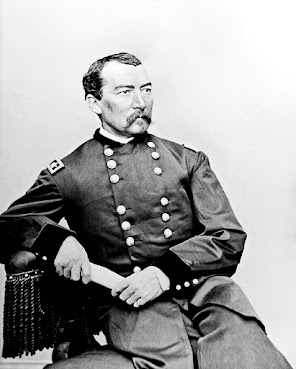
Phil Sheridan and the Complexity of Historical Judgment
A career US Army officer, he spent most of the 1850s in the Northwest, leading topographic surveys and defending settlers against Indian attacks. Much of his job involved negotiating with Indian leaders, and he came to like them. For a while he lived with an Indian mistress, the daughter of a chief. So far as I can tell he tried to be fair, but after all it was his job to restrict Native Nations to reservations to make room for white settlers, and he did it.
When the Civil War broke out he rose rapidly from 1st Lieutenant to Brigadier General, commanding troops in a long list of battles. Grant, a pretty good judge in these matters, once called him the best battlefield commander in the world. When Grant was summoned east to take charge of the Union army in Virginia he brought one subordinate with him: Sheridan. Sheridan became commander of the Union cavalry corps but his role grew until by the end of the war he was Grant's all around right-hand man and the driving force of the pursuit that ran Lee's army to ground at Appomattox.
Sheridan was one of the hard men of Grant's school, who thought the way to win the war was to fight harder, kill more Confederates, and destroy more of their property. In the Fall of 1864 Sheridan led an expedition into the Shenandoah Valley, which was the main source of food for Confederate troops in Virginia. After defeating Confederate forces in two battles he instructed his men to wreck the valley so thoroughly that a crow flying across would have to carry his own food.
After Appomattox Sheridan was sent to Texas, because Confederate troops there were slow to surrender, and because a Civil War in Mexico threatened to spill over the border. Benito Juarez was leading Mexican opposition to a French effort to install Archduke Maximilian of Austria as ruler, backed by 40,000 French troops; Sheridan was supposed to neutral but later said that he found covert ways of supplying Juarez's men with weapons and ammunition.
During the first years of Reconstruction Sheridan was the military governor of Texas and Louisiana, and he was one of the hardest fighters against neo-Confederate resurgence. Here's a snippet of his wikipedia bio:
On July 30, 1866, while Sheridan was in Texas, a white mob broke up the state constitutional convention in New Orleans. Thirty-four blacks were killed. Shortly after Sheridan returned, he wired Grant, "The more information I obtain of the affair of the 30th in this city the more revolting it becomes. It was no riot; it was an absolute massacre." . . . In March 1867, with Reconstruction barely started, Sheridan was appointed military governor. Sheridan severely limited voter registration for former Confederates and ruled that only registered voters (including black men) were eligible to serve on juries. After an inquiry into the deadly New Orleans riot of 1866 implicated numerous local officials; Sheridan dismissed the mayor of New Orleans, the Louisiana attorney general, and a district judge. He later removed Louisiana Governor James M. Wells, accusing him of being "a political trickster and a dishonest man". He also dismissed Texas Governor James W. Throckmorton, a former Confederate, for being an "impediment to the reconstruction of the State", replacing him with the Republican who had lost to him in the previous election. . . . If Sheridan was unpopular in Texas, neither did he have much appreciation for the Lone Star State. In 1866 his quip was widely reported: "If I owned Texas and Hell, I would rent Texas and live in Hell."Sheridan's efforts to reconstruct the South got him fired by Andrew Johnson, so in 1867 Sheridan was sent north to take command of the army fighting Indians on the plains. Realizing that he did not have enough men to defend all the points he was supposed to be defending, he went over to offense:
In the Winter Campaign of 1868–69 he attacked the Cheyenne, Kiowa, and Comanche tribes in their winter quarters, taking their supplies and livestock and killing those who resisted, driving the rest back into their reservations.
The massacre of peaceful Cheyenne known as the "Battle of Washita River" was part of this campaign. Sheridan was in overall command of the Department of Missouri for the next decade, presiding over the wars that destroyed the Cheyenne and Lakota nations.
The world's first National Park, established at Yellowstone in 1872, was part of Sheridan's military territory, and he fell in love with the place. In 1881 he wrote a formal report arguing that the park needed more funding for development (things like boardwalks so people could see the hot springs without damaging them) and a company of cavalry to prevent wanton destruction by loggers, hunters, and trophy takers. The report was ignored. Feeling that his military position prevented him from going directly to the press, he enlisted master publicist Buffalo Bill Cody to draw public attention to the cause. (Love it that this Washington Post article identifies Cody as one of the first "reality stars.") Sheridan also brought President Chester Arthur to Yellowstone on a carefully managed trip; no reporters were allowed, but Sheridan's staff wrote up daily press bulletins. In the end Sheridan managed to secure the funding he wanted, and when Washington refused to authorize cavalry patrols he just ignored them and sent men to the park anyway.
To my mind Sheridan's career is a good example of what we can expect to see in any major figure of the nineteenth century. He fought for some things I can believe in – Union, abolition, Reconstruction – and he fought hard and well for them. He also reveled in battle to an alarming degree, and ruthlessly sacked officers he thought were too soft, too much concerned about the lives or comfort of their men. He did what he could to promote Reconstruction, including the rights of black men to vote, hold office, and serve on juries. He was probably a racist in the way of most men of his time, but on the questions that mattered he was for equality. Against orders, he helped Mexico fight off foreign domination. He then turned his military talents to the Indian wars, found the weakness of the plains tribes and brought them to heel. One of his last public acts was to insure the future of Yellowstone National Park.
What can we say about him, except that he was soldier of another time?
Saturday, January 22, 2022
Debating E.O. Wilson's Legacy
Biologist E.O. Wilson died on December 26. Many of his obituaries had a somewhat guarded tone, because while he was an eminent scientist his career was controversial. On the one hand he was a noted environmentalist and helped introduce the concept of biodiversity into the environmental lexicon. On the other, his 1975 book Sociobiology waded into questions of how much about human societies, sex differences, and so on is genetic, applying the methods he honed studying ant societies to those of humans. Late in life he added a new focus for controversy when he publicly renounced kin selection as the source of altruism in animals in favor of group selection, a model that has become in some hands a justification for militarism.
The question of how much human behavior is genetic is of course an old one, and it has always been political. Defenders of aristocracy long defended the superiority of noble blood lines; one of the founders of modern liberalism, John Locke, advanced the tabula rasa (blank slate) theory that we in fact inherit nothing. Locke had no evidence for his view, he was simply proposing on the philosophical plane arguments that helped his support his views on politics. Anyway it is not just recent "woke" people who get upset over the political implications of research on human genetics, and it has long been the case that the Left wanted to deny inheritance while the Right talked it up.
Wilson's story took a turn last week when Scientific American ran an essay about him by Monica McLemore, subtitled "We must reckon with his and other scientists’ racist ideas if we want an equitable future."
His influential text Sociobiology: The New Synthesis contributed to the false dichotomy of nature versus nurture and spawned an entire field of behavioral psychology grounded in the notion that differences among humans could be explained by genetics, inheritance and other biological mechanisms.
E.O. Wilson never supported any "dichotomy," false or otherwise, but he certainly believed that some differences between humans are rooted in genetics. Others did use his work to make simplistic arguments about heredity, but I'm not sure that's his fault. Honestly I found this essay mostly just kind of lame, without any of the fire I expected from others' reaction to it. One passage that made some scientists howl was this one:
First, the so-called normal distribution of statistics assumes that there are default humans who serve as the standard that the rest of us can be accurately measured against. The fact that we don’t adequately take into account differences between experimental and reference group determinants of risk and resilience, particularly in the health sciences, has been a hallmark of inadequate scientific methods based on theoretical underpinnings of a superior subject and an inferior one.
A "normal distribution" is just a kind of curve in the dataset that in fact describes a huge number of natural and human phenomenon; it has nothing to do with the question of human diversity and whether different groups will respond differently to different drugs or whatever. But I get what McLemore was trying to say, and I think it is true that many Big Picture scientific studies sweep a lot of diversity under the rug. As my readers know, I regularly complain about this when it relates to anthropology. Anyway a bunch of scientists were incensed by McLemore's article, mainly because it calls Wilson "racist" without offering any evidence that he believed in meaningful differences between human races. In fact he explicitly denied believing any such thing on multiple occasions. A long list of biologists wrote a rebuttal letter to Scientific American, which refused to print it. So it has been posted online.
The argument over Wilson interests me because much of it hinges on the definition of "racist." To Wilson, and that whole side of science, asking questions about the genetic roots of human behavior is important and interesting, so we should do it. That's what sciences is for. That's what science is. Besides, they often throw in, so far science says nothing material about behavioral differences between races anyway. (It does, of course, have a lot to say about differences between the sexes.)
The scientists who signed the letter believe that science, done properly, cannot possibly be racist. Its goal is to discover the truth about the world, whatever its moral and political implications. It is up to us to adjust our morality and politics to fit reality, and it is emphatically not the job of scientists to alter their findings to fit our morals or our politics.
To their opponents, all talk about human genetic traits is inherently dangerous. The very idea of approaching questions of genetic difference without ideological preconceptions disturbs them. To them, anyone without a strong ideological preconception against racism is suspect; anyone who thinks there could be a neutral approach to questions of the differences between races is a racist. For many of them, the notion that the truth should be our highest goal is just plain wrong. Our highest goal should be justice, and anyone who disagrees needs to be called out.
Under this definition, Wilson was a racist because he studied human genetic differences without a strong and loudly proclaimed commitment to racial justice. He thus, whatever his intentions, became a tool of racists, and anything that serves racism is itself racist. To a lot of scientists, and many other liberals, this is the most dangerous possible kind of thinking: to them, allowing our politics to dictate what we believe about reality is the definition of totalitarianism.
Wherever science intersects with morality and politics, there will be conflict. Certain scientists will be shocked that anyone attacks their scientific work on political grounds, but of course they should know better. Topics like human genetic differences, human-induced climate change, welfare economics, and so on are inherently political, and it is foolish to think they could ever be discussed without political consequences. Complaining about wokeness, as many contemporary scientists like to do, hardly scratches the surface of this dynamic, especially when the topic has been controversial for centuries. The letter written on behalf of Wilson makes no attempt to address any of this, and its authors come across as baffled that anyone could see any problem with Wilson's work. Honestly their piece did not impress me any more than McLemore's did.
I believe in the truth, and I don't think it was racist of E.O. Wilson to pursue it. Maybe Wilson's defenders are right to pitch a fit when the word "racist" is applied to him; maybe such charges have to be answered. But if they don't understand where their opponents are coming from, they are unlikely to make much headway against them.
Wednesday, October 27, 2021
The Thought Gap after Conversation
Here's an interesting article abstract, Cooney, Boothby, & Lee, in the Journal of Experimental Psychology:
After conversations, people continue to think about their conversation partners. They remember their stories, revisit their advice, and replay their criticisms. But do people realize that their conversation partners are doing the same? In eight studies, we explored the possibility that people would systematically underestimate how much their conversation partners think about them following interactions. We found evidence for this thought gap in a variety of contexts, including field conversations in a dining hall (Study 1), “getting acquainted” conversations in the lab (Study 2), intimate conversations among friends (Study 3), and arguments between romantic partners (Study 4). Several additional studies investigated a possible explanation for the thought gap: the asymmetric availability of one’s own thoughts compared with others' thoughts. Accordingly, the thought gap increased when conversations became more salient (Study 4) and as people’s thoughts had more time to accumulate after a conversation (Study 6); conversely, the thought gap decreased when people were prompted to reflect on their conversation partners’ thoughts (Study 5). Consistent with our proposed mechanism, we also found that the thought gap was moderated by trait rumination, or the extent to which people’s thoughts come easily and repetitively to mind (Study 7). In a final study, we explored the consequences of the thought gap by comparing the effects of thought frequency to thought valence on the likelihood of reconciliation after an argument (Study 8). Collectively, these studies demonstrate that people remain on their conversation partners’ minds more than they know.
This is something I learned rather late in life. With some people (notably my wife and children, and certain of my colleagues) it is not necessary for me to repeat things that I feel haven't sunk in, because they will sink in later when people brood on them. For some of the people who have worked under me, the slightest criticism reverberates for days. Understanding this puts an obligation on us, as I see it, to choose our words carefully; they don't just pass through the air and disappear, but may linger for decades.
Sunday, June 27, 2021
Consent and the Primacy of the Individual Will
This morning, completely by chance, I read two NY Times articles in succession. The first is titled "Is this Railroad for the Rich?" and discusses the very strict zoning of many towns along the Long Island Railroad. It is illegal to build multi-family housing near any of the LIRR stations in Nassau County. In one town, Bellerose, it is illegal to build any new housing at all, since that "would be detrimental to the integrity of the village and to the health, safety and welfare of its residents." Any professional planner would say that around commuter rail stations is the perfect place for new apartments or condominiums, but the people of Nassau County don't want it and they have the power to stop it.
From there I clicked to an interesting article by Parul Sehgal titled "Consent." Consent, preferably verbal and explicit, was established a generation ago as the essential precursor to any sort of sex. But a raft of books has appeared over the past few years asking hard questions about this notion, which seems to be wholly inadequate to protecting people (and especially girls and young women) from harm. Some feminists have argued that sex can still be rape even when explicitly consented to, for example when men lie about being married. We have also been treated to scenes in the movies and on television in which creepy abusers bully girls into saying "yes" out loud, then using this as a cover for doing whatever they want.
It’s upon this shifting terrain that these new works are set. “I May Destroy You” is based on Coel’s experience of sexual assault, around which orbit other stories of ambiguous sexual encounters — “thefts of consent,” she calls them. . . . Annabel Lyon’s prizewinning novel “Consent” follows, in part, a woman disturbed to learn that her intellectually disabled sister wants to marry — is she capable of consent? In Shatara Michelle Ford’s film “Test Pattern,” the question of consent hinges not just on a woman’s assault by a stranger but on the putatively protective behavior of her partner afterward. The acclaimed French writer Annie Ernaux took 60 years to piece together her latest memoir, “A Girl’s Story,” about the trauma of her first sexual experience, “because it was so complex.” “Had it been a rape, I might have been able to talk about it earlier, but I never thought about it that way,” she has said. “I gave in, so to speak, out of ignorance. I don’t even remember saying, ‘No.’”
Even more than these explorations of ambiguity, what struck me is that some thinkers are extending the notion of consent well beyond relationships between two people. If the two people involved have a major disparity of power – teacher and student, boss and employee – does consent mean anything? Should we, maybe, try to restructure our whole society in an anarchist direction, to minimize the extent to which people ever do things to which they would not wholeheartedly consent?
And then this:
What if it were acknowledged not just as a private transaction between individuals, but, as Milena Popova suggests in her study of the term, “Sexual Consent,” as something ever-present in our enmeshment with the world? Where is our consent in the water we drink or the air we breathe?
Setting aside the narrow if vital question of sex, I want to ask this: to what extent should we think about life as things to which we do or do not consent? When can things be forced on us without our consent? How much do we have to know, and how much control of a situation do we have to have, before we can meaningfully consent to anything? In what sort of mental states can we meaningfully consent, and might we rather often be so confused or bedazzled that the concept does not apply? When would the cost of saying no, for example to our employers, be so high that our choice is taken away from us?
We are watching this unfold across the world about Covid-19 vaccinations, with hundreds even of hospital employees refusing the shot and raising hell at the prospect of their bodily integrity being violated without their consent. And yes there are people who explicitly equate forced vaccination with rape.
In the words of the Hagakure, "this understanding extends to all things." The people of Nassau County do not consent to the building of apartment buildings near their homes, and if that means somebody else suffers, too bad; they believe absolutely that their homes should not be changed without their consent. Millions of people in the US and Europe feel this way about immigration: they have not consented to seeing their communities transformed by strangers, and they hate that this happened without anyone asking their opinion. As Matt Yglesias once put it, "change feels coercive."
How big a role can we grant to the pursuit of this kind of individual integrity, the refusal to do or endure anything we have not consented to? Some anarchists extend it very far indeed. I think that is simply unworkable, and that some decisions have to be made politically and enforced on everyone. But I think you can go a long way toward understanding modern politics by hearing people say, "I did not consent to this," and I think it would do us all good to reflect on what our own politics might entail forcing on others, and how we would feel if the same were done to us.
Friday, May 28, 2021
Individualism and Altruism
Interesting essay in the Times by Abigail Marsh asking whether America's individualism – however you measure that trait, the US always come out at or near the top – makes us worse people. Marsh says it does not, and that in fact Americans are by most measures among the world's most altruistic people. We give more to charity, donate more organs, care more about animal rights, and so on. Marsh:
How does individualism manage to promote altruism? One possibility, supported by other research, is that people in individualist cultures generally report greater degrees of “thriving” and satisfaction of life goals — and as noted above, such subjective feelings are meaningfully correlated with greater amounts of altruism. (Indeed, research has shown that being altruistic, in turn, promotes greater feelings of personal well-being, creating a virtuous circle.)
Another possibility is that individualism boosts altruism by psychologically freeing people to pursue goals that they find meaningful — goals that can include things like alleviating suffering and caring for others, which studies suggest are widespread moral values.
A third possibility is that individualism promotes a more universalist outlook. In focusing on individual rights and welfare, it reduces the emphasis on groups — and the differences between “us” and “them” that notoriously erode generosity toward those outside one’s own circle.
This is interesting but not, I think, definitive. Americans give more to charity partly because we pay lower taxes and have a less robust welfare state. Americans donate more money to victims of disasters in faraway places, personally, but governments like those of Norway and Germany devote a much bigger percentage of their budgets to such efforts.
I do agree with the main point, though, which is that old-fashioned group loyalty is not necessarily an ethical boon. Sometimes strong communities tightly control their members and punish any violation of common values with shunning or worse. And sometimes strong communities are hostile to outsiders; much of human history consists of strong communities that looked after their own waging war against other, similarly strong communities.
No system is perfect. Raised an American, I prefer the freedom of our system, but I recognize that our mutual indifference can be a serious problem. A world in which people care for each other without wanting to control each other, and without hostility to outsiders, seems beyond our reach.
Friday, February 12, 2021
Joss Whedon is a Creep. So?
Joss Whedon is to my mind one of the great geniuses of television. I would rank Buffy the Vampire Slayer as my third favorite TV series, after Star Trek and The X-Files. I really enjoyed what little there was of Firefly.
When I heard there were "allegations" against him, I thought, oh, great, who did he rape?
But honestly I am having trouble figuring out exactly what Whedon did wrong. Here is Slate's version:
On Wednesday, actress Charisma Carpenter accused Joss Whedon, the celebrated screenwriter and director behind Buffy the Vampire Slayer and The Avengers, of “abusing his power” when she worked with him.
“Joss has a history of being casually cruel. He has created hostile and toxic work environments since his early career,” Carpenter wrote in a statement posted to Twitter. “I know because I experienced it first-hand. Repeatedly.”
Carpenter is best known for her role as mean-girl-turned-demon-fighter Cordelia Chase on Buffy the Vampire Slayer and its spinoff show Angel. In her statement, Carpenter says Whedon berated her over her appearance — reprimanding her for getting a tattoo, calling her “fat” when she was pregnant — and became vindictive when, after refusing multiple phone calls from her agent, he learned of her pregnancy.
Carpenter has stated publicly before that she believes she was written off of Angel in 2003 as retaliation because she became pregnant. . . . .
But in her new statement, for the first time, Carpenter says that upon learning that she was expecting a baby, Whedon asked her if she was “going to keep it” and then accused her of sabotaging the show. She also adds that after her doctor recommended shortening her work hours, she was told to report to set at 1 am, and in the midst of the resultant stress, she experienced Braxton Hicks contractions. “It was clear to me the 1:00 AM call was retaliatory,” she writes.
Gee, if you hate your boss and think your work environment is toxic, maybe you should, I don't know, quit? And if you stay because you think the million a year makes it worth it, you have just lost all my sympathy. For all that she complains about the toxic environment, Carpenter's biggest gripe is that she got fired. She didn't see it as a release? If it was so awful, why not?
Whedon comes across as a monomaniacal jerk who cares not a whit about the personal lives of the people around him and expects them to be as relentlessly devoted to the show as he is. Like, I don't know, all the famous directors and producers of the whole twentieth century.
Repeat after me: all creative geniuses are monsters.
It isn't literally true, but it is pretty close, and honestly Joss Whedon is minor league compared to many of the other big art world figures of recent decades. Balanchine. Andy Warhol. Francis Bacon.
I found it interesting that Anthony Stewart, the only grown-up among the Buffy regulars, says he had no idea there was anything unpleasant going on. I imagine this is because having already spent 15 years on stage and in television he was used to high-pressure acting, and he probably considered Whedon no worse than other directors he had worked with. For the young stars who grew up on the show, Whedon was all they knew. I suppose that did give him power over them, and made his insults hurt. But not because he was worse than many others.
Or perhaps Anthony Stewart just isn't the kind of person who feels abused. One of our themes here over the past year has been "nothing makes sense except in light of inter-individual variation," and maybe that's what we're seeing. But anyway, whatever Joss Whedon was doing, half the crew didn't think it was worth commenting on.
But various online commenters have tied all this up with Whedon's work since Firefly, which they find insufficiently feminist. I don't watch superhero movies, so I don't have much to say about The Avengers. But here is Slate again:
The feminist backlash against Joss Whedon began in earnest in 2015. Back then, it centered on a scene in Avengers: Age of Ultron, written and directed by Whedon, in which Black Widow appeared to say that because she can’t have children, she’s a monster.
“What about me, Joss Whedon?” wrote one disillusioned fan. “Do you think my broken ovary and useless fallopian tube make me a monster?”
Um, maybe you shouldn't have your self-esteem wrapped up in the pronouncements of comic book superheroes? But even Slate admits that was a misinterpretation of Black Widow's actual words, and Whedon was guilty only of "clumsy writing." In a superhero movie? I am completely shocked.
The backlash developed further in 2017, when Whedon’s unproduced 2004 script for Wonder Woman leaked, mostly because of a lengthy sequence it contains in which Diana is put into chains and forced to say, “I submit,” repeatedly.
The scene is clearly intended to critique the patriarchal power structures that force Diana into submission. But it’s a sharp contrast to the joyous empowerment offered by 2017’s Wonder Woman (written by Allan Heinberg and directed by Patty Jenkins): Instead of glorying in Diana’s iconic stride through No Man’s Land, Whedon’s imagined audience is instead asked to suffer through her humiliation with her.
And where the Patty Jenkins Wonder Woman is explicitly told from Diana’s point of view, Whedon’s leaked script frames the character through the point of view of her love interest, who speaks in the signature quippy patterns Whedon usually grants to his authorial avatars (think Buffy’s Xander, Dollhouse’s Topher, or Firefly’s Wash). One viral Twitter thread described the script as “viscerally insulting.”
Anyone puzzled that Wonder Woman should be tied up and abused never saw the comic, because that happened in nearly every issue. And anyway Wonder Woman is an unbelievably stupid character with an unbelievably stupid story, and if you take it seriously you have far worse problems than Joss Whedon.
The narrative these critics are pushing might be summarized as "Joss Whedon should never have been a feminist hero." And I agree! If you take your cues about the important things in life from entertaining television, you're committing a category mistake. Whedon has a fascination with attractive young women who turn out to be really tough. That is not feminist philosophy. If your idea of feminism is, "women should kick men's butts on television," you're not getting it.
If star artists commit crimes, they should go to jail like anyone else. I have no patience with rapists. But going public with a bunch of complaints about other people being jerks isn't progressive politics. It's demeaning for everyone, but especially for the people doing the whining.
Tuesday, December 29, 2020
"It's a Wonderful Life" in Maine
Ralph and Lisa Turner run Laughing Stock Farm in Maine, where they grow organic vegetables that they always sold wholesale to restaurants in Portland. In March, all the restaurants in Maine were shut down because of the pandemic, and they were left with ten tons of unsold produce plus eight greenhouses full of unharvested plants. They didn't have the financial reserves to ride out the loss of all that income and still plant for the fall, so they were looking at bankruptcy.
Not knowing what else to do, they decided to open a farm stand. They sent out emails to people they knew in the neighborhood and in the restaurant business and began bagging up produce for sale. Lisa Turner:
If you want to live in a better world, one less focused on money and profit, with more room for friendship and caring, more room for small organic farms, make it happen.We bagged up stuff as if we were going to have maybe 10 people a day come.
We sent it out to probably 450 email addresses — and then people just started sharing it and sharing it and sharing it. The first day it was like, wow, that was a lot of people. And I had to refill some stuff that I wasn’t really expecting to.
The eggs were flying out of here — we had kind of a back stock of eggs. We went through 130 dozen eggs in two and a half days. It was insane.
I called a friend who has a beef farm. And I said, we’re doing this — what’s your minimum delivery? Just bring me some stuff. She said, yeah, we can bring 40 pounds. I never got it into the freezer. I never got it priced. People were taking it out of the box and saying, how much is this? I had to look at the invoice and figure out what I was going to charge for it. It was nothing that we had imagined. It was the nuttiest thing we had ever seen.
It was so astonishing that you couldn’t process it. It really did feel like people were just coming in and throwing money at you. There were people who came in and were just like, yeah, here, keep the change. I’m going to take a $3 bag and I’m giving you a $10 bill, keep the change.
There were a gazillion people. . . .
It was like when they threw money at Jimmy Stewart. There were people coming in, just wanting to help. It was a lot of our customers and friends. And it was also a lot of people that we’ve never met.