But Qiaomei Fu, a geneticist who played a part in identifying Homo denisova, had his suspicions that this was really a Denisovan. He eventually got the chance to study the skull. First attempts did not identify any DNA but they did produce some protein sequences that matched Denisovan sequences from the famous finger bone. Then, anayzing some dental calculus, they found mitochondrial DNA that closely matches Denisovan DNA.
There are a lot of caveats to be made here, in particular that we're talking about DNA snippets rather than long strands, and we already know that there was human diversity and interbreeding in East Asia in that period. But this looks pretty good to me, so the digital model you see in these two images may well be the cranium of a Denisovan.Saturday, June 21, 2025
The "Dragon Man" Skull was Probably a Denisovan
Monday, March 4, 2024
Denisovans in Southeast Asia
Major paper in Nature this week summarizing what we have learned about ancient Denisovans from a pathetic pile of fossils and extensive genetic research. (NY Times; good summary article about Denisovans at Britannica)
The first discoveries, made at Denisova Cave in Siberia, showed that Denisovans had been around from, at minimum, 150,000 to 75,000 years ago; that they interbred with Neanderthals; and that some of their genes seemed to be present in modern East Asian humans. Other likely Denisovan bone fragments have now been found in Tibet and Laos.
More recent genetic studies suggest further intermixing with modern humans in Southeast Asia, perhaps as recently as 25,000 years ago. The Denisovan signature seems to be particularly strong in some groups in New Guinea and the Philippines. This may mean that they were able to thrive in both Siberia and tropical southeast Asia, giving them one over Neanderthals, who have not been found outside Ice Age climes.
I caution that all of this is very new and rather speculative; I am especially skeptical of DNA found in soil rather than bones. But it truly is remarkable that modern genetics has allowed us to conjure up a lost branch of humanity from a few shards of bone.
Sunday, June 4, 2023
Hațeg Island's Mini Dinosaurs
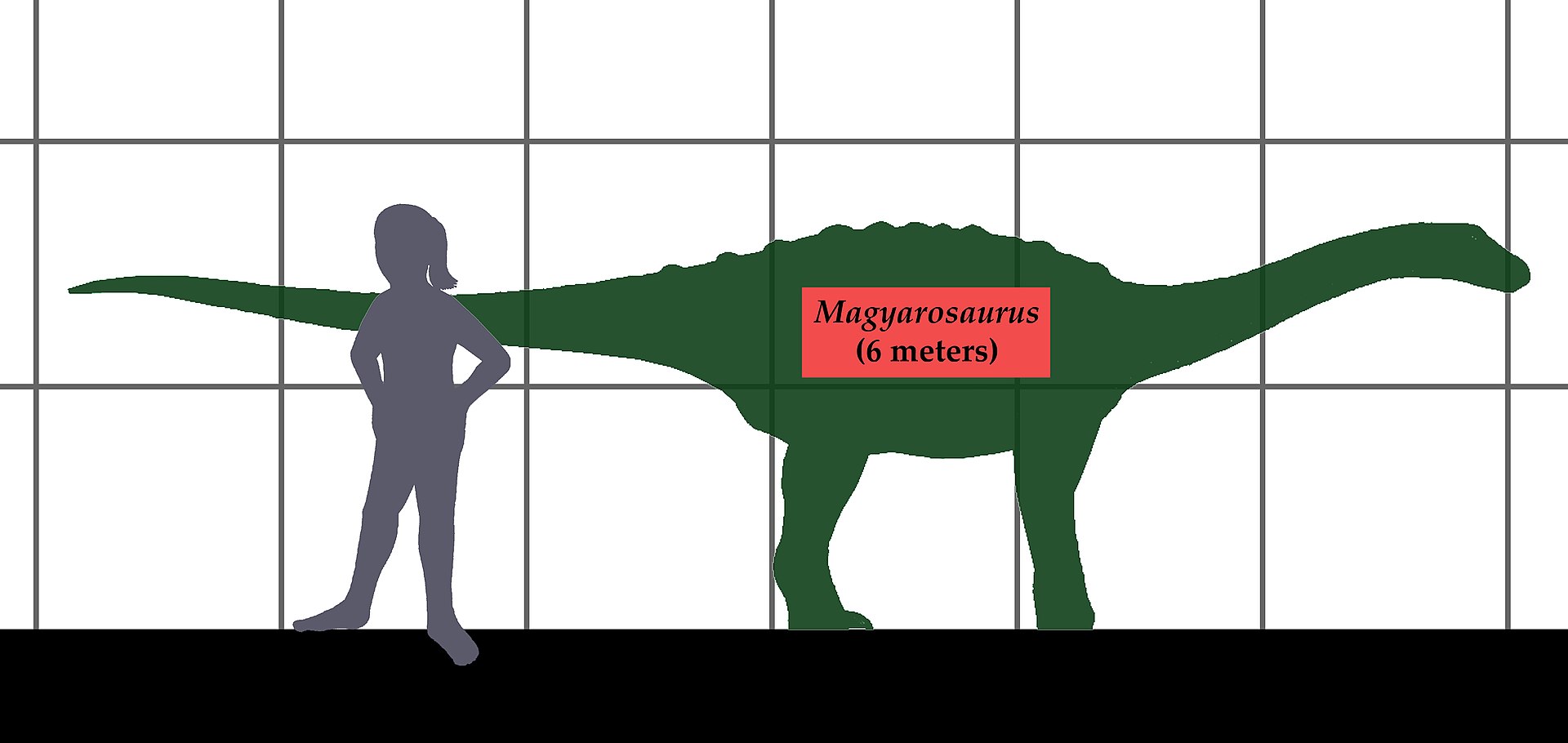
The fascinating thing about Hațeg Island is that the patterns of animal life we know from modern islands were present there in distorted, dinosaur-age form. For example, most terrestrial animals were smaller than their mainland forms. Above are a skeleton of an Inguanadon of the genus Zalmoxes, named after a Thracian god about whom Herodotus told stories of human sacrifice, and a diagram showing how much smaller it was (in purple) than most other Iguanadons. The diagram at the top of the post compares Zalmoxes robustus, from Hațeg, to the next smallest known species.Here's a Titanosaur from Hațeg called Magyarosaurus. Most Titanosaurs were gigantic beasts, but this one was horse-sized. (The grid is 1-meter squares).
But while many species shrank on the island, the opposite also happened. Just as some islands came to be inhabited by huge flightless birds, Hațeg was home to gigantic pterosaurs. This is Hatzegopteryx, probably the dominant predator on the island. Only very partial fossil remains have been found, so it is unclear whether Hatzegopteryx could fly. But it certainly didn't need to.
Monday, April 17, 2023
Icaronycteris gunnelli and the Evolution of Bats
The Field Museum has a delightful slide show of specimens from Fossil Lake.This small carnivorous mammal has the first known prehensille tail, and in fact its tail has more verterbrae than any other known species.But to get back to bats! This one is from wikipedia, found in 2021 and not yet identified.
Saturday, January 8, 2022
Miocene Fossils from McGraths Flat, Australia
The secret to the fossils’ preservation is up for debate, but McCurry thinks it would have happened over hundreds of years rather than in a sudden event.Close-up of the sawfly above, showing its head, and a microscopic image showing the pollen grains still visible there. Astonishing.A larval mussel riding on the fin of a fish as a parasite.Tiny flowers.Longhorn Beetle. Original publication, long story at the NY Times.
Iron-rich water, maybe from nearby outcrops, could have flowed into a shallow billabong, periodically deoxygenating the water, killing the organisms or encasing flora and fauna in sediment that turns into the rocks found in the field.
Friday, October 2, 2020
Meet Stan
Tyrannosaurus Rex skeleton from South Dakota, 67 million years old, to be auctioned off by Christie's on October 6. Most likely it will end up in a museum whoever buys it, because even for a billionaire mounting and maintaining a fossil like this would be quite a burden.
Tuesday, May 19, 2020
From Christie's Online Auction of Rocks and Fossils
Extraterrestrial peridot, from the Admire meteorite.
Bison antiquus, c 15,000 years old; this is the native North American bison that went extinct at the end of the Pleistocene, to be replaced by Bison bison.
Bicolor cubic fluorite.
Palm leaves with fish, Eocene, c. 50 million years old. A "composite" formed by placing the fossil fish onto a different layer of the rock with the palm leaf in it. So all real fossils, but arranged by human hands. I wonder what the people who do this call themselves. Fossil artists?
Gogotte, which according to this site
are formed from quartz crystals and calcium carbonate. They were produced when superheated water extruded through crevices into a basin of extremely fine white silicate sand. The water was saturated with calcium carbonate (Limestone). The swirls and eddies of the water were captured in the gradually concreting stone, forming the most wonderful natural sculptures.Large ammonite, Jurassic, 2 feet (60 cm) across. Much more here.
Wednesday, May 1, 2019
Denisovan Jawbone Found in Tibet
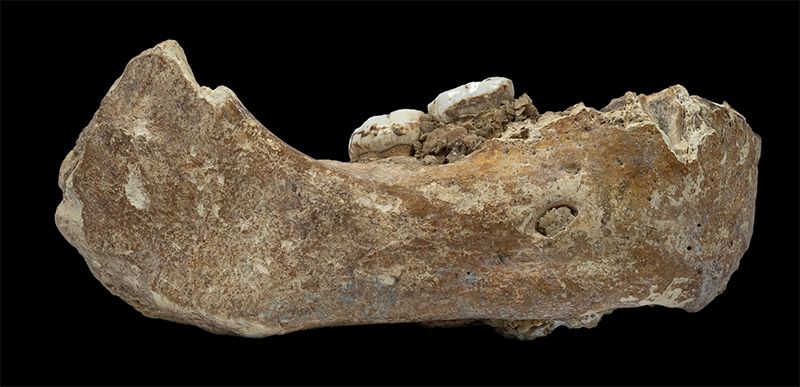
It's quite odd, really, that we have discovered (or possibly imagined) so much about these people with no fossil record beyond a toe bone and some fragments. This one jaw increases our knowledge of Denisovan bones tenfold. It was found in Tibet back in 1980 and has been sitting on a museum shelf ever since, paleontologists occasionally wondering what it might be but not coming to any conclusions. It dates to about 160,000 years ago.
As to why Chinese paleontologists think this jawbone is Denisovan, well, that is a tale. Pondering this ancient jaw, which doesn't seem to belong to any known species but isn't all that old as these things go, they at first tried to extract DNA. No luck. So they tried again with proteins, eventually extracting and isolating collagen proteins that could be sequenced. The sequence is clearly not from a modern human, and it matches more closely to those from Denisovan bones than those from Neanderthals.
It's impressive work but this is a new technology and far from certain. Still, that jawbone has to be something, and if it isn't Denisovan then there was yet another human species wondering around out there.
And then there's this:
The altitude of the new Denisovan’s home — 3,280 metres above sea level — surprised researchers, and helps to solve a mystery about Denisovans’ genetic contribution to modern Tibetans. Some Tibetans have a variant of a gene called EPAS1 that reduces the amount of the oxygen-carrying protein haemoglobin in their blood, enabling them to live at high altitudes with low oxygen levels. Researchers had thought that this adaptation came from Denisovans, but this was difficult to reconcile with Denisova Cave’s relatively low altitude of 700 metres. The latest study suggests that Denisovans evolved the adaptation on the Tibetan Plateau and passed it to Homo sapiens when the species arrived around 30,000–40,000 years ago.Don't ask my why having less haemoglobin helps you survive with less oxygen, but wikipedia's article about EPAS1 says the same thing, so there it is.
Sunday, March 31, 2019
The Day the Dinosaurs Died?
In the deposit, the team discovered an ancient freshwater pond whose occupants had been quickly cemented together by waves of sediment and debris. The fossils include sturgeon and six-foot-long paddlefish, their scales intact but their bodies ripped and smashed; marine mollusks; leaves and tree fronds, and the burned trunks of trees. The fish carcasses were not bloated, decayed, or scavenged, suggesting that they were buried quickly — and that few animals were left alive after the cataclysm to come digging.
The fossil deposit also teems with tektites, tiny glass beads that are the telltale fallout of planetary-scale impacts. Fifty percent of the fossilized fish were found with tektites in their gills, as if the fish had inhaled the material. Also recovered were tektites trapped in amber. Their chemical composition was unchanged in 66 million years, and it closely matched the unique chemical signature of other tektites associated with the Chicxulub event.
The top layer of the fossil bed was found to be rich in iridium, a rare metal that Dr. Alvarez had originally identified at other sites as arising from the giant object that struck the Earth. Iridium, a precious metal belonging to the platinum group of elements, is more abundant in meteorites than in terrestrial rocks.
Amazing.
Friday, June 15, 2018
Thursday, December 7, 2017
Little Foot
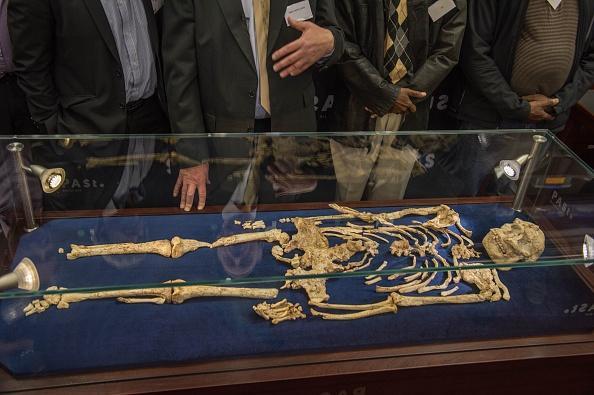
Previous attempts to date Little Foot have yielded highly uncertain results, ranging from 2.2 million years to over 4 million years old. The dating technique used in the new study, called isochron burial dating, calculates the age of a specimen based on when it was last on the surface, exposed to cosmic radiation that produces radioactive isotopes of the elements aluminium and beryllium. When the sediments washed into the cave, the isotopes stopped accumulating, and instead begin to decay at a steady rate. Nine out of eleven samples from rock surrounding the skeleton gave an age of 3.67 million years.I think paleontologists spend too much time an energy fighting over which fossil was first and which species they belong to. The long-running South vs. East Africa debate is irritating and probably unresolvable. But the ever-growing number of old human and human-like fossils is fascinating, and the diversity of their shapes shows evolution in action in a compelling way. The broad distribution of Australopithecus afarensis is also interesting, since fossils have now been reported from South Africa to Chad. This was not a shy, rare species, but a very successful one that used its slightly-smarter-than-a-chimp brainpower and upright posture to spread across the continent, hinting at the future dominance of its lineage.
Friday, December 1, 2017
Two Hundred Pterosaur Eggs
The species that laid the recently discovered eggs is known as Hamipterus tianshanensis. It lived during the early Cretaceous period and its wings stretched about 11 feet long. It also sported a thick forehead crest and had a mouth full of pointy teeth for snatching fish.This is strong evidence that these pterosaurs nested in big colonies like some modern seabirds.
Xiaolin Wang, a paleontologist at the University of Chinese Academy of Sciences, Beijing, and lead author of the study, discovered the eggs in a 120-million-year-old pterosaur boneyard in the arid Gobi Desert in northwestern China. When the pterosaurs thrived, the place was most likely a lush lakeshore. The team suggested that a strong storm most likely washed the eggs into the lake, where they were buried alongside pterosaur bones and preserved for millions of years.
Saturday, September 30, 2017
How Dinosaurs Lost their Teeth
Using fossils and a large comparative analysis of modern animals, Dr. Balanoff and a team of evolutionary biologists, led by Shuo Wang from the Capital Normal University in Beijing, found that the loss of teeth and the emergence of beaks are connected processes in theropods. As the beak grew across the dinosaur’s face, it also inhibited the growth of teeth, the team suggested. On an evolutionary scale this transition happened until theropods developed mouths that resembled the bird beaks seen today.All three of these dinosaurs had beaks with vestigial tooth sockets, as in the Sapeornis jaw above.
In earlier research, Dr. Wang’s team discovered an emu-like theropod called Limusaurus that began life as a baby with teeth, but lost them as it grew older and morphed into an adult with a beak. [above]
For their most recent paper, he and his colleagues examined more dinosaur jaw fossils and found two other theropods that underwent transitions similar to Limusaurus: an early Cretaceous bird called Sapeornis, which resembled modern birds, and a small caenagnathid oviraptorosaur, which resembled a velociraptor but with a beak.
“This demonstrates an evolutionary process of the beak for the first time,” said Dr. Wang.
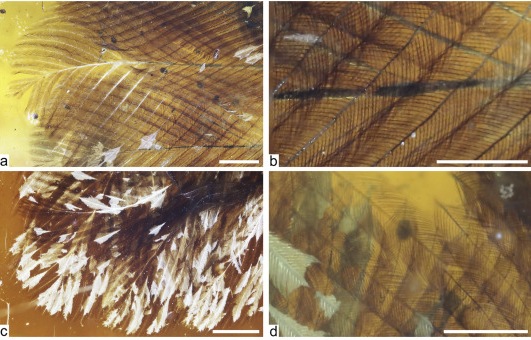
When paleontologists look closely at any change in the fossil record that seems like a dramatic break, they find lots of intermediate cases and strange branchings and evidence that the change took place in different ways in different groups and so on: in other words, a disorderly mess. Evolution is like that. Birds once seemed different from dinosaurs in both having feathers and having beaks. Now we know that lots of dinosaurs had feathers, including most if not all theropods, and from fossils in amber and mudstone and we have learned a lot about how many different sorts of feathers they had and begun to understand how they evolved. We are just in the early stages of understanding beaks, but already enough is known to show that they evolved in several different lineages of dinosaurs.
Saturday, August 12, 2017
Gliding Mammals of the Dinosaur Age
and Vilevoledon. Both about 170 million years old. These are not placental mammals, so they are not related to flying squirrels; just another case of convergent evolution.
There were no flowering plants yet, so no fruit; perhaps they fed on conifer seeds.
These gliding animals are a good example of the great diversity of mammals that lived in Jurassic times, something we knew nothing about until the 1990s. Besides gliders, Chinese paleontologists have also found mammals that swam like otters and mammals with claws like those anteaters use to pull open insect mounds.