Friday, September 20, 2019

Ben Rawlence, "City of Thorns: Nine Lives in the World's Largest Refugee Camp"

This book was a lucky impulse buy for me. Wandering in an independent bookstore, the kind I wish the world had more of, I considered that I ought to show my support by buying something, and this was to hand and looked interesting so I bought it. I'm glad I did, because it is amazing and eye-opening and not in my public library.

Ben Rawlence is a former researcher for Human Rights Watch turned journalist, and City of Thorns (2016) chronicles life in Kenya's Dadaab refugee camp, at that time (2010-2015) the largest in the world. Nobody is sure how large, since the Kenyan government forbade the UN to take a census, but best estimates for the peak population come in around 800,000 people. Most of them were Somalis, fleeing the war that has torn their country apart for a generation. There were also Ethiopians, who fled a civil war in the Ogaden region that most westerners have never heard of, and a few others. These days the camp still exists but has shrunk to about a quarter of what it was it its peak, most of the residents having gone back to Somalia or vanished into Kenya's large Somali population.

Rawlence tells the stories of nine camp residents, based on extensive interviews with them and what others told Rawlence about them. You might think that this would be a very depressing book, but I did not find it so. Yes, it is full of horrors, from starvation to corruption to suicide bombing. But it is also a tale of amazing resilience, of people getting on with their lives despite terrible hardship, and of generosity. Rawlence would probably dispute that last, since he spends much time complaining about the refusal of most nations to accept more than a trickle of refugees, and about the harsh discrimination against them, but it was the kindness of strangers that kept all these people alive through decades of war and a terrible two-year drought.

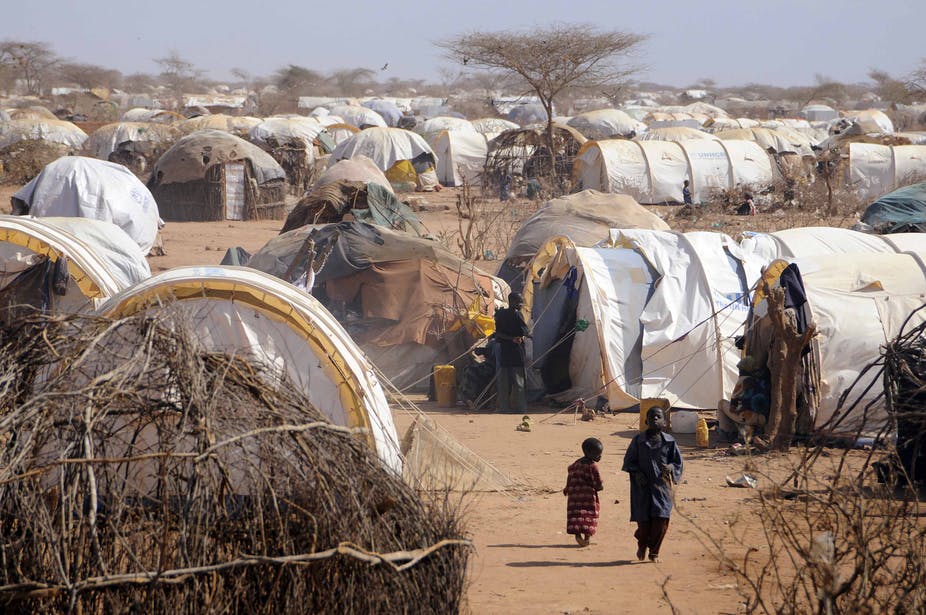
Almost all the people in the camp lived in shelters like the ones shown in these photos, a frame of wood cut from scrubby thorn trees covered with UN tent fabric. Around them was the bare red soil, dust in the dry season, mud when the rains came. Water came from deep wells, distributed to central pumps where people collected their daily ration in plastic bottles. Rations had to be collected every two weeks by waiting in a long line.

Dadaab was set up in 1991, and Rawlence met people who had been there ever since. Some of those early arrivals prospered in the camp's weird economy, based on UN food aid, other kinds of relief, work for relief agencies, and smuggling. Sugar, in particular, was smuggled from Somalia into Kenya on a massive scale, to avoid Kenya's high import tariff; after reading about the amount smuggled and the complicity of the police one can only assume that the tariff exists mainly to allow well-connected Kenyans to take a cut of the smuggling profits. Some of those early arrivals had founded thriving businesses selling things like cell phone time, television watching, vegetables, meat, clothing, household goods, and khat, the ubiquitous drug of the Horn of Africa. It is fascinating to see that even among people who would all be considered desperately poor in the US there are differences in wealth that seem very important to the people of Dadaab.

In 2010, before the crisis of the great famine, two week's rations for an adult consisted of:
3 kg. wheat flour
2 kg. rice
1 kg. beans
1/2 l. cooking oil
1/2 cup salt
That's enough calories to live on, but since in fact most residents sold some of them to get money for phone time or television time or vegetables or to save for a wedding feast or a thousand other things, many people were slowly starving. And that was before the crisis.

The horrible famine of 2011-2013 was caused by a complete failure of seasonal rains two years in a row, exacerbated by the ongoing war. Half a million more people became refugees, and thousands died, many of them in the desert on their way to Dadaab. The arrival of hundreds of new refugees every day for months, many of them close to death, led to a huge crisis that got the attention of the world media and led to surge of donations, which eventually brought the crisis under control. But for a while the situation was very grim. The UN issued ration cards to everyone who showed up at the camp, under the assumption that nobody who was not an actual refugee would want to live on flour, beans, and rice in a squalid refugee camp. But during the crisis thousands of Kenyans came to the camp, because at that time there was no food anywhere else in the region.

There were other ways that life in the camp was better than outside it. The Medical care provided by NGOs was better than that available to many Kenyans. Education was also provided, primary school for all children and high school for a select group. One of the mothers Rawlence chronicles thought at one point about going back to Somalia but decided to stay in the camp because there her daughter could continue in school, which would be impossible in Somalia.

In Rawlence's telling the worst dangers of life in Dadaab were not physical but psychological. One of the rules set by the Kenyan government was that the refugees could not work, so they would not take jobs from Kenyans. Many did anyway, for example for the smugglers or for businesses in the camp, but this was difficult and many could find nothing to do. (Those who worked for aid agencies were theoretically "volunteers" and were paid only a tenth of what a Kenyan got for the same job.) Getting by day to day on their UN rations, any spending on entertainment paid for by going hungry, nowhere to go, nothing to do, nothing to see but red dust, thorn trees, and huts roofed with UN tenting, many fell into despair. They dreamed about being accepted for resettlement in Europe or Australia, but less than 1 percent ever were. They fantasized about heading across Africa to the Mediterranean and boarding a boat for Europe, but that is expensive and many who tried were robbed and ended up stranded in some other nowhere place even farther from home. Of those who did make it to the sea, many were drowned. The refugees in Dadaab knew this, but in certain moods they said they would rather die trying to reach Europe than live any longer in the noplace of Dadaab.

Yet most went on: working when they could, finding ways to amuse themselves when they could not, marrying, raising families. Among other things they created soccer leagues with several different levels of play, mosques, churches, musical groups, and a radio station that broadcast stories of refugees collected by refugee reporters. The Muslim extremists who ruled much of Somalia, al Shabaab, tried to recruit in the camp but found very few supporters; the refugees had fled from them and their violence and even the promise of power and regular pay tempted only a few to join them.

Many westerners are dubious about creating refugee camps and keeping them running for decades. Do the camps, perhaps, keep conflicts going longer by creating a sort of safety valve where threatened people can flee and survive, rather than facing the prospect of surrender or death? Do refugee camps keep people living in places where the environment simply will not sustain them? Do they efficiently prevent people who must move from assimilating into their new homes? Maybe. But they also give victims of war a chance to live again.

Links 20 September 2019

Cover to Jules Michelet's La Sorcière (Witchcraft), 1862.

During tournaments, chess grandmasters burn calories like marathon runners. The average top player loses 10-12 pounds over the course of a 10-day tournament, and a championship match had to be cancelled in 1984 after Anatoly Karpov lost 22 pounds.

Cryptography in Renaissance Venice. They had an official Cryptographer by 1506.

"Pseudoaddiction" has become a hated word for drug companies pushing opiates and has even been denounced in the US Senate, but really it is one way of trying to understand the very complex problem of who should get pain killers and how much. Sometimes people begging for more morphine are addicts, but sometimes they are just in terrible pain, and if you think it is easy to tell the difference you should read this article.

Excellent long article by Robert Wroth on the hell that is Yemen at war, with some background on how it got that way. Trigger warning: awful photos of famine victims.

In Nairobi, concrete tenements are replacing shacks as the main housing for the poor. How you feel about this news might say something important about you.

The Free Library of Philadelphia owns a copy of Shakespeare's First Folio, printed in 1623, that was annotated in the 17th century. Jason-Scott Warren claims the annotator was John Milton, and several scholars have chimed in and said they agree.

Brazil as a green country:
It is unfair to single out Brazil for criticism. It is one of the world’s greenest countries: over 60 per cent of its territory is covered with natural vegetation, its agriculture grew based on productivity gains and technology rather than land expansion, and about 45 per cent of its energy comes from renewables, compared with a global average of 14 per cent. It also has one of the world’s most stringent land usage regulations, known as the forest code. How many farmers around the world are required to leave aside 20-80 per cent (depending on the biome) of their native forest land?
Amusing obituary of a lifelong prankster.

Zaddies: the current vogue for white-haired male runway models.

Remembering the time when two Viet Cong commandos sank a major US warship in Saigon harbor. The North Vietnamese put this on a postage stamp, but the US government denied it had even happened and I just learned about it today.

Following the Transumanza in Italy, the ancient journey of cattle from summer to winter pasture, very authentic except for the tourists and the two documentary film teams.

This week's web site: Orkneyjar, a wonderful collection of articles on the history, archaeology, folklore, and everything else about the Orkneys.

Thursday, September 19, 2019

The Lille Panther


Imagine this kitty came up to your window and meowed to come in. It was roaming rooftops in Lille, France yesterday before being cornered by police and captured.

Wednesday, September 18, 2019

More on Money and Happiness

Money has some effect on how happy you are, but not very much. The latest attempt to quantify the relationship comes from Justin Wolpers, who finds that to raise your happiness by one standard deviation you would have to raise your income by 1,640%.

And remember that this is not a flat curve, and most of the impact comes at the bottom; once you're in the upper middle class the impact of more money on happiness is hard to measure and you are not likely to notice.

Two things that are worth more than all the money in the world: a good marriage and a group of friends you see on a regular basis.

Being too Interested in the Nazis

For most of my life the niche of "people who seem too interested in the Nazis for their or our good" was mainly filled by war buffs. After all the Werhmacht really was an amazing war machine, and the Nazi bid for supremacy as a stark act of mechainzed Will to Power had something awesome about it. It was a common theme of discussion among table-top wargamers that the designers were all pro-Nazi, assigning German units higher strengths than history suggests they deserved.

Anyway I was thinking about that because of a new art exhibit in the Netherlands focusing on Nazi design. Fascism after all was partly an aesthetic movement. Its central rituals were massively choreographed displays of uniforms and precision marching, and its leaders were very interested in cultivating a style to match their swagger. In writing about 1945 Tony Judt found several witnesses who mourned the fall of Nazism as an aesthetic catastrophe; one wrote, "I will never see anything truly beautiful again."

If the Times has it right, the curator of this exhibit is mainly a rebel bad boy who wants to tweak the noses of earnest liberals:
In an interview with De Volkskrant, a Dutch newspaper, last year, he positioned himself as a renegade, describing the Dutch museum world as “too feminine” and “destructively politically correct.”
But his exhibit makes many people nervous because of the return of far-right politics in Europe. Is now really the time, critics ask, to remind people that the Nazis had cool posters?

Will we now see a category of suspiciously pro-Nazi people who claim to just be interested in their design, you know, because of its technical excellence?

The Nazis are fascinating, even to many liberals, even to many Jews. They just are. I am very curious about them, and honestly I would probably read more about them if I didn't sometimes get a sense of personal corruption and complicity from doing so.

And yet they are not like the medieval Mongols or the Assassins, far enough away from us that no harm can come from admiring their efficiency. The Nazis still have real followers determined to do evil things. As I said, I don't read much about the Nazis any more because I have the guilty sense that paying so much attention to them only feeds destructive politics in our own time. But I have a hard time condemning others who give in to the temptation to watch.

Billionaires are Changing

Thomas Edsall, from a piece about how the richest Americans are giving less money to Republicans:
This downward trajectory coincided with the steady transformation of the sources of wealth for those on the Forbes list. In 1982, when the list was first published, solidly Republican manufacturers and energy producers dominated — 89 of the 400 richest Americans having made their fortunes in oil.

By 2018, 59 of the Forbes 400 had made their fortunes in technology, including six of the top ten: Jeff Bezos, No. 1; Bill Gates No. 2; Mark Zuckerberg, No. 4; Larry Ellison, No. 5; Larry Page, number 6; and Sergey Brin number 9. Eighty-eight more made their money in the financial sector. In contrast to the 1982 Forbes list, only 14 on the 2018 list made their money in manufacturing and 24 in energy.
Incidentally Trump is on track to raise more money from small donations than any candidate in history.

Tuesday, September 17, 2019

Appian Way

By Lucio.

Are Unions Back?

GM workers just walked out on strike, trying to leverage what seems to be an upsurge of support for unions and strikers across America:
Successful strikes beget more strikes. When nearly 50,000 General Motors workers walked out at 11:59 p.m. Sunday, it was just the latest in the largest burst of strikes in decades. Last year’s victorious teachers’ strike in West Virginia was the initial spark, helping inspire statewide walkouts in Oklahoma and Arizona as well as strikes in Kentucky, Colorado and Los Angeles.

The G.M. strikers could taste labor’s newfound successes and momentum.

The teachers’ unions felt unusually robust public support, as parents and students marched with them. Union leaders and union members felt a new boldness from the surge of good will. This helped inspire a strike last fall by 7,700 Marriott workers in eight cities, and those workers trumpeted a message that resonated far beyond their industry: that their pay increases were not nearly keeping up with soaring housing costs, so they could not survive on one job.

The hotel workers’ success in turn helped inspire the strike by 30,000 Stop & Shop workers in New England in April. Union leaders there were surprised by the deep community support the grocery workers received — supermarket cashiers have never been as beloved as public-school teachers. Politicians stepped up, too. Joe Biden, Pete Buttigieg, Amy Klobuchar and Elizabeth Warren marched alongside them. The G.M. strikers are no doubt counting on similar political backing.

The strong public opinion behind these strikes can be tied to Americans’ widespread dismay with wage stagnation and income inequality, even as corporate profits are flying high. While job numbers and economic growth are strong, many American are barely getting by. . . .

All this might help explain why a recent Gallup poll found that public approval for unions has climbed to 64 percent, up from 48 percent a decade ago and near its highest level in 50 years. An M.I.T. study last year found that nearly 50 percent of nonunion workers say they would vote to join a union if they could, up from 32 percent in 1995.
I find all this very encouraging. Opinion on both the left (Berniebros) and the right (Trumpism) has moved in favor of workers and what Marxists used to call "industrial action." If some of the energy we have been devoting to hating the other party can be channeled into unionization and fighting for pay increases, we might actually achieve something beyond claiming corpses on Twitter. But note that even now the highest number any poll has produced for workers wanting to unionize is 50 percent, and it will take a lot more support than that to bring unions back as a major tool of economic leveling. I still doubt that our individualistic age will go there.

Monday, September 16, 2019

Rainbow Falls

Yosemite Falls in just the right light, from a video shot by Greg Harlow.

Today's Place to Daydream about: The Orkneys

The Orkneys are a rainy, windswept, sea-lashed chain of about seventy islands, home to millions of seabirds, hundreds of dolphins and whales, myriad wildflowers, and amazing monuments that mark 5,000 years of human history.

The southernmost islands about 10 miles off the north coast of Scotland. Only 20 islands are inhabited by humans, the rest being left to terns, gulls, majestic sea eagles, puffins, and feral sheep that feed on seaweed.


Parts of the islands are rocky, with spectacular cliffs and scenery like the west Highlands.


Other parts are low and sandy.


Wildlife: a puffin, feral sheep, a gray seal, a white-tailed sea eagle.

The biggest town is Kirkwall on Mainland, the biggest island; this is the old harbor. Kirkwall was founded by Vikings who took over the islands in t he ninth century, holding them until 1468, when they became part of Scotland as the dowry of a Norwegian princess.

Kirkwall is home to St. Magnus Cathedral, built by the Viking Jarls. Construction began in 1137 and it was essentially complete by 1400.


The most famous monuments of the islands are Neolithic. These include the wonderful little village of Skara Brae, c. 3200-2200 BC, buried in sand and then partially exposed by a great storm in 1850. Love the stone furniture.

There are several great tombs, most notably Maeshowe on Mainland and the Tomb of Eagles.


There is a famous stone circle, the Ring of Brodgar.

And two great Brochs built by Picts in the 1st millennium AD.

I especially like the layering of history one can find. For example, some Vikings dug their way into Maeshowe, probably in the 12th century, and left about twenty runic inscriptions. Most are just graffiti --  Haermund Hardaxe carved these runes, Ingebjork is a fair widow -- but one records that in 1153 the men of Jarl Harald broke into the mound in search of treasure to fund their Crusade to the Holy Land.

Some Viking also made the famous little carving known as the Maeshowe Dragon, the model for thousands of pieces of jewelry.

Seems like a wonderful place to be on this slow Sunday afternoon.

Sunday, September 15, 2019

The Perdigões Archaeological Complex

One of the most interesting ongoing digs in Europe is at the Perdigões Archaeological Complex in Portugal. This site was discovered in 1996 during the planting of a new vineyard and has been very intensely dug.

The site was occupied from around 3500 to 2000 BC, from the late Neolithic to the early Bronze Age. This spans the period of the Bell Beaker culture, which seems to have originated in Portugal. (Smashed pot.)

In form the site is a series of concentric circles, here shown as defined by magnetometry. The diameter of the largest circle is 450 m, or 1500 feet. It began as a ceremonial enclosure defined by a ditch and bank, along with some standing stones. The first burials were outside the ceremonial core, but over time the site expanded and the burials were included within the enclosure.

Aerial vew of the site at the end of the last field season, with the older core of the site at the bottom and later structures at the top.


The burials are of many types: single, group, intact skeletons, and dismembered skeletons. During the Bell Beaker period in particular (2800-2300 BC) the residents liked to cut skeletons up and arrange the body parts in various ways.

During the Beaker period the site may have been re-oriented to face the winter solstice sunrise.

There were structures in the enclosure, but it is not known whether this was any kind of settlement; most of the animal bones recovered seem to relate to ritual feasting rather than everyday life.

The site has produced a wonderful array of artifacts, like this copper blade that may be an axe head.


And numerous figurines, some made of elephant ivory.

It's a truly amazing site, and ongoing analysis of the bones (DNA, chemical elements) will add even more to our knowledge of this distant time. The project has all sorts of social media presence, including a terrific blog, so you can find lots of information about the ongoing project online.

Good Husbands in Short Supply

Interesting study that used data from the American Community Survey to investigate why women complain that there is a shortage of marriageable men. The investigators created "synthetic husbands" from an average of the actual husbands of women of any given age and ethnicity, then compared them to the single men such women might marry:
These synthetic husbands have an average income that is about 58% higher than the actual unmarried men that are currently available to unmarried women. They also are 30% more likely to be employed (90% vs. 70%) and 19% more likely to have a college degree (30% vs. 25%). Racial and ethnic minorities, especially Black women, face serious shortages of potential marital partners, as do low socioeconomic status and high socioeconomic status unmarried women, both at the national and subnational levels.

Houthi Drones Strike Saudi Oil Refineries

Yemen's Houthi regime has been engaged in a campaign of long-distance harassment against the Saudi oil industry for more than a year, as part of their ongoing war. This week they achieved their first significant success:
Drone attacks claimed by Yemen’s Houthi rebels struck two key oil installations inside Saudi Arabia on Saturday, damaging facilities that process the vast majority of the country’s crude output and raising the risk of a disruption in world oil supplies.

The targeted oil facilities can process 8.45 million barrels of crude oil a day between them, the bulk of production in Saudi Arabia, the world’s largest oil exporter. Saudi Aramco, the state-owned oil giant, said production of 5.7 million barrels a day — well over half of the nation’s overall daily output — was suspended.
Armed drones are so cheap now that any self-respecting terrorist force can use them, and Yemen has used them to launch a damaging strike across 500 miles. I mention this because it is a sign of changing military realities around the world, giving weak states another means of harassing stronger enemies and raising the cost of warfare. This reality is part of why the US military is so nervous about a war with Iran, since Iran can launch enough drones and missiles to shut down the Persian Gulf oil industry and make big trouble for US ships and bases.

Fear of this kind of warfare -- attacks by swarms of drones and cheap missiles -- is driving US military research and development, and is why we are spending billions developing laser weapons. Lasers are lousy weapons for killing people but they can disable drones and damage missiles, and they can fire very fast, perhaps (nobody really knows) protecting US assets from these new threats.

Meanwhile the immediate response of the Trump administration to this attack was to blame Iran, no surprise since they are always looking for things they can be mad at Iran about. And it is probably true that Iran supplied either the weapons themselves or the technical knowhow to make them. But the real cause is the disastrous Saudi war in Yemen, and the way to end this threat is for the Saudis and the Houthis to negotiate a peace.

Saturday, September 14, 2019

Robert Caro's Thoughts on Truth

Biographer Robert Caro has published a memoir about his life as a researcher and writer, in which he wrote this:
While I am aware that there is no Truth, no objective truth, no single truth, no truth simple or unsimple, either; no verity, eternal or otherwise; no Truth about anything, there are Facts, objective facts, discernible and verifiable. And the more facts you accumulate, the closer you come to whatever truth there is. And finding facts -- through reading documents or through interviewing and re-interviewing -- can't be rushed; it takes time. Truth takes time.

How Democratic is Your World?

Robin Hanson read a book called 10% Less Democracy, an argument against populism, and this inspired him to ask how democratic our society really is:
In a 100% democracy, all citizens have an equal say and can vote directly on all government choices, and government can control all other choices. In a 0% democracy, citizens can only vote on own self/property and organizations they are in, which doesn't include government. What do you guess is ideal % democracy? 
I'm going to go for 80% percent.

And my own question: where are we now?

I say 70%.

Thoughts? I'm more interested in quick reactions than long arguments.