Wednesday, September 7, 2016

Leonora Carrington's Sculpture

Leonora Carrington (1917-2011) was the last of the original surrealists. She was born in England but lived most of her adult life in Mexico City, and she is often seen as a Mexican artist. (The Necromancer)

Much of what passes for knowledge of her early life comes from her 1944 autobiography, which is full of outrageous stories and a few that are downright impossible. So when you see a career summary that goes something like, "she eloped with Max Ernst, fought Nazis, escaped from a Spanish mental hospital" and so on, caveat lector.

Carrington was the daughter of a textile magnate and was by her own account thoroughly spoiled as a young child. When she was sent away to school in the British way she rebelled and was expelled from two schools. She never worked seriously at anything until she discovered surrealist art in the 1930s. It was love at first sight. She studied at the Chelsea school of art for a year and then briefly at the Ozenfant Academy, run by French cubist and anti-fascist Amédée Ozenfant during the two years he spent in London.

In 1937 she met German surrealist painter Max Ernst, whose work she already admired. They became lovers – she was 19, he 46 – and lived for a while in Paris in the heart of the art world, friends with Picasso and Dali and all the rest. In 1938 they married, and they lived together in the south of France until war broke out. Ernst was arrested by the French as an enemy alien, then by the Germans because of his "degenerate" art. Ernst claimed that he escaped from the Gestapo and fled to Portugal, but hardly anyone escaped from the Gestapo and more likely they decided he would be less trouble in exile than in prison and put him on a train for the border. There he was taken in by Peggy Guggenheim, who took him to New York, married him, and then divorced him a few years later. But he and Carrington never got back together.

Instead she fled to Mexico, where she became friends with Frida Kahlo, Remedios Varo, and others of their circle. She was supported for a time by eccentric millionaire Edward James, a great admirer of her art. She later married Hungarian-born photographer Csizi Weisz, and they had two sons.


Whereas most of the surrealists were obsessed with Freud, Carrington preferred Jung. She shared Jung's interests in alchemy and Kabala, which she studied intensely in the 1940s and 1950s. This partly explains why I love her work, which is full of magicians, witches, shamans, and other esoterica.


She is best known for her paintings and I just discovered her amazing bronze sculptures. All of them seem to exist in several versions, some in museums and some in outdoor settings. These pictures were taken in the Leonora Carrington sculpture garden in Mexico City.


Other versions are regularly installed around Mexico, especially in tourist towns, and most of the pictures one finds online are from these exhibits.

But wherever they are, they are amazing.

Wood Ant Purgatory

Weird story from Poland, where biologists recently discovered a strange "colony" of wood ants living in an abandoned concrete bunker. Many years ago wood ants built a large mound over the top of the bunker, but over time the metal cover of the bunker's ventilation shaft rusted through, creating a big hole in the middle of the mound. Thousands of ants fall down the hole into the bunker and can't climb out. They have subsisted down in the bunker in a minimal sort of way, recreating ant life as best they can:
What they found, over two seasons of observation, was a group of almost a million worker ants whose lives are so strange that they hesitate to call them a "colony" in the observations they just published in The Journal of Hymenoptera. Because conditions in the bunker are so harsh, constantly cold, and mostly barren, the ants seem to live in a state of near-starvation. They produce no queens, no males, and no offspring. The massive group tending the nest is entirely composed of non-reproductive female workers, supplemented every year by a new rain of unfortunate ants falling down the ventilation shaft.
I find this to be a perfect metaphor for certain things about life: the impulse to go on overcomes everything else, even for sterile groups that can't possibly reproduce themselves. The worker ants go on doing the things they are programmed to do, gathering and storing what food they can find and clearing waste like dead ants out of their living areas. It's what living things do.

Words for Children

Thomas Friedman:
Robert Macfarlane, in his book “Landmarks,” about the connection between words and landscapes, tells a revealing but stunning story about how recent editions of the Oxford Junior Dictionary (aimed at 7-year-olds) dropped certain “nature words” that its editors deemed less relevant to the lives of modern children. These included “acorn,” “dandelion,” “fern,” “nectar,” “otter,” “pasture” and “willow.” The terms introduced in their place, he noted, included “broadband,” “blog,” “cut-and-paste,” “MP3 player” and “voice-mail.”

Tuesday, September 6, 2016

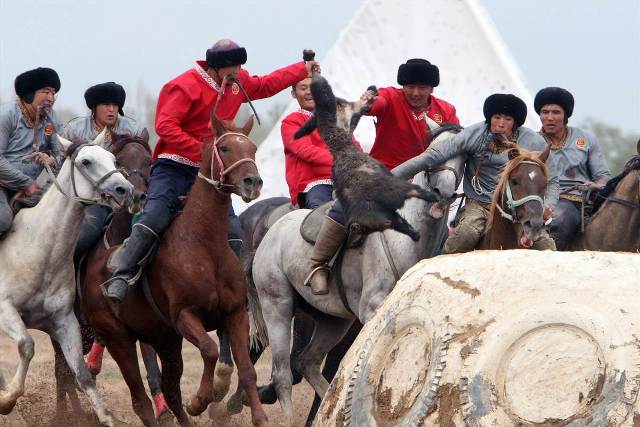
Meanwhile at the World Nomad Games

No, horse racing while on fire is not event; this is from the opening ceremonies. Apparently fire riders are a traditional Kyrgyz way of honoring an elite visitor.

Wikipedia lists the events of the Games like this:

  • Alysh (Kyrgyz: Алыш), a kind of belt wrestling,
  • Salburun (Kyrgyz: Салбурун), a sport mixing falconry, mounted archery and hunt assisted by Taigan [dogs],
  • Shagai,
  • Horse racings (At Chabysh), (Kyrgyz: Ат чабыш),
  • Er enish, (Kyrgyz: Эр эңиш),
  • Toguz korgool, (Kyrgyz: Тогуз коргоол),
  • Kourach,
  • Kok-boru, a sport similar to Buzkashi, a kind of polo played with a goat carcass. (Kyrgyz: Көк бөрү)

Very helpful to know that Kok-boru is similar to Byzkashi; that explains so much. I take it this is the sport in question. According to The Guardian, this is "the biggest draw and most fiercely contested sport." Looks like a blast.

Weird that Shagai is on wikipedia's list, since it is an old gambling game played with the ankle bones of sheep as dice. But maybe you can get really good at it.

I'm also wondering about Salburun, the trifecta of falconry, hunting, and mounted archery. If the modern pentathlon (running, swimming, horse riding, shooting and fencing) was supposed to represent what a military courier might have to do to bring a message from behind enemy lines, what is Salburun? What a nomad might have to do to get dinner?

In case you were curious, Er enish is a kind of wrestling done on horseback, with hurling your opponent to the ground as the equivalent of a pin; Toguz korgol is a board game something like backgammon; and Kurash is something like judo. As you can see from the picture above, at Er enish the skill of the horse matters as much as that of the man; this one is kicking the opponent off his horse. According to CBS News this was not part of the games but an impromptu bout that broke out among some men who got bored waiting for the opening ceremonies to begin.

The Best Bag

The United Kingdom Environmental Agency carried out detailed calculations to figure out how much carbon is produced by each kind of bag you might use at the store.
The UKEA study calculated an expenditure of a little less than two kilograms of carbon per HDPE bag. For paper bags, seven uses would be needed to achieve the same per-use ratio. Tote bags made from recycled polypropylene plastic require 26, and cotton tote bags require 327 uses. (Although they weren’t included in the study, one can presume that designer totes, made with leather adornments, metal, and so on drive the required number of uses into basically astronomical numbers.)
Single use plastic bags come across well because they are so cheap and easy to make. If you use one twice, you are probably doing as well on your carbon budget than you would with any tote bag, since tote bags tend to be discarded before they are used 50 times.

Cotton bags are expensive, in both cash and carbon terms, because agriculture is just a less efficient way to make things than modern petrochemistry. By the time you have plowed, planted, fertilized, harvested, shipped, combed, spun, woven, shipped again, and so on you are using up a lot of oil.

Of course this is just the carbon budget side of things, and it doesn't take into account how many bags end up littering the landscape or dissolving into the oceans. Nor does it get into the deeper question of disposable thinking, that is, how our whole relationship with material things has been changed by our sense that they are all meant to be used for a short while and then discarded. But a hyper-rational approach to reducing CO2 emissions, for example via a steep carbon tax, would not move us from plastic to organic cotton; rather the reverse.

More Failures of Military Intelligence

The difficulty with using even the best intelligence is underscored by this story from the Arab-Israeli wars. In 1970 Ashraf Marwan, the son-in-law of Egypt’s President Gamal Abdel Nasser and one of his closest confidants, volunteered his services to Mossad as a spy. He was code-named Angel and was for years Israel's best agent:
A new book by veteran Israeli intelligence expert Uri Bar-Joseph tells the story of the Angel, Marwan’s code name, in detail. This is a tale of espionage at the highest level. The Angel provided Israel with Egypt’s entire order of battle for its armed forces and Egypt’s war plans for attacking Israel across the Suez Canal. He provided details of Sadat’s meetings with the Soviet leaders and up-to-the-minute reports on Soviet arms deliveries to Cairo.

But the Israeli military intelligence experts in the Directorate of Military Intelligence, which was solely responsible for producing the national intelligence estimates on whether Egypt would go to war, were convinced Sadat would not take the risk. The DMI had a concept of war planning. In the concept, Egypt could not beat Israel because of Israel’s overwhelming air superiority, which Egypt’s leaders knew made war suicidal. Thus Sadat wouldn’t attack.
So despite clear warnings from their top agent the Israelis were surprised by Egypt's 1973 attack across the Suez Canal, and it took them hard fighting and good luck to avoid losing a whole infantry division to Egypt's pincer attack.

The story doesn't get any better after the war. Eli Zeira, the chief of Israel's Directorate of Military Intelligence, faced hard questioning about why he had not taken Marwan's warning seriously. He responded by launching a covert campaign to smear Marwan as an untrustworthy double agent, eventually leaking so many details about his spy that Marwan's identity was exposed by the press, leading to his murder in London in 2007. Now that's a great way to encourage future agents to risk their lives for you.

Monday, September 5, 2016

Swallowtail


London's Burning

Yesterday the City of London commemorated the Great Fire of 1666 by setting fire to a 400-foot long model of the 17th-century city, installed on barges along the waterfront.


The model was designed by American artist David Best, based on contemporary engravings.


Famous map showing the burned area, and detail. The fire burned for four days and consumed 13,000 buildings, 87 churches, and the cathedral, but it burned rather slowly, so there were very few deaths.


Views of the city from the south bank.

A Strange Place to Live

The proprietors of the Cavin-Morris Gallery in New York, whose stuff I feature here from time to time, posted these pictures of their residence.

I look at these and think, How can anybody live like that? I mean, the art is amazing, but who could be comfortable surrounded by so much expensive, fragile stuff? I would have to tiptoe around, elbows in, and chances are I would still knock something over at least once a week. Yow.

Imagine stumbling on those stairs.


Sunday, September 4, 2016

Morning Glories Gone Wild


Self-seeded morning glories climbing up the front of my house, yesterday. Today I managed to get outside during the half hour between when the sun hits them and they close up, with the results below.


Goddesses of Heraklion

At the Museum of Heraklion on Crete is a display of terracotta figurines known collectively as the Goddesses with Upraised Hands. The tallest is about a meter (40 inches) high.

All date to the "post-Palace" period of Cretan history, 1400 to 1100 BCE, when the great Minoan palaces had been wrecked and the island was more or less a colony of Mycenaean Greece. They came from religious sanctuaries at sites around the island.


Besides being more evidence for my theory that the Bronze Age was the great era of silly hats, these statues summon up a vision of Crete as a post-apocalyptic world, where people who lived amidst the ruins of their gorgeous palaces, under the harsh rule of dour foreigners, and retreated to caves or remote shrines to find solace in worshiping these crude goddesses.

The most famous of the set is the Poppy Goddess, crowned with poppy seed pods. She stands 0.8 meters (31 inches) tall. She was found in Gazi and dates to 1300-1200 BCE. She is beloved of modern drug cultists but to the ancient Greeks poppies were more associated with sleep and death than good times, and some archaeologists think she is the goddess of the underworld.

Because Donkeys Don't Judge

Weird and fascinating look at Hudson Valley Donkey Walkers, 400 people who hang out with miniature donkeys for therapeutic purposes:
On this day, the guests included Brittany Hill, who has been living with leukemia for 11 years, and an extremely shy man who by the end of the afternoon would speak of the confidence that walking a donkey had given him.

Ms. Hill, 26, said she kept returning because donkeys “don’t judge.”

“They understand, even though they don’t talk,” she said.

Indeed, anyone expecting a miniature-donkey meet-up to be some kind of braying contest was in for a surprise. “Their instinct is to ponder things,” Mr. Stiert said.
The love we have for our pets speaks to something deep about our needs, and to the trials of life as a social mammal. Interactions with other humans can be great but are always fraught: am I being judged? lied to? laughed at? despised?

So we have bred animals whose sole job is to love us unconditionally, to meet some of our needs for society and affection without the risks inherent in loving and trusting another person.

Saturday, September 3, 2016

Rubens: Eleven Studies of Women's Headdress

Worth enlarging for a fascinating look at 17th-century fashion.

Meanwhile in Suburbia

The Frederick News-Post reports on the latest round of protests in the local schools:
On Wednesday morning, as a dozen Urbana Middle School eighth-graders prepared to enter school, most wore baggy yellow T-shirts that read in marker: “I am more than just a distraction.”

They were among students in two Frederick County Public Schools who claim their respective schools’ dress codes unfairly target girls and promote a culture of shaming them.

School district administration said the dress codes, which individual principals have wide latitude to determine in their respective schools, are in place to ensure a safe, nurturing learning environment, free of distractions.

Urbana Middle welcomed a new principal this year, Peter Daddone from Montgomery County Public Schools. Girls at the school, interviewed on Wednesday, said Daddone has taken an authoritarian approach with enforcing the dress code, making them wear ill-fitting yellow T-shirts to cover up dress code violations.

Dress code infractions have been turned into a verb by students and parents — students are “dress-coded” when they violate the policy.

District spokesman Michael Doerrer said the yellow T-shirts are not a punishment, and merely a way for each student to return to class until a parent can bring an appropriate outfit to school.

“It’s not a scarlet letter,” Doerrer said.

Students at Urbana Middle, however, disagree.  . . . Students started “rebelling” on Monday, in part because they felt humiliated by the yellow shirts, eighth-grader Abby Carioti said. That day, when students infringed on the dress code and were given the shirts, the entire cafeteria cheered when they walked back in.

“They’re telling us it’s our responsibility to not be distracting, when it should be their responsibility,” Carioti said of the administrators.
I was told about this by a colleague whose daughter is involved. Her complaint was that it is all but impossible to buy clothes that conform to the code, viz., she once tried to reject as too short a pair of shorts her daughter had picked out, but her daughter showed her that there were no longer shorts to be had anywhere in the Mall. She was also pissed because this same principal said that the girls only had to wear the yellow shirt "until their mothers bring them something more appropriate," a trick for a woman like her with a job in downtown DC.

I love it that it was actually the school spokesman who made the analogy between the yellow shirts and the scarlet letter. Bit of a guilty conscience there, perhaps?

Maria Theresa's Chasuble

In Vienna, the Schatzkammer is displaying some of their amazing collection of ecclesiastical vestments, which are considered too fragile to be on permanent display. This is a chasuble worn by 18th-century Empress Maria Theresa; the image file calls this a "Black Ladies Chasuble," but I can't seem to find out what that means; perhaps there was some ritual in which the empress and her ladies all wore black dresses and these. Via The History Blog.

Friday, September 2, 2016

Meeting Trump's Louisiana Supporters

Arlie Russell Hochschild wanted to understand the other half of America's great divide, so she left Berkeley and spent years among white Tea Party supporters in Louisiana, visiting their homes and talking to them about their problems. This is her summary of their worldview:
What the people I interviewed were drawn to was not necessarily the particulars of these theories. It was the deep story underlying them—an account of life as it feels to them. Some such account underlies all beliefs, right or left, I think. The deep story of the right goes like this:

You are patiently standing in the middle of a long line stretching toward the horizon, where the American Dream awaits. But as you wait, you see people cutting in line ahead of you. Many of these line-cutters are black—beneficiaries of affirmative action or welfare. Some are career-driven women pushing into jobs they never had before. Then you see immigrants, Mexicans, Somalis, the Syrian refugees yet to come. As you wait in this unmoving line, you're being asked to feel sorry for them all. You have a good heart. But who is deciding who you should feel compassion for? Then you see President Barack Hussein Obama waving the line-cutters forward. He's on their side. In fact, isn't he a line-cutter too? How did this fatherless black guy pay for Harvard? As you wait your turn, Obama is using the money in your pocket to help the line-cutters. He and his liberal backers have removed the shame from taking. The government has become an instrument for redistributing your money to the undeserving. It's not your government anymore; it's theirs.


I checked this distillation with those I interviewed to see if this version of the deep story rang true. Some altered it a bit ("the line-waiters form a new line") or emphasized a particular point (those in back are paying for the line-cutters). But all of them agreed it was their story. One man said, "I live your analogy." Another said, "You read my mind."
I think that is part of the story, but far from all of it. The sort of  white solidarity politics Trump has perfected is only partly about economics. Another big part is the sense of violence and disorder that pervades America; Trump talks more about immigrants as criminals than about immigrants taking jobs. To his followers the country is in danger of falling into violent chaos, and that can't be our fault so it must be someone else's.

Another part is basic tribalism vis-a-vis the rest of the world. One thing about Trump that confuses mainstream observers is his foreign policy; is he for more foreign wars and interventions or less? Neither, actually. What bugs Trump and his fans about American foreign policy is a sense that we are losing, and what they want is to feel like winners again. His basic position about for example the Islamic State is that they are winning and we need to turn that around; ditto his position on trade with China, which is not based on an economic analysis of trade's effects but a raw sense that they are beating us.

People who praise the strength of old-fashioned communities, such as small white towns in the South, usually ignore the extent to which their strong senses of togetherness are based on violent opposition to outsiders: Indians, Yankees, Nazis, Commies, liberals, uppity blacks. Trump taps into a sense of economic unfairness, yes, but he is also making a more primitive call to rally the home team against threats from the outside.

Alfonzo Balzico: Cleopatra, 1874


Photos by adrianovero.

Thursday, September 1, 2016

Veselin Atanasov

Autumn's Motif, shot in the Balkan Mountains of Bulgaria. From National Geographic.

Knowing Each Other

Interesting bit of psychological trivia:
It’s true that couples are better at knowing each other’s minds than are strangers, but it’s not by very much. Strangers, remember, were able to guess what each other might be thinking and feeling at an accuracy rate of 20 percent. Couples, in comparison, did only a little better, guessing right an underwhelming 35 percent of the time. In his book, Epley describes a similar experiment, one that worked something like a nerdy Newlywed Game: One half of a couple took a series of surveys, while at the same time in a separate room, the other half of that couple was taking the same set of surveys — only they were instructed to predict the way their significant other would likely answer. One question, for example, asked participants questions about their sense of self-worth, ranking how much they agreed on a scale of one to five with statements like “I tend to devalue myself.” (These were not exactly lighthearted questions.) On average, people were pretty good at predicting their partners’ answers, getting them right about 44 percent of the time. But they were not nearly as good as they thought they’d be: When asked to predict their own accuracy, they assumed they were getting these questions right 82 percent of the time. “These couples hit a double,” as Epley explains it, “but they thought they’d hit a home run.”

What’s even more disheartening, though, is that “this overconfidence increased in proportion to how long two people had been together,” he continues. The couples in this study had been dating for up to six years, and the “longer they had been together, the more they thougth they knew about their partner … More time together did not make the couples any more accurate; it just gave them the illusion that they were more accurate.”
Personally I think they didn't have the right people in the study. In terms of knowing each other, dating for six years is trivial compared to having been married for 20.

Defining Modernity

Adam Kirsch in the New Yorker:
We like to think of ourselves as living in an age of unprecedented disruption. Just look at all the commonplace features of our world that didn’t exist a century ago—jet travel, television, space flight, the Internet. If you could transport someone from the year 1916 to the present, we ask a little proudly, wouldn’t that person be stupefied by the changes? And, of course, he would be, at least for a few days, until he figured out how everything worked. But one thing would be very familiar to such a time traveller: the pride, and the anxiety, we feel about being so modern. For people in the early twentieth century were as acutely aware of their modernity as we are of ours, and with just as good reason. After all, they might have said, imagine someone transported from 1816 to 1916: what would that person have thought of railroads, telegraphs, machine guns, and steamships?

Modernity cannot be identified with any particular technological or social breakthrough. Rather, it is a subjective condition, a feeling or an intuition that we are in some profound sense different from the people who lived before us. Modern life, which we tend to think of as an accelerating series of gains in knowledge, wealth, and power over nature, is predicated on a loss: the loss of contact with the past. Depending on your point of view, this can be seen as either a disinheritance or an emancipation; much of modern politics is determined by which side you take on this question. But it is always disorienting.
I second this; the defining feature of our age is our experience of the present as something radically different from the past, along with the amount of thought we devote to a future different from either.