Sunday, September 11, 2022

Putin's Situation

From Dmitri at WarTranslated, English-language Twitter's go-to translator of intercepted Russian phone calls and the like:

Putin’s in a precarious position. On the one hand, his current team can’t make anything work.

On the other, a different, more capable team would hang him at the earliest opportunity.

Conservatives, Liberals, and the Dangerous World

It is an old idea that conservates see the world as a dangerous place, while liberals see it as a safe place to explore, hence their greater openness to new ideas and less interest in militarism.

But this is a cartoon. It completely ignores the question of what dangers we are talking about. To take just one example, many liberal feminists are very worried about the danger of rape. So a serious look at the question might produce a result like this:

Decades of research suggest a correlation between belief in a dangerous world and political conservatism. However, research relied on a scale that may overemphasize certain types of dangers. Furthermore, few other world beliefs have been investigated, such that fundamental worldview differences between liberals and conservatives remain largely unknown. A preregistered study of nine samples (N = 5,461; mostly US Americans) found a negligible association between a newly improved measure of generalized dangerous world belief and conservatism, and that the original scale emphasized certain dangers more salient to conservatives (e.g., societal decline) over others most salient for liberals (e.g., injustice). Across many measures of political attitudes, other world beliefs—such as beliefs that the world is Hierarchical, Intentional, Just, and Worth Exploring—each explained several times more variance than dangerous world belief. This suggests the relevance of dangerous world belief to political attitudes has been overstated, and examining other world beliefs may yield insights.

Over the past six months I have spent a lot of time reading various miltiary thinkers and writers, some of whom are very conservative. I will say that a majority are obsessed with danger in the world: Iran-sponsored terrorism, Houthi anti-ship missiles, a Chinese invasion of Taiwan. They like to stare at graphs of rising Chinese naval strength and get really mad about it. They identify strongly with Israel as a place under siege by nefarious elements who might attack at any moment, and who can only be stopped by constant armed vigilance. They share videos of crime sprees in the US. They see a world in which everything they love is under constant threat from Bad Guys.

I also follow the environmental news, so I also regularly read pieces by people who think the world is dying from climate change, acidification, toxin poisons, deforestation, and so on. 

Who is more afraid?

Some fears cut against each other. While environmentally-minded liberals are afraid of climate chage, many conservatives are afraid of an environmental tyranny that will force them to give up their cars, their houses, their lawns, and their right to have children. Maybe their fears are overblow, but it is not at all hard to find environmentalists who want to ban cars (all of them, not just gas-powered ones) and legally limit childbearing to one per family.

And then there are people like me, who are most afraid of fear itself. None of the American and British commentators I follow is more obsessed with the Ukraine war than I am. Ukraine represents dangers I fear greatly. For me, the greatest danger in the world is what we might broadly call Fascism: armed national pride, fed by a belief that the world is full of enemies who must be opposed by toughness and violence. A fear of disorder so great that it seeks to impose ever greater surveillance, ever greater unity, ever greater control; that equates freedom with chaos. Of that, I am very afraid.

All attempts to reduce political division to simple emotions fail, because the world is too complex, and we are too complex, to be understood reductively.

Saturday, September 10, 2022

Needless Words

Dear Mr. —

It comes down to the meaning of ‘needless.’ Often a word can be removed without destroying the structure of a sentence, but that does not necessarily mean that the word is needless or that the sentence has gained by its removal.

If you were to put a narrow construction on the word ‘needless,’ you would have to remove tens of thousands of words from Shakespeare, who seldom said anything in six words that could be said in twenty. Writing is not an exercise in excision, it’s a journey into sound. How about [Macbeth’s] ‘tomorrow and tomorrow and tomorrow’? One tomorrow would suffice, but it’s the other two that have made the thing immortal.

Thank you, thank you, thank you for your letter.

Yrs,
E. B. White.  

From The Letters of E.B. White

Reminds me of the agents who said they wouldn't read my book because it was too long.

Ukrainian Onslaught Continues

I woke up this morning afraid to check the news from Ukraine, in case the amazing good tidings of the past two days were a mirage. But no; the advance continues. Izium, which Russia took in March after weeks of hard fighting, and even then only after a collaborationist local official handed them a plan of Ukrainian positions and suggested a way around them, was retaken with hardly a shot fired. Seeing that the whole front was collapsing around them, the Russians simply left as fast as they could.

Which was probably the right decision for them, but having to secure another city would at least have slowed Ukrainian forces a little. Instead they are simply plunging onward into the vaccum left by fleeing Russians.

Now the word is that the Russians have also abandoned Lyman, another town they fought hard to take. And still there is no sign of any force forming to stop the Ukrainian advance. There are traffic jams at the Russian border as civilians who collaborated with Russia try to cross.

The only good news for Russia is that most of their troops seem to have escaped, so far, by running faster than their pursuers. But not all; Ukraine reports "thousands" of prisoners, and we have pictures of two captured Lt. Colonels (battalion commanders). Probably hundreds more Russians are just wandering around now in areas bypassed by the fighting, and will be rounded up in coming days.

Photographs of abandoned and destroyed Russian gear are flooding the internet. And this includes high value items like radars, electronic warfare stations, surface-to-air missile launchers, and self-propelled artillery pieces. Dozens of abandoned supply dumps have also been photographed, including large ones in Balakliya and Kupyansk.

I should note that some western observers have been expecting this. They noted a couple of things: first, reports about the shortage of soldiers for the Russians, the forced recruitment of untrained old men into LPR and DNR units, etc., which, taken together with the ongoing Russian offensive in some areas, meant that they could not have enough good troops to defend their whole line; and, second, rumors of new forces being built by Ukraine, along with the fact that some weapons known to have been donated by the west had not been seen in combat, which meant Ukraine was assembling a reserve somewhere, for something. The betting was that this would be used for a major counter attack, although nobody knew where.

Russia simply tried to hold too much territory with too small a force, especially given that they had significant forces concentrated at the locations in Donbas where they were still attacking. The line was bound to crack sometime.

People are noticing that things are hardly going as Putin predicted. Already we have seen rumblings of dissent in Russia, with calls by local officials for Putin to be arrested. This collapse won't help. Here's a good observation:

To foresee literally none of the consequences of the invasion has to be called quite an achievement by Putin.

And I think this is fair:

Given the situation for his forces, Putin's silence over the past days looks rather pathetic. At least, say something to your people.

A cowardly loser.

Zelensky spoke to his people every single day even on the darkest of days. This is leadership, and this is why what is happening is indeed happening.

Friday, September 9, 2022

Links 9 September 2022

Bronze beast found in excavations at Sanxingdui, China, 150 kg

Accusations of "indoctrination" in America public schools go back to the 1840s, when there were ugly battles over whether "non-denominational" religious instruction was really anti-Catholic.

Psychedelics have some promise in the treatment of depression and other mental health problems but some worry they are being dangerously over-hyped.

Photographs of interesting human figures made from trash illegally imported into the Democratic Republic of the Congo, half art, half protest.

The "Toledo War" over the boundary between Ohio and Michigan.

Wonderfully detailed picture map of the road to Kyoto, 1690.

A visti to the Cimetière des Chiens et Autres Animaux Domestique in Paris, one of the world's oldest pet cemeteries.

Twitter thread on the dismal arithmetic of book publishing. Most books sell very, very few copies.

And a Twitter discussion of the new labels on the art works at the Burrell Collection in Glasgow, glossed by one writer as "the worst I have ever seen." What happens when the desire to be accessible crosses with wokeism.

Nearly a quarter of Hong Kong's young workers have emigrated in the past year.

Good explainer on the water crisis in Jackson, Mississippi: the underlying problem is disinvestment, driven by the falling population, severe city budget crisis, and lack of interest by the state legislature in helping a majority black city. Interesting to note that when a city's population falls, all of the old water infrastructure remains in place – even the parts no longer serving anyone – becoming an ever-greater maintenance burden.

Americans are unhappy with the economy, but our GDP is doing much better than that of the big European economies, and our inflation is lower. And that's without even factoring in Europe's war-related energy price spike. (Kevin Drum)

Ancient Maya graffiti.

An argument that cell phones reduced violent crime by making it less important for drug dealers to control territory. 

Via the Silicon Tribesman, photographs of the array of Roman shoes found at Vindolanda. And more of the same.

South Korean government proposes providing parents of newborn children a subsidy of about $740/month in a desperate attempt to raise their birth rate, one of the world's lowest.

Black flight: hundreds of thousands of African Americans have moved to the suburbs, and blacks are now not much more likely than whites to live in big cities. Some people blame "gentrification" but what's really going on is that all the races are becoming more alike in terms of where people want and can afford to live.

In response to the energy crisis created by the Ukraine war, European governments are abandoning orthodox economics and ramping up their spending amidst high inflation. Some are also enacting price limits, profit taxes, and the nationalization of key firms. “Government intervention is back in vogue in a really big way,” says one consultant. People like or tolerate capitalism when things are good, but quickly move away from it in a crisis. (NY Times)

Interesting that event planners in Britain have for years been taking out insurance in case their events had to be cancelled due to the queen's death.

In the NY Times, David Brooks takes on one of the worst trends in American business, the open-plan workplace: 
For decades, research has found that open plan offices are bad for companies, bad for workers, bad for health and bad for morale. And yet they just won’t die. Human beings, if they are to thrive, need a bit of privacy — walls and a door. And yet employers, decade after decade, neglect to give workers what they need, refuse to do what’s in their own self-interest.

Ukraine Update 9 September 2022

Major news from Ukraine! In the north, east of Kharkiv, Ukrainian forces broke through Russian lines and advanced nearly 40 km over the past two days. They have taken hundreds of prisoners and captured dozens of vehicles and artillery pieces. On Friday morning they reached the outskirts of the railroad junction of Kupyansk, which is a key supply node for Russian forces in the north. And they may keep going, since there doesn't seem to be anything to stop them.

The story seems to be that in order to defend Kherson in the south and maintain its own offensive in the east, Russia stripped much of its line of army troops. Defense was left to barely trained reservists from the LPR and DNR, Russian police forces, and so on. Front line men were dug in, but there were few tactical reserves behind them. 

On Tuesday morning Ukraine launched an assault at a point in the line just north of Balakliya. According to Russian bloggers, this was led by an "powerful armored fist" of 15 tanks. (Which is not really a lot of tanks; on this front in WW II an "armored fist" would have been at least 40 tanks, and both sides have hundreds of tanks in action.) The front line was overwhelmed, and with no reserves the Ukrainians simply poured through the gap and drove on through one town after another. Again according to Russian sources, the main defenders of Balakliya were Rosgvardia (police) troops whose only heavy weapons were two mortars they did not know how to fire, and who did not know how to reach artillery support on the radios they had been issued. Unsurprisingly, they surrendered or ran. According to Igor Girkin, the attack was aided by Ukrainian special forces roaming in Russian rear areas, causing trouble. There was so much chaos that Russian pilots could not tell friend from foe, so they returned from many missions without discharging their weapons, and when they did fire they sometimes attacked their own men.

Already on Thursday Ukraine had regained the road hub of Balakliya, which was a key Russian objective on the first day of the war; Ukrainian troops raised their flag over the city hall and posted a moving video in which they address their President and say, "we have executed your order." And they are threatening much more. Ukrainian troops are taking losses but they seem to be thrilled to be moving forward after months of stasis; this video shows some crazy guys charging into a Russian-held town on their Humvee, heavy machine gun blazing. With that kind of force and momentum it will take a strong defensive position manned by brave soldiers to stop them, and so far there is no sign of such a defense in this area.

Some Russian bloggers are furious at local commanders, because the bloggers had been reporting a concentration of Ukrainian forces in this area for more than a week, but nothing was done to shore up the line. This makes me suspect that the line was not shored up because there were no troops to send. Not that Russia has no more men, but many are still tied up in the slow-moving Donbas offensive, which has taken less territory in the past month that Ukraine took over the past two days. Others are resting and refitting after six months of combat, and as I said a large force has been committed to the defense of Kherson in the south.

Russian Infantry Fighting Vehicles Abandoned 
during the Retreat from Balakliya

To get an idea of the scale of the losses here, look at the Oryx lists of destroyed Russian vehicles for September 7 and 8, which total 18 tanks, 51 APCs, infantry fighting vehicles etc., 4 towed artillery pieces, 4 self-propelled 152 mm guns, 5 multiple rocket launchers, and 36 others. That's 2-3 battalions, wrecked.

As of Friday morning some observers think the offensive is still rolling and the 10,000 Russian troops at Izium (a major hub with a corps headquarters and so on) are in real danger, and bloggers are frankly begging the Kremlin to send reinforcements. Russian MOD did put out a video showing one battalion of armored infantry on the move, saying they were headed toward Kupyansk, but there's no way to verify that and since Ukraine is said to have 7,000 troops in this offensive, that won't be nearly enough. The advancing forces are pumped up by overrunning one weak Russian position after another and from being cheered by the residents in every town. The map above comes from Rybar, a pro-Russian blogger with a pretty good reputation for accuracy, but it looks worse for Russia than any other map out there. If it is correct, Russian troops will have to abandon a lot more ground in a hurry to avoid capture.

American commentator Mick Ryan says the strategic initiative has shifted decisively to Ukraine.

This could end up being a major turning point in the war. It is a huge moral victory already, lifting Ukrainian spirits and showing their European backers that they can win.

More Ukraine Links

LPR volunteer "Murz" thinks Urkaine's southern offensive will fail, but worries that the Russian leadership will believe their own reports that they have slaughtered Ukrainians and greatly weakened them and then order more suicidal attacks by under-armed and under-trained troops.

Russia has now lost at least 1,000 tanks in Ukraine since February 24, all visually confirmed.

Report from the Wagner Group-affiliated Grey Zone Telegram account on Ukrainian advances in the South.

In Kharkiv, a chimpanzee escaped from the zoo, but then it started to rain and the chimp ran to the keepers who were following it and "agreed to return to the zoo." Video here.

A Russian soldier describes what it's like to be an occupier of Kherson.

Putin seems to be betting that energy warfare will force Europe to abandon Ukraine, but this author doubts that will work. Partly this is because of the impact of Russia's war crimes; after seeing the pictures from Bucha and hearing the regular genocidal pronouncements on Russian television, European leaders are trapped and really cannot make a deal with Putin until he backs down in Ukraine. Plus, the Poles will starve and freeze before they make a deal with Russian invaders, and in the US we are doing fine, and that's really all that's needed to sustain aid to Ukraine.

Here's an interesting tweet: "Spent the day at a parking lot in Zaporizhia where Ukrainians who fled Russian-controlled territories make their first stop. One thing I did not expect: parents saying it's the prospect of their children having to study using Russian programs that finally convinced them to leave." People don't want to watch their children turned against them.

The US supplies Ukraine with the VAMPIRE missile system, which is designed to shoot down drones with missiles that don't cost far more than the drones they are fired at, a major problem with other systems.

MilitaryLand summary of the surprise Ukrainian offensive at Balakliya on September 6-7.

Long interview with a Ukrainian man who just escaped from a Russian-occupied area.

You might have heard that recruitment in the LPR is "scraping the bottom of the barrel;" here's what that means, and what happened when one of these unit found itself in the path of a Ukrainian offensive.

War and tradition: in the first six months of this year Ukraine registered a 21% increase in the number of marriages.

Wednesday, September 7, 2022

Pictish Symbol Stones at the Meigle Museum, Scotland

The Silicon Tribesman photographs a bunch of obscure Pictish symbol stones at the Meigle Museum in Scotland; I've never seen some of these. They mostly date to the 9th to 10th century.


And below, a very famous stone, Meigle 2, depicting Daniel in the Lions' Den.

And below, Meigle 7, one of the older stones with the symbols something are a form of writing.


Tuesday, September 6, 2022

Keeping the Dead from Walking

In Poland, archaeologists have announced the latest in a long series of European "vampire burials," in which measures seem to have been taken to keep the corpse from rising from the grave and causing trouble. The burial dates to the 1600s. The belief that corpses could rise and do harm is very widespread, but it does seem that early modern Europeans had a particular fear of it; to take one example I happen to know about, ancient Babylonians and Assyrians were a lot more worried about ghosts from bodies that had never been buried at all, which they thought roamed in the desert wilderness. As a guess, the European fear of walking corpses has something to do with the Black Death, since the association of vampires with contagious disease is strong in folklore.

This Polish example is a "sickle burial," buried with a sickle across its neck. This does not, so far as I know, appear anywhere in folklore, so it is just a guess that the sickle was intended to keep the body from rising. Some archaeologists have expressed doubts. But what else would it mean? Above is another example, excavated in Poland in 2012.

The most recent example was a mature woman with a strangely placed front tooth (above), which might have inspired rumors about her. She was probably not poor, since she was buried in a silk cap. Besides the sickle, she had a padlock on her toe, which certainly looks like another means of keeping her from walking.

The sickles are only one suspected vampire-thwarting technique. Another method documented in Italy and Poland, was to wedge a brick or stone into the corpse's mouth. In Italy this goes back at least to the 6th century AD. The example above, dating to the 1400s, is known as The Vampire of Venice.

One method that is well documented in folklore, and also in travelers' accounts from the 1700s, is to separate the body from the head. And archaeologists have found several of these, for example a group of graves in Poland that were buried with their heads between their legs. On the other hand this was also sometimes done to criminals, either as a means of execution or after death, so not every headless corpse will be a suspected vampire. 

As you might imagine from modern lore, some bodies had stakes or iron rods driven through their chests to hold them down. In older folklore this is always done to corpses lying in the grave; so far as I know its use on walking vampires is a modern notion.

This area of research may actually have been helped by sensationalizing news stories about these burials. It's certainly the only reason I know about them, and I suspect that Polish and Italian archaeologists might not even know that these techniques were used in both countries if the media had not spread these accounts so widely. I did a lot of research on this sort of thing in the 1990s and at that time there were very few examples in the accessible literature, none of them as clear-cut as these.

Monday, September 5, 2022

Chileans Reject a Proposed New Constitution

Chile's constitution was promulgated by a right-wing dictatorship in 1980. After massive protests in 2019, which were triggered by a proposed hike in Santiago's subway fares but ended up making demands for fundamental change, the government agreed to write a new constitution and put it to the people for a vote.

They held a special election and convened an assembly of 150 people to write a new document. This was an intriguing process, because the assemby included not just politicians but leading figures in other walks of life, such as doctors, educators, a chess master and a gadfly protester who liked to dress as Pikachu. But about 2/3 were to the left, which does not really reflect the positions of Chileans and probably doomed the effort from the start.

The convention eventually came up with a book-length document that enshrined so many rights very few people in Chile ever knew what most of them were, and the voters rejected it decisively.

NY Times:

Chilean voters rejected a 170-page, 388-article proposal that would have legalized abortion, mandated universal health care, required gender parity in government, given Indigenous groups greater autonomy, empowered labor unions, strengthened regulations on mining and granted rights to nature and animals.

In total, it would have enshrined over 100 rights into Chile’s national charter, more than any other constitution in the world, including the right to housing, education, clean air, water, food, sanitation, internet access, retirement benefits, free legal advice and care “from birth to death.” . . .

The text included commitments to fight climate change and protect Chileans’ right to choose their own identity “in all its dimensions and manifestations, including sexual characteristics, gender identities and expressions.”

Which is exactly what I would expect from a roomfull of liberals. We just have trouble saying no. What committee of liberals is going to tell minority rights activists, Native rights activitists, environmentalists, indeed any kind of activists, that they have no place in the constitution and should go home? So the document grows and grows until all the pressure groups get the paragraph they want, and your document looks a lot like a phone book, and then the whole thing crashes and burns.

This is a problem with constitution writing that goes all the way back to the creation of the US version. The people gathered in Philadelphia thought their job was to create a system of government, so they focused solely on the mechanics of government and state power. But they were immediately challenged by people who thought the Constitution should enshrine, not just democracy, but the rights for which Americans had fought. Hence the first ten Amendments, which were approved by the states at the same time as the main document.

And I would say that the history of those ten Amendments shows what a difficult process this is. Most of us feel pretty good about “Congress shall make no law abridging the freedom of speech, or of the press; or the right of the people peaceably to assemble.” But the Second Amendment has caused no end of trouble, and the Eighth is so vague (what is “excessive bail”?) as to be pretty much a dead letter, and the Tenth does nothing but encourage random revolutionaries to blow things up. Two are bizarrely out of date; anyone had trouble recently with the government quartering troops in private houses? And rather embarassing to have $20 dollars written into the Constitution as the threshold for a jury trial in private lawsuits. The problems have continued; the proposed Equal Rights Amendment failed because nobody could say exactly what difference it would make in practice, leaving its opponents to paint all sorts of lurid pictures.

I hate to say it, but this might be a case, and an important one, where putting ten powerful people in a secret room might work better than transparent democracy. I don't think a constutition that enshrines every good thing that people want is workable. I think a lot of people would say that only the most basic and fundamental rights should be listed, but good luck getting 150 people, anywhere in the world, to agree on what those are.

Sunday, September 4, 2022

Electric Rickshaws and Scooters are Taking Over India

From the NY Times:

Indian automakers sold 430,000 electric vehicles in the 12 months that ended in March, more than three times as many as a year earlier. Most were two- and three-wheeled vehicles, with cars accounting for just 18,000, according to industry data. 

If you search for "electric rickshaw" or "electric rickshaw India" what you get is not news articles but a vast array of slick ads from Indian companies. The picture above comes from one of them. In India this stopped being news two years ago and is now just business.

This points to one reason for environmental optimism. Some people say it won't matter how much Europeans and Americans limit their carbon emissions, because rising incomes in China, India, and Africa will increase their emissions so much as to overwhelm the planet. But that doesn't have to happen. In the long run solar power is simpler and cheaper than coal, and that is even more true in the tropics than in temperate latitudes. Solar can also be implemented on a village-by-village basis; in remote parts of Africa and India, beyind the reach of transmission lines, entrepreneurs have set up solar-powered charging stations for phones and other devices. They can do the same for e-scooters.

Nations without oil are moving agressively to put these measures into place, and the fact that electric vehicles now dominate the Indian rickshaw market shows that this can work.

Saturday, September 3, 2022

Casina Pio IV

Yesterday I stumbled across this photograph, captioned Vatican Gardens: Mosaic Walls of the Nympheum, Casina Pio IV. I was entranced and looked up this mysterious building.

I discovered that the Casina Pio IV is a small villa within the Vatican Gardens that now houses the Pontifical Academy of Sciences.

Its construction is not well documented, but construction seems to have begun in the spring of 1558 by order of Pope Paul IV. In that early form it was called the 'Casina del Boschetto'. By the following May a courtier wrote that the Pope spent "two thirds of his time at the Belvedere, where he has begun to build a fountain in the woods".

After Paul IV's death in 1559, Pope Pius IV took on the unfinished project and hired architect Pirro Ligorio to make changes in the design. I couldn't find any indication of who did the sculptures on the facade.

The building is amazing overall, and has many small wonders.


Interior views.


Floors.

Friday, September 2, 2022

AI Wins Digital Art Prize

NY Times:

This year, the Colorado State Fair’s annual art competition gave out prizes in all the usual categories: painting, quilting, sculpture.

But one entrant, Jason M. Allen of Pueblo West, Colo., didn’t make his entry with a brush or a lump of clay. He created it with Midjourney, an artificial intelligence program that turns lines of text into hyper-realistic graphics.

Mr. Allen’s work, “Théåtre D’opéra Spatial,” took home the blue ribbon in the fair’s contest for emerging digital artists — making it one of the first A.I.-generated pieces to win such an prize, and setting off a fierce backlash from artists who accused him of, essentially, cheating.
The prizewinning work is at top and above. Not bad.

Persistence of Social Stratification through Revolutions

From a new paper by Alberto Alesina et al:

Can efforts to eradicate inequality in wealth and education eliminate intergenerational persistence of socioeconomic status? The Chinese Communist Revolution and Cultural Revolution aimed to do exactly that. Using newly digitized archival records and contemporary census and household survey data, we show that the revolutions were effective in homogenizing the population economically in the short run. However, the pattern of inequality that characterized the pre-revolution generation re-emerges today. Almost half a century after the revolutions, individuals whose grandparents belonged to the pre-revolution elite earn 16 percent more income and have completed more than 11 percent additional years of schooling than those from non-elite households. We find evidence that human capital (such as knowledge, skills, and values) has been transmitted within the families, and the social capital embodied in kinship networks has survived the revolutions. These channels allow the pre-revolution elite to rebound after the revolutions, and their socioeconomic status persists despite one of the most aggressive attempts to eliminate differences in the population.

Links 2 September 2022

Okuyama Gihachiro, Morning After the First Snow, 1950s

Photographs of "spirit bears." The kermode bear is a subspecies of the North Americal black bear, and the population of kermode bears in British Columbia has a recessive gene that leads to about 20 percent of them being white.

The US Fish & Wildllife Servie is air dropping millions of doses of oral rabies vaccine wrapped in fish meal – they look like ravioli – across the Appalachian region from Alabama to Maine to reduce the amount of rabies in raccoons and other small predators.

Collection of old news articles illustrating some of the many social changes that were blamed on jazz. Serious question: does any kind of music – jazz, rock, punk, opera – have cognitive effects in itself? Plato and Confucius thought so. Or it is that in the 20th century any kind of music might have become associated with rebellious youth culture?

Did Christianity revolutionize ethics? The review at the link argues that it did. I say, maybe in theory, but in practice Europe continued to despise the weak and downtrodden for a long time. Donald Trump still despises them, and he was elected President by Christians.

NY Times review of a book about why culture seems to be stagnating: when there was a cultural center that everyone recognized, people fought for status within it by innovating. Now that there is no cultural center to fight over, people can only squabble over popularity and money. "It makes more sense for a parvenu to fake a ride on a private jet than to fake an interest in contemporary art." The sad conclusion would be that people only get excited about stuff that lots of others are excited about.

US life expectancy fell again in 2021, so we're back to the level of 2003 now. This was mostly because of the pandemic, but "deaths of despair" (overdose, liver disease, suicide) also remain high.

Tweetstorm providing a succinct summary of the saga of government documents at Mar-a-Lago.

The trapeze disrobing act of circus strongwoman Miss Charmion, filmed in 1901 by Thomas Edison. Film clip here, article here, with much better pictures of  Miss Charmion. She was buff.

The manufacture of amphetamines has long been a specialty of the Islamic state, originally for the use of their own soldiers. Their product is called "captagon," but most of it is just generic methamphetamine. Now they have turned this into an export business; the Saudis and the Turks have both recently reported seizing loads of Captagon pills from Syria worth hundreds of millions of dollars.

Trying to catalog all the miseries of life at the TSA. 

There is a claim that another ancient language has been deciphered: Linear Elamite. But not everyone accepts the claim.

Tinder is 10 years old. Instead of a happy story about all the loving relationships that began online, the NY Times chose to mark this anniversary by runnig a really depressing screed about people burned out from years of fruitless attempts to find a soul mate.

So Gorbachev is dead. I never knew what to make of him, but I was very interested in a book I read arguing that he and his allies moved to reform the Soviet state because they could no longer stand the sheer scale of the lying. The original purpose of glasnost, in this view was just to make it possible for decision makers to get accurate information. It is indeed hard to rule when nobody tells you the truth.

Ukraine Links

How Russia and Ukraine have adapted to a changing battlefield.

Two big Russian Telegram accounts discuss the effectiveness of HIMARS.

LPR volunteer "Murz" reviews the discouraging state of the war six months in. 

Ukraine is increasingly using electronic warfare against Russian drones. And here is an account from the Wagner fightner known as Grey Zone.

NAFO, the ubiquitous shiba inu dog, and the meme war over Ukraine. People really feared that Russian online trolling and so on would have a significant impact on Ukrainian morale and opinions in Europe, but the opposite has happened. Turns out fighting for freedom against evil tyranny is popular.

Two minute video of Ukrainian MiG-29s in combat, includes firing of US-made HARM anti-radar missiles.

Eighteen men from one Russian Spetsnaz unit were killed in a single missile attack on July 19, including their commender, a Major. 

Twitter collection of interviews with Ukrainian soldiers.

Podcast featuring Michael Kofman on Ukraine's "southern offensive." Twitter thread summary here.

Prospects for Ukraine's southern offensive, interesting.

Questions that Lead to Love

From the NY Times, a sample of their 36 Questions that Lead to Love. The theory is that if two people work through this exercise together that can radically accelerate intimacy. What I take away from this is that many people habitually share so little of their inner lives that even a little sharing can be very powerful.

1. Given the choice of anyone in the world, whom would you want as a dinner guest?

2. Would you like to be famous? In what way?

3. Before making a telephone call, do you ever rehearse what you are going to say? Why?

4. What would constitute a “perfect” day for you?

7. Do you have a secret hunch about how you will die?

9. For what in your life do you feel most grateful?

10. If you could change anything about the way you were raised, what would it be?

12. If you could wake up tomorrow having gained any one quality or ability, what would it be?

14. Is there something that you’ve dreamed of doing for a long time? Why haven’t you done it?

15. What is the greatest accomplishment of your life?

16. What do you value most in a friendship?

17. What is your most treasured memory?

18. What is your most terrible memory?

19. If you knew that in one year you would die suddenly, would you change anything about the way you are now living? Why? 

 26. Complete this sentence: “I wish I had someone with whom I could share ...”

Thursday, September 1, 2022

David Weiller, Insect Camouflage


And below, a caterpillar that carries its own fake leaf around. All from YouTube.


Not Being Seen

Cindy Craig, Sometimes I Feel Invisible, 2022, for sale on Artsy

It was reading an article at the NY Times that got me started on this. It was about how Asian Americans feel invisible, unnoticed in a country where other people command all the attention:
In her memoir, Ms. Miller writes about how growing up Asian-American had made her feel “used to being unseen, to never being fully known. It did not feel possible that I could be the protagonist.”
From there I ended up at a The New Republic article about the debate over wokism which included this about Andrew Yang, the author of The Souls of Yellow Folk:
Yang speaks from the tormented perspective of one of the overlooked. Despite outward signs of assimilation and success, Asian Americans, he writes in “Paper Tigers,” are considered “a mass of stifled, repressed, abused, conformist quasi-robots who simply do not matter, socially or culturally.” The men, in particular, are sexually undesirable, powerless, and emotionally crippled by a servile subculture that is obsessed with academic success, with math and violin lessons—with a soulless, by-the-numbers kind of American dream. The proof lies in both anecdote and data: the painfully maladroit men who confide in Yang that they cannot live comfortably in their own skin, the way whites do; the ranks of exquisitely credentialed Asian Americans who fill the middle tiers of this country’s most profitable companies, but rarely make it to the top.
This is of course almost a parody of an old complaint from Black Americans. Ralph Ellison's The Invisible Man (1952) begins:
I am an invisible man. No, I am not a spook like those who haunted Edgar Allan Poe; nor am I one of your Hollywood-movie ectoplasms. I am a man of substance, of flesh and bone, fiber and liquids—and I might even be said to possess a mind. I am invisible, understand, simply because people refuse to see me.
Ta-nehisi Coates once wrote that even Barack Obama was invisible to his opponents, who simply could not see him.

Or this from the NY Times, about Native Americans failing in school:
“I’m just there,” Ms. Fourstar said. “I feel invisible.”
But it's not just minorities! Do a quick search for "I feel invisible" and half the links that come up will be pieces by and about older women. Here's one titled Why Women Our Age are Saying 'I Feel Invisible.'  And another: Are You a Woman Over 45? Guess What? You're Invisible.


What's really going on here is that in a huge society like ours, almost everyone feels invisible. Don't believe me? Just Google. Or go on Reddit, where there are hundres of threads that start like this one:
Lately I've been feeling down and I've just got to get this off my chest... .. . I feel invisible.

Let me elaborate. My whole life I've felt like I was that kid that was just there. The kid that sits and eats their lunch alone, the kid that goes to the school yard and just walks around, viewing what's around him. The kid in the family who was one the one they weren't expecting or didn't want, but then there they are.
The thing that irritates me about this discourse is the assumption that some other group of people feels differently. It's just Asians who feel this way, or Blacks, or women over 45, or introverts. Other people are doing fine. It's an imperialism of suffering, as people try to claim more and more grim ground for themselves while excluding others. You don't suffer like I do!

But that's just wrong. Look around: there are prayers for when you feel invisible, support groups for people who feel invisible, a shelf of books about feeling invisible. Name any subset of Americans with more than a million members and I will bet you that in five minutes I can find at least two plaints that they feel invisible. It is a huge human problem.

Speaking for myself, I spent my whole youth feeling uncomfortable in my own skin – a total failure of a white person, I guess. Watching movies full of white people has never made me feel seen. I do not see George Clooney and think, "There is someone like me." I see a glamorous celebrity who lights up the screen just by looking at the camera, and I am none of that. Why do you suppose anyone puts up with all the hassles of being a celebrity? Because in our world it is only way to really feel seen, and to many people that is worth a vast amount of trouble.

I'm not trying to say that everyone is the same on this metric. People get differing amounts of attention, and some feel a lot more seen than others. This may even correlate with race, although I would bet the correlation is a weak one. 

This game of believing that you only suffer because of something about you or your group is annoying, misleading, uncharitable, uncompassionate, and bad for all of us, and we should stop.

Tuesday, August 30, 2022

Pierre Tallet and Mark Lehner, "The Red Sea Scrolls: How Ancient Papyri Reveal the Secrets of the Pyramids" (2021)

Despite the awful title, this is a book about a major archaeological discovery by two real archaeologists. Unfortunately, the title is not even close to being the worst thing about the book, so I am going to spare you the trouble of reading it by telling you what it says.

The shores of the earth's oceans are mostly rich in life, including human life; most of the non-frozen seas are lined with cities and towns. But not the Red Sea. Until the modern era of canals and steam ships, there were no towns on the Red Sea at all, and hardly anyone lived there. It almost never rained anywhere along its shores; a glance at a map will show you that not a single river flows into the sea. The wind either blew from the north or not at all, making sailing difficult. The Romans found it easier to sail down the Nile for 300 miles and caravan across 200 miles of desert to Berenike rather than try to sail the northern reaches of the Red Sea. 

Old Kingdom Stela Near the Copper Mines of Sinai

But the ancient Egyptians needed and wanted things not found in their own land. Two of the most important to them were copper, from which they made tools, and turquoise, with which they adorned their leaders and honored the gods. Both could be found in large quantities in the southern Sinai peninsula, 150 miles across a bitter desert and then 10 more miles across a bitter sea. Since nobody but a few desert nomads could live on either shore of the Gulf of Suez, no ports or mining settlement grew up. Instead the Egyptians mounted occasional expeditions into that desolation. These were made up of hundreds to a few thousand men. The men were sent across to Suez at the least unpleasant season of the year, there to mine and smelt for a few months until they ran out of food and water. Then they came back, laden with treasure. After, for the benefit of future generations, raising stelae like the one above in which the expedition's leader boasted (always) that his expedition had mined more copper and turquoise than any before him.

All of this has been known for more than a century. A few intrepid 19th-century explorers had even found what they thought were ancient settlements along the western shore of the Gulf, which they thought might be associated with this trade. In 1956 two Frenchmen proposed to make a real study of one of these ports, but then the Suez Crisis erupted and they were expelled from the country. So there things rested until the 1990s, when archaeologists began exploring two sites called Ayn Sukhna and Wadi al-Jarf.

Plan of the Rock-Cut Galleries at Wadi al-Jarf

What they found in those sites has been extraordinary from the beginning. The sites both date to the Old Kingdom, between 2700 and 2200 BC. They consisted of stone building foundations, landscape modifications like terracing and roads, "galleries" carved into the rocks, and, at Wadi al-Jarf, a stone jetty that makes this the oldest artificial harbor yet discovered. 

Jetty at Wadi al-Jarf, 4600 years old

Since, remember, it hardly ever rains here, the galleries contained wonderfully preserved artifacts of wood, fiber, and papyrus.

Artifacts from Wadi al-Jarf

It seems that when an expedition was launched to the Sinai, the whole crew marched to one of these harbors. There they unsealed the galleries, which had been blocked with huge stones, and withdrew the material cached there. This included whole, disassembled boats and various other gear needed for sailing to Sinai. When they were done, they disassembled the boats, put everything back in the galleries, blocked them with with stone again, and marched back to the Nile.

Inscription from the reign of Khufu (2589-2566 BC) at Wadi al-Jarf

One interesting point is that Old Kingdom Egypt needed tons and tons of copper. Sinai copper was naturally alloyed with a little arsenic, which made it harder than pure copper, but still not as hard or durable as bronze. The chisels Egyptians made from Sinai copper were the size of a finger, and experiments show that they were worn half away in just a few hours of work on stone. It boggles the mind to ponder how many chisels were used up building one of the great pyramids – in fact I have not even found an attempt at a calculation. 

Anyway, these discoveries at the Old Kingdom temporary ports were exciting in themselves, revealing a lot about Egypt and providing many fascinating artifacts like these water pots photographed in one of the galleries at Wadi al-Jarf. (The closest spring to Wadi al-Jarf is 6 miles away)

But among the papyrus fragments lodged between two stones at the front of one gallery was a whole bundle of pages covered with similar columns of text. These turned out to be the logs of a work gang from the reign of Khufu, detailing their activities over about seven months, during which they helped to build the Great Pyramid. It's quite astonishing, really, that such a thing should survive. I mean, if you had been at a party with a bunch of historians and they started talking about what lost document they most wanted to recover, and somebody said, "I want the working logs from the building of the Great Pyramid," you would have laughed loud and long at that hubris. But here it is.

These work gangs were a regular feature of Egyptian life; their word was aper. We know about them because they regularly signed their stonework in places where it wouldn't show; dozens of separate gangs have been identified at Old Kingdom pyramids. The crew whose log was found went by the name of "The Escort Team of The Uraeus of Khufu is its Prow." (An Uraeus was a sort of divine snake symbol; it is entirely typical of The Red Sea Scrolls that the authors use the word about ten times before finally defining it on page 185.) The most likely interpretation of the name is that Uraeus of Khufu is its Prow was the name of a ship, and this gang was attached to it.

The gang was made up of four crews. The records are of two sorts, general accounts for the whole aper and records kept by Merer, who was the foreman of the crew known as Great. It is Merer's accounts that are particularly wonderful, since they lay out, day by day, what his men were doing for most of that seven month period. They spent much of it transporting limestone from quarries at a place called Tula to the building site of Khufu's Great Pyramid; the pyramid was once coated with bright white limestone, which was almost all removed in later years. They also spent a month in the Nile Delta working on some kind of maritime construction project, perhaps a jetty or a levee. They spent one day at the royal palace participating in a religious festival, providing some of the cheering crowds needed for great royal events. Then they were sent across the desert to the Gulf of Suez, where they transported supplies to miners. And then, somehow, the log book was lost, ending up trapped between two stones when they were used to seal up one of the rock-cut galleries.

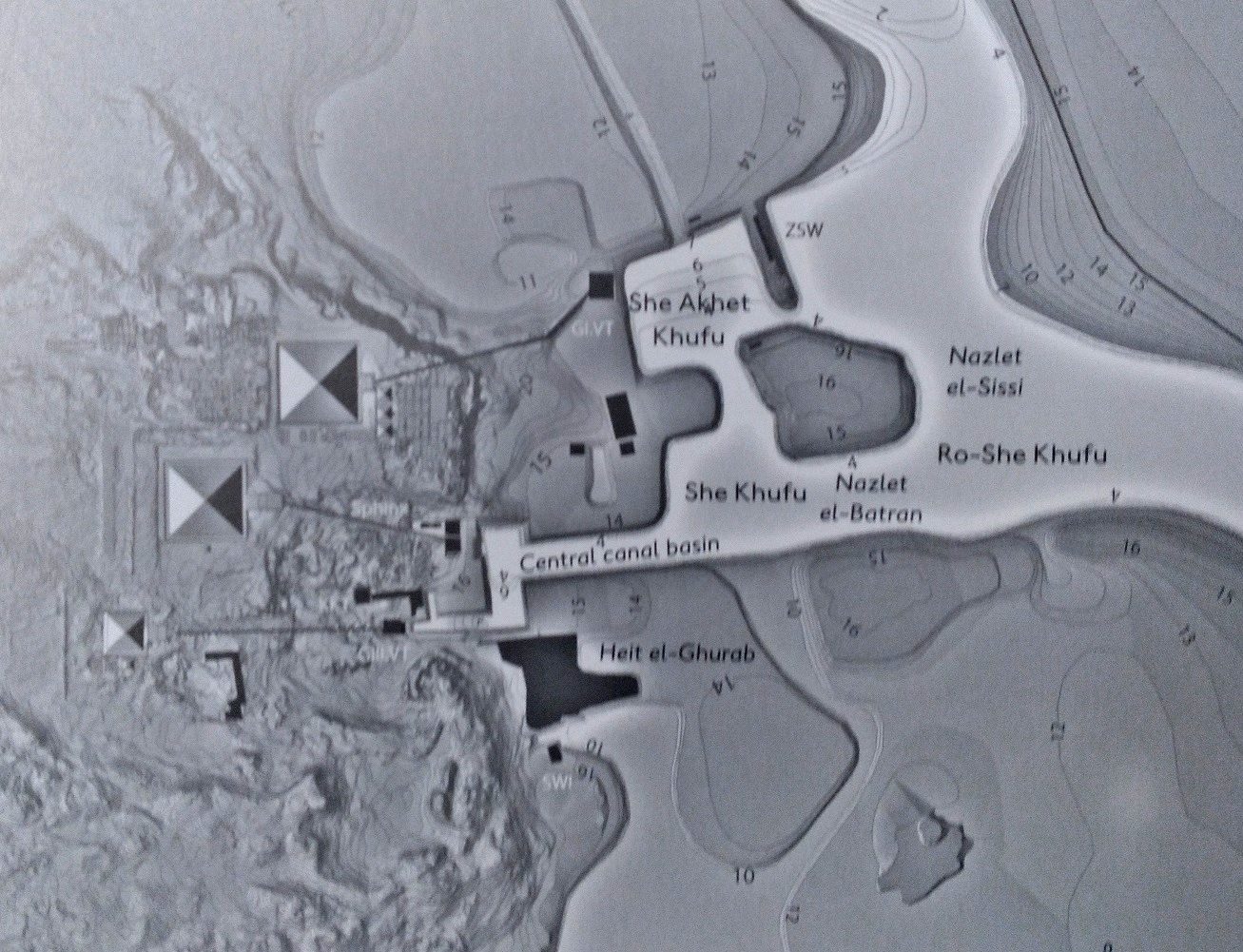
Plan of the artificial harbors and canals at the pyramid building site

From there our attention moves to the building of the Great Pyramid. It seems clear from evidence already found that the building was done by work crews just Merer's. One interesting point is that the dozens of barracks buildings that have been unearthed around the site are divided into sections that seem about the right size for 40 men, so perhaps this was a typical size for work crews.

As for the building of the pyramids, what can one say that hasn't already been said? Calculations done for the quarrying and erecting of all that stone come to around 200 million man-days, at a time when Egypt had about a million inhabitants. And that's just for the pyramid itself; to that you have to add the building of all the associated sub-tombs, temples, processional ways, etc., besides the vast harbor and canal complex (see map above) that was excavated 8m deep, the expeditions to obtain copper for tools, and all the barracks for the workers, the bakeries, the breweries, etc., etc. That might double the total. Khufu reigned for 23 years, or about 8,400 days. Which means that on every day of his reign, about 47,000 Egyptians were working on their king's tomb. If we assume that a million Egytians included 250,000 adult men, it looks like building Khufu's tomb consumed about one fifth of all the male labor available in his kingdom. Remember, also, that this far from exhausts the demands of the Egyptian state; after all Merer's men spent a month on an unrelated project in the Delta, and the pharaohs also conscripted men to fight whenever they needed an army or navy.

Old Kingdom carving of an Egyptian ship

An internet fight has broken out lately over the status of the people who worked on the pyramids. Our old stories say slaves, but Afrocentrists have correctly noted that this is wrong. Most of the labor was provided by regular Egyptians who had been drafted to do this work by the state. When I explained to one of my sons that in less cash-dominated societies governments often extracted labor from their people rather than money, he said, "so instead of taxation as theft, it's taxation as slavery." Yes, pretty much.

The whole internet argument about pyramid labor rests on dubious foundations, especially a clear division between "slave" and "free." The model many Americans have, based on North America in the 19th century, is that some people are slaves with no rights, while others are free people who have many rights and indeed a privileged status. That does not apply at all to ancient Egypt, or indeed to almost anywhere else besides North America and the Caribbean between 1700 and 1865. Egyptians were free to work the land their parents had worked, free to hand over much of their harvests to various nobles and officials who lorded over them, and free to spend years of their lives hauling stone for the Pharaoh's tomb. If they objected, they were killed. The hieroglyph for a work crew (aper) was a cow that had been hobbled so it couldn't wander away.

The discovery of Merer's work logs is astonishing, and I love the story of ancient Egyptians mounting expeditions across to Sinai to mine copper. The building of the Great Pyramid is one of history's grandest and weirdest events, and how wonderful to have found a new source showing how the work crews were organized, and even a few of their names. Maybe some day somebody will write a good book about it.