Showing posts with label Ukraine. Show all posts

Thursday, July 23, 2026

Drones and Economic Warfare

Daniel Miessler on Twitter/X:

Something that the Ukraine and Iran wars have taught me is that for a lot of countries, including very big countries, there are a small number of buildings and infrastructure components that are required for their economy to function. . . .

You can just make a list of oil refineries and production plants and the infrastructure around their main exports, and you can just attack them and destroy them and take them off the list.

4 years ago I would have thought there are too many of these components and they're too easy to recreate, but both of these collisions have taught me that there are far fewer and that many of them will take years, if not over a decade, to rebuild.

It's very strange to me that drones can now effectively harm the economy of a country. 

According to the Kyiv Post, Russia's capacity to refine oil has fallen by 43 percent, and I have seen other serious estimates as high as 58%. This hurts, as the long lines at gas stations show.

And now attacks on Wildberries warehouses; Wildberries is sort of the Amazon of Russia, and these warehouses hold billions of dollars worth of stuff. Forbes estimates the losses in three warehouse attacks like this.

  • Seller inventory losses in the Moscow region: at least 150 billion rubles ($1.91 billion) and warehouse restoration cost: up to 33 billion rubles ($420 million).
  • Seller inventory losses in Krasnodar and Nevinnomyssk: 100–120 billion rubles ($1.27–1.53 billion).
  • Total estimated damage: 283–303 billion rubles ($3.60–3.86 billion).

On the one hand, yes, it is impressive how much damage Ukraine is doing to Russia's economy, especially when you consider that Russia has enormous air defense resources compared to most other nations. On the other, the war goes on, and neither side seems interested in peace, after many months of attacks employing tens of thousands of drones. It may be possible to seriously damage a nation's economy, but it is not easy.

Saturday, July 18, 2026

Moscow, Today

Smoke from a burning warehouse after a Ukrainian drone attack.

Wednesday, July 8, 2026

A New Russian Joke is an Old Soviet One

A Russian man is in line at the gas station. "I've had enough," he says to his wife. "You take the wheel, I'm going to shoot Putin."

After two hours he returns and gets back behind the wheel.

His wife asks him, "Did you shoot him?"

And he replies, "No, the line to shoot Putin is longer than this one!" 

–source

Sunday, June 7, 2026

Nature Adapts

Bird's nest in Ukraine made largely from discarded fiber optic drone cables. (Source)

Wednesday, June 3, 2026

What's Slowing the Russian Army

Jack Watling at Foreign Affairs, from an article titled Ukraine Turns the Tide:

Russian recruitment has kept pace with losses in large part because of the strong financial incentives offered by the Kremlin, including significant pay and debt forgiveness. Although this approach has proved to be an effective way of drawing unskilled new soldiers, it has not attracted a corresponding body of technical specialists who can command reasonable salaries in the civilian or military-industrial economy. The Russian army, for example, is far below its recruitment targets for drone operators.

Pay as the primary motive for service has also created an accumulation of personnel in Russian units who are eager to avoid combat. Officers accept bribes from soldiers who don’t want to be part of an assault. Meanwhile, soldiers who break the Russian military’s growing array of contradictory standing orders are punished by being thrown into assaults. This uncompromising approach often sweeps up important support troops, such as those responsible for logistics, who have run afoul of regulations. In a force in which logistics is overwhelmingly coordinated through the social media app Telegram, but in which Telegram is banned, a conscientious logistician is at high risk of finding himself stopped by the military police and either being shaken down for money or reassigned to assault units.

The result over time has been a buildup of connected and fee-extracting soldiers at intermediate echelons, such as the regiment, and a hollowing out of personnel with any professional experience in subordinate units as they are killed or wounded in attempted assaults. The lack of quality at lower levels has seen a deterioration in performance and an inability to execute plans or orders. Many officers have received their promotions in the field, without having gone through extensive officer training, and their foremost task has been to psychologically prepare their soldiers for attacks rather than to plan and execute competent attacks in the first place.

In previous years, the devastating effect of Russian artillery, drone strikes, and glide bombs compensated for the poor performance of Russian infantry. But the battlefield now looks and functions very differently from how Russian military planners are used to imagining it. Today, the battlefield does not consist so much of opposing frontlines as it does a belt of contested territory some 18 miles wide in which both sides are intermingled. The cartographic tools that Russian planners use are not well suited to accurately reflect how forces are fighting. The result is a divergence in what Russian planners map, and what orders are actually possible to carry out. That has led to growing inefficiency in the coordination of strikes.

Nor do officers at lower levels necessarily know how to execute the orders they receive. Intermediate level officers, moreover, are encouraged to report success up the chain. These factors have brought about a growing discrepancy between where senior Russian commanders think their troops are, and the reality on the ground. As a result, the Russian military routinely makes mistakes in assigning artillery and drone assets and issues an array of orders, premised on bad information, that cannot be carried out. In short, Russian forces are increasingly unable to turn plans into military operations, with a corresponding weakening in their attacks.

Much more at the link, unpaywalled for now.

Monday, May 18, 2026

Layered Defense in Ukraine, with Some Thoughts on the Battle

Via Perun's new video on the battlefield situation in Ukraine, an example of Ukraine's new approach to defense. Many of the barriers are intended to slow or stop light troops on motorcycles and SUVs; hung up the wire, they become easy marks for drones.

The traditional way to breach such a line would involve heavy use of armored vehicles, but Russia is running low on those and is reluctant is expose them to drone attack. Russian artillery fires are also way down, partly due to the drone threat, partly due to ammunition shortages. So Russia relies on glide bombs to blast gaps in these defenses. That is going very slowly, which is why Russian progress is so slow this year.

Perun accepts the evidence that Russian progress has slowed to near zero, and he gives credence to the argument that Russia is now losing more troops than it is recruiting. He notes that this doesn't necessarily project into the future, but says there should be "cautious optimism" that things have shifted Ukraine's way.

Monday, May 11, 2026

Putin is Looking for a Way out of His War

Like Trump, Putin seems to be searching for a way out of the unwinnable war he started. Reuters:

Russian President Vladimir Putin said on ​Saturday that he thought the Ukraine war was coming to an end, remarks that came just hours after he had vowed victory in Ukraine at Moscow's most ‌scaled-back Victory Day parade in years. "I think that the matter is coming to an end," Putin told reporters.

Exactly how that end would come about it unclear, since Russia still officially maintains its maximal war aims, which an undefeated Ukraine will never accept. As Noah Smith explains, this shows the limits of dictatorial wars of choice:

Ukraine never threatened Russia at all. The whole Russian cause in this war is based on the notion that Ukraine’s potential accession to NATO and the EU was threatening Russia’s “sphere of influence.” But the idea of “spheres of influence”, while sometimes a good factual description of how powerful countries operate, is not a good moral principle. The idea that countries deserve “spheres of influence” is just the claim that powerful countries ought to dominate their weaker neighbors. In other words, it’s just imperialism.

Morality doesn’t field divisions, of course…or does it? Putin can pay desperately poor people to fight in his wars, or empty his prisons of criminals, or buy mercenaries, but can he persuade regular middle-class Russians in Moscow and St. Petersburg to die for the glory of the New Russian Empire? Not really, no — which is why as soon as casualties get too high to replace without general mobilization, he starts to think about ending the war.

Ukraine, meanwhile, was defending itself against conquest — a conquest that would have stripped away its national identity, brutalized its population, and kept it in poverty. That threat provided a powerful motivation for regular Ukrainians to sign up and risk their lives on the battlefield. Ukraine became a nation in arms, while Russia was still trying to fight a “special military operation”, because Ukraine had a compelling cause and Russia had an unconvincing one.

Tuesday, January 27, 2026

The Lonely Soldier

In one of the saddest videos of the war, a lone Russian soldier is sent on a solo march across a kilometer of open, treeless, snow-covered ground toward Ukrainian positions, without any winter camouflage. He doesn't even try to hurry, but just trudges along, knowing he is doomed. 

The Ukrainian observation drone has plenty of time to study his progress, tracking him until an attack drone can fly in to kill him.

One supposes this was some kind of punishment, but given how the Russians are operating, who knows? The whole scene summarizes for me the awful waste and inhumanity of Putin's terrible war.

There is another awful video going around these days that shows a Russian soldier sitting in a shell crater, surrounded by the corpses of seven or eight other Russians. He doesn't dodge or flinch or show any emotion as the drone flies at him, just sits there, staring straight at it, perhaps stunned by whatever killed his comrades, but perhaps welcoming an end to his nightmare.

Sunday, January 11, 2026

A Russian Mil-blogger Confronts his Stuation

Russian Z-Blogger Maxim Kalashnikov contemplates the recent anniversary. Via Illia Ponomarenko:

“WE CAN DO IT AGAIN” HAS FAILED

So, the Ukrainian war has now lasted longer than the Great Patriotic War. One can say with confidence: the long-standing propaganda slogan “We can do it again!” has confidently failed. We can’t. In the fifth year of positional slaughter in Ukraine, both the leadership and the top-level command nodes (civilian and military) remain intact. The bridges across the Dnipro and major railway hubs are intact. And our infantry is forced to pay with bodies (people versus drones) for turtle-paced advances. All of this is already leading to irreversible perturbations inside the Russian Federation after the war. My soul feels extremely heavy. I am restraining my emotions as much as possible.

It is already clear that all the benefits of this war will be reaped by the USA and the PRC, while Russians are left with blood, ruins, and losses. This is, without a doubt, a case of “we have outsmarted everyone” and a triumph of foreign policy.

After 1,418 days of war, our military reputation has been severely undermined. The United States is openly mocking us. And it’s not just about what happened in Venezuela. The point is that American military analysts say: the Russian Federation failed to achieve full air supremacy, as a developed country is supposed to do, and therefore slid into a losing war of attrition.

…It is obvious that the Russian Federation is being steered toward a forced end to the war and toward further stagnation in the role of a poor and weak “junior partner” of Washington in the confrontation with the PRC.

At the same time, Kyiv receives security guarantees from Washington, NATO troops on its territory, and investments of 800 billion dollars in the reconstruction of Ukraine.

An entire era is coming to an end: when the authorities of the Russian Federation were engaged exclusively in imitating great-power status rather than creating it in reality. When PR and propaganda triumphed over real life…

In 2026, this war will be forcibly brought to an end.

After it, the Russian Federation will face the harshest hangover and “withdrawal.” A Transition is inevitable, along with shifting responsibility for what happened onto a specific individual and an analogue of the “debunking of the cult of personality at the 20th Congress of the Communist Party of the Soviet Union.” [When Kruschev denounced Stalin.]

This will be followed by painful attempts to reform the failed political and economic models. A new attempt at perestroika awaits us.

I reject the version according to which, after the "special military operation," an extremely harsh regime with an “electronic concentration camp” and ruthless repression will be established in the Russian Federation.

Because our “elite” is mortally afraid of such a scenario. Because it understands that repression would begin grinding it up first, launching a bloody redistribution of property and control over financial flows. Any attempt to “tighten the screws to the limit” would be extremely short-lived. The scenario of “withdrawal due to fatigue” is far more realistic.

I call on all true Russian patriots (let the pro-Western traitors go to hell) to think about how to live on. How to act in the most difficult and dangerous post-war period. 

This war has been one of the saddest events of my lifetime. It has inflicted losses on the whole world and helped nobody but arms manufacturers.

Saturday, January 10, 2026

The Ukraine War in Context

As of today, the Russian attack on Ukraine has lasted as long as the German attack on the Soviet Union in WW II, from 22 June 1941 to the fall of Berlin.

Tuesday, December 30, 2025

A Russian Report from the Front Lines

Via Andrew Perpetua:

December 2025 , Kramatorsk District, Donetsk People's Republic, Russia.

24 hours of war.

We're advancing, but the cost of these advances is only increasing.

Bringing fighters into the area has become even more difficult—the enemy controls the entire sky to a significant depth.

Now, we can only bring them in one at a time, and only on foot—it's not a guarantee, but the only solution. Going in two at a time means zero chance.

The approach is divided into several stages and stretches over two days of walking for one attacker.

From the moment the attacker begins his advance toward the front line, he is accompanied by our drone, which monitors the air situation and provides direction if the fighter starts to wander.

The concentration of enemy drone operators in the area is off the charts.

Last night, the enemy simultaneously launched seventeen FPVs against one fighter. Every one reached the objective.

After the first FPV arrived, the fighter began providing self-help with his first aid kit. But then sixteen more arrived immediately. This happened as the fighter was crossing a small river—he'll likely never be found.

The neighbors [adjacent Russian unit] are lying. They entered the first house on the outskirts of the village, but claimed that they had occupied the entire first street in the village.

Our troops advanced along this street, and as early as the third house from the edge, the houses came under enemy fire. The price of lies has once again become a reality in the fighters' lives.

This morning, another fighter tried to move into position. But the enemy spotted him, too. First, two FPVs, and then a Vampire with mines.

The unit has only one Mavic. We can't ram the enemy—there are no more birds, and we won't be able to guide fighters, track the enemy, or generally manage the battle. We also don't have fiber optic FPV.

Yes, the unit that's first on the ground has no birds. . . .

The soldiers are wondering: why does the Ministry of Defense prefer to pay colossal sums of compensation for the deaths of soldiers, when saturating the sector with fiber optics (on the ground, not in reports) could save soldiers' lives and colossal budgetary sums?

The answers will probably come later—in new high-profile corruption cases. But the soldiers' lives will never be brought back.

Perpetua recently reported video evidence for 369 Russians being killed in one day, with an average of 174/day during December.

Thursday, July 10, 2025

Marco Rubio's Comments on Ukraine

Interesting:

And again, I mean, it’s – every time you see this in the headlines and people die, it reminds you of why the President wants this war to end. As he has said from the beginning, his number one interest here is to stop people from dying and the destruction that’s ongoing every single day. They’re going to be having a conference – maybe it starts today, if I’m not mistaken – about reconstruction and the rebuilding of Ukraine. Every time one of these strikes is launched, the price of reconstruction goes up, right? There’s also the destruction of the country’s capabilities, the country’s economic capabilities, that has to be added to this.

But obviously the loss of life is something of grave interest – of great interest to the President. It’s important to note that since January of this year, as an example just to give you, on the Russian side, they’ve lost 100,000 soldiers – dead – not injured – dead. And on the Ukrainian side, the numbers are less but still very significant. And so that’s – the President doesn’t like wars. He thinks wars are a waste of money and a waste of lives, and he wants them to end. And he’s going to do everything he can within his power to end this war and any other war he has a chance to end, as you’ve seen in the past.

And so, we’re going to continue to work at it. We understand that these things take time and patience, but obviously we’re also frustrated that more progress has not been made. And hopefully, based on today and in the days to come, we’ll have more clarity about what exactly the Russian position and priorities are in this regard, and can begin to make some progress. But it’s been difficult, as you’ve seen.

Let's give Trump and Rubio the benefit of the doubt here and say they really want to end this war. Maybe they're worried about loss of life, maybe they're worried about lost opportunities to make money in Russia. I don't really care.

But I do believe, as I have written here many times, that it will be very hard to get Putin to give up his maximal goals in Ukraine. He considers Ukraine a rebellious province and wants to conquer it, plain and simple. Apparently Trump has signaled that he may well accept the latest sanctions bill to come from the Senate, so long as there is a clause allowing him to suspend it. Perhaps he hopes to threaten Putin with this.

But more sanctions will not move Putin. The deaths of a few hundred thousand more soldiers will not matter to him. The only things that might, I think, would be serious battlefield defeats or a real collapse of the Russian economy. I think both are unlikely to happen this year.

So I think Trump is wasting his time trying to reach a deal.

Thursday, July 3, 2025

A Russian General's Death and a Shift in the Narrative

Multiple Russian news sources have confirmed that Major General Mikhail Gudkov was killed in a Himars strike on a headquarters where he was meeting with about 20 other officers; sources speak of at least ten deaths. Gudkov was the former commander of the 155th Naval Infantry Brigade, which has been heavily committed to fighting in Ukraine since the invasion began. He has lately been serving as the deputy commander of the Russian Navy, which I imagine means that Putin wanted to reward a hard fighting combat officer over the sailors whose main accomplishments in the war have been getting chased out of Crimea and boosting Ukranian morale by losing several valuable ships.

Early in the war, the deaths of senior Russian officers were covered up, and we learned about them via dodgy posts on Telegram. The quick confirmation of Gudkov's death represents, I think, a change in the Russian narrative. The war began as a "special operation" that was supposed to go quickly and with minimal losses. That narrative was sustained domestically by never talking officially about casualties. But as the war went on and the losses mounted that narrative broke down. After all the Russian military, like most major forces, has traditions of funerals and military monuments that are very important to soldiers and their families. So the funerals had to be held, and new names had to be added to the monuments, and it became impossible to ignore the size of the losses.

Instead a new narrative has emerged that yes, men are dying, but it is justified because Russia is involved in a struggle for its survival against the united forces of the west. This is how the creators of the Russian Officers Killed in Ukraine website put it:
It also seems to me that society has shifted over the past 3 years—the tendency to hide the dead has disappeared. It’s hard to justify when propaganda claims that they are dying to protect Russia and are heroes...
I think this narrative has been successful with many Russians, which is one reason why there has been no real opposition to the war.

Wednesday, June 11, 2025

A Russian Bemoans the State of Russian Power

This, via Natalka on Twitter/X, is supposed to be an essay by a Russian named Igor Dimitriev. I have not been able to find the source, since there seem to be about a thousand people named Igor Dimitriev, but this is certainly interesting despite the machine translation. Dimitriev notes that in January 2022 Russia seemed to be rising in power and influence, using the CTSO (Collective Security Treaty Organization) to dominate much of the old Soviet Union. Now, not so much:

Even the memory of that brief euphoria that accompanied the entry of the CSTO [forces] into Kazakhstan in January 2022 is gradually fading. Then it seemed that Russia was the guarantor of stability, the arbitrator, the center of power. Now there is nothing left of that feeling.

Kazakhstan is confidently following its own path, forming its own security strategy. It signed a military cooperation plan with Great Britain, including the training of officers in British military academies. It is building a plant with its Singapore partners to produce 155 mm ammunition, NATO standard. It is introducing a territorial reserve system based on Western models. (There was even a scandal there recently with the local analogue of the Territorial Center of Recruitment). All this in a paradigm where Russia is seen not as an ally, but as a potential threat.

Azerbaijan has finally liquidated Armenian Artsakh [Nagorno-Karabakh] without regard for the CSTO and killed Russian peacekeepers. After the downed plane in December 2024, it publicly demanded an apology and compensation from Moscow, closed the offices of Russian government agencies. Aliyev acts openly - he is increasing cooperation with Ukraine, supplying humanitarian aid, and avoiding even formal neutrality.

Armenia - in the past, the main ally in the Caucasus - has effectively left the Russian orbit. Pashinyan has repeatedly announced his withdrawal from the CSTO, the country recalled its permanent representative to the organization, and closed Russian propaganda channels.

Uzbekistan has ignored the CSTO since 2012 and is actively developing partnership with Europe through summits and sectoral agreements.

Last year, there was tension between Moscow and Tashkent in connection with the assassination attempt on one of the government officials and the alleged "Chechen trace".

Instead of neutral Finland, there is now a 1,300 km border with NATO. Sweden, which remained neutral even during the Second World War, participates in NATO military exercises and supplies weapons to Ukraine. The entire north of Europe is reorganizing its armed forces for joint exercises in the Arctic and the Baltic.

All of Europe is turning into a single anti-Russian coalition. Germany is reorienting its production capacities to military orders. The EU's defense spending is aimed at 5% of GDP. For the first time, a single European military budget has appeared.

Syria, which recently played the role of a showcase for Russian geopolitical influence, is now a platform for the mass execution of pro-Russian elements. The Russian bases in Syria are the most vulnerable issue for [Russia’s] African initiatives.

Over the past three years, the security architecture in Eurasia has changed radically. Russia is no longer a regional leader, a political center, or a guarantor of stability. Geopolitical weight is not just decreasing — it is being reset. In fact, the entire scale of Russia's foreign policy today is tactical battles in the Donetsk and Sumy regions.

What was intended as a quick regime change in Kyiv has turned into a protracted meat grinder, devouring the country's geopolitical capital. The entire military machine is focused on storming Ukrainian villages. All resources are squeezed out for the sake of a front that is barely moving.

Where everything is heading was clear back in 2022. Nevertheless, the leadership of the Russian Federation has been hammering away at the Ukrainian defense with maniacal persistence.

Apparently, the Kremlin believes that if they manage to destroy Ukraine, all the problems will dissolve on their own and 2021 will return. However, by the time Ukraine collapses - if it collapses at all - the world around will be completely different. Well, yes, we haven't even touched on the issue of sanctions, loss of markets, total dependence on China.

What does Russia get in return? Compliments from an inadequate American president and visits from African leaders. Oh, and regular calls and visits from world leaders with an offer to... end the war.

Previously, Russia was surrounded by a buffer zone of formal neutrality; now it is surrounded by a system of defensive alliances, where Moscow often has neither allies nor intermediaries.

Such tectonic shifts are irreversible. This very fact suggests that the geopolitical “special operation” has led to the exact opposite of its goals.

Monday, June 2, 2025

Mass Ukrainian Drone Strike on Airfields Hosting Russian Long-Range Bombers

While Russia continues to attack Ukrainian civilians night after night, Ukraine has responded with a massive coordinated attack on four airfields where Russian long-range strategic bombers are based.

In Russia, 41 aircraft were damaged, including an A-50, Tu-95, Tu-22M3, and Tu-160, according to the head of the Security Service of Ukraine. . . . The estimated value of the damaged strategic aviation is over $7 billion.

One of the airfields struck was in Siberia, 4,000 km from Ukraine, and Ukraine claimed that this attack was mounted by smuggling the drones into Russia and launching them from trucks. Some links:

Story at the Kyiv Independent.

Satellite image of the Belaya airfield in Siberia here, with at least three destroyed aircraft, likely Tu-22 bombers. More here.

A deputy in the Russian Duma went on a rant about the lack of preparations for such an attack, and the intelligence failure involved.

Satirist Darth Putin on negotiations in Istanbul:

Russia: "you have no cards"
Ukraine: "you have no bombers"

Video posted by a Russian citizen: "Here's a plane burning down, and seven more like it."

Thread from Evergreen Intel, which she is updating as new images and video come in.

Update 6/2: thread listing confirmed losses, which are up to 16 aircraft destroyed or "damaged," meaning damaged in a way that you can see from space.

Summary of the overall military situation from Ukrainian reserve officer Tatarigami. He notes that although Ukraine is holding the front line, that is not enough to induce Russia to make peace:

To truly shift the calculus in Ukraine’s favor, there must be a combination of a stalled frontline and mounting costs for Russia - not just in monetary terms, but in strategic capacity. These costs include Russia’s diminishing ability to project power globally, compete economically with the West and China, and maintain its status as a relevant geopolitical force.

Today's attack is a clear example of a strike that, while not directly influencing the battlefield, significantly erodes Russia’s long-term strategic assets - many of which are Soviet-era legacies that Russia cannot replace in the near term. The loss of AWACS aircraft, a quarter of the Black Sea Fleet, much of its Soviet-era armored inventory, a substantial portion of its attack helicopter fleet, its positions in Syria, and now a major blow to its strategic aviation - all cumulatively weaken Russia’s global military reach.

If Ukraine can continue to hold the line, even if that means gradual tactical withdrawals from small settlements while stalling Russian forces at the operational-strategic level, then the ever-increasing cost of war may eventually compel the Kremlin to acknowledge a sobering reality: that continuing the war not only worsens the situation in Ukraine, but accelerates Russia’s own strategic decline.

Monday, May 26, 2025

Trump, Putin, and Ukraine

Many in the pro-Ukraine community, including some of my friends, have been worried for quite a while that Trump would do some kind of deal with Putin that would sell Ukraine out. I have never been very nervous on this score. As I keep saying, Putin's goals in Ukraine are simply not compatible with any kind of deal or any peace short of total victory. Trump wants to make a deal, and over Ukraine there is just no deal to be made. I have long considered it at least as likely that Trump would try to sell Ukraine out but find, as everyone else has found, that on this issue Putin is intractable, and end up getting mad about it. Like this:

"I'm not happy with what Putin is doing. He's killing a lot of people and I don't know what the hell happened to Putin. I've known him a long time ... we're in the middle of talking and he's shooting rockets into Kyiv and other cities. I don't like it at all. I'm surprised."

I feel for Trump here. He is trying to make a deal, because that is one of the things he most prides himself on, and because, he says, he really wants to bring the slaughter to a halt. A Ukraine peace deal would be a real achievement, something that might get smart people across the world to think of him as more than a corrupt blowhard. But in the middle of his deal-making blitz Putin ramps up his missile war against Ukraine, striking Kyiv, killing twelve civilians in one night. He is probably thinking, I really tried to give Putin something, put myself out on a limb here when all the European leaders were saying it was a mistake, and Putin can't even help me out by not launching missiles for a few days. 

What comes of this, I don't know; I will not attempt to predict Donald Trump's behavior. But a deal made behind the backs of Ukrainians and other Europeans seem even more unlikely to me.

Tuesday, May 20, 2025

Teaching History in Russia/The Ukraine War

JSTOR daily called my attention to a fascinating article on the teaching of history in Russian schools. It begins like this:

In May 2016, a few hundred teachers and education officials took part in a conference hosted by the Moscow regional parliament. The theme was ‘history teaching as a national security issue’, and the conference was part of a larger cycle of events devoted to the patriotic education of the young — how to make people love and be proud of their country and its history. The main speaker, a professor of history at one of Moscow’s universities, painted a picture of Russia as being the target of a US-directed information war with the ultimate aim of breaking up and destroying the Russian Federation. His core message was that the current official Russian ban on state ideology makes it impossible to use history as a defensive weapon in this information war. Not being able to defend Russian historical science against the enemy onslaught would lead to the disintegration of historical consciousness and, ultimately, ‘the death of Russia’.

Here's another good bit:

A 2015 paper published by a Kremlin-affiliated think tank warned that “if the current state of history teaching in schools continues, Russia will run the risk, in the next 10–15 years, of losing her sovereignty and being split up into several dozens or hundreds of territories that will inevitably fight each other.” 
Russia is a multi-ethnic state; or, if you prefer, an empire. Ethnic Russians are a clear majority, making up around 72% of the total. But there are plenty of areas where some other group outnumbers them, e.g. Chechnya and parts of central Asia. Russian nationalists therefore focus a lot of attention on convincing all those minorty groups that they are really Russians. There is nothing particularly unique about this; many modern nations have regions or ethnic groups not sure they belong in the larger state.

To get back to education, the strategy Russian education authorities have hit on to encourage Russian nationalism is to emphasize World War II:

The history on which the government focuses its energy is almost exclusively military, with a very heavy emphasis on the “Great Patriotic War”—not precisely what we would call World War II, but, specifically, the 1941–1945 fight between the Soviet Union and Nazi Germany. Putin has argued that the war is a topic that unites Russians across ideological, and generational lines. . . .
Starting with President Boris Yeltsin in the late 1990s, and intensifying with his successor, Vladimir Putin, the nation’s leaders attempted to reclaim “the Russian idea” with manifestations including Victory Day military parades and the revival of Soviet-era “patriotic education.” Other methods for spreading the orthodox view of history include military-style youth organizations and government-approved talk shows, cartoons, and documentaries. Meanwhile, a 2014 law made it a crime to spread historical narratives deemed contrary to patriotic values.
Which I find fascinating in an academic sort of way.

What makes this urgently relevant is how it relates to the Putin regime's desperate determination to subdue Ukraine. Yes, Putin is a grasping, greedy thug. But I think he seriously believes in Russia as a multi-ethnic but powerfully united state. He believes that Chechens and Buryats are just special kinds of Russians who should love Russia as much as ethnic Russians do, and he believes that this is vital to Russia remaining a great and powerful state.

He believes the same about Ukraine. To him, Ukrainian nationalism is a mistake, just like Chechen or Buryat nationalism would be. 

So to Putin, subduing Ukraine is not an external war; it is about the unity and power of Russia.

Saturday, May 10, 2025

Ukraine War Update

Russian donkey carrying a drone jammer

I haven't posted much about the Ukraine war here lately, because it seemed like all the important action was in Washington. But the war has raged on, and I have spent several hours this week catching up.

First, the tone of the top Ukrainian posters is upbeat and defiant. They say, and western governments generally agree, that since October Russia has suffered its worst losses of the war for its smallest gains. The comic book evil of some Russian actions – for example, drone operators hunting random civilians in the city of Kherson – has only fed Ukrainian determination, and that of their European friends. I have seen no signs of fear or even nervousness about what Russia might achieve. It is widely asserted that Russia keeps making outrageous demands in peace talks because they have no chance of achieving those goals on the battlefield. (For example, control of all of Kherson.) I have seen several posts saying some version of, "For the defending side to win a war, all they have to do is keep defending." Ukrainian bloggers widely shared a Forbes estimate that at current rates of advance it would take Russia several centuries and tens of millions of casualties to conquer Ukraine. Ukrainians believe they can keep defending for years, with or without US help.
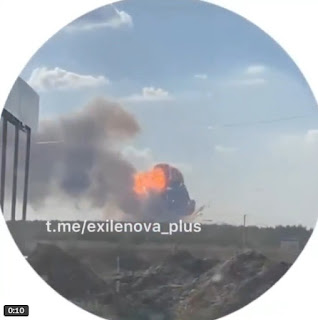
Ukraine set a goal of manufacturing one million military drones in 2024, and exceeded that target by November. Their goal for 2025 is 4.5 million. This is mostly cheap quadcopters but it includes new variants with ranges of more than a 800 miles and warheads weighing up to 250 pounds. They have also launched a massive program for drones controlled by fiber optic lines with ranges of up to 30 km. Operators fly these fiber optic drones into buildings and underground bunkers before detonating them. Ukrainian drones recent clobbered a large Russian ammunition storage facility near Moscow (51st GRAU Arsenal), leading to massive explosions that went on for hours and the evacuation of four nearby villages (above). Ukrainians pass around photographs of these ammunition dump explosions to use as backgrounds on their phones. On May 1 there was a massive drone attack on Russian air defense installations across Crimea, with video showing several hits on radars. Attacks on airbases are routine, focusing on fuel and weapons storage structures, steadily degrading Russia's ability to keep planes in the air.

Meanwhile, Ukraine claimed, and Osint folks have confirmed, that a Ukrainian drone boat shot down a Russian Su-30 fighter-bomber with repurposed air to air missiles. (NewsweekTwitter/X ) Russia had found that the best defense against drone boats was aircraft, especially helicopters, so boats that can shoot back at aircraft are a major problem for them. When you consider that Ukraine launched its first drone boat attack less than two years ago, this is astonishing progress. Plus, aircraft losses matter. Russia has been very conservative in using its air force because they simply do not have that many good planes or combat-ready pilots and cannot easily summon up hundreds more. So they are now facing a dilemma: whether to risk valuable aircraft and pilots protecting their fleet, or risk losing more ships to drone boat attacks.

Ukraine has also released video of new drone boats that carry aerial drones.

The vast array of drones makes the battlefield increasingly deadly. Russia has continued to make some mechanized assaults, but they generally fail, and half the armor is knocked out by drones before it has advanced half a mile. So most Russian attacks are now made by infantry, either on foot or mounted on dunebuggies, atvs, and small motorcycles. Ukraine has reponded to this tactic by stringing hundreds of miles of barbed wire all along the front. Wire isn't much use against tanks, but it is deadly to men on motorcycles. Incidentally, both sides now generally use land drones to lay both barbed wire and minefields.

The guys who count equipment losses in the war are still at it. The lastest update on Russian equipment losses shows at least 100 more tanks and 300 other armored vehicles destroyed in April, bringing the total losses to 3947 tanks and 8550 other armored vehicles, plus 139 jet aircraft, 155 helicopters, 322 SAM systems, more than 2,000 artillery pieces, etc., to a total of more than 21,000 systems. People who study Russia's vast array of military equipment storage bases say that almost all the good armored vehicles have already been withdrawn for refurbishment, and that what remains is increasingly outdated and rusted out. Those old vehicle hulls are still useful, but the cost of making them combat ready is rising, and the end result is probably less effective. Russia is not "running out" of armored vehicles, since they continue to manufacture hundreds every year, but they really are facing a shortage and this shows up in their pathetic offensive progress. 

 At least 5921 Russian officers have been killed in the war, based on memorials and funeral announcements. Mediazona and the BBC have counted 106,745 Russian dead overall and estimate the actual total is 164,000 to 237,000. The higher figure is about how many Americans died in Europe during World War II. Russia is a nation of 144 million, with 800,000 Russian boys turning 18 every year, so they can obviously endure such losses, especially since many of the men in the assault squads are older volunteers and quite a few are criminals. Still, these losses hurt. Plus, on paper Russia has a fairly generous system for taking care of elderly combat veterans and especially disabled veterans, and that is going to impose huge costs going forward.

The Trump administration's attempts to broker a cease-fire foundered on Russian intransigience, although, to be fair, the Ukrainians were probably only pretending to go along because they knew Russia would balk; they don't want a cease-fire either.

So the tragedy goes on, with Russia's losses mounting and Ukrainian resolve unshaken, no end in sight, Russia unable to give up but equally unable to win.

Saturday, December 7, 2024

We Are Not Taken in By Your Lies

Polish Foreign Minister Radoslaw Sikorski at the OSCE meeting on December 5:

Elina has just reminded us of the origin of this organization. The Helsinki process was basically a grand bargain between the then communist bloc, which sought the confirmation of borders in Europe, and the then west, which wanted respect for human rights in the Soviet bloc. Today Russia respects neither borders nor human rights. There are no free media in Russia, there are no honest elections, and there are more political prisoners than in the Soviet Union under Leonid Brezhnev at the time of Helsinki. When the Soviet Union collapsed, we encouraged Russia to become a normal democratic nation state. But they failed. It proved too difficult to emerge from their own political culture. Russia's rulers chose the path of aggressive, repressive kleptocracy.  

My message to the Russian delegation is the following: We are not taken in by your lies. We know what you're doing. You're trying to rebuild the Russian empire and we will not let you. We will resist you every inch of the way. And the Russian war criminal at this table must know: Ukraine will win this war and justice will prevail.

Monday, October 21, 2024

Russia will not Accept Peace with Ukraine

Chatham House report:

Many Ukrainians fear not just a long war, but a potentially ‘endless’ war. As the Russian historian Sergei Medvedev has observed, Russia finally found its ultimate national idea after a search lasting three decades – since the collapse of the USSR – and that idea is war.

For today’s Russian authorities, war is a tool for preserving the cohesion of society and ensuring the legitimacy of their rule even if this requires increased repression. However, although the Putin regime is brittle like most personal autocracies that lack reliable mechanisms for succession, the country appears far from a situation comparable to 1917 when war weakened Tsar Nicolas II’s grip on power and made revolution unstoppable. On the surface, Russia appears both equipped and motivated to continue the war for several years if necessary. . . .

While Vladimir Putin controls the levers of power, it is difficult to see a recalibration of Moscow’s strategic goals in Ukraine. He has committed Russia to expanding its territorial gains in Donbas, ‘demilitarizing’ Ukraine, changing the country’s leadership (denazification) and forcing it to accept neutrality. The goal is the full abolition of Ukrainian sovereignty.

Ukraine is not Finland in 1939. On the contrary, it is viewed by wide sections of Russian society as an inalienable part of the country’s identity as a European power and, therefore, as synonymous with Russia. For the Russian elites as well as the public, settling for less than Ukraine’s surrender would not amount to victory and could call into question the huge price paid by the country in terms of human and economic losses and the damage to its reputation.

I share this outlook. It is difficult to imagine any peace amounting to more than a cease fire as long as Putin is in power. He has committed everything – his personal power and prestige, and the resources and even the identity of Russia – to conquering Ukraine. All we can do is surrender to this evil or help Ukraine fight.