Showing posts with label Egypt. Show all posts

Tuesday, August 30, 2022

Pierre Tallet and Mark Lehner, "The Red Sea Scrolls: How Ancient Papyri Reveal the Secrets of the Pyramids" (2021)

Despite the awful title, this is a book about a major archaeological discovery by two real archaeologists. Unfortunately, the title is not even close to being the worst thing about the book, so I am going to spare you the trouble of reading it by telling you what it says.

The shores of the earth's oceans are mostly rich in life, including human life; most of the non-frozen seas are lined with cities and towns. But not the Red Sea. Until the modern era of canals and steam ships, there were no towns on the Red Sea at all, and hardly anyone lived there. It almost never rained anywhere along its shores; a glance at a map will show you that not a single river flows into the sea. The wind either blew from the north or not at all, making sailing difficult. The Romans found it easier to sail down the Nile for 300 miles and caravan across 200 miles of desert to Berenike rather than try to sail the northern reaches of the Red Sea. 

Old Kingdom Stela Near the Copper Mines of Sinai

But the ancient Egyptians needed and wanted things not found in their own land. Two of the most important to them were copper, from which they made tools, and turquoise, with which they adorned their leaders and honored the gods. Both could be found in large quantities in the southern Sinai peninsula, 150 miles across a bitter desert and then 10 more miles across a bitter sea. Since nobody but a few desert nomads could live on either shore of the Gulf of Suez, no ports or mining settlement grew up. Instead the Egyptians mounted occasional expeditions into that desolation. These were made up of hundreds to a few thousand men. The men were sent across to Suez at the least unpleasant season of the year, there to mine and smelt for a few months until they ran out of food and water. Then they came back, laden with treasure. After, for the benefit of future generations, raising stelae like the one above in which the expedition's leader boasted (always) that his expedition had mined more copper and turquoise than any before him.

All of this has been known for more than a century. A few intrepid 19th-century explorers had even found what they thought were ancient settlements along the western shore of the Gulf, which they thought might be associated with this trade. In 1956 two Frenchmen proposed to make a real study of one of these ports, but then the Suez Crisis erupted and they were expelled from the country. So there things rested until the 1990s, when archaeologists began exploring two sites called Ayn Sukhna and Wadi al-Jarf.

Plan of the Rock-Cut Galleries at Wadi al-Jarf

What they found in those sites has been extraordinary from the beginning. The sites both date to the Old Kingdom, between 2700 and 2200 BC. They consisted of stone building foundations, landscape modifications like terracing and roads, "galleries" carved into the rocks, and, at Wadi al-Jarf, a stone jetty that makes this the oldest artificial harbor yet discovered. 

Jetty at Wadi al-Jarf, 4600 years old

Since, remember, it hardly ever rains here, the galleries contained wonderfully preserved artifacts of wood, fiber, and papyrus.

Artifacts from Wadi al-Jarf

It seems that when an expedition was launched to the Sinai, the whole crew marched to one of these harbors. There they unsealed the galleries, which had been blocked with huge stones, and withdrew the material cached there. This included whole, disassembled boats and various other gear needed for sailing to Sinai. When they were done, they disassembled the boats, put everything back in the galleries, blocked them with with stone again, and marched back to the Nile.

Inscription from the reign of Khufu (2589-2566 BC) at Wadi al-Jarf

One interesting point is that Old Kingdom Egypt needed tons and tons of copper. Sinai copper was naturally alloyed with a little arsenic, which made it harder than pure copper, but still not as hard or durable as bronze. The chisels Egyptians made from Sinai copper were the size of a finger, and experiments show that they were worn half away in just a few hours of work on stone. It boggles the mind to ponder how many chisels were used up building one of the great pyramids – in fact I have not even found an attempt at a calculation. 

Anyway, these discoveries at the Old Kingdom temporary ports were exciting in themselves, revealing a lot about Egypt and providing many fascinating artifacts like these water pots photographed in one of the galleries at Wadi al-Jarf. (The closest spring to Wadi al-Jarf is 6 miles away)

But among the papyrus fragments lodged between two stones at the front of one gallery was a whole bundle of pages covered with similar columns of text. These turned out to be the logs of a work gang from the reign of Khufu, detailing their activities over about seven months, during which they helped to build the Great Pyramid. It's quite astonishing, really, that such a thing should survive. I mean, if you had been at a party with a bunch of historians and they started talking about what lost document they most wanted to recover, and somebody said, "I want the working logs from the building of the Great Pyramid," you would have laughed loud and long at that hubris. But here it is.

These work gangs were a regular feature of Egyptian life; their word was aper. We know about them because they regularly signed their stonework in places where it wouldn't show; dozens of separate gangs have been identified at Old Kingdom pyramids. The crew whose log was found went by the name of "The Escort Team of The Uraeus of Khufu is its Prow." (An Uraeus was a sort of divine snake symbol; it is entirely typical of The Red Sea Scrolls that the authors use the word about ten times before finally defining it on page 185.) The most likely interpretation of the name is that Uraeus of Khufu is its Prow was the name of a ship, and this gang was attached to it.

The gang was made up of four crews. The records are of two sorts, general accounts for the whole aper and records kept by Merer, who was the foreman of the crew known as Great. It is Merer's accounts that are particularly wonderful, since they lay out, day by day, what his men were doing for most of that seven month period. They spent much of it transporting limestone from quarries at a place called Tula to the building site of Khufu's Great Pyramid; the pyramid was once coated with bright white limestone, which was almost all removed in later years. They also spent a month in the Nile Delta working on some kind of maritime construction project, perhaps a jetty or a levee. They spent one day at the royal palace participating in a religious festival, providing some of the cheering crowds needed for great royal events. Then they were sent across the desert to the Gulf of Suez, where they transported supplies to miners. And then, somehow, the log book was lost, ending up trapped between two stones when they were used to seal up one of the rock-cut galleries.

Plan of the artificial harbors and canals at the pyramid building site

From there our attention moves to the building of the Great Pyramid. It seems clear from evidence already found that the building was done by work crews just Merer's. One interesting point is that the dozens of barracks buildings that have been unearthed around the site are divided into sections that seem about the right size for 40 men, so perhaps this was a typical size for work crews.

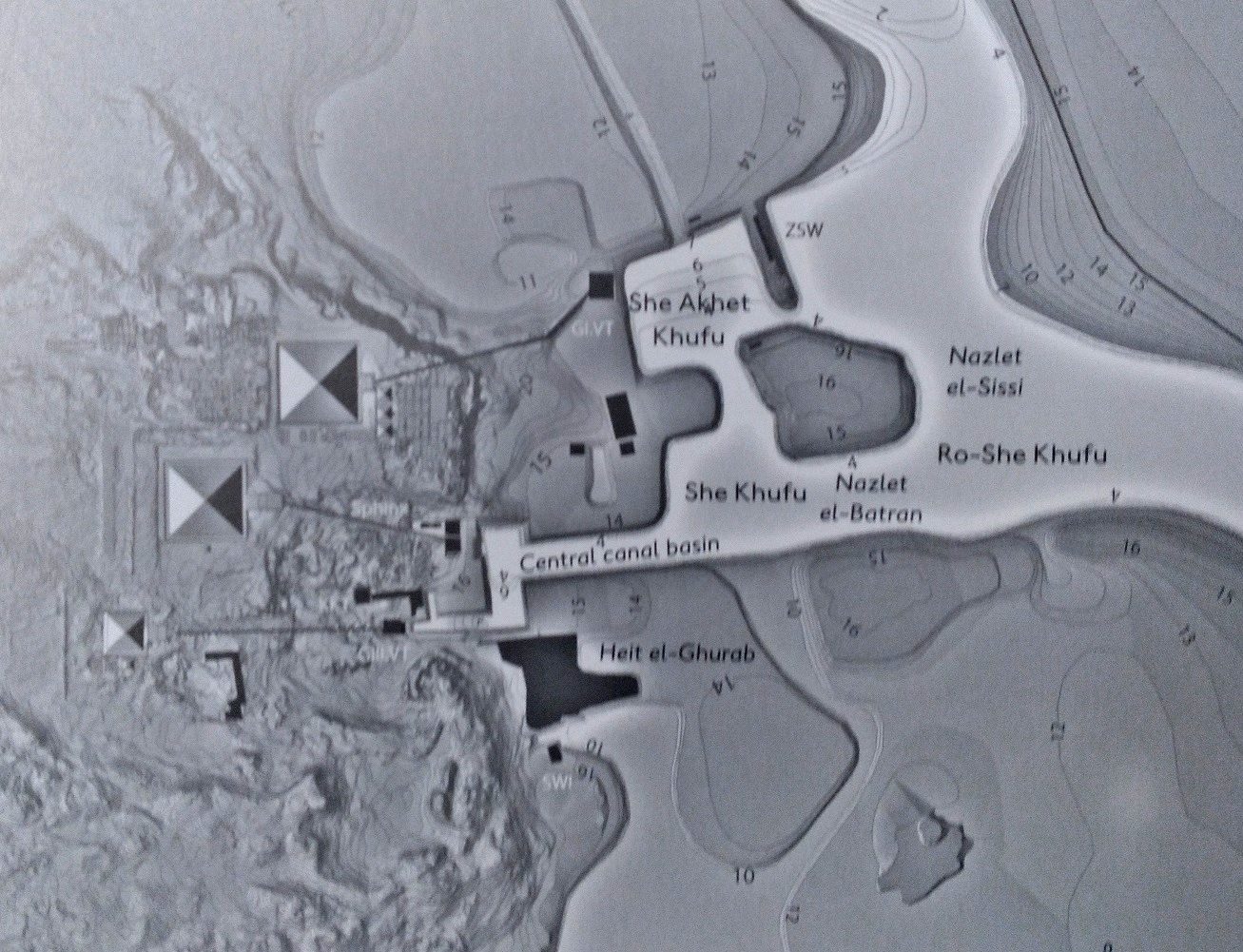
As for the building of the pyramids, what can one say that hasn't already been said? Calculations done for the quarrying and erecting of all that stone come to around 200 million man-days, at a time when Egypt had about a million inhabitants. And that's just for the pyramid itself; to that you have to add the building of all the associated sub-tombs, temples, processional ways, etc., besides the vast harbor and canal complex (see map above) that was excavated 8m deep, the expeditions to obtain copper for tools, and all the barracks for the workers, the bakeries, the breweries, etc., etc. That might double the total. Khufu reigned for 23 years, or about 8,400 days. Which means that on every day of his reign, about 47,000 Egyptians were working on their king's tomb. If we assume that a million Egytians included 250,000 adult men, it looks like building Khufu's tomb consumed about one fifth of all the male labor available in his kingdom. Remember, also, that this far from exhausts the demands of the Egyptian state; after all Merer's men spent a month on an unrelated project in the Delta, and the pharaohs also conscripted men to fight whenever they needed an army or navy.

Old Kingdom carving of an Egyptian ship

An internet fight has broken out lately over the status of the people who worked on the pyramids. Our old stories say slaves, but Afrocentrists have correctly noted that this is wrong. Most of the labor was provided by regular Egyptians who had been drafted to do this work by the state. When I explained to one of my sons that in less cash-dominated societies governments often extracted labor from their people rather than money, he said, "so instead of taxation as theft, it's taxation as slavery." Yes, pretty much.

The whole internet argument about pyramid labor rests on dubious foundations, especially a clear division between "slave" and "free." The model many Americans have, based on North America in the 19th century, is that some people are slaves with no rights, while others are free people who have many rights and indeed a privileged status. That does not apply at all to ancient Egypt, or indeed to almost anywhere else besides North America and the Caribbean between 1700 and 1865. Egyptians were free to work the land their parents had worked, free to hand over much of their harvests to various nobles and officials who lorded over them, and free to spend years of their lives hauling stone for the Pharaoh's tomb. If they objected, they were killed. The hieroglyph for a work crew (aper) was a cow that had been hobbled so it couldn't wander away.

The discovery of Merer's work logs is astonishing, and I love the story of ancient Egyptians mounting expeditions across to Sinai to mine copper. The building of the Great Pyramid is one of history's grandest and weirdest events, and how wonderful to have found a new source showing how the work crews were organized, and even a few of their names. Maybe some day somebody will write a good book about it.

Saturday, May 1, 2021

Inji Efflatoun

The New York Times has been running a long series called "Overlooked No More" that provides belated obituaries for people whose deaths the newspaper did not mark at the time. The conceit is that they were ignored because they were women, or black, or toiled in third world obscurity, but in our more enlightened time we can now recognize their importance. I have found them to be a mixed bag. Some strike me as unremarkable people no more deserving of a Times obituary than millions of others. A few, I think, deserve to be forgotten, like the woman whose only claim to fame was having shot Andy Warhol. My favorite so far appeared today, commemorating the life and art of Egyptian painter and activist Inji Efflatoun (1924-1989). (Weaver in Akmim, 1971)

Efflatoun was born into a French-speaking bourgeois family in Cairo; her father was a biologist who founded the first department of entomology in Egypt, at the University of Cairo. Her mother divorced her father and founded a fashion boutique catering to Cairo's elite, westernizing women, earning enough to keep her family in bourgeois style. Inji's talent was recognized by her parents, who encouraged her to study art. In fact they hired one of Egypt's most famous modernists, Kamel El-Telmissany, to be her tutor. El-Telmissany was among the founders of a radical group called Art et Liberté, one of those modernist cabals devoted to Revolution in everything: art, politics, personal relations. In 1942 the 18-year-old Efflatoun was invited to exhibit at their annual show. As the work above (Girl and Monster, 1942) shows, at that time her painting was very much of the Surrealist 1930s, nothing yet very distinctive about it.

After the war she developed as both a painter and an activist. She actually stopped painting for nearly two years in 1946-1948, but resumed after taking several trips to upper Egypt. In 1948 she married a radical lawyer also involved in political agitation; he died in 1956. She devoted a lot of time to the status of Egyptian women, and to the poor. (The Dye Workers, c. 1955)

In 1945 she attended the First Women's International in Paris. As a young cynic I always thought those conferences sounded like a big waste of time, lots of empty slogans and tedious manifestos about Brotherhood and Sisterhood and Revolution. But if you read the biographies of activists in that time, especially from Africa, you see that being able to attend such international meetings was huge for them. Most mention in their memoirs how energized they were by meeting people from around the world working on the same issues.

(I have to insert a pedantic note here about a sentence I have now seen in half a dozen biographies, to the effect that Efflatoun "turned her back on the aristocracy to work for the welfare of the poor." First, she was not an aristocrat, just rich. Second, being an aristocrat does not mean being conservative or even being wealthy, but it does mean believing that you are extremely special and your actions have great importance. Since the days of Washington and Jefferson there has been nothing more aristocratic than leading a revolution.)

When Efflatoun started her work Egypt was a semi-colony dominated by Britain, but as it achieved its full independence under Nasser things did not get much better for women or the poor. Efflatoun continued her activist work and in 1959 she was arrested. (Prisoners, 1957)

During the five years she spent in prison she painted her most famous works. Which is on the one hand a testimony to her resilience, but on the other shows how class-bound the world's prisons were and in general still are: the poor get hard labor, the rich get to paint. Anyway it is her paintings of prison life that dominate the contemporary appreciation of her work. (In the Women's Prison, 1960)


Two painting titled Prisoner, both dated 1960.

Motherhood, one of Efflatoun's most famous works, depicting a woman who death sentence was deferred for a year to allow her to breastfeed her baby.


After she got out of prison Efflatoun changed her style again and painted mostly landscapes and scenes of the Nile, in an impressionist vein. I can't find out much about her life in this period, but judging from the work you have to think that she withdrew from politics into a more pure sort of art, and a more generalized appreciation for her homeland. I find it typical of our age that all the scholarship about Efflatoun focuses on the 1948-1965 period, lots of articles with titles like "The Fusion of Feminism, Socialism, and Art." Neither the Times obituary writer nor anybody else seems to care what she was up to when she painted these scenes.

I just love this one, White Gold, 1967, which sold at auction in 2015 for $68,750. I would take this over a roomful of $100 million Basquiats.

Welcoming the South Lebanon Bride, 1971

Discovering a new artist I love always puts me in a good mood, so now I can head out to face the day with a smile. (Cow between Palm Trees, 1966)

Friday, February 19, 2021

The Catacombs of Kom-el-Shoqafa

In 1900, so the story goes, a donkey fell through a hole in the ground and disappeared. This was in Alexandria, Egypt, where such events are far from rare, so the donkey's owner went to the museum and asked if someone could come check the site quickly so he could resume work. 

His work was never resumed. The donkey, if there was a donkey, had fallen into a great shaft 18 feet wide descending four stories into the earth. A spiral staircase runs around the outside of the shaft, separated from it by a wall. 

The staircase takes you down to this spectacular chamber with its weird mix of classical and Egyptian imagery. This seems to have been built in the 100s AD.

Around the central chamber are several smaller rooms, decorated with themes that include the mummification of Osiris (above) and the abduction of Persephone.

The original route to the catacombs themselves was blocked by rubble, so today you follow this tunnel dug by medieval grave robbers.

The catacombs themselves are plain, their paintings long faded. That is, the ones we can reach. There is another, flooded level beneath this one, but if one of those Archaeology as Adventure shows has ever sent people diving in to investigate I can't find a record of it.

What a strange and fascinating place.

Tuesday, February 19, 2019

Statue of the Lector Priest Kaaper

Old Kingdom, 5th Dynasty, ca. 2494-2345 BC. This statue is made from sycamore wood, eyes made from rock crystal rimmed with copper.

The statue was recovered from Kaaper's tomb, a Mastaba in in North Saqqara.

It was excavated by French archaeologist Auguste Mariette around 1860. According to his account, an unpopular mayor in the village had died, and when the local workmen looked into the eyes of this statue they believed that he had returned. Thus, Mariette dubbed it the Sheikh el-Balad, The Headman of the Village.

Saturday, February 16, 2019

Gaming Lions

Ivory Board Game Pieces, Early Dynastic Period, ca. 3100-2890 BC.

This game is known to moderns as The Coil, because it seems to have been played on a round board that took the form of a coiled snake. Now in the Egyptian Museum, Cairo. From Egypt Museum.

Friday, July 27, 2018

What Happened to Mohammed Morsi?

Ever since Egyptian president Mohammed Morsi was overthrown in 2013 I have been wondering what happened to him. Yes, he was from the Muslim Brotherhood, but he won the election; how could the Obama administration, after making so many public commitments to democracy in the Arab world, have turned so quickly against the only Egyptian leader ever chosen in a free election?

Now Times reporter David Kirkpatrick, who was their Cairo bureau chief at the time, has come out with an article that offers some context. First, it turned out that within Egypt, the people whose streeet protests led to the fall of the military regime and the holding of that fateful election were not really interested in democracy. What they wanted was a country more like Europe: more personal freedom, more equality for women, a freer and richer economy. When they got the Muslim brotherhood instead most of them decided to turn against the election and start calling for another military intervention.

There were also big divisions within the Obama administration over how to react:
“The people who wanted to have a different kind of relationship with the Egyptian people, including the president, were on an island in our own government,” Ben Rhodes, Mr. Obama’s deputy national security adviser, later told me. “There was a sense of inevitability about the military resuming control.”
The American military were especially leary, since they spent a lot of time working with Middle Easterners – Saudis, Kuwaitis, Israelis, the Egyptian military – who regarded the Muslim Brotherhood as just another ally of al Qaeda and a terrible danger to peace in the region. But not just the military:
Civilians in government were skeptical, too. Secretary of State John Kerry had grown close to many of the most fiercely anti-Islamist Persian Gulf royals during his decades in the Senate, even sometimes yachting with them. He had always distrusted the Brotherhood, he told me years later. When he visited Cairo for the first time as secretary of state in March 2013, he took an immediate dislike to Mr. Morsi.

“He is the dumbest cluck I ever met,” Mr. Kerry told his chief of staff as they left the presidential palace. “This isn’t going to work. These guys are wacko.”

Mr. Kerry got along better in his one-on-one meeting with Gen. Abdel Fattah el-Sisi. A former military intelligence chief, General Sisi had vaulted himself into the job of defense minister in a shake-up just a few months before.

“I will not let my country go down the drain,” General Sisi told Mr. Kerry, as he later recalled to me. He knew then that “Morsi was cooked.” General Sisi was prepared to intervene. Mr. Kerry felt partly relieved, he told me.

“It was reassuring that Egypt would not fall into a civil war or a complete massacre of the public or an implosion,” Mr. Kerry said, although he added, “I did not sit back and think, ‘Great, our problems are going to be solved.’”
Obama spoke to Morsi and urged him to make some dramatic gesture to his opposition, reminding him that Nelson Mandela made one of his own prison guards head of his presidential security detail.
“Be bold,” he added. “History is waiting for you.”
But Morsi would not or could not reach out to his opposition, so hardliners within the US government eventually got their way and we ended up endorsing the coup against him.

It's a sad tale. But it also makes me wonder: could a different man, in Morsi's position, have made those bold gestures, brought some of his opponents into his administration and engineered a different outcome? Or was Morsi simply in an impossible position, unable to make any concessions without alienating his own key supporters?

Are the divisions within Egypt simply too raw and deep to be bridged within a democratic system, or would it have been possible with the right inspired leadership?

How much difference can one person make in a nation's history?

Friday, July 7, 2017

The Arab Spring, Failed Hopes, and Self Doubt

The Arab Spring, a great movement for democracy, human rights, and hope, has crashed and burned. Outside Tunisia it has led only to some combination of civil war and renewed repression. Algerian writer and activist Kamel Daoud wrote a moving essay about these events for a French newspaper that has now been translated and published in the Times. It makes me wonder.

Daoud admits that the dreams of the protesters and the rebels are dead or dying, but he does not attribute this to any sort of natural disease. He believes that those dreams were murdered. They were murdered by dictators like Assad with their airplanes and poison gas, by cynical foreign governments, by lies. The liars claim that attempts to establish Arab democracy only empower radicals like the Islamic state and lead to chaos and foreign intervention:
For President Abdelaziz Bouteflika of Algeria, the Arab springs were “devastating conspiracies.” According to a private Egyptian television channel, even ‘‘The Simpsons’’ contained proof of untoward foreign designs in Syria. The political chaos in Libya has fanned distrust as well.

The foreign-intervention theory is used as a weapon against local dissenters. In 2016 Bouteflika, ailing and immobilized, announced that he would seek yet another term, after having the Constitution amended so that he could stay in office for the rest of his life. When his opponents countered his proposals by invoking democratic values, government media accused them of being traitors, Western agents or Zionists.

The case of Syria — subject to alliances with Iran or Russia and playing against Saudi Arabia, Qatar or the United States — gives weight to such propaganda. It seems to demonstrate that any demand for democracy eventually translates into chaos, and chaos invites the return of colonialism. The same goes for Libya. Better then to submit to one’s dictators than compromise oneself with foreigners.
I want to agree with Daoud that the dream of Arab democracy remains alive, and that things might have gone differently. But I am not sure. I am not much of a believer in luck or genius. I think most of what happens in history is driven by vast, long-term forces that we only partially understand and can rarely control. It seems to me that people who point out what happened in Libya when the dictator was overthrown are onto something. The situation did not degenerate into chaos for no reason at all; it degenerated because Libyans are deeply divided among themselves by region, tribe, class, attitudes toward Europe, and their interpretations of Islam, so much so that once the heavy hand of dictatorship was removed the situation spontaneously combusted. Can democracy flourish in such circumstances? Assad has held onto power in Syria not just because he has airplanes and poison gas, but because he has the support of many Syrians. Foreign powers meddle in Arab conflicts not just for their own nefarious purposes but because various Arab factions are always begging them to.

Consider events in Iraq and Egypt. In Iraq the US removed the dictator and his whole apparatus, and so far the result has been corruption, conflict, terrorism, the rise of the Islamic state, a devastating civil war, and the effective secession of Kurdistan. Consider the still smoldering ruins of Mosul, once one of the Arab world's great cities, as collateral damage from this experiment. In Egypt democracy was established and an election held, but the winner was from the Muslim Brotherhood. The secular, western-oriented people who began the protests and launched the revolution recoiled in horror from what their countrymen had chosen and allied with the military to overthrow the Morsi government and return Egypt to dictatorship. The hard, rational part of my brain says this all proves that most of the Arab world is simply not suitable for democracy.

But even as I reach that conclusion I doubt it. Americans always used to say that Latin America was unsuitable for democracy and pointed to the numerous failures, but right now most of the region is democratic, and some of those democratic nations are thriving. Am I just being smug and indifferent when I write off the dreams of Daoud and millions of others? Is my resignation just an excuse for the west's clumsy combination of military meddling and moral indifference? For my refusal to endorse spending American dollars and soldiers overthrowing Assad? I don't know.

I would never tell Daoud or an other citizen of a dictatorship to give up hope; hope is a precious thing in any circumstances. But I am not myself optimistic that things will get better in the Middle East any time soon.

Monday, May 30, 2016

Dark Surrealism after the Arab Spring

The news from Cairo:
Basma Abdel Aziz was walking in downtown Cairo one morning when she saw a long line of people standing in front of a closed government building.

Returning hours later, Ms. Abdel Aziz, a psychiatrist who counsels torture victims, passed the same people still waiting listlessly — a young woman and an elderly man, a mother holding her baby. The building remained closed.

When she got home, she immediately started writing about the people in line and didn’t stop for 11 hours. The story became her surreal debut novel, “The Queue,” which takes place after a failed revolution in an unnamed Middle Eastern city. The narrative unfolds over 140 days, as civilians are forced to wait in an endless line to petition a shadowy authority called The Gate for basic services.

“Fiction gave me a very wide space to say what I wanted to say about totalitarian authority,” Ms. Abdel Aziz said in a recent interview.

“The Queue,” which was just published in English by Melville House, has drawn comparisons to Western classics like George Orwell’s “1984” and “The Trial” by Franz Kafka. It represents a new wave of dystopian and surrealist fiction from Middle Eastern writers who are grappling with the chaotic aftermath and stinging disappointments of the Arab Spring.

Five years after the popular uprisings in Egypt, Tunisia, Libya and elsewhere, a bleak, apocalyptic strain of post-revolutionary literature has taken root in the region. Some writers are using science fiction and fantasy tropes to describe grim current political realities. . . .

“There’s a shift away from realism, which has dominated Arabic literature,” said the Kuwait-born novelist Saleem Haddad, whose new book, “Guapa,” is narrated by a young gay Arab man whose friend has been imprisoned after a political revolt. “What’s coming to the surface now is darker and a bit deeper.”
Fascinating how this same literary impulse has surfaced again and again when writers confront repressive rule, from Lenin's Russia to dictator-laden Latin America, and now to the Middle East.

Wednesday, March 25, 2015

The Practical Transvestite

Jared Malsin in the Times:
She has worked for more than 30 years among the shoeshine men of Luxor. She sits with men in coffee shops, prays with them in the local mosque and dresses just as they do in pants or a traditional floor-length tunic known as a galabeya.

Many people believed Sisa Abu Daooh was a man until several weeks ago, when she publicly revealed her 42-year-old secret.

Perhaps surprisingly in a society where many hold conservative notions of gender roles, Ms. Daooh’s announcement was greeted not with condemnation but with curiosity and a flurry of mostly positive reactions from local news media and officials. On Sunday, Egypt’s president, Abdel Fattah el-Sisi, personally gave her an award for being an extraordinary mother.

In an interview last week, Ms. Daooh, 64, said she began dressing as a man as a practical matter, to escape restrictions on women’s employment in a patriarchal culture and earn enough to support her daughter, Hoda. But now, whether she still needs to pose as a man or not, she said she had no intention of changing. What began as a way to survive rural poverty has evolved into her preferred way of life and a means of navigating a world dominated by men.

Sunday, January 4, 2015

Kampp 327: A Tomb for Osiris

Italian archaeologists exploring an Egyptian tomb dating to around 1200 BCE have realized that it is modeled on the Tomb of Osiris described in Egyptian myths. The tomb, known as Kampp 327, has long been known but never published.
After a transverse hall supported by 5 pillars, a staircase goes down into the bedrock leading to a complex dedicated to the god of the netherworld, Osiris. A statue of Osiris is located in a chapel with a vaulted ceiling in the middle of an intricate structure. In front of the Osiris statue there is a staircase with a shaft cut into it. This shaft goes down for about 9 meters, leading to a room and a second shaft, which is about 6 meters deep, ending in the deepest part of the monument.

The symbolism of Osiris is very evident here, since all the elements recalling the mythical “Osiris tomb” are present: a big staircase of 3,5 meter long with a 4 meter high ceiling at the bottom leading to the Netherworld and another one leading directly to the Osiris statue, which is therefore at a higher level and ideally isolated on “his island”; the Osiris statue itself; the empty corridor surrounding it which symbolizes the channel of water (see Osireion in Abydos); the expected burial chamber below the statue, thus identifying the deceased with Osiris.
The ancient Egyptians put an astonishing amount of effort into their tombs and associated rituals. This is the most striking thing about their society, and has been the subject of scholarly discussion for 200 years, but I have yet to encounter an explanation for this that makes sense to me.

Plan of the tomb. This is my favorite detail, of which I sadly cannot find a picture:
The room on the west side, which was inspected during the present season, is a funerary chamber decorated with reliefs representing chapels with demons and deities holding knives. These figures, running around the walls, were meant to protect and guard the body of the deceased.

Tuesday, September 23, 2014

Textiles from Roman Egypt


Amazing that these things survive. Above, tapestry of Actaeon and Artemis surrounded by red flowers and dancing figures. Woven from linen and dyed wool. Dated to the 4th century CE, probably made at Akhmim in Egypt. Purchased in 1924 from an antiquities dealer in Cairo and currently in the British Museum.

Woven fragment from Egypt, wool and linen, 3rd to 5th century CE. In the Met, which has more than a thousand textile fragments from Egypt dating to the 1-500 CE period. All the images below are also from the Met. An hour ago I would never have guessed that so much beautiful weaving survives from the Roman world.


Two tunics, wool, from Akhmim, Egypt, 5th century CE.

Detail of the tunic above, showing Dionysian imagery around the neck.


Fragment of a Cover, Egyptian, 5th century CE.


Fragment of a tunic, Egypt, 5th century CE.

Woven square, Egypt, 3rd to 4th century.


Fragmentary Coptic hanging, 5th century.

Tapestry fragment, probably from Egypt, 4th to 5th century.

Textile fragment with birds, Akhmim, Egypt, 3rd century.