Showing posts with label environment. Show all posts

Thursday, September 25, 2025

The Global Retreat from Climate Change Politics

David Wallace-Wells in the NY Times:

The retreat from climate politics has been widespread, even in the midst of a global green-energy boom. . . .

To our north, the former central banker Mark Carney — whose 2015 warnings about the financial risks from climate change helped set the stage for Paris by alarming the world’s banking elite — became prime minister of Canada in March and as his very first act in office struck down the country’s carbon tax, before storming to a landslide victory in the April election. To our south, President Claudia Sheinbaum of Mexico, a former climate scientist, has invoked the principle of “energy sovereignty” and boasted of booming oil and gas production in her country — and enjoys one of the highest approval ratings of any elected leader anywhere in the world. Almost everywhere you look, the spike of climate alarm that followed Paris has given way to something its supporters might describe as climate moderation but which critics would call complacency or indifference. “You can’t walk more than two feet at any global conference today without ‘pragmatism’ and ‘realism’ being thrown around as the order of the day,” says Jason Bordoff, a former Obama energy adviser who now runs Columbia University’s Center on Global Energy Policy. “But it’s not clear to me that anyone knows what those words mean other than this whole climate thing is just too hard.”

This:

Climate activists were once venerated as moral authorities by heads of state and a broadly liberal mass media; now they are being given jail sentences stretching multiple years for the crime of merely planning protests that might block up commuter traffic or for throwing paint against plexiglass they knew would protect the artwork hung behind it — a victimless publicity stunt if ever there was one.

Wallace-Wells objects to this, but I think it is vital for the promotion of environmental causes. All this paint-throwing crap hurts the cause, and the sooner we end it, the better. People hate attention-seeking, know-it-all jerks. But I would point to something deeper as the real point of conflict: the alliance of climate change activists with people determined to make the world poorer.

To me this has always been the Achilles heal of environmentalism, the nagging, hectoring attitude toward anybody who wants air conditioning or a big truck. This is just never going to work; nobody is signing on to environmental causes if it means giving up materialism.

And it doesn't have to! Solar power is booming worldwide, the price still falling every year. Electric cars are not taking over as quickly as some people predicted, because of issues with their batteries and overall reliability. But they will keep getting better; battery technology is also progressing very fast, and when batteries get as convenient as fuel tanks electric cars will dominate, because electric engines are just far superior to internal combustion or diesel engines. Electric cars already dominate new vehicle sales in China. Here is a nice anecdote:

Consider Pakistan. When Russia invaded Ukraine in 2022, it threw the world’s energy markets into crisis, sending already-high prices soaring and redirecting fossil fuels headed to markets in the developing world instead to energy-starved Europe, where each shipment could fetch a still-higher price. In Pakistan as elsewhere in South Asia, the result was rolling blackouts and widespread political discontent. And then, something miraculous happened: Without any coordination or planning, millions of frustrated Pakistanis began buying and importing rooftop solar panels manufactured in China, which had grown so inexpensive that in some global markets they were cheaper to buy than the wood for a fence.

Solar power is also taking off in Africa, for the same reason and in the same populist way, individuals and business buying their own Chinese solar panels. This is what we need: bottom up, demand-driven change. So long as environmental measures are imposed by distant governments on people who don't want them, they will lose politically.

Anyone who worries about climate change needs to stop focusing on Paris-style global plans or government mandates and join in the things already happening around us. The best thing many Americans could do to promote electrification is to go to planning meetings and speak against the NIMBYs trying to keep solar farms out of your county.

Stop railing against humanity and start celebrating our future.

Tuesday, August 5, 2025

The Four Pests

Beginning in 1955, the Chinese government began calling for the extermination of the "four pests": rats, flies, mosquitoes, and sparrows. People have long claimed that the "smash sparrows campaign" in particular was a disaster, because sparrows controlled insect pests. Wikipedia: 
The eliminate sparrows campaign resulted in severe ecological imbalance, and was one of the causes of the Great Chinese Famine.

According to the government, 2 billion sparrows were killed in 1958, and 1 billion in 1959. 

First hand account: 

It was fun to 'Wipe out the Four Pests'. The whole school went to kill sparrows. We made ladders to knock down their nests, and beat gongs in the evenings, when they were coming home to roost.

It seems to have worked, with very few sparrows reported in China by 1961. On the other hand, sparrows didn't just eat grain, and by 1960 ornithologists began sounding the alarm about multiplying insect pests.

But as I said, that is old news, and most of the articles I have found about it don't radiate objectivity. Lots of "look what happens when people mess with nature" sort of stuff. But now a new paper from Chinese researchers supports this claim and offers some serious estimates of the harm:

How do large disruptions to ecosystems affect human well-being? This paper tests the long-standing hypothesis that China's 1958 Four Pests Campaign, which exterminated sparrows despite scientists’ warnings about their pest-control role, exacerbated the Great Famine—the largest in human history. Combining newly digitized data on historical agricultural productivity in China with habitat suitability modeling methods in ecology, we find that, after sparrow eradication, a one-standard-deviation increase in sparrow suitability led to 5.3% larger rice and 8.7% larger wheat declines. State food procurement exacerbated these losses, resulting in a 9.6% higher mortality in high-suitability counties—implying nearly two million excess deaths. 

I suggest a new list of the four pests: tyrants, the lackeys of tyrants, ignorant ideologues, and people who venerate "action" over understanding. 

Thursday, May 29, 2025

Supreme Court Decision on NEPA

The decision was effectively unaminous, because nobody could read the law and think the process as it now exists is what Congress had in mind. Sotomayor wrote a concurrence, which has more pro-environment rhetoric but so far as I can tell is substantively the same. This, from Bret Kavanaugh's decision, sums it up:

Simply stated, NEPA is a procedural cross-check, not a substantive roadblock. The goal of the law is to inform agency decisionmaking, not to paralyze it.

The lawsuit concerned the construction of an 88-mile railway in Utah to carry waxy crude oil to existing rail lines. Environmental groups sued because they said the NEPA review should have considered, not just the direct impact of building the railroad, but the overall impact of refining and using the oil from this source. This outward spiraling of "impacts" is one of the things that make NEPA so crazy; how could you, even in theory, estimate all the potential future impacts of how piece of infrastructure will be used? Consider that the Environmental Impact Statement in question was 3,600 pages long, and a court still held that it was not far-reaching enough.

This is what NEPA requires of federal agencies before they approve projects:

  • Consider alternatives, including the "no action alternative."
  • Get an appropriate level of information on how the project would impact a range of stuff, like endangered species, cultural resources, wetlands, and air pollution.
  • Have roughly the same level of information on all the alternatives being considered. (You can't delve much more deeply into the impact of the alternative you think you're going to choose.)
  • Make their decision in the light of this information.

That's it. It in no way requires that the agency prioritize environmental protection over other concerns, nor does it have any detail about what that appropriate level of information might be. That is left to the agency. There are cases where a responsible decision-maker would want a whole lot of information; for example, the Corps of Engineers did a bookshelf of studies before embarking on their multi-billion-dollar plan to alter water flows in South Florida to protect the Everglades. But for many cases the process has gotten completely out of hand, with stacks of fat reports piling up for the construction of single buildings, or adding turn lanes at intersections. None of that is in NEPA, and none of it was done in the first 15 years of the law's existence.

The meat of the Supreme Court's decision is that the lower courts who tried to interfere in this case did not grant "sufficient deference" to agency decision-makers:

Courts should afford substantial deference and should not micromanage those agency choices so long as they fall within a broad zone of reasonableness.

I think this is the key. Letting NEPA become completely unreasonable, which I think has happened in many cases, is bad for the country and will, if not checked, eventually lead to the dismantling of the whole process. Preservationists of all sorts need to think harder about what realistically can be preserved, and how big a burden they should be imposing on their fellow citizens.

Thursday, July 25, 2024

Carbon Dioxide and Global Greening

Climate change is really complicated. From the Yale School for the Environment, here's an article on how rising carbon dioxide concentrations are so good for plants that some deserts are greening even without increased rainfall:

Southeast Australia has been getting hotter and drier. Droughts have lengthened, and temperatures regularly soar above 95 degrees F (35 degrees C). Bush fires abound. But somehow, its woodlands keep growing. One of the more extreme and volatile ecosystems on the planet is defying meteorology and becoming greener.

And Australia is far from alone. From Africa’s Sahel to arid western India, and the deserts of northern China to southern Africa, the story is the same. “Greening is happening in most of the drylands globally, despite increasing aridity,” says Jason Evans, a water-cycle researcher at the Climate Change Research Centre of the University of New South Wales in Sydney, Australia.

What is going on? The primary reason, most recent studies conclude, is the 50-percent rise in carbon dioxide concentrations in the atmosphere since preindustrial times. This increased C02 is not just driving climate change, but also fast-tracking photosynthesis in plants. By allowing them to use scarce water more efficiently, the CO2-rich air fertilizes vegetation growth in even some of the driest places.

Friday, May 31, 2024

We're All Doomed Etc.

As a share of US electrical consumption, renewables have doubled in just five years:

March 2024 21.2%
March 2023 18.7%
March 2019 10.5%

Meanwhile, as I have covered here, the first new nuclear units in decades have gone online, with others in the works; the first US offshore wind farms are starting to produce; and the Bureal of Land Management has just put in place a fast-track policy for all geothermal energy projects. (Typical Biden: no announcement, no fanfare, just a quiet word to all the players in the industry.) Projections show that by the end of the year fossil fuels will be producing less than half of US electricity for the first time ever. If I weren't bound by confidentiality agreements I could give you a list of solar projects under way in North Carolina and Virginia that you literally would not believe.


Tuesday, June 20, 2023

Forest Fires in Eastern Canada

If somebody tries to tell you that the Canadian wildfires are caused by climate change – like this essay at the NY Times – refer them to these, sent to me by a friend who is researching the ecological history of Labrador. This is only a sample of the material he has accumulated. Those forests burned all the time even during the coldest decades of the Little Ice Age.

In 1661, the Jesuits Gabriel Druillettes and Claude Dablon traveled by canoe up the Saguenay as far as  Lac Nicabau and reported: 

Nothing beautiful, nothing attractive is to be seen here —the soil being dry, barren, and sandy, and the mountains covered only with rocks, or with little stunted trees. . . . The air here is almost always brown with smoke, caused by the burning of the surrounding woods, which, catching fire all at once within a circuit of fifteen and twenty leagues, have sent us their ashes from more than ten leagues' distance. For this reason, we have but rarely enjoyed the beauty of a cloudless Sun, it having always appeared to us veiled by those clouds of smoke —and sometimes to such a degree that the most Perfect Solar eclipses do not render air, earth, and herbage more gloomy and somber. These fires —which are very common here for a month or two in the Summer, and as a result of which we have seen many forests wholly composed of charred wood —keep the atmosphere so very warm, and make it so stifling, that it is difficult to live in it.

Jesuit Father François de Crépieul went up the Saguenay in the winter of 1673-4. In the first week of December, he was camped near Lake St. John: 

About this time there was a very noticeable earthquake near us. I had still further opportunity, during our journey, to observe the extraordinary ravages of the terrible earthquake that took place some years ago in these wild regions. There may also be seen the recent traces which cruel fires have left in these vast forests. The Savages say that they have spread over more than two hundred leagues.
And here is an 1842 description of the landscape inland from Hamilton Inlet: 

… in looking down from the brow of some more elevated hill, an interminable succession of naked hills and lakes is seen, giving an indescribable aspect of desolation to the country, which is greatly heightened by the effects of the fires that have ravaged the whole country. Indeed, there can be but little doubt, that at one time nearly, if not the whole, of the interior of Labrador was covered with wood, which has since been destroyed by fire; in almost every direction, the naked stumps of trees are seen, rising out of the moss that now covers the country. Hundreds of miles of the country are now nothing but a barren waste of naked rock from this cause, which in the recollection of some of the old hunters were covered with wood formerly.

Very dark days, because of smoke from distant fires, were reported from New England in 1706, 1716, 1732, 1780 (when May 19 was called Black Friday or The Dark Day), 1785, 1814, 1819, 1836, 1881 and 1894. The number of such days declined in the 20th century, most likely because intensive logging thinned out the forests, so in a sense the return of Dark Days shows that the forests are returning to something more like their natural cycle.

Certain landscapes just burn on a regular basis, and the only way to prevent really big fires is to encourage lots of little ones.

Friday, March 10, 2023

Thomas Massie and Populist Environmentalism

There is an old strain of American politics that sometimes aligns with environmentalism, but not because of anything to do with environmental science. These people are in favor of traditional rural life (as they understand it) and opposed to big business, big government, giant strip mines, superhighways, chemicals with unpronouncible names, globalism, the UN, foreign wars, and big city snobs trying to tell them what to do. The "Split Wood not Atoms" meme of the 1970s sprang from exactly this kind of thinking.

One of their leading spokesmen has long been Kentucky farmer/poet Wendell Berry. Berry believes passionately that big-city busy-ness is death to the soul, and that we need to thrive is a much slower and more earth-bound way of living. Berry is always writing things like this:

We have lived our lives by the assumption that what was good for us would be good for the world. We have been wrong. We must change our lives so that it will be possible to live by the contrary assumption, that what is good for the world will be good for us. And that requires that we make the effort to know the world and learn what is good for it.

Yet most people of this type drive trucks and tractors and use chain saws and generally take advantage of whatever about modernity makes their own lives easier. Some of them seem not to realize that a chainsaw requires a gigantic upstream infrastructure of iron mines, copper mines, train tracks, highways, oil wells, refineries, chemical plants, steel mills, assembly lines, and so on. Some, as I said; one thing about the people I am describing is that they are diverse in their backgrounds and opinions. They include Biblical fundamentalists, lesbian organic farmers, libertarian engineers, survivalists, aging ex-hippies, and truck-driving good ole boys. 

Now a new name has come forward as their public face, at least on the conservative side: Kentucky Congressman Thomas Massie.

The self-styled “greenest member” of Congress is a Republican from rural Kentucky. He lives in an off-the-grid home he built himself, using timbers cut and rock quarried from his family cattle farm. He pipes in water from a nearby pond, and powers the home with solar panels and a battery from a wrecked Tesla that he salvaged and retrofitted.

But while he lives on, and even makes part of his living from, the land, very few people would call him an environmentalist. The car he drives back and forth from Washington has a license plate advertising his support for coal. He likes to lean on his experience as a robotics engineer to argue against precipitously switching over to renewable energy, claiming that rapid changes could crash America’s power grids. And he once mocked John Kerry, who has a degree in political science, in a congressional hearing on climate threats: “I think it’s somewhat appropriate that someone with a pseudoscience degree,” he said, “is here pushing pseudoscience.” (NY Times)

Massie has some of the opinions we associate with wild-eyed Republicans, for example he introduced a bill to eliminate the Department of Education. But in other ways he comes across quite differently:

Outside the public eye, he has been quietly advancing what for a Republican politician are an unusual set of stances: evincing deep opposition to the national security state, resistance to the influence wielded by corporations and interest groups over our policymaking, and a sense that Americans need a better, more sustainable relationship to the land. It is a politics almost always built around the idea of scaling back, making systems smaller, simpler and more local. That’s an odd kind of politics for a Republican, or any major elected official, but it suddenly seems to have appeal even beyond the G.O.P.’s narrow base, and it has already made Mr. Massie the closest thing the party has to a cult hero lawmaker.

Many Americans from big urban areas find this mix of opinions baffling, but this and much weirder combinations are common across the hinterland. What unites many of these disparate ideas is a belief that the way we have been doing it is good, and what you outsiders says about it is wrong. Massie supports coal, because his neighbors have been mining it for generations, and because big-city liberals keep saying it is bad. He lives "off the grid" with his own solar array partly because "independence" has long been the ideal of many rural folks, and partly because he enjoys the idea of using his technical knowledge and self-reliant grit to out-ecologize Washington liberals. In an interview, Massie once said, 

If Thomas Jefferson could have had solar panels at Monticello, he’d have had solar panels. The less you have to go to the store and buy, the less dependent you are on Walmart — it’s not just that you’re greener, but you’re more independent. . . . Independent, green, sustainable, frugal — those overlap.

A big rift opens between people like Massie and mainstream environmentalism over the issue of climate change. Mainstream environmentalists now mostly think that a pending climate crisis renders almost every other issue irrelevent. So they support, for example, new cobalt and lithium mines, despite the destruction they inevitably cause. Others have taken the position that traditional farming will have to disappear and be replaced with hyrdroponic farms and vat-grown meat, because farming just produces too much CO2. Which makes people like Massie howl. The answer to the destruction wrought by giant international systems of profit and control cannot be, they believe, more giant international systems of profit and control. It cannot be nuclear power plants and geothermal wells drilled five miles deep, paid for with financial gimmicks and stock speculation. No, the answer must be local, frugal, indepent, and green in a literal sense, about plants rooted in the soil. It must be about loving your place, not engineering your planet.

A big part of my heart is drawn to this kind of thinking, but my brain can't go there. I think that to get out of the mess we are in we need more technology, deployed on a massive scale. We do not live in a village, but in a global system that operates on a gigantic scale. Living frugally and close to the earth may be a great path for people who can do it, but I fear it won't mean much on a planetary scale.

Wednesday, March 8, 2023

Fllint's Water and Endless Outrage

Depressing:

This is very sad: Marc Edwards, the Virginia Tech professor who first exposed toxic levels of lead in the water supply of Flint, Michigan, was initially a hero to the Flint community. Thanks to him, Flint became the target of nationwide outrage, and steps were finally taken to reconnect Flint to the (safe) Detroit water supply. In less than a year, lead levels in Flint water had dropped to safe levels.

So what did Edwards do? Well, he’s a scientist, and just as he had honestly exposed Flint’s problems in the first place, he also continued to honestly report the results of the intervention. When the water was once again safe, he said so—and that turned him from a hero into a pariah.

We've been through this before with dangerous contaminants that you can't see, taste, or smell: once people become afraid of them, they find it very hard to let go of that fear. And in this strange political moment, anyone who finds a reason to be outraged absolutely refuses to let go of that. It's as if we horde our anger as our most valuable possession. By August 2016, Edwards was saying publicly that Flint's water was safe:

But that narrative contradicted the perspective of advocates and groups such as Water Defense, an environmental nonprofit started by actor Mark Ruffalo, which brought in its own expert to sample the water in Flint….Edwards’s tests continued to show that contaminant levels had dropped. In September 2017, his findings were in line with the state’s, showing lead levels within federal regulations….The state had been providing residents with bottled water for drinking, but Edwards maintained they could also drink out of the tap again if they used filters, and that unfiltered water was safe to bathe in.

….Some residents, however, heard something else in Edwards’s conclusions. Abel Delgado, a Flint resident and activist who signed the letter criticizing the professor, says that he and others felt betrayed when Edwards seemed to imply the crisis was over. The professor appeared to be “giving in to the narrative of the state, and not the narrative that Flint was facing,” he says….Lawrence Reynolds, a pediatrician in Flint and a member of Michigan Gov. Rick Snyder’s Flint Water Advisory Task Force, says Edwards was “irresponsible” to tell residents that they no longer had to worry about the water.

"Irresponsible" to report the findings of science. And let me tell you, they were testing the heck out of Flint's water by then.

But wait, it gets worse. While the amount of lead in Flint's water was in violation of US safety standards and at a level most experts consider unsafe, the amount of lead in the blood of Flint's children never got especially high. It was always lower than the average level in Detroit, for example, where the water is fine but there is all sort of lead in paint, soil, and other places. But now Flint is experiencing a rise in the number of students in special education, and the amount of disruptive behavior reported by special education teachers. Studies have not found any corrolation between the students being placed in special ed and their exposure to lead.

The scientists who studied this seem to be baffled, and they suggest that it was caused by a nocebo effect. (That's the opposition of placebo, that is, something you think will hurt you does hurt you.)

A nocebo effect is consistent with the trend of rising special education enrollment after the [Flint water crisis] was exposed. As a top news story of 2016, the crisis engendered negative psychological effects described by residents as “Flint fatigue,” and the surrounding international media coverage has continued for over five years with negative headlines. The news reports and their popularity on social media and negative perceptions of Flint community leaders and parents could have heightened negative expectations about the effects on children, who readily accept and act on information from those they trust.

So not only is all the alarm about water in Flint no longer necessary, it is actively harming children.

I suspect this is only one example of many harms done by our need to feel persecuted and angry about it.

Sunday, November 27, 2022

The Mid-Barataria Sediment Diversion

As Louisiana erodes into the sea at a rate of about an acre every two hours, people have been geting to work on how to save it. These efforts received a huge shot in the arm from the settlement of the BP oil spill, which cost the company $20 billion, much of which has been allocated for coastal restoration efforts of various kinds.

Everyone understands the root of the problem. Southern Louisiana was built by the Mississippi River, which used to flood across all these lands every year, dumping millions of tons of silt. But as the Mississippi was confined within levees and the flooding controlled, the silt stopped coming, and the sea began to take it all away.

Map from Louisiana's Coastal Restoration Plan; the green areas places where new land is to be built

The solution is what are called "diversions." This means cutting channels through the levees and allowing the flooding river to flow back into the marshes. The first diversion was actually completed in 1991, and even though it was designed to lower the salinity of nearby marshes, rather than build land, it has in fact built new land. In a region where dozens of place names had to be removed from maps when they disappeared into the sea, the diversion is now building new places, including a channel dubbed Bayou Bonjour:

Bayou Bonjour debouched into a steaming marsh indistinguishable from thousands of others in southern Louisiana. Suspended in the shallow water were what botanists call S.A.V., or submerged aquatic vegetation, that took the form of green Mardi Gras wigs, tattered velvet, elephantine dill. The roots trap sediment like weirs. The mud clots until it surfaces as islets. The virgin land sprouts exclamatory tufts of giant cut-grass, named for its razor-edged leaves, which draw blood. Saplings colonize the accreting land, led by black willow, which shoot up 30 feet within a few years. “I don’t think anyone in their wildest dreams imagined that there’d be a forest here,” Lopez said. But a forest stood before him. It stood at the edge of the marsh, on land that 15 years ago was the open water of Big Mar pond. The Caernarvon diversion has created more than 800 solid acres in Big Mar alone.

New land at Bayou Bonjour

But that was just a sideshow compared to what is planned now. The first BP-funded mega-diversions are planned for Plaquemines Parish, south of New Orleans, one on each side of the river. The 5,000-page final environmental impact statement for the one on the west side, the Mid-Barataria Sediment Diversion, has just been published by the Corps of Engineers, which means that construction may go forward within a year or so.

These will be huge channels, capable of carrying more water than the Hudson River. As to what will happen when they are opened, nobody knows. But projections show first, an ecological castrophe as the plants and animals of the brackish marsh are drowned in fresh water and silt, and then land building in the bay with ecological recovery to the south, along the new boundary between land and sea.

They will probably help save Louisiana from washing away. But they are just a first step, and the steps looming in the future will be harder. These two diversions will exhaust Louisiana's share of the BP money, which means that future diversions will have to be paid for by taxpayers. Plus, these diversions are politically the least controversial, because they mostly avoid displacing people. Future diversions may wipe out whole neighborhoods.

But as I said when I wrote about this two years ago, we can either do things like this, or watch the whole Cajun country wash away.

Monday, September 12, 2022

Solar + Wind is Not Enough

Ezra Klein notices something important:

The center of our decarbonization strategy is an almost unimaginably large buildup of wind and solar power. To put some numbers to that: A plausible path to decarbonization, modeled by researchers at Princeton, sees wind and solar using up to 590,000 square kilometers — which is roughly equal to the land mass of Connecticut, Illinois, Indiana, Kentucky, Massachusetts, Ohio, Rhode Island and Tennessee put together. “The footprint is very, very large, and people don’t really understand that,” Danny Cullenward, co-author of Making Climate Policy Work, told me.

Obviously that is not going to happen. Which is why we need something else:  most likely that will eventually be nuclear and geothermal, but over the next 15 years it means natural gas. This is also an important point:

The old theory was that we would price carbon, and the market would take care of the planning for us. But we never passed a national carbon tax or cap-and-trade plan. Other countries rely on much more centralized planning by the national government, but our federal government doesn’t have that authority or that capacity. What we’re betting on now is coordination, in part greased by money. But it needs to happen at a scale and speed unlike anything in our recent history. We are already failing to build infrastructure on budget and on time. How will the fractured systems struggling to deliver those projects now begin building more projects, and building them at a far-faster pace?

What the Biden administration is trying to do is just very hard within the US system. Building long-distance transmission lines is a nightmare because there are so many possible stumbling blocks, and building solar farms is getting harder and harder because of local opposition.

Sunday, September 4, 2022

Electric Rickshaws and Scooters are Taking Over India

From the NY Times:

Indian automakers sold 430,000 electric vehicles in the 12 months that ended in March, more than three times as many as a year earlier. Most were two- and three-wheeled vehicles, with cars accounting for just 18,000, according to industry data. 

If you search for "electric rickshaw" or "electric rickshaw India" what you get is not news articles but a vast array of slick ads from Indian companies. The picture above comes from one of them. In India this stopped being news two years ago and is now just business.

This points to one reason for environmental optimism. Some people say it won't matter how much Europeans and Americans limit their carbon emissions, because rising incomes in China, India, and Africa will increase their emissions so much as to overwhelm the planet. But that doesn't have to happen. In the long run solar power is simpler and cheaper than coal, and that is even more true in the tropics than in temperate latitudes. Solar can also be implemented on a village-by-village basis; in remote parts of Africa and India, beyind the reach of transmission lines, entrepreneurs have set up solar-powered charging stations for phones and other devices. They can do the same for e-scooters.

Nations without oil are moving agressively to put these measures into place, and the fact that electric vehicles now dominate the Indian rickshaw market shows that this can work.

Monday, August 22, 2022

Conscientious Objectors in the Lanternfly War

Since the spotted lanternfly first appeared in North America in 2014, the governments of the US and the affected states have launched a campaign of extermination against it:

To fight back, state and local officials in infested areas have enlisted their constituents in an anti-lanternfly militia. Authorities in battlegrounds such as New York, New Jersey and in particular, Pennsylvania, the insects’ apparent ground zero, have framed the campaign against the creature as an act of civic duty.

Calls to action to civilians to stamp out the invaders— literally — have been enthusiastically met; in New York, Brooklyn summer campers engage in lanternfly hunts and the state park preserve on Staten Island hosted a squishathon in 2021. Last year, a New Jersey woman threw a lanternfly-crushing pub crawl; one Pennsylvania man developed an app that tracks users’ kills called Squishr. . . . The Pennsylvania Department of Agriculture runs a hotline to report the bugs at 1-888-4BADFLY, and asks people to “Kill it! Squash it, smash it … just get rid of it,” on its website.

In an intriguing NY Times story, Sarah Maslin Nir describes people who have taken stands against the annihilation:

Mr. Weiss is among an emerging group of conscientious objectors to the open-season on the insect. Their reasons differ: Some are vegans who find killing even pests wrong. Others doubt the threat lanternflies pose or have been repulsed by the glee surrounding lanternfly annihilation. Some people are faced with a flurry of lanternflies, despite years of dedicated squishing, and have just given up.

Still another few think lanternflies are too cute to kill. . . .

Jody Smith, 33, a software developer, so far has declined. Mr. Smith is vegan, yet not an absolutist: he will exterminate cockroaches in his apartment in Manhattan’s Union Square, he said. But the state-endorsed bloodlust when it comes to lanternflies, and the sense that they are disposable, makes him uncomfortable. “If someone was like, ‘Oh, we have to kill all the Pomeranians,’ people might feel a lot differently about it.”

I mention this because a number of people I know have qualms about all our wars against “invasive species.” The language of invasion just feels too militaristic to them, and the campaigns of extermination too violent. Plus, there are deeper qualms: who are we to decide which species should live where? Especially when you consider that when it comes to threatening local ecosystems, the most destructive species by far is us. Some of those I know who worry about this are professional ecologists who understand the changes an alien species can bring, but are skeptical that any effort of ours is really going to make things better.

I think we really have no choice; we are in control of the planet now, and pretending that we are not doesn't help much. It is true that we are unlikely to eradicate the lanternfly or any other insect species, but we can probably manage them for better or worse outcomes. This applies equally well to native species like deer. We have too much power for pretending to “let nature run its course” to really be a neutral act.

Thursday, June 30, 2022

The Supreme Court's EPA Ruling

Despite all the sound and fury, this ruling will have zero effect on CO2 emissions. This lawsuit was a meaningless political stunt by a coal state attorney general, and the ruling is equally meaningless.

EPA regulations have not, to date, prevented the emission of one kilogram of CO2. The first key date in the "Clean Power" plan that the court struck down is 2030, by which point the plan required that emisions be cut by 32% compared to 2005. We're going to meet that target by 2025, and not because of the CPP or any other regulation. Coal is dying because natural gas, solar, and wind are all cheaper. Right now, solar is cheapest of all.

In 2022, we should be retiring 12.6 gigawatts of coal-fired electricity generation. We should be adding 21.5 gigawatts of solar and 7.6 gigawatts of wind. None of which has anything to do with the Clean Power Plan. None of which will suffer in any way because of the Supreme Court.

What really matters, in terms of reducing CO2 emissions from power plants, is that government continue to push for more solar and wind power. The Biden administration understands this and they are indeed pushing hard, especially for offshore wind. Secondarily, I think the government should continue to fund research in other technologies, such as geothermal and new kinds of nuclear.

Besides which, if you believe the projections from the leading climate scientists, the Clean Power Plan would not get us anywhere near the reductions we need to really impact the climate. After all, emissions from electricity generation are only about 32% of our total greenhouse gas emissions. If we are serious about reducing those emissions we need a radically different approach, which means new legislation.

If our goal is just to achieve the reductions called for in the Clean Power Plan, all we have to do is sit back and watch the economic incentives do their work. If we want something more, we need new legislation anyway.

Wednesday, June 1, 2022

Life in the Misnamed Great Pacific Garbage Patch

NY Times:

In 2019, the French swimmer Benoit Lecomte swam over 300 nautical miles through the Great Pacific Garbage Patch to raise awareness about marine plastic pollution.

As he swam, he was often surprised to find that he wasn’t alone.

“Every time I saw plastic debris floating, there was life all around it,” Mr. Lecomte said.

The patch was less a garbage island than a garbage soup of plastic bottles, fishing nets, tires and toothbrushes. And floating at its surface were blue dragon nudibranchs, Portuguese man-o-wars, and other small surface-dwelling animals, which are collectively known as neuston.

Scientists aboard the ship supporting Mr. Lecomte’s swim systematically sampled the patch’s surface waters. The team found that there were much higher concentrations of neuston within the patch than outside it. In some parts of the patch, there were nearly as many neuston as pieces of plastic.

Buoy barnacle, Dosima fascicularis

By-the-wind sailor, Velella species. Just two of a bunch of cool drifting animals documented in the Times story.

Which is not to say that plastic in the ocean is a good thing; we know it kills thousands of sea birds and marine mammals, and who knows what the long-term impact will be? But Lecomte and his team are now worried that people who plan to scoop tons of plastic out of the ocean with giant nets will end up killing millions of tiny animals. Because very few things in the world are all good or all bad, and it does not surprise me at all that many species are enjoying ocean plastic.

Sunday, February 6, 2022

Climate Doom

Grimly fascinating article by Ellen Barry in the NY Times about all the therapists who now mainly talk to people about their anxiety over climate change:

A 10-country survey of 10,000 people aged 16 to 25 published last month in The Lancet found startling rates of pessimism. Forty-five percent of respondents said worry about climate negatively affected their daily life. Three-quarters said they believed “the future is frightening,” and 56 percent said “humanity is doomed.”

The blow to young people’s confidence appears to be more profound than with previous threats, such as nuclear war, Dr. Clayton said. “We’ve definitely faced big problems before, but climate change is described as an existential threat,” she said. “It undermines people’s sense of security in a basic way.”

I suppose the problem is this: people worried about climate change feel like they are meeting enormous resistance to their efforts to reduce our impact on the planet. So, they keep getting ever louder and more shrill. But their rhetoric has no effect on many and maybe most people, so the resistance remains. Instead, their rhetoric has a catastrophic effect on sensitive people and especially sensitive, young people. The level of doom-mongering needed to achieve even modest reductions in greenhouse gas emissions is enough to send some of us crawling into therapy.

You all know what I think: we're not going to solve any of our problems if we're too depressed and anxious to work at solving them, so this is completely counter-productive.

I wonder why climate change is doing this? I think humanity is objectively in a much better place than we were during the Cuban Missile Crisis; the chance that climate change is going to kill a few billion of us strikes me as much lower than the danger that nuclear weapons posed during the Cold War. My own personal environmental nightmares were all bound up with population growth, and it looks like we are solving that problem so fast that rapidly falling populations might soon be one of our biggest problems.

I have a sense that climate change is not really the source of this anxiety, just a convenient target for our anxious world to focus on. And as to why we are so anxious, I have no idea.

Monday, January 17, 2022

Trees on Buildings and the Green Aesthetic

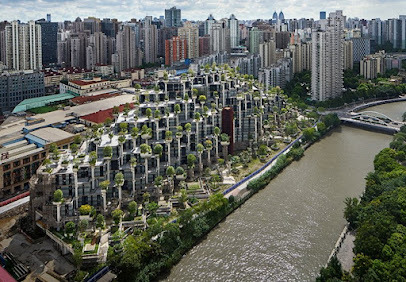
This is 1,000 Trees, a mixed use building in Shanghai by Heatherwick Studio. I think it is ok, aesthetically, certainly better than bare concrete and glass. Aesthetically, I like covering buildings with trees and vines.

But this sort of design is not really eco-friendly. Consider the planters in which those thousand trees reside, each at the top of a tall concrete column:

Measuring from drawings, I estimate a typical planter and column top contains around 14 tonnes of reinforced concrete. Each kilogram of reinforced concrete releases 0.111 kilograms of carbon dioxide in its production . . . . A single planter would have an embodied carbon of 1,554 kilogrammes carbon dioxide equivalent (CO₂e). The amount of carbon dioxide a tree absorbs is dynamic, and depends on a variety of factors, but can be estimated as 10 kilogrammes per year for the first 20 years of its life.

This means the carbon dioxide absorbed by a tree would take around 155 years to offset that emitted in the production of the concrete planter.

Of course trees do more than just absorb CO₂, so that isn't the whole equation, but then again just building the planter does not represent the whole cost of the design. In defense of Heatherwick Studio, they don't claim that this building is "green." Which is good, because this building is not green at all, just trendy and expensive.

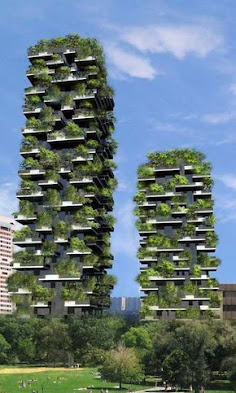
But plenty of other architects have evoked saving the planet in their designs for tree-covered towers, for example Milan's Bosco Verticale. I haven't seen calculations for these towers, but I am sure keeping trees alive up there costs a lot, and since the actual ecological impact of a thousand small trees is modest, I very much doubt it will offset just the number of extra elevator trips involved in tending the trees. These buildings are expressions of a post-industrial, "green" aesthetic, but they will not help the environment of Milan one bit.

Environmentalism is a mix of science, aesthetics, emotional revulsion against industry, attachment to small-scale communities, and so on. That's ok, everything big, important thing is complex. But if you really care about improving the health of ecosystems, you should defer to science, because a lot of stuff that looks or feels "green" is not.

Thursday, August 26, 2021

Form Energy Goes for Iron-Air Batteries

Form Energy is a new company whose investors include Bill Gates, Singapore's sovereign wealth fund, and several other big players. The founders are all scientists at MIT. They are trying to improve electrical grids and speed the transition to renewable power two ways: better batteries, and better grid-control software.

The buzz about the company is mainly about iron-air batteries. Metal-air batteries are an old technology; they basically work by turning a pure metal into its oxidized form and back again, like iron to rust and back to iron. This is a great way to store energy but if you think about rust for a minute you might realize that it flakes off and turns to dust and otherwise falls apart, making it hard to turn it back into whatever its previous form was. This has always been the main limitation on metal-air batteries; they work great, but only for a few cycles. After that they quickly degrade.

Form Energy claims to have a solution. If so, that is big news, because existing utility-scale batteries rely on rare metals like lithium and cobalt, and people are worried that this will make it hard to decarbonize the economy that way. But we have iron in practically limitless supply, and we are also very good at recycling it when it is worn out. So if we could build even a decent fraction of our batteries with iron that would very much help.

More: Form Energy's web site, wikipedia article on metal-air batteries.

Sunday, July 4, 2021

Environmentalists Against Fighting Climate Change

European governments have decided that the way to reduce carbon in the atmosphere is to electrify everything. This requires, as we discussed a few weeks ago, massive new mines for lithium, cobalt, and other metals, and all proposals for these new mines have been fought by local environmentalists. It also requires new factories to make a lot of batteries, like the one Elon Musk is building outside Berlin. This is, however, not at all popular with many locals:

Walking along the edge of part of the site late last month , Steffen Schorcht, one of a group of residents fighting the Gigafactory, outlined some of their complaints. He says the company has not done enough to protect local wildlife and the environment. The factory is built on an area previously planted for timber and abuts a conservation area.

“Our critique is not against Tesla cars or the Tesla company,” he said. “Our critique is for them to use this area to build this factory.”

Having lost their battle to prevent felling on all but a tiny portion of the site, environmental groups lobbied for more to be done to protect and rehome hibernating bats, smooth snakes and ants.

When the first stretch of forest was cleared last year to make way for the factory, a solitary tree was left standing as some bats needed to be left until they woke from their slumber.

But now they have zeroed in on what they see as a potentially bigger environmental concern: the project’s water consumption and polluting potential.

They complain that Tesla has not been upfront during the planning process, only submitting for approval last month plans for the addition of what Musk says will be the biggest battery cell production plant in the world.

The factory has already been held up for a year and who knows how long this might stretch out.

Some environmentalism is based on more or less rational fears about what we are doing to the world, whether that is CO2 emissions, plastic in the ocean, or hormone mimicking chemicals. But a lot of it is frankly aesthetic, a preference for forests over factories and parking lots. Some is a revulsion against modernity in all its forms; this is where Greens meet Tories, both wanting to preserve villages and organic farms against intrusions of big business or the state. Some is very localized, a fondness for familiar woods and fields. The Germans quoted in the Post's story insist that they are not opposed to electric cars in general, just the building of electric cars in their neighborhood. Somebody else's woods should be cut down, somebody else's water taken. (Not that Berlin is short of water.)

But keeping a few hundred trees won't, at this point, help the planet much. We need bigger actions, bigger answers, and that's going to involve its own arc of destruction.

Tuesday, May 25, 2021

Baku's Oil Boom

I'm still listening to Simon Momtefiore's marvelous Young Stalin (2008), and I was blown away by his description of Baku in the early 1900s. Baku, an old Persian town on the Caspian Sea, was one of those places where oil oozed naturally from the ground, and the inhabitants had long burned it for cooking and heating. Wells were drilled by the 1500s to get a purer, better burning product. Only a small amount was exported, by packing it in barrels. 

The oil was most famously used for the perpetual flame burning at an ancient Zoroastrian fire temple. (Which is still there, its fires still burning.)

Things started to change after Baku was conquered by the Russian Empire in 1806. Baku was connected to a large part of Russia via the Volga River and a growing system of canals, and oil exports gradually increased. Baku changed from being an almost entirely Persian community to a multi-ethnic city, with large populations of Armenians, Jews, Russians, and others.

Oil production really took off in the 1870s, and this caught the eye of outside investors. In 1882 the Nobel brothers from Sweden founded an oil company called Branobel in Baku; in 1883 the Rothschild banking family opened their own Baku firm. The company that eventually became Royal Dutch Shell was also founded here. This grim photograph shows the Baku oil field in 1879.


By the 1880s Baku had the look that Americans associate with an oil boom town, with a forest of wooden derricks.


By 1900 Baku was world famous and there are hundreds of photographs.

The Branobel refinery. The Nobels and the Rothschilds vied in technological innovation, and modern refining techniques and much else were pioneered here.

Among other innovations the Nobel brothers built one of the world's first oil tankers, the Zoroaster, to carry oil from Baku up the Volga into Russia. What made this a "tanker" was that instead of loading the ship with barrels, the oil was pumped directly into the hold and then pumped out again. This was a steam-powered ship, so great care had to be taken to keep the coal burning under the boilers from somehow igniting the oil. That's why before this time oil had generally been shipped on sailing vessels.

The oilfield workers lived in shanty towns close by the wells; the largest was known as the Black City. The whole city stank of oil but it was worst in the workers' district. Oil regularly rained down from the sky, blackening everything. It ran in ditches and lay in pools on the ground. It tainted the water and the air. One foreign writer calculated that life expectancy in the oilfield districts was about 25 years, on par with the worst periods of industrial Manchester and Liverpool.


Fires were frequent. These caused horrific injuries and a few deaths, and since they frequently burned for weeks they added to the awful pollution. When Stalin was in Baku in the early 1900s he set at least one fire and extorted money from the oil firms by threatening to set more. According to Montefiore, in 1906-1912 the Bolshevik organization got most of its funding from these oil companies, thanks to their power among the workers.

The place was crazily violent. There were brawls between workers of different ethnicities. There was the violent workers' struggle led by Stalin. There were violent gangs of criminals who specialized in kidnappings or bank heists – some of whom were also allied to Stalin. This old print shows Russian troops firing on rioters in Baku, a common occurrence. Montefiore says that the revolutionaries actually had a fair amount of support among oil company managers and their wives; even to the people benefiting from it, the system stank of oil, cruelty, and corruption.


In 1900 Baku and its hinterland produced half the oil in the world. Which means, of course, that it was producing a staggering amount of wealth. I always thought the Nobels got rich from dynamite, but not so; most of their money came from Baku oil. The Rothschilds, already insanely rich, doubled or tripled their fortune. At least ten other men got crazily rich off Baku's oil, including some Armenians and Persians. They spent their money building lavish villas. (And staffing their villas with platoons of bodyguards.) Above is the Ismailiyya Palace, built in 1906-1913, in old and recent photographs.


Homes of two Armenian magnates. These buildings were all seized by the Soviet state in 1920 and they now house various organs of Azerbaijan's government.

The headquarters of the Rothschilds' oil company.


The Baku Club, then and now, said in 1902 to be the most expensive club in the world. It now houses the national symphony. 


Views of the main streets. People said the central city was like Paris, with beautifully dressed people promenading down the boulevards and through the parks. Except that the very rich were shadowed by teams of bodyguards, any shift in the wind might blow in rains of oil or oil smoke, and a violent fight between workers and Cossacks might erupt at any time. 

The Governor's Garden, open to anyone who could afford to dress appropriately. 


Even though it sits in Central Asia, at the far edge of Europe, Baku's history epitomizes the industrial revolution. Technological innovation ran at a dizzying pace, and the world's wealth was rising exponentially for the first time. The middle class grew enormously; for the first time in history, masses of people lived comfortable lives. Cities were built from nothing in a few years, or completely rebuilt. Iron train tracks and canals crisscrossed the landscape. Among the things they carried were people, who left their old homes and moved to new cities at an incredible pace. In many places, like Baku, this led to greatly increased human diversity and the breaking down of old ethnic and class barriers.

But the cost was staggering: the despoiling of the earth, the staining of vast areas with the black poison of coal or oil, the ruination of millions of workers by coal dust, oil fumes, chemical reagents, or asbestos. A surge in inequality as the rich got staggeringly rich. And the awful, violent politics of revolution and reaction, driven by the workers' sense that they were being treated as just another raw material for the mills. This was starkest in Russia, where the Tsars responded to any challenge by sending in the Cossacks. They thought they could ride the two-headed hydra of accelerating economic change and worker resentment by violently applying spurs and whips, but they could not, and it is easy to think that 1917 was no more than they deserved.

Friday, May 7, 2021

Lithium: A Glimpse into the Biden Administration's New School/Old School Democratic Politics

Silver Peak Lithium Mine, Nevada

If we're going to move to an electrified future, we need a lot of batteries. Making batteries takes a lot of metal, especially Lithium and Cobalt. Modern metal mining is a hugely destructive process, involving blasting away whole mountains. This creates a serious environmental trade-off problem. 

Environmental activists have spent decades fighting the opening of new mines and the like, because, well, there isn't much you can do to a mountain worse than blasting it away and digging a gigantic pit where it used to be.

(There is an alternative to batteries, hydrogen-powered fuel cells, but this comes with two big problems: it requires us to create a vast new infrastructure for making and distributing hydrogen, and, for reasons I don't fully understand, the technology seems to be at least a decade behind batteries. So over the next 20 years it's batteries or oil.)

Which brings me to an interesting article in today's New York Times about Lithium mining in America. There is currently only one Lithium mine in the US, and it produces only about 10% of what we use. The Trump administration was determined to change that and as one of its last acts approved a new mine on Federal land in Nevada, called Lithium Americas. And this is another Trump policy Biden's people seem determined to push forward:

Most of the raw lithium used domestically comes from Latin America or Australia, and most of it is processed and turned into battery cells in China and other Asian countries.

“China just put out its next five-year plan,” Mr. Biden’s energy secretary, Jennifer Granholm, said in a recent interview. “They want to be the go-to place for the guts of the batteries, yet we have these minerals in the United States. We have not taken advantage of them, to mine them.”

In March, she announced grants to increase production of crucial minerals. “This is a race to the future that America is going to win,” she said.

So far, the Biden administration has not moved to help push more environmentally friendly options — like lithium brine extraction, instead of open pit mines. The Interior Department declined to say whether it would shift its stand on the Lithium Americas permit, which it is defending in court.

There is even a proposal out there to invest $10 billion of the infrastructure bill into Lithium extraction and processing.

Biden and his people do seem to be serious about climate change, but they are also serious about putting America first, and about creating blue collar jobs. Biden is the sort of Democrat more comfortable touring a factory with Union reps than communing with the mountains. His climate change policy is all about building things: more solar farms, more wind farms, more lithium mines, more battery factories. Other approaches are possible, for example getting more serious about recycling –hundreds of tons of Lithium end up in landfills every year – and reducing our energy consumption. But "build more stuff" is probably the most realistic approach over the next few decades. We're going to lose a few dozen more mountains, but to me that seems better than the risk of frying the planet.