Showing posts with label climate change. Show all posts

Tuesday, November 4, 2025

Nunalleq, After the Typhoon

Nunalleq is an archaeological site in western Alaska that dates to between 700 and 400 years ago. The site was never lost and the Yu'pik people who used to live there now live just a few miles away. Over the past twenty years Nunalleq has been eroding into the see, and the locals reached out to archaeologists to help them recover artifacts from the site before it disappeared. This led to a very fruitful cooperation between local people and archaeologists from the University of Aberdeen, and the establishment of a local museum. I have written about this site here twice before (2014, 2019).

Wooden artifacts from Nunalleq

Then last month the remains of Typhoon Halong slammed into the coast, eating 60 feet into the land and washing away most of the site. People began finding artifacts all along the shore, like the wooden mask at the top of the post. In the NY Times, Sachi Kitajima Mulkey has a good article about the effort to recover artifacts from the beach and the ongoing debate among the Yu'pik over whether they should move their village even farther from the sea. Climate change has not yet had much impact across most of the world, but in the arctic the impact has already been profound.

Thursday, July 25, 2024

Carbon Dioxide and Global Greening

Climate change is really complicated. From the Yale School for the Environment, here's an article on how rising carbon dioxide concentrations are so good for plants that some deserts are greening even without increased rainfall:

Southeast Australia has been getting hotter and drier. Droughts have lengthened, and temperatures regularly soar above 95 degrees F (35 degrees C). Bush fires abound. But somehow, its woodlands keep growing. One of the more extreme and volatile ecosystems on the planet is defying meteorology and becoming greener.

And Australia is far from alone. From Africa’s Sahel to arid western India, and the deserts of northern China to southern Africa, the story is the same. “Greening is happening in most of the drylands globally, despite increasing aridity,” says Jason Evans, a water-cycle researcher at the Climate Change Research Centre of the University of New South Wales in Sydney, Australia.

What is going on? The primary reason, most recent studies conclude, is the 50-percent rise in carbon dioxide concentrations in the atmosphere since preindustrial times. This increased C02 is not just driving climate change, but also fast-tracking photosynthesis in plants. By allowing them to use scarce water more efficiently, the CO2-rich air fertilizes vegetation growth in even some of the driest places.

Tuesday, March 5, 2024

That Comet Theory

Did a comet impact 12,900 years ago cause the Younger Dryas cold event and otherwise have big impacts on the planet and the course of human civilization? A science writer named Zach St. George, whom I never heard of until today, has an excellent article in the NY Times on the subject and the very weird debate that surrounds it.

The Younger Dryas is a rather mysterious climate event that took place at the end of the last Ice Age. Consider the graph above, which weirdly runs from right to left. You can see that the Northern Hemisphere was getting warmer, up to nearly modern levels, and then, boom, the temperature fell off a cliff, back to Ice Age conditions for a thousand years. This is very clearly visible in the archaeological record from my part of the world. We have a decent record of human presence in that warm period – called the Bølling–Allerød Interstadial – in the form of Clovis people. But we have next to nothing from the Younger Dryas, none of the distinctive stone tools known from farther south during that period.

Nobody knows what caused the Younger Dryas. But that isn't especially surprising, since nobody knows what causes Ice Ages or Interglacial Periods, either. Geologists used to say that it was caused by a huge flow of fresh water from melting glaciers into the Atlantic, disrupting the currents that bring warm water northward. But nobody has been able to make that work in detail, and lately even the theory's originator has backed away from it; a flood of meltwater that large ought to have left lots of evidence, and there just isn't any along the St. Lawrence River or any other plausible route to the Atlantic.

Enter a band of semi-plausible scientific types and their weird theory. Back in 2006-2007, archaeologist William Topping, physicist Richard Firestone, and geophysicist Allen West published a popular book arguing that the Younger Dryas was caused by a comet that struck the North American ice sheet, and they followed this up with a major scientific publication that had 22 co-authors. The theory intrigued scientists and archaeologists from the start because of the remarkable variety of evidence introduced: carbon nanospheres, nanodiamonds said to have been created by impact shocks, metal spherules, fullerenes with extraterresterial Helium, a weird soil layer they called the "black mat," and more. The scientific publication was fairly restrained, but the popular books was wild. St. George:
In The Cycle of Cosmic Catastrophes, a book published around the same time, two of the researchers described the scene more vividly. The impact caused the ground to shake and the sky to glow, they wrote. A hail of tiny molten particles sank into flesh and set forests ablaze. Soot blotted out the sun. Earth’s magnetic field wavered, and living things were bombarded by cosmic rays, confounding the navigational senses of turtles and porpoises, which beached themselves en masse. Addled birds plummeted from the sky.

Most disastrous of all, the impact shattered the ice dam holding back Lake Agassiz, a vast expanse of glacial meltwater that stretched across Manitoba, Ontario, Saskatchewan, Wisconsin and Minnesota. The lake cascaded into the Atlantic Ocean, where the freshwater pooled over the denser seawater, disrupting the convection current carrying warm water north from the tropics. The Northern Hemisphere plunged back into full-glacial cold.
The initial scientific response to these claims was muted partly because nobody had the expertise to evaluate more than a small part of the evidence they presented. But people's skeptical radars were very much on, partly just because these guys made the mistake of publishing the popular book before the scientific paper. Scientists hate that. The book also (see the title) tied their theory to the ancient global folklore of lost civilizations and repeated catastrophes, which is something else that scientists hate.

So people began to look into the evidence for a cometary impact 12,900 years ago. A raft of skeptical publications followed, arguing that 1) nanodiamonds are not a real thing; 2) nanodiamonds are ubiquitous and have nothing to do with impacts; 3) carbon spheres are ubiquitous and have nothing to do with fires; 4) carbon spheres are related to fires but are not especially common around 12,900 years ago; 5) carbon spheres are actually made by fungi; 6) there isn't any evidence that their Helium was extraterrestrial; 7) their Helium might be extraterrestrial but it can't be dated, so we have no idea that it was related to any particular impact; "black mats" are common archaeological sediments in no way related to comet impacts or climate change (there's one in post-Roman London); and their theory about fresh water flow into the Atlantic has the same problems as all other such theories. We also know, thanks to the wonderful record of the Greenland ice cores, that sudden cooling episodes like the Younger Dryas are not rare.

You can see that this was a little confused. Which makes me think that the initial publication was a stroke of genius: to get your whacky theory into print, just introduce so many kinds of new evidence that nobody can evaluate them all. This will intrigue people enough to get them talking about your ideas, and by the time the dust settles you are famous and have a book contract.

If you are curious about the current state of the scientific debate, the place to look is a long article from December, 2023, by Vance Holliday and many others, titled, "Comprehensive Refutation of the Younger Dryas Impact Hypothesis." I think this article is excellent and makes the whole Topping-Firestone-West theory look very bad. On the other hand you can learn from this paper that research on many of these topics – nanodiamonds, carbon spherules, etc. – is still in a primitive state, with very little agreement about what these objects represent.

So the debate goes on, even among people with no connection to the original team. Questions about impacts are very hard, as the still-not-completely-settled wrangling over the Chicxulub Crater and the end of the dinosaurs shows, and, as I want to keep emphasizing, nobody knows what caused the Younger Dryas.

But there is one thing that I feel quiet confident in asserting, which is that whatever caused the Younger Dryas it had no particular impact on the course of human evolution.

One of the claims made over and over by comet impact theorists is that the Clovis culture of North America "disappeared," and that the impact provides an explanation for this disappearance. The Clovis culture did not disappear; it evolved into other, obviously related cultures. At the Clovis type site in New Mexico it evolved into the Folsom culture, and despite what Graham Hancock says, there is no thousand-year gap in the sequence. (The obvious, well-documented evolution of Clovis into a dozen other cultures in different parts of the Americas is the best piece of evidence for the "Clovis First" theory about when humans first came to the Americas.) Impact theorists want the comet to be the cause of the mass extinction of North American mammals, but a model based on human predation and introduced dieases fits the evidence much better. The origins of agricultural in the Middle East are indeed rather puzzling, but the process was well under way before 12,900 years ago and so far as we can tell it continued along a pretty smooth curve right through this period.

And once we get into Graham Hancock "the comet impact destroyed the great white civilization of Atlantis" level crap, we're outside of science altogether.

Zach St. George is particularly good on the weird internet "debate" that has grown up around this stuff:
There are now many dozens of videos about the Younger Dryas impact hypothesis on YouTube. Some YouTubers doubt the hypothesis or even try to debunk it, but many more treat it as true. In their retellings, the hypothesis takes on the sheen of legend, with new embellishments, new twists, new conclusions. Some YouTubers use the impact and its supposed connection to rapid climatic cooling to challenge the importance of modern anthropogenic contributions to climate change. Others tie the impact to biblical events. Skeptics of the hypothesis, meanwhile, swell into villains — members of the “scientific cabal,” as one YouTuber describes them, or victims of groupthink.

“What’s crazy is that this evidence has already existed for years but has been shunned by the mainstream scientific and academic communities,” says Jimmy Corsetti, who runs the YouTube channel “Bright Insight,” in one video. “They don’t want to talk about it, and the reason is, is because this is people’s livelihoods. A lot of people in the scientific community have become very wealthy.” Reporters, too, are complicit. “The failure to properly report evidence for the Younger Dryas Impact will one day be understood as the worst intellectual crime in the history of science journalism,” writes the Comet Research Group member George Howard, who describes himself as an “avocational expert” and “noncredentialed scientist,” on his blog, “The Cosmic Tusk.”
This kind of nonsense fascinates me. Once you decide that your view is absolutely true, you have to imagine why some people nonetheless oppose it. The claim that they do so for money shows up over and over again in this kind of theorizing, which is completely crazy. Sure, tenured scientists have pretty good lives, but they don't make any extra money for opposing crackpot theories. The only people who have made real money out of this affair are the proponents, notably Graham Hancock, who got a best-selling book and a Netflix TV series out of it. 

But there is a deeper misunderstanding of science here. These guys assume that scientists derive their status from defending a status quo to which they are attached, so new theories are a threat to them. But nobody ever got to be a famous scientists just by defending the status quo. The way to become a famous scientist is to either come up with a bold new theory or latch onto one early on and become one of its leading proponents. Some people oppose new theories because they are conservative curmudgeons, but in science that is never enough to stop a new theory. In our world, the incentives are all on the side of the bold and the new. 

The same is true for journalists. And everybody else, for that matter; we live in an age of rebellion so constant that it is sometimes hard for would-be rebels to find any establishment to rebel against.

Besides, some of my best friends are climate scientists, and I can tell you that they responded to the initial claim of cometary impact with great curiosity. The thing seemed kind of mad, but, again, the variety of new kinds of evidence got everyone's attention and led to all kinds of new work and new partnerships between people in different disciplines. (Who do we know who can help us with nanodiamonds?) The biggest hurdle for any radical theory is to get established scientists to pay attention to it at all, and the amount of attention that has been showered on the cometary impact theory shows how seriously it has been taken.

Now I have reached the point where I have to offer my own explanation of why my opponents cling to their false beliefs. I suggest two: first, we love anti-establishment rebels, and here we have some bona fide anti-establishment rebels with a bold and fascinating new theory that might potentially explain a lot of things. Second, many humans for thousands of years have been fascinated by catastrophes that destroyed ancient civilizations. It's just an idea that many people find cool and meaningful. Graham Hancock has written a bunch of books that mention archaeological evidence, but he cares not a fig for evidence. He believes in lost ancient civilizations as a spiritual pursuit, and his ideas are no more subject to refutation than faith in the resurrection to come.

Research on possible cometary impacts continues, in North America and other places. Comets and asteroids are certainly real, and their impacts might have numerous and varied effects. Right now, though, the Younger Dryas Impact Hypothesis looks bad, and the work of its initial advocates looks very sloppy. 

Friday, February 10, 2023

Drought and the Fall of the Hittite Empire

Famous Hittite Standard

The most dramatic thing that happened during the "Late Bronze Age Collapse" was the fall of the Hittite Empire. In 1200 BC it was a very powerful state; by 1177 BC it was gone. As we have discussed here before, one of the main theories about the whole regional collapse has to do with drought. It is well-established that the 12th century BC was a drier period than the 13th, and evidence of a major drought around 1200-1190 BC has been found in pollen cores from the Sea of Galilee. 

Now along come some American scientists who threw a powerful combination of radiocarbon dating, tree-ring dating, and stable isotope analysis at the very large sample of wood from the Anatolian mound known as the Tomb of Midas. (Article, popular summary)

Here is the wooden structure in question, a remarkably rich collection of very old juniper trees, giving us a paleoclimate record for Anatolia that stretches from 1775 to 748 BC.

The new study confirms earlier findings about a general drying in the Middle East between 1220 and 1150 BC. It also pinpoints a severe Anatolian drought that they date precisely to 1198 to 1196 BC. That certainly looks like a bad drought. The date may or may not be exactly right, but their science is very impressive, so let's assume they nailed it. 

But if we're going to put dates on the Hittite collapse, we have to consider that the archive of Ugarit in Syria includes letters sent by Hittite officials in 1190 BC, which make no mention of their own empire having collapsed or being threatened in any way. The Egyptian written record has the Hittites being destroyed in either – depending how you count some obscure reigns – 1188 or 1177 BC. 

So while it remains true that a period of severe drought was part of the background to the political events we call the Bronze Age Collapse – the fall of the Hittite Empire, the withdrawl of Egypt from Canaan and the resulting conquest by the Hebrews, the fall of Troy, the sack of Ugarit, the invasion of Egypt by the "Sea Peoples" – the exact mechanisms of the politics remain complex and obscure. You can certainly imagine that a terrible, three-year drought, coming in the middle of a generally dry period, would have severely stressed the Hittite homeland in Anatolia. This might have led, say, to a collapse in tax revenue leading to the king not being able to pay his soldiers or even feed them properly, leading to revolts, etc., leading to the fall of the state a decade later. One of the famous Ugarit letters says that Ugarit was under attack by its own soldiers and sailors, providing some evidence for the "revolt of unpaid armies" theory. But Assyria, which experienced the same climate disaster, did not fall, and in fact emerged a few decades later as a dynamic and expanding empire. How does a drought that impacted both explain why one Middle Eastern empire fell and the other did not? Some other factor is needed.

The authors of the new article say themselves that their data records six severe three-year droughts in the 1775 to 748 period, and nobody has claimed that any of the other five had any political impact.

And the reason this matters is that the authors of this article, with, one has to assume, the blessing of the editors of Nature, come right out in their introduction and say this is relevant to our times because

The potential of climate change to substantially alter human history is a pressing concern, but the specific effects of different types of climate change remain unknown. This question can be addressed using palaeoclimatic and archaeological data.

To which I respond, I can tell you exactly and precisely how climate shocks impact state-level societies: in every way you can imagine. Sometimes droughts cause war and rebellion; sometimes they cause an intensification of elite control. Somtimes they cause societies to collapse; sometimes they inspire a burst of technical creativity in irrigation and allied sciences, followed by a population boom. Sometimes you can't tell that anything happened at all.

The worst climate event to impact Europe in the past 10,000 years was the Little Ice Age, which was at its most dire in the 17th century and the 19th, when Europe was conquering the world and creating modern civilization. 

Obviously climate impacts civilization. Nobody lived in northern Europe during the Ice Age. When the glaciers melted, huge areas were flooded by rising seas, driving the people out. When the Sahara dried up, hundreds of towns and villages disappeared. But civilizations have existed and continue exist in diverse regions with very different climates. People are clever and adaptable. If some society or state falls because of a climate catastrophe, that probably means it was in some way highly vulnerable or unstable, and if it fails to come back when good weather returns, that must surely mean that the people decided some other arrangement would suit them better. There is nothing at all inevitable about the impacts of modest climate change like the drought of 1200 to 1190 BC. To be fair to the authors of the article in question, they say this in their conclusion, but only after making a lot of far-reaching claims about the importance of climate in history.

Tuesday, December 27, 2022

Hurricanes and Past Climates

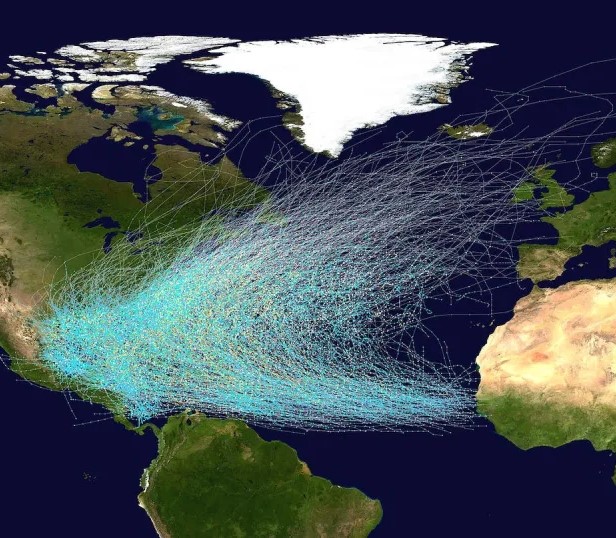
Hurricane tracks, 1851-2020

One of the main models used to predict how rising CO2 levels will impact the climate finds that rising temperatures should lead to more and more powerful hurricanes in the North Atlantic. Not all models show this, which we'll come back to in a minute, but anyway this connections is widely believed. After every hurricane somebody says that it was caused or worsened by climate change, and you can usually find people saying that things never used to be this bad. Is that so?

We have pretty good written records of hurricanes going back to the 1930s, and less good written records going back to 1851. These records do seem to show that 2000-2020 was a bad period. Of course 2022 was one of the weakest hurricane years on record despite being very warm in the North Atlantic, but nobody thinks the correlation is exact. But for something with such a big year-to-year variation, 90 years of data is not very much.

As it happens we have several methods we can use to estimate hurricane frequency and strength going back centuries. Hurricanes stir up the ocean floor and throw sand in crazy ways, and by coring into the bottoms of certain normally sheltered coves, or into "blue holes" in the Bahamas, you can find a record of how much sand was tossed around by storms at various times in the past. What do they show?

Hurricane proxy records from the Bahamas

The most studied place is the Bahamas, because it sees a bigger percentage of Atlantic hurricans than anywhere else. And Bahamanian records show that the past 150 years has been a relatively quiet period. If there is any correlation with temperature, it is negative; the Little Ice Age saw strong and frequent hurricanes, the Medieval Warm Period fewer and weaker ones.


Here are some other series from other locations, which as you can see show quite a bit of variation. But only one, a compilation of New England records, shows that the current period is a bad one for hurricanes.

This does not mean that climate change is a hoax etc., it just means that the climate is fiendishly complex and more atmospheric CO2 does not seem to correlate in a simple way with more storms. As to why cooler temperatures might correlate with fewer hurricanes, the author of the article from which I got all this data has a theory:

The compiled Bahamian records document substantially higher hurricane frequency in the northern Caribbean during the Little Ice Age, around 1300 to 1850, than in the past 100 years. 

That was a time when North Atlantic surface ocean temperatures were generally cooler than they are today. But it also coincided with an intensified West African monsoon. The monsoon could have produced more thunderstorms off the western coast of Africa, which act as low-pressure seeds for hurricanes.
So maybe the strength of the monsoon is more important than temperature, or maybe it is something else we know nothing about.

Monday, October 17, 2022

Climate Incoherence

The two activists who threw tomato soup on a Van Gogh painting the other day were part of a group called “Just Stop Oil.” In the NY Times, Ross Douthat zeroes in on the incoherence of the statement they issued afterward:

Celebrating their vandalism, the group declared that the “disruption is in response to the government’s inaction on both the cost of living crisis and the climate crisis,” and that it was deliberately timed to protest both the “launch of a new round of oil and gas licensing” and “an energy price hike” that threatens to throw “almost 8 million households” into “fuel poverty.”

It’s a mistake to demand perfect consistency from activists, but if you read the preceding paragraph carefully you will note a certain tension. The activists are protesting both the expansion of energy supply, on the grounds that fossil fuels are pushing the world toward climate apocalypse, and the energy supply’s constriction, on the grounds that higher prices are cruel to struggling households.

This tension has always lurked beneath the surface of left-wing climate activism, whose vision often imagines rich societies accepting a certain austerity, a retreat from the growth mentality of capitalism, a simpler, more ecologically wholesome way of life … while also imagining that somehow this austerity will fall only on the greedy rich and consumerist upper middle class, while the poor and working class experience the post-capitalist, de-growth future as more affordable, not less.

Yeah. There is simply no way to move away from fossil fuels without some economic pain, and to move away as fast as radical climate activists want to will cause a lot of pain. Some of that pain will fall on the poor. 

In fact Just Stop Oil is so incoherent that the internet is full of rumors that they are some kind of oil industry psy-op, out to discredit climate activism by their stupidity.

I suppose that's possible, but I don't find the incoherence of Just Stop Oil in any way surprising. It is part of a widespread sense that all of our economic suffering – long work hours, low wages, inequality, pollution, plastic bags, rude sales clerks – stems from "capitalism." Reading screeds from people like Just Stop Oil, you would think that oil wills are only drilled so that evil capitalists can get rich. 

But in fact oil wells are drilled so the rest of us can drive our cars, fly in airplanes, enjoy fresh produce trucked to our local stores, and so on. The share of the blame for this that falls on oil executives is, in my view, very small. Electric cars have been around since the 1970s, but nobody bought them. This was our choice, not forced on us by oil companies or anyone else.

The modern oil industry is not even all that capitalist, as big industries go, since so much of it is controlled by the countries that own the oil. As it happens I was just reading about the origins of the oil industry in Iran. The wells were drilled, and the pipelines built,by a company called Anglo-Iranian, which was partially owned by the British government and operated as an arm of the empire. Making a profit was well down on this list of its priorities, after keeping Russia out of Iran and supplying oil for the British fleet.

Here in Maryland we rely heavily on coal for our electricity. Far from being a capitalist conspiracy of some sort, this was engineered by the state in the 1960s as a way for wealthy eastern Maryland to subsidize the impoverished coal country in the west. And Maryland's devotion to coal is a small thing compared to that of the German government, which has massively subsidized their coal miners for decades. 

Meanwhile the current European energy crisis has been caused by a long list of government actions, including the closing of nuclear plants, the building of gas pipelines to Russia, and then Russia's decision to use energy in its war with Urkaine.

To blame all of this on "capitalism" strikes me as absud. And if we are ever going to escape from out dependence on oil and gas, wicked capitalists like Elon Musk are going to play a big part in the transformation.

But to get back to Just Stop Oil: it is their incoherent rejection of the the whole politico-economic system that makes them symptomatic of our time. We are trapped in a system that some of us think is wicked, but we have no idea what to do about it. We don't trust big companies or our governments, but can only fantasize about alternatives to their power. Throwing soup is not going to accomplish anything, but for people of their anarcho-communist-environmentalist mindset, I don't know what actions would.

Thursday, August 11, 2022

Politics and Science Don't Mix

From Science:

A major controversy in marine biology took a new twist last week when the University of Delaware (UD) found one of its star scientists guilty of research misconduct. The university has confirmed to Science that it has accepted an investigative panel’s conclusion that marine ecologist Danielle Dixson committed fabrication and falsification in work on fish behavior and coral reefs. The university is seeking the retraction of three of Dixson’s papers and “has notified the appropriate federal agencies,” a spokesperson says.

Among the papers is a study about coral reef recovery that Dixson published in Science in 2014, and for which the journal issued an Editorial Expression of Concern in February. Science—whose News and Editorial teams operate independently of each other—retracted that paper today.

The investigative panel’s draft report, which Science’s News team has seen in heavily redacted form, paints a damning picture of Dixson’s scientific work, which included many studies that appeared to show Earth’s rising carbon dioxide (CO2) levels can have dramatic effects on fish behavior and ecology. “The Committee was repeatedly struck by a serial pattern of sloppiness, poor recordkeeping, copying and pasting within spreadsheets, errors within many papers under investigation, and deviation from established animal ethics protocols,” wrote the panel, made up of three UD researchers.

This is always a grave danger whenever scientists work in a politically charged environment. I have worried about this sort of thing for decades now, ever since the political pressure to find worrisome things about climate change became intense. In a field where political positions are so strongly entrenched, science needs to be perfect to persuade anyone. But right now the rewards for findings that support climate change alarmism are so large that of course some people will give in and shade their results.

On the other hand, Dixson was eventually caught, and the paper retracted, which puts science as a field way above most. If only political pundits were held to this standard. . . .

Sunday, September 13, 2020

Why the Fires?

Why is the US west burning? Everybody is saying "climate change," but that is only partly right. The basic reality is that dry forests burn. If you don't let small fires reduce the amount of fuel available, old wood builds up until any fire will be catastrophic. Scientists understand this perfectly well. They have pressured the federal and state governments to stop fighting all fires and to use controlled burns to reduce fuel. But this, it turns out, is really hard to do, because nobody like fires and any plan to start one intentionally is met by angry opposition.

Academics believe that between 4.4 million and 11.8 million acres burned each year in prehistoric California. Between 1982 and 1998, California’s agency land managers burned, on average, about 30,000 acres a year. Between 1999 and 2017, that number dropped to an annual 13,000 acres. The state passed a few new laws in 2018 designed to facilitate more intentional burning. But few are optimistic this, alone, will lead to significant change. We live with a deathly backlog. In February 2020, Nature Sustainability published this terrifying conclusion: California would need to burn 20 million acres — an area about the size of Maine — to restabilize in terms of fire. . . .

Carl Skinner, another Cassandra, who started firefighting in Lassen County in 1968 and who retired in 2014 after 42 years managing and researching fire for the U.S. Forest Service, sounded profoundly, existentially tired. “We’ve been talking about how this is where we were headed for decades.”

“It’s painful,” said Craig Thomas, director of the Fire Restoration Group. He, too, has been having the fire Cassandra conversation for 30 years. He’s not that hopeful, unless there’s a power change. “Until different people own the calculator or say how the buttons get pushed, it’s going to stay that way.”

A six-word California fire ecology primer: The state is in the hole.

A seventy-word primer: We dug ourselves into a deep, dangerous fuel imbalance due to one simple fact. We live in a Mediterranean climate that’s designed to burn, and we’ve prevented it from burning anywhere close to enough for well over a hundred years. Now climate change has made it hotter and drier than ever before, and the fire we’ve been forestalling is going to happen, fast, whether we plan for it or not.

Megafires, like the ones that have ripped this week through 1 million acres (so far), will continue to erupt until we’ve flared off our stockpiled fuels. No way around that.

When I reached Malcolm North, a research ecologist with the U.S. Forest Service who is based in Mammoth, California, and asked if there was any meaningful scientific dissent to the idea that we need to do more controlled burning, he said, “None that I know of.”

Part of the problem is that setting fires is inherently risky, and our systems are set up to avoid risk. With so many people living in the forests, a fire that gets even a little out of control could destroy homes and endanger lives, and who wants to take responsibility for that?

Burn bosses in California can more easily be held liable than their peers in some other states if the wind comes up and their burn goes awry. At the same time, California burn bosses typically suffer no consequences for deciding not to light. No promotion will be missed, no red flags rise. “There’s always extra political risk to a fire going bad,” Beasley said. “So whenever anything comes up, people say, OK, that’s it. We’re gonna put all the fires out.”

Some of the experts cited in this article talk about wanting to burn a million acres a year, but when asked how that might happen, they are stumped. One suggested that if a fire destroyed San Diego, that might be enough. But then again it might not.

Friday, January 3, 2020

Sign in an Australian Bookstore

Post-Apocalyptic Fiction has been moved to Current Affairs.

Sunday, June 16, 2019

Geoengineering and Climate Change

Lots of people say, over and over, that climate change presents humanity with an existential crisis. Some of them think we need to take drastic action now, or else we're doomed; others think the amount of CO2 in the atmosphere means we are already doomed.

I have trouble taking all this doom-mongering seriously. Not that atmospheric CO2 might not end up creating a crisis; it certainly might. That is what the best science we have on the subject says, and the logic is pretty straightforward.

The reason I am puzzled by all the howls of anguish is that we know, or think we know, how to cool the planet. Lots of ideas have been proposed. Two of the best thought-out involve dumping minerals into the ocean to create giant algal blooms, which would soak up CO2 and transport much of it to the sea bottom, and spraying reflective particles into the upper atmosphere. Honestly we don't really know how well either of these would work, but the science that says they would cool the planet is exactly the same science that says CO2 is warming it.

It seems to me that if we are really facing a climate catastrophe, as I read almost every day, we ought to be trying everything we can think of. But we are not, and this is the puzzle I want to write about.

Nature recently published a little essay on this topic by two scientists who chaired a UN working group on geoengineering. Their task was to assess the state of the field and propose a framework for how geoengineering efforts should be regulated. The found that so little work has been done that there was nothing to assess, and since no work seems to be ongoing there isn't anything to regulate.
Storing carbon in the oceans sounds promising to some. The oceans are vast, and there could be fewer political trade-offs to deal with than on land. For example, fertilizing the water with iron would speed up the growth of phytoplankton and thus take up CO2, some of which would sink into the deep ocean as carbon when the organisms die. Another proposal is to spray seawater into the air to help form clouds that reflect sunlight and cool the planet.

Techniques such as these would need to be used on a massive scale to cap global warming at safe levels. For example, to mop up CO2 chemically, the entire Pacific Ocean would have to be sprinkled with one billion tonnes of powdered minerals similar to chalk. . . .

Little is known about the consequences. Scant research has been carried out for a range of reasons. The controversial nature of geoengineering divides researchers. And some research trials that have been funded have subsequently been abandoned, owing to a lack of rules for performing them and to conflicts of interest, such as patent applications. Even basic tests of equipment haven’t been done. . . .

This dearth of information is hampering the development of a global framework for regulating geoengineering research, despite more than a decade of debate. Researchers and policymakers need to know which negative-emissions technologies are worth investigating, and which will never work or are too damaging to pursue. The potential benefits and risks of the technologies need to be established before country leaders or companies decide to implement them prematurely.
Again, it's very puzzling. Are we in a crisis or not? If we are, why aren't we doing anything about it? It's a complicated question, but a big part of the reason is that research into geoengineering is strongly opposed by the same environmentalists who think climate change presents us with an existential crisis. The position statement of the Environmental Defense Fund, for example, says
Deliberate climate interventions such as albedo modification should not be undertaken for the foreseeable future as they present serious ecological, moral and geopolitical concerns.
I agree! Geoengineering presents all those questions. But if climate change is a catastrophe that is already upon us and may kill (as some say) a billion people this century, wouldn't that outweigh a quite a few ecological, moral and geopolitical concerns?

(For an example of a research project stopped by such objections, see here.)

Why would you both believe that atmospheric CO2 threatens the existence of humanity and oppose efforts to do anything about it? I think it is because for many environmentalists atmospheric CO2 is not really the problem. It is more like a symbol of the problem, or perhaps a single case of a very broad phenomenon that is the deeper problem. That broad phenomenon is humans messing with the planet. Environmentalists as a group are worried, not so much about the level of CO2 in the atmosphere and how that might affect the climate, but by all the ways we are changing our home and all the ways that might be bad. Even if geoengineering worked, in that sense that it might undo the warming caused by all the CO2 we have pumped into the air, it would in the broader sense only be another way we are messing with the planet, which is the thing they want to put a stop to.

I think this is short-sighted. If the models are right and the planet is going to warm dramatically, we don't have time to prevent that by limiting our future CO2 emissions. Those are coming down as fast as I think will ever be feasible; despite what some environmentalists want, we are not going to junk our cars and turn off our air conditioners because of a vague future threat that nobody really understands. If atmospheric CO2 is an existential problem, geoengineering is the only feasible solution.

Climate change remains, as I have always said, a serious potential threat to humanity and earth's other residents. But I will believe we are in actual crisis when people who worry about this issue start acting like we are.

Thursday, May 11, 2017

The Top Solution for Climate Change

Paul Hawken and a large team of experts tried to crunch the numbers for different proposed remedies to climate change, from vegan diets to offshore wind farms. The result:
The number one solution, in terms of potential impact? A combination of educating girls and family planning.
All of our impacts on the planet are driven by rising population, and the best way to limit the impact is to limit population growth. And the best ways we know of to do that are to educate girls and provide birth control and family planning advice to those who want it.

Friday, April 21, 2017

Geoengineering to Fight Climate Change

Pretty good article by Jon Gertner in the Times on the scientific and ethical questions that surround climate manipulation. If our equations are right, it ought to be fairly simple to cool the planet:
Ten Gulfstream jets, outfitted with special engines that allow them to fly safely around the stratosphere at an altitude of 70,000 feet, take off from a runway near the Equator. Their cargo includes thousands of pounds of a chemical compound — liquid sulfur, let’s suppose — that can be sprayed as a gas from the aircraft. It is not a one-time event; the flights take place throughout the year, dispersing a load that amounts to 25,000 tons. If things go right, the gas converts to an aerosol of particles that remain aloft and scatter sunlight for two years. The payoff? A slowing of the earth’s warming — for as long as the Gulfstream flights continue.
Dumping iron into the Pacific Ocean is another scheme some have suggested, and there are many other plans. One or another of these schemes really ought to work. And honestly I just don't take seriously people who say it is somehow immoral to try to engineer the planet, considering all the ways we have already engineered it. If we are warming the planet, we really ought to cool it back.

Every serious person involved in this and other geoengineering efforts agrees that for now what we need is a lot more research. and even then we may never know if it will really work until we try it on a large scale:
David Battisti, an atmospheric scientist at the University of Washington, told me, “It’s not obvious to me that we can reduce the uncertainty to anywhere near a tolerable level — that is, to the level that there won’t be unintended consequences that are really serious.”
But what if we do the research and find that this stuff works?
What then? The world would need to agree where to set the global thermostat. If there is no consensus, could developed nations impose a geoengineering regimen on poorer nations? On the second point, if this technology works, it would arguably be unethical not to use it, because the world’s poorest populations, facing drought and rising seas, may suffer the worst effects of a changing climate.
Honestly if the planet gets much warmer somebody is going to do this; there are too many nations, and corporations and even individuals who could afford to fund it. If the US and the UN have not approved, what are we going to do? Shoot down the planes?

If I were a science fiction writer I think I might get to work right now on a story about a war between some tropical dictator who wants to dramatically cool the planet and northern countries who want to keep it warm.

Thursday, February 9, 2017

Republicans for a Carbon Tax

One thing about which I agree with the Republican platform is that using complex regulations to achieve public goals can be a miserable drag, and we should always be looking for simpler alternatives. And there is actually a better, simpler alternative to Obama's Clean Power Plan and other regulatory attempts to reduce carbon dioxide emissions: a carbon tax. Various right-of-center columnists have been making this argument for years, but very few Republican politicians have signed on, because of the party's aversion to any sort of new tax.

So I was thrilled to read that a bunch of retired Republican office-holders have come out in favor of a carbon tax:
The group, led by former Secretary of State James A. Baker III, with former Secretary of State George P. Shultz and Henry M. Paulson Jr., a former secretary of the Treasury, says that taxing carbon pollution produced by burning fossil fuels is “a conservative climate solution” based on free-market principles. . . .

A carbon tax, which depends on rising prices of fossil fuels to reduce consumption, is supported in general by many Democrats, including Al Gore. Major oil companies, including Exxon Mobil, have come out in favor of the concept as well.

The Baker proposal would substitute the carbon tax for the Obama administration’s Clean Power Plan, a complex set of rules to regulate emissions which President Trump has pledged to repeal and which is tied up in court challenges, as well as other climate regulations. At an initial price of $40 per ton of carbon dioxide produced, the tax would raise an estimated $200 billion to $300 billion a year, with the rate scheduled to rise over time.

The tax would be collected where the fossil fuels enter the economy, such as the mine, well or port; the money raised would be returned to consumers in what the group calls a “carbon dividend” amounting to an estimated $2,000 a year for the average family of four.
Under the plan, a majority of families would actually come out ahead. But that probably won't make any difference to most elected Republicans, who have been putting themselves on record against carbon taxes for years.

Tuesday, February 7, 2017

Curiosity, Mars, and Climate Modeling

Once upon a time, about 3.5 billion years ago, Mars had liquid water on the surface. Signs of this are everywhere, and most scientists now regard it as a fact.

But how did such a small, cold world ever have lakes and rivers of liquid water? The reigning theory was that the thin atmosphere once contained so much carbon dioxide that the greenhouse effect made the planet warm enough. To test this theory, NASA sent the Curiosity rover to the bed of an ancient lake (above) to sample the sedimentary rocks within it. Rocks that formed in an atmosphere dense with CO2 ought to show evidence of that, in the form of carbonate minerals.

But no:
The same Martian bedrock in which Curiosity found sediments from an ancient lake where microbes could have thrived is the source of the evidence adding to the quandary about how such a lake could have existed. Curiosity detected no carbonate minerals in the samples of the bedrock it analyzed. The new analysis concludes that the dearth of carbonates in that bedrock means Mars' atmosphere when the lake existed -- about 3.5 billion years ago -- could not have held much carbon dioxide.

"We've been particularly struck with the absence of carbonate minerals in sedimentary rock the rover has examined," said Thomas Bristow of NASA's Ames Research Center, Moffett Field, California. "It would be really hard to get liquid water even if there were a hundred times more carbon dioxide in the atmosphere than what the mineral evidence in the rock tells us."
So it's back to the drawing board in trying to model the ancient atmosphere of Mars.

Thursday, February 2, 2017

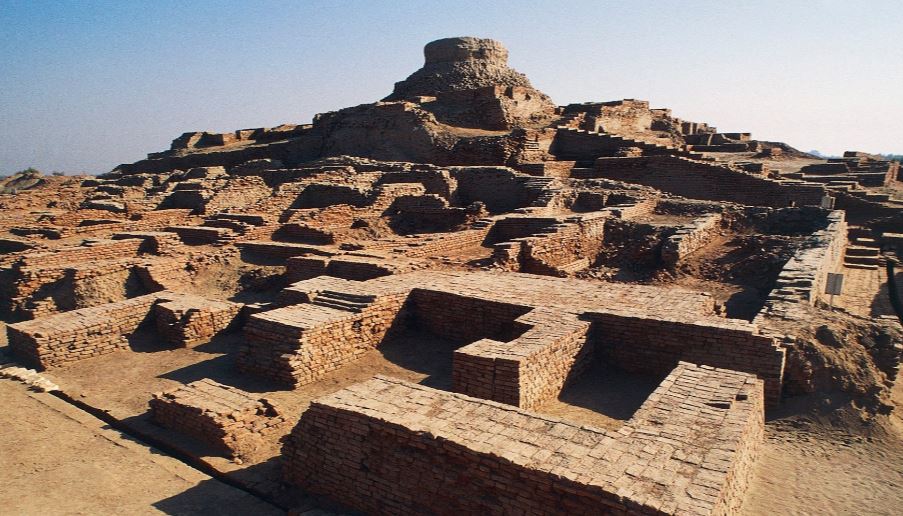
Climate Change and the Indus Valley Civilization

The Indus Valley or Harappan Civilization was at its peak between about 2600 and 1900 BCE. After that it rather mysteriously declined. The part of the world where these people lived (Pakistan and northwestern India) contains a bunch of old, dried-up river courses and lake beds, which show that it was once wetter than it is now. So as far back as the nineteenth century archaeologists argued that maybe the Indus Civilization was done in by climate change.

And there have been claims that the drying of the region happened at about the right time, c. 1900 BCE. But the science on this is very iffy, and there have been lots of other claims. The latest, coming from a major study across a wide swath of India, suggests that the greatest drying occurred around 2200 to 2000 BCE. When they announced this dating, the archaeologists involved said that they had found the cause of Indus civilization's decline.

Of course 2200 BCE is 300 years before Indus Civilization began its precipitous decline, and 300 years is a long time to hang on without enough water. So the same group of archaeologists set about figuring out how people adapted to that change. Did they grow different crops, put more emphasis on herding, extend irrigation, move to someplace wetter? No. So far as this study showed, people changed nothing at all.
We argue that rather than being forced to intensify or diversify subsistence practices in response to climatic change, we have evidence for the use of millet, rice, and tropical pulses in the pre-urban and urban phases of the Indus Civilization. This evidence suggests that local Indus populations were already well adapted to living in varied and variable environmental conditions before the development of urban centers. It is also possible that these adaptations were beneficial when these populations were faced with changes to the local environment that were probably beyond the range of variation that they typically encountered
Translated into English, that seems to mean that people did not have to change because their existing style of farming was already flexible enough to cope with a great deal of variation in rainfall.

I personally love this result, because I have gotten tired of climate change being used lazily an an explanation for every change in human society. People are adaptable, and thrive in all but the driest and coldest climates. I can imagine a scenario in which the climate continued to worsen and the early success people had adapting to declining rainfall without major changes only made them more vulnerable when things got too bad for their system to continue. But that is not what this study shows; it shows the Indus civilization sailing through what the authors identify as the period of most profound change in the climate over the past several thousand years.

I would say that leaves the relationship between the drying climate and the end of Indus Civilization as much up in the air as ever.

Monday, April 18, 2016

The Climate Change Hiatus and the Weird Presentism of Political Debate

Lots of chatter this week in climate science circles because of a new note published in Nature Climate Change arguing that the "hiatus" in global warming over the past 15 years is real. They call it the "warming slowdown." After applying gobs of statistics to the global temperature data, they conclude that the rate of temperature increase has in fact slowed since 2000.

But if you're like me, you looks at the above graph and ask, what about this hiatus? I mean, given the vast number of pixels that have been spewed over the internet about the recent "hiatus", you might think it is some kind of unusual event. But it is not, and in fact it is a lot less important than the big pause we had from 1945 to 1980. The authors of this paper in Nature recognize that, and they offer an explanation that they think explains both slowdowns: that these are phases when the oceans were warming, and therefore soaking up heat, and in between came a phase when the oceans were cooling and therefore accelerating the change. (You have to remember that most, as in almost all, of the heat in the climate system is actually in the oceans, not the atmosphere.)

The climate change debate is a good example of a big problem with human thinking in general, a problem that makes it very difficult for us to deal with problems like global warming. Our thinking is far too short term. Both people terrified of climate change and people who dismiss the whole thing as a hoax spend way too much time and effort arguing over whether the world was warmer in 2010 than in 2000, when the only serious answer is, who cares? What matters is the trend since 1850 when we really began pumping CO2 from fossil fuels into the atmosphere, and that trend is up.

And the question that matters, and that we cannot answer, is why the global temperature, which seems to track the level of carbon dioxide in the atmosphere, has gotten decoupled from it in recent decades. As you can see in the graph above, the CO2 level has soared in recent decades while the plant has warmed only a little. Is that because some other mechanism cancels out the effect of all that greenhouse gas? Or is it because the change is just taking some time to work its way through the system? Most scientists are betting on the latter, and if they are right we are in for terrible trouble.

And one thing we know about the climate is that it does not generally warm or cool in smooth curves, but like a flight of stairs, with periods of rapid change separated by periods of stasis. So even if we are in a pause, that in no way implies that we won't start warming rapidly in a year or two.

Monday, November 2, 2015

The Climate is Complicated

Interesting study just released by NASA:
A new NASA study found that Antarctica has been adding more ice than it's been losing, challenging other research, including that of the UN's Intergovernmental Panel on Climate Change, that concludes that Earth’s southern continent is losing land ice overall.

In a paper published in the Journal of Glaciology on Friday, researchers from NASA's Goddard Space Flight Center, the University of Maryland in College Park, and the engineering firm Sigma Space Corporation offer a new analysis of satellite data that show a net gain of 112 billion tons of ice a year from 1992 to 2001 in the Antarctic ice sheet.
You can put this beside the frightening NY Times story from last week about melting glaciers in Greenland.

The scary things forecast by climate science are not happening yet. The planet seems to be getting a little warmer, but opinions differ as to whether the changes we are seeing are within the normal range. What is scary is what might happen if the planet suddenly decides to warm to the level predicted by the very high level of carbon dioxide in the atmosphere. Nobody would pay that much attention to the changes we are seeing now, except as signs that the predicted big warm-up might be getting started.

From as far back as we have records (millions of years) to 1945, there was a close relationship between the amount of CO2 in the atmosphere and the temperature. Since 1945, the level of CO2 has soared without the temperature changing very much. If it actually does warm to the level that would match the very high CO2 concentration, we are cooked. And we know that the earth's climate can change fast. That is the fear, not some matter of a little less ice in Greenland or a few more hurricanes.

Sunday, September 20, 2015

Ancient Traditions and Rising Seas

How long can tribal societies preserve oral traditions?

It is a hard and complicated question. On the one hand certain myths, archetypal images, and associations can be preserved for tens of thousands of years; consider that the world tree of the Maya is identical in many details to that of the medieval Norse and modern Siberians, apparently preserved for 13,000 years. But scholars who have studied more concrete traditions, such as accounts of actual battles or great earthquakes, say that they fade away after 500 or at most 800 years.

Which makes a new article by Patrick Nunn and Nicholas Reid extremely interesting. Nunn and Reid have studied he traditions of coastal people all around Australia, many of whom have stories about lands inundated by the sea. The map above shows the sources of the stories they analyze, and the extent of land in Australia around 20,000 years ago. From their abstract:
Stories belonging to Australian Aboriginal groups tell of a time when the former coastline of mainland Australia was inundated by rising sea level. Stories are presented from 21 locations from every part of this coastline. In most instances it is plausible to assume that these stories refer to events that occurred more than about 7000 years ago, the approximate time at which the sea level reached its present level around Australia. They therefore provide empirical corroboration of postglacial sea-level rise. For each of the 21 locations, the minimum water depth (below the present sea level) needed for the details of the particular group of local-area stories to be true is calculated. This is then compared with the sea-level envelope for Australia, and maximum and minimum ages for the most recent time that these details could have been observed are calculated. This method of dating Aboriginal stories shows that they appear to have endured since 7,250–13,070 cal years bp. The implications of this extraordinary longevity of oral traditions are discussed, including those aspects of Aboriginal culture that ensured effective transgenerational communication and the possibility that traditions of comparable antiquity may exist in similar cultures.
Two examples of of these traditions:
Kangaroo Island or Karta (4405 km2) lies at the mouth of Gulf St Vincent, its closest points to the Australian mainland being to the south coast of Yorke Peninsula (40 km) and across Backstairs Passage to the southwest end of the Fleurieu Peninsula (13.5 km). The earliest and most detailed versions of the story about the drowning of Backstairs Passage were collected from the Raminyerar and Jaralde peoples of the mainland. All involve an ancestral figure named Ngurunduri whose two wives ran away from him. He pursued them relentlessly along the south coast of the Fleurieu Peninsula, finally catching sight of them as they were crossing what was then a strip of land connecting it to Kangaroo Island across Backstairs Passage. Infuriated, he caused the sea to rise and drown them; the women and their belongings became the islands known as The Pages (Meralang) and the sea never again receded from the passage.
The Narrangga tribe living on Yorke Peninsula ‘had a story that has been handed down through the ages' which recalled a time when Spencer Gulf was dry land, ‘marshy country reaching into the interior of Australia'. In another account, probably from a different source, this country is described as ‘a valley filled with a line of fresh-water lagoons', each associated with particular types of water bird; the ‘open country between the lagoons' was occupied by ‘emus, curlews and mallee fowls' while elsewhere there were other creatures. Both versions of the story describe the initial flooding of the Gulf as having been catastrophic rather than gradual, the result of a mythical/giant kangaroo using a magic bone to cut a trench; ‘the sea broke through, and came tumbling and rolling along in the track … it flowed into the lagoons and marshes which completely disappeared'
I find these remarkable. As Nunn and Reid write, these traditions are different from the Genesis/Gilgamesh sort of flood story in that the flood waters never recede. In every case the description of the world before the flood is plausible; there is nothing parallel to Plato's crazy Atlantis, just ordinary stretches of land or mash. The flooding is said to have been catastrophic, but in fact that is how it happened in many places; the seas did not rise gradually, but in a series of strong "pulses," and this effect was multiplied in the sorts of bays and inlets where many of the Australian stories are set. These inlets might indeed have flooded rapidly when the seas breaches dunes across their mouths. Many of the tales attribute the flooding to a great ancestor or spirit animal, but one can hardly blame ancient Australians for not knowing about melting glaciers.

I think Nunn and Reid make a strong case that these stories are authentic folk memories, and the geology makes it clear that most of them are at least 7,000 years old. Amazing.

Monday, August 24, 2015

Carbon Dioxide and the End of the Last Ice Age

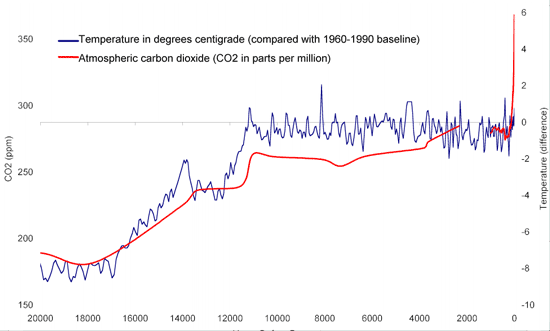
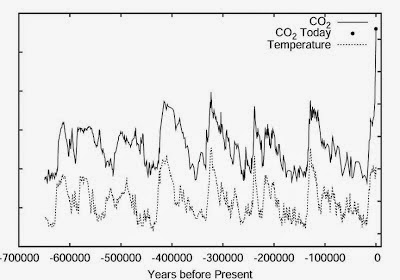
At the end of the last Ice Age, the level of Carbon Dioxide in the atmosphere soared. As the CO2 level rose, so did the temperature. Behold how closely the two lines track each other in the graph above.

Or in this one.

So you might say that the rising level of CO2 obviously caused the rising temperature, the retreat of the glaciers, and the origins of the modern climate. That's what this new study concludes, after making the most detailed comparison yet between temperature and CO2 levels:
A team of scientists led by Jeremy Shakun of Boston College re-examined the ages of more than 1,100 previously studied glacial boulders by measuring a particular isotope -- Beryllium-10 -- produced by exposure to cosmic rays.

They compared their findings, the most accurate so far, to the timing of the rise of carbon dioxide in the atmosphere, data gleaned from ice bubbles trapped in ice cores.

The results were unequivocal.

"The only factor that explains glaciers melting all around the world in unison during the end of the Ice Age is the rise in greenhouse gases," said Shakun.
Well, maybe. But what caused the rise in the carbon dioxide level? Where did all that carbon come from?
Scientists are still not sure what triggered the gradual release of CO2 into the atmosphere starting 19,000 years ago, or exactly where it came from.

"It's fair to say that the reason CO2 went up and down over the Ice Ages is one of the biggest palaeoclimate mysteries out there," Shakun said by email.

The most likely scenario, according to co-author Peter Clark of Oregon State University is that huge quantities of carbon bubbled up from the sea. "The carbon was likely released because of changes in the ocean and its circulation that were triggered by changes in the Earth's orbit around the Sun," he wrote in an email exchange.
So does that mean the real cause of the rise in temperature was  "changes in the Earth's orbit around the Sun"?

What these authors would probably say -- it's what most climate scientists say, anyway -- is that whatever caused the rise in carbon dioxide at the end of the Ice Age, the rise in carbon dioxide was the mechanism by which the planet was warmed. So the current rise in CO2 -- from 280 ppm over most of the past 12,000 years to about 400 ppm now -- is cause for alarm.

Climate scientists spout a lot of nonsense these days, but the reason they spout nonsense is that they are really freaked out by the red spike at the far right of that top graph. Until 1940 or so, temperature and CO2 tracked each other pretty closely. Since then, the CO2 concentration has soared, and temperature has not. When scientists try to model the climate, their equations keep telling them that those two curves must eventually come back into sync. That is, sooner or later the temperature must rise to match the rising level of CO2, because the two curves have always been so closely aligned in the past.

If you are a skeptic, you might say that we know no such thing. We only know that whatever global processed drove climate change in the past worked that way. Burning coal is something new in history, so maybe it will work out in a completely different way. And it might. But that seems to me like a risky bet that we would be fools to take.

Wednesday, May 27, 2015

What If Global Warming is Postponing a New Ice Age?

The combination of atmospheric physics and historical geology seems to prove that carbon dioxide in the atmosphere warms the planet. How much may depend on particular circumstances, but the basic effect does not seem in doubt. So the current, historically high level of atmospheric CO2 is reason to worry; we don't know how hot the earth might get over the next century, or how much of the polar ice will melt.

The thing is, compared to most of the past 2 million years, it is already very warm on the earth. We are what geologists call an interglacial era, a time between ice ages. The cycle seems to be driven by wobbles in the orbit of the earth, so the timing ought to be fairly consistent. And if this interglacial were like the last two, the temperature should be falling by now. But it isn't. Some scientists -- including my only close friend who is a climate expert -- feel certain that our warm period is being extended by human CO2 emissions. To these scientists, the "Little Ice Age" that started around 1250 CE ought to have been the start of a new downward trend in the temperature, but coal burning and forest clearing turned things around and made the planet warm again.

A new study just published in Nature Geoscience makes the argument quantitative. The authors believe that a new Ice Age would certainly begin within the next 1,500 years, but high atmospheric CO2 levels are preventing this. Right now the level is about 390 ppm, and these calculations show that it would have to fall below 240 ppm for the glaciers to resume spreading.

I don't mean by this to dismiss worries about climate change or to argue that it is really a good thing. Compare those numbers: right now the CO2 level is vastly higher than it would have to be to prevent another Ice Age, and it is still rising rapidly; scalding seems like a much more immediate threat than freezing. But it is important to remember that the earth's climate is always changing. Compared to most of the past 2 million years, it is warm on the earth, but compared to most of the 100 million years before that we are a frigid era. On the whole the earth seems to be getting colder, too, with recent Ice Ages colder and longer than they were before. What impact our vast experiment in changing the atmosphere will have on this complex system is very hard to predict, but disaster is certainly within the bounds of the possible.