Showing posts with label demography. Show all posts

Monday, February 9, 2026

Government Measures Influence the Timing of Births More than the Total Number

From an excellent, detailed article on recent human fertility, I extract this graph. In 1967 the dictatorship in Romania banned abortion and modern contraception. The result was a birth boom. But the boom was short-lived and a sharp decline soon followed. Comparison with Bulgaria, another communist government with a similar economy, shows that Romanian policy had little impact on completed cohort fertility (the number of babies women have over the course of their lifetimes). Women who had babies in 1968 just had fewer babies later.

This seems to be happening in Hungary now. The government's birth subsidies did encourage women to have babies, but now fertility is falling again and it seems those were just babies women were planning to have at some point down the road.

Via Marginal Revolution.

Friday, January 23, 2026

A Thought About Fertility Decline

Jesús Fernández-Villaverde on Twitter/X

Perhaps the fastest decline in fertility ever recorded has taken place in Guatemala’s poorest, least educated, and indigenous majority rural areas, where women’s rights are weakest, between 2006 and 2025.

In 2006, Guatemala’s total fertility rate was 3.8, comparable to that of a sub-Saharan African country. By 2025, it had fallen to 1.8, only slightly above the fertility rate of non-Hispanic Whites in the United States (around 1.6). At the current pace, Guatemala will have a lower fertility rate than non-Hispanic Whites in the U.S. before 2030.

Does your preferred explanation (women’s education, feminism, smartphones, or women choosing holidays in Bali over children) fit that pattern? 

Tuesday, November 25, 2025

Hungary's Pro-Natalism

Hungary has gone all-in on promoting births:

Since 2010, Hungary has implemented a variety of policies, including zero-interest “baby-expecting” loans and debt forgiveness for couples with children, personal income tax relief for mothers, and housing support for married couples, in an effort to reverse demographic decline. Hungary spends around 5 percent of GDP on family subsidies, and the OECD ranks Hungary among the top five OECD countries overall in public spending on family benefits.

But as you can see from the chart above, the results have been unimpressive, and they are nowhere near their goal of raising TFN back to the replacement level of 2.1. Last year Hungary recorded 127,500 deaths and 77,500 births.

On the other hand, most of those benefits are only available to married couples, and that has led to a decline in the number of children born to unwed mothers.

Thursday, October 9, 2025

The Baby Boom was Weird


Two charts from Jeremy Horpedahl, based on census data. People tend to forget that spinsters  and bachelors were big things in the 19th century.

Thursday, August 28, 2025

Tuesday, June 17, 2025

The World Divided into Four Equal Parts

Not sure where this came from, but it looks about right. 

Wednesday, April 23, 2025

Falling Populations

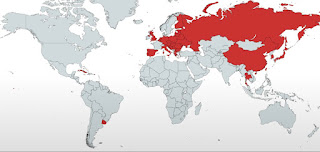
The countries in red had more deaths than births in 2024.

Monday, April 21, 2025

Meanwhile, at the Pro-Natalist Conference

This NY Times piece on the recent Natal Conference in Austin, by Emma Goldberg, is highly ironic and actually quite clever. Goldberg avoids doing the thing that makes so much reporting by liberals unreadable, that is, dismissing whole movements because some of their members are obnoxious racists. She found all sorts of people at the conference, including white nationalists but also tech types and women with lots of children just looking to connect with people like themselves. One woman said she had attended because “I knew having five kids wouldn’t make me the weirdest person in the room.”

Here's one good bit; when economist Bryan Caplan was challenged on how few women were among the speakers, he said,

“We were going to have more women. But they all got pregnant.” (He meant this literally; the conference organizers said four female speakers had dropped out, citing either pregnancy or caring for a sick child.)

The key observation is that while the mostly male attendees all think it is important to get women to have more babies, none of them have a clue how to do that. And so far as I can tell, the only answer anyone has found is “patriarchal religious cultism,” which I doubt will be successful on a large scale anywhere.

What struck me most was the sense many attendees had that having lots of kids makes you weird:

“If you want to have babies, go girl boss that,” said Hannah Centers, 41, a mother from Tennessee who home-schools her three children and said she felt judged by her neighbors when she told them she was pregnant with her third.

I have more children than any of my close friends, but if they think my family is weird, they are careful not to say anything in front of me. In fact I cannot remember ever feeling judged or shamed about my family. Some people clearly think it is crazy, but in the spirit of thinking people are crazy for being into ice climbing. So I'm not sure if people really are judging these mothers, or if maybe they are just insecure and seeing judgment where there is only bemusement. 

Saturday, December 14, 2024

Some Demography

In ancient and medieval societies, cities always had higher death rates than the countryside, and only matinained their populations due to immigration. Now urban areas have lower death rates. When did that change? A careful study of French data finds that the switch didn't happen until the 1940s.

And now to the thing demographers mainly talk and tweet about, fertility decline. I am not myself full of doom about declining birth rates, partly because I remember population bomb doomsterism from the 1970s and so don't trust anybody's 50-year projections. But I am tracking the remarkable decline in fertility around the world and wondering what it will mean.

Despite massive government spending to encourage childbirth, Poland now has the lowest total fertility of any EU state, 1.11. The previous front-runner was Spain, which held steady at 1.13.

Meanwhile in the US total fertility is holding steady around 1.62; interesting that white fertility surpassed that of black Americans for the first time ever, 1.534 > 1.529. I would call that a tie, but these are very accurate numbers, and the difference would have been greater except for women born in Haiti. 

Dramatic fertility declines in Latin America over the past decade:

* Argentina 2.25 to 1.25
* Mexico 2.11 to 1.45
* Colombia 1.94 to 1.21
* Chile 1.78 to 0.88

Most of the high birth rate nations in the world are in sub-Saharan Africa, but some demographers have been predicting birth rate collapse in those nations for a decade, it looks to be happening. For example, in Lesotho, total fertility has fallen from 3.5 in 2004 to 2.5 today, and the rate of decrease appears to be accelerating.

And this: "Iran is the greatest example of how superficial traditionalism does nothing. Iran is on the same track regarding metrics like birthrate, GDP, female university attendance, that you would expect if the Shah had never fallen. Average modernizing middle income country." Sometimes, in some ways, stuff like elections matters a lot, but sometimes it seems like everything else is downstream of the basic techno-cultural system.

Thursday, October 10, 2024

Isabel Wilkerson, "The Warmth of Other Suns"

Between 1915 and 1970, about 6 million black Americans migrated out of the south to cities in the north or on the west coast. Demographers call this the Great Migration, and it was a big, powerful, and very important event. The Warmth of Other Suns (2010) is a wonderful book about it.

The Warmth of Other Suns has four interleaving elements. There is, first of all, a general narrative of the event, drawn from demographic, sociological and historical studies. That general narrative is made specific through the lives of three migrants who represent the three main flows that made up the movement: from Florida, Georgia and the Carolinas to the northeast, from the Mississippi Delta to Chicago, and from Texas and Louisiana to the west coast. Ida Mae Gladney was a sharecropper's daughter who moved from Mississippi to Chicago in 1937. George Starling moved from Florida to New York City in 1943, where he found a job working on the New York to Florida trains that had carried him north along with a million others. Robert Foster was a physician who left Louisiana for Los Angeles in 1953, where he eventually became a celebrity surgeon and big-time gambler who could stay and eat free at any casino in Las Vegas; after he repaired damaged tendons in Ray Charles' hand, Charles wrote a song about a doctor named Foster stealing his girlfriend that was a big hit in 1962.

The migration began during World War I, when manufacturers, cut off from immigrant flows – migration from Europe fell by 90% during the war – and needing to ramp up production sent agents to travel through the south recruiting sharecroppers to come north and work. Southern planters were so alarmed by this threat to their labor supply that they passed crazy laws against the recruiters, some imposing fines of up to $10,000 for enticing laborers to leave the state and others requiring a recruiting license that would cost up to $75,000. But word spread anyway, and half a million blacks moved north between 1916 and 1920. Many people expected that the movement would die down after the war, but instead it accelerated, and it never really slackened until after the passing of the Civil Rights Act and the mechanization of agriculture gave southern blacks hope that their lives might improve at home.

Active recruiting by northern companies only happened during the World Wars. What kept the migration going the rest of the time was ties of kin and neighborhood between folks in the south and those already set up in the north. People kept moving to wherever the first people to leave their district had ended up; one sociologist noted that every person who had gone north from one South Carolina county went to Philadelphia. One Mississippi county sent hundreds of people to Beloit, Wisconsin. People in big cities like Chicago or Los Angeles formed clubs with people from their own towns or districts, like the Monroe, Louisiana club in LA that endured into the 1990s.

To me one of the most interesting themes of the book is the relationship between individual choice and social change. Wilkerson asked many migrants, starting with her own mother, if they were aware that they were part of a major national movement. Did knowing that millions of blacks were moving to the north influence their own choices? All said no, her mother quite indignantly. To them these were personal choices made for narrow, personal reasons. For Ida Mae it was bound up with her choice of husband, which fell on a man determined to move north over another suitor who stayed in Mississippi and was still a farmer in the 1970s. In 1943 George Starling had been organizing pickers in the orange groves to demand higher wages during the wartime labor shortage when a friend tipped him off that a group of growers might be planning to have him killed. To him, there was no choice, just a flight out of the county in the dark of the night. Robert Foster had the kind of dreams that drove millions of people from small towns to the big city, dreams of hitting the big time and being somebody, with a Cadillac and flashy clothes and capital R Respect from everybody around him.

And yet they added up to a mass movement. 

How this happens is, I think, the key question of sociology. One of the causes of the Great Migration was certainly Jim Crow. Many, many people told interviewers that they went north to "breathe free" or "live like men," and plenty of others fled from assaults or threats. Sociologists think, although this has been hard to prove, that the departure rate increased whenever there was a lynching in the county. The promise of higher wages was certainly another cause.

One of the Wilkerson's themes is that the Great Migration was much like the migrations from Europe and Mexico to the US, and that migrants to the north lived through some of the same patterns as migrants from outside the US. But the migrants themselves, she discovered, hated this kind of thinking; they were Americans, and they resisted any comparison between themselves and Irish or Mexican migrants.

There is too much in The Warmth of Other Suns for any summary to do it justice. Wilkerson covers the real estate wars of the 1960s and 1970s – Ida Mae Gladney bought a house in a mostly white neighborhood of Chicago only to have all of her new white neighbors leave within a few months – the rise of drugs and crime in northern cities, the slow fading of Jim Crow barbarism in the south, and much more. The amount of research behind this book is simply staggering. Wilkerson says she interviewed 1200 people, and I believe her. Her interviews with her three main subjects must have added up to hundreds of hours; she lived with her subjects (by then all elderly), drove them to their medical appointments, met their families, attended their Thanksgiving dinners. She interviewed their friends and co-workers, went to their home towns to check on their recollections, verified every verifiable claim with newspaper stories, birth and death certificates, and whatever other records she could find.

I think the great acclaim this book has received (second on the NY Times best books of the century list) comes from the positive story it tells about the black migration. Much of this story will make black readers proud: the defiance of segregation, the determination to live free, the humanity and dignity of Wilkerson's subjects. But to me the most moving part of the book came at the end, where Wilkerson chronicles the final illnesses, deaths and funerals of the three people she had befriended. These were good deaths, people who were surrounded by friends and kin, who were members of churches where people gathered to mourn them with full ceremony. And yet they overwhelmed me with sadness. It seemed to me that in the face of death, the whole story shifted; does it matter where we live out our short times on earth? Whether we work in offices or cotton fields? Whether we can vote? I would say that it does matter, but I do not know how I would refute an argument that says it does not. The shadow of death is deep and dark, and the way decay slowly overwhelms our bodies, stripping from us one thing after another that we fought and struggled for, has an awesome and awful finality.

I give The Warmth of Other Suns my highest recommendation, but if you are uncomfortable with intimate recountings of death you might want to stop before the end.

Thursday, July 25, 2024

World Population Prospects 2024

The latest from the UN. Key points:

1. The world’s population is expected to continue growing for another 50 or 60 years, reaching a peak of around 10.3 billion people in the mid-2080s, up from 8.2 billion in 2024. After peaking, it is projected to start declining, gradually falling to 10.2 billion people by the end of the century.

2. One in four people globally lives in a country whose population has already peaked in size. In 63 countries and areas, containing 28 per cent of the world’s population in 2024, the size of the population peaked before 2024. In 48 countries and areas, with 10 per cent of the world’s population in 2024, population size is projected to peak between 2025 and 2054. In the remaining 126 countries and areas, the population is likely to continue growing through 2054, potentially reaching a peak later in the century or beyond 2100.

3. Women today bear one child fewer, on average, than they did around 1990. Currently, the global fertility rate stands at 2.25 live births per woman, down from 3.31 births in 1990. More than half of all countries and areas globally have fertility below 2.1 births per woman, the level required for a population to maintain a constant size in the long run without migration.

4. The population of China is likely to fall by more then 200 million by 2054, that of Japan by 21 million, that of Russia by 10 million. In percentage terms the biggest declines will be in the Balkans, where Albania, Moldova, and Bosnia are all likely to lose more than 20 percent of their people. By 2100 China's population may fall by 55%.

5. The UN expects a "rebound" in birth rates in countries where fertility has fallen below 1.4, but not up to replacement level; perhaps up to 1.8. They say this has been observed in some countries already. However, this won't slow population decline, since the declining number of potential mothers means the population would fall even if fertility rose back up above 2.

6. Most of the growth in global population will happen in sub-Saharan Africa; growth will also continue in a few other countries (Yemen, Afghanistan, central Asia). Latin America and East Asia are already shrinking; Europe and North America would be, except for immigration.
And note that many demographers think these projections understate fertility decline, which they think is accelerating almost everywhere.

Wednesday, April 17, 2024

Population Peaks

Via Birth Gauge on Twitter/X, a map showing when each US county peaked in population. Dark blue means the population is still rising. 

Lots of people have left the plains.

You have to love Nassau County in western Long Island, where the population would be booming if it were legal to build any kind of housing there.

Monday, February 26, 2024

Fertility Rates by Housing Type

US total fertility by housing type, from the 2021 Community Survey:

Single-Family Home
   2.12   Trailer
   1.95   Single-family detached house
   1.93   Single-family townhouse
Apartment building
   1.74   2 units
   1.80   3-4 units
   1.53   5-9 units
   1.52   10-19 units
   1.39   20-49 units
   1.33   50+ units

This was proposed as a partial explanation for the very low fertility rates in places like Seoul and Bangkok, where most people live in large apartment buildings. Since much of South Korea has very low population density, people could in theory spread out, but of course that has other costs.

But what South Korea and Taiwan obviously need is lots of trailer parks.

And this, from the same source: "Unplanned childlessness is now far more common than unplanned pregnancy!"

Thursday, December 28, 2023

Fertility Decline

Preliminary data for 2023 shows that worldwide fertility continued its precipitous decline. The 2015 to 2023 period has probably seen the biggest change in human fertility in our history.

The UN is projecting that global fertility fell to 2.3 last year, which is one of the estimates for the replacement rate, so we may have achieved a stable human population.

But this is humanity we're talking about, and we don't do stability; instead we seem to be shooting past it toward very rapid population decline. I'm not as alarmed about this as some, because I remember the 1970s and the panic about rising population, and I can't take fifty-year projections of anything very seriously. But this is quite a remarkable thing to see.

Thursday, November 2, 2023

No Deaths of Despair in Italy

Interesting to note that in Italy, where the economy has been much worse than in the US, and the political scene even more chaotic, life expectancy has risen well above the level in the US. The obvious difference is the availability of opiods, although one might also point out that in Italy nobody has any sense of decline, since things there have never been particularly stable or prosperous. (Compared to the US or the rest of Europe, I mean.)

Sunday, August 20, 2023

Chinese Fertility Collapse

Chart from Kevin Drum. Remarkably rapid collapse in the past seven years, to a rate lower than anywhere but South Korea.

Comparable rates for other nations: 

South Korea:  0.8
Japan 1.3
Vietnam  2.0
North Korea  1.9
India  2.0
US 1.7

Friday, January 27, 2023

South Korea's Fertility Collapse

South Korea has the lowest fertility in the world, with total fertility falling below 0.8 last year; that means each generation would be only 40% the size of the previous one. Birth rates are falling across most of the world, but the reason East Asia nations and South Korea in particular are leading the collapse seems to be miserable relations between the sexes. Korean feminists are full of outrage about their second-class treatment, while Korean conservatives (like the new president) regularly say things about feminists that in the US nobody but misogynist trolls would dare to utter. 

As in Japan, the expectation that white collar workers will put in very long hours plays a part; the demands placed on executives are almost impossible to bear without a supportive spouse, so a marriage between two people with careers has no room for parenthood. Korean women complain that their husbands refuse to be any help with children, so they are saddled with the whole burden.

Hawon Jung in the NY Times:

A 2022 survey found that more women than men — 65 percent versus 48 percent — don’t want children. They’re doubling down by avoiding matrimony (and its conventional pressures) altogether. The other term in South Korea for birth strike is “marriage strike.” . . .

Young Koreans have well-documented reasons not to start a family, including the staggering costs of raising children, unaffordable homes, lousy job prospects and soul-crushing work hours. But women in particular are fed up with this traditionalist society’s impossible expectations of mothers. So they’re quitting. . . .

Discrimination against working mothers by employers is also absurdly common. In one notorious case, the country’s top baby formula maker was accused of pressuring female employees to quit after getting pregnant.

And gender-based violence is “shockingly widespread,” according to Human Rights Watch. In 2021, a woman was murdered or targeted for murder every 1.4 days or less, according to the Korea Women’s Hotline. Women have dubbed the act of ending a relationship without getting a vicious reaction a “safe breakup.”

But women haven’t passively accepted the toxic masculinity. They’ve organized raucously, from Asia’s most successful #MeToo movement to groups like “4B,” which translates to the “Four no's: no dating, no sex, no marriage and no child-rearing.”

“The birth strike is women’s revenge on a society that puts impossible burdens on us and doesn’t respect us,” says Jiny Kim, 30, a Seoul office worker who’s intent on remaining childless.

I suppose one underlying factor here is the extremely rapid economic and technological development of South Korea, which has outrun social change and left many people feeling bewildered.

But I am fascinated by this dynamic: that the richer societies get, the more people feel that they can't afford to have children. It is simply not true that having a child in Korea today is a greater economic burden than it was 25 years ago, and yet people feel this to be true. Part of this has to be that however fast our incomes rise, or expectations rise faster, leaving us always behind. Another part is our placement of the "career" at the center of life; more and more people can't imagine life without one, which means other things have to be shoved to the side.

What good is getting richer if it leaves us feeling less able to afford the things we want to do?

Wednesday, December 14, 2022

Global Migration

Circles represent the number of migrants in each country, from UN data

Reading a NY Times story about the latest exodus from Cuba – 250,000 have left over the past year, more than 2% of the population – I got to wondering about the scale of worldwide migration. It seemed to me that it has gone up a lot lately, but I wanted to check the numbers.

Well, the basic picture looks like this: in 1990, 151 million people lived in a country other than the one they were born in, 2.9% of the world's population; in 2020, 281 million did, 3.6%. Continuing with 2020 numbers, there were 87 million migrants in Europe, 86 million in Asia, and 59 million in North America. Migrants made up 16% of the population in North America and 12% in Europe. The number of migrants was growing fastest in Asia. Remittances sent home by migrants totalled $702 billion. 

There is a graphic here that allows you to trace flows between source and destination nations. Incidentally you will note that numbers on migration don't always add up very well, because it is hard to count migrants and there are different ways of counting foreign born students, guest workers, refugees, and so on. I'm just passing on official figures.

In the US, there were 2.8 million people from Mexico, 2.7 million from India, 2.2 million from China, and 2.1 million from the Philippines; the total foreign born population was around 45 million, 14%. 

In Saudi Arabia, there were 2.5 million from India, 1.7 million from Indonesia, and 1.5 million from Pakistan; in 2020 there were more than 13 million immigrants, about 37% of the population of 35 million, which is one of the official figures I think might be way off. In the United Arab Emirates, migrants make up 88% of the population of 10 million; people from India alone outnumber natives.

Meanwhile the UN estimates that 7 million people have fled from Venezuela, 23% of the population; 6.8 million have fled Syria, or 32%; 5.9 million have fled Afghanistan, or 15%. The largest migrant population comes from India at 18 million, but that's only 1.2% of India's population. (Meanwhile 2.5 million people from Bangladesh live in India, along with over a million from Afghanistan. Russia is another country with major migrant flows both in and out: out to western Europe, in from central Asia.) 

The world is in the midst of three great demographic events: a population explosion, from 5 billion in 1987 to 8 billion today; falling birth rates in most of the world, down to replacement or below; and migrant flows from poor, violent countries to safe, rich ones. All of this is shaking up global politics. What terrifies many people in western Europe and the US is the confluence of plunging native birth rates with surging migration.

These changes are massive and what they will mean in the long run is unclear to me. Looking toward the future, there are two things that I think cloud any ability of ours to imagine what the world will be like in 2100: the stunning rise of artificial intelligence, and the massive shocks created by rapid demographic change.

Monday, February 14, 2022

One Thing Uniting Red and Blue America is Falling Birth Rates


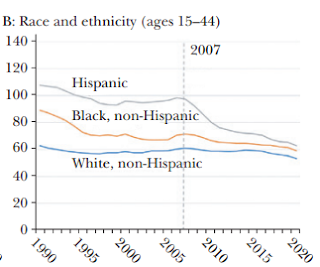
Since the start of the Great Recession in 2008, the US birth rate has fallen from about 68 per 1,000 women to 54, a decline of 21%. As the graph above shows, the biggest decline was among Hispanic women, who are becoming more and more like black women, who in turn are becoming more and more like white women.

The decline has taken place in every state; in every religious, ethnic, and political group; in rural areas, suburbs, and cities. And while the overall birth has declined in all those groups, the birth rate for women over 30 has risen in all of them.

When it comes to what people believe; Americans seem to be radically divided against each other. But in terms of how we live, we are more and more the same.

Thursday, September 30, 2021

US Covid-19 Case Rate vs. Population Density

Above, average daily number of Covid-19 cases diagnosed last month per 100,000 inhabitants; below, population density. The extent to which these are mirror images is quite remarkable. I suppose that's partly because places like New York and Los Angeles had many more cases in the first wave. But you have to think that given how spread out people are in most of Alaska, even a little bit of caution could easily have given them the lowest rate.