
Showing posts with label space. Show all posts
Showing posts with label space. Show all posts
Sunday, February 8, 2026

Friday, December 5, 2025
The Giant Filaments in the Galactic Core


The filaments seem to be made of synchrotron radiation, which is produced by particles moving at nearly the speed of light through a magnetic field. Nobody knows, though, what gave those particles their energy, since the don't seem to be streaming away from anything.
MeerKAT has also observed these filaments in other galaxies, and more recently other filaments have been discovered that are roughly parallel to the galatic plane ("horizontal").
More: Scientific American, LiveScience.
Monday, October 13, 2025
Moon Race?
Can I just say how ridiculous I find headlines like this, from CNN:
Because, you know, NASA already won the Moon race, in 1969. Fifty-six years ago! Who cares whether China sends people to the Moon before we go back? We've already been there.
And why are we going back at all? NASA says it's an essential part of their plan to get to Mars, but I don't buy it.
What an utterly stupid thing to worry about.
Thursday, October 2, 2025
Organic Molecules in the Plumes from Enceladus

They weren't kidding about the long wait. The first serious study of this study was finally published yesterday in Nature astronomy.

The discovery of these molecules, if that is indeed what Cassini found (again, the instrument was not designed for this), shows that the ocean contains organic molecules and has some interesting chemistry. But none of this points toward living organisms.
Again, though, this sample was collected in space by a spacecraft moving very fast and analyzed by an instrument not designed to look for larger organic molecules. So these findings in no way rule out life. But they don't make me believe.
Friday, May 16, 2025
RIP Ed Smylie
Ed Smylie (1929-2025) was just one engineer among the hundreds whose genius made the Apollo missions possible. He got his 15 minutes of fame when an oxygen explosion crippled the Command Module of Apollo XIII, forcing the whole crew to move to the Lunar Module. As the engineer in charge of the life support systems, Smylie immediately realized that the CO2 scrubbers in the LM would not be able to handle the load of three men, so he assembled a team to rig up a solution. The episode is wonderfully depicted in Ron Howard's film, and it is to Smylie that someone says, "You, sir, are a steely-eyed missile man." But as Nixon said when he singled out Smylie in giving the Medal of Freedom to the whole Apollo XIII team, "They are men whose names simply represent the whole team."
I love what the Apollo team did, what America did, possibly the biggest ever cooperative human endeavor that was not a war. It was incredible, amazing; using technology 50 years behind the most basic smartphone, humans walked on another world. The wonder of it still wows me and fills me with hope. And with a rage bordering on despair with the people who deny that it happened, who deny that we, humans, just clever apes cursed with violence, built spaceships and sailed to the moon, the people whose minds are too small to encompass the wonder of what we have done and still can do if we put aside our doubts and out differences and dream together about what the future might be.
Tuesday, October 15, 2024
NASA's Europa Clipper


On the down side, those same electromagnetic fields would rapidly tear apart many of our key molecules, such as DNA and RNA. So Europan life would have to be quite different from ours. Which is, to me, part of the appeal: I tend to think that the first time we find alien life it will be so strange to us that we will have trouble deciding if it is alive or not.
The Europa Clipper won't drill down to that buried ocean. Instead it will repeatedly fly by the moon's surface, scanning it with a variety of instruments and scooping molecules out of its extremely thin atmosphere to study. We know that Saturn's moon Enceladus sometimes erupts with great jets of water from its subsurface ocean, and while we aren't certain that happens at Europa there is some evidence for it, and NASA is hoping to observe such a plume and fly the Clipper through it.
I am not optimistic that life will be found, but I think the search is worth trying; certainly the chance is higher than on Mars. And even if we don't find life, perhaps we will learn more about these strange worlds and their vast, dark oceans.
Saturday, September 28, 2024
Porphyrion and the Fermi Paradox

Astronomers announced last week that they had discovered a black hole spitting energy across 23 million light-years of intergalactic space. Two jets, shooting in opposite directions, compose the biggest lightning bolt ever seen in the sky — about 140 times as long as our own Milky Way galaxy is wide, and more than 10 times the distance from Earth to Andromeda, the nearest large spiral galaxy.
Follow-up observations with optical telescopes traced the eruption to a galaxy 7.5 billion light-years away that existed when the universe was less than half its current age of 14 billion years. At the heart of that galaxy was a black hole spewing energy equivalent to the output of more than a trillion stars.
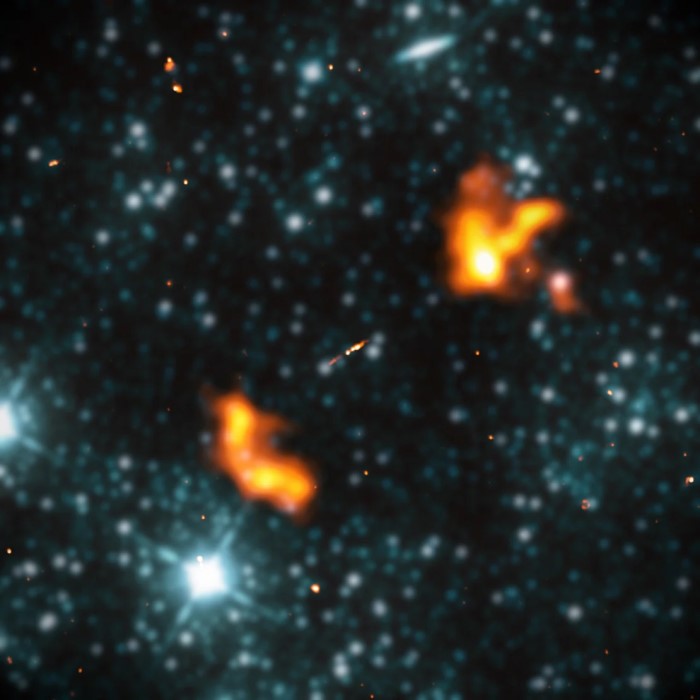
Infrared Image that Sealed the Discovery
The discoverers called this system Porphyrion, after a Greek giant. You can read about this just about anywhere.
I want to write about because for me it ties into the so-called Fermi Paradox. This line of thinking supposedly got started when physicist Enrico Fermi asked, "Where is everybody?" That is, where are all the alien civilizations.
One way to think about the problem is the Drake Equation, which looks like this:

The terms represent the rate of star formation, the fraction of stars that have planets, the fraction of planets where life is possible, the fraction of those planets where life appears, the likelihood that life becomes intelligent, the fraction of civilizations that develop technology we could see from light years away, and the duration of the average such civilization.
I don't see why the obvious rarity of spacefaring civilizations is any kind of paradox; if you simply assume that any one of the middle terms is one in a hundred trillion, the "paradox" disappears.
And one reason I think those terms could be very small is the titanic violence of the universe. The discoverers of Porphyrion think its power is so great that is is rerranging matter across a supercluster of galaxies, and therefore that the uneven distribution of matter in the universe might be partly due to such phenomena. Imagine what would happen to any civilization that got in the way of such a blast.
These enormous jet systems may be the most striking examples of galactic violence we know of, but lesser violence is everywhere: colliding galaxies, giant black holes, colliding planets, exploding stars. The more I ponder what the galaxy is like, the more I think we are riding a stupendous lucky streak. We got lucky when one of our sun's rocky planets ended up in a zone where water is liquid much of the time, making it possible for life to get going. Life has tenaciously hung on every since, but it has been nearly wiped out several times (or at least complex multi-cellular life has). We have had mega-extinction after mega-extinction, caused by asteroid impacts, volcanism, a planetary ice age, and who knows what else.
And having dodged all of them, we may one day be finished off by another space rock or, if we last long enough, by the expansion of our aging sun.
Our world is a miracle of astonishing improbability, and we should cherish the chance we have been given to thrive.
Sunday, January 7, 2024


Monday, August 21, 2023
The Ring Nebula


Sunday, July 2, 2023


Thursday, April 20, 2023
Starship Blows Up

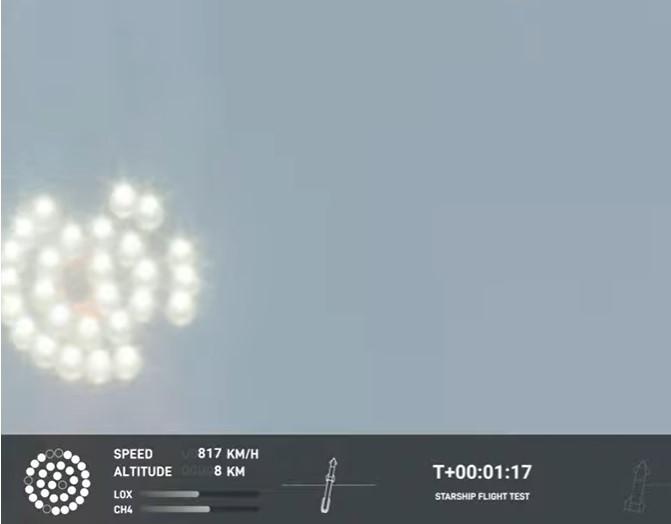
The strange thing about the video of the disaster that SpaceX immediately uploaded to Youtube is the excited atmosphere. The video starts with clips of other SpaceX failures, and when Starship blew up the assembled crowd cheered.
Elon Musk is of the "move fast and break things" school of engineering, and he made SpaceX in that image. His whole approach is that space can be reached much more cheaply if we cut back on the bureaucracy and take more risks. And on the whole it seems to be working; SpaceX launched around the same time as other private space companies but has progressed much faster; its Falcon 9 rocket has made 217 launches, of which 152 were reflights, making it by far the leader in commercial satellite service. Its Dragon capsule is now the main way people and gear reach the International Space Station. Starship, when and if it actually reaches space, will be the most powerful launch vehicle ever made.

Falcon 9 launch vehicle landing on the droneship
So in a sense the whole mission is based on accepting the chance of failure. I don't think the cheerful, excited tone of SpaceX's failure video is all fake. I think that is genuinely the culture they are trying to cultivate, and I have no trouble believing that many of their employees buy into it.
Whether that sort of spirit can really get us to Mars, I have my doubts. I don't have the passion for crewed space flight that animates Musk and people like him, so I am not all that charged up for the mission. If I were in charge of the space budget I would blow up the ISS tomorrow and put an end to all this nonsense about going back to the Moon. We've been there and already know there's no reason to go back. Instead I would send highly capable robots to the moons of Jupiter and Saturn, where there are still discoveries to be made.
But other people feel differently, and if they want to cheer the launch of Starship and then its self-destruction, I wish them all the best.
Thursday, October 20, 2022
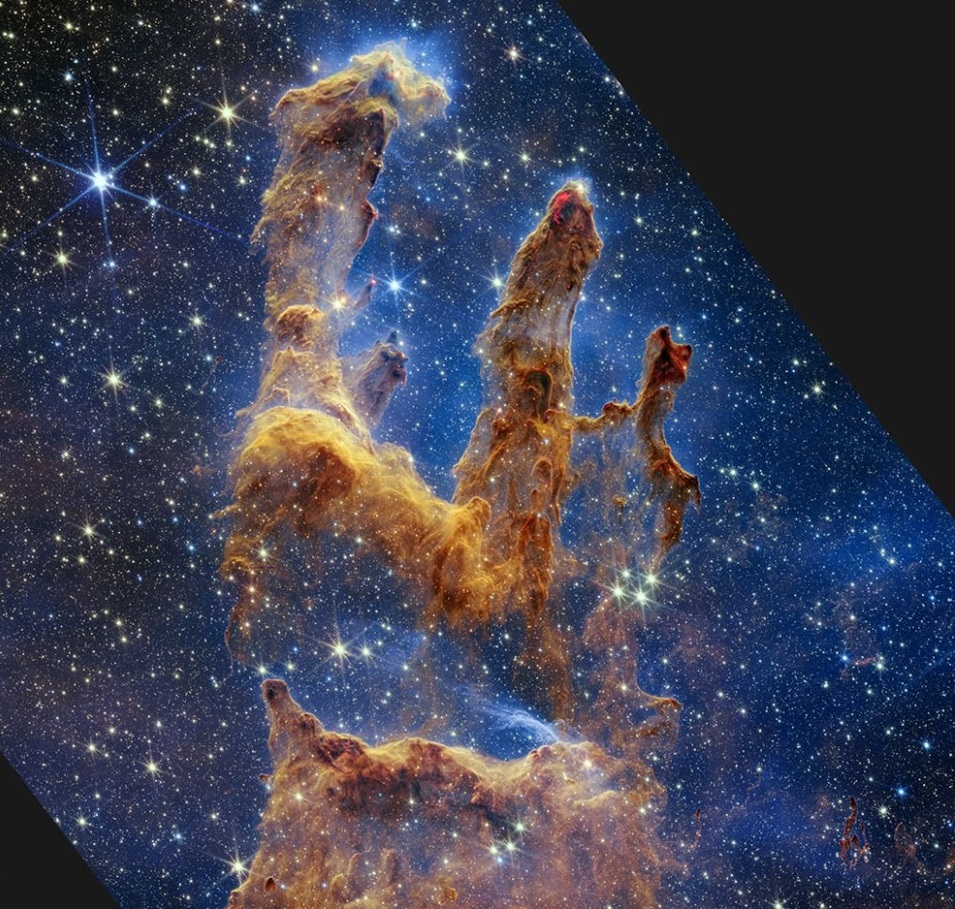
Webb vs Hubble at the Pillars of Creation

Thursday, September 30, 2021
Jupiter's Red Spot Has Shrunk a Lot


Tuesday, April 20, 2021
To Fly on Another World

The deniers are already at it; I've received multiple links to posts claiming it must be a hoax, since there just isn't enough air on Mars to support flight. But there is, and we can.
Thursday, December 24, 2020
Pieces of an Asteroid, via Hyabusa2


Friday, October 2, 2020


Tuesday, September 15, 2020
Not Excited about Life on Venus

Lots of buzz in the news this week about two scientific papers arguing there must be life on Venus. They base their conclusion on the discovery of phosphine (PH3) in the Venusian clouds. Which I admit is pretty cool. Phosphine seems to be a byproduct of respiration among some bacteria, so it might be a sign of life. These scientists go on to say that no known inorganic process could produce it outside the titanic pressures of Jupiter's inner atmosphere, so there must be life on Venus.
Maybe. But since we understand Venus' strange atmosphere only a little, and its conditions are very difficult to replicate on earth, who knows? Claims that methane and oxygen found on Mars are evidence of Martian life have not exactly panned out, and incidentally nobody knows what made those gases, either.
I despise scientific arguments that go, "I can't think of any other explanation, so it must be alien life." For one thing we still don't even understand how or why bacteria on Earth produce phosphine, so it might turn out to be a fairly simple reaction,
I support dreaming up some way to study the Venusian clouds and sending a spacecraft to do it, but I am not optimistic that it will find life. I don't think we understand nearly enough about the universe for this sort of leaping to conclusions.
Tuesday, June 23, 2020
Ingenuity, the Mars Helicopter

Ingenuity weighs 1.8 kg (4 pounds) and its rotors span 1.2 m (almost 4 feet). The blades are supposed to spin at 2400 rpm. It does have cameras, so it may get us some nice photographs of the rover in the Martian landscape.
Landing for Perseverance is scheduled for February 18, 2021. Maybe they will fly the copter to celebrate my birthday on the 26th.
Sunday, December 15, 2019
Juno at Jupiter


Tuesday, August 20, 2019
Today's Big Number

Subscribe to:
Posts (Atom)


