
I think all of this is a bit speculative, but it does add another thread to the connections between east and west Asia in antiquity, fascinating glimpses into hidden ties between civilizations.
I think all of this is a bit speculative, but it does add another thread to the connections between east and west Asia in antiquity, fascinating glimpses into hidden ties between civilizations.

The fascinating complications of the placebo response. Among other things, it seems to be getting more powerful in US drug trials.
It's not just you getting older; is really is getting harder to understand the dialog in movies. There are a lot of reasons for this, some of them related to money, others to streaming platforms. But I have personally noticed a major shift in acting, from theatrical, look-at-the-audience-and-enunciate speech to looking away and muttering, and I am glad to see that Hollywood insiders agree: "in the old days, you could count on an actor's theatricality to deliver a line to the back seats. But acting styles have changed so dramatically over the years that it has become much more difficult to capture great sound on the set."
Commonwealth Fusion Systems is a company founded by MIT physicists and funded by people like Bill Gates and George Soros. They say that new superconducting magnet technology will allow them to make a commercial fusion reactor by 2030. Not holding my breath.
The religious power of music, exemplified in the Saint John Coltrane Church in San Francisco. (NY Times)
Kevin Drum says the debate about Critical Race Theory, the 1619 Project, etc. is really about patriotism: do you love America despite its flaws, or hate it because of them?
In New York, and many other places, any complaint you make against a prosecutor disappears under a veil of judicial secrecy, and outsiders never find out what happens to most of them. But we know it isn't much, since prosecutors are hardly ever fired for misconduct. The rule that people will behave horribly when they can keep it secret applies here as everywhere. (NY Times)
These demographers predict that the world's total fertility will fall below replacement rate by 2040. I might live to see one of the most profound changes in human history, our escape from the iron scissors of Malthus.
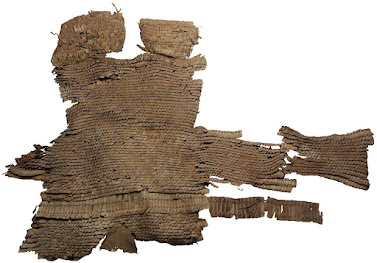
What do all the horned helmets from the European Bronze Age mean? Interesting 25-minute video. The much simplified answer is they started out as a sign of divinity, then of semi-divine heroes, then were adopted by some human warriors.
How one reporter's tweetstorm got the port of Long Beach to change its rules and allow stacking of containers more than two high, helping to unsnarl traffic at the port.
Two-minute clip from the new Beatles documentary shows Paul composing a new song while he waits for John to show up for a recording session.
The Hubble Space Telescope, offline for a month over the summer because of computer problems, failed again on October 25, but it is now back online for "full science operations." It is 31 years old, a long time for such a complex satellite to function, so I think it can't last much longer. Fortunately its replacement is due to launch before the end of the month.
One-minute video of a giant phantom jelly (Stygiomedusa gigantea) recorded 3000 feet down off the coast of California. And the weirdness of the barreleye fish.
Soda shops, where you can order custom mixes of name-brand sodas adulterated with all manner of fruit juices and flavors, have been big in heavily Mormon areas for years and are now expanding across the country. "Happiness in a cup" for people who don't drink coffee. (NY Times)
Volunteer at a Massachusetts center for "farm based therapy" dies of cardiac arrest after being repeatedly rammed by a sheep.
At the Met, an amazing zoomable image of a 17th-century tapestry depicting the labors of the months. A nice reminder that while the world was beginning to change rapidly in that era, much of the civilization remained medieval.
Dirtbag Catullus, delightfully raunchy contemporary renderings of Latin poetry.
David Foster Wallace's 2005 Kenyon College commencement address is very famous, and I think deservedly so. Amazing.
David Brooks on contemporary conservatism: "The rich philosophical perspective that dazzled me then has been reduced to Fox News and voter suppression." (The Atlantic)

Michael and Judith Steinhardt have long been among the world's top collectors of ancient artifacts. They also have a long history of run-ins with the law, as various objects in their collection have been traced back to looting from archaeological sites.


Now the Manhattan DA's office has seized a pile of 180 artifacts from Michael Steinhardt's home and office, said to be worth $70 million. They also got him to sign an agreement promising never to acquire any ancient artifacts again. I've seen some complaining online about how Steinhardt can be involved in thefts worth millions and do no jail time when poor people can be sent up for stealing food. There is something to that, but on the other hand it is almost impossible to prove that a collector like Steinhardt knew the objects were looted, and anyway there is a medieval saying that fits the case: poor man hanged by the neck, rich man by the purse.




Fascinating op-ed at The National Interest, co signed by the Ambassadors to the US of China and Russia:
Peace, development, fairness, justice, democracy, and freedom are common values of humanity. Democracy is not a prerogative of a certain country or a group of countries, but a universal right of all peoples. It can be realized in multiple ways, and no model can fit all countries. Whether a country’s path works depends on whether it meets the country’s realities, follows the trend of the times, and brings about economic development, social stability and progress, and better lives for the people. Ultimately, it relies on the support of the people and will be proven by its contribution to human progress.
Therefore, a basic criterion of democracy should be about the people, i.e. whether the people have the right to govern their country, whether their needs are met, and whether they have a sense of fulfillment and happiness. If the people are only awakened when casting their votes and sent back to hibernation when the voting is over, if they are served with sweet-sounding slogans in campaigns but have no say after the election, if they are wooed during canvassing but left out in the cold after that, this is not a genuine democracy.
What China has is an extensive, whole-process socialist democracy. It reflects the people’s will, suits the country’s realities, and enjoys strong support from the people. In China, the people have the right to elections, and they can get deeply involved in national governance, exercising their power through the People's Congresses at the national and other levels. China has eight non-Communist parties participating in governance, as well as a unique system and corresponding institutions of political consultation. On matters concerning people's keen interests, there are broad-based and sufficient consultations and discussions before any decision is made. Policies and measures can only be introduced when there is a consensus that they are what the people want and will serve the people’s needs. It has been proved that the whole-process democracy works in China, and works very well. China calls for building a community with a shared future for mankind. As residents of the same global village, we should handle international affairs through consultation.
It has to be said that elections are not the end-all and be-all of life, and that many if not most people care more about jobs and social order. The ongoing debate we have in the US, about whether our old racist, sexist democracy should be celebrated, raises another issue: democracy really can lead to intensified ethnic conflict and the oppression of minorities. But I think it remains true that even with all its flaws a properly functioning democracy is still better than any other system, with more scope for self-correction and more freedom for dissenters. Some anarchists would love a sort of soviet system in which local committees elect representatives to higher level committees and so on, but the experience of Russia and China shows that this leads to capture of the system by insiders, not people power.
And then this:
There has seen no shortage of wars and turmoil worldwide to prove that spreading “democracy,” its political system, and values against other countries’ will severely undermine regional and international peace, security, and stability. Bombings of Yugoslavia, military intervention in Iraq, Afghanistan, and Libya, and “democratic transformation” do nothing but harm. Countries should focus on running their own affairs well, not condescendingly criticizing others.
I agree with this completely; the on-again, off-again US project of promoting democracy by force has not gone very well, and I suspect it is true that democracy is just not an option for some places. But without democracy, how does anybody know what a "nation's will" is? Dictatorial regimes love to equate their own desire's with the nation's and their own power with that of the whole people, but I don't believe them. Even if it is true that for some nations in some periods dictatorship is the best option, democracy is still the best system and the world's oppressed people long for it with good reason.
The Omicron variant was already spreading in the US before it even had a name; public health officials have confirmed multiple cases contracted in November. At least two of them may be associated with a big convention called Anime NYC, attended by 53,000 people November 19-21. This isn't confirmed, but New York is trying to call or email everyone who attended, urging them to get tested.
The urge to resume pre-pandemic life is overwhelming, but it looks like the virus is not through with us yet.






May no one slight, with tears or a reproach,
This declaration of God’s mastery,
That, with sublime irony,
Gave me at once books and the night.
He vested those lightless eyes
With guardianship of the city of books,
Even though they can read
But senseless passages in the library of dreams,
Where sunrises give way to zeal. The day
Lavishes them in vain with infinite books,
Toilsome like the manuscripts
That perished in Alexandria.
Of hunger and of thirst (or so goes the Greek legend)
A king once died amidst fountains and gardens;
Aimless and unrelenting I tire the confines
Of this blind vault of a slender library.
Encyclopedias, atlases, the East
And West, centuries, dynasties,
Symbols, the cosmos and cosmogonies,
Afford us the walls, albeit uselessly.
Slow by my shadow, I explore the
Hollow penumbra with a tottering crosier,
I, who imagined Paradise
Under the figment of a library.
Something unnamed, certainly not
Random fate, governs all this;
Somebody else has already received in hazy
Evenings the many books, and their shadow.
As I rove through the slow galleries,
I happen to feel with sacred horror that
I am the other, the dead one, who must have
Ambled his days past, in a similar vein.
Who between the two writes this poem of
A plural me albeit of just one shadow?
Who cares about the word convoking me
If the anathema is one and indivisible?
Groussac or Borges, I behold this dear
World both distorting and dying down
Into a pale, vague ash, all too
Similar to both slumber and oblivion.
1957


I don't get it, but then I'm about to turn 60 and VR makes my stomach heave. But I think it is worth pondering what will happen as the technology spreads and gets better. Zoe Weinberg in the NY Times:
Today, glimpses of the metaverse are everywhere. Virtual concerts attract record audiences; high-end designers sell virtual fashion; and gaming has become a livelihood for people around the world. Many of the closest corollaries to a full-fledged metaverse are immersive games like Fortnite, Minecraft and Roblox, where players can socialize, shop and attend events in a virtual world.
I find this puzzling, and I doubt online socializing will replace much of the material world. That is largely because of personal experience. In 1999 I threw myself online in hopes that I could find there what had eluded me in the material world since I left college, a community of people interested in the things that interest me. I never found anything close. I found that the internet seems to promote fractal splintering, with the focus on narrow special interests. General intellectual conversation is nowhere to be found. And if a lively intellectual conversation does spring up, for example on Scott Siskind's comments section, it rapidly swells to hundreds of people making thousands of posts, something I don't have the time for.
Which is how I ended up just starting my own blog. But anyway I am dubious of the notion that the online world is much of a substitute for this one.
Weinberg is very interested in the political side of the multiverse:
There’s already evidence that online multiplayer games can enable the spread of disinformation and conspiracy theories. Players can use in-game communication tools to disseminate rumors or “fake news,” targeting others in difficult-to-track ways.
The metaverse could allow motivated regimes or extremist groups to go a step farther. Immersive layers of text, voice and visuals in virtual environments would provide new, convincing ways to broadcast misleading or extremist content.
Virtual environments have also shown promise for activists resisting digital authoritarianism. On Minecraft, Reporters Without Borders has sponsored an Uncensored Library where users could see content by dissident writers that had been censored in countries like Saudi Arabia, Russia and Vietnam. It’s possible that the metaverse may bring new promise for freedom and transparency across borders.
But the metaverse’s consequences may be even more radical.
If it becomes as all-encompassing as some predict, the metaverse may foster virtual communities, networks and economies that transcend borders and national identities. Individuals might one day identify primarily with metaverse-based decentralized autonomous organizations with their own quasi-foreign policies. Such a transition could mandate the reconceptualization of geopolitical affairs from the ground up.
I find this intriguing. Suppose you are a young person profoundly frustrated by the politics of your own nation, either because they are just really bad (Egypt, Venezuela, Bulgaria, etc.) or because your own views are such a minority that they have no chance of being enacted. Might you turn to the metaverse in search of a way to be meaningfully involved? Might we see grand political experiments in the metaverse, like anarcho-communist states or an Islamic Caliphate? A truly borderless Europe? A nation of the African Diaspora? And if one of those states was successful, might we see serious attempts to recreate it in the material world?
One thing to note is that language barriers are if anything more important online, although improvements in translation technology have already eased that and may one day make it a mere annoyance.
As I said, I am skeptical of all of this, but I recognize that my skepticism is related to my age and my membership in a generally flourishing nation. For young people who have grown up online it may be very different, especially if they live in places where material life just isn't very appealing,
From her interview with Tyler Cowen:
COWEN: A very broad question, but if we look at the Enlightenment as a whole and not just the French Enlightenment, but what is the underlying principle that gives it a unified flavor? What is enlightenment, to paraphrase Kant?
SCURR: For me, it’s liberty. It’s the evaluation of liberty above all else. I see this most in Tocqueville, because he is, obviously, the first generation who has no personal memories of the Revolution. But when he looks back on the Revolution and he tries to explain what has happened and, in fact, to explain not just the beginnings of democracy in France but also, of course, in America, he sees a fundamental conflict between liberty and equality. And he is always prioritizing, if he can, liberty while expecting that equality will win out as the stronger value.
COWEN: Was Hayek correct that the French Enlightenment theorists were too rationalistic, assigned too strong a power to human reason, and thus inevitably were led down a kind of slippery slope where their liberty was self-undercutting — and that the British empiricist tradition is far superior? Agree or disagree?
SCURR: I disagree with that, actually. I don’t think you can be too rational. In that regard, I’m a real signed-up Enlightenment person. . . .
COWEN: Are the origins of today’s woke and cancel culture found in the French Revolution?
SCURR: I don’t think the origins of it are. I think there are resonances, and I think that’s a very important difference. I think you can definitely look at the revolutionary rhetoric, the prescription of certain views, and the radical attempt in the French Revolution to cancel the past. This was absolutely explicit, right down to changing the calendar. They said, “We do not want to continue with this oppressive framework that we have inherited from the church, and therefore, we are going to have a new calendar based upon the natural world, etc.” That’s just one example of the determined attempt to cancel what was, by the revolutionaries, perceived as an inextricably oppressive past.
Of course, it’s very interesting to use the Revolution as a prism. You can look at it, you can see what happened as a result of that. You can think about the resonances. But I don’t think what we see today is directly related or in any sense caused by that.

India's total fertility has dropped below replacement. Last year it was 2.0 overall and only 1.6 in the cities. (Washington Post)
The virtues of a carbon tax, which sadly we are never going to get.
Big Roman mosaic showing Achilles and Hector unearthed at a villa in Rutland, England.
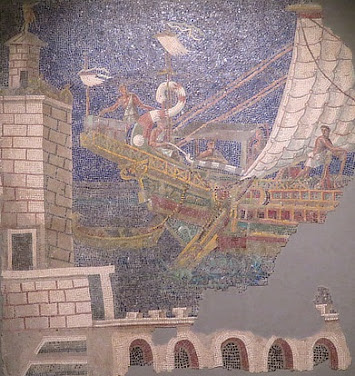
Sailcargo, Inc. is building a sailing ship that they hope will be the first of a fleet of emissions-free cargo transports. So one day your local co-op will be selling organic, fair trade, rain forest friendly coffee that has crossed the ocean by sailing ship. More seriously, high-tech sails that can supplement the power of big cargo ships may really be on the horizon.
Jack London's photographs of London, very interesting.
9,000-year-old necklace made of 2,580 beads.
"Plunge party": some evangelical churches are staging baptisms of teenagers as spectacles, with rock bands and customized t-shirts; one church rents a water park.
People like to pretend that Machu Picchu is mysterious, but there really isn't any mystery about it. If you want an Inca mystery check out the Stone Depressions of Moray, very strange terraced pits that look a little like amphitheaters. The best guess now is that they were a sort of agricultural test station. (Atlas Obscura, wikipedia)
The 59 stone penises of Hadrian's Wall.
Something I always wondered about: for the most part, recipes are not protected by copyright law, and you can't get in trouble for copying them without credit. (NY Times)
A French dictionary included the non-binary pronoun "iel" in its online edition and furor ensued over American "wokeism."
The intensifying military space race (Washington Post).
Elizabeth Samet thinks the mythology of World War II as "the good war" has made it easier for American leaders to drag us into bad ones, and she is on a mission to remind everyone of how complicated and sometimes bad the war was. Here's a review of her new book at the NY Times. Someone else could equally well argue that Samet's de-glorification of WW II is just a transparent attempt to keep the US from fighting any more wars, no matter how necessary they might be. I think that US and Soviet leaders knew perfectly well how bad the war was, and that this memory helped them avoid fighting each other.
Plans have been announced for a floating city off Busan, South Korea; designer Oceanix thinks this is how we will replace coastal cities drowned by sea level rise.
Historian Richard White argues that the transcontinental railroads were a corrupt, government-financed boondoggle, not any kind of triumph for anybody.
Teenage British metal detectorist finds hoard of 65 bronze axe heads. She should quit now.
A camera the size of a grain of salt.
The 3.66-million-year-old Laetoli A footprints are likely from an unknown hominin, not a bear.
Why do people with mental health problems suffer worse from Covid-19?
The islands with two much power: 5-minute video about the Orkneys, where constant winds, big tides and a small population mean they generate far more renewable electricity than they can use. As a result they are switching rapidly to electric vehicles etc.
The Phoebus Cartel, an association of the world's five biggest lightbulb makers, conspired to reduce the lifespan of lightbulbs and therefore increase sales; it lasted from 1925 to 1939 and reduced average lightbulb lifespan from nearly 2500 hours to under 1200. (wikipedia, 17-minute video)
Newly discovered exoplanet is about half the size of earth and appears to be all iron. (NY Times)
First, on the subject of adoption: Amy Coney Barrett said that no woman really needs to have an abortion because she could put the child up for adoption instead. But I think genetic technology has made that a lot more complicated. Consider a case that Rod Dreher reported on a few years ago. A young woman was raped by a family member, exactly the situation for which a large majority of Americans support abortion. She had the child and gave him up for adoption, everything was hushed up, and she went on to lead what looks like a fairly normal life. But then her child, using matches in an online DNA database, found his birth family and brought the whole thing out into the open, leading to a lot of pain and angst. I think this is the future that any young mother has to consider, because there can no longer be any hope for secrecy.
And then this:
The case that could lead to the end of Roe v. Wade includes a novel argument: that the right to an abortion is no longer necessary because it has become much easier for women to combine work and family.
In Roe, the Supreme Court said that an unwanted pregnancy could lead women to “a distressful life and future,” and in a 1992 case, Casey v. Planned Parenthood, that abortion rights were necessary for “women to participate equally in the economic and social life of the nation.”
On Wednesday, the court is hearing a case from Mississippi regarding a law banning most abortions after 15 weeks. In a brief to the court, lawyers for the state argued that those ideas about women’s lives had been obviated by “the march of progress.”
“In these last 50 years,” Mississippi’s attorney general, Lynn Fitch, said in a statement, “women have carved their own ways to achieving a better balance for success in their professional and personal lives.”
This isn't really true, and an unplanned birth is still an economic catastrophe for single women. (Mississippi in particular does almost nothing to require paid leave for childbearing or to support poor mothers.) But I would say that this argument shows one of the problems with the way Roe v. Wade was originally argued and decided. The court has said repeatedly that part of the government's interest in abortion is economic, in that abortion keeps women in the work force. I think that is a lousy argument and it shows that the court was basically floundering around to find a constitutional justification for their belief that abortion is a woman's right. The result is, I think, a very weak legal argument that has stood so long for purely political reasons.
I have always thought that although I consider Roe v. Wade a bad decision without any real constitutional justification, it was probably better for the nation to have it settled by the Supreme Court rather than becoming an even more toxic political issue that will only add to our already disturbing partisanship. I think we are soon going to find out if that is so.
Tyler Cowen interviews Ruth Scurr:
COWEN: You also wrote, and I quote, “When I was an adolescent, Wuthering Heights appealed to me much more than Sense and Sensibility, but now the reverse is true.” How did that happen?
SCURR: Age.
COWEN: Why does age flip you away from Wuthering Heights?
SCURR: Wuthering Heights is the —
COWEN: It’s over the top, right?
SCURR: — high passion; Heathcliff, Cathy out on the moors. I thought that was it: I thought that was what it meant to love someone, to the extent where they’d be visiting you after their death and trying to get in through the window.
Actually, I completely changed my understanding of what’s involved in loving another person and actually being gentle with another person, whoever they are — my children, my relationships with my parents, and other significant relationships in my life. I think the Wuthering Heights model has not weathered well.
This resonated with me because I think my ideas about love have changed more since I was 19 than any of my other core ideas.

Where Trump oversaw more than 1,600 air and artillery strikes in Iraq and Syria during his first 11 months in office, Airwars reports just four during Biden's term so far. Strikes in Somalia fell from roughly 75 last year to fewer than 10 this year, with no civilian casualties. And in Yemen, the annual total dropped from about 18 to maybe four, with fewer than 10 casualties of any kind.
Which I think is great. But notice that Biden has said exactly nothing about this in public. I suppose he thinks talking about this would just make him look weak.


It is hard for a rationalist like me to evaluate something like QAnon. How much does this fountain of nonsense matter? It seems just too crazy to me to have any impact on the real world, and yet polls show that millions of Americans give some credence to the pronouncements of QAnon prophets.
But one thing we know about movements like this is that crazy people don't get along with each other very well, making it hard for them to organize or stay unified. Rolling Stone reports that QAnon stalwart Lin Wood has attacked the "Stop the Steal" fundraising organization created by some of Trump's friends:
Right-wing darling Kyle Rittenhouse, the teen acquitted of murder for killing two people at a racial justice protest, sent the QAnon world into a tailspin when he said in interviews that Lin Wood, a leading QAnon believer and Trump attorney who briefly represented Rittenhouse, was “insane” and had “taken advantage” of him.
That prompted right-wing Trump allies — including Rep. Marjorie Taylor Greene, alt-right activist Jack Posobiec and former Trump White House aide Sebastian Gorka — to come out against Wood. In response, Wood has been posting through it, making wild claims without evidence. Over the past few days, he has shared increasingly outrageous claims on his Telegram and turned on pro-Trumpers who used to be his allies, including Sidney Powell, Sebastian Gorka and Michael Flynn.
“After doing the research and connecting the dots, I have reached the conclusion that the Stop the Steal organization is a Deep State organization to raise money for purposes other than to FIX 2020. … WATCH OUT for anyone affiliated with Stop the Steal. Every lie will be revealed,” Wood posted on Friday. . . .
The posting continued on Saturday after he took a six hour overnight break. Wood accused Trump-endorsed Vernon Jones, who is running Georgia’s lieutenant governor, of being a “career Democrat, racist [and] sexual predator.”
Wood also promised, “More Deep State players will be revealed to you.”
I didn't hear about Patrick O'Brian's series of sea novels until about 15 years ago, maybe because of the 2003 movie. I checked in my library but all I found was one volume, maybe the 15th in the long series. It was boring. I mentioned this to a friend who is a fan and he said, "Yeah, he should have stopped writing long before the end. You should read one of the first few."
Last week I noticed that my library had purchased new copies of the first ten book in the series, so I took the first one home: Master and Commander, published in 1969. I just finished it and I liked it, but I don't think I will rush out and get another.
The story opens in 1800 in Minorca, one of the chief bases of the British Mediterranean fleet. The two central characters are Jack Aubrey, a naval officer, and Stephen Maturin, an Irish physician who is broke and needs a job badly enough to sign on as a ship's surgeon. Aubrey receives his first command, a sloop called the Sophie, and sets off cruising the Spanish coast in search of trouble.

There are two remarkable things about the book, and, I gather, the others in the series. First is O'Brian's astonishing knowledge of Napoleonic seafaring and naval warfare. This is actually what attracted me to these stories. I have long been fascinated by the lore that sailors and shipwrights built up through the centuries of European expansion, allowing them to build vast fleets of wooden ships and sail them across all the oceans of the world. Not that I have room in my brain for much of that knowledge, but it intrigues me that it existed and has since been lost. Anyway Patrick O'Brian knew the rigging of such a ship as well as anyone in the twentieth century, and he immerses you in world where the wind and the power to harness it determine everything. The battle scenes are also as accurate as O'Brian could make them, since he copied them all straight out of admiralty reports, figuring that only by strict fidelity could he convince readers that such insane things really happened.
More interesting to me was O'Brian's recreation of the mental world of his protagonists. The British navy of that period was a fascinating monster. Engaged in a brutal struggle for world domination, it practiced a savage level of violence and held its officers and men to a standard of courage which seems to me downright insane. And yet it was much more than just a fighting force. It was a vast social world with its own politics, its own rituals, its own language. It was a gigantic career ladder that many men were ferociously determined to climb. I think O'Brian's Captain Aubrey splendidly captures the mindset of a man who thinks about battles half in terms of how to win or at least survive them, and half in terms of how fighting or not fighting them will impact his career.
I was even more impressed by the mind of Stephen Maturin. He strikes me as a spot-on recreation of a physician of the period, half practical knowledge and half Galenic theory; one of my favorite bits in the book is when he starts adding foul-tasting herbs to his medicines because the sailors think potent medicine should taste bad. His naturalizing is also terrific; he is boundlessly curious about everything from the distribution of plants to the anatomy of porpoises, but it all seems like random knowledge, with no meaningful theory or structure. I loved him.
The writing is pedestrian, and the plot is more a series of events than a story. But if you want to spend a few hours in the world of wooden ships and the violent men who sailed them, I know of no better way.


The copper mines in Israel's Timna Valley may or may not have been "King Solomon's Mines" (a phrase that never appears in the Bible), but archaeology done there raises all sorts of interesting questions about the societies and governments of Canaan in 1000 BC. (Smithsonian)
A Cambodian looter, facing death from cancer, is now identifying the objects he stole in museums and private collections around the world, helping Cambodia to recover them. (NY Times)
The Aerial Archaeology Mapping Explorer, which allows you to view archaeological features that have been documented across a fair percentage of England. Extraordinary.
Dezeen's architecture awards for 2021. A few are ghastly but some are interesting.
There is a woman on tiktok who has gotten kind of famous by arguing that ancient Rome didn't exist but was invented in the Renaissance, and Pompeii is a Victorian theme park. Of course I have not seen any of her videos but I always wonder in these cases who believes it and why. Is it all just trolling? Sometimes I feel bad that I have never had more success as a blogger but then I read about the people who have and have no desire to be them.
Wild turkeys were rare a hundred years ago, but as hunting has declined and suburbs have spread, they have surged back. Now they have become pests in many areas and are taking over college campuses across the Midwest and Northeast; most people find this cute, but they can be aggressive and some people are not amused by their thievery. (NY Times)
Magdalena Andersson was Prime Minister of Sweden for seven hours. I foresee a long future for her as the answer to a trivia question.
Large trial finds that psilocybin is an effective treatment for depression. On the other hand the study seems to show that psilocybin works about as well as Lexapro, which I find discouraging; if you can get the same effect from a much less dangerous drug, why would you take psilocybin? Ok, I can think of one reason why, but this doesn't seem like great medical progress to me. This is nothing like as promising as the results some trials are finding for ketamine.
The killers of Ahmaud Arbery were convicted after a trial in which the prosecutors never mentioned race or racism. I feel like there is a lesson in that about how progressives can make progress on a whole range of issues. (NY Times)
The current course of the pandemic doesn't look good. It seems clear that everyone is going to need at least one booster, and that we need a new vaccine better formulated to fight the Delta variant. New variants keep emerging, and one spotted in South Africa may be even more resistant to the existing vaccines. I suspect that we are in for another bad wave over the winter. I suppose the bright side is that improvements in treatments mean that fewer people will die.
The grim toll of air pollution, especially in the cities of India and China. The rich nations have shown that cleaning up particulate pollution can be done, but they have also shown how much it costs to do so.
Glossary of new dating terms. I love "breadcrumbing."
Shaun Tan, wonderful sculptural illustrations to Grimm's Fairy Tales.
The ancient songs used to soothe cattle.