Eulophophyllum kirki, a new katydid from Borneo first identified from a photograph, rather than the usual dead specimen.
Cheirogaleus shethi, a new species of dwarf lemur from the dry forests of Madagascar. This animal was actually discovered in 2014, but it took until recently for DNA studies to prove that it is really a new species.
Parafimbrios lao, the Ziggy Stardust snake, and Tylototriton anguliceps, the Klingon Newt, two new species from the Mekong Delta.
Drosera magnifica, a giant sundew from Brazil, the first new species identified from a biologist's post on Facebook.
An as-yet unnamed species of jellyfish discovered in the Marianas Trench, nicknamed the spaceship.
Murina kontumensis, a new species of Woolly-Headed Bat
Umma gumma, new species of damselfly discovered in Africa by Pink Floyd fans. This was published in an article that announced 60 new species of damselflies and dragonflies, the greatest total from a single publication in decades.
Acanthosaura phuketensis, the Phuket horned tree agamid, a medium-sized lizard from Phuket Island off Thailand.
Aphonopelma johnnycashithe, Johnny Cash Tarantula (because it wears black and was discovered near Folsom Prison).
Sirdavidia solannona, a new species of flowering tree discovered by the side of a road in a popular national park in Gabon, under the noses of park rangers, biologists, and everyone else.
Gekko bonkowskii, discovered in the remote mountains of Laos.
Illacme tobini, a millipede with 414 legs, no eyes, 200 poison glands, and four penises. Take that, world.
Tuesday, February 7, 2017
AlphaGo and the Problem of Human Excellence
From Scott Alexander's summary of a recent conference on Artificial Intelligence, this interesting bit about the Go-playing computer program AlphaGo:
There was a guy who nearly wrecked naval wargaming a few years ago. He kept diving into the rule book to produce fleets that made no sense in real-world terms but were unbeatable in the game – for example he once used a vast fleet of immobile boats with no armor, each with one huge gun. Since most naval wargamers want to imagine themselves in actual historical situations, commanding fleets that make historical sense, this enraged them. Unable to write rules that prevented his crazy tactics, they eventually told him that they were just going to cancel all their tournaments until he agreed not to enter.
On a more serious note, politics. Did Donald Trump just show that the whole apparatus of parties and campaign staffs and strategists and ad buys is a complete waste of time compared to a clever twitter account? Maybe so. And Republicans in Congress seem to have hit on a pretty good new strategy for dealing with a President of the opposite party: refuse any cooperation, vote against everything, denounce him at every opportunity as an un-American extremist. I hated this, but I see pieces every day from Democrats arguing that they should now do exactly the same thing to Trump.
And what about real war? Surely the way the American military fights is not the best possible way.
It bears thinking on that the way we do things is dependent on the way our systems and habits have evolved over time, and the optimal solution is almost certainly something different.
AlphaGo has gotten much better since beating Lee Sedol and its creators are now trying to understand the idea of truly optimal play. I would have expected Go players to be pretty pissed about being made obsolete, but in fact they think of Go as a form of art and are awed and delighted to see it performed at superhuman levels.I think many fields have developed this way. There is a strategy, and someone develops a counter to that strategy, and somebody develops a counter to that, and so on, so that each move is determined by previous moves and nobody ever steps outside the discourse to consider novel approaches. I keep raising this with my son who plays an online game called League of Legends. Every team plays this in pretty much the same fairly obvious way, and I refuse to believe that it is necessarily the best way. Why, I keep asking, don't people experiment with radically different strategies? He replies that sometimes people do but they usually lose; I am not impressed by this answer, since one might have to employ a new strategy dozens of times to figure out the necessary nuances.
More interesting for the rest of us, AlphaGo is playing moves and styles that all human masters had dismissed as stupid centuries ago. Human champion Ke Jie said that:
After humanity spent thousands of years improving our tactics, computers tell us that humans are completely wrong. I would go as far as to say not a single human has touched the edge of the truth of Go.
One Go master said that he would have “slapped” a student for playing a strategy AlphaGo won with. A couple of people talked about how the quest for “optimal Go” wasn’t just about one game, but about grading human communities. Here we have this group of brilliant people who have been competing against each other for centuries, gradually refining their techniques. Did they come pretty close to doing as well as merely human minds could manage? Or did non-intellectual factors – politics, conformity, getting trapped at local maxima – cause them to ignore big parts of possibility-space? Right now it’s very preliminarily looking like the latter, which would be a really interesting result – especially if it gets replicated once AIs take over other human fields.
There was a guy who nearly wrecked naval wargaming a few years ago. He kept diving into the rule book to produce fleets that made no sense in real-world terms but were unbeatable in the game – for example he once used a vast fleet of immobile boats with no armor, each with one huge gun. Since most naval wargamers want to imagine themselves in actual historical situations, commanding fleets that make historical sense, this enraged them. Unable to write rules that prevented his crazy tactics, they eventually told him that they were just going to cancel all their tournaments until he agreed not to enter.
On a more serious note, politics. Did Donald Trump just show that the whole apparatus of parties and campaign staffs and strategists and ad buys is a complete waste of time compared to a clever twitter account? Maybe so. And Republicans in Congress seem to have hit on a pretty good new strategy for dealing with a President of the opposite party: refuse any cooperation, vote against everything, denounce him at every opportunity as an un-American extremist. I hated this, but I see pieces every day from Democrats arguing that they should now do exactly the same thing to Trump.
And what about real war? Surely the way the American military fights is not the best possible way.
It bears thinking on that the way we do things is dependent on the way our systems and habits have evolved over time, and the optimal solution is almost certainly something different.
Curiosity, Mars, and Climate Modeling
Once upon a time, about 3.5 billion years ago, Mars had liquid water on the surface. Signs of this are everywhere, and most scientists now regard it as a fact.
But how did such a small, cold world ever have lakes and rivers of liquid water? The reigning theory was that the thin atmosphere once contained so much carbon dioxide that the greenhouse effect made the planet warm enough. To test this theory, NASA sent the Curiosity rover to the bed of an ancient lake (above) to sample the sedimentary rocks within it. Rocks that formed in an atmosphere dense with CO2 ought to show evidence of that, in the form of carbonate minerals.
But no:
But how did such a small, cold world ever have lakes and rivers of liquid water? The reigning theory was that the thin atmosphere once contained so much carbon dioxide that the greenhouse effect made the planet warm enough. To test this theory, NASA sent the Curiosity rover to the bed of an ancient lake (above) to sample the sedimentary rocks within it. Rocks that formed in an atmosphere dense with CO2 ought to show evidence of that, in the form of carbonate minerals.
But no:
The same Martian bedrock in which Curiosity found sediments from an ancient lake where microbes could have thrived is the source of the evidence adding to the quandary about how such a lake could have existed. Curiosity detected no carbonate minerals in the samples of the bedrock it analyzed. The new analysis concludes that the dearth of carbonates in that bedrock means Mars' atmosphere when the lake existed -- about 3.5 billion years ago -- could not have held much carbon dioxide.So it's back to the drawing board in trying to model the ancient atmosphere of Mars.
"We've been particularly struck with the absence of carbonate minerals in sedimentary rock the rover has examined," said Thomas Bristow of NASA's Ames Research Center, Moffett Field, California. "It would be really hard to get liquid water even if there were a hundred times more carbon dioxide in the atmosphere than what the mineral evidence in the rock tells us."
Questions from Children
My youngest daughter:
Dad, do the blue and red in the American flag stand for Democrats and Republicans?
Monday, February 6, 2017
More Earthworks in the Amazon
As Brazilian cattle ranchers clear more and more of the Amazon, more and more ancient earthworks are exposed. This group doesn't seem to be a village, because few artifacts were found there, so it may be some sort of ceremonial site. And below, another, from a separate study in Science.
The American Story
One of the things Americans have fought over tenaciously in recent decades is how to tell our story. The old tales about the Pilgrims and Thanksgiving, John Smith and Pocahantas, seem pretty lame these days, and heroic narratives of settlers battling against savage Indians feel a tad one-sided. Clearing the forests and plowing up the prairies don't seem as positive as they used to. The era of great inventors, from Eli Whitney to Henry Ford, was also the era of raw capitalism, robber barons, and labor strife. During the War of 1812 the perfidious English went sailing around the South freeing slaves and arming them to fight against their former masters; this tactic had little impact on events at the time, but it has thrown a big wrench into how we in the 21st century understand those times.
Ross Douthat thinks our lack of a common narrative is a major reason our politics are so bitter:
But I know that many people want a clear story, with lessons, and they will keep rewriting history to provide them. Since I don't see how we are going to agree any time soon on who we are, I very much doubt we will agree on a story of how we got here.
Ross Douthat thinks our lack of a common narrative is a major reason our politics are so bitter:
So far we haven’t found a way to correct the story while honoring its full sweep — including all the white-male-Protestant-European protagonists to whom, for all their sins, we owe so much of our inheritance.Rod Dreher had this comment:
Instead liberalism, under pressure from the left, has become steadily more anxious about its political and cultural progenitors, with Woodrow Wilson joining Jackson and Jefferson in the dock. Meanwhile the right’s narrative has become steadily more exclusionary — religious-conservative outreach to Muslims has given way to Islamophobia, racial optimism has been replaced by white resentment.
Maybe no unifying story is really possible. Maybe the gap between a heroic founders-and-settlers narrative and the truth about what befell blacks and Indians and others cannot be adequately bridged.
But any leader who wants to bury Trumpism (as opposed to just beating Trump) would need to reach for one — for a story about who we are and were, not just what we’re not, that the people who still believe in yesterday’s American story can recognize as their own.
I’ve told the story in this space before about going to visit a school in a very poor part of Dallas, and hearing a fourth grade Latino boy, the son of immigrants, give an oral report on his hero. His report was on Santa Anna — the great villain in the founding myth of Texas! This kid wasn’t trying to be provocative or anything. He was just a kid. Santa Anna is a heroic figure to him. I don’t know how that gap gets bridged, to be honest, unless it’s by all Texans coming to believe that they don’t need a founding myth to live by. That doesn’t seem likely. All humans live by narrative myths, whether they think they do or not.As a professional historian I may be the worst person to comment on this. I see in the American past such a complex web of forces that I can hardly pick out a narrative beyond the basic one of modernity. Attempts to judge the past based on our own criteria, whether those of nationalism or liberalism, leave me shrugging. I see history as a boundlessly vast and mostly tragic novel with more amazing characters and extraordinary events than anyone could possibly invent, but precious little sign of a moral.
But I know that many people want a clear story, with lessons, and they will keep rewriting history to provide them. Since I don't see how we are going to agree any time soon on who we are, I very much doubt we will agree on a story of how we got here.
Ambivalence about Winning
Yesterday's Super bowl gave us another triumph for coach Bill Belichick and quarterback Tom Brady, who are famous for doing anything to win: listening in on other teams' play-calling, under-inflating footballs, or staying up all night pouring over the rulebook looking for an obscure loophole to exploit on a key late-game play. Or letting veteran players go at the first sign of decline, when other teams would keep them on for a year or two out of loyalty or to please their fans. Their confidence and ability are amazing, but behind their victories is a hard-edged desire to win at any cost.
Meanwhile the Times is running a comparison of two of basketball's greatest athletes, LeBron James and Carmelo Anthony. James has won three championships and Anthony none, and this is generally explained by pointing out their different attitudes toward winning. Anthony is often in the news for feuding with his bosses or his teammates or some off-court shenanigan, but James only makes the news by doing absolutely anything to win a championship. (Change teams, get involved in personnel decisions, etc.) As one of James' friends and teammates recently put it, "LeBron may be the most physically gifted basketball player to ever step on a court. But because he has those physical attributes, some people try to discount or disparage his desire, and it’s unfortunate. Because once you get to play with him, you realize there isn’t a place he won’t go in order to win."
There isn't a place he won't go in order to win. I would put that next to "Winning isn't everything, it's the only thing" in the lexicon of championship sports. Because, really, that's what winning championships is about. Yes, these people are great athletes and train amazingly hard. But at the highest level, there are lots of great athletes who train hard. What separates the champions more than anything else is a desire to win at an almost insane level. Michael Jordan, Serena Williams, Tom Brady, Lionel Messi: these people are crazy. But because the things they are crazy about are games that millions of people love to watch, we heap them with riches and adulation.
Understanding this infuses my appreciation of sports with an ambivalence that borders on melancholy. Because, really, what kind of person would sacrifice everything else to win a championship? Is that the sort of world we want to live in?
It's the meritocracy in its most extreme form. Which is what some people love about it; no politics, no bs, just a game played by rules that everybody knows, the crown going to the best player or the best team. No trophies for participating, no whining about unfairness.
As a Sunday afternoon fantasy, it's fun and exciting. The things our best athletes can do astonish and delight. But it's a dangerous attitude to have toward life. Having a good life is not so much about achieving goals as it is about loving and being loved, knowing and being known. It's about connections, not victories.
And a good country is one that tries to give as many people trophies for participating as possible, not one that only has time for champions.
Meanwhile the Times is running a comparison of two of basketball's greatest athletes, LeBron James and Carmelo Anthony. James has won three championships and Anthony none, and this is generally explained by pointing out their different attitudes toward winning. Anthony is often in the news for feuding with his bosses or his teammates or some off-court shenanigan, but James only makes the news by doing absolutely anything to win a championship. (Change teams, get involved in personnel decisions, etc.) As one of James' friends and teammates recently put it, "LeBron may be the most physically gifted basketball player to ever step on a court. But because he has those physical attributes, some people try to discount or disparage his desire, and it’s unfortunate. Because once you get to play with him, you realize there isn’t a place he won’t go in order to win."
There isn't a place he won't go in order to win. I would put that next to "Winning isn't everything, it's the only thing" in the lexicon of championship sports. Because, really, that's what winning championships is about. Yes, these people are great athletes and train amazingly hard. But at the highest level, there are lots of great athletes who train hard. What separates the champions more than anything else is a desire to win at an almost insane level. Michael Jordan, Serena Williams, Tom Brady, Lionel Messi: these people are crazy. But because the things they are crazy about are games that millions of people love to watch, we heap them with riches and adulation.
Understanding this infuses my appreciation of sports with an ambivalence that borders on melancholy. Because, really, what kind of person would sacrifice everything else to win a championship? Is that the sort of world we want to live in?
It's the meritocracy in its most extreme form. Which is what some people love about it; no politics, no bs, just a game played by rules that everybody knows, the crown going to the best player or the best team. No trophies for participating, no whining about unfairness.
As a Sunday afternoon fantasy, it's fun and exciting. The things our best athletes can do astonish and delight. But it's a dangerous attitude to have toward life. Having a good life is not so much about achieving goals as it is about loving and being loved, knowing and being known. It's about connections, not victories.
And a good country is one that tries to give as many people trophies for participating as possible, not one that only has time for champions.
Saturday, February 4, 2017
Cixin Liu, "The Three-Body Problem"
On the recommendation of our ex-President, I checked The Three-Body Problem (2006, English translation 2014) out of my library. It's excellent science fiction, with a good story, clever use of contemporary technology, and some fun speculation beyond the edge of science as we know it. There's even one memorable character. The plot unfolds from ignorance to understanding, so I won't say much about it, but it held my attention from first to last.
One thing that struck me was how important memories of the Cultural Revolution still are in China. Cixin Liu was born in 1963, so he can't remember the horrors of that time, but in his story those events turn out to be crucial to the future of the human race. I think that was no random act; I have the impression that for many Chinese people, the Cultural Revolution was a taste of what the end of civilization would be like.
Father and Son
Father: Where did you go?
Son: Nowhere.
Father: Then why are you late?
– Babylonian scribal exercise, second millennium BCE
Son: Nowhere.
Father: Then why are you late?
– Babylonian scribal exercise, second millennium BCE
Stone
Just a few things for sale at the Curator's Eye online auction site. This is spessartine with schorl, Little Three Mine, San Diego County, California; spessartine is a close relative of garnet.
Cuprosmithsonite from the Tsumeb Mine, Tsumeb, Namibia.
Euclase on Cleavelandite, La Marina Mine, Boyacá Dept., Colombia
Pink Topaz in matrix, from Minas Gerais, Brazil. Besides its beauty, this is interesting for business reasons. One reason you have not heard of some of the beautiful minerals sold this way is that they are not hard enough to be cut and sold as gem stones. (Diamonds, rubies, emeralds and sapphires are among the hardest of all natural materials.) But Topaz is hard enough, and not so long ago this would have immediately been carved up for pendants and earrings. But someone saw this striking arrangement and decided that in the current market it would be worth more sold in this semi-raw form to a mineral collector. The topaz is about 1.5 inches long, 2.8 cm.
Multicolored Tourmaline on Smoky Quartz, Paprok Mine, Nuristan Province, Afghanistan
Smoky Quartz on Dolomite, Cavradi, St Gotthard, Switzerland
Mimetite, Congresso-Leon Mine, San Pedro Corralitos, Chihuahua, Mexico
Red Beryl, Harris Claim, Utah.
Malachite on Shattuckite with Quartz, Omaue Mine, Namibia
Cuprosmithsonite from the Tsumeb Mine, Tsumeb, Namibia.
Euclase on Cleavelandite, La Marina Mine, Boyacá Dept., Colombia
Pink Topaz in matrix, from Minas Gerais, Brazil. Besides its beauty, this is interesting for business reasons. One reason you have not heard of some of the beautiful minerals sold this way is that they are not hard enough to be cut and sold as gem stones. (Diamonds, rubies, emeralds and sapphires are among the hardest of all natural materials.) But Topaz is hard enough, and not so long ago this would have immediately been carved up for pendants and earrings. But someone saw this striking arrangement and decided that in the current market it would be worth more sold in this semi-raw form to a mineral collector. The topaz is about 1.5 inches long, 2.8 cm.
Multicolored Tourmaline on Smoky Quartz, Paprok Mine, Nuristan Province, Afghanistan
Smoky Quartz on Dolomite, Cavradi, St Gotthard, Switzerland
Mimetite, Congresso-Leon Mine, San Pedro Corralitos, Chihuahua, Mexico
Red Beryl, Harris Claim, Utah.
Malachite on Shattuckite with Quartz, Omaue Mine, Namibia
Friday, February 3, 2017
Treasures from Han Tombs
A wondrous array of great artifacts from classical China is going on display this winter at the Asian Art Museum in San Francisco. The exhibit is titled Tomb Treasures: New Discoveries from China’s Han Dynasty (206 BCE - 220 CE). This dragon is the base of a musical chime.
It might seem odd that anybody would bury a whole carillon of bronze bells in a tomb, but I saw one many years ago in another exhibit of Han treasures, so it was done at least twice.
Jade coffin.
Clay figurine of a dancer.
Jade cicadas. Cicadas were associated with eternal life because of the way they emerged almost magically from the ground after long absence.
Jade ornament.
Two small figurines listening to music, from a set of four.
Half of a belt buckle set. More at The History Blog.
It might seem odd that anybody would bury a whole carillon of bronze bells in a tomb, but I saw one many years ago in another exhibit of Han treasures, so it was done at least twice.
Jade coffin.
Clay figurine of a dancer.
Jade cicadas. Cicadas were associated with eternal life because of the way they emerged almost magically from the ground after long absence.
Jade ornament.
Two small figurines listening to music, from a set of four.
Half of a belt buckle set. More at The History Blog.
William Callow
Grand Canal, Venice, and detail. Callow seems to have spent a lot of time in Venice, a place that suited his style.
Ship Building.
Papal Palace, Avignon.
More views of Venice.
Swiss Lake View, detail.
Thursday, February 2, 2017
Climate Change and the Indus Valley Civilization
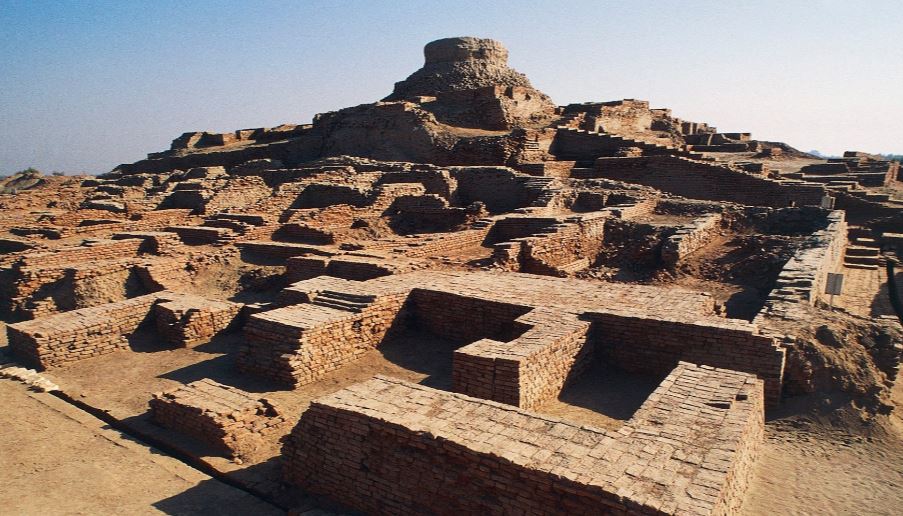
The Indus Valley or Harappan Civilization was at its peak between about 2600 and 1900 BCE. After that it rather mysteriously declined. The part of the world where these people lived (Pakistan and northwestern India) contains a bunch of old, dried-up river courses and lake beds, which show that it was once wetter than it is now. So as far back as the nineteenth century archaeologists argued that maybe the Indus Civilization was done in by climate change.
And there have been claims that the drying of the region happened at about the right time, c. 1900 BCE. But the science on this is very iffy, and there have been lots of other claims. The latest, coming from a major study across a wide swath of India, suggests that the greatest drying occurred around 2200 to 2000 BCE. When they announced this dating, the archaeologists involved said that they had found the cause of Indus civilization's decline.
Of course 2200 BCE is 300 years before Indus Civilization began its precipitous decline, and 300 years is a long time to hang on without enough water. So the same group of archaeologists set about figuring out how people adapted to that change. Did they grow different crops, put more emphasis on herding, extend irrigation, move to someplace wetter? No. So far as this study showed, people changed nothing at all.
I personally love this result, because I have gotten tired of climate change being used lazily an an explanation for every change in human society. People are adaptable, and thrive in all but the driest and coldest climates. I can imagine a scenario in which the climate continued to worsen and the early success people had adapting to declining rainfall without major changes only made them more vulnerable when things got too bad for their system to continue. But that is not what this study shows; it shows the Indus civilization sailing through what the authors identify as the period of most profound change in the climate over the past several thousand years.
I would say that leaves the relationship between the drying climate and the end of Indus Civilization as much up in the air as ever.
And there have been claims that the drying of the region happened at about the right time, c. 1900 BCE. But the science on this is very iffy, and there have been lots of other claims. The latest, coming from a major study across a wide swath of India, suggests that the greatest drying occurred around 2200 to 2000 BCE. When they announced this dating, the archaeologists involved said that they had found the cause of Indus civilization's decline.
Of course 2200 BCE is 300 years before Indus Civilization began its precipitous decline, and 300 years is a long time to hang on without enough water. So the same group of archaeologists set about figuring out how people adapted to that change. Did they grow different crops, put more emphasis on herding, extend irrigation, move to someplace wetter? No. So far as this study showed, people changed nothing at all.
We argue that rather than being forced to intensify or diversify subsistence practices in response to climatic change, we have evidence for the use of millet, rice, and tropical pulses in the pre-urban and urban phases of the Indus Civilization. This evidence suggests that local Indus populations were already well adapted to living in varied and variable environmental conditions before the development of urban centers. It is also possible that these adaptations were beneficial when these populations were faced with changes to the local environment that were probably beyond the range of variation that they typically encounteredTranslated into English, that seems to mean that people did not have to change because their existing style of farming was already flexible enough to cope with a great deal of variation in rainfall.
I personally love this result, because I have gotten tired of climate change being used lazily an an explanation for every change in human society. People are adaptable, and thrive in all but the driest and coldest climates. I can imagine a scenario in which the climate continued to worsen and the early success people had adapting to declining rainfall without major changes only made them more vulnerable when things got too bad for their system to continue. But that is not what this study shows; it shows the Indus civilization sailing through what the authors identify as the period of most profound change in the climate over the past several thousand years.
I would say that leaves the relationship between the drying climate and the end of Indus Civilization as much up in the air as ever.
Wednesday, February 1, 2017
Fire Hose
In Hawaii this week lava from the Kilauea Volcano has been pouring into the ocean as a spectacular stream called a "fire hose." Amazing video here.
Doesn't this look fake?
Matt Taibbi is Depressed
Sean Illing interviews Matt Taibbi about his new book on Donald Trump. First, they go through some stuff about Taibbi's last book:
Illing: In 2009, you wrote a book called The Great Derangement in which you talked about various fringe political movements around the country. A big theme was the loss of trust in national institutions, like Congress and the media. You even described a possible future in which politics “stopped being about ideology and … instead turned into a problem of information.”The interview closes with some thoughts about the future:
That reads like prophecy now. What did you see in 2009?
Matt Taibbi: The main thing was that I saw people tuning out the media. A lot of us have this idea that the truth has a kind of magical power, that if the truth is out there it will convince the country to unite behind it. But this isn't so. People can simply decide to not believe a version of events now. They can shop for information the same way they'd shop for everything else, and they pick the reality they find most pleasing.
Back when I was thinking about the rapture movement or the 9/11 truther movement, what struck me was that there are bubbles now that you can stay in and you don't have to engage with reality if you don't want to. So it occurred to me that in the future, people might decide en masse to completely tune out. Even the idea of having a debate with people about a commonly accepted body of facts seemed to be slipping away at the time.
And that's kind of what happened in this election. It was one group of people believing one thing and another group of people seeing something completely different.
Illing: Speaking of the next four years, your book ends on a pessimistic note. You basically declare the dream of unified country dead. Is it that dark?I am with Taibbi in this: the really disturbing thing about out time is the collapse of any shared notion of truth. If Americans divide into two groups with two completely different narratives about the world, I don't see how we can live in the same democracy.
Taibbi: Yeah, I think it is.
Illing: Are you encouraged at all by the massive protests or the fact that Trump is historically unpopular?
Taibbi: Not enough to feel especially hopeful about the future. I lived in Russia for several years and one of the things that struck me is how naive I had been growing up in the United States. If you grew up in America, you have no idea how bad it can get. The possibilities for awfulness in human experience are far beyond what we're used to.
I think we're just beginning to see how bad things can get. We have an illusion of stability thanks to our wealth and geography and the fact that we're still a young country. We take so much for granted. As Yeats said, things can fall apart. The center doesn't hold forever.
I see things starting to fray here and it's unsettling.
Illing: Political order is perilously contingent, and that’s a lesson America hasn’t learned in a long time.
Taibbi: That's exactly right. I’m not sure how this will play out, but it feels like we’re at the beginning of … something.
The U.S. Army in the 21st Century
I was struck by these numbers:
In January, a US Army brigade of nearly 3,500 troops and 2,700 pieces of heavy equipment arrived in Poland in the largest deployments of US troops and armor to that country. . . .
Too Much Politics?
Lots of news lately about how politics is dividing America. First an excellent story in the Times about Sauk County, Wisconsin, which split fifty-fifty in the election and where many find they can no longer even mention politics in public:
It was late afternoon and her bar was close to empty, so Lisa Buttonow poured herself a cherry-chocolate beer and broke one of her rules: Never reveal in a public place how she feels about President Trump.Politics is also spilling over into business at the national level. First we had liberals deleting Uber from their phones over its stand on the airport protests, and now this:
“You’ve got to be so careful around here,” explained Ms. Buttonow, owner of the Branding Iron Roadhouse in Lime Ridge, population 165. “You never know who’s a Democrat and who’s a Republican.” (As if to emphasize the point, she insisted that her own leanings were not for publication.) . . .
Some people said that even in a place with a nearly 50-50 mix of Republicans and Democrats, they still managed to live in their own bubbles.
“I try to hang around with the people that I’m used to hanging around with, people that I know share my beliefs,” said Larry Mundth, 61, a dairy and beef farmer in Reedsburg who is a Democrat. “I do know people who are positive, optimistic and Democratic. Those are the people I surround myself with, more often than not.”
Republicans described a similar silence on political talk. John Starling, 55, a farmer in Lime Ridge who is a Republican, said that even mentioning whom you voted for could be needlessly provocative. “It’s so polarizing,” he said. “You don’t torment people to their face.”
Al Exner, chairman of the Sauk County Republicans, sat in a diner in Reedsburg on a recent morning, recounting the times when arguments about politics could go on “tooth and nail” for hours, even among the best of friends, and nobody would walk away offended.
Mr. Exner, 80, regularly gets together over eggs and hash browns with old friends who have met for years. There are a few Democrats in the group. No one is allowed to discuss the new president or his policies.
“I’ve learned to keep my mouth shut,” Mr. Exner said. “There were days when we had our differences, but you could talk about it. Those days of disagreeing and being able to continue a conversation just don’t exist anymore.”
Some Starbucks customers are threatening to boycott the coffee giant after its CEO took a stand against President Donald Trump's executive order barring immigrants from seven majority-Muslim countries from entering the US.This sort of thing worries me a lot more than the antics in the White House. The country is very evenly divided between Democrats and Republicans, and we have to be able to live together.
On Sunday, Starbucks announced it planned to hire 10,000 refugees worldwide in the next five years. "We are living in an unprecedented time, one in which we are witness to the conscience of our country, and the promise of the American Dream, being called into question," CEO Howard Schultz wrote in a letter to Starbucks employees about the plan.
While many customers were immediately supportive of Starbucks' actions on social media, others threatened to boycott after the letter's release.
"Upon hearing about your decision to hire 10000 refugees instead of Americans I will no longer spend any money at Starbucks," one such Facebook user wrote on Starbucks' page.
Tuesday, January 31, 2017
Jokes, Memes and the Election
As the father of 23- and 19-year-old sons, I had an up-close look at the importance of jokes in this election. In The New Yorker, Emily Nussbaum has a good piece on this phenomenon:
Since November 9th, we’ve heard a lot of talk about unreality, and how what’s normal bends when you’re in a state of incipient autocracy. There’s been a lot written about gaslighting (lies that make you feel crazy) and the rise of fake news (hoaxes that displace facts), and much analysis of Trump as a reality star (an authentic phony). But what killed me last year were the jokes, because I love jokes—dirty jokes, bad jokes, rude jokes, jokes that cut through bullshit and explode pomposity. Growing up a Jewish kid in the nineteen-seventies, in a house full of Holocaust books, giggling at Mel Brooks’s “The Producers,” I had the impression that jokes, like Woody Guthrie’s guitar, were a machine that killed fascists. Comedy might be cruel or stupid, yet, in aggregate, it was the rebel’s stance. Nazis were humorless. The fact that it was mostly men who got to tell the jokes didn’t bother me. Jokes were a superior way to tell the truth—that meant freedom for everyone.If the defining feature of the current moment is confusion about what is real, edged humor has played a big part in creating this confusion. Trump has again and again introduced serious ideas into the discourse by pretending they are jokes: asking the Russians to find Hillary's missing emails, for example. Trump's supporters made everything into a joke, including the things they believed most strongly. As Nussbaum explains, humor was especially prominent in the struggle over "political correctness," expressing the bitterness of people who hate being told what they can't say. She spends some time on South Park's crude fictionalization of the election, which gave us gangs of angry feminists battling men's rights activists while "Mr. Garrison" tells jokes about Muslims, blacks, women, and anyone else. South Park did not capture everything about the election, she writes, but it did get
But by 2016 the wheel had spun hard the other way: now it was the neo-fascist strongman who held the microphone and an army of anonymous dirty-joke dispensers who helped put him in office. Online, jokes were powerful accelerants for lies—a tweet was the size of a one-liner, a “dank meme” carried farther than any op-ed, and the distinction between a Nazi and someone pretending to be a Nazi for “lulz” had become a blur. Ads looked like news and so did propaganda and so did actual comedy, on both the right and the left—and every combination of the four was labelled “satire.” In a perverse twist, Trump may even have run for President as payback for a comedy routine: Obama’s lacerating takedown of him at the 2011 White House Correspondents’ Dinner. By the campaign’s final days, the race felt driven less by policy disputes than by an ugly war of disinformation, one played for laughs. How do you fight an enemy who’s just kidding?
how dangerous it could be for voters to feel shamed and censored – and how quickly a liberating joke could corkscrew into a weapon.
Subscribe to:
Posts (Atom)