Another review from my old web site:
Neal Stephenson, Anathem. New York: William Morrow, 2008.
The leading literary spokesman for the technogeek class is back with another very long, very interesting book. I read all 890 pages in less than two weeks, which, considering that I have five children and a job, implies a pretty high degree of focus. I think it’s great.
Anathem is set on a planet much like the earth. The 18-year-old narrator and the other main characters inhabit the Concent of Saunt Edhar, a sort of monastery for mathematicians and philosophers – “saunt,” we are told, is a shortened form of “savant.” In this world the scientific elite is separated from the general population and forbidden to use computers or most other technology. Unable to do experiments, they devote themselves to “theorics,” which means mostly higher math, astronomy, and the philosophy that undergirds them. They have an elaborate ritual life and have raised their music, which is much like the chanting and singing of monks, to a high art. They grow their own food and manage their own affairs. The avout, as these mathematical monks are called, are divided into four classes, based on how frequently they interact with the secular world. The Unarians open their doors once every year, the Decenarians once every ten, the Centennarians once a century, and the Millenarians once a thousand.
The complex, 3000-year relationship between the secular and “mathic” worlds is laid out in some detail (you can give a lot of background in 890 pages). It seems that 700 years or so before our story civilization had grown wealthy and technologically advanced but destroyed itself through war and ecological disaster. Much of the blame was placed on the scientists who created the superweapons used in these wars, so they were banished to their “maths” and the separation between the two worlds was rigidly enforced. Since then the secular world has been relatively peaceful but technologically and economically stagnant, while the mathic world has gotten caught up in abstruse and unresolvable philosophical debates.
Much of Anathem moves quite slowly. The plot doesn’t really get going until page 250 or so, and after that there are more long patches in which very little happens. I kept reading because I found the world fascinating and because the characters talk about interesting things. Stephenson’s world is full of marvelous details. He has developed an extensive vocabulary that helps make the world feel different from earth despite the similarities. Data is “givens,” videos are called “speelies,” and video cameras are “speelycaptors.” The sociology is particularly interesting, such as the ways different seculars feel about the avout. Some consider the avout useless fuddy-duddies, some think they are evil sorcerers, some think they have special contact with god. I never minded that little was happening, because for me just exploring this world was enough.
The plot, once it gets going, it pretty interesting. I’m not going to say anything about it, because it relies on surprises I don’t want to spoil and because it isn’t really the main point of the book anyway. The most important section of the book, I thought, was a hundred-page-long discussion revolving around the speculation that the many-worlds interpretation of quantum mechanics explains consciousness. The plot follows out certain very far-fetched real-world consequences of this idea. I don't happen to think that this view of the world is correct, but, hey, this is what science fiction is about: what might happen if this crazy but possible scientific notion were true? Stephenson shows himself to be a master of this kind of writing.
The many worlds interpretation grew out of the frustration physicists have felt when they try to connect the mathematics of particle physics to a logical narrative of what is happening in the world. Quantum physics gives no absolute account of where things are or what state they are in, just probabilities. An electron might be just about anywhere in the universe; in quantum mechanics it doesn’t have a location, just a sort of cloud of probability. Nor is this just the vagueness of a guess. In some kinds of experiments the electron seems to be smeared out in space, for example, passing simultaneously through two holes in a screen. In other cases an electron seems to be in two places at once, or to have two different spin states at the same time. But if you look for the electron, for example by bouncing an x-ray off it, it has a definite location. What happens to the probability cloud that it appeared to be a millisecond before?
Nobody knows. Textbooks say that the wave function of the electron, which describes that smeared-out probability cloud, has “collapsed” to one point. As I understand it, nobody has been able to model this collapse in a rigorous mathematical way, and physicists have grown increasingly uncomfortable with the textbook description. So they have tried some very weird ways to make sense of the quantum world. The many worlds interpretation asserts that, in fact, every possible outcome does happen. Every time someone measures the spin state of an electron or measures its exact location, the world divides into many worlds, with each possible outcome happening in one of those worlds. The many worlds interpretation has some obvious problems. First of all, it seems impossible almost by definition to ever prove that it is true or false, which according to the standard definition means that it isn’t really science. There is also the Schroedinger’s cat problem: what kind of event triggers the division of the cosmos into different “world tracks”? And what about probability? What does it mean to say that one outcome is more likely than another if, in fact, every possible outcome does happen? But for Neal Stephenson’s purposes as an author, and ours as readers, it is enough that a great many scientists find the idea intriguing.
I had never before encountered the connection between the many worlds interpretation and consciousness, but since it seems, once you hear it, rather obvious, I assume that Stephenson didn’t invent the model he proposes. (One of his characters notes that people have been speculating on these topics for a thousand years.) The idea goes something like this: one way to define consciousness is to think of it as the ability to hold different models of the future in our minds at the same time. When we think about what to do, we imagine the consequences of different actions. We also think about the past, wondering how things might be different if we had made different choices. In the terms sometimes used by physicists, we are holding in our minds separate world tracks; as some philosophers have put it, we live extended in time. Recall that it is possible for subatomic particles to be, or at least to appear to be, in two different states at the same time. Such a particle exists simultaneously in two separate world tracks. This is the property that would be taken advantage of by quantum computers, should they ever be created: a transistor that can be in two states at once can do a lot more work than one that has to be in one state or the other. What if, this speculation proceeds, our brains work that way? If we hold different models of the future in our minds using the quantum properties of electrons in our brains? Why, then we are quantum computers, and our brains are able to travel some distance along parallel world tracks, existing for at least a short time in multiple universes. This ability to exist simultaneously in parallel universes defines consciousness, or at least is a key part of it, and it makes our minds fundamentally different from ordinary computers.
Whatever you think of this model, in Stephenson’s hands it makes for some fascinating conversation among his characters and some wonderfully bizarre happenings. (Suppose there were people who learned to travel along separate world tracks for more than the microseconds that most of us can, perhaps for hours or days; might not this ability to follow out the consequences of actions until they become clear before choosing one seem like a kind of sorcery?) If you think you might like reading a novel that mixes conversations on such matters with some intense action and the exploration of a very cleverly imagined world, run out and get a copy of Anathem. If not, well, read something else.
One of the things I find most interesting about Stephenson as a writer is that he so clearly defines himself as a particular kind of person, writing for those like himself. He knows a lot about digital technology and something about math, and he looks down on those who don’t. Government comes across as a sort of conspiracy set up by those without technical knowledge to control those who do, and to take some of the wealth they create and distribute it to people who have done nothing to deserve it. Stephenson’s bestselling book so far, Cryptonomicon, features a lot of straight out anarcho-libertarian fantasy. Characters live in fortified compounds on lightly governed islands, their privacy protected from government snooping by strong cryptography, their money shielded from taxation in a completely secret international internet bank. Government agents and especially lawyers appear as irrational, power-mad goons. Brilliant codebreakers exploit the ignorance of their military bosses to carry out their own diplomatic policies, along the way making fools of those same bosses with practical jokes that the generals never even understand.
Compared to the world of Cryptonomicon, Stephenson’s new world shows some of the same tendencies, but in a more nuanced way. It seems less juvenile, less like the sort of thing dreamed up by a 20-year-old fan of Ayn Rand. Since it is presented in a more grown-up and serious way, it seems fair to treat the philosophy espoused here seriously, and to ask whether it has any value.
Stephenson puts a very high value on rational, scientific thought. In Anathem he allows some value to poetry, but in all his books he heaps abuse on religion. In one of my favorite moments in Anathem, the narrator has a discussion with a religious believer about Saunt Bly, a famous character who, centuries before, had left his math and ended up as the focus of a religious cult. The “deolater” says that he believes that Saunt Bly was expelled from the concent because he proved the existence of god. “That’s interesting,” says the narrator, “because what would really happen is that we would say ‘nice proof, Bly’ and start believing in god.” At a wedding, the deolater preacher gave “one of his exasperating sermons, filled with wisdom and upsight and human truths, fettered to a cosmographic scheme that had bee blown out of the water four thousand years ago.” It was nice to see that Stephenson has created some interesting god-believing characters who come across as generally positive, but in the end they still suffer from that silly weakness, the inability to think in a rational and rigorous way.
The secular powers get a similar treatment. Some individual politicians are educated and sensible, and individual soldiers come across as decent guys who are very useful in an emergency, but on the whole government is a deeply frivolous enterprise. The leading avout understand the world so much more profoundly than the “panjandrums” that the notion of their following secular orders is a joke. Even the 18-year-old narrator is wiser than the political class.
I have nothing against intelligence and education, and I am myself a big fan of rational, scientific thought. But that is far different from the claim that the technical elite should rule the world. Stephenson seems to think that there is nothing to government but intelligence and rationality. I was reminded of the claim, made by the King of the Brobdignacians in Gulliver’s Travels, that there is nothing to government but goodness and common sense. But it simply is not true that scientists, even the greatest, have any special wisdom when it comes to politics. George Orwell, confronted by the claim that a more scientific education would make the English better citizens, asked why, if that was so, so many scientists of the 1920s and 1930s became communists and Nazis. In fact, over the past century highly educated, philosophically minded people have been drawn to radical politics in much greater numbers than the populace at large. (Communists, racists, John Birchers, etc.) Here’s a question to ponder: which group, scientists or ministers, has been a more important force for political good in America?
I would say that Stephenson’s own politics disprove his notion that the elite has more wisdom than the masses. Of all the competing political philosophies in the world, I think libertarianism is the stupidest. We cannot survive without government. Even Stalinism, for all its horrors, managed to work for a while. Libertarianism would never work at all. We could certainly get by with a lot less government than we have now, and I am attracted to libertarian positions on several issues. But the notion that we could get by without a strong state is simply nonsensical. Too see what would happen, you have only to look at what happened in Europe when the Roman Empire collapsed. The economy collapsed with it, the population cratered, and the survivors mostly ended up as serfs of powerful lords or great churches. Without a government stronger than the corporations, we would all end up as the serfs of corporate masters, or of individual billionaires.
Yeah, ok, it’s a novel, and I am once again indulging my habit of taking everything too seriously. But it’s Neal Stephenson’s own fault. By incorporating so much fascinating, high-level discussion of ideas into this terrific book, he has put me in a reflective, thoughtful frame of mind. How many entertaining books can do that?
October 26, 2008
Showing posts with label science fiction. Show all posts
Showing posts with label science fiction. Show all posts
Saturday, October 12, 2024

Monday, June 24, 2024
Denis Villeneuve's "Dune"


It pleases me that it has finally been put on screen in a version good enough that I can happily share it with my sons.
Saturday, November 26, 2022
Neal Stephenson, "Fall" (2019)
So just suppose we really figure out how to scan dying people's brains so they can live again in a digital world. What would that be like?
In Fall: or, Dodge in Hell, Neal Stephenson approaches this question from several angles, which is the sort of thing you can do when all your books are 800 pages long. The story begins in the near future, with the death of billionaire videogame company founder Dodge Forthrast. It turns out that many years ago, apparently without thinking very hard about it, he signed a contract with a group that planned to put bodies in cryofreeze for future revivification. But that entity went bankrupt, and anyway the contract said that the preservation should be done with the "best available" preservation technique. After a legal struggle, it is decided that the best available preservation technique is to scan Dodge's brain with an electron beam, recording all the connections between his neurons. The vast file containing this data is stored on a computer at the Forthrast Family Foundation, where nobody knows what to do with it.
Then, 15 years or so later, Doge's grandniece crosses a strange America divided between civilized cities and rural areas where civilization is collapsing because of conspiracy theories run amok. This was actually my favorite part of the book, although it is short and not relevant to the main story. Then the niece, working as an intern at the foundation, decides to "flip the switch" and activate Dodge's brain.
This action will be controversial forever after, but what is done is done. Dodge comes to life, or a sort of life, alone, in a world of chaos. He has only vague memories of his previous existence, and as he brings a world into being around him, he draws on his half remembered time on earth. Starting from a single red leaf, he slowly creates a continent.
From there we enter the realm of myth: a bit of Genesis, some Titanomachy, a hint of Ragnarok. A world takes form in a digital space, and as more and more people are scanned, it has more and more inhabitants. To the disappointment of many who are watching from meatspace, the world becomes depressingly like our own, with a ruling class, race slavery, the punishment of heresy, murder, war, etc. Billionaires are able to launch their avatars with extra resources, ensuring themselves leadership spots.
In the final section the world is dominated by a vengeful god (a former billionaire) with an army of angels and another of human slaves, and a plot is hatched at the Forthrast Foundation to somehow overthrow him. Then the story switches into another sort of mode, as a group of Characters embark on a Quest, almost a parody of Dungeons and Dragons or World of Warcraft.
Fall is a puzzling book. It is extremely inventive and the writing is good, but everything about the digital world and its inhabitants disturbed me. I kept thinking, why that? Why not something totally different? And, the thing that bothered me the most: without your memories, are you really you?
No answers are given as to many details, but I suppose if Stephenson had explored questions like "Why only one continent? Why didn't someone else make another one?" the book would have been even longer. He does have an answer to one of the biggest questions, why the digital world has to end up something like our own: because we made it, and that is the only world we know how to make.
So, some questions:
Would you like to live another life as a digital avatar?
Would you want your digital avatar to live in an earthlike world, with gravity, land, sea, and sky, with plants and animals and food and work and sex? Or would you want something completely different?
Can you imagine something completely different?
If, instead of a life in an artificial world, the system just made you feel blissfully happy, would that be better? What would your blissful happiness be like?
Wednesday, June 8, 2022
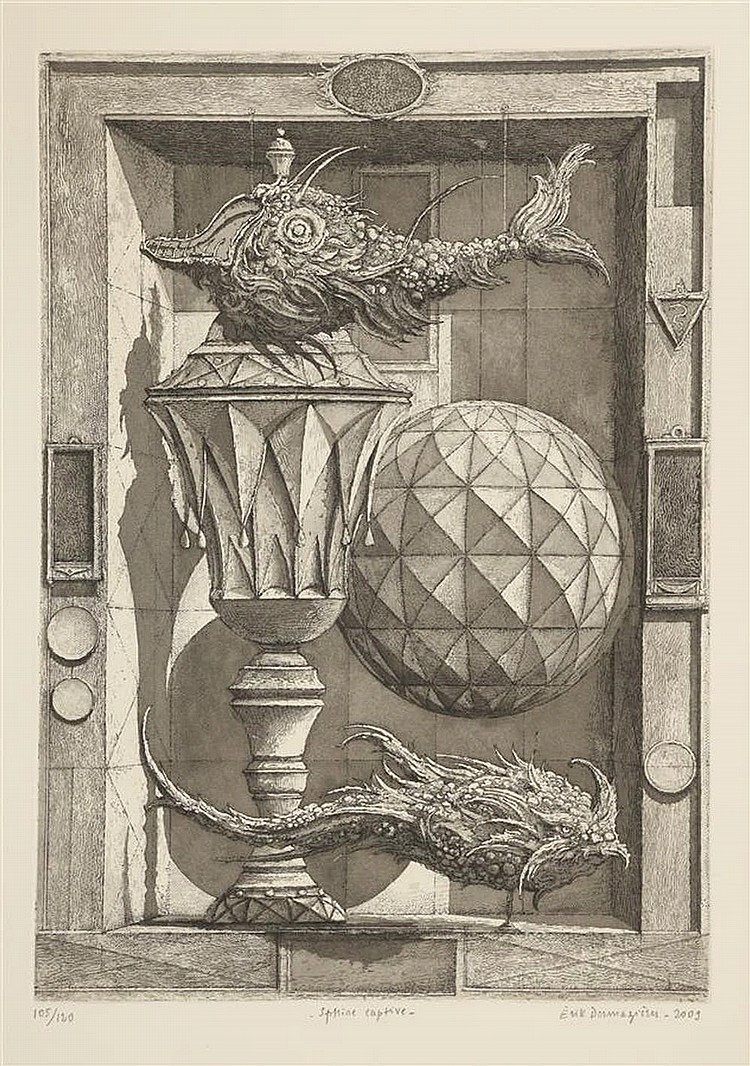
Erik Desmazières




Thursday, November 4, 2021
Jill Lepore Tries to School Elon Musk and Jeff Bezos on the History of Science Fiction
Jill Lepore has an interesting essay in the NY Times about billionaires, space travel, and Elon Musk's fantasies. But I think she misunderstands what people, or at least men of my generation, found exciting about science fiction. Like this:
Weirdly, Muskism, an extravagant form of capitalism, is inspired by stories that indict … capitalism. At Amazon Studios, Mr. Bezos tried to make a TV adaptation of the Culture space opera series, by the Scottish writer Iain Banks (“a huge personal favorite”); Mr. Zuckerberg put a volume of it on a list of books he thinks everyone should read; and Mr. Musk once tweeted, “If you must know, I am a utopian anarchist of the kind best described by Iain Banks.”
But Banks was an avowed socialist. And, in an interview in 2010, three years before his death, he described the protagonists of the Culture series as “hippy commies with hyper-weapons and a deep distrust of both Marketolatry and Greedism.” He also expressed astonishment that anyone could read his books as promoting free-market libertarianism, asking, “Which bit of not having private property and the absence of money in the Culture novels have these people missed?”
I think that what Musk and millions of others find appealing about science fiction is not the details of the social arrangements, but the absence of limits. From what I remember of the Culture series, the characters do pretty much whatever they want. That is the fantasy, not the absence of stock markets. I would say the same about avowedly libertarian sci-fi like Neal Stephenson's; the characters are too smart to be controlled by bureaucrats and the police, so they find ways to do whatever they want despite the evils of statism.
The economics of the Star Trek universe are not very well worked out, but I always thought that one of the main points was that money simply didn't matter. If you want something, you ask the replicator to make it for you. The main obstacle seems to be finding something interesting to do with your life.
The fantasy is the freedom. The dream is that science and cleverness will one day make us truly free. The nightmare is that science and cleverness will one day make us utter slaves.
Lepore finds ten different ways to point out that these libertarian capitalist dudebros were inspired by socialist books, but so what? None of the books she cites is remotely realistic about communism; the closest thing in a famous sci-fi book is probably Le Guin's Dispossessed, which I thought was awful preachy nonsense –although even she realized that many of the residents of her communist utopia would be pining to escape to the roaring capitalist planet nearby.
And how, do you suppose, could a resident of our world best approximate the total freedom of sci-fi heroes? Why, by getting obscenely rich. By heading a giant company that will respond to their wishes. By building their own rockets and flying themselves to Mars.
It makes perfect sense to me.
Friday, September 18, 2020
Camille Flammarion: the Scientist who Wanted to Believe

If you ever wondered where this image came from, I can tell you: it's from an 1888 book called L’atmosphère: météorologie populaire by a French astronomer named Nicolas Camille Flammarion (1842-1925). The name of the artist is unrecorded, but Flammarion designed all the illustrations in his books, so I think we can consider him at least the co-creator. It represents, I think, his understanding of science as a way to see beyond the limits of our little world to the unimagined wonders just over the horizon.
Flammarion was a fascinating character, a scientist who straddled its boundaries in two directions. He was a great popularizer, author of many books and articles for a mass audience and for a while the publisher of a science magazine for the masses. He was also very interested in spiritualism, ghosts, and the like, which led eventually to his being more or less banned from serious scientific circles.

Flammarion's first famous book was published in 1862, when he was only 20. La Pluralité des Mondes Habitées (The Plurality of Habitable Worlds) considered which of the other planets might be inhabited, which intrigued Europeans of the day enough to sell a lot of copies. This launched Flammarion on his career and also made him the century's most famous explorer of the idea of aliens. He later wrote two more books on the same theme and also a novel told from the point of view of a living comet. It has to be said that while Flammarion had a lot of ideas, as a writer he was no match for his countryman Jules Verne.

Like many people of his time, Flammarion was fascinated by psychic phenomena and spiritual mediums. He wanted, it seems, to find scientific proof of spirits and the afterlife. He wanted to believe. But he found, like many of his own time and since, that without some kind of scientific evidence he simply could not. He wrote:
It is by the scientific method alone that we may make progress in the search for truth. Religious belief must not take the place of impartial analysis. We must be constantly on our guard against illusions.

He carried out study after study of ghosts, séances, telepathy, and more. He made a two-year long study of automatic writing, which many thought was dictated by spirits. After working with a dozen of the most famous practitioners in Europe he concluded, "the subconscious mind is the explanation and there is no evidence for the spirit hypothesis." After years of studying mediums he complained, "It is infinitely to be regretted that we cannot trust the loyalty of mediums. They almost always cheat."
Over the years he accumulated many cases of phenomena that he thought could not be explained materially, and he argued that science ought to take this seriously. But he was never able to convince himself that these random anomalies proved the existence of spirits or life after death:
This is very far from being demonstrated. The innumerable observations which I have collected during more than forty years all prove to me the contrary. No satisfactory identification has been made. The communications obtained have always seemed to proceed from the mentality of the group, or when they are heterogeneous, from spirits of an incomprehensible nature. The being evoked soon vanishes when one insists on pushing him to the wall and having the heart out of his mystery. That souls survive the destruction of the body I have not the shadow of a doubt. But that they manifest themselves by the processes employed in séances the experimental method has not yet given us absolute proof. I add that this hypothesis is not at all likely. If the souls of the dead are about us, upon our planet, the invisible population would increase at the rate of 100,000 a day, about 36 millions a year, 3 billions 620 millions in a century, 36 billions in ten centuries, etc.—unless we admit re-incarnations upon the earth itself. How many times do apparitions or manifestations occur? When illusions, auto-suggestions, hallucinations are eliminated what remains? Scarcely anything. Such an exceptional rarity as this pleads against the reality of apparitions.
For his trouble he ended up shunned by both spiritual believers, who thought him a disruptive skeptic, and scientists, who thought him a crank.

Flammarion dreamed of wonderful worlds: of planets populated by alien beings, of planes filled with spirits, of secret knowledge that would be revealed by some combination of scientific rigor and spiritual practice. He never found them, but to some extent he did imagine them, and through his stories and the engravings he commissioned he shared those visions with the rest of us.
Saturday, May 5, 2018
Fantastic Cities


Other suggestions? I have the feeling I'm missing something famous.
Wednesday, April 18, 2018
Today's Big Number
Viruses raining from the sky:
Each day some 800 million viruses fall onto every square meter of the planet.
Sunday, January 7, 2018
Gregory Manchess, Above the Timberline


Saturday, December 9, 2017
Jo Walton, Among Others

It's about a girl, Morwenna Phelps, who is 15 years old in the Britain of 1980. There are two things about her: she is a smart kid in love with science fiction and fantasy; indifferent to the concerns of her classmates, she ignores sports and music but reads ten or more books a week. And, she talks to fairies and learns from them how to stop her mother, a mad witch, from becoming the Dark Queen of some big part of the earth.
It is the more prosaic parts of the story that grabbed me. Mor (as she calls herself) reads like I did at times when I was 15, going through stacks of sf and fantasy that I got from the library or the 25-cent bin at One Horse Books in Rolla. Her voice as she pours scorn on the other 15-year-olds rang true to me. She is perhaps a bit too calm and self-possessed for a real teenager, but I loved the way she looked at life. A creature of books, she sees the world through a reader's eyes, using words and categories from her favorite stories. When stressed she recited the "litany against fear" from Dune, something I once did myself. She and her sister name the old industrial ruins around her home in Wales after places in Tolkien: Osgiliath, Ithilien. She finds her first real joy in the story when she joins the sf book club at her local library; finally, people she can talk to about what she really loves and cares about! The first time I read the book I had a little trouble with these parts, because she mentions dozens of sf novels from the 60s and 70s and I kept trying to remember which ones I read and whether I had liked them, and it bothered me that except for a few favorites I had largely forgotten. This time I let it go and liked it better.
Most of the magic is the sort that could be taken for something else, maybe luck or fate, and the fairies slide between being real and serving as a sort of synecdoche for imagination. It is possible to read the story and think of it all as metaphor: for creativity, for a determination not to be like everyone else, for the way Mor expresses her growing understanding of the world, for the way she breaks away and finds her own path. But it is also possible to read the fairies as real and the magic as darkly powerful. In the wonderful ending, the two interpretations come together perfectly.
I love it. If it sounds like the sort of thing you might like, get it.
Thursday, November 23, 2017
The Interstellar Visitor

Subscribe to:
Posts (Atom)


