Showing posts with label Vikings. Show all posts

Friday, June 16, 2023

The Hiddensee Treasure

In 1872 the small Baltic island of Hiddensee was struck by destructive floods. Sometime around then, a wonderful hoard of gold objects from the Viking Age ended up in the museum at Rügen, a larger Baltic island now in Germany.

As to how they ended up there, most internet sources have little to say. The only exception I found is this numismatic site, which is so paranoid that even an attempt to screen cap their text generates a message about potential legal action. Anyway the paranoid coin collectors tell us that Baltic fishermen began offering extraordinary gold objects for sale around Rügen, including in the open marketplace. A local teacher and amateur archaeologist named Rudolf Baier realized their scholarly importance and bought all he could find for the sum of RM 2,257. Baier bought them by weight, paying ten times the going rate for plain 14 karat gold.

Baier eventually put them on display in the Stralsund Museum. That 2,257 marks was a lot of money, but not even the paranoid coin collectors have any speculations about how a schoolteacher raised a sum that was surely more than his annual salary. According to various sites, the purchases were made in 1873 and 1874, so likely at several separate times from multiple sellers, which raises the possibility that some objects from the hoard have disappeared.

Modern art historians think these finds date to the 10th century. The Danish National Museum, which included these in an exhibit a few years ago, tells us:

The processing of such a quantity of gold in the hollow jewelery bodies, with this precision of the granulation technique, in interaction with the braided ribbon and pearl wire ornamentation and with the bird of prey head on the hanging loops, can only have taken place in the environment of a princely centre. It is believed that the jewelry is related to the Danish Viking king Harald Bluetooth. After his baptism at the Ottonian court around 965 AD, Bluetooth led Christianity in Denmark. 

Which brings me to another point, because the identity of these objects is much disputed online. The Danish National Museum thinks this is an explicitly Christian hoard, but all the online sellers of Viking art call these Thor's hammers. I suppose that is just the pagan preferences of contemporary Viking fans, but I'm having trouble turning these into Christian symbols myself.

Anyway this is a remarkable find, and another insight into the vast amount of gold treasure that washed through the Viking world as they looted, conquered, and traded their way across Europe.

Saturday, June 10, 2023

The Broa Bridle

This bridle was found in a man's grave at a farm called Broa, on the Swedish island of Gotland. The leather is modern, of course; only the  bit and the 21 gilt bronze mounts are original. 

The carved bronze mounts are famous in Viking art, one of the works that define the Broa/Oseberg style.


This one piece probably took hundreds of hours to create.


Amazing. The detail of the beasts and dragon in the image directly above stuns me.

Just when I think I have seen all the really amazing works of Viking art, I discover something new.

Thursday, May 18, 2023

Searching for Jomsborg

Recreated "Slavs and Vikings" Settlement in Wolin, Poland

Andrew Higgins has a story in the NY Times today about Polish archaeologists searching for the lost and possibly legendary Viking outpost the sagas call Jomsborg. 

The Jomsviking Saga was written in Iceland in the 13th century, describing events supposed to have taken place in the 9th and 10th centuries. It exists in four different versions that differ in length and detail, so there is not really even an original saga, let along an original story. The saga says that a great warrior named Palnatoke, which is not really a Norse name, founded a brotherhood of warriors and built a wooden fortress on an island in the Baltic Sea off Poland. The Jomsvikings were a sworn order who had to follow a law laid down by Palnatoke. They could not withdraw from combat except in the face of overwhelming numbers, could not wage blood feuds against each other, and had to obey all orders from their commanders. They were forbidden from showing fear. No women were allowed within the walls of the fortress. (Since the Viking ethos scorned any man who played the passive part in gay sex, it's hard to see how they could have had much of that, either.) To join, a man had to have a reputation as a warrior and then pass some sort of challenge that most authorities think was ritual combat against one of the Jomsvikings.

In the saga, the Jomsvikings were mercenaries who sold their services to the highest bidder. This included Harald Bluetooth, the king who unified Denmark, and it is in histories of his reign that we have a few hints they might really have existed in some form. Those historical accounts, though, seem to portray the Vikings of the Polish coast as mainly pirates who occasionally fought in wars when it suited their interests. Putting together bits of the saga with other accounts, it seems that the Jomsvikings, if they existed, went into decline after they suffered a terrible defeat around AD 985.

The Jomsvikings were pagan through the time when many Norse were converting to Christianity. The saga, though, does not make them out as very good pagans. Of course it was written by Christians centuries later who may have wanted to play down their paganism. But as written the stories make it seem that they had given up on religion altogether, beyond an obsession with death. 

What is fascinating to me in Higgins' story is that many contemporary Poles have gotten seriously into the Jomsvikings. The Nazis, of course, loved the Jomsvikings, and the first excavations on the island off Wolin where Jomsborg is supposed to have stood were carried out by Nazi archaeologists. So after World War II the story of the Jomsvikings was buried in Poland, and in fact Norse invaders were largely written out of their history. 

Now, though, a new generation has rediscovered them. The city of Wolin is trying to extract tourist revenue from the story, and Higgins talks to young enthusiasts who spend all their spare time researching the Vikings and searching for remains of Jomsborg. People reenact their battles. The hook for the Times story is the discovery, during routine archaeological survey for a new observation tower, of what may be a wooden pallisade from the 10th century. Which would be very cool, but a lot more work will have to be done to show that any sort of Norse fortress stood there, let alone what it might have had to do with the stories of the Jomsvikings.

Tuesday, March 14, 2023

The First Mention of Odin

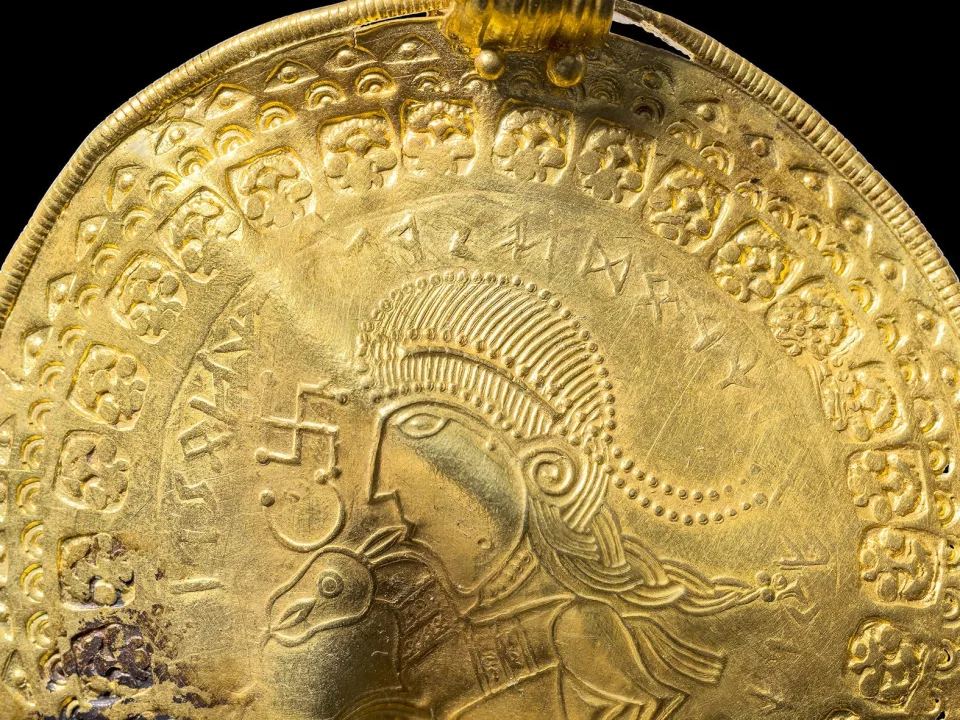
This gold disc – the term of art is "bracteate," but that just means a gold disc that isn't a coin – was excavated in Denmark in 2020 and dated to the early 400s AD. It was made in a mold and two others of the type are known, one found back in 1870. But the others were too worn for the runic inscription to be read. Because of the swastika, associated with Odin in the Viking period, people had long wondered if this depicted Odin. (Announcement in Danish, English summary)

But the inscription on the new find is legible and has now been partially translated. It seems to refer to the pictured person as Jaga or Jagaz, "Odin's man." So this is not Odin himself but a great lord who was one of Odin's followers. This is the oldest known mention of Odin.

And it fits perfectly with our understanding of how and when Viking culture arose. As I have written here before, archaeological evidence points to the late Roman period, c. 250 to 450 AD, as the time when the Norse first had great lords living in longhouses, surrounded by their warriors. Since the worship of Odin was central to both kingship and warrior culture in later times, one would assume that Odin was central to those things during the period when they arose. As this find confirms.

Monday, January 2, 2023

Bosta: Vikings on the Isle of Lewis

The only famous bit of Viking archaeology on Lewis, or anywhere in the Hebrides for that matter, is the chessmen, 78 amazing pieces found in 1831. But these date to the very end of the Viking age in the 12th century, and written sources tell us that the Vikings were on Lewis by 800 AD. What other traces did they leave behind?


In 1992 a severe storm exposed stone walls of an ancient village which had lain hidden under sand dunes at Bosta Beach. These included oval foundations from Pictish houses of the Iron Age and rectangular Viking foundations. This probably should not have been a surprise, since Bostadh means farm in Old Norse. 

View of the site, with a reconstructed Pictish house in the center. You can see that this is a sheltered valley with access to the sea, the perfect spot for a Viking setller.

The reconstructed Pictish house. 

Incidentally it was the Viking form, the rectangular "Black House," that dominated the Hebrides from Viking times down to the nineteenth century, so that was one concrete legacy they left. Above is a restored village of Black Houses you can visit on Lewis, showing the form, although of course the chimneys are a 17th-century addition.

Vikings made boring pottery and not much metalwork was found at Bosta. The most interesting finds had to do with food, both animals and plants. Let's start with fish, because there was a major difference between the Viking period fish bones and those from the Pictish period. The Picts ate fish, but it was all caught close to shore. The Vikings, as you might expect, went much farther out to sea for their catches, and they also practiced net fishing of herring, which required the cooperation of several seagoing boats and dozens of people. This was another long-term impact they had on these islands, re-orienting them toward the Atlantic and in particular toward communal fishing.

The most common animal bones were actually from cattle, but cattle bones are much bigger and tougher than fish bones, so they survive much better, so this doesn't necessarily mean they ate more beef than any other meat. The bones included many young calves, which means that they kept their cows mainly for their milk; if you want beef, you let the cows grow for a year or two before you kill them. In later times the rents of some islanders were paid in butter.

Sheep, by contrast, were not killed until they were a year old, which is the normal pattern when people raise them for meat and wool. There were very few pig bones. The wild species included red deer (elk), gray seals, dolphins, otters, and a pine marten, the last two hunted for their fur.

The plant remains show that barley and oats were the main crops, as one would expect in this environment. The Vikings also grew flax, which the Picts did not, so that might be something else they introduced to the island.

How many Norsemen came to Lewis? Modern genetic studies suggest that about 22% of islanders' genes in the male lines come from Scandinavia, and 11% in the female lines. But that may not reflect the situation in the Viking Age; after all, the Scots reconquered the islands around eight hundred years ago, and we know of at least two waves of migration from the mainland to the outer islands, one in the 1740s. So in the year 1000 I suspect the number of Vikings was larger. The 2:1 ratio of male to female Norse is less than you see in many other violent conquests, so it seems that migration to the Hebrides was something of a family affair.

Combining this sort of archaeology with written sources gives us a picture of Viking life on Lewis. Some people lived in towns; Stornaway seems to be a Viking foundation. A Jarl lived there, with a court, which we know about because some bits of verse composed by Hebridean skalds were written down much later. But most people lived in farmsteads scattered across the island. They grew oats, barley, and flax; they raised cattle and sheep; dairying was a major focus of their work, especially for women. They lived side-by-side with people of Pictish and Irish descent, and their descendants ended up speaking Gaelic, a version of Irish with a bunch of Norse loan words.

Graveyard on Barra, Outer Hebrides

But in their hearts, the men at least were people of the sea. Those surviving bits of Hebridean poetry are all about sailing, including a poem called "Gigantic Waves." They loved ships and boats. When they went to war, it was by ship; a lord's strength was measured in ships. When they wanted a contest, it was often a rowing race. The work that most captured their imaginations was at sea, daring the Atlantic in pursuit of fish, seals, and whales. Communities were built around herring fishing, and local leaders arose to lead these communal hunts. Their homes were built so they could look out at the ocean. Very often, they died at sea, for the Atlantic was not a forgiving place.

Saturday, February 5, 2022

Vikings in the East: the River Route

During the Viking age, people from Scandinavia traveled across eastern Europe to the Black and Caspian Seas, where they traded, raided, and served as mercenaries in the armies of Byzantine Emperors, Khazar Khans, and various other rulers. 

How did they get there?

You've all probably heard an answer that goes something like, "They sailed down the rivers." But as I just learned from River Kings, a 2021 book about the Viking Age by Norwegian/British archaeologist Cat Jarman, this was actually very difficult. There were many portages, some of them miles long, a few of them dozens of miles long. Jarman reports that while many teams of Swedish, English, and Russian adventurers have tried to voyage from the Baltic to the Black Sea via the rivers, none have succeeded; all eventually gave up and loaded their boats on trucks for substantial segments of the route.

So most likely the journey from the Baltic to Kiev involved a lot of walking. Not that the Vikings were afraid of walking; one of the mercenary armies that fought on the Caspian Sea got there by sailing to the eastern end of the Black Sea and walking across the Caucasus. But it seems unlikely that very many ships were ever sailed and dragged from the Baltic to the Black Sea. Jarman says the consensus among archaeologists today is that the trade from the Baltic to the navigable parts of the Dnieper and Volga Rivers was carried out in shallow-bottomed rowboats. And rather than dragging their boats across the longer portages, they may simply have left one boat or fleet behind, carried their goods overland – or made them walk, since the most valuable part of what they sold south was slaves –and then loaded onto another set of boats when they reached the next lake or river.

And yet when the Byzantines and Arabs encountered Northmen on the Black Sea, they were sailing what sound exactly like the Viking ships of northern waters. There is even this famous graffiti from Hagia Sophia in Istanbul depicting a Viking ship with a dragon prow. The fleet of "Normans" that attacked Constantinople in 860 was said to contain more than 200 ships, and if that is an exaggeration, well, surely you would have wanted an awful lot of ships to attack the massive walls of the mighty imperial city. But since, again, it would have taken a staggering effort to somehow drag all those ships past swamps and rapids and over the hills to the source of the Dnieper, they were probably built along the navigable part of the river, in the vicinity of Kiev or even farther south. The shipwrights may have been Swedish, but then again they may have been Slavs who had been trained in Swedish ship-building techniques; the ethnic make-up of the people known to history as the Rus is a complicated question that will get a post of its own.

People did travel this whole route, from Sweden or England to Constantinople and even Baghdad. We know some of their names: Harald Hardrada,  Bolli Bollason, Ingvar FarTraveller. But the usual course of commerce did not involve one merchant taking a load of goods from Gotland to the Mediterranean. Furs from Finland may have changed hands half a dozen times before they reached the southern markets where they sold for princely sums. This was a trading system, not a waterway down which ships sailed, laden with goods.

Monday, April 26, 2021

Vikings, an Icelandic Cave named Surtshellir, and Ragnarök

Surtshellir Entrance

The news from Iceland:

Archaeologists have discovered the remains of rare artifacts from the Middle East in an Icelandic cave that the Vikings associated with Ragnarök, an end-times event in which the gods would be killed and the world engulfed in flames.

The cave is located by a volcano that erupted almost 1,100 years ago. At the time of that eruption, the Vikings had recently colonized Iceland. "The impacts of this eruption must have been unsettling, posing existential challenges for Iceland's newly arrived settlers," a team of researchers wrote in a paper published recently in the Journal of Archaeological Science.

Archaeological work shows that after the lava cooled, the Vikings entered the cave and constructed a boat-shaped structure made out of rocks. Within this structure, the Vikings burned animal bones, including those of sheep, goat, cattle, horses and pigs, at high temperatures as a sacrifice. This may have been done in an effort to avert Ragnarök.  

This is an extremely cool find. The abstract to this article adds that the ritual site was more than 300 m (1,000 feet) from the cave's mouth, and that the ritual activity inside went on for at least 80 years. The cave (a lava tube, technically; photo above shows part of the passage) is more than 1,000 m long. It was definitely known in medieval times, since it is mentioned in the Book of Settlements. After the island converted to Christianity the cave was mostly avoided as a cursed spot until the mid 1700s. The name connects it to the fire giant Surt, whose flaming sword was supposed to burn up the earth at the end of this age.

Imagine hearing that story told a thousand feet underground in a dark volcanic cave, the poetry echoing off the black basalt walls.

But given that this is the Vikings we are talking about, how do we know that the sacrifices in the cave were intend to avert Ragnarök? Seems to me they could just as well have been intended to bring it on. Plenty of people have longed for the end of the world, and the craziest Christian apocalypticists were not the least bit crazier than a lot of Vikings.

Friday, April 9, 2021

Neil Price, "The Viking Way: Magic and Mind in Late Iron Age Scandinavia"

The Viking Way is an amazing, impressive, fascinating and profoundly learned book, but not always in a good way.

It started as Neil Price's dissertation back in the 1990s, and a first edition appeared in 2002. At that time it was a standard-sized academic book, with very few illustrations. The second edition of 2019 is a large format book full of pictures, including amazing drawings of burials by Thorhallr Thrainson, and it also has added text and a new final chapter. In Price's praise, I will say this: I have been reading about the Vikings for going on forty years, and I learned many new things from this book.

But. 

It starts badly, because it still has the first chapter from that dissertation, one of the most appalling strings of flattering citations I have ever waded through; if I had been on his committee I would have told him to throw it out. Price seems very worried that you, the reader, might think he had not read a single important work about the Vikings, so they all get at least a sentence. He wants you to know that he is a scholar of great breadth, so he name checks Braudel, Simone Beauvoir, Konrad Lorentz, Foucault, and on and on. But he is also politically up-to-date and lectures us about the perils of western scholars using their knowledge of indigenous peoples to misrepresent them, or colonize them, or whatever. He is hip to Queer Studies. He seems positively terrified of offending any scholar currently working on Viking religion and magic, so he cites them all. There are a lot.

Modern Reconstruction of a Norse Magical Staff

Parts of the book are little encyclopedias. I enjoyed some this material: the list of all Odin's known names and titles, and those of the Valkyries; the description of every single iron staff recovered from a Norse grave (36 pages of iron staffs); the categorizing of every type of magic performed by Norse sorceresses. But it is certainly not light reading. Even harder going is the discussion of the words for Norse magic and magical practitioners. It is not Price's fault that the terminology varied across time and space in ways we need to understand if we want to read the sources properly, but the topic is very obscure and Price's account is hard to follow.

What redeems The Viking Way is Price's profound enthusiasm for his subject. I have never read a scholar who conveyed more love for his material than Price does. He thinks Viking magic is absolutely the most fascinating thing in the world, and he has thrown his whole soul into mastering everything there is to know about it. 

A strange burial from Sweden: a young woman buried sitting on an older man's lap, with a speak thrust into the ground above them, perhaps dedicating them to Odin

The main organizing theme of The Viking Way is shamanism, and the main question is: to what extent was Viking magic and religion shamanistic? This matters, says Price, because shamanism is not a random assemblage of techniques; it makes sense only if you believe certain things about the universe. Shamans imagine a universe full of spirits, and they believe that the actions of those spirits determine much of what happens to humans. The shamanistic universe is not friendly, but full of terrors, and they tend to think the whole universe will end badly, its fate is already fixed. The powers of a shaman can be used to mitigate, a little, the suffering of people trapped on this cruel planet; but shamans are just as likely to be troublemakers who are actively making things worse.

Viking shamanism has been debated for a century because it is a great problem. There is much evidence one could bring up to defend the notion. First and foremost is the story of Odin, chief of the Norse gods, who repeatedly acts exactly like a shaman. He rides on an eight-legged horse, as many Siberian shamans did in their visions. He has animal familiars. He hung himself on a tree for nine nights to obtain wisdom; for some shamans this was not a metaphor but something they actually did, spending many days and nights, tied to trees or standing on platforms, seeking. In one of the most famous Norse poems Odin describes all the magic spells he knows, and all can be found in the literature of Siberian shamanism. I find it hard to see how anyone could argue that Odin is not a shamanistic figure, although of course people do argue that.

The Norse were intimately acquainted with shamanistic neighbors, the Sami. The archaeology suggests that the Sami used to live farther south than they have in historic times, and Price has examples of what look like contemporary Norse and Sami communities on opposite sides of the same lake in central Sweden. The sagas tell us that Norwegians sometimes hired Sami magicians to cast spells for them, and several Norse sorcerers are said to have been trained by the Sami. So the medieval Norse must have known quite a lot about shamanism in its Sami form.

Norse magical practitioners made a habit of prophesying about the future, staging rituals that have much in common with those some Siberian shamans used when they predicted the future.

One of the most striking things about shamanism among Siberian peoples and Native Americans is its connections to sexuality and gender identity. In many cultures shamans are notoriously horny, and their public performances often involve simulated sex. In other places they must be completely chaste.  Many shamans are bisexual, and many dress as the opposite sex when performing their rituals. Among the Chukchi of eastern Siberia the most powerful male shamans stop being men and pass into a third gender, the "soft men," from then on dressing as women and doing women's work. Similar ideas are found among some Native Americans.

(Contemporary trans people are very interested in these gender shifts, but it should be noted that all these communities thought shamans were crazy, and gender transformation was often viewed as traumatic; among the Chukchi the process began when the shaman was raped and subjugated by a powerful demon while in a trance, and informants said this is so awful that a majority who experience it commit suicide.)

And there is a lot of sexuality and sexual identity swirling around Norse magic. Price cites a Norwegian law code that listed two insults so heinous one could legally respond to them with immediate violence: to call a man a passive homosexual, or to call him a sorcerer. The insinuation is that this was the same thing. There are several hints in the sagas (which were written by Christians and are reticent about sex) that male sorcerers were homosexual. Female sorcerers were often thought of as promiscuous. I think Price makes the case that the sexual issues surrounding Norse magic are parallel with those of Siberian shamanism.

But here's the problem: there is not, in Norse literature, a single clear description of a seer or seeress going into a trance state and returning from it with knowledge gathered in the Other Lands. Since that is the fundamental act that defines shamanism, how can we say that the Vikings were shamanistic?

Neil Price goes at this question from every angle he can think of. He pays particular attention to archaeology. A great deal of magical paraphernalia has been excavated from Norse tombs, including several women who seem to have been sorceresses. (See here on the Sorceress of Fyrkat, the most famous.) I love this stuff: the detailed analysis of amulets and seeds, the question of whether artifacts grouped together were in bags or hung from belts, how to tell a magical iron staff from a roasting spit.

The archaeology confirms the picture we get from the sagas, which is that the Norse believed in magical powers, and that practitioners were common and important figures. But it doesn't really tell us if anyone was a shaman in the full sense.

This brings us to Price's second main thesis about the Viking world, the centrality of violence. Other than the myths about Odin, the one place where we clearly see Vikings acting like shamans is on the battlefield. Berserks who fought in self-induced battle fury, beyond fear or pain, communing with the battle spirits (Valkyries) that haunted every warzone but could only be seen by the wise, are the mostly clearly shamanistic figures in the Norse world. To Price this makes perfect sense, because he believes the lives of Norse men (and warrior women, whom he believes in very much) were built around a cult of killing and death. Price's Odin is a death god first, and second and third, too. The Norse understood that shamanism was a way of seeking wisdom; that, after all, is what they imagined Odin doing, and there is a famous poem called Voluspa in which a seeress lays out the future doom of the world. But for themselves they were mainly interested in magic as a way of inflicting harm.

So to Price, Norse shamanism was a way they understood the cruel, violent universe in which they lived, and a way in which they sought to inflict more cruelty and violence on their enemies.

For a book like The Viking Way, though, a summary of the argument misses much of the point. The point is to ponder images of shamans in bear costumes set beside fragmentary felt masks from the Viking age, to read the roll of Odin's 215 titles, to imagine a seeress speaking from the high seat about the year to come, to imagine the king's berserks in the prow of his ship, shrieking and clashing their weapons as they try to enter a state of battle madness. To imagine ourselves as the archaeologist whose trowel uncovers the face of a sacrificial victim, dedicated to Odin by a spear thrust into the ground above her. It is the details that tell the story, and there are few books with more grand details than this one.

Saturday, March 6, 2021

The Viking Sorceress of Fyrkat

Fyrkat Grave 4 by Thorhallur Thrainsson

Those of us interested in past beliefs about magic do a lot of hoping and wishing. Like, it's true this text was written two centuries after the events it describes, but maybe it is based on earlier sources or a strong oral tradition. Or, yes, there are other possibilities, but isn't the most likely explanation that this body was a victim of human sacrifice?

But sometimes the evidence is pretty much irrefutable, and can say with very little doubt that we are reading about or looking at an actual witch or wizard, someone who was deeply learned in an ancient, arcane tradition. One of those cases is the woman I will call the Sorceress of Fyrkat, although technically she is the occupant of Fyrkat Grave 4.


Fyrkat was one of the fortresses built by the kings of Denmark, probably around 980 AD. There are at least two other nearly identical fortresses from the Viking age, and two other possible ones. The best guess is that kings had them built as part of preparation for a major campaign. In this case the king would have been Harald Bluetooth, and the campaign was his successful war to regain southern Jutland from the German emperors. Note that Harald Bluetooth had by this time converted to Christianity and required all of his followers to do likewise.

The street that ran out Fyrkat's northeast gate led to a graveyard. Outside the gate the street was raised on a wooden walkway supported by posts, and the graves were laid out neatly along its sides. One of the graves held a woman of exalted status and very strong magical associations. She wore a blue dress with accents of red and embroidery in gold thread. Over it was a linen garment that has been seen in various ways; the Danish National Museum interprets it as you see here, as a shawl so thin as to be nearly transparent. This would have been a highly stylish get-up at the time, just like those worn by noble women in the German empire. Rich Norse women usually held their attire together with a lot of fancy pins and brooches, but this tailored dress needed no such fasteners. She was laid in the bed of a wagon. Wagons like this were standard coffins for high status women in this age, showing that while alive they did not have to walk but were driven everywhere.

She was not buried with a huge quantity of grave goods, but the select items placed with her tell a remarkable story. Near her head was this box brooch, which was filled with what seems to be white lead makeup. This is highly unusual for the Viking world, and the substance was probably imported from the Mediterranean.

On her second toes were two silver toe rings, of which these are replicas. These are the only toe rings known from the whole Norse world and they probably came from the Middle East or Central Asia.

Near her feet was this bronze cup, also probably from the Middle East. This is a more standard object for a rich Norse or Anglo-Saxon burial; Byzantine or Arab bronze and brass ewers, bowls, and so on seem to have been common luxury items in the north.

A group of objects was concentrated around her waist. They are thought to have been suspended from her belt, as shown here in a drawing by Hayo Vierck. There is a knife, its sheath bound with silver, and a slate whetstone. Since Vikings and Anglo-Saxons had a thing for fancy whetstones, which we often find in graves or other ceremonial contexts, we should probably imagine that a sacrifice was preceded by a dramatic sharpening of the killing instrument. (Imagine this act accompanied by chanting and drumming, as the tension builds.) Item 5 in the drawing is a guess about the origin of numerous tiny pieces of thin glass, which may represent a small ampule of this type. This was a common form of protective amulet in the classical world and their use continued into Christian times, when they were filled with water used to wash saints' tombs. Item 2 is a hypothesized bag that contained a pile of henbane seeds. Henbane can give you strong hallucinations, and it is one of the plants most commonly associated with magic in northern Europe.

Item 3 is this "duck's feet" pendant, probably from Russia. Only one other example is known from the Norse world, from another grave that might be a queen.

Item 4 is this chair-shaped amulet. These are one of the items most strongly associated with Norse magic, known only from the graves of women suspected of being seers or sorcerers. They probably represent the "high seat" on which a völva sat to make her prophecies, as described in several Norse sources.

You may be wondering why I haven't called Fyrkat 4 a völva, since that is how modern writers usually refer to Norse magical women or prophetesses. But the Old Norse terminology of magic and magical practitioners is one of those topics that, once you dive into it deeply, you wish you hadn't. There are several terms that all shifted meaning over the centuries. It is quite possible that this woman considered völva such an unbearable insult that she would have had her men cut your tongue out for calling her one, before prophesying ruin for your whole family. (Like "witch.") So it is safer to avoid Norse terms altogether and use something generic and English. Incidentally you may think you know why a Norse wise woman was called a völva, which looks like an evocation of feminine mystery. Really it means "staff bearer". Which brings me to the other incontrovertibly magical item from Fyrkat 4, a badly corroded iron staff or wand with bronze fittings.

About thirty of these are known; this image is from the British Museum. Some of them, like these, have ornamentation that sets them apart, but others look pretty much exactly like cooking spits. And indeed some of them may have been cooking spits, although in burials they are associated with fey women. So likely they were used for a different purpose.

The chest at the feet of Fyrkat 4 was old and had been repaired multiple times with different sorts of wood, which is an odd detail. It contained mostly clothing, of which all that survived was a quantity of gold and silver thread. So very fancy clothes. There also a set of the standard objects buried with Viking women: shears, a spindle whorl, another whetstone.

The Fyrkat sorceress must have been a formidable woman. Rich, she spent much of her money on exotic goods from far away, favoring in particular fashions that had not been adopted by her peers. And she was, in an allegedly Christian kingdom, a devotee of an ancient magical tradition.

Bronze bowl from Fyrkat 4, Item 1 above

That tradition had many elements. The best known and probably central was prophesying. The sagas tell us that seers regularly traveled through the Norse lands, calling at each prominent farm. There they were lavishly welcomed and they and their followers provided with a feast. They presided over a ritual that involved chanting and, in pre-Christian times, animal sacrifice. They then dressed up in an elaborate costume –was this when the Fyrkat sorceress painted her face white? – took their place on a chair atop a platform and prophesied what the year would bring for the household. According to our sources, they usually provided good news. Again according to our sources, they could be bribed, and would issue better prophecies for those who fed them better. This same accusation was of course made about oracles in the ancient world and is still made about modern shamans, often by other shamans, so this debate seems to be part and parcel of the whole business of prophesying.

The "Pagan Lady" from Peel Castle, Isle of Man, Viking Sorceress buried with a Swan's Wing. By Thorhallur Thrainsson.

Notice that the saga sources say little about the seeress going into trance or ecstasy. But henbane is no trivial drug, and anyone who took enough might go very far indeed past the rational state. Plus ecstasy of one kind or another is almost universally part of the prophetic tradition. So I think we should imagine that Norse seeresses at least sometimes drugged themselves into a trance state to seek answers to pressing questions. One thing we have learned from modern shamans is that they are capable of working in multiple modes, giving pat answers to standard questions – yeah, sure, you'll have a great harvest, what are we eating? – while also drugging or otherwise driving themselves into very dangerous trance states when confronted with a real crisis.

I have also refrained from calling Fyrkat 4 a seeress, which is how the Danish National Museum titles her. I did this because the Norse magical tradition also included other elements besides prophecy, among them the standard repertoire of cunning folk: healing, finding lost objects, making protective amulets, and so on. They were also said to summon storms and curse their enemies to death. I assume that the Fyrkat sorceress engaged at least in healing, and it is fun to imagine that sometimes King Harald sent his bishop away and asked his sorceress to curse his enemies or seek a vision of how his upcoming wars might go.

The "Staff Wielder" or "Weapon Dancer" figurine from Birka in Sweden

Much of this material comes from Neil Price, The Viking Way: Magic and Mind in Late Iron Age Scandinavia.

Friday, October 9, 2020

A Pagan Temple from 8th-century Norway


Archaeologists excavating a site near the town of Ørsta in western Norway have uncovered the remains of a 1,200-year-old pagan temple. These structures are not very common in the archaeological record because the Norse did not acquire the temple-building habit until around 300 or 400 AD and continued to do a lot of their worship outside, or in their houses. Then, after not building many temples, they converted to Christianity in the 10th and 11th centuries. 


The temples that archaeologists have been able to recognize had a distinctive form, which is the main reason they can be recognized as temples. This is the archaeological plan of the Ørsta temple, and at the top is a digital reconstruction. The key to the form is the four large posts forming a square in the center, almost certainly to hold up a central tower. The same technique was used in some medieval stave churches. The building was about 45 feet (14 meters) long and 26 feet (8 m) wide, and it may have been up to 40 feet (12 m) high.


The best example of such a building is at Uppåkra in southern Sweden, which I wrote about two years ago.


Two different reconstructions of the Uppåkr temple.

Both Uppåkr and Ørsta were the seats of very wealthy, prominent families. The building of temples seems to be related to the rise of these mighty kings and jarls, who dominated the politics of the Viking age. By building temples next to their halls they took charge of the religion of their communities, tying all their neighbors even more closely to their authority.