The amazing thing about Hurricane Season (2017, English translation 2020) is its frantic energy, an electrical storm of words, images and emotions. In a poor part of rural Mexico, a strange character known only as The Witch is murdered. The story is told from the perspectives of four characters, two male and two female, all with their own passions and their own hatreds, their own vocabularies of abuse that they direct at the world around them. In particularly they despise and abuse the opposite sex. The crimes here are all sex crimes, in a broad sense: they are about gender relations, male attempts to control women, female attempts to get something from men, straight scorn for homosexuality, and the rage of men whose machismo is threatened. In one sense it is an indictment of male misdeeds, but it is not preachy; it just turns its electric gaze on awful things, lighting up the horror and the pain of those acts like it lights up everything about its characters' worlds.
I don't recommend it for everyone. It is obscene, profane, confusing, and sometimes grim, but it is the least boring book I have listened to in years.
.jpg)
When Spanish friars asked the Aztecs about their history, they heard a lot about people called the Toltecs. The Aztecs considered the Toltecs to be their predecessors as overlords of Mexico and the source of much of their culture. Indeed their word for "master craftsman" was toltec. Archaeologists date the Toltec culture to between 900 and 1200 AD.

Aztec lore masters told many stories about Toltec history. Which are, some colonial Spaniards had already noticed, suspiciously similar to stories told across central America about gods like Quetzacoatl. These similarities have spawned a debate that still rages between scholars who think there is real history in these stories and those who think they're just myths that somehow got attached to a list of Toltec kings. If the names were Toltec kings. If there ever were any Toltec kings. Or any Toltecs.

One example: the Aztecs said that the founder of the Toltec empire was a king named Cē Ācatl Topiltzin Quetzalcōātl, which means something like Quetzalcoatl Prince of Reeds. Quetzalcoatl was of course one of the great gods, and the Aztec myths were full of cities named Reedtown or the like. The son of a god, Cē Ācatl Topiltzin Quetzalcōātl led the Toltecs on a long trek around central America before founding the city of Tollan (Reedville). There he established their civilization and made Tollan into a paradise of a city where all crops yielded double. But he was undone by his evil nemesis, the god Tezcatlipoca. Tezcatlipoca got Cē Ācatl Topiltzin Quetzalcōātl drunk and induced him to commit incest with his sister, which so shamed him that he wandered off alone into the east to die; according to one version, he burned himself alive in a canoe.


Besides the stories of the Toltec kings, there are many questions about their capital, Tollan. Most archaeologists identify Tollan with a site called Tula; to archaeologists "Toltec" basically refers to the culture of Tula and its surroundings. But Tula was no paradise; in fact it was much smaller and less wealthy than the Aztec capital of Tenochtitlan, although the storytellers insisted on the opposite. It may be that the Aztecs had confused Tula with Teotihuacan, was was indeed huge and splendid. But Teotihuacan had been abandoned centuries before the Toltecs appeared in central Mexico.

Indeed Tula is so unimpressive that many archaeologists refuse to believe its rulers were overlords of the Valley of Mexico. There are three or four other sites of the period at least as big. So, some archaeologists think the Aztecs invented the business of Toltecs ruling essentially the same territory the Aztecs did, and think that the valley was divided into several small states.

So if you try to read about the Toltecs at any level beyond "look at these cool stones", as I did this week, you wind up hardly reading about the Toltecs at all. The Toltecs are buried under a Talmudic density of argument, and every sentence references what Smith and Montiel wrote what about what Diehl wrote about what Brinton wrote about what Manuel Orozco y Berra published in 1880. (Some people you run into online have opted out of the whole debate by only citing stuff published before 1890.)

It's a lesson in why it's so hard to write about archaeology for the public. It's easy to write about the thrill of finding treasure in the ground, but geting from that to any understanding of what people were like in the past is just hard. Trying to write a popular account of the Toltecs you could either retell the Aztec legends, which would almost certainly be wrong, or you could try to explain what might really have happened, which would be complex, uncertain, and probably tedious as hell.


The first is called Map of the Founding of Tetepilco, and is a pictographic map which contains information regarding the foundation of San Andrés Tetepilco, as well as lists of toponyms to be found within Culhuacan, Tetepilco, Tepanohuayan, Cohuatlinchan, Xaltocan and Azcapotzalco. The second, the Inventory of the Church of San Andrés Tetepilco, is unique, as Oudijk remarks, since it is a pictographic inventory of the church of San Andrés Tetepilco, comprising two pages. Sadly, it is very damaged.
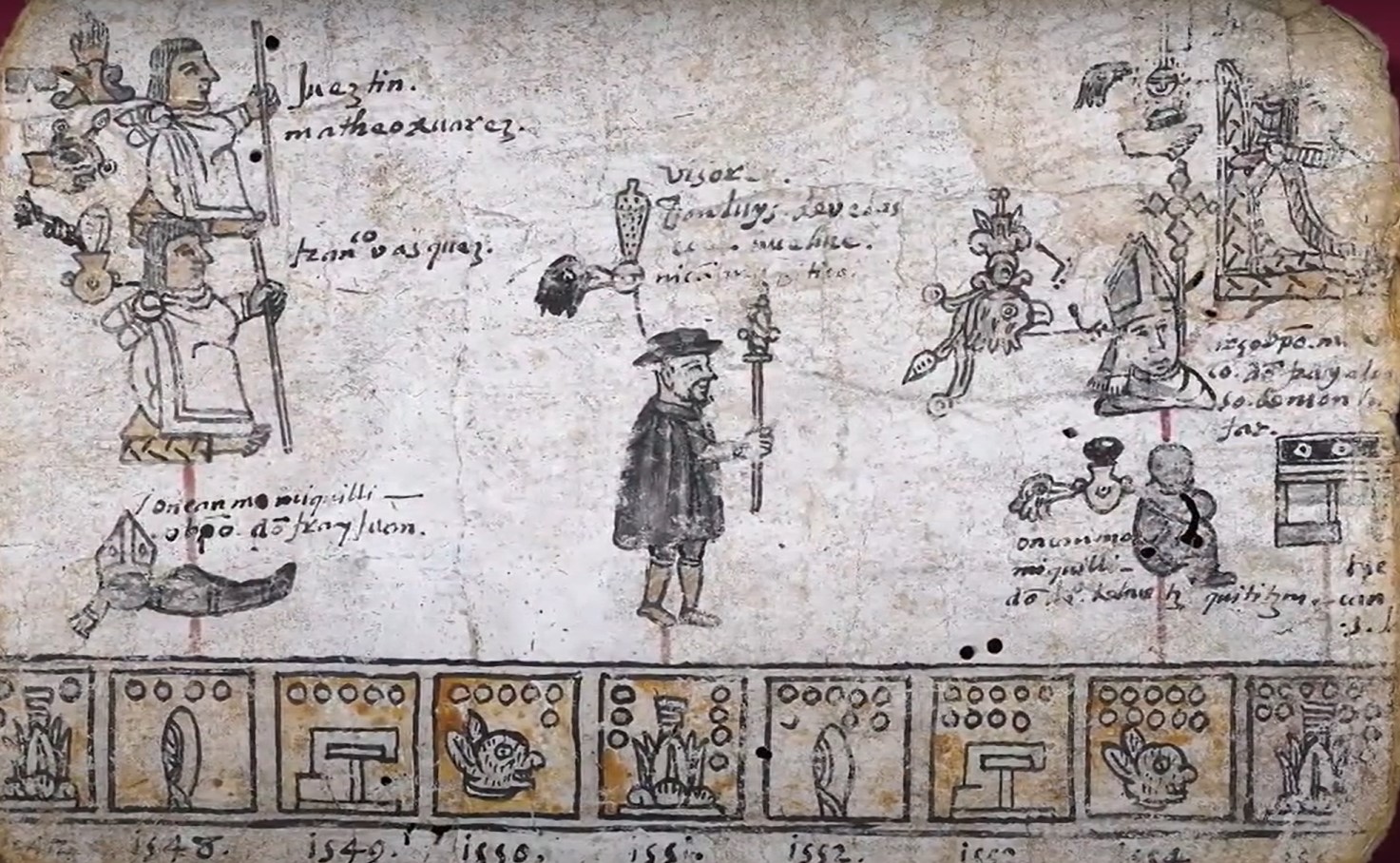
Finally, the third document, now baptised as the Tira of San Andrés Tetepilco, is a pictographic history in the vein of the Boturini and the Aubin codices, comprising historical information regarding the Tenochtitlan polity from its foundation to the year 1603.