Showing posts with label Iran. Show all posts

Wednesday, March 11, 2026

Matt Yglesias on the Iran War

Intelligent take:

They say that defeat is an orphan while victory has a thousand fathers.

So even though the invasion of Iraq was extremely popular in 2003, you rarely meet someone who’ll own up to having supported it at the time. Both that war and the one in Afghanistan shook out so badly that their architects have been retrospectively cast as a team of buffoons.

At the time, though, Colin Powell was the most popular public figure in the United States. Dick Cheney and Don Rumsfeld were old policy hands with long and wide-ranging track records. Their actions were widely embraced by knowledgeable elites, including top former officials from the Bill Clinton administration.

Which is not to say that the ideas of these members of the George W. Bush administration were good or that their policies worked (clearly they were not and did not), just that it’s not right to think of what happened in the early aughts as “a bunch of clowns took over and wrecked things with their clowning.”

The danger of this line of thought is made clear, I think, by the way that Donald Trump seems to have talked himself into a new round of military adventurism in the Middle East. If the problem with the Bushies was that a bunch of morons got the United States sucked into “forever wars” through their obsession with nation-building, then the solution is to build a team that’s not made up of morons, a team that is relentlessly focused on lethality. They put their ideas to the test with a smaller-scale strike on Iran last year. Then again in Venezuela. And it worked, so why not try it again?

What all this misses is that this is exactly what the Bush administration thought they were doing.

In the 2000 campaign, Bush denounced nation-building and peacekeeping missions as a waste of time. His team contained many believers in a Revolution in Military Affairs involving (to quote a 2002 article) the “use of smart machines that allow networked, integrated forces to become more lethal at the same time they become more agile.”

Which is just to say that they didn’t intend to get bogged down in simultaneous counterinsurgency missions. It’s not like someone was sitting around the Pentagon saying that it would be a good idea to engineer a situation where, years after the invasion, Marines were engaged in intense house-to-house fighting in Anbar province, and years after that, isolated garrisons were trying to secure American interests in a country whose politics are dominated by pro-Iranian political parties.

Quagmires happen by mistake. 

I was thinking this just the other day: Trump and Hegseth keep saying that their war will go better because they are not idiots, but whatever label you want to give to Cheney, Rumsfeld, Addington et al. they were not stupid.

What they shared with Trump and Hegseth was the belief that violence can be used to reshape the world as we would wish. This belief may sometimes be true, but it is always very dangerous.

Tuesday, March 3, 2026

Things Happening in the Middle East

Successful Iranian attacks against oil infrastructure are multiplying: here, here, here, here, here

Oil prices are rising and stock prices are bouncing around. (NY Times, CNBC)

Seems clear that neither the US nor our Gulf allies have enough cheap ways to shoot down drones, leading us to shoot $4 million Patriot interceptors at $100,000 drones. We have programs to create better anti-drone defenses, and I have written about them here, but we don't seem to have procured them in anything like the numbers needed for such a war. 

Riots in Bahrain as the Shi'ite majority protests their country's involvement in the war against Iran. Did anybody plan for this?

Turns out that the FBI agents Kash Patel recently purged for investigating Trump's document dump at Mar-a-Lago were from an elite counter-terrorism group called CI-12 with expertise in Iran

Trump says in the same post that 1) US weapons stockpiles are sufficient, and 2) they are depleted because Biden sent too many weapons to Ukraine. 

Three US F-15 fighters were shot down by Kuwaiti air defense. The pilots survived.

I see floundering men drowning in their own foolish hubris.

Monday, March 2, 2026

The "Plan"

I've been trying to withhold judgment, because it seems that the Trump administration actually did have a plan for Venezuela. But the signs concerning any Iran plan are not promising. The NY Times:

In a brief telephone interview with The New York Times, Mr. Trump offered several seemingly contradictory visions of how power might be transferred to a new government — or even whether the existing Iranian power structure would run that government or be overthrown.

Among the options he suggested was an outcome similar to what he engineered in Venezuela, in which only the top leader was removed during an American military strike and much of the rest of the government remained in place, but newly willing to work pragmatically with the United States. . . .

During the roughly six-minute call, Mr. Trump said he had “three very good choices” about who could lead Iran, although he declined to name them. Earlier on Sunday, Iran’s top national security official, Ali Larijani, said that an interim committee would run the country until a successor to the supreme leader was chosen. . . .

When pressed on his plans for a transition of power, Mr. Trump said he hoped Iran’s elite military forces — including hardened officers of the Islamic Revolutionary Guard Corps who have held substantial influence and profited from the existing regime — would simply turn over their weapons to the Iranian populace. “They would really surrender to the people, if you think about it,” he said.

It was those same security forces — in particular, the Basij, which organizes local militia — that opened fire on street protesters in January and killed thousands.

Then he offered a very different model of what the transition of power in Iran might look like, referring repeatedly to his experience in Venezuela after he ordered a Delta Force team to seize Mr. Maduro.

“What we did in Venezuela, I think, is the perfect, the perfect scenario,” Mr. Trump said. . . . “Everybody’s kept their job except for two people,” Mr. Trump said of the outcome in Venezuela.

He was vague on the question of who should be in the top ruling position in Iran after the ayatollah’s death, or even who should decide. At first, when asked whom he wanted to lead Iran, he said, “I have three very good choices.” He added: “I won’t be revealing them now. Let’s get the job done first.”

But then he described a scenario in which the Iranian people would overthrow the existing government. “That’s going to be up to them about whether or not they do,” Mr. Trump said. “They’ve been talking about it for years so now they’ll obviously have an opportunity.” That would, of course, be the opposite of the Venezuela model that he had said minutes earlier he wanted to replicate.

Not encouraging. Trump says we have the weapons for four or five weeks of aerial attack. What happens in five weeks when the battered government is still in place? We're talking about a regime with thousands of determined guerrilla fighters who have been skirmishing with the US for decades. They are not likely to go quietly. So far as I can see, the only remotely plausible outcomes are 1) the regime remains in place, either chastened or with renewed fervor, and 2) we install a new regime that is then embroiled in civil war with surviving elements of the old, just like in Iraq.

Grim.

Wednesday, February 11, 2026

Art of Ancient Persia at the Met

Cat rhyton, Parthian, 1st century BC


Plate with a hunting scene from the tale of Bahram Gur and Azadeh, Sasanian, ca. 5th century CE, and detail

Belt clasp, Parthian 1st to 2nd century AD

Sassanian sword and scabbard, 7th century AD, detail

Achaemenid plaque with "horned lion-griffons," 5th or 4th century BC.

Achaemenid gold vessel in the shape of a "fantastic leonine creature"

Parthian sculpture of a standing man, 2nd century AD

Detail of a plate showing a king hunting, Sassanian, 6th century AD

Friday, January 9, 2026

Iran

One hestiates to hope, but Iranian protesters have taken control of several cities and burned numerous police stations and other government buildings. In some cities, the police have joined them. Could it be?

Thursday, June 26, 2025

The Ayatollah's Strategy

Interesting piece in the NY Times by Vali Nasr:

If this history is anything to go by, Ayatollah Khamenei will not retreat, let alone surrender. He has, for now, accepted a cease-fire with Israel — but only because he is confident that Iran held its ground in the face of U.S. and Israeli strikes. In the past, too, he has made concessions when necessary. Tehran entered both the 2015 nuclear deal and the most recent round of nuclear negotiations with the United States in order to relieve economic pressure.

Ayatollah Khamenei is uninterested in making compromises that could fundamentally change Iran’s trajectory. He is wary of even appearing open to compromise, which he believes the United States would interpret as weakness. “America is like a dog,” he told his advisers in a meeting over a decade ago. “If you back off, it will lunge at you, but if you lunge at it, it will recoil and back off.”

Iran’s supreme leader has instead sought an equilibrium that can be summarized as “no war and no peace.” He wants neither confrontation nor normalization with the United States. What he wants is for Washington to stop containing Iran, unshackle its economy and allow Iran to embrace the status of a regional great power.

Ayatollah Khamenei believes that Iran can achieve this goal in time. If Tehran perseveres, he thinks, it can outlast Washington and Israel’s appetite for a fight.  

As a minimal sort of strategy, this is plausible, but it ignores the vast gains Iran could achieve by actually making peace.

Tuesday, June 24, 2025

It Keeps Getting Weirder

So Trump and the Emir of Qatar have arranged a cease-fire between Israel and Iran. Which both sides promptly violated, which led Trump to publicly berate both sides:

We basically have two countries that have been fighting so long and so hard that they don’t know what the fuck they’re doing.
Which as a summary of Middle Eastern politics has much to recommend it. As of Tuesday afternoon, there is no news of attacks, so for now the cease fire holds.

The real reason for the cease-fire has to be that both sides agree with Decker Eveleth's assessment, which I posted here a few days ago: 

Neither side has demonstrated the capability they need to end the conflict on favorable terms to them.

Israel's decapitation strike did not disable Iran's military, their bombs only did limited damage to Iran's nuclear sites, and their air force is probably reaching the end of its ability to continue large nightly strikes. (Pilots, aircraft, and missile stockpiles all have limits.) 

Meanwhile Iran's ballistic missile attacks were diminishing and they seemed to be running out of missiles about as fast as Israel was running out of interceptors. Since they have apparently decided not to try interfering with oil shipping through the Straight of Hormuz, I'm not sure what other options they had.

So, exhaustion, declining returns on their efforts, etc.

But is anything resolved? Inspectors from the IAEA says they have not detected any increased radiation in Iran's air, which probably means that no bombs hit stores of uranium. (Unless maybe far underground? I have no idea about that.) Which is a good thing for people in the region, but if nothing was destroyed but a few dozen centrifuges, what did Israel accomplish? Report are coming out today that purport to be based on early US intelligence assessments of our own strike, and they all look like this:

Early US intel assessment suggests that the strikes on Iran did not destroy nuclear sites. Core components of the country’s nuclear program are still intact and the program is likely only set back by months.

I can't see that anything about regional politics has really changed. It would be great if this defeat emboldens people in Iran to overthrow their government, but I don't see that happening. Instead the news from Iran is of "victory rallies," with regime supporters paryting in the streets to celebrate their survival.

(Incidentally, the Ukrainian bloggers I follow are disappointed in Israel and Trump, and really wanted them to keep bombing until Iran had endured at least as much suffering as the Shaheds have imposed on Ukraine. Several people in my Ukraine feed reposted a cartoon that shows a Russian and a Ukrainian watching the US and Israeli bombing campaigns and saying, "You fight like pussies.")

The only clear winner in this fiasco seems to be Donald Trump, who has been on a roll. Here's another Turmpian gem:

As you know, Vladimir Putin called me and asked 'Can I help you with Iran?'

I said 'No, I don't need help with Iran. I need help with you.' 

I mean, I don't think his strike accomplished much beyond 1) showing support for Israel, and 2) reminding Iran that facilities deep underground can, in fact, be bombed. But nobody else has been able to solve this problem, either, so that would be a lot to ask of a deranged orange narcissist. Glad that he put his personal reputation behind the cease fire when that could easily have gone badly for him.

If this cease fire holds, my overall response is going to be "it could have been a lot worse." But it would probably have been better not to do it at all.

UPDATE

From this morning's breakfast conversation here: "If Trump is the sanest person in the room, that's a really crazy room."

Monday, June 23, 2025

Aftermath

Some negative reactions:

Jeffrey Lewis (aka Arms Control Wonk):

Why am I so unimpressed by these strikes? Israel and the US have failed to target significant elements of Iran's nuclear materials and production infrastructure. RISING LION and MIDNIGHT HAMMER are tactically brilliant, but may turn out to be strategic failures.
Lewis says that so far as we know, Iran's store of highlly enriched uranium (60%) was in tunnels at a site that hasn't been attacked yet, but it may well have been moved, so right now we have no idea where it is. It still needs further refinement to get it to bomb grade, but Iran may have more centrifuges in other buried sites, so that isn't a major barrier. But the hardest thing about making a bomb isn't anything physical, it's knowledge. It's hard to bomb knowledge, and once a program is set up, you no longer need those top famous scientists, just a lot of skilled techs.
Let's say Iran decides to rush a bomb. Iran can install ~1.5 cascades a week. In six weeks, it could have 9 cascades of IR-6 machines. It would take those machines about 60 days to enrich all 400 kg to WGU. Altogether that's about five months.

Decker Eveleth:

I largely agree with Jeffrey here, and the same logic applies to the Iranian missile program. It appears Israel and US believed that Iran was at the cusp of deploying ICBMs (per @DefenseIntel) and large numbers of missiles, enough to overwhelm Israel.

So Israel has been targeting critical linkages in Iranian missile production, like mixing facilities to destroy difficult to make industrial planetary mixers. But these facilities can always be rebuilt, and sanctions can always be evaded.

Once the tech has been figured out, there is nothing stopping Iran from rebuilding everything that Israel has destroyed in five years - perhaps now with a more aggressive, North Korean style quick-launch missile posture.

Those who are defending the strike basically fall back on the "mow the grass" scenario:

They can also be hit again. It’s a mistake to view this as a one off campaign.
To which Eveleth responds:
But that is my point. Israel seems willing to lock itself into a forever war they can never really win.

Which is why, I guess, Israel is hoping for Iranian regime change; because they don't see any other way to end the violence.

Since October 7, Israel has imposed major losses on three of its main military opponents: Hamas, Hezbollah, and Iran, plus the Assad regime was overthrown by its own people (with Turkish help). Their military should feel good about their accomplishments.

But how much better is their political situation? The problem of the Palestinians remains, despite millions of Israelis praying every day that they will simply disappear. The Netanyu government would love to ethnically cleanse them out of Gaza, but that would mean finding someplace for them to go. Israel's successful belligerence has reinforced the admiration that fans of successful belligerence have long felt for them. But others are increasingly exasperated with them, and though the Trump administration may be trying hard to clamp down on pro-Palestinian protests, the anti-Israel sentiment is still common, including among some of Trump's biggest supporters. So far as I can tell, in the US at least antisemitism really seems to have gotten worse over the past decade.

No doubt Iran's military has been heavily damaged. Hundreds of missiles may have been destroyed. Perhaps its bomb program has been set back months or years. But I can't see how the attack on Iran has radically improved Israel's strategic situation. I also don't know what the strike has done for the US. Ok, we showed off our stealth bombers and our big bombs, and did a solid for our Israeli friends. But if Trump is serious about wanting to stop all Iranian enrichment, this is only one step and many more will be required. That would involve negotiations, as Trump himself has said many times. Have we made those negotiations harder or easier? Beats me.

Sunday, June 22, 2025

What Now?


First satellite image of the Fordow nuclear complex
after the US attack

Well, Trump did it. 

I've been expecting it ever since he said that "we" had achieved air superiority over Iran. His excitement over Israel's swaggering aerial victory overcame his hesitation at getting involved in a war with no clear end point; everbody was crowing about Israeli success, and he wanted to be part of that thrill ride.

Based on the images we are seeing today, the attack on the underground nuclear facility of Fordow may have been "successful," in the sense of badly damaging that facility. 

Yay, B-2. Yay "Massive Ordnance Penetrator." Go team.

But to what end?

If the goal is Iranian surrender, I doubt it. I suspect the regime will let us bomb until we run out of bombs before they give up their sovereignty. Satellites have recorded long columns of trucks at Fordow recently, so many of the centrifuges and much of the highly enriched Uranium may already have been moved. Come to think of it, that may be why Trump attacked now.

Meanwhile, the former president of Russia says that "a number of countries" are now ready to supply Iran with warheads. Did anybody consider that if US and Israeli behavior got too outrageous, somebody might just sell Iran a bomb?

If Iran just does nothing, how long will we keep this up? I mean, Hezbollah never surrendered. Israel certainly won a victory of sorts over them, but the government of Iran is not just going to fade into the mountains.

Will we ever again have a US president who won't give in to the calls to "do something" and the pressure to bomb?

By coincidence, this is the 84th anniversary of the start of Operation Barbarossa, Hitler's invasion of Russia. That campaign certainly started out as a rousing success, but it did not end well for the attackers. Not that Iran is ever going to take Washington, but wars have a way of not going according to plan.

Update 1, 6/22/2025

Farzan Sabet (IranWonk on Twitter/X) has this, from a post in Farsi: "If you don't want to go nuclear right now and unveil the arsenal, end this nauseating show, sign a humiliating peace, and be done with it." Sabet says this is a common sentiment in Iran, that the regime should either build a bomb now or definitively give up and normalize relations with the world.

Update 2, 6/22/2025

Gregg Carlstrom on Twitter/X

In between "symbolic retaliation followed by serious diplomacy" and "wider regional war" there are other murky scenarios: no big escalation but also no deal, a regime more intent on a bomb than ever. The consequences of Trump's strike are far from clear.

Friday, June 20, 2025

Pondering War with Iran

Oz Katerji:

Comparisons with Iraq fall short.

In Iraq, WMD was the pretext, regime change was the objective, occupation was the strategy.

In Iran, WMD is the pretext, objective remains unclear, strategy remains unclear.

The US actually had a plan in Iraq, this is something else entirely.

I was not expecting to see ‘actually, by comparison, Iraq was the *better* plan’ crop up in my life…

Wednesday, June 18, 2025

Iran and the Strange Bedfellows

I noted here a long time ago that my steady opposition to any war with Iran has regularly landed me in bed with some strange people. Like, the driver of a truck covered with signs about the Illuminati conspiracy and other arcane matters, but also NO WAR WITH IRAN. Now I find that the strongest opposition to the war seems to be coming from, on the one hand, cranky leftists who think Israel's campaign in Gaza is funded by global capitalism as part of their long-term plan to keep the former colonial states oppressed, and on the other, Tucker Carlson, who shredded Ted Cruz over Cruz's complete ignorance of the country he wants to attack. The top opponent within the Trump administration seems to be Tulsi Gabbard, who is in most matters (so far as I can tell) a complete lunatic.

Sigh.

Monday, June 16, 2025

Thoughts on Israel and Iran

Iranian missiles on their way to Israel,
filmed from an airliner over Saudi Arabia

So far, Israel has wrecked real damage on the Iranian defense establishment, and Iran has stretched Israeli missile defenses and landed several missiles in Israeli cities. But is anyone winning? What would that even mean?

For decades, wargames have shown the Iranian regime surviving a war with the US (here and here), so I have my doubts that Israel can achieve their overthrow. It is true that the mass of the Iranian people is unhappy with their government, but I very much doubt that Israeli bombs are encouraging them to revolt. On the contrary most who have written about the possibility of the US bombing Iran have assumed that this would only increase the power of anti-western hardliners. Maybe there could be an opening after the war, if the regime is humiliated, but I am not optimistic.

So what is Israel achieving?

The stated goal was to destroy Iran's nuclear program. To date, though, there have been rather few attacks on the main Iranian nuclear facilities. The initial wave focused on air defenses, as you might expect, and Israel now says they have air superiority over the western half of Iran. But instead of intensifying attacks on nuclear sites they are deploying their planes to hunt Iranian ballistic missile launchers, and they brag every morning about how many they have destroyed before they could launch. Yes, this is the best way to protect Israel from Iranian strikes, but is it really a winning strategy? Seems to me like a vast expenditure of effort for little gain, and therefore a big diversion of valuable assets into a side eddy to the main conflict.

But even if they do get around to focusing on it, can Israel prevent Iran from making a bomb? For years, experts have been saying things like this about the Iranian nuclear program:

Striking Iranian nuclear sites is like mowing the grass. Unless a strike succeeded in permanently crippling the Iranian capacity to produce and weaponize fissile material, the grass would only grow back again. And no strike -- or even series of strikes -- can accomplish this. Iran's hardened sites, redundancy of facilities, and secret locations present significant obstacles to a successful attack. Even in the best-case scenario -- an incomplete strike that, say, set back the Iranian nuclear program by two to three years -- the Iranians would reseed it with the kind of legitimacy and urgency that can only come from having been attacked by an outside power. Self-defense would then become the organizing principle of Iran's nuclear program; it would resonate tremendously throughout the Middle East and even in the international community.

I wondered, when satellite photos after the first attack showed little damage to nuclear sites, if Israel was planning to land commandos to go into underground facilities and destroy them. But that didn't happen, and one has to assume that Iran is doing all they can to make that very costly. So it looks to me like this will be done from the air or not at all. 

I doubt that Israel can do it by themselves, but with US help, no doubt something could be achieved. (29 US aerial refueling tankers deployed to Europe last night, which looks like preparations for a strike.) But how much? At this point, do the US and Israel even know where all of Iran's nuclear material is stored? I have no idea. And, again, at the moment I don't even see that Israel is trying very hard.

There are rumors that Iran is now seeking a deal that would involve promising to give up all enrichment, but that is a rumor and so far is having no obvious impact on events.

So the cycle of hate and death goes on.

Update 1, 6/16:

Jeffrey Lewis (aka Arms Control Wonk) has some good material on Twitter/X. Like this on the deeply buried nuclear site at Fordow: "If Israel doesn't have a plan for destroying Fordow, I don't see how any of this is worth it." And this on the puzzling way the Israeli attack has unfolded: "Netanyahu's attack on Iran is about sparking regime change with just enough strikes on nuclear facilities to frame it as an act of preemptive self-defense. I doubt this will turn out well."

Update 2, 6/16

Decker Eveleth: "I have no idea how or when this will end as neither side has demonstrated the capability they need to end the conflict on favorable terms to them. Also notable: all major potential mediators have expressed varying degrees of disinterest in getting involved."

Update 3, 6/16

Heatloss on Twitter/X: "Somebody asked how Israel achieved air superiority over Iran so easily, when Iran had a full arsenal of anti-air missiles. I can answer that in three characters: F-35."

Thursday, March 14, 2024

Iranian Fire Festival as Protest

Farnaz Fassihi in the NY Times:

Iranians have looked for opportunities in recent months to display defiance against the rules of the clerical government. In Tuesday night’s annual fire festival, many found a chance. Across Iran, thousands of men and women packed the streets as they danced wildly to music and jumped joyfully over large bonfires. . . . The police said the crowds were so large in Tehran and other cities that traffic came to a standstill for many hours. . . .

This is the festival called Chaharshanbeh Suri, part of the lead-up to Nowruz, the traditional Persian New Year, which falls at the Spring Equinox.

In many places, the gatherings turned political, with crowds chanting, “Freedom, freedom, freedom,” “Death to the dictator” and “Get lost, clerics,” . . . The dancing crowds were another example of how far a large part of Iran’s society, particularly the youth, has moved away from the ruling clerics.

In some apartment complexes in Tehran and other cities, DJs played Persian pop songs as a packed crowd danced and sang along. . . People circled the bonfire and held hands while singing “For Women, for Life, for Freedom” from the lyrics of “Baraye,” an anthem of the female-led uprising in 2022.

It's deeply moving to see people defying their oppressors in this joyful way, but I still see little chance that the regime will fall.

Monday, February 26, 2024

What's Happening in Iran?

A while back the announcer at an Iranian soccer game asked for a moment of silence for the people of Palestine, but the crowd instead erupted into boisterous shouting.

It was a small thing, but I found it telling; many Iranians are so embittered by their own Islamic government that they can't even muster sympathy for fellow Muslims under Israeli bombardment.

This came to mind because Tyler Cowen linked to a tweet about the study from which the chart at the top comes, documenting the steep decline in religion in Iran. Based on survey data, the study found that more Iranians claimed to be atheist, agnostic, or "none" than Shiite. Cowen's comment section then filled up with supporting posts from people who claimed knowledge of Iran and said things like:

  1. Islam is seen by younger people as the doctrine of a failed government staffed by a bunch of crooks.
  2. And it's a foreign, Arab imposition, while the "real Iran" - the Achaenemids - were Zoroastrians, but quite willing to allow non-judgemental religious pluralism.
  3. The IRGC is staffed by redneck losers, or by non-Iranians. (Iran has a separate "regular army" that all Iranian men must join as conscripts.)
  4. There is a rather vast city-country divide, with people in the big Iranian cities largely non-religious or dabbling in Zoroastrianism, with the last stronghold of Islam being rural areas, particularly near Afghanistan (and around some of the religious cities).

Or:

Based on my interactions in person and online, most Iranians hate their terrible government and everything it stands for.

And this:

I don't support the US killing Iranians - too many innocents and future friends there.

Which I think is very wise.

But that doesn't answer the question of what is likely to happen in Iran now. The mass protests of the past couple of years showed that hundreds of thousands of Iranians hate the regime and its form of religion, but they were unable to budge it. Does that mean the anti-regime forces are weaker and less numerous than they seem from a western perspective? Or that the regime is willing to hold onto power using force and fanaticism? Experience seems to show that 25% is enough support to keep a dictatorial regime in power, especially when they are the most determined and violent part of the population.

I don't see the Iranian regime falling soon, but I wonder what happens as the people increasinging turn against the mullahs and their ideology.

Wednesday, August 16, 2023

Two Amazing Carpets from 16th-Century Iran


Above, the Schwarzenberg Carpet in the Museum of Islamic Art, Doha, Qatar; below the Emperor's Carpet in the Met. The Emperor's Carpet was made in Iran but ended up belong to the Habsburg emperors of Austria.


Sunday, August 6, 2023

Barack Obama's Girlfriends and the Red Line in Syria

Remember this?

In August of 2013, a rebel-held suburb of Damascus was attacked with sarin gas — a nerve agent that causes lung muscle paralysis and results in death from suffocation.

The attack killed 1,400 men, women and children, and at the White House, officials asserted “with high confidence” that the government of Bashar al-Assad was responsible.

One year earlier, President Barack Obama had described Assad’s potential use of chemical weapons as “a red line” that would have “enormous consequences” and “change my calculus” on American military intervention in Syria’s civil war.

When Assad appeared to cross that line, Obama ordered the Pentagon to prepare to attack.

But of course Obama changed his mind, and instead of a massive air strike we got a deal whereby Assad handed a bunch of chemical weapons over to the Russians, and the mess in Syria ground on without much US intervention.

This event still looms large for many people: anti-government Syrians and their allies, many US military and foreign policy types, some Europeans who think it was US weakness in Syria that made Putin think we wouldn’t help Ukraine – I’ve seen this stated several times on Ukraine war Twitter – and the sort of people who think the best way to understand history is by psychoanalyzing world leaders.

Within that last category we find David Samuels. Samuels, a long-time Jewish journalist, uses an actually rather interesting interview with Obama biographer David Garrow to develop his theory that everything wrong with the Middle East is Obama’s fault. (Besides inequality, tech monopolies, and Lord knows what else.) Samuels traces Obama’s failure to stand up for Syria back to his false version of his break-up with one of his white girlfriends, Sheila Miyoshi Jager. 

Biographer Garrow tracked Jager down and got her version of their break-up, which Obama had described in Dreams from My Father. In both versions this had something to do with Obama’s turn toward blackness. But in Obama's version this was a “a passionate disagreement following a play by African American playwright August Wilson, in which the young protagonist defends his incipient embrace of Black racial consciousness against his girlfriend’s white-identified liberal universalism.” But it Jager's version the fight was about Obama’s  

refusal to condemn a Black mayoral aide named Steve Cokely who, in a series of lectures organized by Louis Farrakhan’s Nation of Islam, accused Jewish doctors in Chicago of infecting Black babies with AIDS as part of a genocidal plot against African Americans. . . . It was not Obama’s Blackness that bothered her, but that he would not condemn antisemitism.
Samuels claims that the invisibility of Jager and her account of the relationship was some sort of conspiracy among Obama-loving journalists, which to me sounds like a weird description of his time in office; was there anything that some conservative did not accuse him of? But this all goes much deeper:

I have never seen any evidence that Barack Obama has the slightest personal animus toward Jews as individuals. But from his denial of American exceptionalism, and his sourness toward Israel, going all the way back to Sheila Miyoshi Jager’s account of their breakup, there does seem to be an awareness of the underlying problem posed to his politics by Jews—that is, the problem posed by Jewish group survival and their continuing insistence on Jewish historical particularity.

It’s all about the Jews! 

Because, see, the Progressive narrative is all about the noble suffering of oppressed groups and the perfidiousness of their oppressors, the White Race. Jews screw this up by being both oppressed (in the general historical sense, and in the Holocaust) and oppressors (as wealthy people in the US who own buildings in black neighborhoods).

How can Jews be “privileged white people” if they are clearly among history’s victims? And if Jews aren’t white people, then perhaps lots of other white people are also victims and therefore aren’t “white,” in the theological sense in which that term gains its significance in progressive ideology. Maybe “Black people” aren’t always or primarily Black. Maybe the whole progressive race-based theology is, historically and ideologically speaking, a load of crap. Which is why the Jews are and will remain a problem.

So, I guess, in order to maintain the narrative that history is about oppressors and the oppressed, Jews have to be wished out of existence. And that, plus a generalized Progressivism, explains why Obama worked so hard to avoid war with the “antisemitic state” of Iran. Samuels thinks that Obama refused to bomb Syria because he wanted the Iran deal (the JCPOA) so badly, and he wanted the Iran deal so badly because he hated “American exceptionalism,” the Vietnam War, colonialism, and Israel, and was at best ambivalent about Jews.

The sheer amount of political capital and focus Obama put into achieving the JCPOA during his second term, to the near-exclusion of other goals, suggests that the deal was central to his politics. It also carries more than a whiff of the kind of politics in which the American Empire is seen not just as unexceptional, but also, in some ways, as actively evil. It was a politics born out of the confluence of the Vietnam War and the civil rights movement, which saw a racist war abroad being used to protect a racist power structure at home. That old alliance of civil rights, anti-imperialism, and identity politics made the Democratic Party that Obama positioned himself to lead—college-educated, corporate-controlled—seem cool, allowing it to use post-1960s radical ideology as a language to sell stuff.

This kind of history simply befuddles me. If only Obama had recognized antisemitism and not lied to himself about why he ditched Jager, we could have had a peaceful, democratic Syria! Besides less inequality and tech monopolies!

But it was not just Obama who did not want to intervene in Syria, it was the vast majority of Americans, including such Obama haters as Sarah Palin. One day of bombing was not going to change the war; to have any real impact we would have had to send in a massive force and remove the Assad regime. That was not going to happen, especially under a President whose whole campaign was focused on avoiding more Middle East wars.

As for war with Iran, I think that would have been a catastrophe on par with what Russia is experiencing in Ukraine.

I think the stuff Garrow dug up about Obama is interesting, and I agree that he is a strange person who has written two dishonest memoirs. But the history of the world doesn’t really depend on the psychological quirks of term-limited Presidents.

Tuesday, March 28, 2023

Islamic Art in the Cleveland Museum

The Wade Cup, Iran, Seljuk Period, 1200-1221 AD


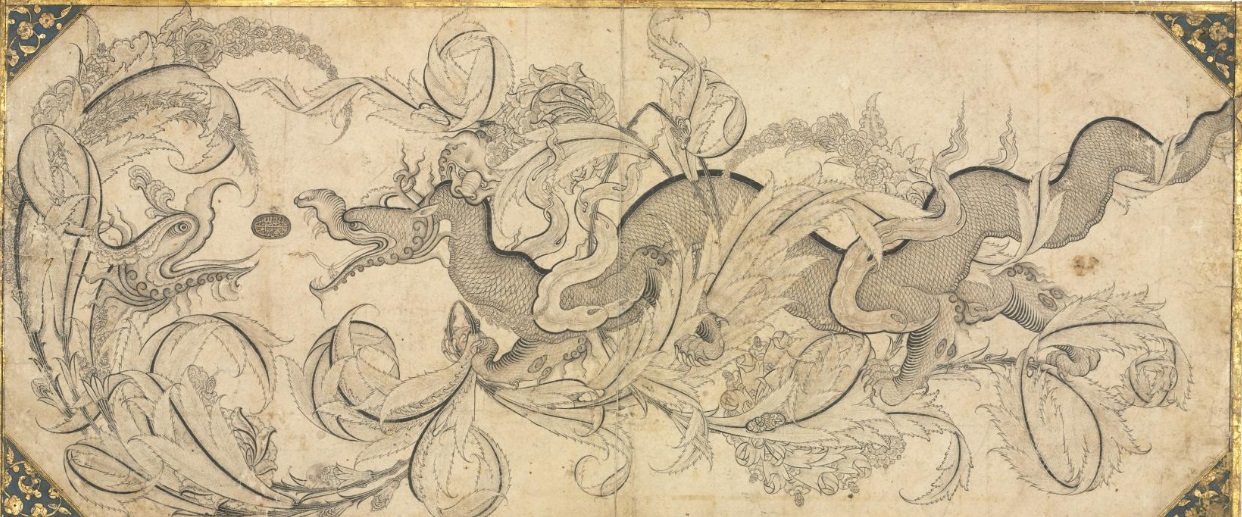
Ink drawing of a dragon with a phoenix head by the Turkish artist Sahkulu, mid 1500s

Iznik dish with artichokes, c 1535-1540


Rustam kills the White Div, from Firdausi's Book of Kings, mid 1500s

Dragon-headed stand, Syria, 1200-1260

Mihrab (prayer niche) from Isfahan, Persia, mid 1500s, unless it is a 20th-century fake. If it is a fake it's pretty damn amazing anyway.

Dish from Nishapur, Iran, 819-1015

Illustration from a manuscript of the Book of Kings known as The Great Mongol, Iran, c. 1370-1500. Notice the Chinese porcelain prominently displayed outside the king's tent.

Detail of a brass ewer made at Khurusan in Iran, 1256-1352. Lots more here.

Saturday, August 13, 2022

Horoscope of Prince Iskandar

Horoscope of Prince Iskandar, grandson of Tamerlane, the Turkman Mongol conqueror. This horoscope shows the positions of the heavens at the moment of Iskandar's birth on 25th April 1384. It was created in 1411 in Shiraz, Iran. The chief astrologer was Imad ad-Din Mahmud al-Kashi, but the names of the artists are not recorded. Huge file at wikimedia commons.


Monday, March 29, 2021

Sanctions Hurt People, not Regimes

Azadeh Moaveni and Sussan Tahmasebi have a piece in the Times today protesting that sanctions on Iran mainly hurt the very people who hate the regime most, middle class women.

A few weeks after the Trump administration withdrew from the Iran nuclear deal in May 2018, Secretary of State Mike Pompeo condemned “brutal men of the regime” in Tehran for oppressing Iranian women who were demanding their rights. “As human beings with inherent dignity and inalienable rights, the women of Iran deserve the same freedoms that the men of Iran possess,” Mr. Pompeo said. . . .

The decimation of Iran’s economy is unfolding in the lives of the very constituency that has been working for reform and liberalization, and in whose name Mr. Pompeo and other leading American officials speak: middle-class Iranian women. The slump is tearing away at their fragile gains in employment, upper management positions and leadership roles in the arts and higher education, while reducing their capacity to seek legal reforms and protections.

When the sanctions hit, Mahsa Mohammadi, a 45-year-old editor and language teacher in Tehran, was saving to pay for a graduate degree in education at a university in Istanbul. Her rent in Tehran doubled because of inflation, and she was forced to move with her young son to a small city with no cultural life.

Inflation continued rising; the rents doubled again. Ms. Mohammadi lost most of her income from English tutoring. No one could afford language classes anymore. She could then no longer afford even the small city. She moved to a cheaper, conservative hamlet near the Caspian Sea where people look down on divorced mothers. Studying abroad is now an increasingly elusive dream.

“All our demands and hopes have whittled away,” she said. “The pressure is unbearable.”

The problem with using sanctions as a weapon against repressive regimes was laid out by George Orwell in 1984. Orwell's mega-states fight endless wars against each other, partly to whip up patriotism but partly to use up resources that would otherwise lift the populace out of poverty and therefore out of their complete dependence on the regime. Digging and refilling enormous holes, he wrote, would work just as well, but war was more plausible.

Many social scientists have said the same thing more analytically: poverty helps thugs stay in power, because when resources are scarce they control the only path to a decent material life.

On the other hand we tried to opposite tack with China, thinking that trade and openness and rising incomes would moderate their regime, and that hasn't worked very well, either.

I am not sure where this leaves us, since I think war with Iran would be disastrous for everyone. Perhaps admitting that events in other countries are not really something we can or should try to do something about.

Tuesday, March 17, 2020

The Mantis Man of Teymareh

Perusing the images from a major photographic survey of rock art in central Iran, archaeologists noted this figure. The pose is a common one called the "squatting man", except that this particular figure has extra limbs, two of which are hooked like those of a praying mantis. So they call this a Mantis Man. That's a bold claim because images that combine humans with insects are vanishingly rare before modern times. Still, could be. Scale in centimeters. The carving was likely done between 7,000 and 4,000 years ago. Below, more images of rock art in the Teymareh Mountain locale, from this site: