Monday, July 25, 2022

Vladimir Nabokov, "Lolita"

Existence is a series of footnotes to a vast, obscure, unfinished masterpiece.

—Vladimir Nabokov

From my old web site:

I just finished listening to Vladimir Nabokov's Lolita (1953), read by Jeremy Irons (who does a great job). I never read this before because the subject matter holds no interest for me. But I needed something to listen to and there this was on the library shelf, taunting me with my ignorance of so many famous classics, and I thought, why not?

Eeeeuuwwww.

Actually only a few parts of the book are really icky, in that they force you to imagine things better not imagined. (Like, the scene early on where the pedophile ejaculates in his pants from the 12-year-old Lolita's squirming on his lap as they wrestle.) Lolita is mostly a construction of words, a castle in the air of lovely phrases, sentences, and paragraphs, full of allusions to older masterpieces of European literature and invocations of the ancient past. Much of it is beautiful. Why, one has to wonder, did Nabokov shower this beauty onto the stony soil of a pedophile's memoir of his sins? Did he bet a friend that he could write a great novel about any subject, to which the friend replied, "All right, child abuse"? Did he want to explore the sort of evil that is everywhere around us, in the safest suburbs? Was he looking for shock value and the attention that we shower on artists who offend us in intriguing ways?

I suppose most of you know the plot. The narrator, who calls himself Humbert Humbert — the conceit is that this is a memoir written in prison, and that all the names have been changed to protect the innocent — marries a woman who revolts him in order to get closer to her lovely "nymphet" of a daughter. The mother then dies, leaving Humbert and Lolita alone together. He takes advantage. They go on a year-long car trip across America, staying in every sort of hotel and motel and cabin, visiting tourist sites; then they settle for a year in a college town; then they start another road trip. Eventually she flees from him and he misses her.

What comes to my mind now as I remember the book is what it says about love. Humbert insists throughout that he loves Lolita. He expounds his passion in the highest sort of literary language, full of classical allusions and perfectly balanced sentences. In a sense, he does. Lolita is the most precious thing in the world to him, and he gives up everything else to keep her. Yet he realizes, toward the end, that he has been cruel to her and deprived her of her childhood. He does not actually regret what he did, but he has some insight into how their years together looked to her — as imprisonment, as a terrible price paid for small rewards, as something to be escaped from and, as much as possible, forgotten. His love for her led him to make her his prisoner, and it made him jealous to the point of murder of anything that threatened to take her away from him.

What are we to make of such a love? Is the measure of love the passion it inspires in the breast? Is it the amount we are willing to give to possess the object of our desires, to make it our own? Or does real love require that we value our beloved as a person and care about his or her own happiness?

Humbert would have laughed at notions of love as respect for the freedom of our equals, all that "let the bird fly away and see if it comes back" sort of stuff. For him, sane, respectful, gentle love is a pathetic thing compared to the passion he feels for Lolita. His love is a madness that takes over him completely and renders him oblivious to every sort of convention, law, and psychological insight. Rather than envying others their normal desires, he pities us for not having passions as mad and as deep as his own.

The well-educated Humbert also reminds us that our notion of love is hardly the only one to have been celebrated in civilized places. In the ancient Mediterranean it was normal for mature men to bed 12-year-old girls, even to marry them. For some, at least, of the Greeks, the most normal sort of love was that between an older, more experienced man and a young boy or girl. Is our revulsion at such love, or at least at such sex, a sign of increasing humanity like our abandonment of slavery, or is it a fad like psychoanalysis?

One of Nietzsche's most widely quoted aphorisms is, "All that is done from love lies beyond good and evil." One can consider Lolita as a meditation on this sentence, and indeed on the whole notion of rendering human values into simple declarations. What Humbert Humbert does from love is terrible despite being mixed up with all sorts of tender feelings and noble sentiments. Lolita is sometimes read as an allegory of tyranny, with Humbert's imprisoning love for Lolita representing the patriotic dictator's love for the country he oppresses. I doubt Nabokov had any such neat parallelism in mind. I read it as a meditation on emotion, sanity, and perhaps especially narcissism. Humbert's greatest flaw is his self-involvement, which leads him to be completely incurious about others. He is interested in Lolita only insofar as she represents something he desires. He loves what he sees of Lolita, but he does not see very far into her soul, and he does not care to. This lack of caring, surely, is a big part of his evil. How much, though, do we have to know about others before we can truly love them? Can we ever know enough to justify a great passion, especially the kind that takes over us in the early stages of love, sometimes before we know much of each other at all? If Humbert Humbert were "inhuman," there would not be much point to Lolita. But he is an entirely human sort of monster, and we all have his faults to one degree or another. "Human" is sometimes used as a compliment, or to mean what is best in life — "humanism," "human rights," and so on. Nabokov reminds us that it is a neutral word, describing a species in which good and bad are thoroughly mingled, and the dominance of good is always in question.

June 3, 2011 

Sunday, July 24, 2022

Warrior Women of the Don

Since I couldn't do what I planned to do this weekend, I got back to my long-term project of reposting all the good stuff from my old web site onto this blog. I had an article there about the ancient Amazons and the female warriors of the steppes. I will be reposting that soon, but I noticed that it was out of date and didn't want to put it back up in that form. So I started searching around for newer stuff to include. In the course of this I stumbled on a remarkable Russian excavation that I had never heard of before.

One of the long-known groups of ancient Scythian burial mounds is along the Don River in the Ostrogozhsky district, part of the Voronezh region of western Russia. Now this area is caught up on the war, full of Russian machinery and under fire from HIMARS. But back in the comparatively peaceful year 2019 Russian archaeologists were still working at the mound complex, and they dug into a mound designated Maiden V. The mound was about 40m across the just over a meter tall.

Within it they found a single complex tomb, with stains left by the beams of a large wooden chamber. The tomb had been robbed, and the robber's entrance tunnel could be clearly seen. The first two bodies they found had been disturbed, their bones scattered. But enough remained to identify the occupants as two women, one 20 to 25 years old and the second 12-13 years old. The objects found among the bones included:

More than 30 iron arrowheads, an iron hook shaped like a bird, elements of horse harness, iron hooks for hanging a bridle, iron knives, fragments of molded vessels, and numerous animal bones . . . . In addition, a broken black-gloss aryballic lekythos with a red-figured palmetto was found in the filling of the robbery passage. These vessels date back to the second or third quarter of the 4th c. BC.

Tomb of the Older Woman

So that was pretty cool; too bad the graves were robbed, but enough survived to date the burial securely, and to hint that these were unusual women. As the work was extended to the rest of the mound, it was discovered that the tomb contained two other internments, and these had not been robbed.

The deceased were laid on wooden beds covered with grass bedding, their heads on earthen "cushions" also covered with grass. The first woman (individual no. 1; 40-50 years old) was buried in an extended position on her back along the southern wall and oriented to the west. Her head was decorated with a well-preserved headdress, consisting of stamped gold plates with floral ornaments, as well as rims with amphora-shaped pendants. 

An iron dagger was found nearby, although not close enough to make it a definite part of this woman's burial. The headdress is shown at the top of the post as it was excavated.

Warrior woman in the Rider Posture
The second woman (individual no. 2; 30-35 years old) was buried along the western wall with her head to the south in the so-called "rider posture." A bronze mirror was laid under her left shoulder, along the left half of her body were two spears. On the left hand was a bracelet made of glass beads. Two vessels were found at the feet of the buried woman: a molded incense burner and a black-glazed one-handed kantharos, the production of which can be dated to the second quarter of the 4th century BC. BC. Thus, it is possible to date the burial to the second half of the 4th c. BC.

So here we have four women buried in a single tomb, which means within a few years of each other at most and possibly at the same time. Considering how many Scythian tombs have been dug, we know remarkably little about who was buried in them and why, so we can't say how they were connected. Maybe when peace is restored we will get some genetic data on these women, because the best guess is that they were from a single family. 

At least two of these women were buried with weapons in the form of iron-tipped arrows, and one also had spears. The excavation director, Valerii Guliaev of the Russian Academy of Sciences, told reporters “We can certainly say that these two women were horse warriors.” And that seems likely. Guliaev also said he thinks all four were warriors, but he was careful to qualify that as his opinion. He also said nothing about how the women were related. But all the news stories about this site say that all four of the women were armed, and Haaretz put a headline on this story about "Three generations of Amazons." Which is even possible, but getting far ahead of the evidence.

Notice that the more intact warrior burial is not strictly masculine. She also had a bronze mirror, which is a signal of femininity in this culture, and feminine jewelry. This is interesting because among some cultures where women take on male roles (such as modern Albania) they assume a lifelong masculine persona, dressing and acting in entirely male ways. This does not seem to be true of the Scythians and Sarmatians. The Greeks portrayed them with feminine hairstyles and sometimes showed them dressed differently from men. Of course that might have been a Greek fantasy, but the evidence from Maiden V suggests it might not have been.

The more digging we do on the Black Sea steppes, the more evidence we find that the warrior women the Greeks called Amazons were something much more than a myth.

Florida Education, Part II

Some of my readers may remember that I have a strange fascinations with the school curricula promulgated by state legislatures. I have seen questions in the history sections to which I could not give a complete answer (like Virginia's "Describe the philosophy of government advanced by Machiavelli in The Prince", a question over which political philosophers and historians have spilled millions of words), besides theoretical posers like "explain the benefits and responsibilities of citizenship in the United States of America." Reading these lists makes me wonder if legislators have ever been to a school or met a child.

So I was interested to see that besides the newsworthy anti-woke provisions, the new Florida education law includes a lot of other stuff. For example, Section (2) explains that Florida schools will teach 

efficiently and faithfully, using the books and materials required that meet the highest standards for professionalism and historical accuracy, following the prescribed courses of study, and employing approved methods of instruction, the following:

Highest standards, folks. No slacking. This clause is the lead-in to a rather extraordinary set of requirements. We begin with 

2(2)(a)The history and content of the Declaration of Independence, including national sovereignty, natural law, self evident truth, equality of all persons, limited government, popular sovereignty, and inalienable rights of life, liberty, and property, and how they form the philosophical foundation of our government.

There's your assignment, gang, come up with definitions of "natural law" and "self-evident truth" that are both correct to 1776 and understandable to 14-year-olds. 

We move on through 2(2)(b), the Constitution, and 2(2)(d) Flag education, "including proper flag display and flag salute," to 

2(2)(f) The history of the United States, including the period of discovery, early colonies, the War for Independence, the Civil War, the expansion of the United States to its present boundaries, the world wars, and the civil rights movement to the present. American history shall be viewed as factual, not as constructed, shall be viewed as knowable, teachable, and testable, and shall be defined as the creation of a new nation based largely on the universal principles stated in the Declaration of Independence.
So all you postmodernists out there had better shut about how the past is not knowable and we "construct" it for own purposes. The state of Florida knows damn well what happened. 

By far the longest section is 2(2)(g) The history of the Holocaust (1933-1945), where we are to cover

the systematic, planned annihilation of European Jews and other groups by Nazi Germany, a watershed event in the history of humanity, to be taught in a manner that leads to an investigation of human behavior, an understanding of the ramifications of prejudice, racism, and stereotyping, and an examination of what it means to be a responsible and respectful person, for the purposes of encouraging tolerance of diversity in a pluralistic society and for nurturing and protecting democratic values and institutions, including the policy, definition, and historical and current examples of anti Semitism, as described in s. 1000.05(7) . . .

And so on for about another page. I was relieved to discover that Florida has an official definition of anti Semitism, so we don't have to puzzle over that, leaving us more time to teach 16-year-olds about human behavior, prejudice, racism, democracy, pluralism, and how to be a responsible and respectful person.

In case you were thinking about skipping on this one, 

Each school district must annually certify and provide evidence to the department, in a manner prescribed by the department, that the requirements of this paragraph are met. 

But history is just the beginning here; the list goes on and on. Viz:

2(2)(i)  The elementary principles of agriculture.

2(2)(j) The true effects of intoxicating liquors

2(2)(k) Kindness to animals. 

Is anyone going to point out that one of the elementary principales of agriculture, at least as practiced in most of Florida, is unkindness to animals on an industrial scale?

The next long section is for health. Under 2(2)(m)(1), teachers are to find time for:

a. Injury prevention and safety.
b. Internet safety.
c. Nutrition.
d. Personal health.
e. Prevention and control of disease.
f. Substance use and abuse.
g. Prevention of child sexual abuse, exploitation, and human trafficking.

What, exactly, does one teach teenagers about the prevention of human trafficking?

Sex gets two whole sections:

2(2)(m)(2)  The health education curriculum For students in grades 7 through 12, teen dating violence and abuse. This component must include, but is not limited to, the definition of dating violence and abuse, the warning signs of dating violence and abusive behavior, the characteristics of healthy relationships, measures to prevent and stop dating violence and abuse, and community resources available to victims of dating violence and abuse.

2(2)(m)(3)  For students in grades 6 through 12,  an awareness of the benefits of sexual abstinence as the expected standard and the consequences of teenage pregnancy.
I hope you're all ready to teach to your students how to recognize a healthy relationship.

But we're not done! We're also going to teach

2(2)(m)(4) Life skills that build confidence, support mental and emotional health, and enable students to overcome challenges, including:

a. Self-awareness and self-management.
b. Responsible decisionmaking.
c. Resiliency.
d. Relationship skills and conflict resolution.

And this isn't all; we haven't even started on math or science.

Most of this is worthy; it would be nice if our society devoted some time and energy to teaching children about healthy relationships and self-awareness. And somebody should probably tell 10-year-olds about Internet safety. But count me extremely skeptical that any curriculum that could pass muster with an education bureaucracy will do anything of the kind. And, really, how is anyone going to find the time for 1/10 of this? 

I know, it's a wish list, and a long way removed from the actual curriculum. But reading these documents gives me a strange feeling of having slid into a fairyland where we can snap our fingers and make wonderful things happen. If there are problems in the world, these lists seem to say – ignorance, bad citizenship, drug abuse, cruelty to animals – it's only because our schools aren't trying hard enough to teach the solutions.

Saturday, July 23, 2022

Crypto is Dead

 A sign next to the door of the sleazy little convenience store where I bought gas today said,

BUY BITCOIN HERE

The Battle of Gelduba, AD 69

On December 1, AD 69 – or so the tradition comes down to us – a battle was fought at the place now known as Krefeld, Germany, between the Batavians and two Roman legions. About 20,000 men fought in this battle, roughly half on each side.

Funeral stele of a Batavian soldier in Nero's German body guard

But this was no simple conflict between Romans and Barbarians. It was one small part of the complex civil war we call The Year of the Four Emperors. The Batavians, who lived around the mouth of the Rhine and had their capital on an island there, had been Roman allies since 43 AD and had sent thousands of men to assist in the conquest of Britain. Their leader in 69 is known to history as Gaius Julius Civilis, a moniker he probably assumed to emphasize his loyalty to the Julio-Claudian dynasty and his status as a Roman citizen. He was both the hereditary king of the Batavi and the hereditary commander of their troops in Roman service. He somehow fell foul of Nero's regime (like a lot of other people), his brother was executed, and he was sent to Rome in chains to be judged by the emperor.

Rembrandt, Conspiracy of the Batavians under Claudius Civilis

Understandably, when revolt against Nero broke out under the leadership of Galba, Civilis and the Batavians supported the revolt. After more intrigues, the Batavi ended up supporting the Roman general Vitellius, and the Batavian cohorts helped him win the Battle of Bedriacum and become emperor himself in April 69. But the Batavi felt ill-used by Vitellius; in one of his imaginary speeches, Tacitus has their commander say "That in truth they were no longer held as confederates, but treated like slaves." So when the commander of Roman forces in Syria, Vespasian, launched a revolt of his own, Civilis convinced the Batavi to switch allegiances and support his cause. (Tacitus: "As with mighty concurrence he was heard, he bound them all in a combination, solemnized with barbarous usages, with maledictions and imprecations peculiar to the country.")

Roman period river boat from Krefeld

But the legions along the Rhine remained loyal to Vitellius, so it was as part of a Roman civil war that imperial legions and barbarian horseman happened to fight that December.  The Batavians were actually organized as Roman troops, eight cohorts of allied cavalry and several cohorts of infantry as well. 

Plan of Gelduba

The fight took place outside a Roman fort called Gelduba, within which two Roman legions had been besieged after an earlier battle. When a force came to relieve them they marched out to do battle. According to Tacitus, the Batavian cavalry broke through one Roman legion ("with the hideous chanting of the men, and the howlings of the women") and seemed to be winning the battle, when timely Roman reinforcements arrived in their rear, leading to their defeat, with great slaughter.

One never knows how far to trust such ancient accounts. But we know they did fight because of spectacular archaeological discoveries made around Krefeld since 2017. A news account made the rounds this week that said the finds include "coins, weapons, more than 300 horse skeletons, jewelry, helmets, and a soldier’s belt buckle." The news story was about this mask fragment, shown next to a reconstruction of a complete mask. Quite a few of the known Roman cavalry masks come from the lower Rhine (like the one at the top of the post), so it may be that they were a Batavian specialty.

I spent a couple of hours practicing my German and trying to learn more, but had little luck. The museum where these finds have ended up, the Museum Burg Linn in Krefeld, posts only postage-stamp sized images. Like this one, which depicts a bolt head and sling balls from the battlefield. No sign of a plan of the excavations, or any write-up beyond the paragraph that appeared in the news stories.

One of those 300 horses.

And a helmet, also from the battlefield.

So I can't offer you the illustrations I hoped to find. On the other hand, the museum in Krefeld has a lot of other Roman stuff, most of it from a graveyard where 6,000 Roman- and Merovingian-period graves were excavated over the course of nearly 40 years. Like these pots, which the museum caption simply identifies as "Roman." I doubt Cicero would have agreed. How about "Romano-Batavian"?

A Roman dodecahedron. I never realized until I saw a photo of this one in its case how big some of these are; this one is the size of a large grapefruit.


Bacchus with Germanic drinking horns

It's worth pausing to note that archaeology has confirmed another bit of Roman history that was once known only from a single text. So far as I am aware, none of the major events reported by Livy and Tacitus has ever been shown to be a fabrication. Obviously the details might have gotten muddled, I mean, historians argue over the details of battles fought in Vietnam, for which they have rooms full of documents. But that there was a battle involving Romans, Battavians and horses, fought just outside the walls of a legionary fort, has been spectacularly confirmed.

Friday, July 22, 2022

Links 22 July 2022

Sir Edward Burne Jones, School for Dragon Babies, 1884

"Magic Mirror" with hidden image from Han Dynasty Chian.

Old school Social Democrat Rudy Texiera leaves the Center for American Progress for the American Enterprise Institute. He says the CAP, like everyone else on the left, is too obsessed with race, gender and identity to have any time for economic issues. CAP denies this. I can't tell if Texiera has a case or if he is just grouchy that he can't say what he thinks about trans people.

Two Canadian provinces opt to go forward with mini nuclear reactors.

Agnes Callard: "My theory is that art is for seeing evil."

Putin signs law effectively banning cryptocurrency in Russia, another blow to the struggling crypto world, where thousands of gamblers have lost their stakes in recent crashes. Gosh, I feel so bad.

Bill Gates is sad about the world. On the other hand, he has a lot of money to throw at the problems that are bothering him.

Does drinking hot beverages really cool you down more than drinking cold ones? In certain circumstances, yes.

Extraordinary photographs of dancers by Omar Z. Robles.

I've been carrying out my thought experiments for years using the estimate that there are about 500 billion galaxies. But this is out of date, and the new thinking says there are at least 2 trillion. Not that it matters, it just makes one of the questions I enjoy – why are there so many galaxies? – slightly more extreme and puzzling.

Kevin Drum explains that air travel is in chaos right now because of stupid decisions by executives, who failed to move early enough to meet returning demand. For example, they acted like they thought they could instantly hire new baggage handlers etc. to replace those they laid off, when they ought to have known that the necessary background checks for airport employees take up to three months.

Robert Reich tweet on the average price of insulin around the world.

Wreck of a 13th-century cargo ship found off Dorset, England; it was carrying a lot of stuff made from Portland stone, including mortars and gravestones.

Modern America: NJ transgender woman transferred from women’s only prison after impregnating two inmates.

Ukraine Links

Argument that Putin's new strategy is to force a cease fire by pressuring Europe, using oil, gas, refugees, and political sabotage.

A Russian blogger asks some basic questions about what happened on the first day of the war.

This guy thinks the Russian army is facing a logistics meltdown and will collapse in August, once they run out of key supplies like replacement barrels for artillery. Of course people have been saying that since May.

Simon Tisdall in the Guardian: "Vladimir Putin’s war on Europe’s edge is rapidly rolling westwards. . .  there is only one way to stop him."

Twitter thread on Russian recruitment of prisoners to fight in Ukraine.

Some awesome Russian tank driving.

And some high-level analysis from Russian state television.

A Russian intellectual defends the war: "Ukraine was being turned into a spear aimed at the heart of Russia. . .  Ukraine's citizens are used as cannon fodder in a war to preserve the failing supremacy of Western elites." (NY Times)

Now that Ukrainians have blown up at least 27 significant Russian ammunition depots, up to 85 km behind the front lines, I'd like to ask: how did they find them? Are they reported by spies on the ground? Or do the Americans find them by using satellites to follow trucks around, like they find underground North Korean bases? Or do the Ukrainians do this using drones?

Remarkably clear short video of a javelin missile attack on a Russian tank, shows the attack path.

New, super-detailed map and examination of the military situation from Jomini.

And another summary from the daily livestream with Aleksey Arestovych, Zeleksnky's top aid, from July 21.

Oleg Shulpiak, HIMARS. In Ukraine these days the art is all about weapons.

Wednesday, July 20, 2022

Two Kinds of Criticism

Scott Siskind has an essay this week that I think makes an important point about our age. He takes off from the Effective Altruism movement, the people who try to calculate exactly how many lives are saved or how much suffering reduced by donations to this or that cause. (The winners are all medical charities working in very poor places doing simple things like deworming or malaria nets.)

You might think that people doing this kind of work would dislike being criticized over how they do it. But no; if you look at the EA Forum where insiders exchange messages, the top posts are all #criticism of EA.

At this point, reading an article like this one, you already know what the next “narrative beat” has to be. Despite Their Superficial Openness To Criticism, People In EA Are Only Willing To Engage With A Narrow Selection Of Critiques That Flatter Their Preconceptions, While Truly Threatening Criticisms Are Excluded From The Window Of Acceptable Discourse. People Who Are Able To Speak The Language Of Power And Criticize EA Legibly In Its Own Terms Get Flattered And Rewarded With Trivial Changes, While People Who Genuinely Challenge The Establishment Are Dismissed As Beyond The Pale Of “Respectable” Criticism And Ignored Or Punished.

But actually that is utterly wrong. The criticisms that get upvoted are the most fundamental, the most sweeping, the ones that say EA is based on utterly wrong premises (western, individualistic, racist, sexist, capitalist) and needs to be restructured from the ground up.

Siskind is a psychiatrist, and he notices the same thing in psychiatry:

Psychiatry has its own stock criticisms of itself. We rely too much on pills. We don’t get to know patients enough as individuals. We only treat the symptoms, not the real disease of [insert wild speculation]. We are probably systemically racist somehow, details to be filled in later. Something something Thomas Insel’s RDoC program. Non-psychiatrists in the popular media have stolen these criticisms and made them dumber, but we had them all first. 

Siskind lists some papers from the 2019 meeting of the American Psychiatric Association: "Disrupting The Status Quo: Addressing Racism In Medical Education And Residency Training;" "Grabbing The Third Rail: Race And Racism In Clinical Documentation;" "The Pervasive Role Of Racial Bias In Mental Health;"  "Inequity By Structural Design: Psychiatrists' Responsibility To Be Informed Advocates For Systemic Education And Criminal Justice Reform."  And so on.

But, says Siskind, none of these supposedly deep and fundamental criticisms ever draws a strong reaction. Everyone nods and says, yes, that's true, we need to fundamentally rethink our approach. "Your whole field is racist and wrong" sounds like a biting attack, but somehow it has no bite. If you want to get a reaction, says Siskind, ask a really specific question about actual treatment choices. Like, "why they prescribe s-ketamine instead of racemic ketamine for treatment-resistant depression."

I agree with this completely. In the museum world, radical critique is the daily bread and butter. The day doesn't really begin until someone launches the first attack on how racist, classist, neocolonialist, and exploitative the whole idea of museums is, to which everyone nods, agrees, and looks thoughtful for a minute before going about their business.

Most of the time, the more "fundamental" and "far-reaching" the criticism is, the less meaningful it is, and the less likely to lead to any kind of change.

I wrote here several times about the strange campus protests of 2016, in which students expressed a sort of generalized frustration with everything about the university that they often had trouble putting into words. Eveything was just bad, bad, bad. When they did write lists of grievances they were often strangely petty, the particulars not justifying the overall sense of anger and resentment.

I think this has become a terrible problem with our politics. The best example came in 2011, when we had raging fights in Congress, accompanied by accusations of communism and fascism and attempts to destroy America, over whether the top tax rate would be 35% or 38.5%. The constant resort to the fundamental, deep attack, the insistence that your enemies are wrong root and branch and need to becompletely wiped out, is poisoning everything. And for nothing, because the US economy is not going to be fundamentally changed.

The whole contemporary discourse about race is, I think, poisoned by this problem. Maybe it would be nice if we could eradicate racism root and branch and fundamentally change how Americans think about each other. But since we can't, why waste all our breath shouting about it and making everyone mad? Why not work on some concrete reforms of how police forces operate, how housing policy is set, and so on?

"America is a racist society that needs to be razed and rebuilt from the ground up" is a foolish, counterproductive thing to say. "Capitalism grinds up souls and needs to be destroyed so we can build a just society" is equally foolish and counterproductive. Better to argue for things like minimum wage laws and mandatory vacations that might actually happen.

Fundamental change is very rare in history, and it usually happens because of vast social forces that we can hardly understand, much less control. Your demanding it will not make it happen. Better to think of something good that we might actually achieve and spend your breath arguing for that.

The End of the "Sad White Man" Novel

One of the dominant literary forms of the 20th century was what people are now calling the Sad White Man Novel. Each of these novels gives us a middle class man who is successful enough – good job, marriage, children, house – but deeply dissatisfied with his mediocre lot in life and yearning to break free. One of the most famous examples was The Man in the Gray Flannel Suit by Sloan Wilson (1955). Wilson gave us an advertising executive – i.e., somebody who has a cool, with-it career – who anguished over the limits of his boring life and fantasized about throwing it over and disappearing onto the open road.

In an interesting essay, John Self identifies the prototype as Babbitt by Sinclair Lewis (1922). Babbitt describes himself as

the perfect office-going executive — a well-fed man in a correct brown soft hat and frameless spectacles, smoking a large cigar, driving a good motor along a semi-suburban parkway. . .
but keeps asking questions like, "What was it all about? What did he want?"

Babbitt's question introduces us to one of the themes of this literature: not only are the central characters unhappy, they don't know what would make them happy. They don't know what they want, or even how to want. In Richard Yates' Revolutionary Road (1961) the narrator's wife urges that they should move to France, where "for the first time in your life you’ll have time to find out what it is you want to do." (They never move, and never find out.) Quite a few psychologically-minded critics have made this absence of authentic desire into the central problem of the modern world. In The Culture of Narcissism, Christopher Lasch argued that we have gotten so lost in the thickets of advertising and commerce, so saturated with come-ons, that we not only don't know what we want, we don't understand what an authentic desire would feel like. Edward Teach , as the anonymous blogger at The Last Psychiatrist called himself, wrote about "desiring desire." Porn, Teach thinks, is how we defend ourselves against the unbearable fact that we actually have no desire. 

To people who think this way, and write these books, we are lying to ourselves about what holds us down. Middle class men may say that they feel trapped by obligations: job, spouse, children, familial expectations, but what really traps them is that they don't desire anything enough to make a change.

Of course the one thing these men actually do in such books to shake up their worlds is have affairs, which you might think shows they have desires. Lasch and Teach would disagree, though, and say that pursuing affairs is just a way of concealing from yourself your own lack of desire.

So, anyway, these books are part of a big trend in 20th-century thought, all revolving around the complete inauthenticity of our lives. We have no authentic desires, only those we are told to have, and no authentic selves, just people filling roles in a system we abhor but can't seem to change.

Personally, I always hated these books. I had to read Babbitt for a course in 20th-century American history, and spent the whole time wanting to grab Babbitt and shake him. I tried to read one of John Updike's Rabbit novels once and threw it away after about fifty pages, thinking that if suburban life were really that bad, we'd all be dead by now. I suppose people read them to see other people who feel what you feel, so you understand that to be left empty by your career and marriage and children is something others also experience. Ok, fine, but once that is said, why go on? How did John Updike manage to write thirty novels?

Doesn't it seem strange that these books got so popular? Martin Amis noticed how odd this was in the long view. Tracing the changing identity of literary heroes, he wrote, "First gods, then demi-gods, then kings, then great warriors, great lovers, then burghers and vicars and doctors and lawyers. Then social realism: you. Then irony: me." 

Why not read about heroes? Of course plenty of people did; James Bond was more popular than John Updike. But John Updike won literary awards, and Ian Fleming never did. Somehow the literary culture got obsessed with the Sad White Man novel and made them out to be great works of literature with deep insights and so on. What did that say about our culture?

The point of John Self's essay is to say that this whole tradition is ending, and books like these can't get published any more. In the way of the contemporary world he makes this all about race and sex, and talks about how white male authors are having a hard time getting published. It is probably true that one reason these books are declining is that many Americans just don't want to hear right now about the struggles of the privileged. I, of course, think the White Man business is entirely the wrong framing; John Updike and Ian Fleming were both privileged white men, but their books are hardly in the same category.

I'm just wondering, now, what the praise heaped on those dismal books meant, and what it means that people no longer want to read them. I can imagine what certain kinds of people would say. E.g. the ones who would say we are now too economically insecure for such fantasies, or the ones who think the desperate struggle for justice or civilization is too all-consuming to allow time for them. But those novels were written during the Cold War, which a lot of people thought was pretty important.

Sometimes, maybe, art has a life of its own, and follows certain paths for reasons that have little to do with anything else. If so, I am glad art is moving on. 

Sunday, July 17, 2022

C.S. Lewis on Hamlet

A wonderful summation of tragedy:

I feel certain that to many of you the things I have been saying about Hamlet will appear intolerably sophisticated, abstract, and modern. And so they sound when we have to put them into words. But I shall have failed completely if I cannot persuade you that my view, for good or ill, has just the opposite characteristics—is naïve and concrete and archaic. I am trying to recall attention from the things an intellectual adult notices to the things a child or a peasant notices—night, ghosts, a castle, a lobby where a man can walk four hours together, a willow-fringed brook and a sad lady drowned, a graveyard and a terrible cliff above the sea, and amidst all these a pale man in black clothes (would that our producers would ever let him appear!) with his stockings coming down, a dishevelled man whose words make us at once think of loneliness and doubt and dread, of waste and dust and emptiness, and from whose hands, or from our own, we feel the richness of heaven and earth and the comfort of human affection slipping away.

From his essay on Hamlet

Saturday, July 16, 2022

Marlon James, "Black Leopard, Red Wolf"

On my third try I finally bludgeoned my way through to the end of this book. I felt like a fullback in old-fashioned American football, diving into the line over and over, beaten up and dragged down after small progress but rising to my feet and doing it again and again, marching slowly down the field toward the endzone; four pages and a cloud of dust. 

I kept going because the idea of this book excited me so much. Marlon James, a Jamaican born in 1970, is one of my favorite contemporary writers. I loved both A Brief History of Seven Killings, which won the 2015 Man Booker Prize, and The Book of the Night Women, my favorite novel about slavery. I am also very much intrigued by the idea of fantasy based on west African traditions, which I know just enough about to have a sense of their richness. James seemed like the perfect writer to take on the task.

Plus, Black Leopard, Red Wolf was the most talked-about fantasy novel of 2019, and I felt like if I didn't finish it I would lose all credibility as an expert on fantasy writing.

So I kept at the struggle until, today, sitting in the waiting room of a tire shop, nothing to distract me, I finally battered my way to page 620 and the end.

Let me start by saying that there are glimpses in this book of the idea that excited me: bits of wonderful folklore and sinister magic, glimpses of wild Africa, occasional marvelous sentences that only a writer of James' caliber could pen. But these small virtues drown in an ocean of badness that would take me days to catalog.

For starters, James just doesn't seem to like Africa. Loathing is a word that comes to mind. Or repugnance. Or, to use the sort of language that dominates this book, constantly on the verge of vomiting from the stench of shit, blood, and betrayal. "Fuck the gods," says our narrator, over and over, and that really seems to be how James feels about this tradition. This is a depiction of rotten people doing rotten things in rotten kingdoms on a rotten continent: slavery is a major theme, the blackest sort of black magic is everywhere, often involving baby parts, and killing is done with hardly a thought. All kings are wicked or mad, and those who oppose them do so from greed or their own lust for power. Patriarchy is also everywhere, and we are constantly reminded that men all beat their wives, most of whom are no better off than slaves. 

Imagine Game of Thrones without the Starks or Daenerys or anyone else who has hopes for the future and you might get close to the feel of it. But you'd still have to saturate your image with a flood of black magic, a modern Jamaican radical's seething hatred toward slavery, and a feminist's rage at wife beating. And you're probably still not thinking dark enough.

It is also just hard to read. Everything is out of order; a couple of times our antihero, known only as Tracker, meets someone against whom he has an ancient grudge and tries to kill him, which launches us into a flashback in which we learn why. It took me 200 pages to put my finger on one of the other things that kept impeding my progress, which is that every single conversation is hostile. Some are hostile like two obnoxious men ribbing each other, but in others everyone seems on the verge of killing everyone else. An entirely typical exchange, from the page the book fell open to just now, goes like this:

She looked at me and said to the slaver, "You did not tell me he was a river man."
"I was raised in the city of Juba, not some river," I said.
"You carry the ways of the Ku."
"I am from Juba."
"You dress like a Ku."
"This is fabric I found here."
"Steal like a Ku. You even carry their smell. Now I feel like I'm passing through the swamp."
"The way you know us, maybe the swamp has passed through you."

These are not people who have any reason to dislike each other; this is just how absolutely everyone talks, all the time. It's exhausting. I kept yearning for two people to have a civil exchange, or perhaps even a fond one, but fuck the gods that never happens even once. The hostility sometimes makes it hard to keep track of who is saying what, since the conversations are mostly just insults; there is at least one (p. 444) where James himself got lost and the two arguers switched lines somewhere in the middle. Long around page 190 somebody actually points this out, asking Tracker why he is so hostile to everyone. Good question! Too bad James never answers it. 

My favorite character in this book was a wise buffalo, because he never talks and thus never gets into a single argument.

Around page 400 the plot finally starts coming into focus, and for a few pages you think maybe there is some hope here after all, some noble cause for our ragtag band of mercenaries and witches to pursue. But no worries! It was all a scam, and everything that briefly seemed like it might be noble and admirable is soon exposed as shit-and-blood-stained delusion. Everything is cruelty, malice, and death, mixed with a bit of folly, some sex and a lot of arguing. After a few hundred more killings we come to the end with just about everything lost, including the reader's hope that there might be a few more grains of pleasure in here somewhere. Tracker has only sunk further into melancholic rage:

"Fuck the gods, Tracker. Do you plan to kill everybody?"
"I will murder the world."

After 620 pages of this particular world, you empathize.

What, I am left wondering, is this about? In his interviews James comes across as something of an Afrocentrist, irritated by the all-white cast of "The Hobbit," grouchy that the fantasy world is dominated by European themes. So why is his Africa such a miserable place? And why is this book so hard to read?

It occurs to me that James' Jamaica isn't a very nice place, either; the 18th-century version is dominated by slavery, the 20th-century version by gangsters and corrupt politicians. But Black Leopard, Red Wolf is a fantasy, and he could have made this Africa into whatever he wanted. I can only think that for James, a black, gay, woke man, rage against the world is central to his identity. He is frustrated by Eurocentrism, so he turns to Africa, but what does he find there? Patriarchy, violence, corruption, countries where you can still be jailed for gay sex. Fuck the gods, he thinks.

As for the book's difficulty, that also seems intentional. James told one interviewer that the book contains three distinct tellings of the story, and it is up to the reader to choose one. I didn't see this at all; I could not extract from everyone's angry rantings even one coherent story, much less three of them. But anyway ambiguity is, for James, part of the point. I suppose one is meant to wonder who is really the good guy, and who is bad. 

I didn't wonder, I just hated everybody.

Except for the buffalo.

In one of the many battle of the sexes scenes, a female cavalry commander says to Tracker,

Men and their cursed arrogance. You curse, you shit, you wail, you beat women. But all you really do is take up space.

Fuck the gods, that makes them much like the words in this book.

Friday, July 15, 2022

Hangin' with the Nayarit Indians

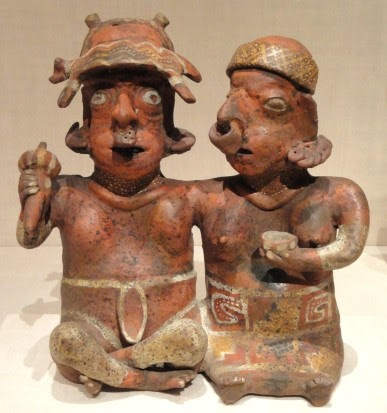
The Nayarit culture of western Mexico is usually dated to around 200 BC to 500 AD. Their art has the quality, rare in the ancient world, of making their lives seem pleasant and relaxed. Consider this dance scene. This may be some kind of religoius ritual, but the feeling one gets from it is that the people are mainly enjoying each other's company.

This famous, badly worn piece is known as the Circle of Friends, and is the model for the logos of several Mexican associations.


Here's a better preserved example of the same design.

A couple of Nayarit gentlemen. There are few depictions of Nayarit men fighting, but plenty of them all dressed up and sitting around.

Even more common are depictions of couples. These all come from tombs, so these were the sort of people who imagined spending eternity together.

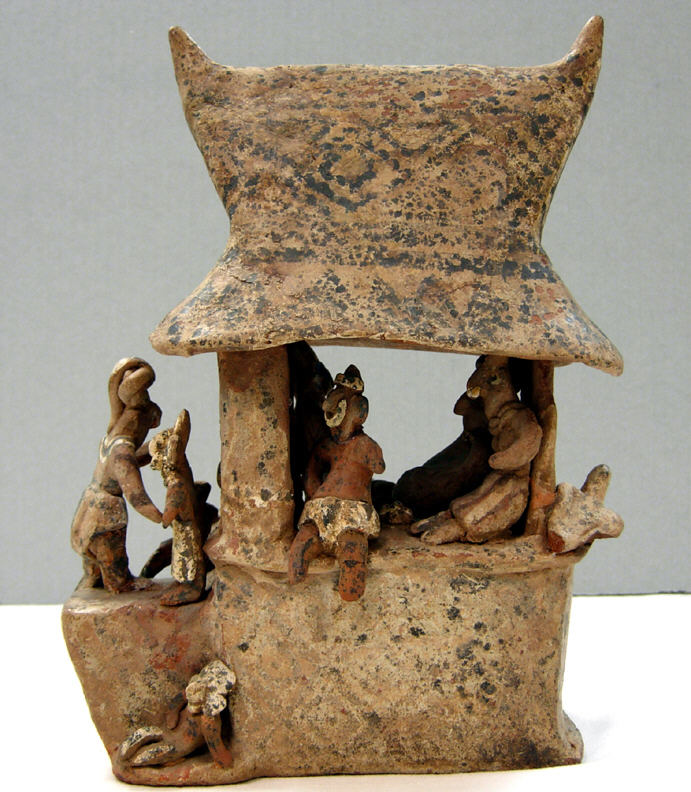
Archaeologists love Nayarit art because of the delightful depictions of houses. Dozens of these are known. 

Some people in the houses seem to be working, but more look like they're just hanging out.

One interpretation of the multilevel houses is that the ground floor represents the underworld where the dead ancestors reside. And what did they imagine dead ancestors doing?

Another house.


Village scenes. Love the hats.

Village with someone who seems to be flying overhead.

Ball court.

Funeral.

When European art historians steeped in the classical tradition first encountered these works, they thought the figuruines were dwarfs, trolls, or some other kind of grotesque. But, no, this was just the way Nayarit artists depicted themselves.

Just looking at these puts me in a better mood. This is my favorite, the character known as the Storyteller. Imagine him with one of those circles of friends and neighbors, leaning in close to hear him recount his tale of ancient gods and heroes; one of the funny ones, most likely, so everyone could laugh about it together.

Ted Gioia Ponders Our Cultural Stagnation

Music critic Ted Gioia worries that even though our gigantic culture industry invests billions every year searching for market share, the whole arts world seems to be stagnating:

The latest news comes today from market research outfit Luminate, who tell us that the share of new music continues to shrink in the face of competition from old songs. I wrote about this a few months ago, and the numbers were already ugly back then.

But they have gotten worse.

The latest report shows that the consumption of old music grew another 14% during the first half of 2022, while demand for new music declined an additional 1.4%. These old tunes now represent a staggering 72% of the market.

And it’s likely to get worse when the full year numbers are released—because we are still in the midst of the Kate Bush/Metallica phenomenon spurred by the showcasing of their old songs on Stranger Things.
Things may be even worse in the movies:
A number of recent articles on Hollywood have announced that we are living in the Golden Age of the Aging Actor. Harrison Ford, who turns 80 this week, may be the most prominent example. As the public face of several major brand franchises, he is still in demand, and will soon show up in another Indiana Jones movie, a kind of Raiders of the Lost AARP Card affair. But this aging Ford assembly line is hardly an isolated example—the graying actor is everywhere. Top Gun is the biggest box office success of the year, and it features Tom Cruise reprising a role he last played in 1986. I fully expect to see a septuagenarian Superman or Batman in the future.

The Ringer recently did the math and found the average age of male leads has risen from around 37 in 2000 to over 45 in 2021. 

I’d like to be amused by all this, or maybe even applaud these senior citizens who have somehow extended their careers beyond normal limits. But the larger picture is disturbing.

Just follow the dollars. Every big budget movie this year is either a reboot, sequel, prequel, remake, or brand extension. Every last one of them. The largest investments in music are the acquisition of old publishing catalogs, while almost nothing is spent developing new artists. . . .

Nobody wants to take a chance on something new and different. It’s just too risky. You could even get fired for that.

Does this matter? Gioia thinks it does:    

But when cultures stop innovating, they soon lose the essential skills they need for their survival. I’m reminded of the Arch of Constantine built by order of the Roman Senate between the years 312 and 315 AD—when the Empire, for all its military might, had forgotten how to create impressive artistic works. As a result, the builders of this monument had to steal parts from older structures.

Decline of empires, etc., etc.

I am not much of a doomster myself, but I share this sense that there isn't much new happening in music, film or television. It has been years since the last time I eagerly awaited a new movie, a new cd, or the new season of a tv show. I am not sure how much of this is a change in me, and how much of that change is caused by cultural malaise. I certainly feel less involved in new cultural products than I used to. Some of that may be aging, but I don't think that's all of it, since my children feel pretty much the same way. I often find myself laughing out loud about the old songs they find to get into. 

I don't know what's going on, but it doesn't feel right.

Links 15 July 2022

Plaster image of the Maize God, recently uncovered at Palenque

Long, interesting NY Times piece on the legacy of Black Mountain College, an experimental liberal arts school in North Carolina whose faculty once included R. Buckminster Fuller, Willem and Elaine de Kooning, John Cage, Merce Cunningham, Peter Grippe, Beaumont Newhall and Richard Lippold, among others.

Interesting Washington Post article about the debate over slavery's legacy in Benin. Some in the country have acknowledged the role of their ancestors in the slave trade; in 1999 the president made a public apology on his knees in a Baltimore church. In a recent presidential debate, one candidate denounced the other as a descendant of slave traders. So the issue is very much alive in some parts of Africa. This came up because a movie is in the works about the Amazons of Dahomey, an actual and very interesting force of female warriors that gets overhyped in dumb internet articles. But 18th-century Dahomey was one of the main slave raiding states, so I wonder if there will be protests against the movie in either Africa or the west.

Huge, zoomable versions of the Webb Space Telescope's first images, along with other scientific results. Very impressive but they aren't enough better than the Hubble's to have the same kind of cultural impact.

Plans for the Webb Space Telescope's first year of operation: exoplanets, the formation of galaxies, and the re-ionization of space.

In Georgia, a grand jury is investigating whether Trump and his people violated Georgia election law; good short article at Vox.

Recently released data suggests that the Chinese government has been overcounting their population, especially babies; according to this demographer, births peaked in 1991 and the population is already declining.

The decline of history as a major. Possible explanations: not careerist enough, not ideological enough, too ideological, not a good signal that you are a smart, serious person, and "Americans don't like to read any more."

Roughly 23% of Americans took a prescription medication for mental health over the past year. Depressing NY Times story with more detiails here.

Five-minute Met video on recreating the color of an ancient statue. Traces of pigment on the head matched pigments used in the Fayum mummy portraits, so those were used as guides.

It interests me that some of the very conservative ex-military guys I've been following on Twitter are really cranky about the militariziation of the police, which they call "larping."  It occurs to me that in the elite parts of the US military, like the special forces, they devote a lot of attention to not shooting the wrong person.

Jewl-encrusted insect ornaments by Sasha Vinogradova.

In British news, "Rampaging wild boars weighing more than 30 stone are attacking lambs."

Irish horror films: "Irish folklore is particularly dark and lends itself to horror. Not a lot of happy endings – a lot of people being dragged to their doom."

Wonderful photo set from the "House-Studio" of Portuguese photographer Carlos Revlas, a truly delightful 19th-century building.

Ray Epps was a Trump-supporting election denier who went to Washington on January 6. But he then became the focus of a conspiracy theory that made him an FBI instigator who urged others to enter the Capitol in a plot to undermine the right, and his life was pretty much ruined. (NY Times)

What if China invades Taiwan? The outcome of a wargame staged at CNAS, 12-page pdf.

Someone posted Google Earth images to Reddit showing a bunch of circles like this one in southern Algeria, in the middle of the Sahara. Some people at Vox decided to figure out what they were, and the result is this fascinating 27-minute video.

Ukraine Links

A US Army manual from 2016 described Russian forward ammunition dumps as "the most unsafe places in any warzone" and advised attacking them early and often.

Extraordinary short video showing another Ukrainian missile strike on a Russian ammunition dump, this one in Nova Kakhovka near Kherson. More here.

Briefing from a "senior US defense official" on artillery support to Ukraine; says that Ukraine is firing about 3,000 155mm shells a day.

Detailed map showing how Russian forces are arrayed along the front between Kharkiv and Bakhmut. 

Some evidence that Ukrainian morale is holding up.

Putin is using a crackdown on corruption to clean house; when everyone is corrupt, the state can always arrest anyone they want to on corruption charges. Reminds some people of Stalin.

Thread on Ukrainian tank tactics, based on an interview with an armored officer.

Short video showing a clear view of a Ukrainian missile striking an oil platform off Crimea.

Kazakhstan Thumbs its Nose at Putin.

Austrian military briefing on the battle of Donbas, past (through July 3) and future, in English.

Speech by the commander of British Air and Space forces; the part about Ukraine is early on, goes on from there to talk about future stuff.

Interesting post by a pro-Russian blogger explaining why full mobilizaton and "total war" are inevitable.

Wednesday, July 13, 2022

A Fifth-Century Anglo-Saxon Cemetery, with Warriors

Both the English and Welsh traditions always maintained that Anglo-Saxons came to Britain as soldiers, either mercenaries or invaders, and that however they arrived they were soon waging a war of conquest.

But until recently the archaeology seemed to be saying something rather different. I summed up the state of knowledge here back in 2103:

The earliest Saxon cemeteries, dating to the mid fifth century and found in the Thames Valley and Essex, seem to be of ordinary farmers. These are poor people, buried without weapons. Their settlements are undefended, and they seem to have existed side-by-side with equally undefended settlements of ordinary Romano-British farmers. There is also considerable evidence for contact between the two peoples: hundreds of British place names survived, the genetics seems to show substantial intermarriage, many old community boundaries were maintained. The culture we call Anglo-Saxon seems to have emerged gradually from the mixing of British and barbarian elements, and not until nearly a century later do we have much evidence for Anglo-Saxon warriors, especially warrior aristocrats.

There were always problems with this model; for starters, what peasant people has ever peacefully welcomed several thousand interlopers from overseas? And if the violent conflict between Saxons and Celts actually developed very gradually over a century or more, why did all of our written sources say something completely different?

In recent years archaeological evidence of early Anglo-Saxon warriors has begun to emerge, and new discoveries at a site called Wendover were announced this week:

A wealthy pagan burial ground, dating from the first years of the Anglo-Saxon invasion of Britain during the fifth century A.D., has been uncovered near London ahead of a high-speed rail project, known as High Speed 2 (HS2). The new discoveries, which include more than 100 skeletons, are among the most important archaeological finds made along the HS2 route. . . .

As well as the human remains, which include a young man who appears to have been killed by a spear, the archaeologists have unearthed the rich grave goods interred with them, such as brooches and rings of silver and other metals decorated with gold.

Personal grooming kits with tweezers and spoons for removing ear-wax were also found in many of the graves; and some of the objects, such as amber beads and glass drinking vessels, were probably brought to Britain from continental Europe. The high-status and expensive grave goods suggest that whoever was buried at the site, which looks out over the vast and flat lands of Aylesbury Vale to the north, belonged to a wealthy Anglo-Saxon community. It may even have been the final resting place of a single affluent landowning family over several generations. . . .

The Anglo-Saxons buried at Wendover were definitely armed — the grave goods included an iron sword, 15 spearheads and the remains of seven shields, Wood said. A metal point, probably the tip of a spear, was found in the spinal bones of one man and seems to have killed him; reconstructions suggest it came from a blow to the front.

However, the young man killed by a spear (above) is the only victim of violence identified so far, which makes this a fairly peaceful group of people compared to the Scythians. There is also little evidence of fortifications from this period.

I think it's wrong to imagine the meeting of Saxons and Britons as entirely violent; we know there was intermarriage, and our sources show us Welsh warriors serving in Saxon war bands. The fact that some Roman administrative boundaries survived into Anglo-Saxon times is particularly intriguing.

But to imagine that tens of thousand of Germans from the continent settled in Britain without violence, or imposed their language and culture without violence, is just silly. This was a warrior age, and war determined who held the land, and who held the power. The increasing cemetery evidence of early warriors in the Saxon population is only what I expected.

All of the artifacts pictured here came from Wendover. The excavators think that this green glass bowl was made before the Romans left Britain in 410 AD, so it was a very old heirloom before it was placed in an aristocratic woman's grave in the late 400s.

Three of the more than 2,000 glass beads found at the site, most likely imported from Gaul.

And a ceramic bead made from old Roman pottery.