Thursday, August 11, 2022

A Medieval Kitchen Unearthed in the Czech Republic

Czech archaeologists working in the town of Nový Jičín, in Moravia, dug down through a paved courtyard dating to the 16th or 17th century. Underneath they found something rather remarkable, an amazingly well preserved kitchen dating to the early 1400s. The intact dishes were so clean the excavators thought they had just been washed and then put on the hearth to dry. (The hearth is the semicircle in the excavation floor; the firebox would have been within the stone walls.) This was a log house with stone foundations. It belonged to a burgher family, but not a rich one:

Since the house was located near the town walls, this would have been a less wealthy burgher family. The richest burghers would have lived in so-called ‘beer court’ houses around the town square.

Pots.

Iron grill deformed by the heat of the fire that destroyed this house. As to why the house was abandoned, the archaeologists have a theory:

The working hypothesis is that the house was destroyed during the conquest of the city by the Hussites in 1427, when Hussite forces campaigned in Moravia and Silesia. Several independent historical sources mention the siege and conquest of the town, including the massacre of some of its citizens.

The first time this happens to you – you find something amazing because people got massacred or what have you – it can be a very disturbing experience. But most of us get used to it. Great stuff almost always ends up buried because somebody died.

Politics and Science Don't Mix

From Science:

A major controversy in marine biology took a new twist last week when the University of Delaware (UD) found one of its star scientists guilty of research misconduct. The university has confirmed to Science that it has accepted an investigative panel’s conclusion that marine ecologist Danielle Dixson committed fabrication and falsification in work on fish behavior and coral reefs. The university is seeking the retraction of three of Dixson’s papers and “has notified the appropriate federal agencies,” a spokesperson says.

Among the papers is a study about coral reef recovery that Dixson published in Science in 2014, and for which the journal issued an Editorial Expression of Concern in February. Science—whose News and Editorial teams operate independently of each other—retracted that paper today.

The investigative panel’s draft report, which Science’s News team has seen in heavily redacted form, paints a damning picture of Dixson’s scientific work, which included many studies that appeared to show Earth’s rising carbon dioxide (CO2) levels can have dramatic effects on fish behavior and ecology. “The Committee was repeatedly struck by a serial pattern of sloppiness, poor recordkeeping, copying and pasting within spreadsheets, errors within many papers under investigation, and deviation from established animal ethics protocols,” wrote the panel, made up of three UD researchers.

This is always a grave danger whenever scientists work in a politically charged environment. I have worried about this sort of thing for decades now, ever since the political pressure to find worrisome things about climate change became intense. In a field where political positions are so strongly entrenched, science needs to be perfect to persuade anyone. But right now the rewards for findings that support climate change alarmism are so large that of course some people will give in and shade their results.

On the other hand, Dixson was eventually caught, and the paper retracted, which puts science as a field way above most. If only political pundits were held to this standard. . . .

August Flowers


Wednesday, August 10, 2022

A Long Expected Party


Piracy and Life

From my old web site:

I. The Madness of Life

As I drive around these days I am listening to a pretty good book about the Caribbean pirates of the 1710s and 1720s – Blackbeard, Bellamy, Calico Jack, and the rest. I am always struck by how miserable life was on those little wooden ships: the awful crowding, the diet of rancid salt beef and worm-ridden biscuit, the constant danger of accident, disease, and shipwreck, the dictatorial power of sadistic captains, the injustice that almost all of the profit went to investors and the captain, whose share even on the most dangerous privateering voyages was as much as 14 times that of a common seaman.

And yet thousands of men chose this life. One thing that always amazes me is how many sailing ships there were in the 18th-century world: 2,000 ships were destroyed in one Caribbean hurricane. It comes home to me how many people were involved in what was really a desperate venture. Sailors who died at home of old age were a small minority. On slave ships the mortality rate of the crew was as high as 40% on each voyage, which means that after five voyages only 8% would still be alive. Well, probably there was a "seasoning" factor, so the death rate was lower for men who had done it once before, but still it can't have been common to survive a decade of slave trading. In the 17th century the death rate was nearly as bad on ships sailing to Indonesia. In the 18th century the East Indiamen took the lead in improving safety conditions, using limes and sauerkraut to fight scurvy, and the like, but the death rate was still staggering by our standards. And those ships were so small that it took thousands and thousand of them to carry on any sort of commerce.

Other professions were just as bad. Gunflint makers died of silicosis after only a decade or two of work, coal miners of black lung or cave-ins, pearl divers of ruptured lung or the bends. And if work wasn't killing enough men there was always war.

There is in our species an astonishing restless vitality that is spendthrift of life. We breed like rats, doubling or tripling in each generation if there is enough food. Our swelling numbers press constantly outward, filling every available niche. We live in desert tents, igloos on the sea ice, and reed huts in malarial marshes; we take on any work no matter how dangerous.

Think of African slaves, seized from their villages, sold to strangers, stacked like barrels in the holds of ships, crossing the ocean in a lake of piss and shit, put to work on sugar plantations with inadequate food and frequent whippings. Some gave up and died, but most struggled on, mated, had babies, raised children, and dreamed of redemption. Now their descendants number a hundred million.

But it is not just us. Ants swarm to attack an anteater even as he sucks them down by the tens of thousands. The maple trees in my back yard must drop a hundred thousand seeds every spring, not one of which will ever grow into a tree, unless for some reason our suburb is abandoned and reverts to woodland. Against that one-in-a-thousand chance the trees are prepared. There is a sort of madness about life, like vines that thrust their way into any crack, no matter how many times they are pruned back, no matter that the crack leads only into a dark space where their leaves will wither and die. This is why I have never believed that there might be life hiding somewhere on Mars, in deep caves or underground lakes. Life as we know it is so powerful and adaptable that it would find a way to live everywhere on the planet, building shields against the ultraviolet radiation and insulation against the cold.

We are part of this madness. We like to imagine ourselves creatures of reason, but by taking to stormy seas in tiny ships, by marching into canon fire, by mining deep into the earth, we act out the part of swarming ants and vines that cannot stop climbing. We are part of the relentlessness of life. We cannot stop. We can only force onward and outward until every place is full, even the places that doom us to misery and death. And we do it with joy. Life loves living; we are living things, and we love our lives. In the face of death we erect monuments to our heroism; in the depths of despair we find spiritual comfort. We take pleasure from pain and toil. When pain and toil give way to victory, we know ecstasy. The beauty of the world moves us, because we are meant to live in it. The pulse and force of life is the greatest wonder we know, and that wonder, the gift given to all living things, is our greatest treasure.

II. Violence and Freedom

When I first read about pirates, as a teenager, I was not much moved by their stories. They seemed to me nothing more than criminal scum. Which, of course, many of them were. But now that I know something about the ruthless injustice of 18th-century life, I am more sympathetic to those who warred against it. Sailors did difficult, dangerous jobs for miserable pay, yet their bosses took every opportunity to cheat them even out of the meager wages they had been promised. If their ships wrecked, or if pirates seized their cargoes, they received nothing. If their employers went bankrupt, they received nothing. Sometimes their masters simply refused to pay them. A few tried to sue in court for what they were owed, but the judges were all shipowners, and the sailors never won anything. In wartime they might be impressed into the navy, forced to do years of dangerous service. If they complained, they were whipped senseless. If they tried to desert, they were hanged.

When war came, many sailors rejoiced. If they could avoid the navy, they could take service on privateers and earn a share of any plunder they could take from their nations' enemies. In war, the strong could take from the rich with impunity. As medieval troubadour Betran de Born, wrote,

Trumpets, drums, banners, pennons,
standards, horses white and black,
we'll soon see, and the times will be good,
as we'll part usurers from their money,
and mule drivers will not dare to go on roads
in broad daylight, nor townsmen without fear,
nor merchants on their way from France.
Those who gladly rob will be rich.
Of course, most did not get rich, but a few did, and that was much more of a chance than any of them had in peacetime. Betran de Born's zeal for war has a sadistic quality, but it still points toward the grim reality of life in an aristocratic society. Most of the wealth was in the hands of the aristocrats, and the only way poor people would ever get any was by taking it. When the law is controlled by the oppressors, the only possibility of freedom may be as part of a criminal gang.

Violence shook up society, and since in the normal run of things society was grotesquely unfair, that meant that poor people might gain from war and turmoil what they could not hope to get in peace. Of course the poor were also the main victims of war, and most of them ended up poor no matter what happened, but violence at least gave some the hope of getting more for themselves. Who can read about one of those protocol-bound courts, like those of the French kings or Chinese emperors, places where outsiders were doomed by embarrassing public miscues or done in by backstairs whispering, without fantasizing that a barbarian horde would ride in and sweep them away?

Nor was violence only a matter or war or piracy. I have lately been working on the history of the Chesapeake and Ohio Canal, which was built in the 1830s by thousands of workers, most of them Irish immigrants. The canal was constantly on the verge of bankruptcy, and the workmen's pay was often short or months behind. Excluded from most kinds of work by "no Irish need apply" rules, the Irish canallers badly needed to be paid for the backbreaking work they did. To get the wages they were owed, some groups rioted and threatened to dynamite the dams and culverts they had spent months building. It worked; faced with the prospect of losing their investment, the Canal Company paid up. When work on the canal wound down and jobs were short, the canallers formed associations based on their counties of origin and tried to drive all the other workers off the canal. Non-Irish workers were their first targets, but they also fought against each other. Work on the canal was so important to them that they fought to keep it. Again, it worked, at least for a while. When the Canal Company finally called in the state militia and arrested the leaders of the associations, wages on the canal fell from $1.25 a day to 87 cents. By banding together and using illegal force, or the threat of it, the workers got much more for themselves than they would have by meekly obeying the law.

Those societies most deeply devoted to freedom are often very violent, for example the plains Indians. In some borderlands peasants who were often needed as soldiers paid much lower rents than their counterparts in peaceful regions. Because of the constant threat of violence, their lords had to offer them good terms to get them to stay. The Roman tradition records that their commoners won political rights by refusing to serve as soldiers in wartime. The patricians tried to argue that in time of war the whole community had to stick together, but the commoners were not moved by this argument. During war was the only time the patricians really needed them, so it was then that they had their only real leverage.

So are violent societies more free? Not necessarily. The Spartans managed to combine regimentation with violence, as did many others. Oppressors can use violence, too, and usually have. It is also important to note that those able to take advantage of the freedom that war and violence brought were mostly men, and that women were more likely to be victims. Some of those free, violent societies, like the Bedouin and the Plains Indians, were particularly harsh to women. Yet when men won power with swords and guns, the women's world was shaken up, too, and they rose and fell with their men.

So violence was an ambiguous force but until modern times it was the one thing able to undermine the fixed and grotesquely unfair order of the world. Before the rampant technological progress of the modern age, civilization tended toward a hereditary hierarchy. In an old civilization, each person's place was fixed when he or she was born, and only extraordinary effort, or extraordinary luck, could ever change it. During long periods of peace, like the heyday of the Roman empire or Ming Dynasty China, social stratification could reach absurd heights, with a tiny minority controlling almost all the wealth. But then the barbarians came, the rulers were cast down, and the deck was reshuffled. The men who overturned the old order were no better than the men they replaced, but they, like the pirates, understood that only hope for change was in violent upheaval.

III. Demography and Destiny

Why did the sailors do it, or the gunflint makers, or the slaves? Because they had no choice. The only real freedom the poor of pre-industrial Europe had was the freedom to starve. If they wanted to stay alive, they had to accept one of the slots the system allowed them. The political science of the 17th and 18th centuries is full of the fear that if poor people ever got too comfortable, they would refuse to do the miserable, badly paid jobs on which society depended. Only people threatened with starvation, the philosophers reasoned, would make gunflints or mine coal. No one in that era seems ever to have considered that such jobs could be made safe and profitable enough to tempt free, well-fed people to take them.

From the founding of civilization to the twentieth century, people took dangerous jobs and lived in horrific places and died early deaths because there was nowhere else for them to go. Because the world was full, and every decent spot was taken. Because there were simply too many people.

In every age, advances in technology that should make us all better off lead instead to population growth, so that the mass of people are as poor and miserable as they were before. Many of my students are puzzled to discover that although Egypt was the richest place in the ancient world it had some of the poorest people – we read of peasants whose estate was one sixth of an olive tree. The riches of the Nile were paltry compared to our power to breed and consume. The technological progress of the 17th and 18th centuries could have allowed a small population to live very comfortably, but instead it set off a great wave of population growth, so that by 1810 the world was again troubled by famine and revolutionary unrest. Since then our technology has advanced so rapidly that much of the world has managed to keep ahead of the Malthusian scissors, but it has been a desperate race, and along the way many have been trampled into the coal dust. Whole peoples, like American Indians and Australian Aborigines, have been crushed, and millions of miners and factory workers used up and cast aside. Yes, there has been progress, but imagine if all that economic progress had taken place in a world with a stable population. Of course growth would have been slower, but its benefits for each person would have been vastly greater.

George Orwell once wrote that the best time in history to have been a working man was during the opening of the American frontier. "If you didn't like the boss, you socked him in the jaw and moved further west." To Orwell the availability of empty lands was the best defense against oppression. If people have somewhere else to go, there is a limit to how much they can be abused. The availability of desert islands in the Caribbean, empty because disease and enslavement had wiped out their natives, certainly helped poor sailors in the 18th century. If they could not find acceptable work, they could row to some remote islet and live for years by catching turtles and raiding sea-birds' nests. Once the region became crowded again, every bit of land claimed as somebody's property, the sea turtles hunted near to extinction, that option was gone, and it was once again work for the shipowners or starve.

In 17th-century Virginia, the authorities imposed draconian penalties on any white or black man who went to live with the Indians. If such reversion to nature ever became common, the possibility of flight would make it too hard for the rich to control their laborers. It was imperative, for Virginia's would-be aristocrats, to convince their servants that Indians were savage heathens with whom no European or African could ever be at home. If men could flee into the great wilderness whenever they felt cheated or used, there would be no keeping them down. Because their own numbers had been decimated by disease, many Indian groups welcomed fugitives who were willing to learn the ways of their hosts. This had to be stopped; scan the letters passed back and forth between Indian chiefs and colonial governors, and you see that one of the main themes is the demand by the governors that runaway slaves and servants be returned.

But the example of colonial America shows the complexity of these interactions. The outcome of the New World experiment was, not freedom for all, but freedom for whites and slavery for blacks. The desire of colonial elites to become aristocratic landowners was extraordinary strong. When they found they could not dominate their own people, they brought in foreigners to rule over. By fanning racism and respecting the basic freedoms of poor whites, they kept the masses from uniting against them, built their plantations, and found their way to riches despite the availability of cheap land on the ever-moving frontier. And consider the effect of the Black Death in Europe. In the west, the sudden death of 1/3 or more of the working people led to a great rise in wages and the disappearance of serfdom. But in the east, the authorities were able to keep control of the situation, and they forced the surviving peasants into even more burdensome servitude. We are not sure why, but part of the reason is probably the availability of alternatives. In the west, town life was more fully developed, and migration from the country to the city was already a common thing. Peasants who did not like the terms of their tenements simply left, going to town or to other regions. In the east, towns were fewer, farther apart, and less welcoming of strangers, so movement was much more difficult. With no place else to go, and fewer men to fight against oppression, the eastern serfs could not turn their increased value into freedom.

I think the greatest achievement of the modern world is our creation of representative democracy. This marvelous system allows the teeming masses of our crowded nations to have some degree of freedom and some degree of control over our fates. Technological progress has kept economic growth ahead of population growth, so that our incomes have risen even as our numbers have swelled. But I do not think we have escaped from the tyranny of demography. Wages are still set by the laws of supply and demand, so more workers means lower pay. These equations are not simple, as the debate over immigration in America shows, but it still must be true that the wages of shirt-sewers and plastic molders are kept low by the enormous number of people in the world who could do the same work. In rural India and parts of Africa, population growth is fast undoing the gains of the "green revolution," and hunger is still a threat to millions.

As the low birth rates of the modern world, which have already spread across east Asia and South America, reach Africa and India, we may at last achieve something unprecedented in human history: a stable population not limited by famine and early death. The great race between population and food supply may finally end, and humanity enter a new era. There may be some loss of vitality in our world, as we are less in the grip of that living madness and less driven to live anywhere and do anything to stay alive. But I do not think we will ever find life boring -- we are made to live, and so we will. We may even find that without the press of ever-growing populations, we have the time and resources to build a more just and reasoned world. 

July 22, 2008 

Tuesday, August 9, 2022

Charles C. Mann, "1491: New Revelations of the Americas before Columbus"

From my old web site:

In 1539, Hernando de Soto landed a small Spanish army in Florida and marched them a thousand miles overland to Louisiana. An account of the expedition by one of its officers gives us our first glimpse of the Indian societies of the southeastern US and the Mississippi Valley. As de Soto and his men passed down the Mississippi from somewhere near Memphis, they saw a landscape "thickly set with great towns," "two or three others to be seen from any one." When they stayed too long in one place they were sent on their way by volleys of arrows from armies they numbered in the thousands, and their crossing of the river was shadowed by a fleet of hundreds of war canoes brimming with warriors. In 1682 another European passed the same way. The Marquis de La Salle canoed the length of the Mississippi from modern St. Louis to its mouth, and he saw no towns, no armies, no fleets of boats. South of Memphis where de Soto saw so many towns, La Salle passed 200 miles without seeing so much as a campfire. The land was deserted.

What happened? Did de Soto lie? What about Cortes, who peopled the Aztec empire with 20 million souls, or Gaspar de Carvajal, who sailed down the Amazon in 1537 and said it was lined with fields and cities? How many Indians were there in 1491, and where did they go?

I have read few best-selling books that I can recommend as enthusiastically as Charles Mann's 1491, published in 2005. Mann, a journalist, has done an amazing amount of work: visited hundreds of archaeological sites, talked to hundreds of experts, read widely; there cannot be many professionals who have as sound a grasp of the current state of such a broad swath of scholarship as Mann. Mann's writing is very clear, and he tells many great stories. Even more impressive is Mann's understanding of the ideological underpinnings of what he is told. All debates about Indians and Europeans are intensely, bitterly political, and Mann always clearly lays out the agendas of the scholars and activists he talks to. But he does not use politics to dismiss anyone; after explaining their ideological or professional agendas, he goes on to discuss their ideas about the past in a remarkably balanced way. Because of his sensitivity and judgment, and the breadth of his research, Mann's book is the best available introduction to pre-Columbian America.

I do have one complaint about Mann, which is that he doesn't give a sufficient sense of how hard archaeology is. People tell him that, say, the Zapotec region of Mexico was a group of small independent towns, but because of increasing warfare they came to form two competing states, which were finally conquered by Monte Alban and joined into one empire, and I think, how on earth do they know? As Mann himself notes, now that we can decipher the Mayan script we know that the politics of the central Mayan region were quite different from the way they had been imagined just from looking at the monuments. My experience of archaeology is that even the most basic questions can be all but impossible to answer. Is that a defensive ditch and bank, or just an eroded gully? Is that spear point in that hearth, or is it in the layer above the hearth? Were those houses occupied at the same time, or in sequence? Archaeologists ought to be more humble. They are not because making bold claims is the way to get publicity, tenure, and funding from National Geographic, but the rest of us ought to approach their claims with more caution than Mann does.

What does archaeology seem to be telling us about pre-Columbian America? In brief, that there were a great many Indians, and that they greatly modified the landscape within which they lived. No one ever doubted that there were many people in the Inca empire, because they filled the Andes with their terraced fields built of stone. Many of those fields were abandoned after the conquest, and despite modern population growth some have still not been brought back into use. Equally certain, if not so obvious, is the change that has taken over the Maya heartland of Guatemala and eastern Mexico. Today the Maya cities are surrounded by jungle, and the small clearings around the temples had to be hacked out with machetes before the modern world could appreciate their wonder. The populations of those cities, estimated at as much as 100,000 for the larger metropolises, were not supported by a bit of slash-and-burn agriculture in the forests. The Maya had cleared hundreds of square miles of the rain forest for intensive farming. Especially impressive are the thousands of acres of terraced fields in swamplands, built by digging drainage canals and piling the muck onto the adjacent plots. Today those old fields are celebrated for the great richness and diversity of the forests that grow on them, but there is really nothing natural about them, and a twelve hundred years ago they were covered with carefully tended plots of corn, squash, beans, and cotton.

More controversial are the histories of eastern North America and the Amazon. North American Indians now claim that their ancestors lived lightly on the land, and that when Europeans arrived the vast forests of their hunting grounds stretched from the Atlantic to the Mississippi. There have always been hints, though, that this was not so. When Samuel de Champlain explored Massachusetts Bay, he saw no forests at all along the shore, only Indian fields.

Accounts of the Chesapeake region are similar; one English pamphlet promoting emigration said that settlers would not have to clear their own fields, "for there are already great reaches of champion country cleared by the natives." Certainly much of the eastern landscape was forested, but those forests were not exactly "natural". Indians set fires in the woods for many purposes: to drive deer in great fall hunts, to clear land for farming, and to manage the woodland. The evidence of the burning is preserved as charcoal layers in the sediments of many ponds and bogs throughout the region. The charcoal becomes much thicker when corn-based agriculture was introduced to the region around 900 AD, but the first evidence of excessive burning goes back much further, to around 2500 BC. The burning changed the composition of the forests, encouraging species the Indians found useful, especially nut-bearing trees, which provided food for them and sustained larger deer herds. Because of the intensive burning, prairies spread into the eastern woodlands. Tracts measuring thousands of acres were described in colonial land patents as "range" or "desert," and according to one account the entire Shenandoah Valley was grassland. Animals from the west such as bison and elk migrated eastward as far as the Atlantic, where European explorers saw and described them. The vast stretches of wild forests that figure in our memory of the frontier seem to have grown up after European disease reached the Indians around 1600, wiping out millions of them and disrupting their management of the land.

Indian land management may have had other, more subtle effects. I have always been puzzled by John Smith's glowing account of the fruits he saw around Jamestown, including strawberries and several kinds of plum trees. I have spent years of my life wandering the forests of the Chesapeake without seeing a single strawberry or native plum. One has to make allowances for the promotional side of Smith's writing, but he was a very astute observer and if he said he saw thickets of plum trees, I believe they were there. What happened to them? Most likely they had been created by the Indians, who encouraged the growth of the trees they wanted and cleared the others until they turned parts of the woodland into semi-wild orchards, much like Indians in the Amazon do today. As for the strawberries, they are plants of open fields, and they were growing in old corn fields that the Indians burned every year to keep trees from growing on them during the 10- to 20-year fallow period that restored their fertility in the Indian agricultural system.

As I said, the extent of Indian forest management in the U.S. is controversial, but the argument is muted and professional compared to the war that has broken out over the extent of Indian settlement in the Amazon. Gaspar de Carvajal, the conquistador who described cities along the river, was not a reliable observer like Smith or La Salle; it was his fanciful account of bow-wielding female warriors that gave the river its name. Besides, everyone knows that the soil of the rain forest is too poor to support intensive agriculture. Except that some of it isn't. All along the major rivers are stretches of what locals call "terra preta," deep, fertile loamy soil where gardens of manioc, beans and other staples thrive. Geologists have never been able to explain terra preta, but now a group of archaeologists thinks that these soils represent ancient Indian gardens. The Indians, in this view, learned how to burn the forests in a careful way that turned most of the wood into charcoal, which they worked into the soil. The soil was further enriched with regular loads of hearth ash, night soil, and every other kind of domestic trash, in effect turning hundreds of square miles of forest into enormous compost heaps. The evidence for human activity is in the form of potsherds, millions of which are mixed into the deep soils of some stretches of terra preta.

The Amazon, alas, is about the worst place in the world to do archaeology. The intensity of growth and rot obliterates almost all human artifacts in decades, ravaging bone, metal, wood, and fiber, and since the natives never made much use of stone, only pottery remains. If you found a large prehistoric settlement, how would you know? With such a paucity of data, investigators have to rely on educated guesswork, and when their results are challenged they fall back on the time-honored tradition of all scientists in data-poor fields: rhetoric, political posturing and savage personal attacks. Anna Roosevelt, who won a MacArthur "genius" grant for her work promoting a large pre-Columbian Indian population, and Betty Meggers, leader of the "low count" faction, have become such bitter personal enemies that conflict between their supporters is poisoning the whole field of South American archaeology.

Of course, the argument about the Amazon is not just about its past, but about its present and future. Environmentalists working to preserve the rain forest have made powerful use of the argument that the rain forests are an irreplaceable treasure that could easily be lost forever, and that must be maintained to preserve the balance of the earth. What becomes of those arguments if we accept that a six hundred years ago the river was home to a thriving civilization with large towns and hundreds of thousands of acres of fields? "Low count" archaeologists frequently accuse high counters of promoting development in the Amazon, or just of promoting the destruction of the earth.

I think that whoever is right about the Indian population of the Amazon, there is something wrong with our whole notion of the "wilderness." If "wilderness" means a place that has not been changed by people, there are no wild places and there haven't been since people entered the Americas more than 13,000 years ago. The re-introduction of wolves to the American west has been hailed as a return to the "natural" state of affairs, when hunting by wolves, grizzly bears and cougars regulated the population of herbivores. Except that this is, in fact, the first time in the history of the world that such an ecosystem has ever existed. For the past 13,000 years the dominant predator throughout the Americas has been us. Before that, the dominant predators were, not timber wolves and grizzles, but saber-toothed cats, dire wolves, short-faced bears, and lions. The dominant herbivores were mammoths, mastodons, horses, camels, ground sloths, glyptodons, and other extinct beasts. Grizzly bears, moose, and elk are not native to North America, but emigrated here in the wake of humans, occupying the niches left by extinct animals. The ecosystem taking form in Yellowstone is fascinating, but it is not ancient, and if "natural" means "without human influence", then it is natural only in a very limited sense.

I think we should discard the whole notion of "wilderness" as a place where the ecosystem excludes people. I don't mean that we shouldn't provide space for wolves, bear and elk in our world, but that we should be very careful of the idea that just staying away from a place will make it "natural." For example, the US National Park Service has for decades prohibited almost all hunting in national parks. The result, though, is not necessarily natural. In the eastern US, parks are now overrun with herds of deer numbering in the hundreds, something that the world may never have seen before 1970. Wolves not being a feasible deer control measure in the suburbs, there is really no alternative in those parks to human intervention. Debates over fire management have long been in the news, because when you get right down to it there is no way of even knowing how much fire is "natural" in a North America crowded with humans.

For good or ill, the world is in our hands. We can pretend to step away from certain parts of it, but sooty rain falls even on Antarctica. We should give less emphasis to leaving the "wild" parts of the world alone and more to our own role as stewards of the planet. We should consider the approach taken by North American Indians and think about how to manage the wild parts of the world. We should work out ways to promote biodiversity; if regular fires keep parts of the American west as a patchwork of different ecosystems instead of an endless pine forest, then perhaps we should encourage fires. There may be other ways we can encourage rare wild species, as the Indians encouraged plums, or as the old Maya terraces support fabulous tracts of rain forest. We should continue our efforts to limit the spread of invasive species, so the whole world doesn't end up with one ecosystem. In some areas forests may be weak because repeated logging has stripped the soil of manganese; perhaps we should think about ways to fertilize those areas and undo the damage we have done. As soon as our technology permits it we should work out how to clone extinct animals and bring them back into the world, starting with the aurochs and the Columbian mammoth. After all, noone stopped us from playing God when we caused their extinction, and reviving them would, to me, only be restoring a balance that we ourselves destroyed.

April 8, 2006

Update, 2022

Over the past 14 years I have regularly reported here on the archaeological revolution in the Amazon, which has spectacularly confirmed the view of high populations and a much-modified landscape. Estimates of the region's population in 1500 now go as high as 8 million, which is more than some people used to think lived in all of the Americas.

Evidence has also continued to accummulate concerning the great impact American Indians had on the landscape of North America; I recently discovered a colonial property deed for 5,000 acres in Anne Arundel County, Maryland known as "the Range."

Sunday, August 7, 2022

Pascal Mercier, "The Night Train to Lisbon"

From my old web site:

I have a friend, a molecular biologist, who believes that within a generation we will be able to rewire our genes and live to be 200. I rather doubt this. After all, there is nothing more fundamental to life than death and decay, and I suspect defeating it will be a very hard problem. Yet I return to this idea again and again because I find it a useful thought experiment. Wondering how things would be different if we lived to be 200 leads me to all sorts of interesting thoughts about our 80-year lives. Such as, it seems obvious that 150 years is too long to pursue one career. Is, perhaps, 50 years to long to pursue one career? More generally: if you lived to be 200, what would you do with the extra time? Why aren’t you doing that now?

I mention this because Pascal Mercier’s fascinating 2008 novel is very much concerned with exactly these questions. It asks us to examine how we spend our time, and, more deeply, what our relationship is to time and its passage. It is a brooding, melancholy book, and only intermittently entertaining. But it is consistently thoughtful and sometimes beautiful, and it has held my attention like the most compelling mystery or thriller. It is not a book for everyone, but anyone who wants to think about life, death, love, and time will find it marvelous and may even fall in love with it.

The American edition of this German book comes equipped with extravagant praise from a raft of European novelists and literary journals. After reading it, said one Danish reviewer, you are not the same person as when you began. A German journal called it “a handbook for the soul, intellect, and heart.” So I began it with high hopes and was somewhat put off that I quickly got bogged down. In the beginning the plot follows one the most conventional possible tropes, the mild-mannered, middle aged man who finally manages to break free of his crabbed existence and live. Raimund Gregorius is a teacher of ancient languages at a Gymnasium in Switzerland. His knowledge of Latin, Greek, and Hebrew is superb, and he is a good enough teacher that he has many fans among his students. But that’s about it. He was once married, to a former student, but she left him after five years of increasing boredom and discomfort. He has only one friend, his ophthalmologist, and his only recreations are reading and chess. Then one day he runs into a mysterious woman on the bridge by his school. Afraid that she is about to jump, he approaches her, and then instead of jumping she writes a phone number on his forehead. It is raining and she is clearly upset, so he takes her with him to his school to dry off. She speaks with an accent, and he asks her where she is from. Portugal, she answers, in a voice that captivates him.

After the woman disappears, Gregorius visits a book store specializing in Romance languages. The proprietor shows him an obscure book of thoughts jotted down by a Portuguese man named Amadeu Prado. Gregorius becomes obsessed with this book, begins to learn Portuguese, and the next day he is on the train to Lisbon. I found this part of the book tedious, both because of its relentlessly conventional plot and because Gregorius spends page after page wondering why he is doing this and whether he ought to go home. I wanted to say, enough already, you have to do this because you are the boring professor in a midlife crisis novel, so just accept it and get on with your adventure!

In Lisbon Gregorius slowly translates Prado’s book and tries to find out everything he can about Amadeu Prado. Here Night Train to Lisbon begins to come alive. Prado’s book is a series of disconnected musings, each from a paragraph to a few pages long. They are marvelous pieces of writing, both because they are spoken in a completely different voice from the main narrator’s and because some of them are striking and thought provoking. You can imagine that a bookish, thoughtful man like Gregorius could become obsessed with the book and its author. As Gregorius searches for Prado by talking to one old friend after another, he becomes a character as present as Gregorius, and a lot more interesting.

Prado and his friends were all involved in the resistance against Portugal’s fascist dictatorship, which lasted until 1975. Prado’s friends tell Gregorius about that time, and the risks and choices it involved. The passages on the resistance are good, but they are not as powerful as the excerpts from Prado’s little book. These are the real heart of Night Train to Lisbon. Prado’s subjects include the problem of how to express unconventional thoughts in written language, which is saturated with convention; how we are shaped by our families; what makes relationships important; whether love can save us; why we are afraid of death; and how we ought to spend our lives. Prado was an extraordinary character, admired by many men, loved by several women, and as we learn about his life he becomes the author of his amazing book. We believe the striking words spring from his life and his mind. The intertwining of Gregorius’ own personal crisis with his search for Prado, his steady progress through Prado’s book, and Prado’s own life, makes for a compelling intellectual journey.

I could go on and on about the insights and the striking phrasing of Prado’s book, but that would rather spoil it, and so I will give only two examples. This is from a section titled “The Shadows of the Soul”:

The stories others tell about you and the stories you tell about yourself: which come closer to the truth? Is it so clear that they are your own? Are you an authority on yourself? . . . In such stories is there really a difference between true and false? Is the soul a place of facts? Or are the alleged facts only the deceptive shadows of our stories?
Another section of Prado’s book describes a conversation he had with a friend about the fear of death. His friend, captivated by the performance of a gifted pianist, buys a grand piano and plans to learn to play. But once it arrives in his house he realizes that he is too old to ever learn to play with real skill, and this plunges him into gloom and thoughts of death. They ponder different reasons why we might be afraid of death. Is it just because we want our lives to go on as they are, more of the same forever? Because we fear the nothingness of unbeing? Prado’s friend’s experience with the piano suggests a different notion. Perhaps our fear of dying might be the fear of having our future cut off. When we are dead, we will no longer have any chance to do the things we have been putting off but thought we might get to one day:
The fear of death might be described as the fear of not being able to become whom one had planned to be. 
There are many more such nuggets, and also much interesting conversation and reflection. Night Train to Lisbon is one of the most richly thoughtful books I know, and once it gets going it is a pretty good read, too. If you're in the mood to reflect, think, or brood, find a copy and read it.

According to the back of his book, Pascal Mercier is a philosophy professor. Why, I have been wondering, did he write his book as a novel, rather than as an essay or even a monograph? Money might have been one motive, I suppose, but although Mercier has ended up making a pile of money from this book I have trouble believing that he planned on it. I imagine his millions are coming as a big surprise to him. I think his motive in writing this novel was to express thoughts that he finds interesting but didn't want to put forth as his own. Mercier seems to be a sort of café philosopher, who likes to toss off ideas and striking phrases but doesn't want to have to defend them. So he creates a larger than life character – aristocrat, resistance fighter, Latin lover – and passes his insights off onto Amadeu Prado. He thus bypasses the academic discourse that passes for philosophy these days and reaches people interested in what he has to say. Writing as Amadeu Prado, he is free to be bold, cursory, contradictory, derivative, or anything else he wants to be, as long as the result is interesting. If someone says, “But Pascal, this argument really doesn't follow,” or, “Pascal, this is just a restatement of something Augustine said 1700 years ago,” he just shrugs and says, “It's a novel! What do you want?”

Another thing that struck me about this book is the strange attitude toward poetry. Prado and Gregorius are both said to be great lovers of poetry. Thinking is the second most beautiful thing, Prado once wrote. The most beautiful is poetry. Like so many other romantic souls in our agnostic age, they seek their divine experiences in love and art, and they speak about poetry as if it could sometimes combine the two. Given all this, I found it odd that there is no poetry in the book. There are literary quotations of various kinds, but no verse, unless you count the opening of St. John’s gospel. When the chracters discuss chess, their speech is full of detailed allusions to famous games and players, differing styles of play, and the like. But when they talk about poetry, all is abstraction. They speak of poetry but not of poets or poems. Why? I have the impression that Mercier actually doesn't know a thing about poetry, certainly not about any being written today. He likes the idea of poetry, and he dreams about contemplating beautiful words that express true thoughts, but actual poetry plays no part in his life. His characters lave lost their faith in god, but retain their belief in poetry, music, and political action. Pascal Mercier has no faith in any of those things, either. What he offers us as a replacement for religion and philosophical certainty is not the refined beauty of poetry, but something more like conversation. He invites us to talk over life and what it means, without illusions, and without any expectation that we will discover they truth. There are no rules in this discourse, only thoughts, feelings, and words. It is not comforting, but it is fascinating and moving. It is intellectual life as I like it best. Mercier may not be a great philosopher or a great novelist, but he is a wonderful thinker and a fine writer, and this book is a treasury of thoughts and words. 

January 27, 2009 

Friday, August 5, 2022

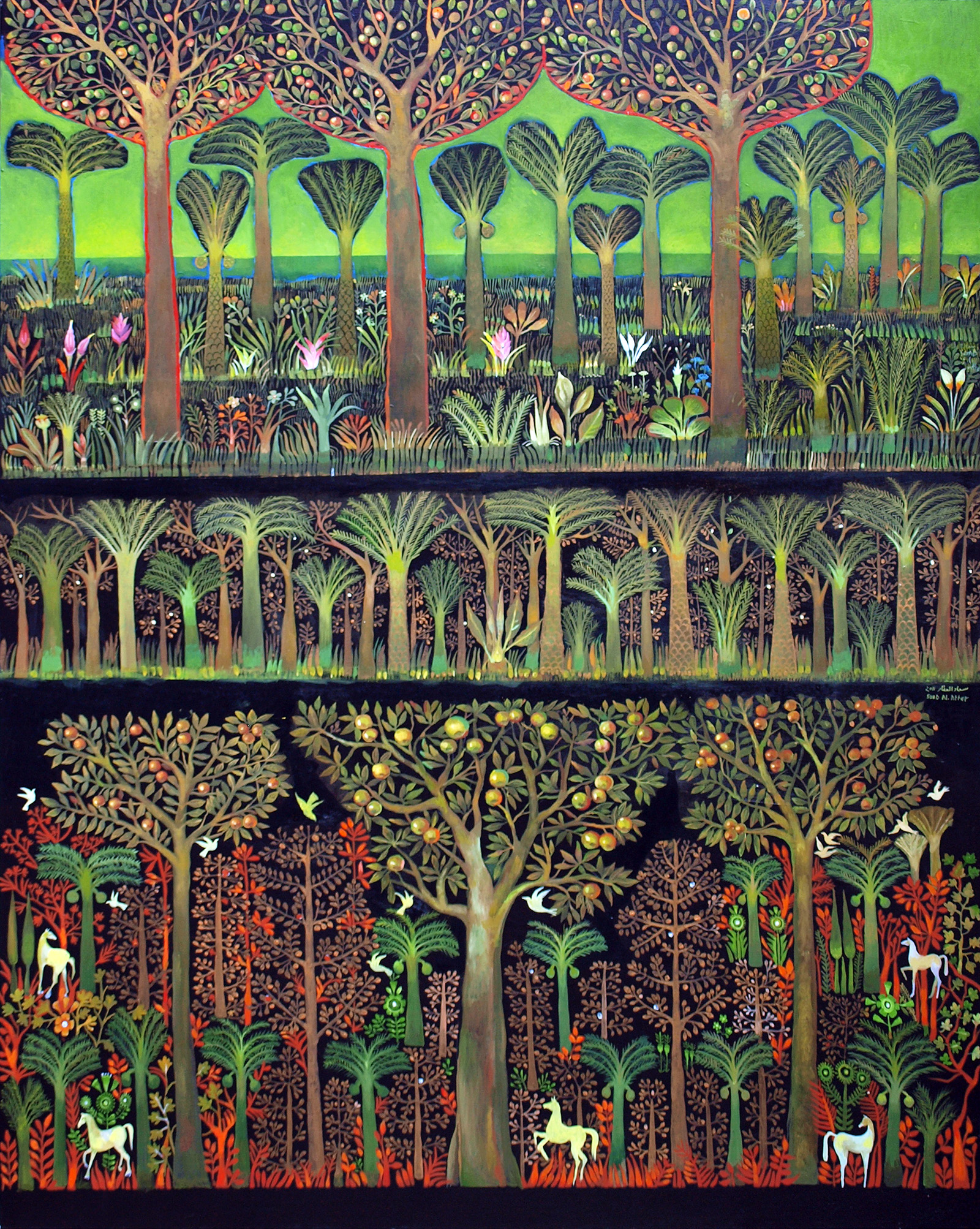
Suad al-Attar

Suad al-Attar is an Iraqi artist born in 1942. She came from an elite family and was tutored by well known artists of the time. Much of her painting is dreamy evocations of Biblical or Koranic themes, especially the Garden of Eden. Above is Visions from the Garden II, 2011.


Al-Attar has lived in London since 1976. Above are three paradise paintings from the 1970s, 1980s, and 1990s.

Blue City
, 1998

In the time of American invasion and civil war al-Attar painted several pieces intended to call attention to her nation's plight; this is the most interesting I have found from that period, Tears from the Ancient Land.


But then she went back to more scenes of paradise, like the one at the top of the post and these. I find them all delightful. Her web site is here.

Links 5 August 2022

Gold bust of the Emperor Septimius Severus, c. 200 AD

Review of The Case Against the Sexual Revolution, a new book by Louise Perry that argues just what you would expect. Video interview with Perry: "Freedom is not the preeminent value. It has to be balanced against other values."

The Uhuru Movement, a Florida-based political group that claimed to  unite “African people as one … for liberation, social justice, self-reliance and economic development”, turns out to have been entirely funded by Russian intelligence.

Nine-minute Vox video on what happened to California high-speed rail.

The criminology professor on trial for arson.

Study says old friends appreciate being reached out to more than you probably imagine.

Interesting NY Times interview with Neil Gaiman, appropos of The Sandman coming to Netflix. He calls himself a "First Amendment absolutist" but has also been attacked for wokeness; honestly his politics come across as largely "don't tell me what to do" grouchiness.

John Lasseter was the creative leader of Pixar until Disney fired him because of employee complaints about inappropriate hugging and a tyrannical leadership style. Now he is back producing animated movies for Apple TV, after outside lawyers decided there wasn't much to the charges against him. More than fifty people have followed him from Disney to his new company. So, yes, you can get fired for stuff that seems to outsiders like no big deal, but on the other hand it won't necessarily end your career. (NY Times)

Leaders of China's $50 billion semiconductor investment fund arrested for corruption. Western observers say they are really being scapegoated because China's chip industry is doing badly.

The threat of lead poisoning from Turmeric.

Very cool short video looking down into the caldera of an erupting volcano, shot from a drone.

Amazing pictures of fireflies in India.

I just discovered that the most distant known individual star is called Earendel, after the star whose light is bottled in the phial of Galadriel.

Webb Space Telescope photography of the Pinwheel Galaxy.

Short video of a very strange jellyfish.

Old E.B. White essay on Summers before Air Conditioning.

Wild man costumes from Spain's ancient carnival rituals. Compare other parts of Europe here and here.

Mass grave of Hessian mercenaries found in New Jersey.

Interesting NY Times story on the debate of whether a "cancer cluster" exists in a New Jersey town; the case got attention when a list of brain tumor patients in people who went to one high school went over 100 names, but state health authorities calculated that, on average, that many people would have 120 brain tumors; after all, 1 in 5 Americans dies of cancer.

Leader of "monkey gang" that has been harassing people in Yamaguchi, Japan, executed by hit squad "specially trained hunters."

Ukraine Links

Badly translated but interesting interview with a Ukrainian general who blames February's official skepticism about the upcoming Russian invasion on Russian agents in the president's office.

Why Timothy Snyder thinks Ukraine is winning.

Russia's population falls to 145.1 million, shrinking by 86,000 a month.

As of July 31, Russia has lost more than 5,000 vehicles and other major pieces of military equipment in Ukraine, including 916 tanks and 147 self-propelled artillery pieces.

The Czech Republic announces it is buying 24 F-35 fighter jets, a staggering investment in defense; right now they only have 14 fighters, all old Saabs. As a percentage of their government's total budget this purchase would be like the US buying over a thousand new fighters. The Czechs are not messing around about the Russian threat. Neither are the Poles, who are buying 32 F-35s of their own, besides replacing their entire tank force with modern models.

Another formerly pro-Russia politician goes full bore for Ukrainian nationalism: "The survival of the nation is at stake. It doesn't matter what you believed was the right way for Ukraine's development yesterday. Today we must protect the country." The same is happening across Europe, if not so dramatically.

As of July 31, the deaths of 952 Russian officers in Ukraine have been confirmed by funeral announcements and other Russian media.

Article on the defense of Bohorodychne.

Lots of chatter on whether the US has a veto on the targets Ukraine attacks with HIMARS missiles.

I find the war more confusing than ever. Russian losses have been staggering, and the new units they are sending to battle have 1970s-era tanks and APCs. The attacks on Russian ammunition depots led to a week-long collapse of their artillery fires. Stories come out every day about men refusing to fight. And yet, they are still advancing, and their artillery fires are bouncing back, presumably because they have found new ways to get ammunition to the front. People keep saying, "they can't keep this up," but somehow they keep it up.

And for Napoleonic history buffs: "The more I look at the Kherson front and Ukraine's repeated announcements of an upcoming 'Kherson offensive'... the more I get the feeling Ukraine is pulling an Austerlitz on the russians: Kherson being the right wing and Melitopol being the Pratzen Heights."

Igor Girkin's latest situation summary, not much happening in his view. And from the Ukrainian side, the latest from Aleksey Arestovych.

Thursday, August 4, 2022

Inventing Yourself as a Success: R. Buckminster Fuller

R. Buckminster Fuller was one of those people who got very famous without accomplishing very much. He portrayed himself as a visionary inventor, a futurist, a counter-culture opponent of everything conventional. But the main thing he invented was himself, and his main achievement was to get very famous on his own terms. Some excerpts from a review of a new biography in the NY Times:

There have been several books about Fuller and his work, but they have tended to be written by acolytes who took the Great Man at his word. The problem, as Nevala-Lee warns, is that “Fuller’s writings and talks overflowed with misinformation and outright falsehoods, which he methodically built into the reality distortion field that allowed him to achieve so much in a single lifetime.” . . .

Fuller came from an elite background and traded on his family connections for decades:

He was born in 1895 in Milton, Mass., an affluent suburb of Boston, to an established New England family, a grandnephew of the feminist writer and editor Margaret Fuller. Like his antecedents, young Fuller attended Harvard. Like Bill Gates and Mark Zuckerberg, he dropped out, although he did not leave voluntarily — he was expelled, twice. Like Steve Jobs, another college dropout, Fuller became an entrepreneur, but he was no prodigy. Jobs lived only 56 years; by 53, all that Fuller had to show for his efforts was a string of business failures: a building system whose financial backers eased him out of the company, a three-wheeled car prototype [top] that overturned and could have seriously injured his wife and daughter, and a prefabricated house that resembled a flying saucer and did not progress beyond the prototype stage.
But Fuller never let his failures daunt him. Not able to impress scientists and engineers with his science or engineering, he moved in different circles:

His unconventional imagination and energetic optimism attracted admirers and supporters. A bohemian at heart, he became friends with the composer John Cage and the sculptor Isamu Noguchi, and was close to Margaret Mead and Marshall McLuhan. “Bucky Fuller was no architect, and he kept pretending he was,” complained Philip Johnson, who was immune to Fuller’s charisma. Yet it was precisely among architects that Fuller acquired an active following. He taught in architecture schools, his work was published in architecture magazines and he was close to Charles Eames and Frank Lloyd Wright. It was Wright who slyly put Fuller in his place: “I am an architect interested in science. Buckminster is a scientist interested in architecture.”

And then came his one real invention:  
By the late 1940s, Fuller had learned his lesson and he avoided investors and financial backers. He built his first experimental geodesic domes inexpensively with students, initially at Black Mountain College, a progressive school in North Carolina. They were extremely strong for their size, and they maximized internal volume with the smallest amount of material. The first practical geodesic application was a covering for the central courtyard of the Ford Rotunda in Dearborn, Mich. The lightweight lattice structure was one-twentieth the weight of a conventional steel roof, which the building wasn’t strong enough to support.

Never mind that the domes Fuller built always leaked and usually fell down; they were cool!  They somehow managed to fascinate both the science fiction, let's go to Mars crowd and the hippies who wrote The Whole Earth Catalog

In 1959, the Museum of Modern Art mounted in its sculpture garden a Fuller show consisting of a geodesic dome, an octet truss (a lightweight space frame) and a tensegrity mast (a self-supporting tower made of cables and rods). The New York Times architecture critic Ada Louise Huxtable gave the work fulsome praise, calling it “the greatest advance in building since the invention of the arch.” The octet truss was invented by Alexander Graham Bell, but never mind — in the eyes of the world, Fuller was a latter-day Edison, a visionary inventor.

Fuller's real gift was with language; he coined the word "synergy" and was the first to write about "spaceship earth."  Those who heard him speak were often blown away, even if they couldn't exactly say what he had been talking about:

A professor at Southern Illinois University, where Fuller was based for more than a decade, observed that “he’s not a teacher — he just talks.” That was not intended as a criticism. Fuller’s public lectures, which could go on for five or six hours, were famous. Always extemporaneous, these modern-day Chautauquas were a startling weave of poetry and science, delivered in his own peculiar locution. Stewart Brand summed it up well: “Fuller’s lectures have a raga quality of rich, nonlinear, endless improvisation full of convergent surprises.”

I wonder a lot about characters like Fuller. Part of me despises them. I think people should be judged for two things they lack, 1) honesty and general moral fiber, and 2) actual accomplishments. And yet another part of me admires this sort of performance, and I have fantasies about standing before an audience and weaving my half-coherent thoughts about society, history, and the future into spellbinding lectures. I also suspect that this is the only possible path to real stardom in our world. You may be great at what you do, but in a global society with millions of members, plenty of other people are great, too. The attention flows to the ones who dazzle, who startle, who shake the pillars of convention, and that attention is crucial to truly moving the culture even a tiny bit.

Monday, August 1, 2022

The 13th-Century "Mortar Wreck" off Southern England

More pictures have come out of the 13th-century shipwreck recently discovered off the coast of southern England. It was carrying a cargo of goods mainly made from the famous Portland Stone of Dorset, including carved and blank grave stones like the one above.

After the discoverers documented the wreck and collected a few artifacts, they buried it with sand bags. There is still quite a bit of wood remaining, which was preserved because the wreck was buried in the mud. Recent storms uncovered it, and that might lead to rapid decomposition of the wood. So for now it has been reburied, until such a time as a bored billionaire comes up with the money for a proper excavation.

Grinding stone

Crock

Jar

Interesting. It never occured to me that the kitchens of English aristocrats and merchants might be full of stone vessels, but these finds seem to imply that.

Robert L. Kelly, "The Foraging Spectrum: Diversity in Hunter-Gatherer Lifeways"

From my old web site:

Now that evolutionary psychology has become both a serious intellectual pursuit and one of our favorite parlor games, everybody wants to know what human life was like while we were evolving into our present forms. Since archaeology tells us precious little of such distant times beyond what sort of tools people used, we naturally turn to the most primitive documented societies to learn what our ancestors might have been like. One thing we know is that our distant ancestors did not farm or raise animals; they were hunters and gatherers. We therefore look to modern hunting and gathering groups for insights into our own distant past.

What are hunter-gatherers like? Are they peaceful or violent? Do they carefully tend the wild resources on which they depend or use whatever they can take? Are men and women equal in status among them? To ask these questions sets us trembling, as before the revelation of some great religious mystery: tell us about ourselves, O Anthropologist. What is our nature?

To ask these questions also assumes that they have answers. We can't say what hunter-gatherers are like unless they are like something in particular. But are they? Not according to Robert Kelly. In The Foraging Spectrum (1995) Kelly argues that hunter-gatherers are so diverse in their behavior that the words do not even denote a meaningful category for analysis. Of course, Kelly managed to write a 446-page book about this non-category, so the words must mean something, but Kelly has a point. Hunter-gatherer societies differ from each other on every point of interest to moderns trying to understand their own origins: some are violent, some peaceful; some are egalitarian, some have chiefs and slaves; in some men and women are equal in most ways, but in others women are denigrated and oppressed.

Before even starting to investigate these matters, we must acknowledge some serious problems with the evidence. Everything we know about hunter-gatherer peoples concerns, by definition, hunter-gatherers who have come into contact with agricultural peoples. Much of our most detailed data has been collected since 1960, and in our age the groups we call hunter-gatherers are all connected in various ways to the New World Order. One very thoroughly studied Australian group actually gets up to half their food from government warehouses. The Ju/'hoansi (the ones who used to be called !Kung), who long passed for the most perfectly preserved of ancient societies, have had trading relations with farmers for a thousand years and may in the past have lived as herders themselves. There are no pure, uncontaminated ancient societies for us to look at. No one knows quite to make of this, and except for some predictable political froth—for example, the a priori assertion that colonialism has made hunter-gatherers more violent and patriarchal—we have no theories and little data on how these contacts have changed the peoples we study.

Also, modern hunter-gatherers tend to live in places farmers do not want, which often means deserts and similarly impoverished environments. Those documented hunter-gatherers who lived in rich environments, like the Indians of the northwest coast of North America, tend to be considered "atypical" because they build villages, erect monumental art, fight wars, and do others things that "typical" hunter-gatherers generally do not; but who knows what was typical when hunter-gatherers occupied all the world's environments? Surely there is nothing "typical" about the Ice Age art of Europe, or the extraordinarily rich myths of the Australian aborigines, and there is really no reason to assume that our distant human ancestors were any less extraordinary than we are today.

These caveats taken on board, what are hunter-gatherers like? Let's start with something simple and measurable, like what they eat. We immediately enter contested terrain, because we have been treated to a long argument about whether men's hunting or women's gathering provides more of the food primitive peoples eat. Your traditional explorer of the Indiana Jones school favors men's hunting and writes books arguing that male hunting in groups is the key to human evolution, but the leftish, feminist sort of anthropologist tends to favor gathering by women. The data? Kelly prints a table showing that the percentage of calories provided by men's hunting and fishing varies from nearly 100 percent among some Arctic groups to 20 percent among some tropical forest dwellers. Of course, there are also groups among which men gather and women hunt, further complicating the picture. When women hunt they usually take small game, or else participate in large communal animal drives like those of the central African net hunters. Since we are discussing people, there is one group that completely violates the rule; among the Agta of the Philippines women hunt large game alone just as men do.

The main reason women do not hunt more, it seems, has nothing to do with physical strength. Hunting generally requires more stealth than strength, and, as Kelly points out, digging roots is often far more laborious. Hunting is men's work because it can't be done with a baby. This points to one of the few regularities in human society: women do most of the baby care, and their work is shaped around their parenting tasks much more than men's work is. But what are hunter-gatherer parents like? The famously kind and indulgent parenting of the Ju/'hoansi serves as a model for some, but Kelly cites other groups who force their offspring to forage for themselves at a very early age and are given to beating the slackers.

Child rearing practices among hunter-gatherers can be divided, in a rough way, into two patterns. In one, mothers generally do most of the care, supported by their husbands and other immediate family members. In the other, all the young children of a band are raised together and much of their care is provided by the older children. There is some evidence that the difference is very important, and that people raised by their own parents are more independent of thought, less violent, and less competitive than those raised in common. But which is the "natural" human way? We don't know, because both are common around the world.

Are hunter-gatherers territorial? Depends. How violent are they? Depends. How big is the group with which they identify? It varies, from the family to a tribal conglomeration big enough to encompass almost anyone with whom they might come into contact. How nomadic are they? Some move 50 or 100 times a year, some only twice. What is their attitude toward the natural world? Some worship nature and beg forgiveness for taking game, and some have little religion at all and do pretty much whatever they want. Magic? Some fill the world with spells and taboos, some are relatively indifferent. And so it goes.

Your sophisticated evolutionist, recognizing that hunter-gatherers do act differently from one another, falls back on a statistical approach. Thus one commonly comes across sentences like, "In a world-wide comparative study of hunter-gatherer societies, 80% of groups practice x...." When I read these sentences I always think, but what about the other 20 percent? Why are they less important? Since modern hunter-gatherer groups live in a non-random subset of the earth's environments, and those that have been carefully studied represent a non-random sample of the non-random sample, and all the groups have been altered in unknown ways by contact with farmers and UN aid workers, what do the numbers mean? Precious little, it seems to me.

I don't mean to completely dismiss comparative ethnography as a way of studying humanity. It seems to me that we can learn some things about human nature from studying hunter-gatherers. We can learn that women care more for babies, that young men are everywhere the most violent group, that even in productive environments people regularly go through seasons where food is short and stored fat reserves can make the difference between life and death. We can also observe some regularities in the differences between groups; for example, groups that live in environments with highly variable productivity share their food more readily, probably because they know their next time it may be they who come home empty handed. In what may be one of the most important regularities, it seems that where men often travel far from women and children in all male hunting or war parties they think less of women and are more likely to actively oppress the ones around them.

The most important lesson of anthropology, though, is not what people have in common but how greatly they differ. The most striking and unique thing about humankind is our diversity; the number of different ways we have found to live sets us apart from every other species. We adapt ourselves to almost any environment and any situation, developing technology and social forms to ensure our survival. Hunter-gatherers include warlike Comanche buffalo hunters and peaceful Ju/'hoansi, status-crazed, potlatch-holding, slave-owning Kwakiutl and fiercely egalitarian bushmen.

The adaptive power of humanity sometimes overwhelms our attempts to understand ourselves, because our inventiveness makes it hard to categorize our behavior. Consider one of the most central and important of human institutions, marriage. Most societies have ideas about who should marry whom, who should choose the mates, who should give whom property to seal the deal, and so on. But, as Kelly documents in some detail, the anthropologist who tries to find out whether these norms are actually practiced runs into a thicket of linguistic obstacles and other run-arounds. For example, many groups believe that the ideal marriage is between cousins. But "cousin" has the same metaphorical use to many hunter-gatherers that "sister" or "brother" has to us, and whether people are considered cousins may depend as much on how their parents get along as on how they are related. One particularly determined researcher figured out that among the G/wi bushmen only 11 percent of marriages actually conformed to the stated norm. Whether the anthropologist's numbers would have made any sense to the bushmen, and whether we should take his interpretation of the rules any more seriously than theirs, is open to question. To be human is to be free, to some extent, to name and define the world.

Yes, we are all human. We have the same bodies, the same minds. We all recognize greed and generosity, lust and restraint, pride and shame, hate and love. We all know both invention and respect for tradition. Yet we must also recognize that change and variation are not peripheral to human nature, but part of its core.

February 6, 2002