Monday, May 8, 2017

Fantasy Castles

Castle Lichtenstein. This was inspired by Wilhelm Hauff's 1826 novel Lichtenstein, built in 1840 to 1842. The architect was Carl Alexander Heideloff. It overlooks the Echaz valley near Honau, Reutlingen in the state of Baden-Württemberg, Germany.


Neuschwanstein, built by Mad King Ludwig of Bavaria in the 1870s.


The Palace of Pena, Portugal, a 15th-century monastery rebuilt into a palace by Ferdinand II. Work began in 1839 and continued to his death in 1885.


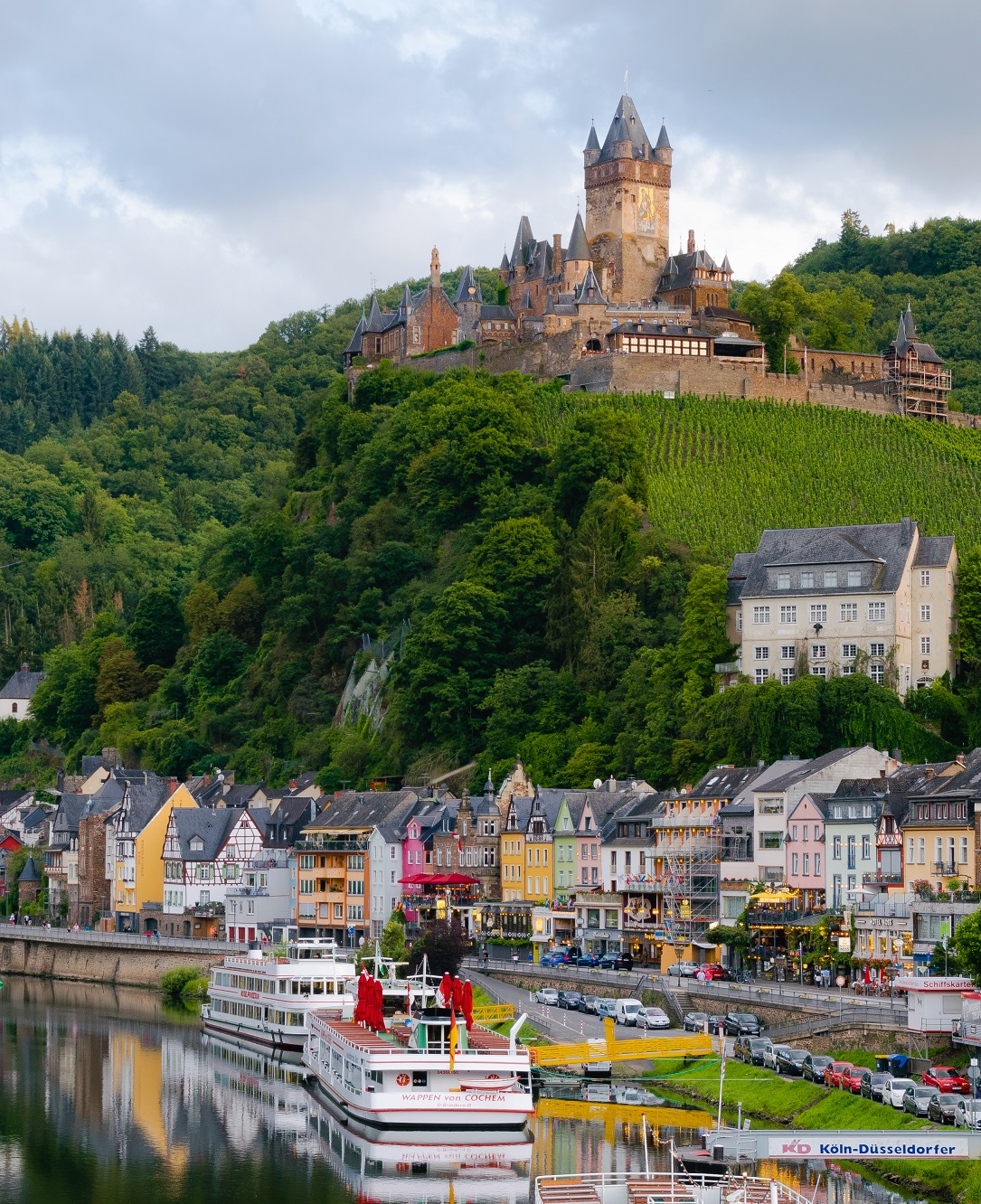
Reichsburg Cochem, a 12th-century castle on the Moselle that had fallen into ruins by the 19th century. In 1868 it was bought by the Berlin businessman Louis Fréderic Jacques Ravené and completely rebuilt.


Gwrych Castle, Wales, built in 1819 to 1825 for Lloyd Hesketh Bamford-Hesketh, these days largely an abandoned ruin. During World War II it housed 200 Jewish refugees, which must have been a strange experience for them.


Butrón is a castle in north-western Spain, an actual medieval edifice but completely rebuilt after 1878 by Francisco de Cubas.

Johnstown Castle, County Wexford, Ireland. This castle evolved from a 15th-century tower house, but everything you can see now was built in the nineteenth century for the Grogan Family.

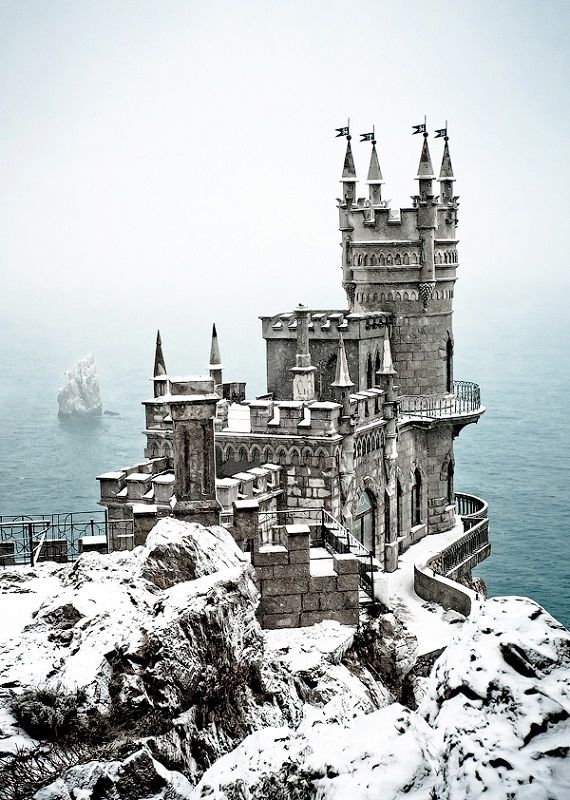
The Swallow's Nest, Crimea, built 1911-1912. Designed by Leonid Sherwood. Only two bedrooms, so you'll have do without the hordes of servants.


Schloss Hohenzollern, ancestral seat of the kings of Prussia. The first castle was built here in the early 11th century. This one was built for Frederick William IV between 1846 and 1867, and required the destruction of all the old stuff on the site. The king was a fan of both English Gothic Revival architecture and the Renaissance Châteaux of the Loire Valley, and he wanted something that looked like both. After, no doubt, much puzzlement and attempts to explain to his majesty about architectural styles, his architects came up with this wonder.

Midnight Monument Removal in New Orleans

At 1:25 AM on April 24, under heavy police guard, a city crew wearing bullet-proof vests arrived to remove New Orleans' "Liberty Memorial", a weird scene the city says was necessary because of death threats against anyone involved in the removal.

This was the first of four Civil War monuments that mayor Mitch Landrieu wants gone and the "most offensive" (his words) of the four. The city council actually voted back in 1993 to declare the statue a "nuisance" and get rid of it, but they were persuaded to let it be re-erected in a less prominent place. The monument was erected in 1891 to honor an 1874 rebellion by the White League against the post-Civil War government of the state, and it glories in the triumph of Jim Crow:
McEnery and Penn having been elected governor and lieutenant-governor by the white people, were duly installed by this overthrow of carpetbag government, ousting the usurpers, Governor Kellogg (white) and Lieutenant-Governor Antoine (colored). United States troops took over the state government and reinstated the usurpers but the national election of November 1876 recognized white supremacy in the South and gave us our state.
So, yeah, pretty offensive, and I doubt there would  have been much uproar about just removing this one.

I think Civil War monuments in general present a hard problem for an America in which issues of race and opposition to national government are still so powerful. Most of them were set up by Jim Crow governments as a way of connecting their own policies with the dead heroes of the war, so in that sense they were always intended to be political documents. I think the uproar that surrounds them shows that they still are; the removal of the average non-Civil War monument hardly merits a yawn. Some of the outcry against the Louisiana monument removals has taken the tone that this is just our history, worthy or remembrance right or wrong. New Orleans businessman Frank Stewart:
I ask you, Mitch, should the Pyramids in Egypt be destroyed since they were built entirely from slave labor? . . . The Colosseum was built by slaves, who lived horrible lives under Roman oppression, but it still stands today and we learn so much from seeing it.
Though this argument is correct, I don't think it really captures the situation with Confederate memorials. When the issues are live and the wounds raw, sometimes historical remembrance has to yield.

I have always opposed the removal of monuments to the ordinary soldiers of the Confederacy, since so many of them just served because their communities called on them. Hundreds of thousands of them died, thousands were maimed, and if their home counties and states want to honor their memory that seems appropriate to me. I agree with Mr. Stewart that the Civil War is one of the central events in our history, and that to erase it entirely from our public spaces would be an Orwellian act. Monuments to soldiers is one way, to me one of the less potentially offensive ways, to keep that connection to the past. But that doesn't mean we should keep every memorial.

The other three monuments that New Orleans has slated for removal are statues of confederate generals Robert E. Lee and P.G.T. Beauregard and president Jefferson Davis. Personally I have never understood why there was ever a monument in New Orleans to Lee, who never gave a damn about New Orleans or anywhere else except Virginia. He thought secession was a terrible idea and only joined the cause when his own home state seceded. He spent the whole war trying to block the transfer of men or resources from the east, where the Confederacy was doing pretty well, to the west where it was failing. So removal would at least get the history closer to right. Jefferson Davis has pretty much come to stand for the Confederacy and its politics, so I can see why that has to go.

But to me Beauregard is a hard case. Pierre Gustave Toutant-Beauregard is one of Louisiana's most famous historical figures, his magnificent name an ode to the state's non-Anglo origins. His character was also considered at the time to be more French than American, full of hot anger, great passions, and grandiose schemes. He was a key figure in the war, commander in two of its most famous battles. Before the war he was a firebrand for secession, but afterwards he was what passed for a moderate in southern politics, working against reconstruction but supporting basic civil rights for black citizens.

Plus I'm just the sort of traditionalist who likes public squares with old elm trees and statues of generals on horseback. If this monument goes, what are we going to get in its place? Some abstract monstrosity?

So if it were up to me I would try to find some way to keep Beauregard, if not in New Orleans then in some other part of the state. But I believe in democracy more than I believe in most other things, so if that is what the citizens of New Orleans have decided it is really their business and not mine.

Sunday, May 7, 2017

Scrap Metal and Basic Capitalism

Yesterday I made a trip to the county dump, excuse me, the Acceptance Facility to get rid of a deceased armchair (children are hell on furniture) and some other junk. This process has gotten a lot more complicated over the past decade because the county now has rules about what has to be taken where. For example, the facility closest to me (there are three) does not take "metal." By this they mean any piece of more or less pure metal that might be salable as scrap, viz., I once saw them reject a bicycle frame. But should you have rejected pieces of metal, fear not! You don't actually have to drive to the other end of the county to get rid of it. Because parked along the road outside the facility is always at least one truck with a sign on it reading "METAL." These small scrap scavengers will happily take whatever you have that the county has rejected, saving you the trouble of a long drive. And then pose for a picture so you can document how businesses spring up in the gaps left by government services in the US just as everywhere else in the world

Saturday, May 6, 2017

Sexual vs. Natural Selection

The sad story of the male club-winged manakin, which has evolved a way of "singing with its wings" that sounds lovely to the females but makes it a clumsy flier and may lead to its extinction.

Castle Duino

Castle Duino perches high on a rock above the Adriatic Sea, not far from Trieste in the region where Italy, Austria and Croatia come together in a jumble of islands and cliffs.


The first castle in this location was built in the 11th century by the Patriarch of Aquileia; now it is a picturesque ruin. Sources on the castle report that Dante stayed here for a while after he was exiled from Florence in 1301; but Dante's exile is poorly documented and placing him in various spots has been an Italian sport since Boccaccio did it in the Decameron, so I leave readers to make their own judgments about this particular story.

The old castle was abandoned in 1389 when the new castle was built. (View of the new castle from the old.) Construction of the new castle was ordered by a certain Hugh, the Captain of Trieste, about whom I can find out nothing. He died not long after construction was began and it was completed by his son in law, Rambert of Walsee.

From the Walsees the castle somehow passed to the Habsburgs, and really "somehow passed" is the best I can do; English wikipedia employs this splendid formulation: "Over time, the Wallsee family disappeared and the castle, after having been used as a prison, became the residence of the Luogar and Hofer." Italian sources explain that the castle was granted to Hofer von Hoenfels sometime in the later fifteenth century.

The castle has belonged to members of that same family ever since, although the names have shifted around because of inheritance by women. Since 1875 the owners have gone by the name of von Thurn und Taxis. This is one of the most famous noble houses in contemporary Europe, widely covered by the scandal press; current members include an editor of Vogue and a character known in her youth as the "Punk Princess." I find the coat of arms of this family fascinating. This crazy mishmash results from the old habit of "quartering" arms, that is, dividing the shield into four parts and putting the father's arms in two quadrants and the mother's in the other two. (As in the English royal arms and the flag of Maryland.) But von Thurn und Taxis has so many noble ancestors they feel they have to honor that their shield ends up like this.

Close-up of the center, which shows the family's origin. The "Taxis" part comes from the Italian "Tasso", that is, Badger, Thurn is from the German for Tower, and the lions represent the principality of Regensburg. The Tassos came from Milan and rose to prominence in the 15th century by organizing Italy's first reliable postal service, connecting Milan, Venice, and Rome. They later entered the imperial service and set up courier services connecting Madrid and Vienna to the Low Countries, Paris and London as well as Italy. From there they passed into the pages of Thomas Pynchon's novel, The Crying of Lot 49, which posits the von Thurn und Taxis postal service as a sort of underground, alternative power center to Europe's nation states, and no it doesn't really make any more sense in the novel. Great paranoid atmosphere, though.

But back to Castle Duino. In Europe's golden era the mistress of the castle was Princess Marie of Thurn and Taxis (née princess of Hohenlohe). She was a great patroness of the arts and among her proteges (and visitors to the castle) were the composers Dvorak and Smetana. In 1912 she had as her guest the German poet Rainer Maria Rilke, who had fallen into a deep depression and not written anything for more than a year. With her help he finished his autobiographical novel, which has been splendidly summarized as "in which a young poet is terrified by the fragmentation and chaos of modern urban life."

While walking along the cliffs near the castle he had the inspiration that became in time the cycle of poems known as the Duino Elegies. He heard, he said, a voice calling him from the mist, saying Wer, wenn ich schriee, hörte mich denn aus der Engel Ordnungen? ("Who, if I cried out, would hear me among the hierarchies of angels?") which is the first line of the cycle. Today you can walk the "Rilke Path" if you like, and hope that the mist will inspire you to write a famous literary masterpiece.


Then, horribly, awfully, sadly-beyond-words, World War I came. Standing near the border of Italy and Austria, the castle was caught up in the fighting and almost completely destroyed. This bit of the castle's history has been effectively buried and goes unmentioned on the castle's own web site and on English and Italian wikipedia.


But the owners, now transformed back into Italians by the magic of the Versailles Treaty, seem to have come through the war largely unscathed, and they immediately set about rebuilding the castle as much like it was before as they could manage, although presumably with better plumbing and wiring.

The castle remains in private hands but for twenty years or so it has been open to tourists and available for spectacular weddings and the like. Seems like an amazing place.

I will close with a bit of the Duino Elegies. These are difficult, very intellectual poems, hard to translate from German, and so not widely read. But some intellectual agnostics consider them among the most profound meditations ever authored on the question of how to live in a world without faith.

Why Live?

Not because there is happiness,
that rash profit taken just prior to impending loss,
not out of curiosity, or to give the heart practice,
reasons that would hold for the laurel too…

but because being here is so much, and because everything
in this fleeting world seems to need us, and
strangely speaks to us. Us, the most fleeting. Once
for everything, only once. Once and no more. And we, too,
only once. Never again. But to have been,
this once, if only this once:
to have been of the earth can never be taken back.

--Rainer Maria Rilke, Duino Elegies

Translated by Galway Kinnell and Hannah Liebmann

The promoters of the castle have take one line from this as their motto: Hiersein ist herrlich, being here is the wonder.

An Interesting Point about Education and Politics

I have always been skeptical of the notion that education transforms people. One reason for my skepticism is that no amount of schooling seems to have any effect on ideology. Well-educated conservatives may be conservative in a somewhat different way than ignorant conservatives, but they are still conservatives. And well-educated leftists gave us communism and anarchism.

Consider that in 2012, the exist polling showed that Obama won about 51 percent of voters with college degrees and 50 percent without, not a very stunning difference.

On the other hand, the most recent analysis shows that Trump won 42 percent of voters with college degrees but 51 percent without. (This analysis seems to show that the reason state polling was so far off in Pennsylvania, Michigan, and Wisconsin was that polling samples in those states were not normalized for education and simply polled too many college-educated people.)

I would be willing to bet a large sum that if we could break down Trump voters by enthusiasm, we would find that many more college-educated Trump voters held their noses while they did so, hoping that a Trump administration stocked with Republicans would somehow be better for than the country than Hillary despite their lack of trust in the man at the top. That is, I bet really strong supporters of Trump are even less educated than his voters as a whole.

So while education does not change many people from conservatives to liberals or vice versa, maybe it does empower people to recognize a complete fraud when they see one.

Murray Fredericks at Lake Eyre

Since 2003, Australian photographer Murray Fredericks has been hauling his camera and a square mirror out to Lake Eyre, a shallow desert salt late in the middle of nowhere even by Australian standards. Quite striking. More at This is Colossal.


Friday, May 5, 2017

Ancient Egyptian Funerary Garden Unearthed

Ancient Egyptian texts describe "funerary gardens" that were planted outside tombs, holding plants considered symbolic of death and the afterlife. There are even paintings and reliefs of these gardens on tomb and temple walls, like the one above.

Another.

Now Spanish archaeologists working in Luxor have uncovered one of these gardens. It measures about 2 by 3 meters (6.5x10 feet), and was placed in the courtyard of a rock-cut tomb. It dates to around 2000 BCE. Each grid square probably held a different plant; the two raised plants in the center probably held shrubs or small trees. The stump of one of these actually survived, a tamarind.

Digital reconstruction of the garden from the project's Spanish-language video.

Yet another way the ancient Egyptians managed to obsess about death and the tomb. What could explain the lavishing of such extraordinary resources on the dead? Once the tradition got started it would become the thing you had to do to uphold the honor of your family, establish the legitimacy of your dynasty, etc.; but how did it start, and why did it endure for so long?

More at The History Blog.

Terracotta God

Found underwater off Kerch in the Crimea, dated to the 5th century BCE.

Thursday, May 4, 2017

Cain and Lucifer

LUCIFER.
I pity thee in loving what must perish.

CAIN.
And I thee who lov'st nothing.

– Lord Byron, Cain

Rage in Portland

The organizers of Portland's Avenue of Roses Parade cancelled this year's event because of a threat of violence against one of the marching organizations, the Republican Party of Multonomah County. A threatening email was sent to the organizers, and a local weekly paper found this post on the Facebook page of a left-wing protest group:
The fascists know that we'll keep shutting their marches down, they are now planning to march within other parades to protect their message of hate and white supremacy - it WON'T work. Nazis will not march through Portland.

The group we're disrupting is #67. It is registered to the Multnomah County Republicans, but these infiltrators are the same folks from Lake Oswego, Salem, Vancouver, and even Berkeley. These are the folks that attacked a woman at PDX, they harassed Latinx parishioners with slurs and threats at a local church, they spew hate, threaten and curse young women at women's health clinics. They seek to intimidate and harass our Latinx, Muslim and LGBTQ+ neighbors and friends. Their Trump flags, their red MAGA hats and their hate group badges are all intended to normalize support for an orange man who bragged about sexually harassing women and who is waging a war of hate, racism and prejudice against our Muslim, Latinx, Black and Native neighbors. They will attempt to march from the Eastport Plaza to Yamhill, but nazis will not march through our city.
The inability to distinguish Democrats from Communists, or Republicans from Nazis, is a serious mental error that seems to be all too common in our partisan age. But I'll keep saying it until I run out of breath: if you cannot live with your political opponents, you cannot have democracy.

Why Not?

I thought this brief thought from a French voter summed up a lot about contemporary politics:
“Why not try Le Pen? Macron won’t do anything for us. He’s just twisting and turning like a flag in the wind,” she added.
Macron is a sort of boring centrist who has no grand ideas, but gets the support of the French elite as someone who at least understands economics and wants to remain in the EU. The response from this ordinary voter is, if the establishment has nothing to offer but more of the same, why not try a radical change? Why not try someone who seems to believe in something?

This sort of thinking is an ever-present danger to democracy. My sons expressed similar sentiments last Fall, which led me to give them a little lecture about Venezuela: just because things aren't great doesn't mean they can't get a whole lot worse.

Wednesday, May 3, 2017

More Albertus Pictor

Back in March I wrote about Albertus Pictor, an artist active in Sweden between about 1460 and 1509. That first post featured paintings from just one church; this post is a grab bag from others.

Chess with death.

Bears eat the naughty boys who mocked Elisha.

The Wheel of Fortune. Again, what I love about these are their ordinariness. These are the stories and images that ordinary medieval people knew. The Wheel of Fortune was not just a literary concept tossed around by Dante and Chaucer and the like, but an idea that most people would have understood.


Beasts.


Some overall views of the churches. Many more at the Swedish site decided to the 500th anniversary of the artist's death.

The Question about America's Political Future

Is demographics destiny?

Consider the suburbs of Atlanta, in the news because a Democrat has a chance to win a formerly deep red congressional seat:
At first blush, Johns Creek might be mistaken for the perfect example of a white-flight Sun Belt suburb. Just over a decade old, the city of 83,000 sits squarely in the congressional district once represented by Newt Gingrich, with excellent public schools and master-planned communities so pristine they could have been built by a model train aficionado. In 2015, the all-white City Council rejected the idea of expanding public transit out from the majority-black city of Atlanta, some 25 miles to the south, on the grounds that it “would increase high-density housing.”

But something has been happening in Johns Creek — and, indeed, across much of the vast archipelago of cul-de-sac communities north of Atlanta that served as the launchpad for Mr. Gingrich’s 1994 Republican revolution. The promise of a suburban idyll has been increasingly attracting all kinds of people — many of whom are not white, and not Republican. . . .

Ms. Enjeti, who moved to Georgia 10 years ago from Pennsylvania, is among the 24 percent of people in Johns Creek who are of Asian heritage. Today, Indian-Americans shop for saris at the Medlock Crossing strip mall and flock to the latest Bollywood hits at the multiplex. Chinese-Americans and food lovers of all stripes head to the Sichuan House, near the Target and Home Depot stores, for sliced pork ears in chili sauce and “tearfully spicy” mung bean noodles.

Indeed, the northern Atlanta suburbs, once considered bastions of Republicanism, are experiencing an identity crisis. . . .
So the question is, will the new Asian, Hispanic and black residents of these suburbs continue to vote their ethnicity, or will they change over time into more typical suburbanites?
Republicans here reject the idea that demography is political destiny. Instead, they envision a future in which the charms of suburban life, and the conservative politics that made it possible, will rub off on everyone. Instead of the newcomers changing the suburbs, they say, the suburbs will change the newcomers.

“You move to Cobb, you’ve got a good job and cheaper property taxes, and you say, ‘Hey, maybe this is a better way,’” said Michael Altman, 58, a former vice chairman of the Cobb County Republican Party.
In the short term ethnic identity will rule, as it usually does. But in the long haul I can see things playing out exactly as Altman suggests, especially for Asians. The danger that the Republicans face in embracing Trump's ethnic nationalism is that it will block that process and turn generations of Asians and Hispanics into loyal Democrats, ready to accept higher taxes and so on if that is what it takes to fight people who don't believe they belong.

Tuesday, May 2, 2017

The Blue Monster

Mural from a thoroughly looted Tang Dynasty tomb, probably 7th century CE.

Today's Strange Fact about 1960s Pop Culture

Marginal Revolutions, from Rob Sheffield's new Beatles book. The Love Story of One Band and the Whole World:
For a while Stanley Kubrick was planning on making a movie version of Lord of the Rings with Paul McCartney as Frodo, Ringo Starr as Sam, and John Lennon as Gollum. George Harrison was to be Gandalf.

The Auto Technician Shortage

Everyone agrees that America has a big shortage of good jobs you can get without a college degree. Yet I regularly encounter stories about companies or even whole industries unable to hire enough people for the good blue-collar jobs that do exist. I recently listened to an architect deliver a 5-minute rant about how hard it is to hire anyone who can install an alarm system properly. In the course of this rant he explained part of the reason for the technician shortage: the alarm systems he was talking about connect to both phone and internet lines, as well as to the building's electricity supply, and therefore installing them requires a high level of technical expertise. The technology is also changing very rapidly, so skills quickly become obsolete if not regularly updated. In other words the job requires an ability to learn and keep learning that could equally well be applied to getting a college degree, and our society puts huge pressure on anyone who could finish college to do so. Hence, not enough skilled alarm techs.

I was put in mind of this by a story in today's Times about the shortage of high-level auto mechanics:
The shortfall of automotive technicians is not new, but as vehicles have grown more computerized and vocational programs have disappeared from high schools, the situation has become more urgent. No longer is the career path a matter of looking over the shoulder of a patient mentor. Advancing in the profession demands digital skills — a diagnostician who can solve puzzles without physical clues, like an engine bearing that knocks or an axle shaft that vibrates.

John Fox, director of Fiat Chrysler’s Performance Institute, said that the automaker’s United States dealerships could absorb 5,000 technicians over the next two years, having hired 3,000 in the last two. Numbers of that scale give Mark Davis, automotive programs manager at Seminole State College in Sanford, Fla., confidence that his estimate of technician shortfalls — more than 25,000 at American dealerships over the coming five years — is actually quite conservative. Worse yet, there may not be enough training institutions in the country to keep up, Mr. Davis said.
That's 25,000 jobs just at car dealers, positions that pay up to $100,000 a year. The story identifies three obstacles to connecting young people with these jobs: first, the technical difficulty; I know a young man who is pursuing this career, and he has spent four years taking various programs at the local community college. Second, because young people don't grow up tinkering with engines the way they used to; modern cars are just too complex for the average tinkerer to get very far, and anyway those kids are all online playing Call of Duty instead of messing around in the garage. Third, because high schools don't teach this stuff any more.

That last is not entirely true, and there are still vocational schools and programs that teach mechanics and similar skills. But to the extent that it is true I find it infuriating. The weird push American educators have been making to send everyone to college is foolish and self-defeating. There just aren't enough jobs that require a college degree to make this economically sensible, and while I found college hugely enriching and mind-expanding that just doesn't seem to be true for many thousands of students. Instead of forcing all high school students to become "college ready" and funneling hundreds of thousands into colleges from which they will never graduate, we ought to be teaching them knowledge they can use. I do understand the class bias and so on involved here, and I understand which sorts of kids are slotted into vocational programs. But forcing young people to study academic subjects that interest them not at all strikes me as just indulging a different sort of bias, besides the vast waste of teaching skill and other resources.

An educational system should do a lot of things, but one of the key goals should be equipping people to support themselves and their families.

UPDATE

It occurs to me that there is also a geographical angle to this story. Most of those high-paying auto dealer jobs are in the places where lots of people drive expensive cars, that is, prosperous cities. So to get one of these jobs a small town kid has to learn all the skills and then quite likely move a long way from home, which another sort of obstacle.

Monday, May 1, 2017

The Federal Budget

Today's big news:
Bipartisan congressional negotiators reached a critical agreement late Sunday on a massive spending bill that if approved by the House and Senate would fund the government through the end of September, senior aides from both parties told CNN.

The plan would add billions for the Pentagon and border security but would not provide any money for President Donald Trump's promised border wall with Mexico, Votes in both chambers are expected by the end of the week. . . .

The bill has $1.5 billion for border security, including for technology and fixing existing infrastructure but it doesn't allow the money to spent on building Trump's wall. There is no money provided for a deportation force and there are no cuts of federal monies to so-called sanctuary cities. . . .

Aides also agreed that the bill includes billions in new defense spending, including for the global war on terrorism, a major demand from Republicans.

In the proposal, there are no cuts to funding for Planned Parenthood, a demand from Democrats. Funding for the National Institute of Health is increased by $2 billion and there is additional money for clean energy and science funding.

Negotiators also agreed to make a permanent fix for miners health insurance and to provide $295 million for Puerto Rico Medicaid. There is also disaster aid package that includes funding for California, West Virginia, Louisiana, North Carolina. There is increased funding for transit infrastructure grants and to fight the opioid epidemic, and year-round Pell Grants were restored.

Talks had also stalled over a threat by Trump to cut off Obamacare subsidies paid to insurance companies to reduce the out-of-pocket expenses of some lower-income users of the Affordable Care Act, but Trump backed off that demand in the face of harsh criticism from Democrats. The subsidies will stay in place as Republicans continue their long-stalled effort to repeal Obamacare, something Trump and his aides hope to revive as early as this week.
So, no real changes. The Democrats accepted Republican demands for more defense funding and more border security, but in return insisted on no real cuts to domestic spending. Republicans agreed to keep Obamacare running until they have an actual replacement plan. Life goes on.

Of course the negotiations on the next budget are already under way.

"Prioritizing These Three Things" Etc.

This article by Colby Itkowitz summarizes some lessons she took from talks she heard at the TED conference. Her piece is titled "Prioritizing these three things will improve your life — and maybe even save it." The three magic lessons and my responses are as follows:

Face-to-face social interaction leads to a longer life
This one is pretty well established and has been for decades, although of course there are problems with causality; maybe the people who don't socialize and die younger don't socialize because they are already sick. Anyway it seems to be true that how much you socialize with others is a better predictor of how long you will live than your weight or how much you exercise. The life-extending effect doesn't require that you have close friends, just that you get out and interact with somebody. This was a truth about life I resisted when I was young and passionately hated casual conversation with strangers or acquaintances. At the time I thought this was a personal quirk but I have since discovered that a dislike of chitchat and a longing for deeper, more meaningful interactions is extremely common, especially among the young. It was only as an adult, having shed much of my youthful self-consciousness, than I began to find pleasure in ordinary human interactions.

Knowing when to turn off your smartphone enriches your life
I don't know about this one. Yes, there are recent studies that show people who spend more time on social media are less happy, but 1) this is just a few recent studies and we could find a few studies to prove anything, and 2) maybe the causality is reversed and it is the loneliest, least happy people who spend the most time on Facebook. (On average, that is.) The obsessive worry about "missing something" that drives some people to check their phones every minute is a common symptom of depression, especially anxious depression. But I would accept as general principles both that online interaction cannot, for most people, substitute for interaction in person, and that there is a whole lot of unhealthy crap online that most of us are better off staying away from. The best uses you can make of your devices are to learn new things and to arrange to get together with your friends.

Chasing meaning, not happiness, is what really matters
This is one of those pieces of advice that is both universally accepted and all but useless. Granted that meaning is a better thing to chase than happiness, what are you supposed to do about it? Suppose that you find yourself thinking, "what could I do tonight that would be fun?" but then you stop yourself and ask instead, "what could I do tonight that would be meaningful?"

You see the problem.

This was from a talk by Emily Esfahani Smith, who distinguishes four forms of meaning: belonging, purpose, transcendence and storytelling. Belonging, sure, it's great to have family and friends and places we feel like we belong. But it is unavoidably true that for many people home and family are ambivalent concepts, riven with pain and disappointment; and it is also true that finding alternative places to belong is one of the hardest things in life.

Purpose is sort of a synonym for meaning, which doesn't help us much, but Smith says that many people find it in work. Here we fall into the trap set by the modern economy, that we both need work and are destroyed by it, since so few of us ever find work that both engages our full abilities and feels genuinely useful. I think work is one of the great puzzles of our age, in that we often hate it but flounder without it.

For those of us who can't stomach organized religion, the pursuit of transcendence is another very hard puzzle; where are we supposed to look? Yes, I have my ways, which I write about here all the time, but there isn't anything simple or particularly helpful about this suggestion.

Storytelling is certainly a universally human thing, and some studies suggest that turning your life into a narrative can help you get a grip on things. I am a little dubious about this because in my experience many organizing narratives are little short of lies. Consider some of the narratives political activists use to infuse their work with meaning: America has to be turned around immediately or our civilization is going to slide off a cliff! Or, from my perspective, the religious narratives that involve god sending you this or saving you from that. Or the victim narrative, that everything wrong with you is because you suffer from Catholic guilt or are oppressed by the man or can't succeed because your parents didn't really believe in you. If this sort of thing works for you, great, I guess, but I am enough of an existentialist to think that there is something wrong with buoying ourselves up using made up stores about our worlds.

I don't mean to mock the pursuit of meaning; if you know where to find it, go get it. But it has in common with most other formulas for the good life that 1) if people knew how to do it they would be doing it already, and 2) sometimes the long-term pursuit of meaning traps you in metaphysical tunnels from which there is no practical escape. Suppose (like me) your idea of meaning has a lot to do with home and family. This requires you to have a job, and to keep at it year in and year out even if it no longer provides you much sense of purpose; the mortgage still has to be paid and all those young ones fed. That is, the big choices in life carry with them huge repercussions, which (it seems to me) cut against the notion that we could just read an article like this and shift our lives in some meaningful direction.