Wednesday, November 2, 2011

Ai Weiwei

Ai Weiwei may be China's most famous dissident -- in fact he may be the only Chinese dissident many westerners can name, especially western art lovers. He is certainly China's most famous artist. He is famous both for his inventive installations, films, and photographs and the long game of chicken he has played with the Chinese authorities. For years he danced along the limits of what was acceptable, goading the government and sometimes frankly daring them to arrest him. And arrest him they have, most seriously this past April, when he was seized at the Hong Kong airport and disappeared for 81 days. He was released after making a deal that (it is reported) included a promise to stay off Twitter. He is back on Twitter now, releasing frequent sarcastic remarks about corruption and stupidity in official China. (A recent example: "In the battle between creating evil laws and creating good laws, speaking out is golden and silence is death.") The secret to Ai's long-term survival must be that he, like Soviet writers in old times, actually has many fans in the party elite. Nationalist Chinese enjoy having an artist who can draw big crowds to museums in London, Paris and Tokyo, and they surely respect Ai's courage and cleverness.

Ai is back in the news today because Chinese authorities say he owes $2.4 million in back taxes, which he says is ridiculous, and are threatening to jail him (again) if he does not pay. It will do much to sum up my attitude toward Ai to say that I bet he is guilty on this charge. You can't glance at an art magazine or web site these days without seeing news about the opening of another Ai exhibit somewhere in the world. He is a gigantic star of the international art world, and such people earn millions a year. Can it really be that Ai, given his contempt for the Chinese government and his love of tweaking them in any way he can, is really paying all the taxes he owes on his foreign income? (The images above are from "Studies in Perspective," a series of photographs showing Ai holding up his middle finger to the top symbolic monuments of a dozen countries.)

I guess I don't really know about the tax issue, so I won't say any more about that. But Ai Weiwei is a strange character and the adoration heaped on him by western art fans has dubious origins. Ai is a real rebel who takes actual risks with his creations, and that gives him a cachet that phoney rebels in New York or Berlin have trouble matching. Who cares if Ai's art is any good? My personal thought is that he has churned out so much diverse stuff so fast that it is hard to get a handle on what is serious and what is not, or even how much he personally contributed. Ai is a notorious jokester whose production company is called Beijing Fake Cultural Development Ltd., and he seems to laugh off questions about his standing as an artist. Is a work like his pile of 100 million porcelain sunflower seeds, which museum goers were invited to walk on, humorous or serious? One critic said they symbolized China's downtrodden masses, but that is just a guess; I can't find the quotation, but once when he was asked about this work Ai said he was just hoping that someone would mistake the seeds for real and break a tooth on one. (A pile of a few thousand of these seeds recently sold at auction for $600,000.) His fans say this is a necessary part of his political struggle, allowing him to disavow many of his rebellious gestures and statements, but surely it is also a major part of his character.

Here, via Wikipedia, is a good example of Ai's jokey artistic rebellion:


The caption(草泥马挡中央, "grass mud horse covering the middle") to Ai's self-portrait sounds almost the same in Chinese as 肏你妈党中央, "Fuck your mother, the Communist party central committee".
Ok, that's funny, and it's a good dig at the Chinese authorities, but in what sense is it art?

Which brings me to the real question: Does "art" exist as a category anyway? Ai's biggest assets in his career are his battle with the Chinese authorities, his gift for getting attention, and his sense of humor. Do the images and objects Ai creates as part of his struggle matter at all, except as gestures of rebellion? By admiring Ai's works, are people doing anything other than expressing solidarity with his political struggle and admiration for his character? Is there such a thing as Ai Weiwei's art, separate from his life and politics?

Here is one of Ai's most famous works, three images from a short film titled "Dropping a Han Dynasty Urn." Nothing like the smashing of a 2,000-year-old relic to get a little attention; and how does this differentiate Ai from a Chinese government that smashed millions of historical objects? Or is that the point? Beats me.

This is my favorite Ai work, Zodiac Animals, which has been displayed all over the world. I find it interesting that none of the descriptions of this work explain where these heads came from; did Ai sculpt them? Are they casts of traditional Chinese images? Three-dimensional renderings of drawings by Ai, traditional Chinese images, or drawings by someone else? Nobody seems to know, and it doesn't seem to matter. By displaying them together with his name on them, Ai has made this his work.

I am on Ai Weiwei's side in his battle with the Chinese government, which (I think) is being quite stupid by taking Ai so seriously. If they just ignored him, his relevance would fade. (He is much more famous since he was arrested than he ever was before.) But he is able to goad them in ways they can't resist responding to. It is important to remember, though, that he is going out of his way to goad them. I got no sense of oppression in China. So far as I could tell, most Chinese people rarely think about the government one way or the other, except in very local matters. Ai is seeking out a battle with the government, and I suspect he is doing so for reasons of vanity as much as anything else. Perhaps it is necessary that someone challenge the Chinese system before it will reform, since, as I said, most Chinese people don't seem interested. But rebels have complex motives, among which a desire to thrust themselves forward is often prominent. Ai wants to make waves, and he is.

I think the most positive way to see Ai Weiwei would be to imagine him as a Trickster, a mythic figure laughing and joking his way toward profound change. Perhaps there is much truth in this. But perhaps also he is a vain self-promoting climber who constantly mocks both the Chinese authorities who struggle to keep him down and the western art lovers who eat up his rebellious creations. It seems to me that this is ever the way with the most important people. Simple goodness never leads to greatness, and monstrous vanity is often part of the complex of qualities that does. I admire Ai Weiwei, and like some of his work. But I am suspicious of the way he has goaded the Chinese government into helping make him an international art star, and very dubious about the motives of westerners who hail him as a great artist.

Tuesday, November 1, 2011

Salewa Headquarters, Cino Zucchi Architects

This is certainly striking. New headquarters for manufacturer of outdoor gear, in Bolzano, Italy. By Cino Zucchi Architetti.

The architects say:
The new Salewa Headquarters, one of the most prominent manufacturers in Bolzano, is situated in an exceptional location adjacent to the Bolzano highway suggesting a “landscape” building, in formal dialog with the surrounding steep cliffs. As well as housing new work spaces and an indoor climbing gym, the building aims to provide a space for interaction and communication between the company and its network of suppliers, partners and clients. The new headquarters represents a point of convergence between different elements of everyday life: from physical, social and communicative dimensions to work styles and leisure. The Salewa headquarter is formed by a series of multifaceted slabs and towers, including a 50 metre-high structure which when built will be the tallest building in the city.
My only criticism is that I would have thought an outdoor company might have gone for a greener building, at least one well served by public transportation instead of alongside a highway. But I don't know that I have ever seen a cooler-looking office building.


They're Baaaack

The vultures that spend the winter right down the road from me, that is. Sorry about the lousy picture but trust me, those are turkey vultures.

The Golden Temple

Diwali at the Golden Temple in Amritsar, India.

High Speed Rail in California

The new estimate for the cost of building California's high speed rail system is $98 billion, up from the original estimate of $65 billion. No surprise there; the costs of big projects always rise over their history, especially when they involve new technology.

Even if the cost rises to $200 billion, I still say it is a better way of spending our money than the trillion dollar war in Iraq. Or than new highways.

You know, they used to have a brightly colored, easy to read map, but they ditched it in favor of this soothing blue and green thing. Some consultant probably told them that hot colors only added to the anger of opponents, or something.

The Gothic Tour of Italy

Nina Burleigh in the Times:
“Italy was the Gothic writers’ favorite background,” wrote Massimiliano Demata, a professor at the University of Bari, who has made a study of the form. The country’s baroque portas, ruined castles, eerie reliquaries and catacombs were a gateway to the uncanny, possessing, as he put it, “a labyrinthine and claustrophobic architecture that was the novels’ perfect physical and psychological setting.” Today, these same books can serve as unconventional guidebooks for tourists who tire of the sun and want to explore the country’s macabre past. . . .
Above, The Lower Church of Santa Maria delle Anime dell Purgatorio.

Monday, October 31, 2011

Happy Halloween 2011

The best reason to keep having more kids.

The American Dream

She wanted what we all want—to be totally unique while being completely accepted.

--Shelton Williams, on his cousin Betty Williams

Drusus' Camp, or, When the Romans Tried to Conquer Germany

Back in the nineteenth century, a bronze Roman helmet (above) turned up near the town of Münster in the Ruhr Valley of western Germany. This sparked a great deal of speculation and a century-long search for the site from which the helmet came. German archaeologists are reporting this month that the site has been found, a Roman camp from the reign of Augustus. Among the finds are potsherds, numerous coins and many bits of Roman gear. The camp is near the village of Olfen on the Lippe River. They think it dates to the campaign of 11 to 7 BC when Drusus, one of Augustus' sons, was commanding Roman attempts to conquer Germany to the Elbe. The camp is rather small, suitable for about 1000 men, so it was not the headquarters of a Legion; perhaps it was a supply depot.

Castle, anyone?

According to The Local, there are several historic castles for sale in Germany; this one, Burg Möckmühl in Baden-Württemberg, was just purchased by Russian magnate Alexander Dragilev. The very weird text of this story, which has a machine-translated feel, says that prospective castle buyers are looking for different things:
Some people want it to look mediaeval, some people want an elegant countryside castle with lots of light and high ceilings. Some people might want something a little darker, more of a classic Dracula castle.
Put me down for a lonely tower on a windswept crag.

Sunday, October 30, 2011

Inside the Mind of an Octopus

Nice article by a biologist on octopus intelligence:

In another experiment, Anderson gave octopuses plastic pill bottles painted different shades and with different textures to see which evoked more interest. Usually each octopus would grasp a bottle to see if it were edible and then cast it off. But to his astonishment, Anderson saw one of the octopuses doing something striking: she was blowing carefully modulated jets of water from her funnel to send the bottle to the other end of her aquarium, where the water flow sent it back to her. She repeated the action twenty times. By the eighteenth time, Anderson was already on the phone with Mather with the news: “She’s bouncing the ball!”

This octopus wasn’t the only one to use the bottle as a toy. Another octopus in the study also shot water at the bottle, sending it back and forth across the water’s surface, rather than circling the tank. Anderson’s observations were reported in the Journal of Comparative Psychology. “This fit all the criteria for play behavior,” said Anderson. “Only intelligent animals play—animals like crows and chimps, dogs and humans.”

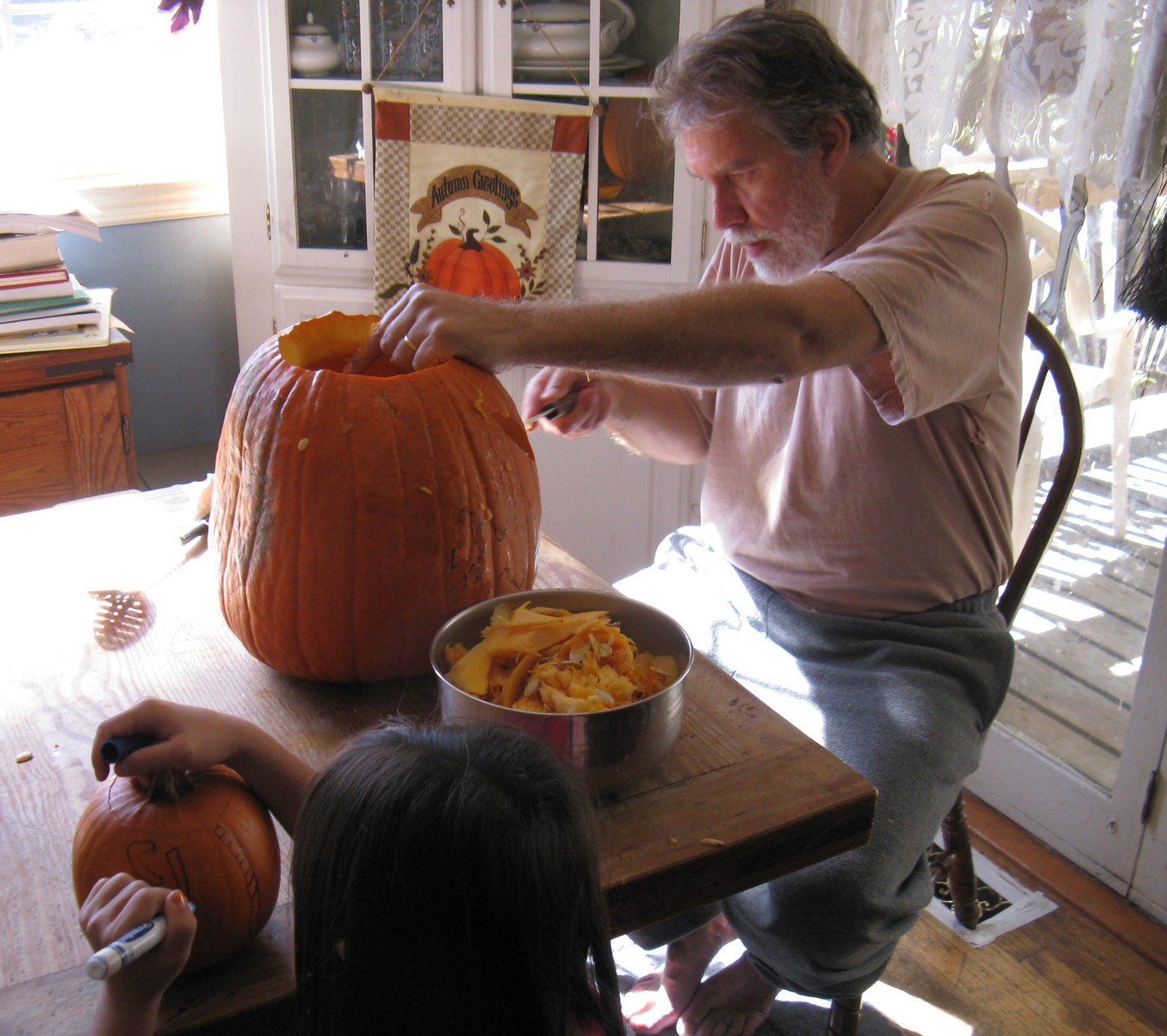
Pumpkin Carving

I carve the big pumpkin while Clara works on the face for hers.

The results.

The Colors of Fall

Today in our woods, the colors were at their peak under a gorgeous blue sky.

Still Mired in the Persian Gulf

American combat troops will be out of Iraq by the end of the year. But the US establishment is still very worried about the situation in the Gulf, especially the possible threats of renewed civil war in Iraq or aggression by Iran. So we are positioning more US forces in other countries, especially Kuwait and Bahrain, and intensifying our defense ties with the Gulf Cooperation Council — Saudi Arabia, Kuwait, Bahrain, Qatar, the United Arab Emirates and Oman. This means an ever closer relationship with the thugs in Bahrain who were so recently shooting protesters and have jailed all the leaders of the opposition, as well as their abetters in Saudi Arabia. I hate this but I do understand the possible problems of withdrawing from the area altogether. Perhaps in the future Iraq will develop into a stable state that will have decent relations with both sides and can help maintain the peace. But even if that happens, it will take a while.

Reduce Spending on Nuclear Weapons

Now that both parties seem committed to cutting government spending, how about we save money on nuclear weapons? It's not like we're ever going to use them, and the amounts we still spend on our arsenal are not trivial. The Times:
Twenty years after the end of the cold war, the United States still has about 2,500 nuclear weapons deployed and 2,600 more as backup. The Obama administration, in an attempt to mollify Congressional Republicans, has also committed to modernizing an already hugely expensive complex of nuclear labs and production facilities. Altogether, these and other nuclear-related programs could cost $600 billion or more over the next decade. The country does not need to maintain this large an arsenal. It should not be spending so much to do it, especially when Congress is considering deep cuts in vital domestic programs. . . .
To get Republican senators to vote for the New Start treaty with Russia, the Obama administration promised all sorts of useless spending on the nuclear arsenal:

He promised to invest an extra $85 billion over 10 years for the nuclear labs to maintain and modernize the arsenal, including overhauling thousands of older bombs that should be retired. He proposed spending $125 billion over the next decade for a new fleet of nuclear-armed submarines, 100 new bombers, a new land-based intercontinental ballistic missile and two other missiles.
Which is just dumb. If the budget has to be cut, why would even Republicans want to save nuclear weapons at the expense of tactical fighters and army brigades that we might actually use? Much of the Pentagon is on board with cutting nuclear spending, especially the Army and Marines. Of course savings in this area don't happen right away, because decommissioning nuclear weapons costs a lot, but the Times came up with ways to save $100 billion over the next ten years.

Frost

Yesterday's Nor'easter gave us a miserable day of rain, sleet, and falling snow, but the temperature stayed above freezing and nothing stuck. Last night, though, the cold crept in behind the storm, bringing the gardening season to an end. This is right on schedule for us; the first frost here is almost always with a few days of Halloween.

Saturday, October 29, 2011

The Queen of the Inch

In the 1950s a tenant farmer on the tiny Scottish island of Inchmarnock hit a stone slab with his plow. This turned out to be the cover of a 4,000-year-old, stone-lined tomb.

Within was a single burial, a middle aged woman who became known as the Queen of the Inch. She had only a few grave goods, but among them was a spectacular jet necklace (above). The queen was dug up, examined by archaeologists, then (in the 1960s) reburied. In 2006 she was dug up again so her bones could be studied using modern techniques, and last year she was reburied again.

This time a reconstruction was made of her face, by the usual forensic method. Isotope analysis of the bones showed that she ate a mostly land-based diet, and that she probably grew up in the Scottish Isles.

Lord Smith of Kelvin, who owns the whole island, had this to say about the investigation and the reburial:
It right that she goes back. When you speak with the researchers and scientists, obviously they wanted her for a period of time. But I was always clear that once they had actually looked at her properly, because we all need to understand what her forebears were like and what they did and so on, she had to go back. It's where she belongs and it's where she was buried and that's where she's going back to, to rest for ever.
Bravo for him.

The Real Nostradamus

If you are curious about who Nostradamus was, I highly recommend this article by Colin Dickey in Lapham's Quarterly. Nostradamus got his start as a plague doctor -- which perhaps explains his obsession with doom and destruction -- then began publishing almanacs. The France of the 1550s was experiencing one of the worse episodes of cold that marked the Little Ice Age, so Nostradamus' grim predictions turned out to be more accurate than anyone else's. This brought him to the attention of the notoriously superstitious queen, Catherine de Medici, for whom he prophesied various catastrophes. Since her reign saw all manner of disasters, Nostradamus once again came closer to the mark than any of the usual flattering royal astrologers. Then came the moment that made his reputation forever:
During a festival on June 30, 1559, Henry II took part in a jousting match, during which a freak accident occurred: his opponent, Gabriel Montgomery, broke his lance on Henry’s shield, and a sliver of the wood shot up under the king’s helmet and lodged above his eye in his brain. Henry bore it bravely, but lingered in agony for ten days before he died.

Now many at court, mourning and looking for answers, turned to the thirty-fifth quatrain in the first Century of the Prophecies:

The young lion will overcome the old
On the field of battle in single combat:
He put out his eyes in a cage of gold:
Two fleets one, then to die a cruel death.

Skeptics could protest that Montgomery may have been only six years younger than Henry—and not exactly “young”—or that Henry’s helmet was probably not made out of gold, or that the splinter in his brain did not actually enter his eye, or that no “fleets” of any kind were involved. But none of those arguments, then or now, mattered to those who—most notably Catherine herself—were convinced that Nostradamus had foreseen the king’s freakish demise.
So if you want to get taken seriously as a prophet, be sure to predict lots of awful things, in a way that might apply to lots of disasters.

Shakespeare and the Power of the Counter Narrative

Stephen Marche on the new film Anonymous:
“Anonymous” subscribes to the Oxfordian theory of authorship, the contention that Edward de Vere, the 17th earl of Oxford, wrote Shakespeare’s plays. Among Shakespeare scholars, the idea has roughly the same currency as the faked moon landing does among astronauts. . . .
(Which goes on my list of the best similes ever.)
I fear that the attraction of the Oxfordian theory, to people who don’t know any better, may be profound. Counternarratives have an inevitable appeal: wouldn’t it be cool if there were yetis? If the United States Army were keeping extraterrestrial remains in the Nevada desert? If aliens with powers beyond our imagination built the pyramids? If Shakespeare wasn’t Shakespeare but actually this, like, lord who had to keep his identity secret?
There is in our species a deeply suspicious strain. Some people, when they find that a theory is supported by the establishment, immediately look for alternatives: if THEY say it, it can't be true. Counter narratives have a magical appeal to their possessors, who feel that they know the secret to which the rest of us are oblivious. Through the possession of this knowledge they become members of an elite. They are revolutionaries of thought, seeing both farther and deeper than the rest of us. Sometimes they may ever be right. But as Marche points out, some counter narratives are just stupid:
The problem is that not everybody does deserve a say. Just because an opinion exists does not mean that the opinion is worthy of respect. Some people deserve to be marginalized and excluded. . . . Somebody here is a fraud, but it isn’t Shakespeare.

The Bolshoi Reopens, or what "Grand" Really Means

The Bolshoi Theater, a symbol of tsarist grandeur that was never properly repaired after World War II and had been slowly decaying into a ruin, has been fully restored and re-opened. The restoration took six years, marred by accusations of embezzlement and gigantic cost overruns, but to me the results look well worth $760 million. What modern theater can compare to this?

Besides, this is the building where Swan Lake was premiered, where the famous Bolshoi company got its start; why would Russia, where they still love dance, want to lose that? Not to mention that high-end, artistic tourism is big business in Russia, and now a ballet performance at the Bolshoi can be added to tours that visit the Hermitage Museum and other cultural sites.

Like the French "grande", "bolshoi" means both "big" and "great," and this building is a primer in what "grand" means. When I look at the public architecture built since World War II I get a sense of retraction, almost of shame. The Victorians knew how to build really grand public buildings: the US Capitol, the great railroad stations, the British Museum, the Library of Congress, and so on. Today we seem to lack an architectural vocabulary for expressing vast public ambition. I suppose contemporary architects consider this sort of decorated neoclassicism inauthentic in our world. And I do understand that to build, today, in this style would be to invite ridicule on the grounds of kitschy ultra-conservatism. But if the alternative is bland boxy modernism that looks like a Walmart, give me kitsch. And preserve and restore the remaining masterpieces of the era when this did seem like an authentic expression of the national spirit.


Friday, October 28, 2011

Indian Palaces II: Gwalior, Rajasthan

The site of Gwalior has been fortified since the 8th century, but this amazing fort was built by Man Singh in the early 1500s.

The Hathi Pol, or Elephant Gate.

Surely this is one the world's most beautiful curtain walls.

A remarkable Hindu temple on the interior.

Roman Boyhood, or, Some Things Never Change

We saw some small boys fiercely competing at a game of throwing shells into the sea. The game is to pick a shell from the shore which has been rubbed smooth by the waves. You hold the shell flat with your fingers, and stooping at an angle and low to the ground, you spin it over the waves as hard as possible, so that it may either strike once and glide smoothly across the sea's surface, or flash and leap as it skips again and again along the tips of the waves. The winner is the boy whose shell travels furthest, and skips the most times.

--Minucius Felix, Third Century AD

The Pope Reaches Out to Agnostics

Benedict XVI in Assisi, this week:
In addition to the two phenomena of religion and anti-religion, a further basic orientation is found in the growing world of agnosticism: people to whom the gift of faith has not been given, but who are nevertheless on the lookout for truth, searching for God. Such people do not simply assert: “There is no God”. They suffer from his absence and yet are inwardly making their way towards him, inasmuch as they seek truth and goodness. They are “pilgrims of truth, pilgrims of peace”. They ask questions of both sides. They take away from militant atheists the false certainty by which these claim to know that there is no God and they invite them to leave polemics aside and to become seekers who do not give up hope in the existence of truth and in the possibility and necessity of living by it. But they also challenge the followers of religions not to consider God as their own property, as if he belonged to them, in such a way that they feel vindicated in using force against others. These people are seeking the truth, they are seeking the true God, whose image is frequently concealed in the religions because of the ways in which they are often practised. Their inability to find God is partly the responsibility of believers with a limited or even falsified image of God. So all their struggling and questioning is in part an appeal to believers to purify their faith, so that God, the true God, becomes accessible. Therefore I have consciously invited delegates of this third group to our meeting in Assisi, which does not simply bring together representatives of religious institutions. Rather it is a case of being together on a journey towards truth, a case of taking a decisive stand for human dignity and a case of common engagement for peace against every form of destructive force. Finally I would like to assure you that the Catholic Church will not let up in her fight against violence, in her commitment for peace in the world. We are animated by the common desire to be “pilgrims of truth, pilgrims of peace”.
Full text here. According to Andrew Sullivan, through whom I found this, Benedict's admirers think he is theologically full of doubts and questions, even as he asserts tight Vatican control over church intellectuals. Like Mother Theresa (who was wracked by a sense of distance from God and doubts about his love), he seems to feel that the right response to doubt is ever greater devotion to the institution of the church.

I am not entirely comfortable, myself, with Benedict's characterization of agnostics as "suffering from [God's] absence" or "seeking the true God," but I am flattered to be considered a "pilgrim of truth" and to be part of a "decisive stand for human dignity."

Paul Ryan Lies about Upward Mobility in America

Paul Ryan recently made a speech in which he argued that his low tax, small government agenda would increase "equality of opportunity" in America. He said:

We are an upwardly mobile society with a lot of income movement between income groups. Telling Americans that they’re stuck in their current station in life, that they’re a victim of circumstances beyond their control, and that the government’s role is to help them cope with it — that’s not who we are, that’s not what we do.

In Europe, by contrast:

Top-heavy welfare states have replaced the traditional aristocracies, and masses of the long-term unemployed are locked into the new lower class. The United States was destined to break out of this bleak history.

All of which is completely wrong. Studies by the Economic Mobility Project (see table) show that there is much less economic mobility in the US than in the high tax countries of northern Europe. Only famously class-bound Britain is our equal in keeping the rich rich and poor poor.

New Islamic Galleries at the Met

The new galleries for the Islamic world at the Metropolitan Museum in New York open November 1. The NY Times has a review, with slide show, and there is much more on the museum web site.

What a wonderful collection. These pictures made me want to hop on the train to New York. I honestly don't remember seeing any Islamic galleries at the Met before; I think I was too caught up in classical sculpture and Renaissance paintings to notice anything else. But I will pay these galleries a visit next time.

Rick Perry Makes a Promise about Jobs He Should Be Able to Keep

Rick Perry, whose campaign for President is based on his alleged record of job creation in Texas, has been running ads promising that if elected he will create 2.5 million new jobs in his first term. And he might, since the US economy creates that many jobs for our growing population even when things are pretty bad, like now:

If Perry believes voters should be impressed with his vow to create 2.5 million jobs, the Texas governor should probably be more impressed with President Obama’s jobs record. . . . Over the last year and a half, as the economic recovery has slowly progressed, the economy has added 2.56 million private-sector jobs. Over that same period — March 2010 through September 2011 — the overall economy has added 2.1 million jobs, and should reach the 2.5 million mark by early next year.

Now, no one is saying these totals are good enough. Indeed, given the job losses in 2008 and 2009, generated by a Great Recession that began in 2007, they’re not even close to what’s needed. The fact that the private sector has added 2.56 million jobs over the last year and a half hasn’t been nearly sufficient to bring the unemployment rate down in a hurry or end the jobs crisis.

But for the purposes of evaluating the Texas governor’s first campaign ad, the bottom line is nevertheless interesting — Rick Perry believes he’ll able to create the same number of jobs in four years that Barack Obama has created in a year and a half.