Showing posts with label India. Show all posts

Tuesday, May 19, 2026

Would Bigger Representative Assemblies Lead to Better Government?

Some folks these days are arguing that what we need is smaller legislative districts, so that legislators would have closer ties to their constituents. I have seen calls for a US Congress with 50,000 members.

Two economists, Veda Narasimhan & Jeffrey Weaver, realized that India's thousands of local councils provided a way to test this theory, since those councils have widely varying memberships. They find that the size of the council has zero effect on anything:

Political inclusion is widely believed to improve governance, motivating the creation of elected representatives for highly localized constituencies. This paper studies 1.2 million "hyperlocal" representatives across 150,000 local governments in rural India. Exploiting discontinuities that determine the number and identity of these representatives, we assess how expanded representation affects governance outcomes. We find precisely estimated null effects on core functions, including public project management, intermediation in access to benefit programs, alignment of policy with citizen preferences, equity of benefit allocation, and oversight of public finances. These findings highlight the limits of expanding political representation if representative capacity is weak.

Friday, March 6, 2026

Chaturmukha Dharana Vihara

Chaturmukha Dharana Vihara is an extraordinary Jain temple in the hills of Rajastan. It was constructed in the 1400s to honor Adinath, the first Tirthankar – great master, exalted teacher, or some such epithet – of the present descending half-cycle. So, in case you were wondering why things are so rough these days, it might just be that we are in the descending half of the cosmic cycle. 

And yet what a building! Pretty good for people in a world doomed to decline and decay.

The richness of the carving is simply astonishing.

Each of the hundreds of pillars is unique.


Sculptural details. The being with five bodies represents the five elements. (Earth, fire, water, air, and ether or heaven)

Famous rendering of the Kalpavriksha, a mythical wish-granting tree that my sources say symbolized divine abundance.

Elephant.


Truly an amazing place.

Thursday, November 27, 2025

William Dalrymple, "White Mughals: Love and Betrayal in Eighteenth-Century India."

Another book review from my old web site, written in 2012.
 
James Kirkpatrick

I have learned more from William Dalrymple's fascinating White Mughals (2002) than anything else I have read in years. This is partly because it is set in a time and place I knew almost nothing about, but there is more. The story Dalrymple tells is one of those in which romance and family life collide with historical change, personalizing great events and casting new light on human life amidst the whirl of cultural conflict. Dalrymple draws many characters and events into his narrative, and almost always the additions add richness to his tale rather than simple heft. The book is quite long, 400 substantial pages, and it seemed even longer because of the confusing thicket of Indian and Persian names, Mughal titles, and unfamiliar institutions. But the length allows Dalrymple to depict a whole world. We see the courts of the dying Mughal empire, the lives of noble women enclosed in the zenana but still wielding great influence, the pageantry of Indian Islam, the adventure of young men come out to work for the mighty East India Company, most of them doomed to early death but the lucky survivors more likely to get very, very rich than almost any group of ambitious merchants in history.

The center of the tale is the marriage of James Achilles Kirkpatrick, the British Resident (ambassador) at the court of the Nizam of Hyderabad from 1798 to 1805, to Khair un-Nissa, a Mughal woman of very aristocratic family. In the seventeenth and eighteenth centuries it had been routine for British men in India to marry Indian women, and indeed to assimilate themselves to Indian culture in other ways. We have many depictions of Englishmen in this period smoking hookahs in native costume while they watch performances of dancing girls or join the hunts of Rajahs and Mughals. Around 1800, though, this was changing. The more puritanical, nationalist, and racist attitudes of the Victorian age were taking hold among the agents of Imperial Britain, and to "go native" was seen more and more as a betrayal of Englishness and the white race. James's marriage caused a great scandal and was the subject of three formal investigations. It is largely as a result of this scandal that we know so much about James and Khair; the many English-Indian marriages of earlier times excited little comment, and so passed mostly beneath the notice of history.

Khair-un-Nissa

James Kirkpatrick had the mindset of the earlier generation. He was a great admirer of Indian culture and of Islam. When he attended the Nizam's court, he dressed as a Mughal nobleman, and he became an expert both in the languages of the court (Persian and Urdu) and in its rituals. It is hardly surprising that when he fell in love, it was with a native woman. James tried at first to keep his marriage from his English superiors, but he had arrived in India too late for his actions to avoid attracting attention. Word spread, and not in pleasant forms. The first rumors that reached Calcutta said that James had raped Khair and then bullied her family into handing her over to him. Since the Nizam of Hyderabad was a crucial English ally in their struggle to control India and keep the French out, this naturally caused great alarm. As the inquests showed, though, it was not true. Rather, it seems that James was at first the victim of a plot hatched by Khair's mother and grandmother, who allowed him to meet their beautiful young daughter and then encouraged the feelings of the two lovers, even allowing them to sleep together before they were formally wed. Why they did this is somewhat obscure, although there was no shortage of rumors. As Dalrymple reconstructs the tale, it seems that they wanted, first, to abort a match proposed for Khair by her uncle and guardian, to a man that the women thought completely unsuitable. They considered the powerful, wealthy, much-admired British resident a much better match, and so they engineered the affair. Or perhaps, as other sources have it, it was driven by Khair herself (above), who fell in love with Kirkpatrick after observing him from behind a curtain, and then as a spoiled favorite child induced her relatives to grant her will. The result of this conniving was that Khair become pregnant, and Kirkpatrick "did the right thing" by formally marrying her.

However the relationship began, it blossomed into a great love. James repeatedly risked his career by determined loyalty to Khair, and she risked her life by fidelity to him. They had two children together, and seemed to have shared much happiness before a series of tragic events got under way that I will not spoil. It is a lovely tale.

The Kirkpatrick Children

The two children were sent to be educated in England, and one of them grew up to be a famous beauty who knew Thomas Carlyle and served as the inspiration for one of his characters. George Chinnery painted the two children just as they were leaving for Britain, a famous image that now hangs in the board room of the Hongkong and Shanghai Bank (above). This was their last week as Indians, dressed in Mughal court finery. As soon as they boarded the ship for England they became George and Kitty Kirkpatrick and were brought up to be English, deprived of all contact with their Indian relatives and their early lives.

In telling this story Dalrymple is not interested primarily in just this one romance. Because both husband and wife were so politically important, their marriage became embroiled in the politics of the Nizam's court, and my favorite parts of the book were actually those that examined the rise and fall of ministers and the mix of ceremonial whirl and political tension that was court life in eighteenth-century India. Dalrymple wonderfully evokes the lost world of late Mughal India, with its poets, saints, warriors, sorcerers, ambitious courtiers, and powerful women who controlled events from behind the scenes. This age still had much of the flavor of medieval Persia, but it is copiously documented, so we can follow the lives of noble Hyderabadis in their own letters and proclamations, local chronicles, reports from British and French ambassadors, and many other sources. My favorite character was the wily minister Aristu Jah ("glory of Aristotle"), who guided Hyderabad through the violent storms of Indian politics at a time when many states disappeared. One of Aristu Jah's few serious mistakes was to convince his master to make war on the Maratha Confederacy, a powerful league of Hindu princes to his north. After Hyderabad was badly beaten in the war, the Maratha chief minister insisted that Aristu Jah be handed over as his prisoner. So Aristu Jah was packed off to prison in Pune, and Hyderabad had to give up much territory along the border and pay a huge indemnity. Did this stop Aristu Jah? No:
In the late summer of 1797 Aristu Jah, the former Prime Minister who had ben imprisoned in Pune for over two years, sent some extraordinary news to the Nizam: not only had he succeeded in negotiating his own release, he had managed to get the Marathas to agree to return almost all the land and fortresses that had been ceded to them after the Battle of Kharlda. They had even waived the enormous indemnity owed to them by the Nizam. So astounding was this news, and so remarkable was Aristu Jah's achievement in neogtiating it from confinement, that many of his contemporaries assumed that he could only have achieved this coup with the aid or sorcery.

Aristu Jah

Even more than the lost world of Mughal India, what Dalrymple most wants is to evoke the time when British and Indians interacted as equals, and the British were just as likely to copy native ways as to impose their own. He wants to dwell on this epoch of cooperation and mutual admiration, before the racism and rigidity of the nineteenth century divided the British and Indians from each other. Perhaps he is a bit naive about this time, and perhaps most people on both sides never felt the sort of warmth that James Kirkpatrick felt for his wife and friends. But in our multicultural age, the behavior of the eighteenth-century British in India is a better model than that of their Victorian successors.

For a historian, the story of Dalrymple's research is as fascinating as that of James and Khair. Dalrymple first heard of James and Khair from a tour guide in Hyderabad, and he learned the basics of their story from a scholar whose office was in a crumbling corner of the old British Residency, built by Kirkpatrick himself. He followed the tale through the records of the East India Company and the letters of the Kirkpatrick family. Some of the crucial letters were in a cipher that he could not break until he stumbled across a letter in which the recipient had written in the translation above the numerical code. With each discovery, his knowledge deepens and the story grows. It is a historians' romance as much as one for lovers. Let me reprint one part of the tale, as Dalrmple tells it, to give the flavor of this remarkable quest:
On the last day of my final visit to Hyderabad, after three trips and several months in the different archives, I spent the afternoon looking for presents in the bazaars of the old city behind the Char Minar. I had forgotten to buy anything for my family, and with my eye on my watch, as the plane to Delhi was due to take off in only five hours' time, I frantically trailed from shop to shop, looking for someone who could sell me some of Hyderabad's great specialty: decorated Bidri metalwork. Eventually a boy offered to take me to a shop where he said I could find a Bidri box. He led me deep into the labyrinth behind the Chowk Masjid. There, down a small alley, lay a shop where promised I would find ‘booxies booxies.'

The shop did not in fact sell boxes, but books (or ‘booksies', as my guide had been trying to tell me). Or rather, not so much books as Urdu and Persian manuscripts and very rare printed chronicles. These the proprietor had bought up from private Hyderabadi libraries when the great aristrocratic city palaces were being stripped and bulldozed throughout the sixties and seventies. They now lay stacked from floor to ceiling in a dusty, ill-lit shop the size of a large broom cupboard. More remarkably still, the bookseller knew exactly what he had. When I told him what I was writing, he produced from under a stack a huge, crumbling Persian book, the Kitab Tuhfat al-‘Alam, by Abdul Lateef Shushtari, a name I already knew well from James Kirkpatrick's letters. The book turnout to be a fascinating six-hundred-page autobiography by Khair un-Nissa's first cousin, written in Hyderabad in the immediate aftermath of the scandal of her marriage to James. There were other manuscripts, too, including a very rare Hyderabadi history of the period, the Gulzar i-Asafiya. I spent the rest of the afternoon haggling with the owner and left his shop £400 poorer, but with a trunkload of previously untranslated primary sources.
If only studying history were like that more often.

December 23, 2012

Thursday, November 6, 2025

The Aga Khan Collection

Some amazing works from the collection of Princess Catherine and Prince Sadruddin Aga Khan, auctioned at Christie's. Above, A Prince Hawking (detail). Attributed to Muhammad Ali, Mughal India, circa 1610 

The Nayika in Distress. Unknown Artist, Guler, Himachal Pradesh, India, circa 1770-80.


Maharao Umed Singh (r. 1771-1819) and Zalim Singh Hunting Tigers
. Signed by Shaykh Taju, Kotah, Rajasthan, India, dated Samvat 38 / 1781 A.D.

The Festival of Nandmahotsav Mewar, Rajasthan, India, c. 1880.

Portrait of Sha Abu'l-Ma'ali of Kashgar. Portrait by Dust Muhammas, Mughal India, c. 1560. 


Eight Horse Merchants from the Fraser Album, Unknown Artist, Delhi, India, c. 1820


A Royal Procession of Raja Tulsa Ji of Tanjore, c. 1775.

Sunday, June 2, 2024

William Dalrymple, "The Anarchy: The Relentless Rise of the East India Company"

India in 1751

William Dalrymple is a British historian and writer who spends his summers in London or Edinburgh and his winters in Delhi. The Anarchy (2019) is the third book of his I have read, and I have enjoyed all of them, so I recommend him if you have any interest in India.

The Anarchy tells the story of how the Honorable East India Company, founded by merchants to trade for money, ended up ruling India. This did not happen gradually, but with stunning suddenness (given the size of India), mostly between 1757 and 1803. The title of the book gives away the story of why that was possible: because the collapse of Mughal rule in India led to an anarchic period of war between dozens of states and semi-independent provinces, coupled with several invasions from Afghanistan and Persia, leaving India ravaged and largely defenseless in the face of any power with organization and stamina.

A Company Official, circa 1760

Dalrymple is an anti-colonial writer and he tried to make this book seem relevant by harping on the dangers of corporate power. The East Indian Company was, he tells us, "The first great international corporation and the first to run amok." It certainly is both weird and important that this one particular corporation ended up conquering an empire with 50 million inhabitants, in order to increase the profits to its shareholders. But what I found most fascinating about the book was Dalrymple's portrayal of the decline and fall of the Mughal Empire.

Bullocks Dragging Siege Guns

The origin of the Mughal Empire is usually placed in 1526, when a warlord from Uzbekistan named Babur defeated the Sultan of Delhi in a great battle and set himself up in the realm that the Muslim conquerors called Hindustan. Other historians think that things were fluid and ad hoc until much later, and they date the real Mughal Empire to the reign of Akbar, Babur's grandson. At their peak in the 1600s the Mughals ruled a state significantly larger than modern India. The Mughals rulers claimed descent from Timur the Lame (Tamerlane), so their dynasty was called the Timurids.

Shah Jahan on Horseback

The Mughals established a glorious court tradition, with wonderful architecture (the Taj Mahal), painting, poetry in Persian and Urdu, and so on. They may have been history's most bejeweled rulers, covering everything they owned with gems, including their famous Peacock Throne. (This is something I have long wondered about; but then most of the world's gems came from India back then, and I imagine the mines must have had a very productive period in 1500 to 1700, which the Mughals appropriated for themselves.) The Mughals also sponsored court historians who created a major scholarly tradition, so their rule is well documented both by outsiders (Persian, Turkish, European) and by writers who personally knew the emperors. Dalrymple makes frequent use of Mughal court writers, and I loved this material.

Aurangzeb, c. 1660

Everyone seems to agree that the empire's decline began under Aurangzeb (r. 1658–1707), but as to whether he was responsible for the decline, that is much disputed. There is at least a tradition that he reversed the tolerant policy of his forebears and began persecuting both his Hindu subjects and esoteric sects of Islam. Other writers say this isn't true at all, and he actually promoted more Hindus into the upper reaches of his government than anyone ever did before. I imagine this is a difficult topic to write about neutrally in contemporary India, so I won't venture an opinion. But it certainly is true that under Aurangzeb a major Hindu revolt broke out in central India, led by bands of warriors who eventually formed the Maratha Confederacy.

Seal of Aurangzeb

Things continued to decline under the reigns of Aurangzeb's son and grandson, with the Marathas gradually expanding their power and various regional governors declaring themselves independent (see the map at the top). In 1739, the Iranian ruler Nadir Shah launched a rapid invasion of the Mughal realm, seizing their capital of Delhi and extracting a vast tribute from the emperor and his nobles. And he kept coming back on regular raids, until there was pretty much no movable treasure to steal left in northern India. The Mughal state was left bankrupt and completely unable to oppose the expanding Marathas.

Meanwhile the British East India Company had founded their own city in Bengal within the mouths of the Ganges, at a village called Calcutta. They gradually built up their trading operations but their attempts to achieve political or military power in this period were defeated by the essentially independent governors of Bengal.

Shah Alam after his blinding

Then we reach the reign of Shah Alam II (1759–1806). One of the lines Dalrymple cites from Shah Alam's biographer says that when Shah Alam tried to do something – I forget what – "the times were not favorable, so nothing was achieved." This might stand as a motto for Shah Allam's reign. The times were basically horrible, and despite intelligence, charm, and decades of effort, his only real achievement was surviving long enough to become a British ward. 

Meanwhile in Bengal, things were really falling apart, leading in 1757 to open war between the Nawab (governor) and the Company. On paper the Nawab had a much bigger army, but he hadn't paid them in months, and when he turned to Bengali bankers for money they decided the Company would be a better customer and told him to get lost. Hence, most of the Nawab's men refused to fight, and a Company force under the redoubtable Robert Clive defeated him at the Battle of Plassey. The company took his treasure, paid the bankers enough to keep them friendly, and sent the rest back to England, introducing the Bengali word "loot" to the English language.

Shah Alam Grants the Company the Right to Collect Taxes in Bengal

Then in 1761 poor Shah Alam was driven from Delhi by yet more Afghan/Persian attacks and went wandering around India in a cavalcade of elephants, horses, and bullock carts, looking for someone who would take him in. Seeing an opportunity to legitimize their rule in Bengal, the Company offered Shah Alam a refuge and a regular pension in exchange for his blessing on their control of Bengal, and a deal was struck. Thus a joint stock company became the legitimate rulers of Bengal, and their career of conquest was launched.

That was far from the bottom for Shah Alam, though. He eventually left the British and lived for a while with the Marathas, who helped him to return to Delhi. Where he was attacked by yet another Afghan warlord, who raped his wives in front of him and then blinded him with a dagger. The Timurid dynasty, people said, went from the lame to the blind. Eventually he was rescued from the Afghans by the Marathas – including a character known as the One-Eyed Bastard of Indore – and then, when the Company defeated the Marathas, taken in by the Company and pensioned off.

Shah Alam was a highly regarded poet, and even in his blindness he kept composing verses on the wonder and beauty of creation and the unlimited thanks due to the Almighty.

The giant Zumrud Shah falls into a well
and is beaten by gardeners, Mughal painting, c. 1560

The story leaves me reflecting on the mutability of fortune, the way things change in ways nobody can predict or understand. The Mughals were invincible, cultured, insanely rich, and then they fell and were gone. The Company was a band of pirates, then city builders, then empire builders, and then they, too, were swept away, leaving museums full of Indian loot and a legend of the opportunistic businessmen who saw a chance, took the risk, and made themselves the tyrants of India.

Friday, March 29, 2024

New Genetic Findings from India

From Elise Kerndocuff of Berkeley and a bunch of others. All of this is based on modern populations, with a sample of more than 2,700 genomes from across the subcontinent:

  1. As with previous studies, the authors find that people in India divide roughly into two groups, known as North Indian and South Indian.
  2. People in India derive 1-2% of their genes from Neanderthals or Denisovans.
  3. Most people in India descend mainly from a single migration out of Africa that took place roughly 55,000 years ago; only 0-3% of genes might descend from an earlier migration of Homo sapiens sapiens out of Africa that the authors date to about 74,000 years ago. (This is important for other debates but not so important about the population of India; basically, there is an archaeological problem because genetic studies keep finding that Europeans and Asians mostly descent from people who left African 55,000 to 60,000 years ago, but there were Homo sapiens sapiens in Eurasia a lot earlier than that.)
  4. Essentially all people in India have genes that descend from Iranian farmers who migrated to India in the Neolithic; to get a sample of south Asian hunter-gatherers without Iranian mixture the authors used Andaman Islanders. Look at the graph at the top and you see that in North India, Iranian farmer (Sarazm) is the largest component, at about 47%. This is what you would expect; farmers had larger populations than hunter-gatherers and genetically dominated wherever they went. The dominance is less extreme in India than in Europe because hunter-gatherer populations were denser in the tropics, and maybe because Indian hunter-gatherers took up farming faster.
  5. Most (but not all) people in India have genes from Bronze Age Steppes invaders. As you would expect, this ancestry is stronger in the north, but it is also present in the south. Most archaeologists think these people brought Indo-European languages and the civilization of the ancient Vedas to India.

The authors, as is proper, present their percentages vaguely, with error bars, and in fact they don't print any numbers at all. But squinting at their graph, I come up with these numbers for the mean points in their ranges.

Like everyone else, modern Indians are a mixture of many different ancient populations, which were in turn mixtures of populations who came before them. There are no pure races, or pure civilizations.

Tuesday, August 8, 2023

Sex-Selective Abortion and Women's Rights in India

Fascinating NY Times story about Sunil Jaglan, a village headman who has become a crusader for women's rights in India.

When the nurse stepped out of the delivery room, her face turned somber as she approached with a baby in her arms wrapped in a blanket. Her voice dropped to a hush, almost like she was ashamed, as she announced to the family: “It is a daughter.”

Nothing about the nurse’s negative demeanor surprised Sunil Jaglan, the newborn’s father. Growing up in the northern Indian state of Haryana, he was accustomed to parents’ strong preference for having sons over daughters.

But something within him snapped, he said, when he offered the nurse money as a thank you gesture, and she refused because she had not handed over a boy. . . .

That episode transformed him into an unlikely champion of women’s rights in a deeply patriarchal society. He turned the nurse’s four words, uttered almost as a curse — “It is a daughter” — into a slogan for a campaign that health officials say is responsible for saving the lives of hundreds of girls in Haryana.
When Jaglan's daughter was born, the state of Haryana had 832 female babies per 1,000 males, mostly because of sex-selective abortion, which is illegal in India but very common nonetheless. 

But of course none of this is simple. Some of what Jaglan has done seems to me unquestionably great, like, he started a social media campaign #SelfieWithDaughter, persuading Indian men to post pictures with their daughters, which took off when some cricket stars did it. But this also has an authoritarian side:

Although it was not within his authority to do so — and some considered it an egregious invasion of privacy — Mr. Jaglan made it mandatory for village families to report a household pregnancy within four weeks, a decision that angered many in Bibipur and beyond.

Through a network of women informers, he and his team of volunteers would follow pregnant women like detectives when it was suspected they were being taken for prenatal sex tests. If that was indeed the case, they would work to have the woman’s husband or her in-laws arrested, with the police operating on the assumption that the pregnant woman herself had little or no say in the decision.

This worked in Jaglan's village, bringing the gender ratio of new births back to 50-50. And thngs do seem to be changing in India as a whole; the ratio of female to male babies has risen from 876 to 1000 in 2015 to 926 to 1000 in 2021. 

I find myself wondering what issues are so important that they justify heavy-handed state intervention. We have seen long arguments about whether drug use justifies a "war." A few years ago there were a bunch of stories about Indian feminists who were smashing up the saloons where rural men were drinking away their salaries, leaving (the activists said) their families hungry. Some Americans think gun violence is such a terrible problem that the government should seize everyone's guns. So if so many families are aborting female fetuses that the gender ratio ends up horribly skewed, does that justify registering pregnant women and encouraging their neighbors to spy on them?

What should a government like India's do to promote gender equality? Can government action really change ancient attitudes about gender in village society? The questions go on and on, as they always do with me.

Sunday, September 4, 2022

Electric Rickshaws and Scooters are Taking Over India

From the NY Times:

Indian automakers sold 430,000 electric vehicles in the 12 months that ended in March, more than three times as many as a year earlier. Most were two- and three-wheeled vehicles, with cars accounting for just 18,000, according to industry data. 

If you search for "electric rickshaw" or "electric rickshaw India" what you get is not news articles but a vast array of slick ads from Indian companies. The picture above comes from one of them. In India this stopped being news two years ago and is now just business.

This points to one reason for environmental optimism. Some people say it won't matter how much Europeans and Americans limit their carbon emissions, because rising incomes in China, India, and Africa will increase their emissions so much as to overwhelm the planet. But that doesn't have to happen. In the long run solar power is simpler and cheaper than coal, and that is even more true in the tropics than in temperate latitudes. Solar can also be implemented on a village-by-village basis; in remote parts of Africa and India, beyind the reach of transmission lines, entrepreneurs have set up solar-powered charging stations for phones and other devices. They can do the same for e-scooters.

Nations without oil are moving agressively to put these measures into place, and the fact that electric vehicles now dominate the Indian rickshaw market shows that this can work.

Saturday, January 22, 2022

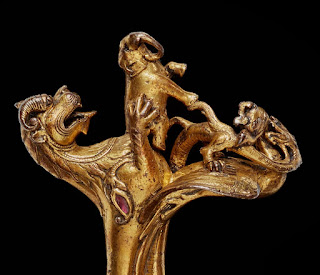
Magical Beasts Dagger, Vijayanagar, Sixteenth Century


Dagger made in one of the Hindu states in central India, probably Vijayanagar, around 1550. The gilded bronze hilt is set with rubies. The design includes a lion-like beast holding an elephant in its paws, a dragon, and two phoenixes. The length is 42 cm. In the David Museum. 

Sunday, April 4, 2021

Shah Jahan

The greatest of the Mughals, or at least the most stylish. Above, as painted by Chitarman, a Hindu artist at his court, c. 1627; below, by Rembrandt, who must have seen a print based on one of Shah Jahan's many portraits. The cultural blending is wonderful; Chitarman's portrait uses Hindu colors and a style of drawing imported from Persia, while giving the emperor a Christian halo and several onlooking putti as well. And Rembrandt is again showing how Europeans of his time were reaching out for inspiration all across the world.

And below, other pages from the Shah Jahan Album, a sort of glorious scrapbook made for the emperor, now in the Met. All of this is inspired by Jason Farago's wonderful picture essay about the Shah Jahan portrait in the New York Times.


Thursday, August 20, 2020

Why People Tolerate Police Brutality

India has its own problems with out-of-control police:

For decades, India has absorbed case after case of police brutality, torture and extrajudicial killings. Every year, scores of Indians are killed in what activists call “fake encounters,” and many more, activists say, are tortured to death in police custody.

Many of these killings have been extensively covered in the Indian news media, and some have set off a few strikes and demonstrations. But rarely have they provoked widespread protests calling for change.

Nothing is ever really done about the problem for the usual reasons: ethnic or religious divisions, and fear of crime:

According to a lengthy report by the National Campaign Against Torture, an Indian rights group based in New Delhi, the capital, at least 1,731 people were killed in custody last year. The majority of the victims, the report said, were the usual victims of abuse: Muslims and lower-caste Hindus. . . .

Many Indians, exasperated with the sclerotic functioning of an overburdened and often corrupt law enforcement system, crave justice and welcome the elimination of people they see as criminals. 

“There are outright public celebrations of police killings,” said Devika Prasad, head of police reforms at the Commonwealth Human Rights Initiative, a human rights organization. “The extremely slow judicial process and low conviction rates make people fear that criminals will get away with their crimes. That’s why many see these killings as just.”

When people are afraid, either of random violence or of group conflict, they will support, even revel in, savage violence by those they see as their defenders.

Wednesday, February 26, 2020

Krishna Killing a Demon with a Cow


Oh, the great deeds of mighty heroes. From India, c. 1800. In the Wellcome Collection.