 By Michael Melford, from National Geographic. Bristol Bay is a major breeding site for walruses.
Friday, October 28, 2011
Bristol Bay, Alaska
By Michael Melford, from National Geographic. Bristol Bay is a major breeding site for walruses.

Update on the Syrian Revolt
I have never thought that Syria's brave protesters really had a chance of overthrowing the Assad regime, which seems to have a firm hold on the army and other key levers of power. But French Foreign Minister Alain Juppe disagrees, and since his government was largely responsible for getting the west to support the revolt against Gaddhafi, perhaps we should pay attention:
"It's true that in New York (at the United Nations) we were blocked, and that is a stain on the Security Council, which said almost nothing about this barbaric repression," Juppe said on France Inter radio. "This will end with the fall of the regime, it is nearly unavoidable, but unfortunately it could take time because the situation is complex, because there is a risk of civil war between Syrian factions, because surrounding Arab countries do not want us to intervene."
Juppe pointed out that Turkey, which had been opposing any outside intervention, has been moving toward the western view, and indeed I just saw a news story saying that Turkey is harboring an armed rebel group dedicated to overthrowing Assad.
Imperialists
Intoxicated by the heady wine of newly acquired power, fearsome like wild animals who see no difference between good and evil, slaves to women, insane in their lust, drenched in alcohol from head to foot, without any norms of ritual conduct, unclean … dependent on material things, grabbing other people’s land and wealth by hook or crook … the body their self, its appetites their only concern – such is the image of the western demon in Indian eyes.
- Swami Vivekananda, 19th-century Indian writer
- Swami Vivekananda, 19th-century Indian writer
Immigration
The tired and poor the Statue of Liberty once welcomed are now often part of a backlog of deportation cases.
--Robert Morgenthau
--Robert Morgenthau
Thursday, October 27, 2011
Banned from North Korea for Life
North Korea once again shows why it is the world's most evil place, by banning the 200 North Koreans working in Libya from returning home. It seems the regime is afraid that they will spread the word that other wicked regimes have been overthrown by their own people:
An estimated 200 North Korean nationals are in Libya and previously worked as doctors, nurses and construction workers, according to South Korea's Yonhap news agency. They had been dispatched to the country in order to earn the hard currency that Pyongyang requires to fund its missile and nuclear weapons programmes. Yonhap reported that the North Korean nationals have been left in limbo, joining their compatriots who are stuck in Tunisia, Egypt and other countries with orders not to return home. North Korean media has so far failed to report that Gaddafi is dead. . . . The decision to ban its own nationals from returning indicates just how concerned the North Korean regime is of the news leaking out to its subjugated people.I wonder how those people feel about being banned from North Korea? Sad? Relieved? Worried about the future?
Another Viking Hoard
 Two hundred pieces of Viking silver in a thousand-year-old casket, found by a metal detector enthusiast in Cumbria.
The Dark Side of Steve Jobs
Nice piece of character assassination by Maureen Dowd, master of the genre:
The lesson, as always, is that geniuses are weird people and generally spring from weird circumstances. Would you want to have any of the latest crop of computer magnates as your friend? Would you want to be any of them? Not I.
Jobs was abandoned by his birth parents, which one of his ex-wives said left him "full of broken glass." He was neglectful of his own children and could be bizarrely cruel to his wives and girlfriends. His temper was infamous.Certainly, Jobs created what Shakespeare called “the brightest heaven of invention.” But his life sounded like the darkest hell of volatility.
An Apple C.E.O. who jousted with Jobs wondered if he had a mild bipolarity. “Sometimes he would be ecstatic, at other times he was depressed,” Isaacson writes. There were Rasputin-like seductions followed by raging tirades. Everyone was either a hero or bozo.
As Jobs’s famous ad campaign for Apple said, “Here’s to the crazy ones. ... They push the human race forward.”
The monstre sacré fancied himself an “enlightened being,” but he was capable of frightening coldness, even with his oldest collaborators and family. Yet he often sobbed uncontrollably.
Isaacson told me that Jobs yearned to be a saint; but one of the colleagues he ousted from Apple mordantly noted that the petulant and aesthetic Jobs would have made an excellent King of France.
The lesson, as always, is that geniuses are weird people and generally spring from weird circumstances. Would you want to have any of the latest crop of computer magnates as your friend? Would you want to be any of them? Not I.
The LIRR Disability Scandal
The NY Times reported back in 2008 that an outrageous number of Long Island Railroad employees were claiming disability pensions -- almost every union employee, in fact, giving them a disability rate about 4 times that of the average railroad. Now the US attorney's office has finally issued indictments in the case:
I think this is a crucial matter for the future of America. It seems inevitable to me that the retirement age is going to rise, as people live longer and longer and many of us put off entering the work force for more and more schooling. But if the retirement age rises to 70, we will need some means of taking care of people who have really worn out their bodies doing decades of physical labor. Some countries have separate pension arrangements for manual laborers vs. others, but I doubt America will ever go that way. So we will keep using the disability system, allowing worn out workers to claim that they are disabled and get earlier pensions that way. But if people think this system is being widely abused, they will rebel against it and shut it down, leaving us with no way to care for people who genuinely can't work any more at 65. So it is of the highest importance to safeguard the integrity of the system, and kudos go to these prosecutors and to the Times reporters who broke the story (Walt Bogdanich, Andrew W. Lehren, Robert A. McDonald and Nicholas Phillips).Ten people, including a doctor and a former union president, were arrested early Thursday and charged in a major fraud scheme in which hundreds of Long Island Rail Road workers made false disability pension claims costing a federal agency an estimated $1 billion, according to people briefed on the matter. Another doctor charged in the case was being sought, the people said.
Most of the people — those charged in the case include seven former railroad workers accused of making false pension claims, the two doctors and a former federal railroad pension agency employee who helped the workers file the claims — were taken into custody in the early morning hours at their homes by F.B.I. agents and state investigators, the people said.
Banteay Chhmar
 A major effort is underway, led by the Cambodian government and the Global Heritage Fund, to stabilize and protect the palace/temple complex of Banteay Chhmar in northwest Cambodia and open it to tourism. The complex resembles the famous Angkor Thom and was actually built at the same time (ca. AD 1200), which makes me wonder where the Khmer kings found the money and the manpower for all that construction.
 The jungle has overrun the site, which is wonderfully picturesque but not very good for the surviving stonework.
 The remote location of the site has left it vulnerable to looting, including the theft of a 30m-long stretch of relief carving.
Mongol Ships and the Divine Wind
 From the Telegraph:
The wreck of a Mongolian ship presumed to have been part of a 13th century invasion fleet has been discovered beneath the seabed off southern Japan. The vessel is the first of its kind to have been discovered relatively intact and dates from a series of attempts by Kublai Khan, emperor of the Yuan Dynasty, to subjugate Japan between 1274 and 1281.The scale of this invasion has always astounded me, especially compared to the tiny fleets that Europe sent out in the age of exploration.
Researchers have previously only been able to recover anchor stones and cannonballs from the scattered wrecks of the Mongol fleets and they believe that this latest find will shed new light on the maritime technology of the day.
The warship was located with ultrasonic equipment about 3 feet beneath the seabed at a depth of 75 feet. The archeological team, from Okinawa's University of the Ryukus, had been carrying out a search of the waters around Takashima Island, in Nagasaki Prefecture, because the area had yielded other items from Mongol ships.
Historical records suggest that some 4,400 ships carrying 140,000 Mongol soldiers landed in Japan in 1281 and skirmished with samurai in northern Kyushu. But after returning to their boats, the fleet was struck by a devastating typhoon that put an end to the invasion plans - a storm known to all Japanese as "kamizake," meaning divine wind, and again invoked in the dying days of the Second World War.
The researchers believe the boats tried to find shelter in the coves of northern Kyushu, an assumption borne out by the discovery by Professor Yoshifumi Ikeda's team. . . .A section of the ship's hull was first found last year but a full archeological excavation only began on September 30. The researchers uncovered a keel nearly 50 feet long and more than 1.5 feet wide. Lengths of wood planking were still buried beneath silt alongside the main spars, they said.
The planks were as much as 9 inches wide and nearly 4 inches thick and were still coated in a grey paint. The planks had been held in place by nails and more than 300 bricks that were used as ballast were located throughout the site, along with ink stones and shards of Chinese ceramics. The archeologists have also recovered weapons and identified the remains of the ship's ribs and bulkheads.

Wednesday, October 26, 2011
Indian Palaces I: Amer, Rajasthan
 Wandering a used book shop in Dupont Circle last week I found a marvelous treasure, The Royal Palaces of India by George Michell and Antonio Martinelli (1994). This sumptuous book overflows with gorgeous pictures of Indian royal residences, from ruined medieval forts to glamorous mansions built in the waning days of the Raj. Over the next few weeks I am going to be sharing the marvelous places I have been learning about, using a few pictures scanned from the book and others found on the web. I begin with the Fort at Amer or Amber, in Rajasthan, now in the municipality of Jaipur.
 The first fort here was built by the Kachwaha Kings -- one of the Rajput clans -- starting around around AD 1200. The current design goes back to a major reconstruction undertaken by Man Singh (ruled 1592-1615). Like most of these palaces, the complex grew from there, with each king adding something of his own: courts, gates, gardens, apartments.
 The building is famous for, among other things, the extensive use of mirrors in the decoration.
 The most famous feature of the palace is the Ganesh Pol, this gate, with an image of the elephant-headed god Ganesh over the doorway.
 And there is this marvelous columned hall of audience. All of the bigger palaces are cities in themselves where one could be lost for hours. Looking through this book made me want to be there, exploring, seeking new sights through every doorway and around every corner. India is a world of which I know little, and these pictures made me want to know more.
Paradise Lost, Book I
At once as far as Angels kenn he views
The dismal Situation waste and wilde,
A Dungeon horrible, on all sides round
As one great Furnace flam'd, yet from those flames
No light, but rather darkness visible
Serv'd only to discover sights of woe,
Regions of sorrow, doleful shades, where peace
And rest can never dwell, hope never comes
That comes to all; but torture without end
Still urges, and a fiery Deluge, fed
With ever-burning Sulphur unconsum'd:
Such place Eternal Justice had prepar'd
For those rebellious, here their Prison ordain'd
In utter darkness. . . .
All is not lost; the unconquerable Will,
And study of revenge, immortal hate,
And courage never to submit or yield:
And what is else not to be overcome?
That Glory never shall his wrath or might
Extort from me. To bow and sue for grace
With suppliant knee, and deifie his power,
Who from the terrour of this Arm so late
Doubted his Empire, that were low indeed. . . .
Farewel happy Fields
Where Joy for ever dwells: Hail horrours, hail
Infernal world, and thou profoundest Hell
Receive thy new Possessor: One who brings
A mind not to be chang'd by Place or Time.
The mind is its own place, and in it self
Can make a Heav'n of Hell, a Hell of Heav'n
What matter where, if I be still the same,
And what I should be, all but less than he
Whom Thunder hath made greater? Here at least
We shall be free; th' Almighty hath not built
Here for his envy, will not drive us hence:
Here we may reign secure, and in my choyce
To reign is worth ambition though in Hell:
Better to reign in Hell, than serve in Heav'n.
John Milton
I just started reading this for the first time, and loved Book I. One advantage to having a spotty literary education is that there is still famous and wonderful stuff I have not read.
The dismal Situation waste and wilde,
A Dungeon horrible, on all sides round
As one great Furnace flam'd, yet from those flames
No light, but rather darkness visible
Serv'd only to discover sights of woe,
Regions of sorrow, doleful shades, where peace
And rest can never dwell, hope never comes
That comes to all; but torture without end
Still urges, and a fiery Deluge, fed
With ever-burning Sulphur unconsum'd:
Such place Eternal Justice had prepar'd
For those rebellious, here their Prison ordain'd
In utter darkness. . . .
All is not lost; the unconquerable Will,
And study of revenge, immortal hate,
And courage never to submit or yield:
And what is else not to be overcome?
That Glory never shall his wrath or might
Extort from me. To bow and sue for grace
With suppliant knee, and deifie his power,
Who from the terrour of this Arm so late
Doubted his Empire, that were low indeed. . . .
Farewel happy Fields
Where Joy for ever dwells: Hail horrours, hail
Infernal world, and thou profoundest Hell
Receive thy new Possessor: One who brings
A mind not to be chang'd by Place or Time.
The mind is its own place, and in it self
Can make a Heav'n of Hell, a Hell of Heav'n
What matter where, if I be still the same,
And what I should be, all but less than he
Whom Thunder hath made greater? Here at least
We shall be free; th' Almighty hath not built
Here for his envy, will not drive us hence:
Here we may reign secure, and in my choyce
To reign is worth ambition though in Hell:
Better to reign in Hell, than serve in Heav'n.
John Milton
I just started reading this for the first time, and loved Book I. One advantage to having a spotty literary education is that there is still famous and wonderful stuff I have not read.
Median Family Income
 This chart of median household income (adjusted for inflation) tells you a lot about the past decade in America. Note that the top line, for pre-tax income, has not gone up at all. The bottom line has gone up a little, because of the Bush tax cuts and the Obama stimulus tax cuts. Of course, these tax cuts have caused the deficit to balloon to a level most people think is unsustainable. But in an environment of wage stagnation, people are justifiably upset about the prospect of their taxes going up.
Yes, this chart does show that median household income has risen since the 70s, but that is entirely because we work more (more women in the workforce, mainly). The average job pays less now. But we really have seen a whole decade of income stagnation for most Americans, while the rich keep getting richer. This basic economic fact feeds the anger in America on both the left and the right, and to get our country back together we need to get that line rising. The modern social contract depends on things getting better for most people.
In Britain, Fights over Building Houses in the Countryside
 Britain's conservative government has just released a revision of the rules governing new housing developments that slims the code from over a thousand pages to 52 and drastically limits the ways local communities can oppose development. The result is a huge fight pitting land conservation groups -- which in Britain are often conservative in politics, led by Prince Charles and other titled characters -- against the country's need for new houses and new jobs.
“This is a densely populated country, and the people of Britain are deeply connected to every square inch of our landscape,” said Ian Wilson, head of government affairs at the National Trust. “Now there are people in government who are trying to use the planning system to stimulate economic growth, and we think that’s very wrong. You cannot put a monetary value on everything.”The Telegraph has launched a Hands off Our Land campaign, warning that the reforms will "put a house in every field." Another article is headlined, "If Planning Reform is Rushed, it Will Ruin Britain."
To this Prime Minister Cameron replied, "take your arguments down to the job center." And England certainly does need more housing for its growing population, more than a million new units by some calculations, and more jobs. The only question is how many of the new units will be in American-style suburban tracts and how many in apartment buildings or townhouse blocks. Strictly speaking, Britain has enough vacant industrial properties around its cities to house everyone in apartments built on such sites. But that isn't where most British people want to live, especially since most of that vacant land is in older industrial centers like Manchester and Sheffield, not near the new jobs. And since the directors of the National Trust mostly live in big 18th-century houses, not high rises, there is some serious hypocrisy in their opposing houses for other people.
In the end this debate will probably be settled as it is in most places, with some rural areas covered in houses and others preserved. I hope the English can find ways to preserve some of their most scenic areas intact, rather than letting piecemeal development churn up half of every place. But in a world of ever rising population and constantly shifting employment, new housing is a necessity.
Tuesday, October 25, 2011
Yay, it's Endangered!


 The latest World Monument Fund list of threatened monuments includes one of my least favorite buildings, Southbank Centre in London. (The old part, not the new part, which is much nicer.) Completed in 1976, as the Great Age of Uglification was winding down into stagflation and disco music, it is considered in some quarters a masterpiece of brutalism, which in this quarter is considered a good reason to dynamite the whole thing. Why, oh why, was it ever considered a good idea to make buildings deliberately ugly?
Great News from Tunisia
 In Tunisia, the first election of the Arab Spring has come off peacefully and all sides are accepting the results. This is great news for Tunisians and good news for everyone in the Middle East. Tunisia is probably the most westernized Arabic-speaking country, so if they could not make democracy work, it is unlikely that anyone in the region could. Their success will encourage democrats elsewhere.
The party that won 40% of the vote, Ennahda, is described as "Islamist," but this is a little tendentious. So far as anyone can tell at this point, they are Islamic in about the same sense that Italy's Christian Democrats are Catholic. Their Islam does not pose any great threat to democracy or human rights. They will probably turn out to be more conservative about social issues and women's issues than I would like, but, hey, they won the election. Since every poll ever taken in the Arab world shows that most people want their governments to be explicitly Islamic, it is not possible to have states in the region that are democratic without being Islamic in some sense. Parties like Ennahda or the Turkish Justice and Development Party represent the liberal side of what is possible, and we should cheer that.
Monday, October 24, 2011
Treasure Hunting
Russia plans to raise the schooner Frau Maria, which sank off Finland in 1771 carrying a cargo of gold, silver, and 20 paintings by Dutch masters that Catherine the Great had purchased for the collection that became the Hermitage Museum.
Not Knowing What to Do about the Economy
I found a flaw. . . . a flaw in the model.One of my themes here has been that although most people agree there are real problems with the global economy and that many of them reside in the financial sector, nobody knows what to do about it. Brian Collins has a long review in the LA Times of two books making similar arguments. Collins writes,
—Alan Greenspan, October 2008
The global financial system still teeters on the brink of collapse, and virtually nothing has been done to avert another disaster. One would have to be pretty cynical to accept that only greed and personal political ambition are to blame for such thoroughgoing paralysis. In view of the spectacle of “extend and pretend” presently unfolding in power centers from Washington to Frankfurt, what needs explaining is why even the well-informed and quite high-minded remain committed to so unpromising a status quo. . . .One reason for this dismal state of affairs, he suggests, is that economics as a science does not provide the knowledge we need:
Mainstream economists failed to predict the crisis because — though smart, hardworking, and for the most part well-meaning — they are formed in a discipline where adherence to market theory, and only market theory, is rewarded, and the fact that it doesn’t tell the whole story is unimportant. The theory works well enough. Until it doesn’t.Summarizing the views of economist Yanis Varoufakis, Collins writes,
The great insight here is that, along with whatever reckless self-interest was at work, the crisis occurred and persists because an alternative was and is mostly unthinkable.And here we reach the nub of the problem. What is the alternative to the current system? What the big banks mostly do these days, it seems, is sell each other ever more complicated financial products, earning money by adding another layer of risk at each step in the process. The numbers involved are huge; in 2007, the nominal value of all the derivatives traded on the markets was 8 times global income. To invest huge sums in such complex securities is a formula for recurrent financial disasters. But what can we do about it? To ban all derivatives (securities whose value depends on the value of something else) would seriously crimp important parts of the economy: global firms depend on derivatives to protect themselves from currency fluctuations, to take just one example. What we want to do is ban needlessly risky, useless derivatives, but how do you write rules to do that?
Economist Varoufakis and his colleagues wrote that
The only hope for a rational future is a massive transfer in social power away from the ‘markets’ (i.e. the banks) to those who cannot be captured by them because they are too many to bribe, threaten and extort.That is, to workers. But what does it mean to transfer social power from bankers to workers?
All the reform plans I have ever heard, right or left, are dismal slurries of ideology, hope, hand waving, ax grinding, special pleading, and electioneering. The world economy is a complex system that we understand no better than we understand the weather, and I do not think anyone knows how to make it safer without stifling it.
The Scarecrows of Middletown
 I just discovered today that the lovely little town of Middletown, Maryland has one of the greatest holiday traditions ever: a Halloween scarecrow contest. This year there are about 40 in all, spread out along a mile or so of Main Street (Alternate 40).
 Homage to an old Carol Burnett skit.
 I wonder if somebody else has a teenage goth daughter to whom they entrusted the family effort.
 Mother Nature, who I suppose is scary because she has a lot to be mad about.
 This one was designed to scare away single men.

 Some movie-themed entries.
 And some views that include the wonderful houses.
Aphrodite Returns to Sicily
 The Getty Museum has returned its looted statue of Aphrodite, which had been the centerpiece of the museum's classical collection, to the Sicilian town from which it was taken in the 1980s. Given how much they have had to return lately -- 47 works, according to Smithsonian -- what do they have left?
 I remain, as ever, ambivalent about all of this. I fail to see what right the Italian government has to these works, many of which were probably stolen from Greece by greedy Romans. The practical effect will be to force looted works off the public art market, where they can be bought by museums, and into clandestine sales to secretive collectors. But I guess that the clear evidence of recent criminal activity made it necessary to do something about these pieces.
 This image, of the official welcome reception for the returned statue, is captioned by Smithsonian "The goddess was greeted like a long-lost daughter in the Sicilian town of Aidone, where it was installed in the local archaeological museum." Yeah, right. If the townspeople were excited by the statue's return, it was because the press had riled them up about rich Californians stealing their heritage. After this year is out, I bet only the barest trickle of Sicilians will bother to visit this thing. They have so much classical statuary in Italy that most of it is just lying around in unheated warehouses, or even in open yards, slowly crumbling. You can't build anything in much of Italy without endless hassles over classical ruins, with nosy Germans and Englishmen demanding careful excavation, and most Italians are sick of it. Tombaroli, as they call looters in Italy, are folk heroes to much of the population. Greece is the same way; I once stumbled into a yard behind the municipal museum in Athens, where I discovered dozens of columns and other bits of classical buildings stacked piled in no particular order, covered with a dusting of snow. Why not send some of those columns to museums or universities in other parts of the world, that would take care of them and display them proudly? It bugs me that nationalism gets in the way of properly caring for the past.
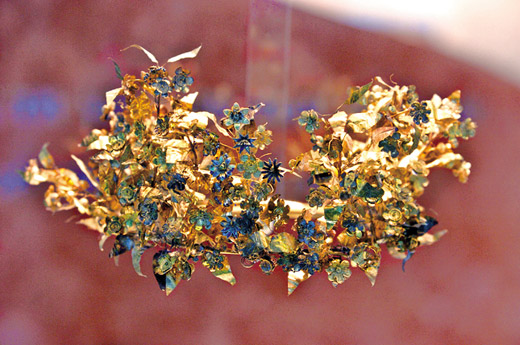 This wreath, no doubt looted from a tomb, is my personal favorite in the recent crop of repatriated items.
Sunday, October 23, 2011
Marriage and the Spectacular
Stacia Brown has been watching cool wedding ads, like the Subaru ad above, and the experience has led her to ponder why she is still single:
I haven’t married, in part, because of this. I am expecting something more spectacular than I’ve experienced.My first reaction to this was to gag, but really I have no interest in judging Stacia Brown. If she can't imagine being happy without feeling overwhelming love and excitement, then she should stay single. In our age there is no reason why anyone has to get married.
But the idea that people can be so moved by advertising that uses wonderful wedding images to sell stuff that they change what they expect in love and marriage is quite disturbing to me. Are we so cut off from any other models of life -- family, friends, community, novels -- that we draw our expectations from advertising?
Certainly not all of us do; here is a commenter on Brown's blog:
See, when I watch those commercials, my reaction is completely different. I don’t see real people; even when I tried to watch them through the lens of this piece, all I see is a fantasy being sold. Things like this were not really part of my thought process when I got married- I figured, we’re both flawed now, we’ll continue to be (and hark! we have), but we work well together and are likely to continue to. I don’t know that it would be fair to either of us to place expectations for undying passion and romance on one another (especially since we plan to have kids at some point!) and I think that I’d have been much more wary about getting married had the decision only been about the emotional side of love rather than also looking in a very pragmatic way about who we fundamentally are.Which actually sounds a little cold and practical to me, but at least she didn't get her ideas from car commercials.
Irish Zombies and Archaeological Fashion
 Discovery has a news story with the title, "Did Zombies Roam Medieval Ireland?" Which made me think, well, there are some questions that are so difficult they may never be answered, and then there are the easy ones.
The subject of the story is the discovery of two more bodies, these dating to the 8th century AD, with stones stuffed in their mouths:
It seems to me like there have been a lot of similar stories over the past few years. I wonder if this is because archaeologists are sensitized to the issue, so they are making more careful notes of such oddities, or if they always have and now the press is paying more attention.The "deviant burials" were comprised of two men who were buried there at different times in the 700s. One of the men was between 40 and 60 years old, and the other was a young adult, probably between 20 and 30 years old. The two men were laid side by side and each had a baseball-sized rock shoved in his mouth. "One of them was lying with his head looking straight up. A large black stone had been deliberately thrust into his mouth," Chris Read, head of Applied Archaeology at IT Sligo, said. "The other had his head turned to the side and had an even larger stone wedged quite violently into his mouth so that his jaws were almost dislocated," he added.
Initially, Read and colleagues thought they had found a Black Death-related burial ground. Remains of individuals buried at the end of the Middle Ages with stones stuck in their mouths have hinted at vampire-slaying rituals. It was believed that these "vampire" individuals spread the plague by chewing on their shrouds after dying. In a time before germ theory, the stone in the mouth was then used as a disease-blocking trick.
Since the vampire phenomenon didn't emerge in European folklore until the 1500's, the archaeologists ruled out this theory for the 8th century skeletons. "In this case, the stones in the mouth might have acted as a barrier to stop revenants from coming back from their graves," Read told Discovery News.
I also wonder about these confident assertions that villagers of the early Middle Ages were not afraid of disease-spreading vampires. There were frequent epidemics throughout medieval times, and the plague had come to Ireland in the 530s. I am not sure that the modern distinction between vampires and zombies makes any sense in this context. I am also not sure that information about how the dead attack the living collected in Renaissance Italy necessarily applies to 8th-century Ireland. Fear of the evil dead is an all-to-common feature of many societies, but it appears in myriad forms.
A Sunny Day in Autumn


 All taken during my walk with the dog today.
 And my wild mums, taking over the herb garden.


Subscribe to:
Posts (Atom)


