Friday, November 18, 2022

Links 18 November 2022

Launch of the Artemis I uncrewed Moon mission using the SLS Rocket, November 16, 2022

Denying the 2020 election results was not a very effective strategy in the 2022 election.

The alleged dungeon master shortage in the Dungeons & Dragons community. According to this, you can now charge for service as a DM. Maybe I should embark on a new career? 

Evidence that our ancestors cooked fish 780,000 years ago; that would presumably be Homo erectus, although the excavators don't say. I caution that many claims for fire use by Homo erectus have been advanced over the years, but all have been questioned and none is universally accepted.

Ukraine's railroads as a microcosm of the nation in wartime: before February 24 the state-owned system was widely thought to be corrupt and was the subject of endless political debate over how it should be reformed; now railway workers are "iron heroes" and the international press runs story after story about how they have kept the trains running. (Long piece at the NY Times; thread by the head of the railways on his return to Kherson.)

Roman shipwreck found off the Croatian coast, text and video.

Congress is looking into banning TikTok, because it is a Chinese company that collects a ton of data on its users to which the Chinese government could have access.

Well-preserved hypocaust (sub-floor heating system) found under Roman building in Bonn, Germany.

It is entirely possible for economies to grow while carbon emissions fall. It is happening in most advanced economies.

Interesting review of a new translation of Ovid's Metamorphoses, with some thoughts on how we relate to ancient authors and how we are supposed to deal with all that rape. If you ask me the stories are full of rape because of the ancient sense that life is violent at its very root; that the verbs we need to describe life in its essence are kill, seize, take, possess, destroy; that creation and destruction are two faces of the same divinity. So the closer one gets to the origin of things, the more creation and destruction mingle, and the more it seems that the birth of new life must spring from the violence of rape.

Banksy in Ukraine.

An artifact recently discovered in Spain bears the oldest sample of written Basque, dating to the 1st century AD.

Study estimates there are 20,000,000,000,000,000 ants on earth, 2.5 million for every human. (NY Times)

Article on narco-submarines from 2020, with a taxonomy of the craft; hundreds of these have been  built by now. And from the same source, a piece on Russia's beluga whale base.

Long, fascinating story about crime in the liberal bastion of Burlington, Vermont, where a rash of bike thefts spawned a (peaceful) vigilante group that recovers stolen bikes, and people worry that the spread of meth and a meth/fentanyl mix are leading to crises of mental health and violence. (NY Times)

Sam Bankman-Fried, CEO of the FTX crypto exchange that just failed spectacularly, seems to have been a regular user of stimulant drugs and related supplements. Scott Siskind delves into whether this was the root of his failure, with asides on stimulant use in the financial industry. His conclusion is that regular use of stimulants doesn't make most people compulsive gamblers, but stimulants at almost any level might increase your appetite for or tolerance of risk. Since Siskind thinks most traders are on stimulants, this might be important.

Vladimir Solovyov, the top analyst on Russian state television, mocks Trump's announcement that he is running for president again. "Really, what is this for?"

Thread on what the bankruptcy investigators found during their first few days of work at FTX. One detail: FTX did not have a list of all its bank accounts.

As one might expect, a lot of attention is being paid to the clothes of Italy's first female Prime Minister, Giorgia Meloni. During the campaign she wore a lot of bright pink, green, and yellow dresses – non-threatening and un-Fascist, I guess – but now she wears dark Armani suits for all important appearances. (NY Times) And so you don't think this is all sexism, the Times also ran a story about the news blowup that Emmanuel Macron caused by appearing in a turtleneck, apparently to signal his willingness to get tough and conserve energy during Europe's coming Russian winter. 

My clothes signal only indifference to clothes. 

Ukraine Links

With the Russian withdrawal from Kherson, Ukraine has regained more than half of the territory Russia had seized in mid March. The regained area totals 28,000 square miles, which is bigger than Denmark and nearly as large as Austria.

A Russian explains what lay behind the ill-fated assault of the 155th Marine Brigade at Pavlivka that led to the soldiers writing a letter of protest. The original idea was for a two-pronged assault, but when it was clear there were not enough men for two attacks, the generals cancelled one but ordered the other to go ahead, even though Ukraine would be able to concentrate all their resources against it.

Cool short video of Ukrainian air defense intercepting a Russian cruise missile.

Lessons from the war: "In the last two weeks, we have been convinced once again the wars of the future will be about maximum drones and minimal humans." Also high marks for a real-time mapping and operations package called Delta, which Ukraine used to track and interdict Russian logistics in Kherson. (NY Times)

The fall of Kherson leads to more angry recriminations on Russian television: "this clownery is indecent." And another talking head wants to know what the goals of the special operation really are, "for a change." These come from Francis Scarr of the BBC, a great source for what is appearing in all Russian media. Like the reports from Belgorod of Ukraine using pigeons to carry bioweapons.

Lots of chatter over whether Ukraine and Russia do "deals." For example, there are rumors that Ukraine and Russia did a deal over Kherson, that if Ukraine let the Russian army withdraw, they would leave Kherson intact. These rumors are passed on by people with contacts in the Ukrainian army; it seems to be Ukrainian soldiers who start them and pass them around. Interesting insight into how ordinary soldiers deal with the information vacuum they fight in.

Thursday, November 17, 2022

Trump as Bonnie Prince Charlie

Catholic writer Matthew Walter has an Op Ed in the NY Times titled "To His Loyalists, Trump is an Emperor in Exile." Walter starts from Frazer's notion of the divine king who embodies the land, who is the rightful ruler because of his mystic connection to the place and its gods. I believe there is something to this. I believe that while democracy has a deep emotional appeal, so does monarchy; that while "we should all talk this out as equals and respect each other" resonates in part of our souls, we also have feelings for what just is, because it is, and therefore should be. Political leaders who can tap into this sense of how the nation ought to be can get great power from it; the best recent example I think is Ronald Reagan. Trump has succeeded with some segment of Americans in linking himself to what America was and should be, not at a level of policy but in a deep stratum of feeling. The more people like waving American flags, the more they like Trump:

What Trumpists have intuited is an essentially illiberal understanding of authority, one based not upon the deliberative processes of electoral majorities but upon a romantic conception of a leader who embodies the essence of a nation.

Fine so far. But Walter then goes on to make what I think is a historical mistake, by comparing Trump to Napoleon.

For the former president’s loyalists, his claim to the G.O.P. nomination owes little to considerations about electability: It is a matter of justice, bound up in inexorable historical forces. . . .

His views on public policy were less important than what he represented in the minds of his supporters and detractors alike. What he promised was nothing less than the total destruction of the established political order (from which he boasted of profiting), a remaking of American institutions in his own image on the scale of Bonaparte’s permanent reforms — upending the legal system, administration, banking and tax collection.

There was also something decidedly Bonapartist in the attitude of Mr. Trump’s early partisans, who seized upon his rhetoric about “American carnage” with the same eagerness that supporters of Bonaparte welcomed an end to the chaos of the immediate post-revolutionary era. Mr. Trump’s avowal of socially conservative causes seemed to carry roughly as much conviction as Bonaparte’s rapprochement with the Catholic Church, but in both cases doctrinal purity was not the point. The consolidation of power was.

On this understanding, Mr. Trump’s defeat in 2020 was merely a kind of exile, with Mar-a-Lago as his Elba. . . . “Stop the steal” was not a precise theory about voter fraud but an existential affirmation of Mr. Trump’s thwarted prerogative. Vive L’Empereur!
As I said, I think this is wrong. Napoleon's claim to the throne was not based on some misty connection with the Glory of France, but on an astonishing string of military victories, and a record of actual legal and administrative reforms that has few parallels in history. He was a Man of Destiny by virtue of his having achieved so much. Much of Europe was in awe of him, even many of his enemies.

Trump, by contrast, has achieved nothing of note. If he were running on his record, everyone would laugh. No, the point to his campaign is the way he embodies the real America, the old America, the true America, which is threatened by nefarious forces: Chinese factories, giant tech companies, furries, unisex bathrooms, bans on tackle football. It is unclear how he will defend that old America, but everyone understands that he stands for it.

A better historical parallel for Trump is the Stuart pretenders to the throne of Britain. When Bonnie Prince Charlie invaded in 1745, thousands flocked to his cause. But not because he had any policy ideas; in fact he had none at all. He questioned nothing about Britain's government except the right of its Hanoverian kings to lead it. People rallied to him because of a sense that the Stuarts really were the rightful rulers, done out of power in a shady deal; and also because Britain was changing in ways they did not like. The King Over the Water represented a tie to the old, rural Britain fast disappearing amidst the rise of commerce, industry, and cities. To support the Stuarts was to protest the changing world. Opposition to the real woes of Hanoverian Britain played some part in this: poor farmers driven from their homes so the land could be mined for coal; rising mockery of religion; staggering corruption, which included dozens of sugar planters who had gotten so rich from the labor of their miserable slaves that they simply bought seats in Parliament. Not, as I said, that the Stuarts had any plans for making this better, but then neither does Trump.

Of course Bonnie Prince Charlie was defeated, his army destroyed at Culloden in a matter of hours. He turned out to be an incompetent leader and a miserable general. That defeat ended the Stuarts as a real political force, but did not end love and longing for them. People went on holding their hands over their water glasses when they said "God Save the King" for two more generations, a gestural protest against the modernizing world. Such piety finally faded when a new British patriotism rose from the fire of war against Napoleon, and rebel dreamers shifted their allegiance from royal blood to socialism.

To me there is a sadness in thinking about Trump's fervent admirers. They feel left behind by history, and they are right. They fear that things they love will be swept away, and they are right. In 20 years, as age debilitates them, we may still hear them griping that things would be better if only Trump had remained in power. About that, they are wrong. 

But just because change is inevitable does not mean it has no victims; even when many benefit, some also suffer. They will protest their suffering however they can, and if they have the vote they will give it to someone they think understands.

Wednesday, November 16, 2022

The Biggest Upset of 2022

According to 538's model, the biggest upset in this year's election was the win by Democrat Marie Gluesenkamp Perez in Washington's Third Congressional District. This is a strong Republican district, largely rural, with a history of logging and mining. There were very few polls, none after Labor Day, because everyone considered this a safe Republican seat; 538 gave Gluesenkamp Perez only a 2% chance of winning.

But the old Congressman from the Third was one of those who voted to impeach Trump, which led to his being ousted in the primary by Stop the Steal champion Joe Kent. Kent turned out to be a terrible candidate who had spent too much time in right-wing chat rooms; for example he mocked football fans for watching sports instead of getting up and doing something, not exactly the best way to connect with the average Republican voter. Gluesenkamp Perez won by only a single percentage point. So, maybe one shouldn't generalize too much from this race. But for what it's worth, here are some gleanings from her campaign web site:

Marie’s great great grandpa Bert Gilmore helped build the Washington State Capitol building as the quarry foreman and her grandmother Carol Gilmore was born in a logging camp in Sappho, Washington. Her own parents met at Western Washington University after her father immigrated from Mexico.

Marie graduated from Reed College and owns an independent auto-repair shop with her husband Dean that has grown to 6-bays wide. They were able to purchase their building with the support of a loan from the SBA in 2018 and are proud to provide living wage jobs to their employees. . . . like so many families today, they struggle with finding quality affordable childcare – so their son goes to the auto shop with them everyday.

In short, Marie is exactly the kind of working class Washingtonian that has been left behind in this economy and frankly ignored by the political extremes in our Nation’s Capital – and that’s exactly why she’s running for Congress in Washington State’s Third Congressional District. 

So, a candidate who lives in a small town, has both long-resident and recent immigrant ancestors, who owns a small business, who isn't rich or out of touch. The bullet point list of her positions:

  • Support small businesses and worker’s rights
  • Lower the costs of healthcare, childcare and prescription drugs
  • Address climate change by investing in clean energy
  • Get big money out of politics by overturning Citizens United
  • Invest and expand apprenticeship and skills training programs
  • Protect women’s access to health and rights
  • Tackle the rising costs of food, gas and housing

The NY Times story where I learned about Gluesenkamp Perez notes that she talks about being "pro freedom" because she supports both abortion rights and gun rights.

I don't know much about Gluesenkamp Perez, and maybe she will turn out to be a terrible legislator. Maybe the Republican will get their act together, nominate a good candidate and crush her next time. But she embodies in some ways the Democratic party I would feel better about supporting. I believe in freedom, and I want to see abortion rights and gay rights defended as part of a broad, pro-freedom agenda that also fights the bureaucratization of the world, the dominance of our economy by a few giant companies who make far too many decisions for us, and so on. I don't think there is much the government can do about inflation in the short run, but in the long run the rising cost of housing is absolutely about the difficulty of building houses and apartments. I support civil rights, but I believe the best way to help poor, minority Americans is with programs that help everyone, without any mention of race. Instead of fighting rear-guard actions to defend Affirmative Action, which voters hate, Democrats should be coming up with creative ways to help disadvantaged students, like the Texas program that admits the top graduates of every high school. Personally I hate guns, but if limiting gun ownership is a political loser, I am willing to jettison it. Abortion rights, health care, and wealth redistribution are more important to me.

The main thing I believe in is democracy. I believe that the voters should decide. Obviously in a complex political sytem, in a huge country, that process will be messy, and political parties can survive while opposing popular things. But a party that loses touch with who the voters are is just doomed.

Monday, November 14, 2022

Charlottesville Shooting

I spent the weekend visiting friends in Charlottesville, Virginia, most of them associated with the university. Among the topics we talked about was how the rise in crime over the last two years has changed the debate over police reform.

Last night a UVA student opened fire in a campus parking garage, killing three and wounding two others; as I write, he is still at large and campus is closed. 

It's a grim reminder that while certain activists like to pretend that the police are the nation's worst instigators of violence, that is not so, and Americans (especially Black Americans) are in much more danger from semi-random acts of violence than they are from rogue cops.

The Unite the Right rally in Charlottesville in 2017 became a very famous event in some circles, symbolizing the far-right threat to America. But the neo-Confederates and neo-Nazis at that rally, horrible as they were, were far outnumbered by counter-protesters. One person ended up dying, when a neo-Nazi rammed his car into a crowd of counter-protesters. It was a disturbing event, but I thought the main message was how the mass of people and the authoritites united against Unite the Right.

What will "Charlottesville" mean in the political discourse now that a random black student has killed three times as many people as Unite the Right did?

Pretending that skinheads and the police are our biggest dangers is wrong and dumb. Reforming the police to reduce the harm they cause, which you all know I support, has to be done while acknowledging the danger citizens pose to each other. Most American murders are committed by young men with guns. Some of them are crazy, some of them are criminals, some of them are wrapped up in gangstah machismo. Politically they span the whole spectrum, from Black Lives Matter to Nazism; most of them have no politics at all. I personally want the police to deal with the threat they pose.

The world is full of dangers, and to focus obsessively on one is usually a mistake. I want an effective police force, and I understand that as long as the whole country is full of guns, the police have to carry them too. I understand that armed police will sometimes shoot the wrong person. I think we could do a lot to reduce that number, but it will never be zero. But as long as the threat of thuggery looms, we are going to need police, and pretending otherwise is intellectually bankrupt, callous to crime victims, and political suicide.

The older I get, the more strongly I believe that the most important thing we can do is to defend civilization. There is no guarantee that this astonishingly rich world we have built will endure; plenty of other civilizations have collapsed or faded back into anarchy and village life. We have to defend it against all kinds of threats: random violence, police corruption, ethnic hate, divisive politics, environmental poisons, outside enemies with hypersonic missiles. We especially need to defend it against forgetting. We are too quick to forget dangers once they fade from the headlines, too quick to forget lessons learned in the fires of World War and violent revolution. I am a liberal, which means I think things could be better and support various reforms intended to make them so. But I never forget that my life depends, not on my party winning, but on the survival of our civilization in the face of a chaotic universe.

Friday, November 11, 2022

Russia Withdraws from Kherson

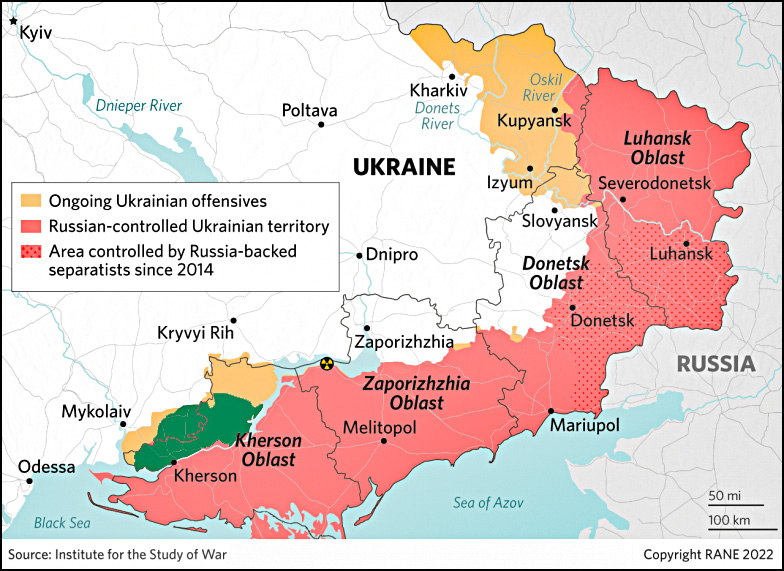
Russian armed forces are withdrawing from Kherson in southern Ukraine, along with all the territory they controlled on the west side of the Dnipro River. This was announced by the MOD in Moscow and seems to have been largely completed by now (7 AM EST). So far as we know, most Russian troops have withdrawn safely. No doubt they will leave a lot of gear behind, but they seem to have been removing their most valuable assets (SAMs, Electronic Warfare, modern rocket artillery) for weeks and have likely gotten much of that across.

Obviously the situation is still unclear and there is a lot of chaos, so maybe Ukraine will round up a lot of prisoners yet. In a Telegram post from Wednesday night, one Russian soldier said "The last order was to change into civilian clothes and f*ck off any way you can." But so far there is no sign that a single large body of Russian troops has been captured.

The area Russia is abandoning is in green

This is a major victory for Ukraine. Kherson was the only regional capital Russia conquered during its initial invasion, and the largest city they were able to take. Surrendering it is a significant blow. Because Kherson has not yet been much fought over, it is still largely intact and thus a valuable asset for Ukraine.

On the other hand, military experts have been saying for months that it would not be possible for Russia to hold on west of the river, with the bridges blown and ferry traffic under constant artillery fire. Supply was too difficult. Also, withdrawing east of the river will free up thousands of men that Russia desperately needs elsewhere. 

Two questions. First, what does this mean for Russia moving forward? Will this be a decisive blow against their morale? Will it lead to more political shakeups?

Lots of Russians are reacting like this guy:


Here's an interesting observation:

Many people are wondering why the Russian MoD announced the retreat from Kherson on TV. It was done to show that it isn't a retreat, but a controlled withdrawal process. It was also done by the MoD, so Shoygu and Surovikin take all the blame and Putin bears no responsibility.

So, obviously, this is bad for Russia, and it might turn out to be very, very bad.

But I am not certain it is a great sign for Ukraine, either. When your enemy has been signalling his imminent withdrawal for months, and then announces it on television, and you still can't trap any significant portion of his force, what does that say about your army? Except for during the Balakliya -Kupyansk breakout in September, the Ukrainian army has always moved slowly and methodically. And even during that September rampage, they pulled up short. When they took Kupyansk the town of Svatove was open and undefended, ten miles ahead of them, but rather than lunge forward to sieze it, they stopped at the Oskil River. Now they have been slowly pushing toward Svatove for a month, taking losses the whole way.

They have forgotten the old military lesson that if the enemy is running, you have to pursue until your men drop.

Napoleon: 

At the start of a campaign, to advance or not to advance is a matter for grave consideration, but once the offensive has been assumed, it must be sustained to the last extremity.

Or, from a different sort of military leader, Nathan Bedford Forrest:

You gotta keep up a skeer.

Shaped by years of trench warfare in Donbass, Ukrainian commanders seem to lack the aggression and speed necessary for decisive attacks. Perhaps they are very worried about the setback that the loss of an armored spearhead would represent, both materially and morally. Perhaps on a battlefield where Russia has more planes and lots of drones and still plenty of modern artillery, this really would be extremely dangerous.

But if you project Ukraine's rate of progress into the future, it would be many years before they achieved their goal of reconquering all their territory. To have any chance of reconquering all or most of that land, they must be willing to take much bigger risks than have so far. In Kherson they seem to have waited for their artillery to make the Russian position untenable, then walked along behind the retreating Russians, thinking that retaking all these towns without a fight is good enough. 

Unless there is some kind of dramatic change in Moscow, this is going to be a long, long war.

Links 11 November 2022

Paulus von Somer, Portrait of Elizabeth Wriothesley, née Vernon, Countess of Southampton, c 1620

Some of the fake websites created by the CIA to communicate with agents in Iran. Love the Johnny Carson fan site.

A Roman-looking sandal melted out of Norway's Horse Ice Patch, a very flimsy shoe for hiking over mountain passes. But you know how people are about fashion.

Two dozen bronze statues found at Roman-period thermal bath site in Tuscany.

CBS news video asking whether clear-cutting forests to make pelletized wood fuel is really "green." Despite the silly nationalism ("ravaging the American South" for foreign energy), they come to the correct conclusion, which is that this makes zero environmental sense.

The intense competition to be Texas' best high school mariachi band. (NY Times) Some easterners imagine that conservatism is about whiteness, so diversity will make America more liberal, but Texas has always been both a diverse state and a conservative state.

Ogham inscription found on Pictish carved stone, one of only thirty known from Scotland.

They're fighting again over what is a real Rembrandt, this time over a painted sketch of Christ on the cross. I find it baffling that "experts" make these bold pronouncements about being able to recognize somebody's brush strokes, when we have a century of evidence that such pronouncements are completely unreliable.

Weird article at the New Republic on the dismal economics of crossword puzzles. With the NY Times paying only $750 for a puzzle, and their top contributor landing 11 puzzles last year, it's no way to earn a living. But does everything have to be a way to earn a living? And is recruiting a more diverse group of puzzle writers really important? This is a hobby mostly persued by retirees, not a career.

Fabulous version of Far over Misty Mountains Cold by the Wellermen.

Levon Bliss, photographs of butterfly chrysalises.

Interesting article on Husayn ibn Mansur al-Hallaj and the history of Sufism.

Depressing little essay by William Deresiewicz on the impossibility of art in a woke age. He says the correct parallel for today's art scene is not the 1960s but the 1930s, when to operate on the left meant kowtowing to the commisars.

A girl buried in England around 625 AD had about 33% west African ancestry. She was buried in a cemetery with people who were probably related to her. This points to the old Roman connections between Britain and North Africa enduring into the early medieval period. 

In case you wanted to know, Matt Levine will explain to you how cryptocurrency exchange FTX went spectacularly bankrupt this week.

Ukraine Links

Margaritis Schinas, Vice President of the European Commission: "Nobody should ever forget that Ukraine is the only country on the European continent where people were shot and killed because they were waving European flags. In Maidan, eight years ago. This creates a huge moral, political, and geopolitical stake for Europe. We cannot tell these people, or the families of these people: you know, sorry, you were waving the wrong flags. They were waving the right flags. And they are suffering a war precisely because of that."

Terrific Catch-22 of life under the Russian dictatorship.

Interesting speculations about murky goings-on in Russian politics.

Short video showing a Ukrainian soldier ambushing a Russian tank at close range.

As of November 4, at least 458 Russian prisoners who had been released to fight with Wagner in Ukraine had been killed; Wagner sends out numbered letters to the families of slain soldiers with their death bonus checks, and examples shared by the families online show the numbers are up to 458. There are also noises about battles in which hundreds of recent conscripts were killed, and accounts that soldiers were told to leave their dead comrades behind so they would not show up as KIA in official statistics. And more here. Hard to know what to make of this, but it seems likely that Russia stablilized its lines in October by a great expenditure of human lives.

Soldiers of Russia's 155th Marine Brigade actually sent a letter to higher-ups protesting terrible handling by their generals that led (they say) to the loss of half their vehicles and 300 men in four days. This generated a lot of chatter on Russian telegram, enough to confirm that something like this actually happened. But here is an official Russian reponse saying losses at Pavlovka were not that bad. Which I suppose depends on what you think is "bad;" I never believe these "90% losses" claims, but for a brigade with an elite reputation to lose even 20% of its men in four days of indecisive fighting is bad enough, and not really sustainable.

Some numbers on the Russian air offensive in the first days of the war, quite a few medium-altitude sorties aimed at Ukrainian air defenses. This is presented as new information but it matches what I remember from the time: that the Russians started out making many deep sorties at medium altitude but gave it up because their losses were too high. This is from a report on Russia's air war by the Royal United Services Institute.

A Russian SAM system was destroyed well behind their lines while moving down a road; some think this means it was hit by a missile or rocket-propelled grenade fired by partisans. There is a lot of partisan activity in southern Ukraine but they have not usually gone for important military targets.

As of November 10, at least 1444 Russian officers had been killed in Ukraine, confirmed by memorial notices: 2 lieutenant generals, 8 major generals, 44 colonels, 98 lieutenant colonels, 195 majors, 288 captains, 478 senior lieutenants and 250 lieutenants. That's more than five officers killed every day of the 250-day war. When I checked the site the latest addition was a Spetsnaz lieutenant colonel, commander of a special forces battalion. 

One interesting point about the list of Russian officers killed is that some retired Russian officers have gone back to the fight as employees of Wagner, which leaves the keepers of the list with the problem of how to count them. I guess life isn't so great for retired Russian officers.

Thursday, November 10, 2022

37 Years of Archaeology

Me in a shallow well, Virginia, August 1985. I believe the person who took this photograph follows this blog sometimes.

Me in a different well, Washington, DC, this week.

Tuesday, November 8, 2022

Ekow Nimako's Lego Afrofuturism

Ekow Nimako was born in Ghana and lives in Toronto. He has made a splash with his Lego visions of Afrofuturism, all in black. More here and here.


Above and top, Nimako. Below, Kumbi Saleh 3020 CE


Monday, November 7, 2022

Roger Berkowitz on the New Class War

Roger Berkowitz has an essay at Salmagundi in which he puts a recent analysis of our political situation by David Brooks side by side with predictions made by Hannah Arendt in the 1950s. Arendt feared a coming class war between an educated, managerial elite and the democratic masses, and she predicted the rise of demogogues who take power by rousing the masses against their would-be managerial overlords. Brooks thinks that is exactly what is happening now in America.

Brooks long ago dubbed the new American elite Bourgeois Bohemians, or Bobos. They are not exactly an economic class, but a looser grouping of people who share a similar outlook:

The Bobos include Wall Street CEOs, starving artists, lawyers, doctors, tenured and untenured professors, struggling journalists, non-profit workers, and government experts. What unites these creative elites is neither economic nor political interest but, rather, an elitist claim to identity and privilege based on education, intelligence, and a shared social-political worldview. In short, what holds the new ruling class together is an ideology, a shared belief in their supremacy over those others who are less intelligent, less open, less good, and, even, less human. . . .

The Bobos “hoard spots in the competitive meritocracy”; they congregate in “wealth-generating metropolises”; they have “created gaping inequalities within cities”; they have “converted cultural attainment into economic privilege”; and they have come to “dominate left-wing parties around the world that were formerly vehicles for the working class.” The rise of this technocratic and creative elite has spawned a reaction, a new cultural force that has arisen largely in opposition to the bobos. “Trump voters listed the media—the epitome of creative-class production—as the biggest threat to America.” Working class plumbers and tradesmen have united with those who “are doing well financially but who feel culturally humiliated” to form an opposing class united by the feeling that “they cannot share their true opinions without being scorned.”

Which is exactly what Arendt predicted:

Arendt articulates a profound worry that the formation of a class of intellectuals or creatives (to use Brooks’ term) might well emerge as “the really new and potentially revolutionary class in society.” If and when intellectuals were to consciously claim their power in pursuit of their interests, Arendt argues, there is “every reason to be fearful as well as hopeful.” The power of intellectuals as a class, she worries, would be “very great, perhaps too great for the good of mankind.” Arendt’s worry about the rise of a super-class of intellectual mandarins is, in part, that these new elites would subject society to pseudo-scientific social theories and thus elevate a technocratic rule that threatens human freedom. The technocratic elite might be well-meaning advocates for social justice and the common good. But there is no reason to assume, she writes, that “those whose claim to power is based on knowledge and technique will be more benign in their exercise of power than those whose claim is based on wealth or aristocratic origin.”

  A second fear Arendt names is that resentment towards these new intellectual elites whose claim to power is predicated on “brain power” will be intense and that “this resentment will harbor all the murderous traits of a racial antagonism, as distinguished from mere class conflicts, inasmuch as it too will concern natural data which cannot be changed.” It is likely, she speculates, that since “the numerical power of the disadvantaged will be overwhelming and the social mobility almost nil,… that the danger of demagogues, of popular leaders, will be so great that the meritocracy will be forced into tyrannies and despotism.”

  In other words, as the technocratic rule of the intellectual elite solidifies, they will breed a quasi-racial resentment by the masses that will be susceptible to mass movements led by demagogues; and the intellectual response to such movements will be to exert ever more fine-tuned surveillance and social control of society. This is the kind of quasi class-war with racialized undertones that Arendt feared would be our fate when she wrote 50 years ago.

I find all of this interesting and partly true. But one thing that strikes me very strongly about current American political divides is the part played in them by individual choice. The nineteenth-century working class was made up of workers, the bourgeois class of the bourgeois. But in America you cannot predict our politics from our backgrounds. Our intellectual, managerial elite includes people like Elon Musk, Peter Thiel, and Tyler Cowen, all bitter opponents of wokeness and socialism. I do not think they are strange outriders, either; I think there are plenty of conservatives all over the economic landscape. The tech world, which is where the smartest people most clearly wield power, is full of cranky libertarians who hate bossy liberals; the same is true of oil, mining, and numerous other industries full of very smart, highly educated people. I also think that both American political parties include millions of people who would put themselves on both sides of this divide. 

And when you look at the issues that divide western countries, foremost are immigration and other ethnic issues. The connection between immigration and the "educated managers vs. regular folks" dichotomy is not simple, and just twenty years ago the Republican Party was led by the pro-immigation Bush team. 

I guess I am saying that while I see the divisions Brooks and Berkowitz are writing about, they do not, to me, explain very well the situation we are in.

Sunday, November 6, 2022

Ancient Stories on Modern Media

It fascinates me that the Internet is full of stories that follow patterns laid down thousands of years ago. These come up for me sometimes at Yahoo after I log out of my email, I suppose because of my history of folklore research. 

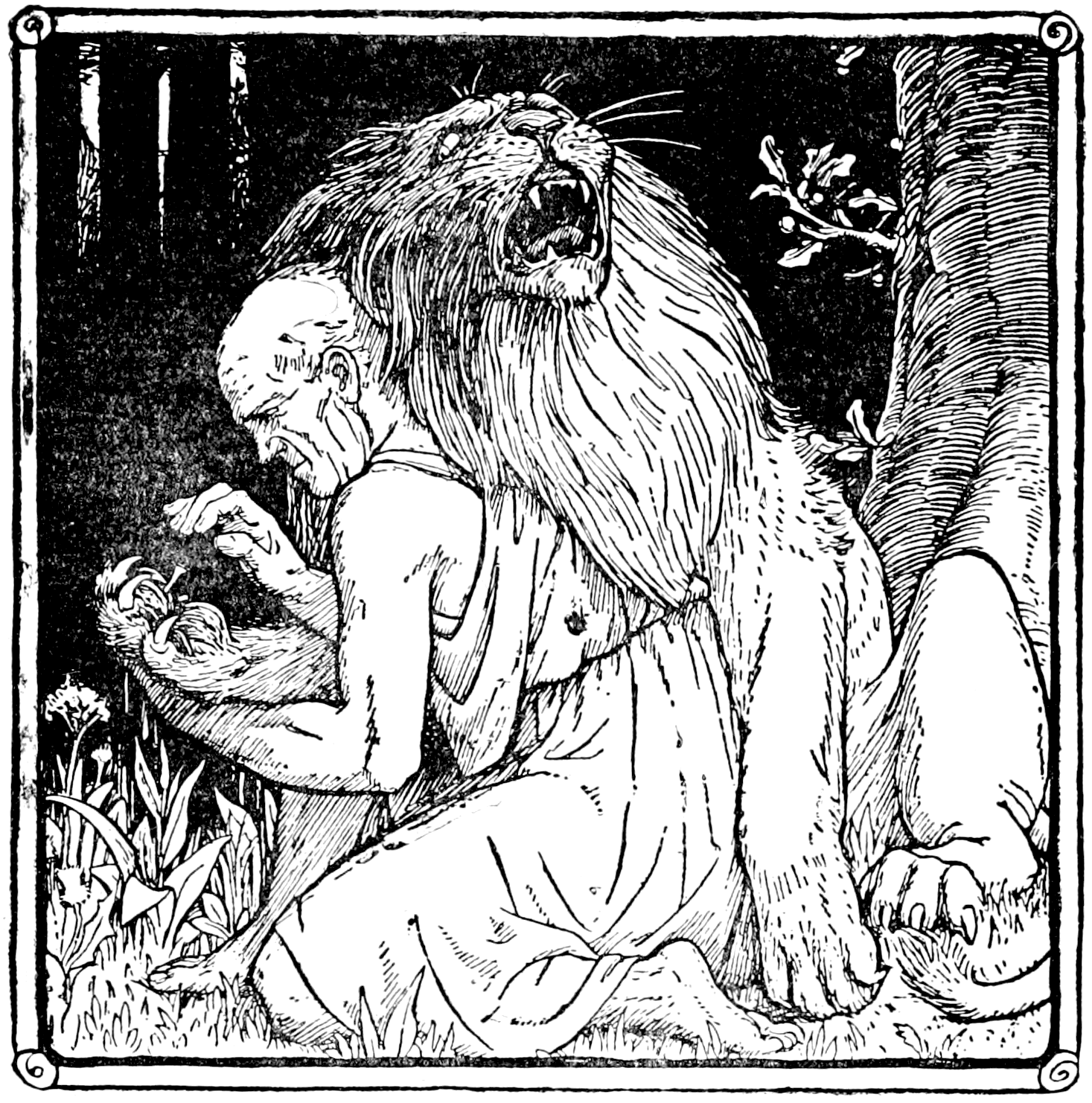
Consider stoies of Animal Gratitude. Stith Thompson has a whole range of folktale types in this category, numbers 350-399.  "Androcles and the Lion" is a famous example, but the internet is full of others: 

Baby Elephant Thanks Little Girl After She Helps It Get Unstuck From the Mud

Mama bear hugs man who rescued cub. I actually watched this one, and in fact the mother bear did NOT hug the men who rescued her cubs from a freezing lake, since they sensibly did not get that close to the mother bear. But the title still emphasizes the imaginary gratitude.

The whale who danced beside her rescurers' boat. (That would be tale type 370, Animals Grateful after Release from Captivity.)

The crows who come back every year to visit the family that rescued them.


There's also "She thought they were kittens/puppies but look what they grew up into." Like the above.

Besides all the tall tales there is actually what looks like one real story out there in this category, about a woman who took in bobcat kittens.

I put this post together quickly, but given the number of thes I have seen over the years, I'm sure I could have multiplied the examples if I wanted to.

File this under "the more things change, the more they stay the same."

Some Images from the British "Landscape Photographer of the Year" Competition, 2022

Will Davies, Brecon in Winter

Damien Walmsley, Regency Wharf

Andrew Robertson, The Broth

Aled Lewis, Tryfan

Paul Killeen, Souls Tied

Fiona Campbell, Wild Elgol

Friday, November 4, 2022

David Brooks on What Has Changed in America

David Brooks says what everyone else says, that electioneering is almost meaningless, and even the candidate who ends up being nominated seems not to matter (Herschel Walker, cough), because the naton is divided into two countries and people just vote for the one they identify with. (NY Times) And then he adds this:

America has always had vast cultural differences. Back in 2001, I wrote a long piece for The Atlantic comparing the deeply blue area of Montgomery County, Md., with the red area of Franklin County in south-central Pennsylvania.

I noted the vast socio-economic and cultural differences that were evident, even back then. But in my interviews, I found there was a difference without a ton of animosity.

For example, Ted Hale was a Presbyterian minister there. “There’s nowhere near as much resentment as you would expect,” he told me. “People have come to understand that they will struggle financially. It’s part of their identity. But the economy is not their god. That’s the thing some others don’t understand. People value a sense of community far more than they do their portfolio.”

Back in those days I didn’t find a lot of class-war consciousness in my trips through red America. I compared the country to a high school cafeteria. Jocks over here, nerds over there, punks somewhere else. Live and let live.

Now people don’t just see difference, they see menace. People have put up barricades and perceive the other class as a threat to what is beautiful, true and good. I don’t completely understand why this animosity has risen over the past couple of decades, but it makes it very hard to shift the ever more entrenched socio-economic-cultural-political coalitions.

This is, to me, the mystery of contemporary politics: not the division, which is old, and probably natural, and possibly even beneficial; who wants a country where everyone agrees on everything? The new thing is the degree of hate and fear. I can think of a few possible causes: the end of the Cold War, the rise of partisan attack dogs to party leadership, the changing media landscape created by cable tv and the internet, the decline of other identities like religion. As to what we might do about it, I honestly have no idea. But it makes me sick.

Links 4 November 2022

Halstatt (early Celtic) rattle, c. 400 BC

Two hoards of Viking silver found in Norway, one cut into pieces ("hack silver") and one of intact objects.

The Verge welcomes Elon Musk to his new role: "Twitter is a disaster clown car company that is successful despite itself, and there is no possible way to grow users and revenue without making a series of enormous compromises that will ultimately destroy your reputation and possibly cause grievous damage to your other companies." And this: "The essential truth of every social network is that the product *is* content moderation, and everyone hates the people who decide how content moderation works."

In Ephesus, an ancient Greek city in Asia Minor, archaeologists have unearthed a Byzantine shopping district violently destroyed around 615 AD, burying lots of great stuff in the ruins.

The inevitable result of violent protest in a democratic society: "Bitterness over looting and destruction that followed the police shooting of Jacob Blake could help tip a governor’s race in the direction of Republicans." (NY Times)

Ghost stories and history at Flagler College.

A lovely Tarot deck from 1789.

Large collection of historical comet images.

Book covers, 1820-1914.

"How the Pre-Raphaelites became Obsessed with the Wombat." Now, I ask you, did anyone out there know the Pre-Raphaelites were obsessed with wombats? Don't tell me you've never learned anything from this blog. Consider: "A remarkable drawing of Jane Morris and the wombat in the British Museum illustrates the degree to which lover and pet merged in Rossetti’s mind as objects of sanctification."

Plastic recycling is a myth: no more than 5% of the plastic collected for "recycling" in the US is ever recycled. Which is actually a good thing, since with current technology it takes so much energy. The obsession of some people with recycling products like glass and plastic, instead of just burying them, is one of the irrational exuberances of the environmental movement. 

At The Atlantic, David Frum covers the latest history wars blow-up, which started when the president of the American Historical Association decided to post a little essay about whether historians are too involved with the present and not enough with the past.

The story of the Ely Copper War, one of the many stand-offs between workers and militia in nineteenth-century America. This one ended peacefully, partly because when the militiamen saw how hungry the miners and their families were they forgot about fighting and starting sharing out their food.

Ezra Klein touted his podcast interview with Pippa Norris as offering "a powerful theory of why the far right is thriving across the globe." But this turns out to be the obvious theory, which is that social and cultural change since 1960 have just been too fast for many (mostly older) people, and the new right wing politics is the reaction against all that change. (NY Times, Google podcasts) One interesting point concerns the appeal of "transgressive," obnoxious, bullying leaders: many people feel cowed by the views of the established majority, so that they can no longer say what they think, so they find it appealing when people come along who refuse to be cowed, who refuse to be bound by any rules or norms that keep them from speaking their minds. If you want democracy, stop making people afraid.

Ukraine Links

Early Saturday morning, Ukraine attacked Russia's naval base at Sevastopol in Crimea using a combination of aerial and naval drones. Summary of what was known about the attack on Saturday evening here. (Update: no visible damage to the Admiral Makarov, although some observers think its steering may have been damaged, and only a little damage to the rudder or screws of a modern ship can require drydocking.)

Short video showing a Russian helicopter shot down by Ukrainian MANPADS.

Finns respond to Russian media reports that they are freezing due to Russia's energy embargo.

Of the first 89 recently mobilized Russians known to have died – known by name, that is – 23 died during training. "The causes of their deaths vary: physical altercations, alcohol, drugs, suicide, and accidents." 

Thread summarizing an article on one group of mobilized Russians who were sent to the front with minimal training, suffered badly from artillery fire, and were led to the rear by their only surviving officer. Now they are being threatened with court martial and some say they are ready to go to jail rather than back to the front.

Message to Russians from Ukrainian soldiers, 2 minute video.

Summary of the military situation by a western expert just returned from a tour of Ukraine.

Thursday, November 3, 2022

The Vermand Treasure and the Culture of Early Medieval Europe

The Vermand treasure was excvated from a grave in northern France by a professional archaeologist named Benoni Lelaurain. Nobody seems to know the date; the sources I have found all say "last quarter of the nineteenth century." Which is the first of many weird things about these artifacts. Why didn't the article published on these finds in 1904 mention when they were found? Perhaps the property had changed hands at some point? Was someone cheated? Did Lelaurain's notes not have a date?

That 1904 publication said that these were Merovingian artifacts dating to the 6th or 7th century. But a second study in 1951 found that they were actually late Roman, likely dating to around 350-375 AD. Which is an important point. We associate Roman art with the classical style, but what we think of as the barbarian style of the early Middle Ages actually began its development under the empire. Classical snobs used to blame this on Germanic interlopers and call it "barbarianization," which is probably true in part, but it might be safe just to say that the empire was changing and styles of ornament were changing along with everything else.

What remains of the treasure is in the Metropolitan Museum, having been snatched up by one of J. Pierpont Morgan's roving buyers. According to the original excavator the grave had been robbed in Antiquity, but those must have been some of history's least efficient grave robbers. Maybe there was a golden bowl sitting on the corpse's chest so they just grabbed it and ran? 

Lost ax head and other objects from the 1904 publication

Other objects had been placed in a local museum but disappeared, possibly but not necessarily during World War I. This is a real, long-term problem with important archaeological finds; local people often want them to be placed in a local museum rather than being shipped off to London or Paris, but small, local museums get robbed all the time, so valuable artifacts placed in them have a bad habit of disappearing.

Random internet image of a cicada fibula

Everyone seems to agree that the man buried in this grave was a barbarian soldier in Roman service. Vermand was at that time the site of a Roman headquarters, part of the frontier defenses of Gaul. The weapons are of Roman type, and the grave was within a late Roman cemetery. But in a 1986 publication, a Met curator named Deborah Schorsch argued that some elements of the decoration are unusual and suggest a more exotic origin. In particular she focused on a small fibula in the shape of a cicada, one of the artifacts that was lost from the local museum. These appeared on the Ukrainian steppe around 300 AD and were widely used in eastern Europe over the next 150 years or so. In the early period they are quite rare west of Hungary, and when they do show up in the Empire that is generally taken to be a sign of Huns, Goths or Alans breaking in. Incidentally the first people to give much attention to cicadas in their art were the Chinese, who associated them with resurrection, so this may be one of the ideas that spread across Asia from one end to the other. (Like the Cindarella story or the Three Hares motif.)

All of this would make the Vernand Treasure one of the many interesting traces of steppes culture in western Europe. The most famous is the Sword in the Stone motif, which comes from the Sarmatians. They worshipped their war god wherever they happened to be on the vast steppe by sticking a sword into a cairn of stones and praying toward it. The Merovingian kings were Franks, but many of their rituals seem to have come from the east, including ringing their royal burials with sacrificed horses. According to Schorsch, the decoration on this spear shaft ornament also looks more like objects from eastern Europe than anything found within the empire; notice the dragons.

(The six-pointed star, incidentally, was widely used across the Empire, not just by Jews.)

I think this is important because of how it relates to a question I have written about here before: what happened to the Roman empire? Why did it never come back, as the Chinese empire kept doing? Why was medieval culture in western Europe so different from classical culture? I believe the barbarian kings and warriors had a lot to do with this. They had their own art, their own stories, their own values, their own kinship systems, their own politics, and they kept much of those things even after they settled within the empire. The war leader of Vermand fought for the empire and used standard imperial weapons, but he expressed his own identity through details like the decorations on his spear and the cicada fibula on his cloak. Perhaps he knew ancient epics of Gothic or Sarmatian heroes, and liked to hear them chanted in his camp rather than Roman marching songs. His descendants were like him; they took much from imperial culture but they did not surrender their identities. In their hearts they remained Franks or Goths, not Romans, and so the world they helped to make would never be a Roman world.

A Powerful Salvo in the Fairy Circle Wars

One of the bitterest debates in ecology is over the origin of the "fairy circles" in the Namib desert, roughly round patches of ground where no plants grow. Among the many theories that have been proposed, the two you hear most about have to do with water and termites. Now the water side have come out with an impressive study that gives them a substantial lead:

“Plants are forced to create these circles to redistribute water to maximize their chances of survival,” said Stephan Getzin, an ecologist at the University of Göttingen in Germany and an author of the study. “We call it ecosystem engineering.”

The Namib Desert is one of the driest places in the world, usually receiving only a few inches of rain each year. Researchers first proposed in 2004 that plants, in competition for water in this harsh ecosystem, may self-organize into fairy circles — an idea originally adapted from pattern-formation theory developed by the mathematician Alan Turing. . . .


For their latest study, Dr. Getzin and his colleagues spent three years examining fairy circles at 10 study sites across 620 miles of desert. One of those years, 2020, was a drought, while 2021 and 2022 were exceptionally rainy — a lucky break that permitted the researchers to compare different conditions, Dr. Getzin said. . . .

After rain, the researchers found that grasses germinated both inside and outside fairy circles, but that within about 20 days virtually all of the young shoots inside a circle had died. They also found that the top eight inches of soil within fairy circles quickly dried out, something they hypothesize is caused when established plants surrounding fairy circles actively draw water toward them.

Interesting.

I find myself musing on why this obscure ecological debate gets covered in the NY Times, and why I also find it fascinating. I suppose this is science in a sort of raw form: here is a phenomenon that cries out for an explanation; what might that explanation be? I never tire of reading about that sort of scholarship.

Wednesday, November 2, 2022

A Search Challenge

I recently stumbled across the picture above. This is a Sarmatian artifact said to be from a kurgan called Kobiakov 10. I have found two images, but both are focused on the seated man. Who is indeed intriguing, but y'all know me, I want to see the dragons. Or whatever they are. 

I can't trace this past here, although I did find one note that it is in the Rostov museum. 

If anyone can find a different image of this that shows the other panels more clearly I would be deeply appreciative.

Japanese Monsters: the Bakemono Zukushi Scroll

The Bakemono Zukushi scroll dates from the Edo period (1603-1867), likely after 1700, but my sources don't get any more specific than that. This is one of a whole class of monster scrolls; wikipedia has another one. Above is an Oyajirome

Daichiuchi

Kami-kiri, the "hair cutter," which likes to sneak up on its victims and cut off their hair.

Yuki-onna, the Snow Woman, who appears in snowstorms as a beautiful woman, luring young men off into the freezing dark.

Buraribi, a white, bird-like creature that always appears wreathed in flame.

Contemplating the Collapse of US-China Relations

Tom Friedman's column today (NY Times) argues that the most consequential event of 2022 will end up being the collapse of the US-China relationship. Some of the military guys I follow on Twitter agree; they seem to think about Ukraine mainly as a testing ground for the tactics and weapons of the coming US-China war.

Friedman notes that as first Trump and now Biden have put up more barriers to US-China trade, the business interests that once bayed loudly for access to the Chinese market have been mostly silent. Unending Chinese favoritism for its own companies, barriers to foreign access to key sectors, and constant theft of intellectual property have finally soured US companies on China. One US expert on China trade told Friedman,

The U.S. business community loved China — there were always tensions, but there used to be a sense of opportunity and partnership. For China to turn the business community sour on China took hard work, but China did it.

Some foreign "China hands" think that Xi's election to a third term means yet more nationalism in China, and more authoritarianism. One said,

The opening up of the Chinese economy is not going to continue. … We have to assume that China is setting itself apart from other countries and will build a counter-model to the liberal, market-oriented model of the West.

Friedman spent significant time in China in 2018:

When I raised China’s unfair trade practices, the pushback sounded like this: "You realize that you Americans are too late? We’re too big to be pushed around anymore. You should have done this a decade ago." I responded that that kind of hubris gets countries in trouble.

This reminds me of the Yuval Levin interview I linked to back in March, in which he worried that an era of peace among the great powers was yielding to a new era of war. 

Which makes me want to scream. Russia was carving out a niche for itself within the global system, supplying energy and modeling an authoritarian alternative to western decadence. They had friends and customers all across the west. Then they decided to throw it all away in a mad crusade to restore the Soviet empire, leaving all their hopes and all their progress strewn across the battlefield like so many turretless tanks. A generation is being killed or fleeing abroad, and their nation will not soon recover.

Now I fear the same will happen with China, that all the economic and social progress of the past 45 years will be discarded in a mad assertion of national will. Already they are crippling the cutting edge of their economy, as the US cuts off technological cooperation and forces its allies to do the same.

I find it hard to even imagine what a US-China war would be like, but I am sure it would be a catastrophe. We are already paying a price for this, as the US military quietly orders thousands more missiles, many of them destined to be stockpiled on Pacific islands. Congress has voted tens of billions to speed the development of next-generation weapons, and they are not intended for fighting Russia or the Taliban.

And for what? What could Russia possibly gain in Ukraine now that would be worth the cost of destroying its army and ruining their relationship with the west? What could China possibly get out of invading Taiwan that would be worth the immense destruction that would ensue? Everything that is good about Taiwan's economy flows from its strong relationships with the west, along with most of what is vibrant about its society. Would China's leaders rather destroy all of that than let its renegade province remain independent?

Maybe.

What a piece of work is man.