Thursday, December 26, 2013

The UFO Under Seattle

What a perfect beginning to a movie!

In Seattle, a giant tunnel-boring machine named Bertha was gnawing its way along the route of a new highway tunnel under the waterfront when it struck -- something. Nobody knows what, only that it is hard enough to stop the machine. Engineers call it "the object."

They say it is probably a giant boulder, but then they would, wouldn't they?

The Dialect Map

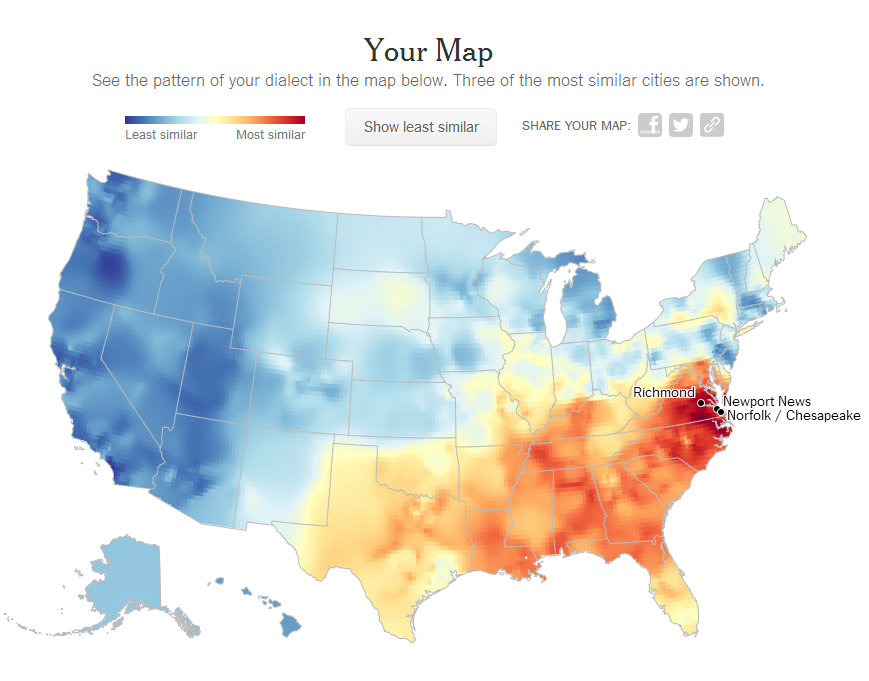
The Times has a wonderful little quiz up that is supposed to tell you where you grew up based on 20 questions about what you call things and how you pronounce words. I cheated a little by using the words I used as a kid rather than those I use now -- I have switched from "lightning bug" to "firefly" -- but that was only a couple of questions. And they found my home, in Richmond, Virginia. Impressive.

NASA's Budget and the Europa Clipper

One of the good things that happened while the Bush and Obama administrations were resolutely not caring about the budget deficit was that NASA got plenty of money. The Cassini mission to Saturn, the Mars rovers, the new space telescope -- all very expensive, and all well funded during the profligate 2000's. Now that a new breed of Republican has come to Congress, determined to rein in government spending, that is changing. The sequester cut $2 billion off NASA's budget, and next year will see another cut. At the moment NASA's budget doesn't even include money to keep the hugely successful Cassini and Curiosity missions going past September 30. Most likely the money will be found to keep them alive, but proposed future missions are seeing at least delays and maybe cancellations.

The future mission that I care about goes by the name of the Europa Clipper. Europa is a large moon of Jupiter that seems to have an enormous ocean of water underneath thin crust of ice. Recent observations by the Hubble Space telescope (above) showed that Europa is surrounded by variable clouds of water vapor, and the only explanation anyone can think of for this is that Europa must have geysers that blast some of its ocean water into space, just like those that Cassini photographed at Saturn's moon Enceladus. This opens up the possibility of an affordable mission to study that deeply buried ocean:
Europa is covered with a shell of ice. It has an internal source of heat from the tidal forces exerted by Jupiter. Europa races around Jupiter in an elliptical, 3.5-day orbit. When the moon is farthest from Jupiter and the gravitational squeeze of the giant planet eases up, the icy shell decompresses just enough to let subsurface water find a path to the surface and vent into space, scientists believe. They say the subsurface ocean could be 50 miles deep at least, containing more water than in all the oceans on Earth.

The geysers are squirting not only water into space, but also whatever else is in that subsurface ocean. Landing on Europa is too expensive, as is sending a probe down through the ice into the water below, but a spacecraft can learn much about the planet through high-resolution stereo imagery, ice-penetrating radar and other instruments. It also could fly through the plumes and, with an instrument called a mass spectrometer, analyze the ejected material.

“This is huge,” said JPL’s Robert Pappalardo, who has worked on plans for the Europa Clipper. “It now means that we could effectively sample Europa’s interior from flybys.”
Jupiter's neighborhood is what NASA engineers call a "challenging environment," because of its powerful gravitational field, the perturbations induced by its four large moons, and the intense radiation it emits The initial cost estimate for a Europa orbiter was $4.7 billion, or NASA's whole planetary science budget for four years. So they are talking about cheaper scenarios:
Rather than orbiting Europa, the spacecraft would go into an orbit around Jupiter, spending most of its time outside the planet’s radiation field, and then swoop in repeatedly, with 34 flybys of Europa and nine of the moon Ganymede.
I think this should be our top priority in space exploration, far above the dismal International Space Station or the fantasy of a manned mission to Mars. But right now the "budget environment" is even more challenging than the environs of Jupiter, and the Europa Clipper may not fly for decades.

The Queen Pardons Alan Turing

The news:
Nearly 60 years after his death, Alan Turing, the British mathematician regarded as one of the central figures in the development of the computer, received a formal pardon from Queen Elizabeth II on Monday for his conviction in 1952 on charges of homosexuality, at the time a criminal offense in Britain. . . . Mr. Turing committed suicide in 1954, two years after his conviction on charges of gross indecency. He was 41.
This was a response to a petition campaign mounted by Turing's fans. Whenever people do this sort of thing, I have to wonder why they want retroactive pardons for their heroes. It seems to me that in a case like Turing's the injustice of the charge against him and his trial are already apparent to everyone. His conviction therefore stands as an indictment, not of him, but of the society and government that persecuted him. The pardon does nothing for him; he is dead, and his innocence is manifest. It only mitigates the guilt of the state, which damn well is guilty in a way that ought not to be swept under the rug. I say let the verdict against Turing and all similar verdicts stand, as a reminder for future generations of the crimes we commit in the name of justice.

Wednesday, December 25, 2013

Christmas 2013

The Bedell children on Christmas morning.

And another.

Here's an interesting picture from the 21st, four Bedell men in a row: my brother Matthew, my sons Thomas and Robert, and me.

Clara is excited for Christmas morning.


The way to get boisterous boys to read is to give them survival manuals.

Thomas and Ben at breakfast, Ben already worn out.

A Young Man in a Tree

My eldest son Robert, 20, frolics in the weridly warm weather of Saturday the 21st. Still a boy at heart.


His younger siblings join in.

Tuesday, December 24, 2013

Merry Christmas

May the season bring you joy.


Harbin International Ice and Snow Festival.

Say what you want about communists, they know how to mount a public festival like nobody else. Helps that Harbin is in northeastern China, where the Siberian wind freezes the local river deep enough to supply all of this ice.


Mixed Up Cats

Liger mother -- half lion, half tiger -- and "liliger" -- 3/4 lion, 1/4 tiger -- cub in the Moscow zoo.


Paul Ryan, God, Conservatism, and the Poor

McKay Coppins has written a fascinating article about Paul Ryan's turn from Ayn Rand to Pope Francis. According to Coppins, while Ryan was Romney's running mate he spent a lot of time fighting with the campaign about where he could go and who he should see. Ryan wanted to visit poor and minority neighborhoods, but the campaign staff "countered that every hour spent on inner-city photo ops was a lost opportunity to rally middle-class suburbanites who might actually vote for them." Eventually they let Ryan do one event, meeting a group of people who work with the poor and giving one speech in a poor Ohio neighborhood:
By the time Ryan arrived backstage at the Waetjen Auditorium less than two weeks before the election, about a dozen advocates for the poor were waiting for him. They took turns telling stories from the front lines of the losing war on poverty. They spoke of their own experiences with addiction and homelessness. They testified of redemption. And then, as Ryan prepared to leave to deliver his speech, a tattooed minister who had arrived at the meeting via motorcycle asked the congressman if he could lay hands on him to pray.

Secret Service agents tensed up as the group surrounded him and the man placed his hands on Ryan’s shoulders — inches away from his neck, a nervous aide noted later. The candidate made the sign of the cross, and the minister called on the power of God to give Ryan strength, and help him fulfill his divine mission. Several people present, including Ryan, became emotional. Ryan left the meeting, gave his speech, lost the election, and returned home to Wisconsin. But several weeks later, he couldn’t stop thinking about that prayer. Speaking with a close aide, he said it was the most powerful experience he’d had during the campaign — and that he felt strongly he needed to act on it.

“This is my next ‘Roadmap,’” Ryan told the aide, referring to the name of the audacious conservative budget that had made him a star in Washington. “I want to figure out a way for conservatives to come up with solutions to poverty. I have to do this.”
Lately Ryan has spent a lot of time defending Pope Francis to other conservatives and  arguing that the Pope has something important to say. Most on the left are cynical about Ryan's alleged conversion, which they think sounds like a campaign narrative. I am not; I am perfectly willing to believe that Ryan has been inspired by his faith to want to help the poor and struggling. The thing is, though, Ryan remains a staunch small government capitalist, whose idea of helping the poor still revolves around 1) cutting taxes and regulations to create economic dynamism and more jobs, and 2) volunteerism, especially through churches. As he said in a graduation speech at a Catholic university,
Concern for the poor doesn’t demand faith in big government. It demands something more from all of us. If we continue to believe that the war on poverty is primarily a government responsibility, then we will continue to weaken our communities. We will drift further apart as people.
Which I think is nice but beside the point. The problems of a $10-trillion-dollar capitalist economy are just too big, its victims too many, for anything but government action to fundamentally change their circumstances. Earlier this year Ryan's party was trying to cut food stamp benefits by $39 billion dollars over ten years, tossing somewhere between 2.8 and 6 million people out of the program. That's a lot for charity to make up. Or consider this: about two million American work for minimum wage, another two million for a dollar more. If the minimum wage were raised by $2, that would collectively increase their incomes by $6 billion a year. Does Ryan think he can raise that much by staging photo ops with community organizers? What does he plan to do about the 40 million Americans without health insurance?

Let me reprise this lovely table which explains why there are fewer poor people in Scandinavia:

It's really quite simple: there is less poverty in Scandinavia because their governments do more for poor people. Nobody has ever figured out how to arrange a capitalist system to give good jobs to everyone. Capitalism needs low-wage workers. In fact, these days it seems to have no need at all for millions of people. The only way we know to lift millions of people out of poverty is massive government spending. Until Ryan accepts that, he will never do anything but nibble around the edges of poverty.

Monday, December 23, 2013

Ice in Toronto

The rain soaking us down here in Washington and Baltimore is ice in Toronto, and the Atlantic has a photo essay. This one is by Chris Helgren.

In the War on Christmas, Christmas is Kicking Ass

Conor Friedersdorf files a report from the front lines of the Culture Wars and finds Christmas winning in a rout. A dispatch from New York:
The tree-lighting ceremony, held in early December, included remarks by Michael Bloomberg, the city's Jewish mayor, who called the Christmas tree "one of New York City’s most beloved and iconic landmarks." Entertainers at the tree-lighting ceremony included global celebrities Mariah Carey, Mary J. Blige, the Goo Goo Dolls, and Jewel. Millions watched the event, which aired on NBC, one of America's oldest and most watched broadcast networks. . . .

The opposition's counteroffensive: Having already secured a ban on nativity scenes in NYC public schools, a small faction of atheists paid for a billboard in Times Square that says, "Who Needs Christ During Christmas?" Zero politicians showed up to celebrate its unveiling, along with zero entertainers and zero broadcast networks. Meanwhile, in shopping districts throughout the city, an army of retail workers busied themselves erecting Christmas displays and covering floor space in the distinct colors of the holiday. . . .

Prediction is Tough, Especially about the Future

Every decade the Bureau of Labor Statistics issues predictions about job growth or losses in certain professions, and their latest predictions are shown above.

Sadly, they are often wrong. Business Insider ran the numbers on actual job growth over the 2002 to 2012 time period and compared it to the last round of predictions. They found that they were a little off. (Above; prediction in blue, actual in red.) They were right about two big categories, since they predicted big growth in health care and steady growth in in leisure and hospitality, but that was pretty obvious, wasn't it? The big growth in "mining" mainly has to do with the boom in fracking for oil and natural gas.

Why is the Current Recession so Bad?

This is Kevin Drum's favorite chart of the year. It shows that one big reason our current recession has been so stubborn is that America's governments have shed 750,000 jobs. This experiment in austerity during tough times is one we have never tried before; even under Reagan, as you can see, the government shed only about 100,000 jobs over the same time frame, and since back then we had high inflation there was some justification for austerity. Now we have austerity for austerity's sake, and we are paying the price.

The Middle Class Revolt

Jackson Diehl takes note of the anti-democratic trend among the global middle class:
The crowds who called for revolution in Cairo, Istanbul, Bangkok and Kiev this year are not the impoverished losers of globalization. They are, for the most part, the economic winners: middle-class, educated, secular, English-speaking. They’ve had the backing of big businessmen who have been enriched by trade, and, as often as not, the sympathy of the Obama administration and other Western governments.

So why are they rebelling? Because globalization is not merely an economic story. It is accompanied by the spread of freer and more inclusive elections to dozens of countries where they were previously banned or rigged. That has enabled the rise of populists who cater to globalization’s losers and who promise to crush the old establishment and even out the rewards. In country after country, they’ve succeeded in monopolizing the political system. Hence, the elite revolt.

Hugo Chávez, elected in Venezuela in 1998, was a pioneer of this trend. He was followed not just by other Latin American caudillos, but also by Recep Tayyip Erdogan in Turkey, Thaksin Shinawatra in Thailand, Viktor Yanukovych in Ukraine and Mohamed Morsi in Egypt, among others. Yes, these rulers have many differences. But they have some big things in common: Their support comes disproportionately from poorer, less-educated and more rural voters, while their opponents are concentrated in cities, especially capitals. The populists are also good at winning elections, but bad at governing — except when it comes to delivering spoils to their followers.
I think that last is unfair; Certainly Morsi and Chávez were pretty bad, but if Erdogan is too authoritarian for my taste he is not otherwise incompetent -- the Turkish economy is doing fine -- and Shinawatra's opponents have hardly given her a chance to run the country. The situation in Ukraine is complicated by ethnic issues (the country contains millions of Russians) and the country's position between Russia and the EU. The real issue is not competence but differing interests. Crafting a political system that creates real government legitimacy in a polarized situation is hard even in old democracies like ours.

High on the Fusion Future

George Will has been at the Princeton Plasma Physics Laboratory in New Jersey, catching the fusion bug:
Given the societal will, commercially feasible production of fusion energy is possible in the lifetime of most people now living. The cost of operating the PPPL complex, which a century from now might be designated a historic site, is 0.01 percent of U.S. energy spending. PPPL’s budget is a minuscule fraction of U.S. energy infrastructure investment (power plants, pipelines). Yet the laboratory, which once had a staff of 1,400, today has only 450. 
How does anybody know that commercial fusion power will be feasible in 50 years? It has never been done. It seems likely to me, I admit, but since nobody has ever been able to make it work, even with rooms full of brilliant scientists and budgets in the billions, it is foolish to think that fusion is inevitable. Making a small, tightly controlled star is not exactly a simple proposition.

Will has a go at explaining why people don't support spending more on this:
The Apollo space program was much less technologically demanding and much more accessible to public understanding. It occurred in the context of U.S.-Soviet competition; it was directly relevant to national security (ballistic missiles; the coin of international prestige); it had a time frame for success — President Kennedy’s pledge to go to the moon in the 1960s — that could hold the public’s attention and incremental progress (orbital flights) the public could comprehend. Because the fusion energy program lacks such immediacy, transparency and glamour, it poses a much more difficult test for the political process. 
Well, ok. But there is also the problem that fusion fans have been promising breakthroughs within a decade for about forty years now. If not commercial power, then they at least promise a reactor that produces more power than it consumes. No such has ever been created, and the whole thing has a bit of the air of perpetual motion. The current machine does not really work, but that is because it is too small and primitive -- just give us a few more years and $50 billion more. . . .

Will then tries to explain why we should spend more money on fusion and less on poor people:
Because of its large scale and long time horizon, the fusion project is a perfect example of a public good the private sector cannot pursue and the public sector should not slight. Most government revenues now feed the public’s unslakable appetite for transfer payments. The challenge for today’s political class is to moderate its subservience to this appetite sufficiently to enable the basic science that will earn tomorrow’s gratitude.
I wonder how Will, a global warming skeptic, justifies accepting the projections of fusion scientists while ignoring those of climatologists? Maybe we should earn tomorrow's gratitude by not poisoning the atmosphere and screwing with the weather systems that keep us all alive? I don't have any problem with spending more money on fusion research, but I would take the money from weapons programs and foreign wars instead of those insatiably hungry masses.

Sunday, December 22, 2013

More on Group Projects and Education


Halifax and Savannah River Points

I am working on the report for the excavation I did last summer in Virginia, and I just received these lab photos of some of the stone spear points and knives we found. Above are Halifax points, ca. 4300-3000 BCE, and things that might be more Halifax points but then again might not. You can see just from a glance at these that some conform very closely to an ideal type but some do not. In this case if you go across the top row from left to right the second, fourth, fifth, and sixth points are classic Halifax: straight edges to the blade, shallow notches on the sides, flat base. Others look sort of like that but not exactly; still others bear a vague resemblance. This sort of variety is found in most stone tools. The material of most of these is quartz from cobbles, which is usually full of flaws that can distort the final shape. Plus sometimes people just made mistakes. This is why dating points you find on the surface is tricky and archaeologist really ought to be working from stratified sides where objects can be dated by the layer they are found in.

These are Savannah River points, ca. 2400 to 2000 BCE about which all the same stuff could be said, except that most of these are quartzite. A classic Savannah River point has a base like the second from the left in the bottom row, with a pronounced, curved indentation. But not every Savannah River point does. And a classic Savannah River point has a triangular blade, not one with long, straight sides. Note that the point in the upper right of this picture is also in the picture above, since opinions differ about what it is.

Recovery

Confederate General John Bell Hood lost his left leg 4 inches below the hip after a wound he suffered at Chickamauga. Several months later, seeing him ride a horse for the first time since his amputation, an onlooker said,
He has enough body left to hold his soul.

Saturday, December 21, 2013

James Treadwell, Advent

James Treadwell is a 40-something English scholar of 18th-century literature who threw it over to write fantasy novels, and Advent (2012) is his first book. I found it interesting and creative but flawed.

The plot concerns the return of magic to an unsuspecting contemporary world, an event that seems to have much in common with the apocalypse. The overall tone is dark, with lots of black clouds and few sunbeams. The main character is a teenage boy who is considered deranged because of his visions, but just you wait. There also much about the famous Johannes Faust (back in the sixteenth century), an immortal prophetess, various dotty moderns who also turn out to be wiser than they seem, a magic ring, an old house in Cornwall that is not really in Cornwall after all, and a wall full of primitive masks that hide many amazing things. The story incorporates familiar mythic elements and quite a few fantasy conventions, but not in an irritating way. It was different enough to intrigue me and well enough written to hold my interest.

I did not love it because it relies heavily on two techniques I dislike: descriptions of action that are deliberately obscure, so the reader has no idea what it going on, and characters who advance the plot by behaving irrationally. This is not false to the characters, who are all considered bonkers by those around them and honestly are none too sane even if their visions are real, or to the story, since much happens that is so weird and baffling you can't blame people for freaking out. But I just don't enjoy reading that sort of thing very much.

I suppose my overall comment is that I already have the second volume of this series, Anarchy, and started reading it this morning.

The Basic Problem with the Left Today

Tony Judt:
Since the late eighteenth century the left in Europe, variously labeled, has been the bearer of a project. Whether this project has been the march of progress, the preparation of revolution, or the cause of a class, it has always invoked the historical process, and history itself, on its behalf. Since the decline of the industrial proletariat, and more precipitously with the end of the Soviet Union, the left in the West has been shorn of its agent, its project, and even its story -- the "master narrative" within which all radical endeavors were ultimately couched, which made sense of their programs and explained away their setbacks. . . .

The real problem facing Europe's Socialists (I use the term purely for descriptive convenience, since it is now short of any ideological charge) is not their policy preferences, taken singly. Job creation, a more "social" Europe, public infrastructure investment, educational reforms, and the like are laudable and uncontroversial. But nothing binds these policies or proposals together into a common political or moral narrative. The Left has no sense of what its own political success, if achieved, would mean; it has no articulated vision of a good, or even of a better, society. In the absence of such a vision, to be on the Left is simply to be in a state of permanent protest. And since the thing most protested against is the damage wrought by rapid change, to be on the Left is to be a conservative.
From "The Social Question Redivivus", 1997

Happy Solstice

May your hopes wax with the sun.

Friday, December 20, 2013

Cheerful News about Museums

Around the world, they are booming, with more visitors than ever. This is especially true of art, science, and natural history museums. Historical museums and historic house museums are declining.

Houston is Sinking

Despite persistent drought, writes Neena Satija,
a large swath of Texas — home to close to one-quarter of its population — is looking for water supplies anywhere but beneath its surface. A century of intense groundwater pumping in the fast-growing Houston metropolitan area has collapsed the layers of the Gulf Coast Aquifer, causing the land above to sink. The only solution is to stop pumping, a strategy that some areas are resisting. The geological phenomenon, unique to this part of Texas because of the makeup of the aquifer’s clay layers, is known as subsidence. Areas in and around Houston have sunk as much as 10 feet in 100 years, causing neighborhoods to flood, cracking pavements and even moving geologic faults that could lead to infrastructure damage. “It’s an upfront and personal issue when you’re on the coast and you see land loss,” said Mike Turco, who heads the subsidence districts responsible for addressing the problem in Harris, Galveston and Fort Bend Counties. “You have oil barracks that are out in Galveston Bay now.”
These days environmentalists are focused on climate change, but fresh water shortages are an equally urgent issue. We simply can't keep pumping more water out of the ground indefinitely. We could easily cut our usage by quite a bit if we stopped growing cotton and green grass lawns in the desert. But all such moves run up against the refusal of many Americans to believe that limits are anything more than a liberal plot.

Tomas Zaczeniuk, Scotland


Polish photographer and digital artist. More here.