These images are from a series of photographs by Finnish photographer Kai Fagerström. Titled The House in the Woods, they show cottages near Kai's summer house that have been abandoned and taken over by animals. I like these badgers best. More here.
Sunday, August 25, 2013
The Death Cultists of Toraja and the Western Tourists who Come to Gawk at Them
The Toraja are an ethnic group on the Indonesian island of Sulawesi, living in a district they call Tana Toraja. There are about 350,000 Toraja people, and not so long ago they lived as rice farmers in their remote land, bothered only by the occasional missionary, anthropologist, or tax collector. Then they were discovered:
What makes these conflicts especially intense is that what really draws people to Tana Toraja is their fascinating relationship with the dead. The Toraja believe, like many people, that death is a long, drawn-out process that has to be managed correctly at every stage. They also seem to have been for a long time fairly peaceful, with no wars or fortresses to soak up their surplus wealth. Instead, they stage extremely elaborate funerals. These involve huge crowds of participants, fed on great slaughters of cattle and pigs. You can imagine that the Toraja were at first perplexed and then annoyed when legions of tourists started showing up at their funerals with cameras.
The main event, the big party just before the corpse disappears, goes on all day and involves lots of great customs like spinning the coffin around so the ghost won't find its way back to trouble its family.
The body is not buried in the ground, but placed on a high platform or in a tomb on a cliff. Those are not corpses but life-sized dolls, which represent the noble corpses interned in the cliff. In the 1980s the government of Indonesia declared 18 of these cliffs to be official "tourist objects." This helped to protect them from development but was nonetheless offensive to some Toraja, for reasons you can imagine.
One detail about Toraja funeral rituals that has lately been all over the internet is the "walking dead." Toraja funerals are expensive, and it sometimes happens that a family lacks the cash for sort of funeral their status demands. So they stash the corpse in a room at the back of the house until they have raised the necessary funds. The corpse then emerges from hiding and "walks" to the funeral, by way of indicating that it is not angry about the delay. There are Toraja folktales about holy men who could really animate the corpse and make it walk on its own. Mostly they are manipulated, sort of like big puppets. But in our zombie-crazed era, the phrase "walking dead" alongside pictures of standing corpses has been enough to launch a thousand blog posts.
I loved this detail about traditional Toraja culture:
My reaction to reading about strange cultures is to hope that they go on as they are, without being ruined by tourists. I have no desire to go see them for myself. I like being able to read about them, so I am happy for a handful of anthropologists to drop in. But the herd migration toward anything different and interesting is quite foreign to me. There's something cool and primitive, let's go spoil it. Sort of like moving out to the country and then becoming an anti-growth activist, or embarking on an exciting career of encouraging other women to stay home with their children. Ah, well, we are a strange species.
In 1972 only 650 foreigners visited the Toraja highlands; by 1985 more than 15,000 foreigners and almost 80,000 domestic tourists the region annually, and in 1987 a total of 179,948 tourists traveled to Tana Toraja.This flood of visitors has led to ongoing conflict between the leaders of Toraja villages and the Indonesian state, which regards the tourist draw of Toraja Tana as a cash cow to be milked and cares not a fig about their semi-Christianized pagan customs. Several villages have tried to completely close themselves off to outsiders. Other Toraja, of course, have tried to cash in, opening stalls and restaurants, managing hotels, and so on.
What makes these conflicts especially intense is that what really draws people to Tana Toraja is their fascinating relationship with the dead. The Toraja believe, like many people, that death is a long, drawn-out process that has to be managed correctly at every stage. They also seem to have been for a long time fairly peaceful, with no wars or fortresses to soak up their surplus wealth. Instead, they stage extremely elaborate funerals. These involve huge crowds of participants, fed on great slaughters of cattle and pigs. You can imagine that the Toraja were at first perplexed and then annoyed when legions of tourists started showing up at their funerals with cameras.
The main event, the big party just before the corpse disappears, goes on all day and involves lots of great customs like spinning the coffin around so the ghost won't find its way back to trouble its family.
The body is not buried in the ground, but placed on a high platform or in a tomb on a cliff. Those are not corpses but life-sized dolls, which represent the noble corpses interned in the cliff. In the 1980s the government of Indonesia declared 18 of these cliffs to be official "tourist objects." This helped to protect them from development but was nonetheless offensive to some Toraja, for reasons you can imagine.
One detail about Toraja funeral rituals that has lately been all over the internet is the "walking dead." Toraja funerals are expensive, and it sometimes happens that a family lacks the cash for sort of funeral their status demands. So they stash the corpse in a room at the back of the house until they have raised the necessary funds. The corpse then emerges from hiding and "walks" to the funeral, by way of indicating that it is not angry about the delay. There are Toraja folktales about holy men who could really animate the corpse and make it walk on its own. Mostly they are manipulated, sort of like big puppets. But in our zombie-crazed era, the phrase "walking dead" alongside pictures of standing corpses has been enough to launch a thousand blog posts.
I loved this detail about traditional Toraja culture:
When the first celestial ancestors came to earth centuries ago, the gods gave them 7,777 traditional rules of conduct to take to earth.And you thought bureaucracy was a recent invention.
My reaction to reading about strange cultures is to hope that they go on as they are, without being ruined by tourists. I have no desire to go see them for myself. I like being able to read about them, so I am happy for a handful of anthropologists to drop in. But the herd migration toward anything different and interesting is quite foreign to me. There's something cool and primitive, let's go spoil it. Sort of like moving out to the country and then becoming an anti-growth activist, or embarking on an exciting career of encouraging other women to stay home with their children. Ah, well, we are a strange species.
Saturday, August 24, 2013
The Chimneys of Chambord
Chambord is one of the most famous chateaux of the Loire Valley, built for Francis I beginning in 1519. But you can see pictures of the whole building anywhere. What I like best about it is the chimneys, so that is what I give you pictures of.
As I have complained before, we have a big problem in our architecture with buildings that look ok except for the junk on the roof -- antennae, air conditioners, what have you. It looks like the architect wanted to the roof to be flat, but was then forced to tack on a bunch of ugly, utilitarian junk. A building like Chambord shows how to make the functional elements of the roof into both key parts of the overall design and objects of beauty in their own right.
This is what great buildings should be.
As I have complained before, we have a big problem in our architecture with buildings that look ok except for the junk on the roof -- antennae, air conditioners, what have you. It looks like the architect wanted to the roof to be flat, but was then forced to tack on a bunch of ugly, utilitarian junk. A building like Chambord shows how to make the functional elements of the roof into both key parts of the overall design and objects of beauty in their own right.
This is what great buildings should be.
Phytoliths and the "First Use of Spices in European Cuisine"
The headlines seem so positive:
Spot the problem? The database of plants with well understood phytoliths that these researchers worked with only includes 120 species. Out of the, what, 120,00 species of plants that grow in Eurasia? How can they possibly conclude anything from that? How do they know that there aren't a thousand other species that produce phytoliths closely resembling those of garlic mustard? They don't. Science quotes some other phytolith experts as concurring that the ones Saul found seem distinctive, but then they have not seen phytoliths from most of the plants in Eurasia, either.
I actually know something about phytoliths, because I spent years trying to use them understand what plants prehistoric American Indians were using in their camp sites by the edge of tidal wetlands. We had a couple of large studies done, and they produced no results; none of the candidate species (goldenclub, arrow arum, pickerel week, cattails, wild rice) produce phytoliths than can be reliably distinguished from the others. Phytoliths are just another one of those archaeological techniques that seem very promising but in practice have never proved anything to my satisfaction.
So maybe Saul is right, but it will take a whole lot more basic work in phytoliths before we know.
Archaeologists Uncover First Use of Spices in European Cuisineand
Prehistoric Europeans Spiced Up Their FoodBut allow me to protest that this research shows nothing of the kind. English paleobotanist Hayley Saul and her colleagues have been looking for phytoliths in samples of charred food from Neolithic Europe:
In their latest research, Saul and her colleagues looked at small samples of charred material scraped from the inner surfaces of pottery fragments from two sites in Denmark and one site nearby in northern Germany. Of 74 samples, 26 included phytoliths with a globular shape and a distinctively wrinkled surface, Saul says. Their average size was about 7 micrometers across, less than half the diameter of the finest human hair. When the researchers compared the phytoliths from the residue with those produced in the stems, leaves, and seeds of more than 120 European and Asian plants, the only ones that matched were those made in the seeds of garlic mustard (Alliaria petiolata), a biennial herb that grows in a swath from Europe through Central Asia to northern India and western China.Garlic mustard has no special nutritional value, but its seeds do spice things up. Presto, Neolithic people spiced their food.
Spot the problem? The database of plants with well understood phytoliths that these researchers worked with only includes 120 species. Out of the, what, 120,00 species of plants that grow in Eurasia? How can they possibly conclude anything from that? How do they know that there aren't a thousand other species that produce phytoliths closely resembling those of garlic mustard? They don't. Science quotes some other phytolith experts as concurring that the ones Saul found seem distinctive, but then they have not seen phytoliths from most of the plants in Eurasia, either.
I actually know something about phytoliths, because I spent years trying to use them understand what plants prehistoric American Indians were using in their camp sites by the edge of tidal wetlands. We had a couple of large studies done, and they produced no results; none of the candidate species (goldenclub, arrow arum, pickerel week, cattails, wild rice) produce phytoliths than can be reliably distinguished from the others. Phytoliths are just another one of those archaeological techniques that seem very promising but in practice have never proved anything to my satisfaction.
So maybe Saul is right, but it will take a whole lot more basic work in phytoliths before we know.
Millennials and their Parents
A recent Pew poll found that 36% of Americans 18 to 31 live with their parents, the highest number ever. Why? Besides housing costs and the lousy job market, Randye Hoder senses something else at work:
The emotional bond between millennials and their parents is simply different from what many of us experienced with our own mothers and fathers — even those of us who have close and caring relationships with our parents.Besides the shared outlook, I think a change in parenting style is also involved. Parents of my generation are less authoritarian than those of previous eras, and more interested in interacting with their children as friends. Whether this is really good for the emotional health of the children is an interesting question.
Many parents of millennials — we boomers — grew up in the 1960s and ’70s, when the “generation gap,” reflected in politics, culture, fashion and music, was the norm. Today, there is no such gap, or at least it’s a lot narrower than it was. In many cases, millennials and their parents share similar tastes in fashion and music (O.K., maybe not hip-hop), and our politics are often aligned.
My daughter and I shop together and sometimes share clothing. My husband has gone to concerts with both of our children, and I’ve worked on political campaigns with them. We share book recommendations, hike together and all enjoy going to the gym. The truth is, our kids seem to like hanging out with us, and we enjoy hanging out with them. We help to make them feel safe in a turbulent world; they keep us connected and make us feel alive and young.
Friday, August 23, 2013
The Bayou Corne Sinkhole
Underneath the wetlands of Louisiana and southeastern Texas are vast deposits of salt, extending a mile under the earth. Geologists call these deposits "domes." Salt mining has been going on in the area for a long time now. These days it is done by "injection mining," which means injecting high-pressure water into the earth, collecting the salty water that emerges and then extracting the salt from it. Once large caverns have been hollowed out within the salt, they make good places to store things like oil and natural gas; most of our strategic petroleum reserve is housed in salt dome caverns far under the earth.
But as geologist Robert Traylor told Mother Jones, "In the oil business, a million things can go wrong, and they usually go wrong." At Bayou Corne in Lousiana, something very bad went wrong in August 2012. A giant salt cavern far under the earthcollapsed, creating a rapidly-expanding sinkhole now 750 feet deep and covering 24 acres. The 350-person town has been evacuated, since nobody really knows what is happening under the surface or how bad things might get. Texas Brine, the company drilled out this particular cavern, certainly does not know, and the state of Louisiana has filled a lawsuit against them alleging that they did not do the proper geological studies of the dome:
You can get an idea of how fast the sinkhole is growing from this video, which shows it swallowing a stand of cypress trees. The boom is there to contain the large amounts of crude oil that bubble to the surface from time to time.
In Oklahoma, fracking has caused earthquakes. In Louisiana, injection mining has already led to the permanent abandonment of a couple of small towns, and it seems to be claiming another. There are always consequences to things like messing around deep under the earth.
But as geologist Robert Traylor told Mother Jones, "In the oil business, a million things can go wrong, and they usually go wrong." At Bayou Corne in Lousiana, something very bad went wrong in August 2012. A giant salt cavern far under the earthcollapsed, creating a rapidly-expanding sinkhole now 750 feet deep and covering 24 acres. The 350-person town has been evacuated, since nobody really knows what is happening under the surface or how bad things might get. Texas Brine, the company drilled out this particular cavern, certainly does not know, and the state of Louisiana has filled a lawsuit against them alleging that they did not do the proper geological studies of the dome:
Texas Brine's Oxy3 cavern, one of 53 in the Napoleonville Dome and one of six operated by the company, is more than a mile below the surface. At that depth, 3-D seismic mapping is both time-consuming and expensive, and as a consequence, injection-mining companies often have only a foggy—and outdated—idea of what their mines really look like. "Everybody wants to do it within a certain budget and a certain time frame," explains Jim LaMoreaux, a hydrologist who organizes an annual conference on salt-cavern-caused sinkholes. In some cases, he says, it's possible that companies cut corners and fail to commission the proper studies.
Texas Brine's first and last mapping project was in 1982, and by the company's own admission, it understated Oxy3's proximity to the edge of the salt dome and the possibility of a breach. When another company surveyed the dome a few years ago, it found that Texas Brine's cavern was less than 100 feet from the outer sheath of oil and gas, far closer than is permitted in other states. While Louisiana had restrictions on gas storage caverns, it had nothing on the books for active brine wells—only what regulators called a "rule of thumb" that wells be set back 200 feet. . . .
You can get an idea of how fast the sinkhole is growing from this video, which shows it swallowing a stand of cypress trees. The boom is there to contain the large amounts of crude oil that bubble to the surface from time to time.
In Oklahoma, fracking has caused earthquakes. In Louisiana, injection mining has already led to the permanent abandonment of a couple of small towns, and it seems to be claiming another. There are always consequences to things like messing around deep under the earth.
Metamorphic
The Prittlewell Chamber Burial
The Anglo-Saxon cemetery at Southend in Essex, England, was discovered during railroad construction back in the 1880s. The site is on a sandy ridge not far north of the Thames Estuary. Dozens more burials were found during road construction in 1923, including 19 of armed warriors, six with swords. The burials seemed to date to the first half of the 600s. Since swords were seriously expensive in the seventh century, this was a highly elite group of men.
Then in 2003, in advance of yet another construction project, archaeologists explored another part of the cemetery. They found many more burials, and among them was a large "chamber grave" dating to around 625. A chamber grave is an underground room, with a floor and walls, within which the corpse is laid on a bed, couch, or bier. Most contain rich grave goods. These chambers originally had wooden roofs, over which the soil from the grave was piled into a mound. But the roofs of course decayed and collapsed, and the mound fell into the grave, squashing the grave goods. But sometimes the collapse had the effect of hiding the grave, since there was no longer a mound to draw the attention of grave robbers; this seems to have happened at Prittlewell.
The first exciting artifacts found at Prittlewell were bronze bowls that had been hanging from the wall. One (above) was imported from the Mediterranean; another was of Celtic manufacture (seven pictures down).
Continuing down, the archaeologists found many more things. The skeleton had disappeared, eaten away by the acidic soil. A wooden lyre survived only in the form of a dark stain in the sand. This Byzantine flagon survived, though.
As did a quantity of glass, including the two blue pieces at the top of the post. Weapons included a sword, shield fittings, and two spear heads, which had fallen in a way that suggested the spears had been leaned against the wall of the chamber.
There was also a sort of folding camp stool, under excavation here. This rather resembles a Roman curule chair, such as a Roman general might have used while on campaign. For me this raises fascinating questions about this man's relationship to the Roman past, and how he saw himself. By way of contrast a large, iron-bound bucket stood in one corner, perhaps once filled with mead.
These gold fittings were attached to either wooden cups or drinking horns. (Shown as they used to be displayed in the Museum of London, with an x-ray picture behind.)
The grave would have looked something like this.
Who was buried in this magnificent tomb? One clue was the mix of pagan and Christian symbolism. These two foil crosses were in the head area; perhaps they had been laid across the corpse's eyes. The body was laid out in the Christian alignment, with the head to the west and the feet to the east. But the mass of grave goods and the emphasis on war and drinking are hardly Christian.
The famous Sutton Hoo ship burial shows a similar confusing mix of religious symbols. This is probably no coincidence. All of the "princely burials" of Anglo-Saxon England date to this period, between about 580 and 650. This seems to be when the royal families were establishing their dynastic power; Bede places most of the founders of the royal houses in this time frame. This was also the period when the new kings were coming under diplomatic pressure to convert to Christianity. This included lavish gifts of Christian artifacts from continental rulers, some of which ended up in the tombs. However, most had not yet converted, and their milieu remained pagan. Whether particular rulers were formally Christian or not they certainly made use of the pagan symbolism of grand funerals and rich tombs to emphasize their wealth and power.
The best candidate for the resident of the tomb is Saberht, King of the East Saxons. According to Bede, he made a dynastic marriage to a Kentish princess, as part of which he accepted baptism. After he died in 616, his three sons repudiated Christianity and the Kentish alliance, sending their bishop packing. Not until after 650 was there another Christian rule of the East Saxons. Perhaps the sons insisted on a royal burial in the grand manner to emphasize their dynastic claim, but respected their father's (or mother's) personal faith to the extent of allowing a few Christian artifacts and east-west alignment. On the other hand they placed the grave in an old pagan cemetery. This is certainly a plausible theory.
Whoever the Prittlewell Prince was, his grave is a great gift to us 1400 years later.
UPDATE May, 2019
The Museum of London has finally published their detailed analysis of this discovery. Love this image of the scraps of the lyre.
The Museum says that the radiocarbon dates for the burial come out to between 575 and 605, which they say rules out King Saberht (died 616) as the occupant. I doubt that; radiocarbon dating just isn't that precise, no matter what people say.
Then in 2003, in advance of yet another construction project, archaeologists explored another part of the cemetery. They found many more burials, and among them was a large "chamber grave" dating to around 625. A chamber grave is an underground room, with a floor and walls, within which the corpse is laid on a bed, couch, or bier. Most contain rich grave goods. These chambers originally had wooden roofs, over which the soil from the grave was piled into a mound. But the roofs of course decayed and collapsed, and the mound fell into the grave, squashing the grave goods. But sometimes the collapse had the effect of hiding the grave, since there was no longer a mound to draw the attention of grave robbers; this seems to have happened at Prittlewell.
The first exciting artifacts found at Prittlewell were bronze bowls that had been hanging from the wall. One (above) was imported from the Mediterranean; another was of Celtic manufacture (seven pictures down).
Continuing down, the archaeologists found many more things. The skeleton had disappeared, eaten away by the acidic soil. A wooden lyre survived only in the form of a dark stain in the sand. This Byzantine flagon survived, though.
As did a quantity of glass, including the two blue pieces at the top of the post. Weapons included a sword, shield fittings, and two spear heads, which had fallen in a way that suggested the spears had been leaned against the wall of the chamber.
There was also a sort of folding camp stool, under excavation here. This rather resembles a Roman curule chair, such as a Roman general might have used while on campaign. For me this raises fascinating questions about this man's relationship to the Roman past, and how he saw himself. By way of contrast a large, iron-bound bucket stood in one corner, perhaps once filled with mead.
These gold fittings were attached to either wooden cups or drinking horns. (Shown as they used to be displayed in the Museum of London, with an x-ray picture behind.)
The grave would have looked something like this.
Who was buried in this magnificent tomb? One clue was the mix of pagan and Christian symbolism. These two foil crosses were in the head area; perhaps they had been laid across the corpse's eyes. The body was laid out in the Christian alignment, with the head to the west and the feet to the east. But the mass of grave goods and the emphasis on war and drinking are hardly Christian.
The famous Sutton Hoo ship burial shows a similar confusing mix of religious symbols. This is probably no coincidence. All of the "princely burials" of Anglo-Saxon England date to this period, between about 580 and 650. This seems to be when the royal families were establishing their dynastic power; Bede places most of the founders of the royal houses in this time frame. This was also the period when the new kings were coming under diplomatic pressure to convert to Christianity. This included lavish gifts of Christian artifacts from continental rulers, some of which ended up in the tombs. However, most had not yet converted, and their milieu remained pagan. Whether particular rulers were formally Christian or not they certainly made use of the pagan symbolism of grand funerals and rich tombs to emphasize their wealth and power.
The best candidate for the resident of the tomb is Saberht, King of the East Saxons. According to Bede, he made a dynastic marriage to a Kentish princess, as part of which he accepted baptism. After he died in 616, his three sons repudiated Christianity and the Kentish alliance, sending their bishop packing. Not until after 650 was there another Christian rule of the East Saxons. Perhaps the sons insisted on a royal burial in the grand manner to emphasize their dynastic claim, but respected their father's (or mother's) personal faith to the extent of allowing a few Christian artifacts and east-west alignment. On the other hand they placed the grave in an old pagan cemetery. This is certainly a plausible theory.
Whoever the Prittlewell Prince was, his grave is a great gift to us 1400 years later.
UPDATE May, 2019
The Museum of London has finally published their detailed analysis of this discovery. Love this image of the scraps of the lyre.
The Museum says that the radiocarbon dates for the burial come out to between 575 and 605, which they say rules out King Saberht (died 616) as the occupant. I doubt that; radiocarbon dating just isn't that precise, no matter what people say.
Thursday, August 22, 2013
Another Excavation Done
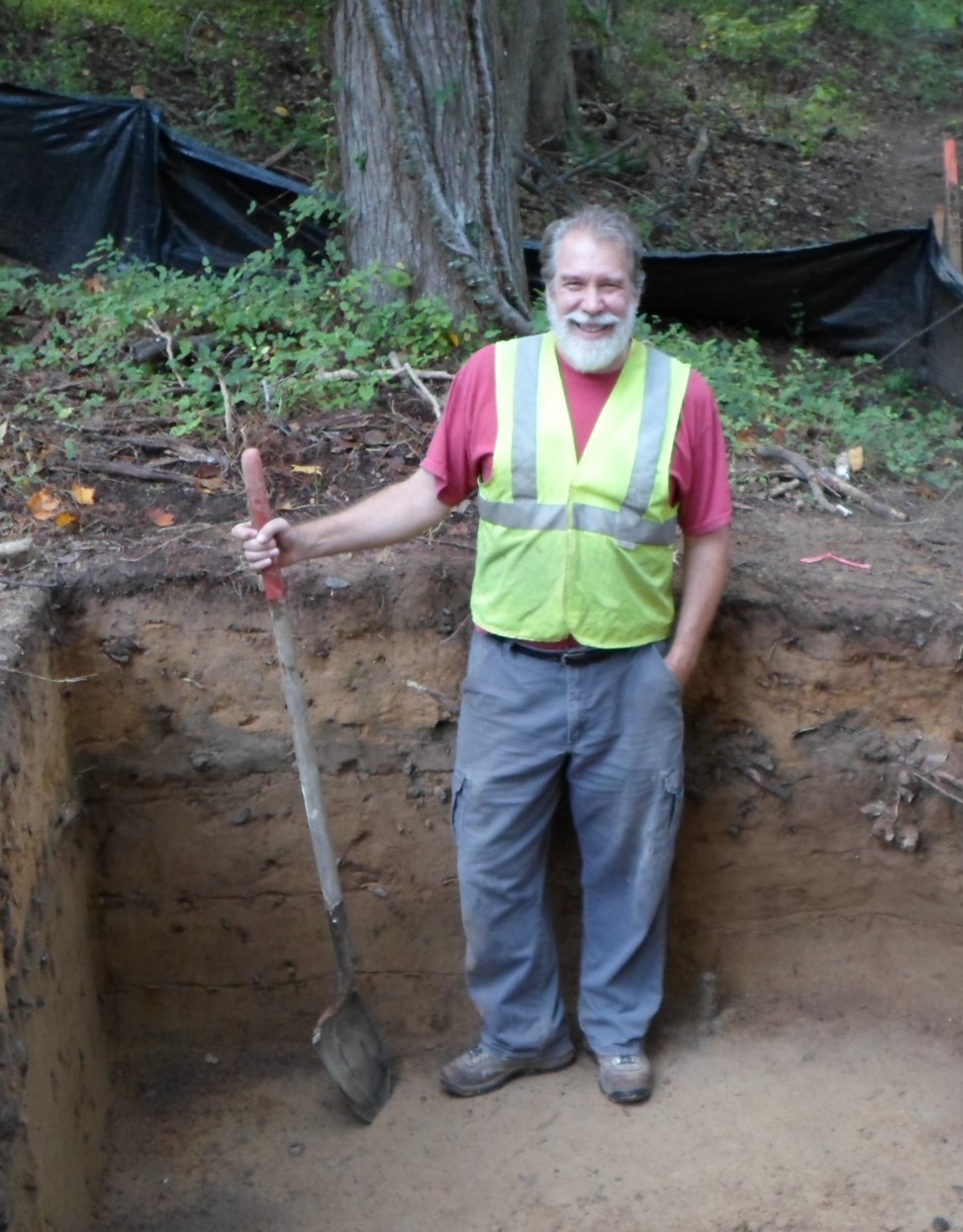
Finishing up our excavation in northern Virginia today. When I left, two people were completing the last test unit and the rest were cataloging artifacts. Digging and cataloging will be done today, leaving tomorrow to clean up the site and try to wash the poison ivy residue off all our tools. Monday my crew will move on to another project and I will go back into the office to start writing the report. That's me above getting ready to backfill one of our blocks.
The whole crew, assembled on the site.
This has been a great project, mainly because of all the interesting stone tools. So, a few more pictures. The lovely point above is probably what we call a Halifax, 6,000 to 5,000 years old.
Another Halifax on top; below is a strange thing with a Savannah River base, which would be around 4,500 years old, but a straight-sided blade. Since Savannah River points all have triangular blades, this is either something else, or a straight-sided knife made by somebody who usually made Savannah River points.
A fishtail point. I will miss finding all these great things, and I know my crew will, too. But it is time to move on.
Farewell.
The whole crew, assembled on the site.
This has been a great project, mainly because of all the interesting stone tools. So, a few more pictures. The lovely point above is probably what we call a Halifax, 6,000 to 5,000 years old.
Another Halifax on top; below is a strange thing with a Savannah River base, which would be around 4,500 years old, but a straight-sided blade. Since Savannah River points all have triangular blades, this is either something else, or a straight-sided knife made by somebody who usually made Savannah River points.
A fishtail point. I will miss finding all these great things, and I know my crew will, too. But it is time to move on.
Farewell.
The London Array
The London Array, 12 miles (20 km) off the coast of Kent, is currently the world's largest offshore wind farm. It features 175 turbines spread over an area of about 100 square kilometers. It is capable of producing 630 Megawatts of electricity, enough to power half a million homes. Generating that much electricity with coal would produce about 925,000 tons of carbon dioxide. Phase II will raise the capacity to 1,000 MW. This part of the North Sea is called the Long Sands, and the water is only about 80 feet (25 meters) deep.
Offshore wind farms offer certain advantages, such as, since people can't see them from their houses they are less likely to protest. The wind is also steadier. But the costs are very high, mainly for construction: right now these cost about three times what a comparable coal or natural gas facility would cost. Costs are starting to fall as the industry develops specialized ships and so on, but so far offshore wind still depends on large government subsidies.
Wednesday, August 21, 2013
Baba Vidin
Scapegoating Christians
After the army's bloody assault on their mostly peaceful protest camps, Egypt's Muslim fundamentalists have retaliated by staging violent attacks on Christian churches. Since the bloody crackdown of August 14, at least 60 churches have been set ablaze in Egypt. This does not seem to be a coordinated campaign organized by the Muslim Brotherhood, but a series of more or less spontaneous acts of local rage. Unable to hurt their real enemies, Egypt's oppressed Muslims lash out against equally oppressed Christians. It is a sad view of human nature.
The result, of course, is to further solidify the view of Egypt's Christians (10% of the population) and more secular Muslims that Muslim fundamentalists are all terrorists with whom no compromise is possible or desirable.
Lyme Disease is a "Tremendous Public Health Problem"
In 1996, when I got my first case of Lyme disease, it was still a relatively obscure disease. My doctor didn't seem to know much about it, he was very reluctant to diagnose it, and from some things he said I think I may have been his first confirmed case. By the second time I had it, five or so years later, the same doctor was very well up on all the literature and discussed the various symptoms with me, as well as the reliability of the test. And no wonder -- the disease has exploded. The CDC has just released a new estimate of the number of Americans who are diagnosed with the disease every year: 300,000. This is not an actual count but an estimate based on three different sampling exercises, but it is the best number we have. I believe it. Every field archaeologist I know has had it, most of them more than once. Just this summer three members of our six-person crew have had it. And we are careful people who know all the precautions.
Unfortunately, many doctors have not kept up like mine has. I hear stories all the time about doctors who don't even know the basics they could read off the CDC web site. One field tech on my crew was covered with bright purple blotches, hot to the touch, which is exactly what I got with my first Lyme case. Her doctor refused to recognize this as a sign of Lyme, even though the CDC has posted pictures just like it and the written guidelines list "any unusual rash" as a sign of Lyme. Ignorant doctors put all their reliance on the Lyme blood test, which far from perfect. As my doctor said, it is "no less accurate than any other medical test." It is an indication, but there are lots of others, and diagnosis should be based on all the factors rather than just the test.
As the CDC says, Lyme disease is a "tremendous public health problem." I have never been sicker than during my first bout of Lyme. Left untreated, Lyme can spread to joints, causing painful arthritis, and into the brain. There is no longer any excuse for doctors not to know about it or not to treat it aggressively.
Unfortunately, many doctors have not kept up like mine has. I hear stories all the time about doctors who don't even know the basics they could read off the CDC web site. One field tech on my crew was covered with bright purple blotches, hot to the touch, which is exactly what I got with my first Lyme case. Her doctor refused to recognize this as a sign of Lyme, even though the CDC has posted pictures just like it and the written guidelines list "any unusual rash" as a sign of Lyme. Ignorant doctors put all their reliance on the Lyme blood test, which far from perfect. As my doctor said, it is "no less accurate than any other medical test." It is an indication, but there are lots of others, and diagnosis should be based on all the factors rather than just the test.
As the CDC says, Lyme disease is a "tremendous public health problem." I have never been sicker than during my first bout of Lyme. Left untreated, Lyme can spread to joints, causing painful arthritis, and into the brain. There is no longer any excuse for doctors not to know about it or not to treat it aggressively.
Tuesday, August 20, 2013
Violent, Racist Archaeology
Michael Lemonick has posted a little profile of archaeologist James Adovasio that reminds me of everything I hate about American anthropology. Adovasio is a major partisan in the ongoing debate over when humans first came to the Americas. There are two theories: "Clovis first," which holds that the Clovis spear points of 13,500 years ago represent the first Americans, and something I am tempted to call "politicized radiocarbon literalism," which holds that people were here thousands of years earlier. As Lemonick tells the story, all archaeologists used to believe in Clovis first (which is not true, but never mind), until radiocarbon dates from the site that made Adovasio famous, the Meadowcroft Rock Shelter, came back thousands of years older:
The date of human entry into the Americas is a great intellectual problem: on the one hand you have the consistent, believable story of Clovis first, on the other the growing number of sites with earlier radiocarbon dates. Adovasio wants turn it this dispute from a debate into an exercise in mudslinging and political posture. When I read this crap I want to throw up my hands and walk away, but I won't. I refuse to let creeps like Adovasio ruin my exploration of the world.
Nevertheless, it took decades for the archaeological establishment to began to accept these findings, in part because several converging lines of evidence supported the previous model. For one thing, the spear tips that, for decades, were the oldest known human artifacts in North America—called Clovis points, because they were first discovered near Clovis, New Mexico—dated from about thirteen thousand years ago. For another, New World mastodons and other so-called megafauna went extinct around that time, too. And, although glaciers still covered parts of North America at the time, receding ice sheets opened up a corridor along the eastern Rockies that would have allowed Siberians to travel south from Alaska with relative ease.See? Adovasio and his ilk can't argue for their views based on the evidence, they have to throw around gratuitous accusations of sexism and racism. Why do they do this? I have the strong impression that they care much more about being on the right side of sexism and racism than they do about being right about the past. This is the great bane of anthropology. At least since Tacitus put pen to paper to write about the ancient Germans, most writers about other cultures have really been more interested in critiquing their own. Adovasio is part of the generation that grew up protesting the Vietnam War, and to him all theories involving violent, male-dominated hunting societies smell of napalm. That there really are violent, male-dominated hunting societies in the world, or that this is the most plausible description anyone has given of Clovis culture, matters not a whit to Adovasio; to think of the first Americans in these terms offends his political sensibilities, so it must be wrong.
The key problem with this whole scenario, Adovasio said, is “that five-hundred-year sprint down the hemisphere. People don’t just go running over the landscape. It takes a while to figure out what to eat, when to eat it, which plants will kill you, and so forth.” In part, he attributes the longstanding acceptance of this implausible story to the fact that, until relatively recently, most archaeologists were men. “I mean, who but a male would think that the ancestors of modern Native Americans sprinted to South America and killed everything in their path?”
If the first immigrants did arrive much earlier, the ice-free corridor through the glaciers wouldn’t have been available. But there’s an alternate route: they could have travelled down the coast in boats. “The colonization of Australia occurred even earlier,” Adovasio said. “It’s, in my opinion, simple racism that we never recognized before that the earliest populations in the Americas were capable of building boats.”
The date of human entry into the Americas is a great intellectual problem: on the one hand you have the consistent, believable story of Clovis first, on the other the growing number of sites with earlier radiocarbon dates. Adovasio wants turn it this dispute from a debate into an exercise in mudslinging and political posture. When I read this crap I want to throw up my hands and walk away, but I won't. I refuse to let creeps like Adovasio ruin my exploration of the world.
The (Alleged) Ostrich-Egg Globe of 1504
Mourning Egypt's Aborted Revolution
Activist Omar Robert Hamilton ponders what has happened in Egypt:
I have a bad feeling that this guy is right:
I sit, for the 12th hour now, alone and struggling for what to do. For the first time since I got on a plane for Egypt on Jan. 29, 2011, I am at a loss. Worse days than today lie ahead of us. We thought we could change the world. We know now that that feeling was not unique to us, that every revolutionary moment courses with the pulse of a manifest destiny. How different things feel today. I will not bury our convictions, but that feeling—youthful optimism? naiveté? idealism? foolishness?—is now truly and irrevocably dead. I mourn the dead and I despise those killing them. I mourn the dead and I despise those sending them to their deaths. I mourn the dead and I despise those who excuse their murder. How did it come to this? How did we get here? What is this place? . . .Omar Hamilton's mistake was a common one, thinking that people with no experience of democracy could easily work things out once they got the big bad generals out of the way. But democracy is hard, and authoritarianism does not appear for no reason. When they achieved power, after decades of oppression, the fundamentalists provoked a crisis rather than compromise with their ideological enemies. When the crisis came, the liberals preferred dealing with the military to leaving the fundamentalists in charge. Neither the liberals nor the fundamentalists really care that much about democracy. Both want to impose their own vision of the good society: free and prosperous on the one hand, godly on the other. Thus the military is left in charge for the foreseeable future.
In November 2011 and in January 2012, the streets echoed with chants demanding the end of military rule. But now it had become the self-appointed role of the politicians to translate street action into political gain. Now, the Army had people to talk to. Had all the forces that were supposedly against the military—the revolutionaries, the liberals, the Brotherhood, and the Salafis—ever truly united, where might we be today? Dead, possibly. But maybe not. Maybe somewhere closer to a civilian state.
A real, ideological alliance was never possible. But a tactical, practical one just might have worked. But rather than work together, each party repeatedly met with and made deals with the Army, consistently placing the generals in the strongest tactical position. Everyone was to blame. . . .
The main enemy of the people has always been the security state—the police and the military. We will never get anywhere until they are dismantled entirely. There was a moment when that could have been achieved, when a civilian state could have been built. But Morsi and the Muslim Brotherhood would have had to choose the challenge of working with the disparate and bickering forces of the left and the liberals over dealing with the organized certainty of the military.
I have a bad feeling that this guy is right:
The revolution is over; the terrorism is starting.
Subscribe to:
Posts (Atom)