Friday, June 28, 2013

Atheist Prayer

It's funny how zeitgeist works. Somehow, the question of non-religious worship is in the air. Or is it just in the Times and the New Yorker? Anyway, the Times is running a Room for Debate feature titled Should Atheists Pray? Kevin Ladd tends toward the affirmative:
Spin a globe and jab your finger at random. If you’re pointing to land, you’re pointing to a place where people are praying. Across Western and Eastern religious traditions, and even in some varieties of atheism, prayer is a core spiritual discipline. Why is so much collective time spent in this activity? Answers are complex, and like prayer itself they change across people’s lifespans and contexts. Most people who pray say it helps them feel “connected” to their own spirituality and beyond themselves. That sense of being not so isolated can be very comforting. Another rationale is more metaphysical. People often remark that praying is “how they live” rather than “something they do.” For them, prayer is, in part, paying attention to choices and striving to translate preferred beliefs into actions.
Hemant Mehta, on the other hand, calls prayer
the last resort of people who have run out of ideas, and the first resort of people who never bothered to think about how they could actually fix the problem at hand.
The always proselytizing Deepak Chopra puts in a word for silent meditation:
Meditation turns silence into something valuable on its own. Our brains change with every thought, because thoughts form a feedback loop that every cell eavesdrops on. In the tradition of meditation, silence also forms a feedback loop. A wordless voice says, “Here is peace.” Cells can eavesdrop on that message, too, and when they do, pathways in the brain are changed just as surely as when we respond to thoughts, sensations and emotions. Even without God, silence may be the womb from which intelligence and creativity emerge. In the meditation tradition, this silence is God. But labels and cultural baggage stand in the way. Even without God, silence may be the basis of the mind, the womb from which intelligence and creativity emerge.
Meditation seems to me a more fruitful path for atheists than prayer. I've never been able to empty my mind, but I have spent many hours happily contemplating obscurities like the Fibonacci sequence or how an atom can appear as a solid ball when examined with the electron tunneling microscope.

Change

US President Barack Obama and his wife Michelle look out from the "Door of No Return" while touring the House of Slaves, or Maison des Esclaves, at Goree Island off the coast of Dakar on June 27, 2013.

Plastisphere

What happens to plastic in the ocean:
Scientists have discovered a diverse multitude of microbes colonizing and thriving on flecks of plastic that have polluted the oceans -- a vast new human-made flotilla of microbial communities that they have dubbed the "plastisphere."

Using scanning electron microscopy and gene sequencing techniques, they found at least 1000 different types of bacterial cells on the plastic samples, including many individual species yet to be identified. They included plants, algae, and bacteria that manufacture their own food (autotrophs), animals and bacteria that feed on them (heterotrophs), predators that feed on these, and other organisms that establish synergistic relationships (symbionts). These complex communities exist on plastic bits hardly bigger than the head of a pin, and they have arisen with the explosion of plastics in the oceans in the last 60 years.

"We're not just interested in who's there. We're interested in their function, how they're functioning in this ecosystem, how they're altering this ecosystem, and what's the ultimate fate of these particles in the ocean," says Amaral-Zettler. "Are they sinking to the bottom of the ocean? Are they being ingested? If they're being ingested, what impact does that have?"

Thursday, June 27, 2013

The Evolution of Throwing Things

So far as we know, only one animal can throw projectiles with enough speed and accuracy to make them deadly weapons: us. Lots of animals sometimes throw things, and chimps sometimes throw things at leopards or baboons. But compared to us they are absurdly clumsy.

I was actually thinking about this the other day on the basketball court, pondering how much subconscious calculation must be involved in lofting a ball into a metal hoop from 20 feet away, something I do without giving the details of the motion any thought whatsoever. My eye is on the basket, and the ball follows it.

When did we evolve this ability? Neil Roach of Harvard and his colleagues have approached this question by analyzing in detail the anatomical underpinnings of throwing. They find that the most important difference between humans and chimpanzees is the reconfiguration of the shoulder so that the tendons can store energy during the back swing and release it during the throw. Based on their study of hominid skeletons, they think the first proficient throwers were Homo erectus, around 2 million years ago.

Fascinating.

Beauty vs. Bureaucracy

Metro threatens Phantom Planter with arrest if he tends his Dupont Circle station flowers
Quirky garden artist Henry Docter has been surreptitiously planting flowers in public places on four continents since 1979. His unauthorized beautification efforts have frequently aroused surprise and delight — but never a problem until this month, when he ran afoul of Washington’s Metro transit system.

Metro threatened Docter with “arrest, fines and imprisonment” if he dared to weed, water or otherwise tend to more than 1,000 morning glories and other flowers whose seeds he planted in 176 barren flower boxes alongside the top stretch of the north escalators at the Dupont Circle station. . . .

“I’m not denying that I’m a little nuts,” Docter said. He calls his plantings a form of performance art, saying, “Flowers are nature’s way of affirming how beautiful life can be.”
Sigh. What are the people who make these inane bureaucratic pronouncements thinking? How can they possibly believe that this is the right thing to do?

Sign a petition supporting Docter here.

Summer Flowers


In the garden today.

Back in the Field

My crew digging in the woods at Quantico this morning. The beefy guy in the yellow shirt is one of our minders from Explosive Ordnance, who are there to make sure we don't blow ourselves up on any of the old mortar bombs and artillery shells that seem to be lying all over the place.

And notice the silt fence. We are right next to tidal wetlands, so this is a sensitive environmental zone and we had to have a formal Erosion and Sediment Control Plan. To get our plan approved I had to pass Virginia's E&SC test and become a Responsible Land Disturber.

A little point I found today, not really distinctive enough to be datable but possibly about 4,000 years old.

And this is a 9,000-year-old point they found yesterday while I was in the office. It's just a little bigger than the one in my hand.

View of Chopawamsic Creek from near the site.

Wednesday, June 26, 2013

Who Goes to Prison

Prison turned out to be not nearly as bad as I expected… We have a vastly different justice system today than we had a generation ago, with an order of magnitude of more people in prison, and one of the things that people don’t stop and think about, is that one of the consequences of mass incarceration is that our prison are filled with really normal people. Mass incarceration did not happen because of some drastic shift in human nature. It happened because the private prison industry was able to change our laws that allows us to lock up a lot more normal people. 
--Climate activist Tim DeChristopher on Letterman

Not Allowed

The fact that you are alive is amazing, so you don't get to be bored.

--Louis C.K.

Inspirational Photo Bingo

A way to amuse yourself while reading articles about why you should be happier, eat healthier, exercise more, and chase your dreams.

The "Defense of Marriage Act" Struck Down

Justice Kennedy:
The law is unconstitutional as a deprivation of the equal liberty of persons that is protected by the Fifth Amendment.
The rapidity of this change is astonishing. Gay marriage has gone from being a joke to a terrible threat to accepted in half the country in twenty years.

Tuesday, June 25, 2013

St. Theodora's Chapel, Vastas, Greece

Twelfth-century stone chapel with 17 oak trees sprouting from its roof. Atlas Obscura:
According to local legend, Theodora lived in the 10th century in the town of Vasta. When the area was raided by bandits, she disguised herself as a man to join the defense. In the battle that followed she was fatally wounded, and just before her death asked God to change her body into a church, her hair into a forest, and her blood into the water that will feed the trees.
The roots of the trees are invisible, and the locals consider the survival of both the trees and the chapel a miracle.

The chapel is built over a spring. Recent investigations using ultrasound showed that the roots of the trees reach the ground by passing through small cracks within the stones of the walls, drawing water from the spring. The roots and the stone have become a single structure, and within it there is considerable tension. The tension holds the chapel up, but one day it might get out of balance and catastrophically implode.


Return of the Archimedes Screw

The ancient wizardry of Archimedes has been given a new use. The Archimedes screw was invented to raise water up, but of course if you let water flow back down it that would turn the screw in the opposite direction, generating power. Compared to the blades in a modern turbine, an Archimedes screw turns very slowly. This makes it inefficient, but it means that many kinds of fish can swim right through it. So, the greenest sort of hydropower. And it is now functioning at many places in Europe, including Windsor Castle.

Inequality is not Necessary for Economic Growth

The Economist savages silly arguments in favor of inequality:
The social purpose of high executive pay is to create incentives for hard work to maximise profit. But these guys are being paid double what their predecessors were making in the 1980s, which was not exactly a period known for its stodgy egalitarianism. Are we seeing startlingly better corporate performance today than we were back then? Is there greater productive innovation in, say, medical technology or commercial real estate? Is our economy growing faster? Are general standards of living rising faster? No, no, no and no. What public interest is served by the fact that these CEOs, as a class, are earning a multiple of what their predecessors did a generation ago? . . .  If the government were to, for example, return top marginal tax rates to the levels that prevailed in the 1990s or the 1970s in order to compensate for the superstar effect, there is no reason to believe that the top one percent would produce any less value for society than they do now.

The Republican Identity

Will Wilkinson explains why immigration reform is a hard issue for Republicans:
The energetic ideological base of the Republican Party is a nationalist, identity-politics movement for relatively well-to-do older white Americans known as the “tea party”. The tea party is interested in bald eagles, American flags, the founding fathers, Jesus Christ, fighter jets, empty libertarian rhetoric, and other markers of “authentic” American identity and supremacy. That America is “a nation of immigrants” is a stock piece of American identity politics, but the immigrants that made America America were, well, not Mexican, and spoke English, or at least Pennsylvania Dutch. Sorry Mexicans! Even if each element of immigration reform, taken in isolation, is agreed to be a good idea by a solid majority of Republican voters, Republican politicians must nevertheless avoid too-enthusiastically supporting this package of good ideas, lest they fail to project sufficient appreciation for the importance of keeping America American and putting Americans first.

The Chimpanzee Wake

A chimpanzee death captured on videotape:'
Pansy was probably in her 50s when she died, which is pretty good for a chimpanzee. She passed in a way most of us would envy — peacefully, with her adult daughter, Rosie, and her best friend, Blossom, by her side. . . .  as Pansy struggled to breathe, Blossom held her hand and stroked it.

When the scientists at the park realized Pansy’s death was imminent, they turned on video cameras, capturing intimate moments during her last hours as Blossom, Rosie and Blossom’s son, Chippy, groomed her and comforted her as she got weaker. After she passed, the chimps examined the body, inspecting Pansy’s mouth, pulling her arm and leaning their faces close to hers. Blossom sat by Pansy’s body through the night. And when she finally moved away to sleep in a different part of the enclosure, she did so fitfully, waking and repositioning herself dozens more times than was normal. For five days after Pansy’s death, none of the other chimps would sleep on the platform where she died.
Chimpanzees seem to practice some of the most basic human death rituals: holding vigils, grooming the corpse, coming to see the body one last time before moving on. What it means to them is obscure; but then, what does it mean to us?

The Paleo Diet is Neither Paleo nor Healthy

Last week on the Metro two fitness buffs stood right in front of me, comparing notes on their workout routines. They then embarked on an extended discussion of the "Paleo diet" so inane that it was a great struggle to keep my mouth shut.

So let me vent here.

The "Paleo diet" has little to do with what people ate in the Paleolithic period, it is not especially healthy, and its current popularity is based on a gross misconception of human evolution.

First, as I have written here before, there is substantial and growing evidence that humans have been eating ground grain for tens of thousands of years. We have evidence that people in East Africa ate sorghum 100,000 years ago; we have found numerous grinding stones from the Middle East dated to 30,000 years ago, and others from China dated to 19,000 to 23,000 years ago. The evidence that humans ate ground grains and beans 30,000 years ago is admittedly not yet very extensive, but it is better than the evidence that humans ate fish or shellfish more than 30,000 years ago, and Paleo diet people seem to eat a lot of such things. Come to think of it, there is essentially no evidence that Paleolithic people ate vegetables, which hasn't stopped Paleo diet faddists from making them central to the diet.

As to what sort of diet is healthiest, we have a ton of data on that. And it all points, not toward actual hunter gatherers -- yes, there are hunter-gatherers in the world, and their diets and health have been extensively studied -- or beef eating Argentines, but toward Mediterranean and Japanese farmers who ate a lot of grain and very little red meat. Before they started eating lots of potato chips and candy, the Japanese were probably the healthiest people in the world, and their words for breakfast and dinner mean "morning rice" and "evening rice."

And why would that be, since nobody thinks that ancient hunter-gatherers ate as much grain or as little meat as medieval Japanese or Italians? Because we have been farming for 10,000 years, more or less, and 10,000 years is long enough for a lot of evolution. Human evolution has not slowed down in the agricultural era; it has accelerated. One part of our genomes that we know has evolved very rapidly is the part that controls our digestion. Since the Neolithic revolution, we have adapted to eat a largely grain diet. The basic intellectual error of the "Paleo diet" is assuming that we are the same as our ancestors of 20,000 years ago, and therefore that what they ate would be good for us. This is just flat wrong.

A really good example of this stupid thinking is the ban on alcohol in many Paleo diets. The mechanisms we use to metabolize ethyl alcohol are found in all human groups everywhere on earth, so they are older than Homo sapiens and were  universal in the Paleolithic period. Evolution does not conserve such systems when they are not used. Ergo, Paleolithic people consumed alcohol.

Even stupider is the "raw diet," since we have been cooking food for at least as long as Homo sapiens has existed, and it seems that it was in fact the invention of cooking that allowed our brains to get so big; "raw food" is eating like a chimp-brained Australopithecene, and if you want to be more like an ape, go ahead.

And yet we all know people who have become healthier and fitter on the "Paleo diet," or its cousin the Atkins diet. Why is that? Well, all diets that work are based on psychological tricks. If your problem is pigging out on cookies or fettucine alfredo, but you have no great temptation to over-indulge in steak, then cutting out carbs might well help you lose weight. I put no great confidence in that, though, since people can lose weight for a while on almost any diet, and the long-term success of the Paleo diet seems to be no better than any other. (Very poor, that is.) Yes, we should probably all eat less refined sugar and more vegetables -- whether or not our Paleolithic ancestors ate them.

But don't be fooled by bad data on what our ancestors ate, or claims that excluding grains from your diet will make you healthy by magic.

Monday, June 24, 2013

Today's Castle: Puilaurens

Le Château de Puilaurens is one of the "Cathar Castles" in the hills above Carcassone where Cathars are supposed to have taken refuge during the Albigensian Crusade (1209-1229). It sits on a rock at an elevation of 2300 feet (700 m), accessible only by that steep, zig-zag  path.

Founded in the 11th century, it was acquired by the Queen of Aragon in 1162. Its location within Aragon protected it from the attentions of the crusaders, and the castellans were from the Saissac family, who are thought to have been Cathar sympathizers. Some time between 1229 and 1255 it was acquired by the French crown, and in the Treaty of Corbeil (1258) this whole district became part of France.

After the treaty the castle was rebuilt on the orders of St. Louis. It became one of the "Five Sons of Carcassone," five castles that guarded this part of the border for the French king. Most of what you can see today dates to this period. It was besieged by the Catalans twice in the fifteenth century and then taken by Spanish troops in 1635. The Treaty of the Pyrenees (1659) moved the border several miles to the south, and the castle, no longer strategic, was largely abandoned.

The questions surrounding the Cathar heretics and the Albigensian Crusade are among the most vexed in medieval history. Everything is disputed. The standard account is that the Cathars were dualists who believed that this world is largely under the control of the evil god, but some historians think this was all invented by learned churchmen who read about such things in St. Augustine and imposed it on the Cathars through imprisonment and torture. Some people of this region certainly supported an alternative religious structure led by men called "Perfects" or "Good Men" who wandered through the countryside preaching. These men distrusted the church hierarchy, but what they believed about god and the universe is, I am sad to say, all but unknowable.

Whatever they believed, the church thought they were heretics, and in 1208 the Pope declared a crusade against them. This was taken up by ambitious nobles from northern France and evolved into a sort of war between north and south, at least as much politics as religion. The end result was to bring this region much more firmly under the control of the French king, and to reduce the cultural independence of the south as well. And this explains why so many good Catholics in southern France have for centuries honored and the mythologized the Cathars. By this time it is impossible to separate out the various strands of folklore, wishful thinking, and actual history that surround the whole problem. One can read in learned-seeming books by respectable gentlemen of the south that many Cathars took refuge in this or that castle, but then see in another book that these refugees are first mentioned in 1835. So I will simply pass on that some historians say many Cathars took refuge in Puilaurens -- you can believe this or not depending on whether you feel skeptical or romantic. Certainly there is one inquisition record of 1241 in which it is asserted that a well-known Perfect was hiding at Puilaurens, but on the other hand there is no special reason to think that this assertion was true.

Even more obscure is the question of how the castle came into the hands of the French king. When the crusaders were fighting, it was certainly Catalan, but then suddenly in 1255 there is a French record describing its French garrison. Local tradition maintains that it was taken by force and numerous Cathar sympathizers executed, but that is something lost behind he veil of lost records, oral tradition, and tales made up for tourists.

But one thing I can tell you about the castle is that it has a "Tower of the White Lady", haunted by a ghost of that description. Or so people say.

Honghe Hani Rice Terraces, China

In far southern Chin, in the mountains of Yunnan Province, rice farmers have carved the hillsides into an extraordinary array of terraces. One region of these terraces has just been listed as a UNESCO World Heritage Site, the Cultural Landscape of Honghe Hani Rice Terraces:
The Cultural Landscape of Honghe Hani Rice Terraces, China covers 16,603-hectares in Southern Yunnan. It is marked by spectacular terraces that cascade down the slopes of the towering Ailao Mountains to the banks of the Hong River. Over the past 1,300 years, the Hani people have developed a complex system of channels to bring water from the forested mountaintops to the terraces. They have also created an integrated farming system that involves buffalos, cattle, ducks, fish and eel and supports the production of red rice, the area’s primary crop. The inhabitants worship the sun, moon, mountains, rivers, forests and other natural phenomena including fire. They live in 82 villages situated between the mountaintop forests and the terraces. The villages feature traditional thatched “mushroom” houses. The resilient land management system of the rice terraces demonstrates extraordinary harmony between people and their environment, both visually and ecologically, based on exceptional and long-standing social and religious structures.
These terraces have long been a favorite subject for landscape photographers, so there are thousands of pictures of them around.


The terraces in several parts of Asia have been in use for 1500 years, so this is a truly sustainable system. It depends on the
unique and integrated ecological system which comprises the forests on the hilltop, the terraced fields and villages on the hillsides, and the water system at the foot of the hills. The forests on the hilltops conserve the water resources. Making use of the water resources conserved by the forest on the hilltops, the terraced fields on the hillsides have formed vast artificial everglade while producing rice and aquatic animals and plants co-existed with these water-filled paddy fields to meet the basic needs of hundreds of thousands of Hani people and other ethnic groups.


This requires the conservation of large ares of cloud forest and the near elimination of erosion. So, there are extensive wild areas with diverse ecosystems in these regions, even though they have very dense human populations.


Sunday, June 23, 2013

Don't Ask Too Many Questions

"If people are too inquisitive," said Baba Yaga to her visitor, "I eat them."

-- from Russian Magic Tales from Pushkin to Platonov, edited by Robert Chandler

New App Prevents Icelanders from Sleeping with their Relatives

Everyone has heard of (or experienced) it when someone goes all in with someone and then later runs into that person at a family gathering some other time. This new app might just prevent such awkward moments.
A real problem, considering that there are only 320,000 people in Iceland, most of whom are descended from a few thousand settlers who arrived on the island more than a thousand years ago, and most of those settlers came from the same part of Norway. We are not talking about a diverse population. But take heart! News of Iceland reports on a new App that can help you from sleeping with people who are too closely related to you:
The Icelandic population is very small and all Icelanders are related. But yet, it is big enough so everyone doesn't know one another. This means that each and every Icelander that is in a relationship, is dating a relative. In most cases those relations are distant. But not always. But how can they know?

We all derive from the same family tree. An online registry, Íslendingabók ('The Book of Icelanders') holds information about the families of about 720,000 individuals who were born in Iceland at some point in time. Today, the population in Iceland is just about 320,000. The database can be found on islendingabok.is and everyone registered in the database has free access to it.

"Am I sleeping with or dating my cousin?" an Icelander might ask. The answer is: Of course you are, but how closely exactly are you related? The answer to that can be found in the online database, but people might not always have the opportunity to look that up when they are for example out partying. But now there is a solution.

Three engineers made an app for the 'Íslendingabók' database. People can now easily, and on the go, look up how they are related to other Icelanders. And a precious feature, using the bump technology, allows people that meet to just bump their phones together, to instantly see if they are too related to take things any further. The engineers' slogan for this feature was: "Bump the app before you bump in bed".
Ah, the wonders of technology.

Today's Place to Daydream About: the Aran Islands

The Aran Islands are three small limestone island off the west coast of Ireland: Inishmore, Inishmaan, and Inisheer. The largest, Inishmore, is nine miles long and two miles wide at the widest (14x3 km). Once a lonely, largely forgotten place, the isles have lately become a vacation spot for those who really want to get away from it all.


The western side of the islands is exposed to the winter gales that blow in from the Atlantic.


So all the settlements are on the more sheltered east side.

The stone walls are one of the most prominent features of the landscape; there are more than a thousand miles (1600 km) of walls on the islands.


The most famous monuments on the islands are two stone forts on Inishmore, Dun Aengus and Dun Eochta. Dun Aengus, built against the cliffs, is featured in every picture book about the Celtic past. Its history, however, is obscure. Radiocarbon dating has shown that the site was occupied by 1100 BCE, but opinions differ as to whether the great wall was built then or around 200 CE. Opinions also differ as to whether it was once a circular fort, half of which has been lost to erosion. And nobody knows why such an impressive and expensive fort was built on this tiny island. Was this the lair of a pirate chieftain? An important religious site? To make the problem worse, there are actually seven ring forts in the islands, all of disputed date, leaving us to imagine that the place might have been full of feuding warlords. Local folklore insists that all were built by the Firbolgs, the pre-Irish inhabitants of Erin.


Not far away is Dun Eochta, built on the highest point on the island. The best guess is that this fortress dates to between 500 and 800 CE, so it was probably not built until after Dun Aengus was abandoned. Probably. The walls here and at Dun Aengus were largely rebuilt in the 19th century, but on visible foundations using stone that was lying around the site.

The Irish monks of the fifth through tenth centuries liked to live in remote spots, so they flocked to the Aran Islands. There were at one time at least a dozen monasteries on Inishmore alone, which began calling itself "the island of saints and scholars." St. Columba once called it "the sun of the west." The ruins of monastic huts dating back to the eighth century can be seen in several places. This is the ruins of Teaghlach Einne, Enda's Household, a monastery supposed to have been founded in the fifth century. The church dates to the eighth century.

Here St. Brendan is supposed to have studied before setting off to explore the Atlantic, and 120 saints are said to lie in the graveyard.

The remains of an ancient cross, probably dating to the 11th century.

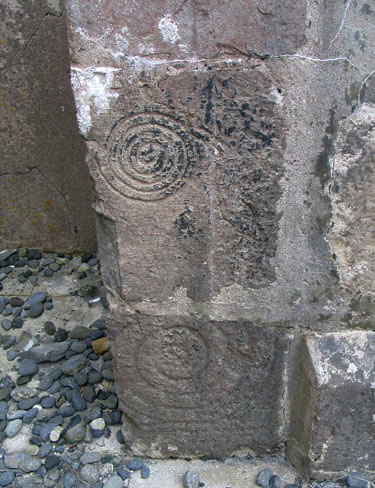
Spirals carved on the altar.

Ruins of more recent date also dot the islands; above, the Inishmore lighthouse. The origin of the current inhabitants is an obscure as almost everything else about the islands' past. Some say they fled to the island during Cromwell's invasion, others that they descend from the original Bronze Age inhabitants. One argument in favor of a recent settlement is that the only sort of agriculture on the islands is completely dependent on potatoes, grown in soil made from sand and seaweed. The islands were discovered by antiquarians in the 19th century. Most of Ireland's famous folklorists visited at some point to collect stories, watch the knitting of the famous local sweaters, and hear what was said to be the Irish dialect least contaminated by foreign tongues. A group of oral autobiographies collected on the islands in the 1930s used to be used to teach Irish in Irish schools.