Showing posts with label aid. Show all posts

Tuesday, July 13, 2021

Should We Stop Sending Aid to Poor Countries?

Brett Stephens is an iron ass conservative (to use one of Bush I's favorite phrases), but he may have a point about Haiti:

Following the 2010 earthquake, pundits and economists proposed multibillion-dollar aid packages for Haiti. Ultimately, some $9 billion in aid and another $2 billion worth of oil arrived. Billions were embezzled and wasted. Both President Moïse and his predecessor, Michel Martelly, ruled autocratically and were widely suspected of corruption. A recent story by my colleagues Dan Bilefsky and Catherine Porter, reported from a leafy residential area in Montreal, gives a clear picture of where some of this aid may have ended up.

The problems aren’t all on the Haitian side. In 2016, Yamiche Alcindor painted a devastating portrait in The Times of the work Bill and Hillary Clinton had done in the country. “Fewer than half the jobs promised at the industrial park, built after 366 farmers were evicted from their lands, have materialized,” Alcindor wrote of one Clinton-supported project. “Many millions of dollars earmarked for relief efforts have yet to be spent. Mrs. Clinton’s brother Tony Rodham has turned up in business ventures on the island, setting off speculation about insider deals.”

Yet the question of whether the greater share of blame lies with the donor or the recipient misses the larger point: Aid to Haiti fosters dependence, invites embezzlement, enervates the institutions of state and civil society, discourages local initiatives, misdirects capital to donor-favored schemes, enriches the well connected and enrages everyone else.

It’s also degrading. Treating people as helpless has a bad way of making them so.

A few years ago I read an academic analysis of the impact of aid on the economic condition of recipient countries over the 1960 to 2000 period, and it found that the impact is zero. Countries that received billions in aid were no better off than those that got nothing. In fact if you excluded South Korea from their analysis – which got billions in US aid in the 1960s and 1970s – the effect was negative. The more aid a country received, the worse its economy.

It may be, as some left-wing critics say, that the problem is the way the aid is given: countries often insist that construction projects be completed by contractors from the donor nation, for example, or require that a percentage of the aid be spent on their own products. World Bank aid often comes with stipulations that require capitalist economic schemes and limit land reform.

But that is the reality: a world in which aid would be given wisely and nobly, and then not stolen by corrupt autocrats, is probably beyond our reach. Given the actual state of nations like Haiti and Zaire, doing nothing may be better than throwing more aid money at problems aid money has helped to create.

While I'm on the subject, kudos to Biden for refusing to consider sending American troops to prop up Haiti's self-proclaimed new leader. I suspect this is another point on which Trump would have agreed, reminding us again that they both represent different aspects of the same United States.

Friday, September 20, 2019

Ben Rawlence, "City of Thorns: Nine Lives in the World's Largest Refugee Camp"

This book was a lucky impulse buy for me. Wandering in an independent bookstore, the kind I wish the world had more of, I considered that I ought to show my support by buying something, and this was to hand and looked interesting so I bought it. I'm glad I did, because it is amazing and eye-opening and not in my public library.

Ben Rawlence is a former researcher for Human Rights Watch turned journalist, and City of Thorns (2016) chronicles life in Kenya's Dadaab refugee camp, at that time (2010-2015) the largest in the world. Nobody is sure how large, since the Kenyan government forbade the UN to take a census, but best estimates for the peak population come in around 800,000 people. Most of them were Somalis, fleeing the war that has torn their country apart for a generation. There were also Ethiopians, who fled a civil war in the Ogaden region that most westerners have never heard of, and a few others. These days the camp still exists but has shrunk to about a quarter of what it was it its peak, most of the residents having gone back to Somalia or vanished into Kenya's large Somali population.

Rawlence tells the stories of nine camp residents, based on extensive interviews with them and what others told Rawlence about them. You might think that this would be a very depressing book, but I did not find it so. Yes, it is full of horrors, from starvation to corruption to suicide bombing. But it is also a tale of amazing resilience, of people getting on with their lives despite terrible hardship, and of generosity. Rawlence would probably dispute that last, since he spends much time complaining about the refusal of most nations to accept more than a trickle of refugees, and about the harsh discrimination against them, but it was the kindness of strangers that kept all these people alive through decades of war and a terrible two-year drought.

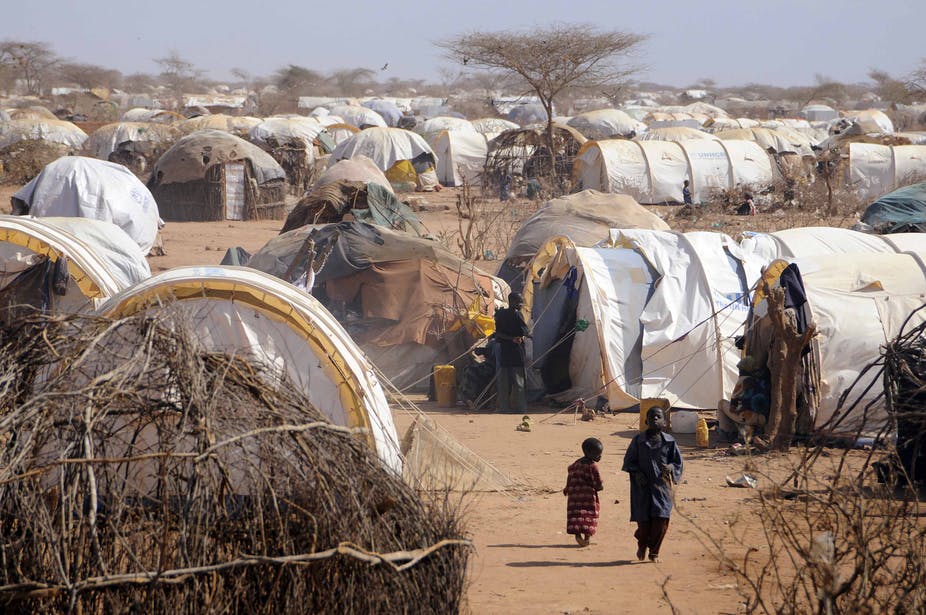
Almost all the people in the camp lived in shelters like the ones shown in these photos, a frame of wood cut from scrubby thorn trees covered with UN tent fabric. Around them was the bare red soil, dust in the dry season, mud when the rains came. Water came from deep wells, distributed to central pumps where people collected their daily ration in plastic bottles. Rations had to be collected every two weeks by waiting in a long line.

Dadaab was set up in 1991, and Rawlence met people who had been there ever since. Some of those early arrivals prospered in the camp's weird economy, based on UN food aid, other kinds of relief, work for relief agencies, and smuggling. Sugar, in particular, was smuggled from Somalia into Kenya on a massive scale, to avoid Kenya's high import tariff; after reading about the amount smuggled and the complicity of the police one can only assume that the tariff exists mainly to allow well-connected Kenyans to take a cut of the smuggling profits. Some of those early arrivals had founded thriving businesses selling things like cell phone time, television watching, vegetables, meat, clothing, household goods, and khat, the ubiquitous drug of the Horn of Africa. It is fascinating to see that even among people who would all be considered desperately poor in the US there are differences in wealth that seem very important to the people of Dadaab.

In 2010, before the crisis of the great famine, two week's rations for an adult consisted of:
3 kg. wheat flour
2 kg. rice
1 kg. beans
1/2 l. cooking oil
1/2 cup salt
That's enough calories to live on, but since in fact most residents sold some of them to get money for phone time or television time or vegetables or to save for a wedding feast or a thousand other things, many people were slowly starving. And that was before the crisis.

The horrible famine of 2011-2013 was caused by a complete failure of seasonal rains two years in a row, exacerbated by the ongoing war. Half a million more people became refugees, and thousands died, many of them in the desert on their way to Dadaab. The arrival of hundreds of new refugees every day for months, many of them close to death, led to a huge crisis that got the attention of the world media and led to surge of donations, which eventually brought the crisis under control. But for a while the situation was very grim. The UN issued ration cards to everyone who showed up at the camp, under the assumption that nobody who was not an actual refugee would want to live on flour, beans, and rice in a squalid refugee camp. But during the crisis thousands of Kenyans came to the camp, because at that time there was no food anywhere else in the region.

There were other ways that life in the camp was better than outside it. The Medical care provided by NGOs was better than that available to many Kenyans. Education was also provided, primary school for all children and high school for a select group. One of the mothers Rawlence chronicles thought at one point about going back to Somalia but decided to stay in the camp because there her daughter could continue in school, which would be impossible in Somalia.

In Rawlence's telling the worst dangers of life in Dadaab were not physical but psychological. One of the rules set by the Kenyan government was that the refugees could not work, so they would not take jobs from Kenyans. Many did anyway, for example for the smugglers or for businesses in the camp, but this was difficult and many could find nothing to do. (Those who worked for aid agencies were theoretically "volunteers" and were paid only a tenth of what a Kenyan got for the same job.) Getting by day to day on their UN rations, any spending on entertainment paid for by going hungry, nowhere to go, nothing to do, nothing to see but red dust, thorn trees, and huts roofed with UN tenting, many fell into despair. They dreamed about being accepted for resettlement in Europe or Australia, but less than 1 percent ever were. They fantasized about heading across Africa to the Mediterranean and boarding a boat for Europe, but that is expensive and many who tried were robbed and ended up stranded in some other nowhere place even farther from home. Of those who did make it to the sea, many were drowned. The refugees in Dadaab knew this, but in certain moods they said they would rather die trying to reach Europe than live any longer in the noplace of Dadaab.

Yet most went on: working when they could, finding ways to amuse themselves when they could not, marrying, raising families. Among other things they created soccer leagues with several different levels of play, mosques, churches, musical groups, and a radio station that broadcast stories of refugees collected by refugee reporters. The Muslim extremists who ruled much of Somalia, al Shabaab, tried to recruit in the camp but found very few supporters; the refugees had fled from them and their violence and even the promise of power and regular pay tempted only a few to join them.

Many westerners are dubious about creating refugee camps and keeping them running for decades. Do the camps, perhaps, keep conflicts going longer by creating a sort of safety valve where threatened people can flee and survive, rather than facing the prospect of surrender or death? Do refugee camps keep people living in places where the environment simply will not sustain them? Do they efficiently prevent people who must move from assimilating into their new homes? Maybe. But they also give victims of war a chance to live again.

Thursday, May 12, 2016

Random Notes on Africa

I'm reading The Rift: a New Africa Breaks Free by Alex Perry, an American-born, British-educated journalist whose bio says he has "reported on more than 35 wars." It's a rather strange book. The introduction and the conclusion are full of optimism about Africa, but in between is a compendium of reportage from the 2002 to 2014 period that mainly focuses on crisis zones. Many of these stories are terrible, some almost unbearable. There is a sort of message, which is that while things in Africa can be pretty awful, part of the reason they are so awful is the misguided efforts of outsiders to "help." Perry is angry and disgusted with both Africa's homegrown villains and the wicked or foolish westerners determined to make things better whether Africans want it or not.

Remember the civil war in Mali? After the fall of Qaddafi in Libya, the story went, a bunch of his former soldiers went south to Mali and helped the desert Tuareg and Islamists from AQIM (Al Qaeda in the Islamic Maghreb) rebel, creating a huge Saharan state and threatening the populated core of the country. Then the French intervened, the Islamists quickly faded back to the desert, and order was restored. What you probably have not heard – I never heard it, anyway – is that both the "Islamists" and the "government" were actually mainly fighting over the profits of drug smuggling. Gangsters had been flying 727-loads of cocaine from South America to Mali and then either distributing it among dozens of "mules" headed for Europe or loading it onto convoys 4x4 trucks that crossed the Sahara on the ancient caravan routes to Algeria. Both the army of Mali and AQIM were at the time mostly funded by drug profits. At various times both would pretend to be against the trade and launch anti-corruption crusades, but it was all show. For example, the government once "arrested" the senior general who was in charge of their smuggling operation, but his "prison" was a luxurious villa within the presidential compound in the capital. For the past two few years we have had comparative peace because both sides are sticking to their agreements over the division of the spoils; when you hear about peace talks, one local tells Perry, "it's not a political thing, it's two cartels doing a business deal. They just put a political hat on it."

Perry has spent a lot of time covering the civil war in eastern Congo, which grew out of the 1994 Rwandan genocide. Perry's favorite African leader is Paul Kagame, the President of Rwanda. It was Kagame's Rwandan Patriotic Front that put an end to the genocide (with semi-secret help from the CIA and others), and just 15 years later Rwanda was one of Africa's success stories. To Perry, Kagame is exactly the kind of leader Africa needs: incorruptible, forward-thinking, determined to make his nation independent of outside assistance. So, of course, westerners keep accusing him of crimes against humanity. Not that Kagame is any sort of saint, but as Perry points out what he has done is only what any western leader would have done. After the RPF drove the genocidal militias out of Rwanda they crossed to Congo. There the UN and others set up a chain of refugee camps for the murderers and their families. Those refugee camps were soon taken over by Interhamwe, an organization led by the organizers of the genocide, and Interhamwe then began launching attacks on Rwanda. So Kagame attacked the refugee camps. What was he supposed to do? If this led to the near complete collapse of government in eastern Congo, and a bloody civil war, was that his fault, or that of the entirely hopeless government of Congo?

The outside world responded by setting up MONUSCO, the United Nations Organization Stabilization Mission in the Democratic Republic of the Congo. Perry is at his best in describing the bizarre uselessness of UN "peacekeepers," who mostly stay inside their air-conditioned trailers, inside their compounds, sending reports home via satellite hookups, next to posters saying things like WE ARE HERE FOR THE PEOPLE. Actually the people are kept outside these safe compounds by massive barriers of razor wire; only UN employees are allowed into these safe zones. At the height of the mission there were 17,000 UN soldiers in the Congo, outnumbering the biggest non-UN fighting force in the region 4:1. Their budget was $1.5 billion a year, while the various armed factions managed to scrape together perhaps a few hundred thousand selling coltan and diamonds. Yet the UN did nothing to stop the violence. In one of Perry's most surreal stories, a rebel commander decides that he really wants to drive a UN base out of his district but doesn't want to assault their razor wire. So he takes a bunch of hostages and starts to behead them one at a time right outside the UN's gates, thinking that surely they will have to emerge and try to stop him. He underestimated their lethargy; his men ran out of heads before a single UN soldier or even a messenger emerged from their compound. And this:
Two months later, with the M23 rebels still on the outskirts of Goma, the UN peacekeepers in eastern Congo finally took decisive action. They fled.

An M23 tank fired a single shell into Goma. Around 1,000 guerrillas began advancing on the city. The UN immediately abandoned the civilian population, retreating in convoys of trucks back inside their bases or moving clean outside the city. The rebels took Goma that afternoon without a shot. By the evening, crowds were gathering in front of UN bases, demanding that those peacekeepers who had not left do so forthwith. 'You could not defend us,' shouted Amani Muchumu, 18. 'You are useless. You are dismissed.'
Perry also has a field day with the way western aid groups routinely exaggerate the human suffering these wars involved. According to the International Rescue Commission, the civil war in eastern Congo claimed 5.4 million lives; according to the US military, it was more like 40,000. After one Rwandan attack into Congo,
The UN said Rwanda's actions had displaced 53,000 people. Oxfam's Congo director, Elodie Martel, made that 500,000, and on Twitter Oxfam said the figure was '2 milion +'.
Aid groups, Perry argues, need African catastrophes to raise money, so when none are handy they simply invent them.

Here is Perry on why South Africa's ANC has had so much trouble transitioning from rebel movement to governing party:
Freedom fighters fought the law. Under an oppressive state, breaking the law was freedom. It was freeing your mind and snatching back your authority. And if you were breaking the law, why not work with the experts? In its fight with apartheid, the ANC, and its Durban branch in particular, had worked in close alliance with black organized crime.

The problems began once the Struggle was over. Once they were the law, many of Africa's freedom fighters saw no reason to stop breaking it. It was who they were, after all; free thinkers and revolutionaries, righteously radical entrepreneurs who took what they wanted and, in that act, found their liberation. It was a mindset well suited to rebellion, but it made for horrible rulers. Once in power, numerous ANC revolutionaries who had fought to better themselves made sure they did, helping themselves to state finances, often in alliance with their old criminal friends. With power so lucrative and used so unscrupulously, comrades were soon killing each other over housing deals or government contracts or simply because they thought it was their turn.

This was the paradox of liberation and democracy, said [former ANC operative] Sifiso. The ANC may have fought for democracy. But to do so effectively, it had had to become profoundly undemocratic. The Struggle had required discipline, hierarchy and a willingness to safeguard the movement above all else. When it took power in 1994, the ANC should have adjusted. "But we did not," said Sifiso. "We did not deliver to the people. We continued to deliver only to ourselves."
As Perry notes, more than 16,000 people are murdered in South Africa each year, ten times the death toll of the civil wars in Somalia that get so much American attention.

South Africa's ANC leaders may have enriched themselves, but they are amateurs at theft compared to the insane kleptocracy of Nigeria. The great majority of the billions foreign companies pay for Nigeria's oil is simply stolen by Nigeria's leaders. In the early 2000s, when the price of oil was high, the Nigerian elite was sending more money out of Africa to their own foreign bank accounts than all the aid flowing into Africa from the outside put together. Frustrated people sometimes fought back against their robber princes, but most of these uprisings were quickly crushed. The exception is the revolt led by Boko Haram, who have made themselves famous by embracing violence as a creed, staging stunts like the April, 2014 abduction of 276 schoolgirls. This kidnapping led to a worldwide outcry, symbolized by the tag #BringBackOurGirls. Americans who rushed in to help were astonished to find that the government of Nigeria seemed not to care:
For close to three weeks after the girls first went missing, the government had appeared not to even notice. It then claimed that they had been set free, then said al-Qaeda was to blame. After that President Goodluck Jonathan's wife Patience accused the girls' parents of inventing the whole affair to embarrass her husband; then had one of the #BringBackOurGirls organizers arrested; then told people not to criticize Jonathan since his presidency was the work of God; then, to press her point, went on live television to evoke God's presence, wailing, "There is God-o!" over and over. The President's office later displayed same sensitivity when it claimed, falsely, that it had a peace deal with Boko Haram, before going on to announce that the slogan for the President's re-election campaign would be #BringBackJonathan.
And so it goes.

In the final section Perry returns to the optimism with which he started. He marvels at Africa's cell phone boom, which was followed by booms in writing cell-phone apps and then a whole system of cell phone banks. Africa went in a decade from having almost no retail banks to being years ahead of the west in mobile banking and payment systems. Perry also talks to people setting up commodities markets and commercial farms and all sorts of business successes. And the one thing all these activities have in common, he says, is that they are not funded with western aid.

Friday, March 14, 2014

Banning NGOs in Somalia, or, Farmers Hate Food Aid

Strange story from Somalia, where Al Jazeera reporter Hamza Mohamed finds many people very happy that the anti-western fanatics of al-Shabab expelled all NGOs and ended food aid:
In November 2011, in a much-criticised move, al-Shabab banned foreign non-governmental organisations (NGOs) from areas it controlled, accusing some of the organisations of "illicit activities and misconduct".

"We want our people to be free of NGOs and foreign hands. We want them to depend on each other and to stand free of outsiders," Sheikh Abu Abdullah, the al-Shabab governor of Lower Shabelle province, told Al Jazeera.

Lower Shabelle is Somalia's breadbasket. During the famine of 2011, which killed more than 250,000 people, the province was hit hard. Many people moved to camps for internally displaced persons in the Somali capital, Mogadishu. On the other side of the town is the farm of Abdi Haji Qarawi, a 47-year-old who is the father of 18 children. On one side of his 17-hectare sesame farm stand triangular heaps of sesame drying in the scorching mid-afternoon sun.

Before the banning of NGOs and the construction of the town's canals, Qarawi says he was a "beggar". "Every last week of the month we used to go to the NGOs' office to ask for food. Sometime they will tell us there was no food. It was a shameful life." Two years after deciding to return to farming, Qarawi is a happy man. "All my children go to school. I can afford to send them to study and I have surplus cash," he said with a smile.
Obviously the farmers are happy about this, since for them food aid amounted to unfair competition. The UN says that main reason things are better in Somalia than in 2011 is that there has been a lot more rain:
But farmers here see the turn of their fortunes differently. The area's newfound prosperity "is because of the NGO ban", said Mohamed Sheikh Abdi, the chairman of the Bulo Mareer farmers union. "They always brought food to the town weeks before the harvest... They bought their food from abroad and never bought from us local farmers. They killed every incentive to farm. We were hostage to the NGOs."
In a traditional peasant society, what happens in years of crop failure is that prices for food soar. Farmers can sometimes do quite well out of this, since whatever little they have to sell is worth a lot more. The main victims are poor townspeople and laborers who don't have crops of their own -- they are the ones in danger of starving. Now bring in a few thousand tons of UN rice, and what happens? Laborers and townspeople are happy, because they can get enough to eat, but farmers find that their paltry crops are not worth that much more, so they are worse off even if not exactly starving. Whether this is a good or bad thing depends on whether you have crops to sell.

I was not surprised that al-Shabab is opposed to food aid. Mohammed Morsi, when he was Egypt's President, also tried limit food imports, which suggested to me that Islamic fundamentalists instinctively take the side of the farmers. Like conservatives in some other places, they admire the self-reliance and toughness of farmers and want to protect them from international agribusiness. Maybe this will work, and with protection and encouragement Somalia can become food independent. But maybe not.

The al-Jazeera story focuses on new canals built by a-Shabab that seem to be making some farmers rich. This may or may not be a good thing, depending; almost all of the world's fresh water gets used by somebody, after all, and the canals that are such a boon to farmers in this district may cause rivers to dry up somewhere else. Hard to know without more detail.

Saturday, July 21, 2012

Sunday, November 22, 2009

Poverty, Aid, and Culture

Nick Kristof has a column today about some of the issues surrounding aid to poor countries, which is intelligent but, I think, unwise. He notes that some kinds of aid work very well but others do not.
For example, the number of children dying each year before the age of 5 has dropped by three million worldwide since 1990, largely because of foreign aid. Yes, aid often fails — but more than balancing the failures is quite a triumph: one child’s life saved every 11 seconds.
Reading through Kristof's cases, it seems to me that a general rule emerges: medical aid works, education aid sometimes works, but aid intended to promote economic growth doesn't work. Aid thus feeds into the Malthusian trap that keeps poor people poor. Africa has actually seen a lot of economic growth since 1960, mainly because of mining, oil, and improvements in agriculture (the "green revolution"), but because population growth has been even more rapid, the result is that poor Africans are worse off than before.

In the contemporary west, population growth has slowed because although we have low death rates we also have very low birth rates. Those low birth rates seem to arrive when societies make the transition from rural, peasant economies to urban, commercial and industrial economies. Across east Asia and South America this transition has been working just as it did in Europe and North America, and birth rates in China and Brazil are lower than they are in the US. But this isn't happening in Africa or much of the Arabic-speaking Middle East.

Why not? It seems to me that to describe the transition from a peasant society to an urban commercial society as "economic" is to miss most of what happens. The difference between peasant farmers and modern urbanites is cultural. We think and act in different ways and have different expectations. Those countries that have modernized rapidly are those that have embraced the cultural side of modernity. The template for such a cultural revolution was set in Japan in the 1860s. Japan's leaders, humiliated by the military superiority of western nations, dismantled their country's traditional institutions, took up western dress and habits, and relegated Japanese ways to harmless bits of heritage.

In Africa and the Middle East there is a huge resistance to adopting western ways and values. So long as that is the case, there will be no economic revolution. Because being rich according to western norms requires living like western people. In this sense, the whole notion of "economic development" is a western construct that really means "people should act like we do." Of course, many people in the world do want to live like Europeans and Americans. But many don't. They want to continue their peasant ways, but somehow to be made richer by economic magic. It can't happen, and even if it did the gains would be wiped out in a generation by population growth. Which is why Kristof's approach to aid, though warm hearted, is ultimately dubious. The sad fact is that without cultural transformation, more children surviving means more poverty for everyone. In Asia we are seeing that population growth can be a factor driving people toward modernity, as they move to cities, take jobs, and need to limit the size of their families lest their overflow their cramped urban apartments. We don't see this happening in Africa. I think we are not because the cultural gap is too wide to be bridged in a single generation. So my forecast for the future of Africa is more misery, more violence, and more hunger, no matter how much aid or what kind we choose to give.