Showing posts with label Korea. Show all posts

Tuesday, July 22, 2025

A Korean Hostage Prince in Tang Dynasty China

Figurines from the Tomb

Under the Tang Empire, China helped the Silla state become rulers of the whole Korean peninsula (c. 668 AD). In return, the Chinese emperors expected the Silla kings to act as Chinese vassals. The politics of this were complex and contentious. One piece of the relationship was that some members of elite Korean families were taken to the Chinese capital of Chang'an and lived there as high-class hostages.

In 2022, Chinese archaeologists excavated a Tang dynasty tomb near Chang'an. The tomb had been looted, but besides a large number of clay figurines, one very important artifact remained: a lengthy inscription describing the life of the deceased (above):

The epitaph, made of bluestone, consists of a square cover and base. The domed cover is adorned with incised cloud and floral motifs, with peonies carved on all four corners. At the center, an inscription in seal script reads: "Epitaph of the Late Lord Kim of the Great Tang." The main epitaph block features an incised grid containing 557 Chinese characters written in regular script.

According to the inscription, Kim Young was a Silla prince who served as a political hostage, or zhizi, in Tang China. He was born in the sixth year of the Tianbao reign (747) and died in 794 at the age of 48 in the Taipingli guest residence in Chang'an.

According to historical records, three generations of his family served as hostages in the Tang Dynasty and were granted official posts. Kim Young himself twice accompanied Tang envoys on diplomatic missions to Silla and participated in ceremonial duties, including mourning and investiture missions. His funeral was organized by Tang officials, with the magistrate of Chang'an county overseeing the arrangements. Both his burial site and coffin were bestowed by imperial decree, demonstrating the Tang court's favor and respect for him.

The inscription also mentions Kim's wife, which is important because otherwise we know next to nothing about that part of the hostage-host arrangement. Kim married into one of the top noble clans of Tang Dynasty China:

His wife was from the influential Wang clan of Taiyuan and the daughter of Wang Qianling, magistrate of Yanshi county. This suggests that hostage Silla princes stationed at the Tang court often married into elite Chinese families.

The ever-growing corpus of tomb inscriptions is probably the main way contemporary scholarship is adding to the history of Han and Tang dynasty China. Tomb inscriptions, some of which are even longer than this one, can add to, and serve as a check on, the royal chronicles that our almost our only textual source for political events.

And how fascinating that in 668 AD a Korean could have the name "Kim Young."

Wednesday, December 11, 2024

The Insane Details of the South Korean Coup Attempt

Via The Blue Roof on Twitter/X. The source is testimony to the National Assembly's Defense Committee, which is investigating the coup:

To arrest key liberal leaders including Lee Jae-myung, the military dispatched the HID unit, the special forces whose main task is to assassinate major North Korean leaders in case of a war. They are normally near the DMZ, but were just outside of Seoul on Dec 3.

The HID unit were not dressed in the ROK military uniform. Instead, they were given a false North Korean uniform. The plan was to have the HID unit either assassinate Lee and others, and if that failed, have the "rescuing" South Korean soldiers to kill both Lee and the HID unit.

The Defense Minister's original plan was to provoke an attack from North Korea, then use that as an excuse to declare martial law. To that end, South Korean military flew several drones over the Pyongyang sky, spraying propaganda fliers. North Korea did not attack, however. . . .

Yoon Suk-yeol directly commanded the military at the scene of the National Assembly to arrest the lawmakers. The president personally called Cdr. Gwak Jong-geun and told him: "They don't have quorum yet. Get in there and drag them all out."

During the coup, helicopters carrying special forces headed to the Assembly were held up at the capital no-fly zone, because the Air Force was not aware of the coup plan. In the end, the Air Force never approved the flight; the Army forged the approval order.

According to other testimony, planning for the coup began in July 2023. The plotters had more units of special forces ready to deploy to Seoul but halted them when the Assembly rescinded the martial law order. Our reporter thinks that might have led to a massacre, but other military observers have noted that the troops deployed to the National Assembly building did not have live rounds in their guns.

The farce has continued since the failure, with one spokesman saying the president ordered the coup because he was lonely and depressed, and one of his top aids trying to commit suicide by choking himself on his underpants.

Weird place, Korea. Of course other sources are denying this, but obviously something very weird happened.

Thursday, June 29, 2023

Meanwhile, in Korea

In South Korea, there is a nationwide debate over no-child zones, which have proliferated over the past decade. Some people are now pointing out that this might be a problem for the nation with the world's lowest birth rate.

But as CNN reports, it isn't just bans on children that are proliferating:

Meanwhile, it would be wrong to suggest that it is only the youngest in society who are subject to such “zoning” requirements.

On Jeju, it’s not unusual to see signs at camping grounds or guest houses stipulating both lower and upper age limits for would-be guests. There are “no-teenager zones” and “no-senior zones”, for example, and even plenty of zones targeting those somewhere in between.

So numerous have the “no-middle-aged zones” become that they have collectively been dubbed “no-ajae zones,” in reference to a slang term for “uncle.”

One restaurant in Seoul rose to notoriety after “politely declining” people over 49 (on the basis men of that age might harass female staff), while in 2021, a camping ground in Jeju sparked heated debate with a notice saying it did not accept reservations from people aged 40 or above. Citing a desire to keep noise and alcohol use to a minimum, it stated a preference for women in their 20s and 30s.

Other zones are even more niche.

Among those to have caused a stir on social media are a cafe in Seoul that in 2018 declared itself a “no-rapper zone,” a “no-YouTuber zone” and even a “no-professor zone”.

But most such zones follow a similar logic – that of preventing disturbance to other customers. For instance, no-YouTuber zones became popular in response to a trend known as “mukbang” (based on words for “eating” and “broadcast”) in which some livestreamers would show up at restaurants without prior consent to film themselves eating.
CNN found one Korean studies professor with a theory:
Koreans in their 20s and 30s, in particular, tend to have a strong concept of personal space, and are increasingly less tolerant of both noisy children in their midst and noisy older people.

Which is something I have noted about Japan, a preference for a controlled, orderly life that pretty much rules out childbearing and much else besides.

Tuesday, February 21, 2023

In Seoul, a Freeway became a Riverside Park

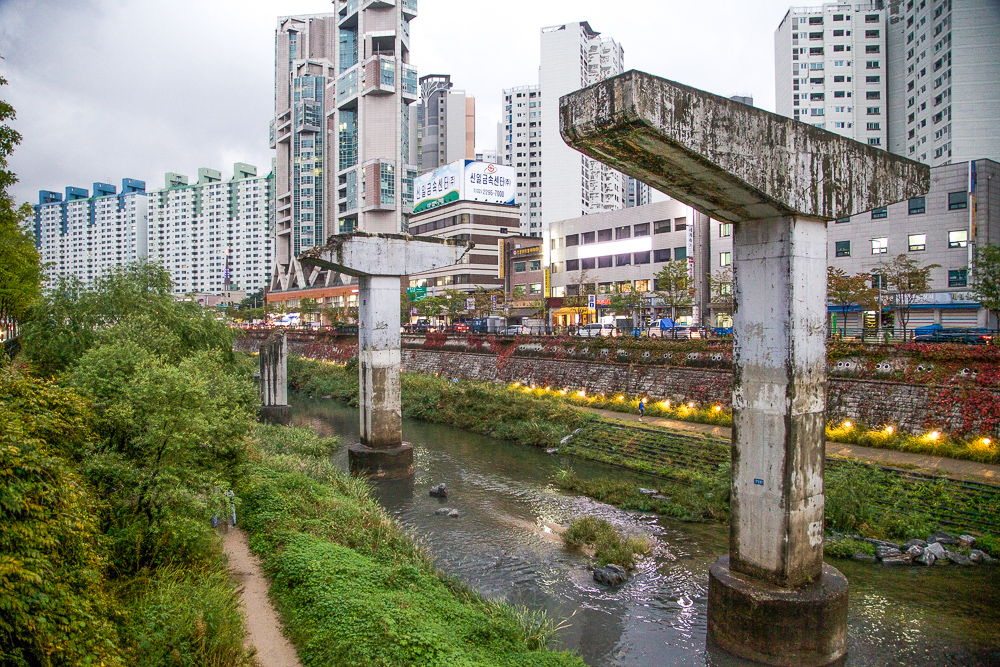
One of the delightful features of downtown Seoul, South Korea, is a stream called Cheonggyecheon. It winds 11 km (7 miles) through the central city, lined with various parks and promenades.

As Seoul grew in the 1600s, Cheonggyecheon served as its sewer. Korean kings invested in improving it, building embankments and levees to control flooding. In 1904 part of it it looked like this, muddy, polluted, some said dangerous. Notice that diversion of the stream's water for human use had reduced it to a trickle during dry seasons. The Japanese imperialists who ruled Korea from 1910 to 1945 also invested in the stream and in Seoul's water and sewer systems generally, and the stream was cleaned up a lot.

When refugees flocked to Seoul after the Korean War, shanty-towns lined the stream and it was once a again an open sewer. In the 1960s growing South Korea decided that the stream was an eyesore. So they put what was left of the stream's flow into a concrete-lined tunnel and built this elevated expressway above it.

But then in the 2000s, as Seoul's people started to want nicer lives, not wider expressways, a plan was floated to get rid of the highway and bring back the stream. The plan was approved in 2003 and construction was completed 2005. The result was this delightful urban amenity.

The transformation was not cheap; the bill eventually came to $281 million. 

Some environmentalists protested spending all that money to create something they called fake. Because, remember, so much of the stream's water had been diverted, the new Cheonggyecheon had to be rewatered using sources like water piped from metro stations and even some municipal water in dry seasons. I don't care if it's fake; it looks wonderful.

Three pillars left as a reminder of the freeway that once ran here.

Projects like this remind us that the world does not have to keep getting uglier. It was expensive, but South Korea is rich, and can afford it. New businesses have sprouted up all along the stream, helped to pay the city back for the expense, and it has also helped the city to attract new residents.

Friday, January 27, 2023

South Korea's Fertility Collapse

South Korea has the lowest fertility in the world, with total fertility falling below 0.8 last year; that means each generation would be only 40% the size of the previous one. Birth rates are falling across most of the world, but the reason East Asia nations and South Korea in particular are leading the collapse seems to be miserable relations between the sexes. Korean feminists are full of outrage about their second-class treatment, while Korean conservatives (like the new president) regularly say things about feminists that in the US nobody but misogynist trolls would dare to utter. 

As in Japan, the expectation that white collar workers will put in very long hours plays a part; the demands placed on executives are almost impossible to bear without a supportive spouse, so a marriage between two people with careers has no room for parenthood. Korean women complain that their husbands refuse to be any help with children, so they are saddled with the whole burden.

Hawon Jung in the NY Times:

A 2022 survey found that more women than men — 65 percent versus 48 percent — don’t want children. They’re doubling down by avoiding matrimony (and its conventional pressures) altogether. The other term in South Korea for birth strike is “marriage strike.” . . .

Young Koreans have well-documented reasons not to start a family, including the staggering costs of raising children, unaffordable homes, lousy job prospects and soul-crushing work hours. But women in particular are fed up with this traditionalist society’s impossible expectations of mothers. So they’re quitting. . . .

Discrimination against working mothers by employers is also absurdly common. In one notorious case, the country’s top baby formula maker was accused of pressuring female employees to quit after getting pregnant.

And gender-based violence is “shockingly widespread,” according to Human Rights Watch. In 2021, a woman was murdered or targeted for murder every 1.4 days or less, according to the Korea Women’s Hotline. Women have dubbed the act of ending a relationship without getting a vicious reaction a “safe breakup.”

But women haven’t passively accepted the toxic masculinity. They’ve organized raucously, from Asia’s most successful #MeToo movement to groups like “4B,” which translates to the “Four no's: no dating, no sex, no marriage and no child-rearing.”

“The birth strike is women’s revenge on a society that puts impossible burdens on us and doesn’t respect us,” says Jiny Kim, 30, a Seoul office worker who’s intent on remaining childless.

I suppose one underlying factor here is the extremely rapid economic and technological development of South Korea, which has outrun social change and left many people feeling bewildered.

But I am fascinated by this dynamic: that the richer societies get, the more people feel that they can't afford to have children. It is simply not true that having a child in Korea today is a greater economic burden than it was 25 years ago, and yet people feel this to be true. Part of this has to be that however fast our incomes rise, or expectations rise faster, leaving us always behind. Another part is our placement of the "career" at the center of life; more and more people can't imagine life without one, which means other things have to be shoved to the side.

What good is getting richer if it leaves us feeling less able to afford the things we want to do?

Monday, February 15, 2021

Studio GAON, "Lucia's Earth", Gong-Ju, Korea

Reconstruction of a house found in a ruinous state, essentially a new house that incorporates salvaged beams and other pieces of the old.


Monday, September 14, 2020

A Noble Woman of Medieval Korea


Images from a grave recently excavated in Gyeongyu, South Korea, dating to the Silla Kingdom, 7th-8th century CE. That's some fabulous archaeological skill right there, to expose all those tiny beads and the gold pieces of the earrings without removing them. The headpiece is gilt bronze.


As are the shoes. Which makes me wonder; did this woman actually walk around in bronze shoes, or was this just for the funeral?


Grave goods. If you want even bigger images, the History Blog has them.

Monday, March 23, 2020

How did Korea control Covid-19?

How South Korea controlled the Wuhan coronavirus:
  • Respond quickly. As soon as their first cases were confirmed, South Korea furiously manufactured test kits, and they now make more than 100,000 per day. They also immediately began tracing the contacts of infected people.
  • Test, test, test.
  • Trace contacts and isolate them. Don't wait for symptoms to appear; if someone has been near an infected person, isolate and test.
  • Enlist the public's help. No scofflaws in Korea partying on the beach.
The result is that Korea has done better at controlling the virus than any other nation, despite an curve that at the start looked just like Iran's or Italy's.

Wednesday, May 8, 2019

"Now on My Way to Meet You"

Weirdly fascinating article in the Times about the fusion of Korean politics with sexuality, comedy, and schlock television:
When it had its premiere in 2011, “Now on My Way to Meet You” was a tear-jerking reunion program featuring families separated by the Korean War, but before the show had a chance to reunite anyone, it underwent a transformation. The way the producers tell it, in their scramble to recruit separated families, they kept running into a new generation of defectors. So they made the rather canny decision to reorient their show around appealing young women, whom they took to calling “defector beauties.” The show’s on-location backdrops of humble homes and noodle restaurants gave way to a glitzy game-show-type set, and estranged septuagenarians were replaced with girlish defectors. Pretty soon, the only thing left of the original program was its name and the desire for reunion. A typical 90-minute episode might veer wildly from a report on rice shortages to a joke about face cream. The aesthetic is loud and frenetic, featuring sound effects and cartoon thought bubbles. At center stage sit a dozen guests, many of them women in short, colorful dresses, their legs all canted in the same direction. The two hosts engage the group in rapid-fire patter, while an all-male panel of B-list celebrities called the South 4 tosses out oohs, aahs and sexual innuendo.
One detail that struck me was the fascination of some South Koreans with a transcontinental railroad. Apparently in 1936 a South Korean competed in the Berlin Olympics for Japan and took a train all the way from Pusan to Berlin. If North and South were at least on speaking terms then that route could be re-opened and South Korea would no longer seem so cut off from the rest of Asia.

Wednesday, February 20, 2019

Getting the Look

From the Times:
One in three South Korean women have undergone cosmetic surgery between the ages of 19 and 29, a Gallup Korea poll has found — a trend that mirrors the narrow beauty standards epitomized by K-pop stars.

Sunday, September 9, 2018

Jang Jirak and Korean Nationalism

When Japan annexed Korea in 1910 many strident Korean nationalists went into exile. Among them were aristocrat Yi Hoe-yeong and his five brothers, who fled to a remote town in Manchuria and set up a military academy disguised as a neo-Confucian school. Only one of the brothers survived to see the rebirth of Korea in 1945, Yi Si-yeong, who became South Korea's first vice president.

One of the graduates of that hidden military school was Jang Jirak, who ended up fighting with the Chinese communists. There he ran into American journalist Helen Foster Snow, who interviewed him in 1937 and wrote a long article about him. Jang said to her:
All Koreans wanted only two things, really, though they differed in how to achieve these: independence and democracy. Really they wanted only one thing: freedom – a golden word to those who know it not. Any kind of freedom looked divine to them. They wanted freedom from Japanese oppression, freedom in marriage and love, freedom to live a normal, happy life, freedom to rule their own lives. That is why anarchism had such appeal. The urge toward a broad democracy was really very strong in Korea. This is one reason we did not develop a strong, centralized system of political parties. Each group defended its right to exist and its right to free expression. And each individual fought to the end for his own freedom of belief. There was plenty of democracy among us – but very little discipline. . . .

Nearly all the friends and comrades of my youth are dead, hundreds of them: nationalist, Christian, anarchist, terrorist, communist. But they are alive to me. . . . They failed in the immediate thing, but history keeps a careful accounting. A man's name and his brief dream may be buried with his bones, but nothing that he has ever done or failed to do is lost in the final balance of forces. That is his immortality, his glory or shame. Not even he himself can change this objective fact, for he is history. Nothing can rob a man of a place in the movement of history.
Jang Jirak was eventually executed in one of the Chinese Communist Party's frequent purges.

–Michael Breen, The New Koreans: the Story of a Nation. 2017. p. 150

Wednesday, August 29, 2018

Pessimism in Korea

I'm reading a book about Korea by British journalist Michael Breen, who has lived in Seoul for many years. He notes that throughout the great economic expansion of 1962 to 2010, foreign observers regularly predicted that the economic boom was about to end, perhaps in a spectacular collapse. They did not do this, says Breen, because they were removed from Korea or hostile to Asians; it was precisely the people who knew Korea best who were most pessimistic. They acquired their pessimism from their Korean friends:
The reader may wonder if I did not rely too much on foreign experts for my analysis of Korea. The answer is yes, but only at first. Turning to peope who are similar to you is normal in the expatosphere because you have to be able to understand your informants. Once on more solid ground, you naturally turn to local experts. And that brings me to the biggest reason of all to have doubted continued development in Korea. Local sources were the most pessimistic.Their worry that it would all go wrong was the greatest influence on foreign observers. So many of the Koreans we worked with and socialized with were convinced, even in the days 8 percent annual growth, that the government was fiddling the figures and that the country was actually in recession or, if not, that disaster lurked in the next quarter. They had opportunity and cash in their pockets but they were shackled by uncertainty. . . . Thanks to this pessimism the Koreans were the last to wake up to their own arrival in the world. I would say that only now, well over a decade into the twenty-first century, are they they getting it. Before this they didn't believe their own propaganda.
As a friend of mine put it, once you've been traumatized – as the Koreans were by Japanese occupation, World War II, and then the Korean war – you may not be able to escape the sense that something is always looming over your head and about to fall.

Tuesday, June 5, 2018

Manchukuo and the Economic Miracles of Japan and Korea

In 1931, after a manufactured "incident," the Japanese Army conquered Manchuria. They then set up what is always referred to as "the puppet state of Manchukuo," with a Chinese Prime Minister and the sad Pu Yi (the "last emperor of China") as head of state, but with all real power wielded by Japanese "deputies." Manchukuo was a brutal colonial regime where hundreds of thousands of Chinese and Koreans were treated as slaves, but it was also a grand experiment in economic planning.

Manchukuo had vast deposits of coal and iron ore and by 1931 it already had the beginnings of an industrial complex. The Japanese leadership set out to make it into a economic engine that would power their war machine. They sent thousands of young Japanese to make this economic explosion happen. In a peculiar irony, many of the economics and engineering majors sent to Manchukuo were leftists. Knowledge of Chinese was a prerequisite, and at that time it was mainly leftist or otherwise counter-culture Japanese who studied Chinese, a decadent tongue rejected by nationalists. Also, in the 1930s it was difficult to find a good job in Japan, and left-wing leanings made it even harder; it was actually illegal in Japan to write or speak anything that advocated changing the political system. Shut out of the Japanese bureaucracy and the big corproations, ambitious left-wing students flocked to Manchukuo.


Japanese-built Steel Works in Manchukuo

In Manchuria, those Japanese planners achieved what they set out to. They multiplied production of iron ore, coal, and steel, and expanded the economy into chemicals, automobiles, airplanes, and more. They built an impressive railway system to move all this around, which is still in use. At first this was done by direct state intervention, under a five-year plan modeled on Soviet plans. But in preparing for the second five-year plan it was decided to open up the field for investment by Japanese industrial conglomerates, the zaibatsu. Sold on the virtues of dictatorial control and a vast work force of semi-slaves, the zaibatsu responded enthusiastically. Nisan moved its headquarters to Manchukuo and created an industrial empire, and the other top firms also made large investments. But the economy remained state-directed, companies investing only in enterprises approved and generally created by the state planning agencies.

The director of Manchukuo's economy in this period was a man in his late 30s named Kishi Nosusuke. In 1941 Kishi moved back to Japan and became Vice Minister of Commerce and Industry, a post he held until the end of the war; most historians think that by 1943 he was in charge of Japan's economy. At the war's end he was jailed by the Americans and charged as a war criminal, but his trial never came up and in 1948 he was released. After a few years of retirement he re-entered politics as a conservative legislator and in 1957 he was elected Prime Minister of Japan. There he continued to promote the same economic policies Japan had developed in the early 20th century and perfected in Manchukuo: private investment firmly guided by the state toward national goals.

GDP per Person in South Korea, 1911 to 2010

But it wasn't only Japan that benefited from the great colonial experiment in Manchukuo:
At the height of the Cold War, in 1961, a staunch anticommunist took power in South Korea by coup d'etat. Following the Japanese wartime model of a planned economy under military rule, boosted by Korean zaibatsu operating in tandem with the government, the South Korean economy grew apace. The strongman in question had graduated in 1942 at the top of his class from the Manchukuo Military Academy in Shankyo, and had been a lieutenant in the Japanese Kwantung Army. In 1948, he was expelled from the South Korean Army for taking part in a plot against Syngman Rhee. His Japanese name during the war Takagi Masao. His real name was Park Chong-hee. One of his great Japanese supporters was Kishi Nosusuke, a fellow veteran of the Manchukuo puppet state.  (Ian Buruma, Year Zero: a History of 1945, p. 270)
The World War II era was not just a time of immense conflict, but the apogee of rational planning in economic affairs. All the wartime economies were under government control, even in the US, and it led to staggering production of war material: to take one example, the US launched more than 6,000 ships during the war years, including 28 aircraft carriers. From that experience most of the world took the lesson that planned economies did better, and outside the US the economic growth of the 1950s and 1960s was heavily planned and managed by governments. Then in the Rust Belt era of the 1970s that started to go sour, and people in Europe and the US turned toward freer markets and lower taxes to get growth going again. I wonder: was either the obsessive planning of 1930 to 1970 or the turn against it rational? Or was it just a change of intellectual fads? Did central planning make more sense in the coal and steel era than today? Or was it that consumer choice was just not very important in 1930 to 1970, so central planners were better able to make what was wanted? I find this all puzzling, and I have grave doubts that neoclassical economics can really explain any of it.

Sunday, May 13, 2018

Korea News

North Korea Requests Commercial Routes to Seoul
The International Civil Aviation Organisation (ICAO) announced earlier today that the Government of North Korea has sent a request to launch routes between Pyongyang and Seoul, the capital cities of North and South Korea, respectively.

This surprising move has come following several peace summit meetings between the North and the South in the last few weeks.

North Korea’s only carrier, Air Koryo, would be the airline to operate the routes between both cities. The carrier already serves three international destinations, including Beijing, Shenyang, and Vladivostok.

Friday, February 9, 2018

Mount Kumgang in a Divided Korea

Timed to coincide with the Winter Olympics, the Met is staging a show of paintings and drawings of Mt. Kumgang, a sacred place in traditional Korea. Jason Farago:
The skiing events take place in the Taebaek Mountains, and for centuries before Alpine sports came to this country, pilgrims, artists and tourists trekked to these thickly forested peaks that span the eastern crest of the Korean Peninsula. No mountain in the Taebaek range is more august than Mount Kumgang, also called the “Diamond Mountains”: a stunning expanse of jagged granite peaks and coursing waterfalls, praised by poets and painters, Koreans and foreigners, Buddhists and neo-Confucianists, for more than a millennium.

“I wish that I had been born in Korea,” the 11th-century Chinese poet Su Shi is said to have wept, “so that I could see the Diamond Mountains in person!”

This month’s visitors to Pyeongchang will not be able to see them either. Mount Kumgang, just 90 miles as the crow flies from the Olympic Stadium, lies in North Korea — and, except during the years of Kim Dae-jung’s Sunshine Policy, it has been impossible to travel there from the South (or, indeed, from almost anywhere). The mountains, central to the cultural history of both countries, have become a misty mirage in the South Korean imagination.
This reminds me of what I posted the other day about the Berlin Wall. As a teenager I believed that the division between East and West Germany was permanent, or at least would outlive me, and that those Germans working for unification were foolish dreamers. But already my children had to learn about all that in history class.

So while unification of Korea does not seem close, who knows?

Friday, September 22, 2017

Kim Jong-un on Trump

One great world leader to another:
A frightened dog barks louder. . . .

I am now thinking hard about what response he could have expected when he allowed such eccentric words to trip off his tongue.

Whatever Trump might have expected, he will face results beyond his expectation.

I will surely and definitely tame the mentally deranged U.S. dotard with fire.
This would be fun if there weren't a chance, in my mind small but real, that this could end in war.

Thursday, July 6, 2017

North Korea is not Collapsing

So far as anybody can tell, the economy of North Korea is growing. In the 1990s North Koreans endured devastating famines after the withdrawal of Soviet support, and many experts in South Korea and the US thought the regime might collapse at any moment. But the country seems to have recovered from that crisis and entered an era of modest but real growth and real improvement in living standards. Opinions about this vary a lot, but at least one economist consulted by the Times thought that recent growth might be as high as 5%.

Today the Times is running a set of aerial photos that show North Korean investment in infrastructure: new dams, markets, schools, even a ski resort and a tree plantation that grows seedlings to replant the forests cut down for firewood during the crisis years.

How? We're talking about a country crippled by energy shortages, dominated by a bizarre dictatorship, suffused with a siege mentality that leads to enormous investments in missiles, nuclear weapons, and a vast network of artillery and rocket emplacements designed to rain destruction on South Korea in the event of war.

A concerted long-range plan to improve electricity supplies has probably helped. But most economists – that is, the ones who believe that this growth is happening – credit the loosening of state economic control that began in the famine. When the government could not feed people or pay their wages at state jobs, they allowed the development of markets and small private farms. Once the famine was over the government of Kim Jong-Il intermittently cracked down on private markets, attempting to keep them within tight limits. But over the past five years Kim Jong-un has, people say, embraced the markets and helped them to flourish.
Since 2010, the number of government-approved markets in North Korea has doubled to 440, and satellite images show them growing in size in most cities. In a country with a population of 25 million, about 1.1 million people are now employed as retailers or managers in these markets. . . .

Unofficial market activity has flourished, too: people making and selling shoes, clothing, sweets and bread from their homes; traditional agricultural markets that appear in rural towns every 10 days; smugglers who peddle black-market goods like Hollywood movies, South Korean television dramas and smartphones that can be used near the Chinese border.

At least 40 percent of the population in North Korea is now engaged in some form of private enterprise, a level comparable to that of Hungary and Poland shortly after the fall of the Soviet bloc, the director of South Korea’s intelligence service, Lee Byung-ho, told lawmakers in a closed-door briefing in February.
I suspect that the example of China is key here. North Koreans used to follow the Stalinist model, but lately they have seen that China's Communist Party has held onto political power despite the booming market economy. As long as they insist on confrontation with the US, they will never achieve China's spectacular growth, which was jump-started by exports and foreign investment. But they can certainly get improved results domestically.

But to get back to where I started: North Korea is not exactly thriving, but conditions have improved a lot since 1995. An American strategy of refusing to talk to them and occasionally making ominous noises about war will not force their government to capitulate. They can go on like this pretty much indefinitely. Nor will they be overthrown in some sort of revolution, since their complete control of the media, the military, education, and all other levers of power will keep any alternative power center from developing.

To broaden the picture: the resurgence of markets in North Korea is yet another argument in favor of capitalism and against strict socialism. One thing we have learned from the past century of socialist experiments is that business – markets, exchange, the pursuit of profit – is quite fundamental to human life and aspiration, popping up wherever it is allowed. It takes a Bolshevik or Maoist level of repression to stamp out markets. And as long as there are markets, some people will become successful businessmen and make lots of money. In any large-scale society there will therefore be rich people, and inequality will become an issue. I don't see any way around this. Any society free enough for me to want to live there will have business, and in business there are always winners and losers. Since strict socialism can only be created by grim oppression, and raw capitalism leads to a world of billionaires and paupers that I find deeply unappealing, that leaves a mixed economy with progressive taxation as the only route we know of to a decent world.

Monday, May 15, 2017

Today's Awesome Headline

If Americans Can Find North Korea on a Map, They’re More Likely to Prefer Diplomacy

Behold the guesses for North Korea's location from 1,746 American Adults; 36% got it right. The headline is a bit  misleading, because those who don't know where North Korea is are more likely to support war, but also more likely to support doing nothing. Those who know where it is tend to support sanctions, cyberattacks, and pressuring the Chinese to intervene, e.g., all the things we have been doing for twenty years.

Wednesday, April 19, 2017

Meanwhile in Korea

You might have been wondering why we suddenly have all this ominous news out of Korea, with rattling sabers and carrier battle groups mysteriously moving around the Pacific. Part of it may be Trump's fault, but another part is that right now South Korea has no leadership. After a year-long ordeal which pretty much blocked normal governance, South Korea's president has been impeached for corruption. Quite the debacle. So whatever else is going on in Washington, they are floundering partly because they are getting no help from our South Korean allies. But that should end soon:
With three weeks to go to the May 9 election, the campaign has shaped into a two-way race. Moon Jae-in, a 64-year-old human rights lawyer of the leftist Democratic Party, which holds the most seats in Parliament, was initially thought to be a shoo-in to succeed Ms. Park. But Ahn Cheol-soo, 55, a former physician who made a fortune in software, has surged in the polls, in part because many voters appear to believe he is better suited to deal with the North Korean threat.

The candidates have advanced similar programs: Both have promised reforms; both have emphasized the importance of the alliance with the United States while stressing the need for dialogue with the North. Yet many South Koreans, especially conservatives, seem to think that Mr. Ahn would be more likely to work well with the Trump administration than the left-leaning Mr. Moon. One key issue is the planned American deployment of an antimissile system known as Thaad. Both candidates initially opposed the deployment, but Mr. Ahn now says it would be “irresponsible” for the next president to reverse the decision of the preceding administration.
Whoever wins the election, it should help matters a lot to have an actual South Korean president. Firm South Korean opposition to any act of violence steered both the Clinton and George W. Bush administrations away from bombing North Korea and toward living with their craziness.

During his campaign Trump talked about pulling out of South Korea and leaving them to defend themselves. After all their economy is about 50 times the size of the North's, and while the North is still struggling to build missiles that work, the South regularly launches its own satellites. No talk of that now. In office a combination of Trump's belligerence and the power of the diplomatic/military/status quo complex will surely keep him from following through on withdrawing American forces, as on every other interesting thing he ever talked about.

Thursday, February 16, 2017

North Korea's Game of Thrones

While you were celebrating Valentine's Day you might not have noticed a strange story out of Malaysia. In the Kuala Lumpur airport, a man whose passport identified him as Kim Chol was killed by two women, who (reports vary) either stabbed him with poisoned needles or sprayed poison in his face. He made it to a ticket counter to ask for help but died en route to the hospital.

South Korean media then revealed that Kim Chol is actually Kim Jong-nam, the older half brother of North Korean dictator Kim Jong-un. Kim Jong-un has killed scores of enemies or imagined enemies since taking power in 2011, so everyone is assuming he was behind his half brother's death.

I love the detail that Kim Jong-nam was purged from his post as heir-apparent in 2001 after trying to visit Tokyo Disneyland with a fake visa. I mean, some people want ultimate power, and some just want to visit Disneyland with their kids. It sucks when the ruthless ones end up murdering the slackers, but it is an old theme in human history.

War I can understand: open violence, open hatred. But the murkiness that surrounds murderous dictators and kings is a complete mystery to me. How can anyone live like that? And why would anyone want to?

I guess that puts me in the Disneyland faction.