Thursday, May 28, 2015

The Collapse of Order in the Middle East

Tom Friedman is worried about events in the Middle East:
The Arab world is a pluralistic region that lacks pluralism — the ability to manage and embrace differences peacefully. As such, the Middle East’s pluralistic character — Sunnis, Shiites, Kurds, Christians, Druze, Alawites, Jews, Copts, Yazidis, Turkmen and an array of tribes — has long been managed by iron fists from above. But after we removed the fists in Iraq and Libya, without putting a new bottom-up order in place, and the people themselves tried to remove the fists in Syria and Yemen, without putting a new live-and-let-live order in place, a horrifying war of all against all has exploded.
I have to think that this chaos is temporary by its very nature; human societies have a strong tendency toward order, and order will eventually reassert itself. Friedman himself point toward the example of Lebanon, where "the civil war ended after 14 years by reconciliation-through-exhaustion."

But in the meantime there is going to be a whole lot of misery, no matter what we do.

Wednesday, May 27, 2015

Gold and Drugs from a Scythian Mound

Back in 2013, Russian archaeologist Andrei Belinski began exploring a burial mound that happened to be in the path of a new electric power line. The main burial chamber had been thoroughly looted. But beneath it the archaeologists noticed a suspicious layer of clay, different from the natural soil. They dug through the false floor into an untouched chamber lined with flat stones. There they found this hoard of gold objects, with a total weight of 7 pounds (3.2 kg). The hoard was deposited around 400 BCE.

Inside the vessels was a black residue. Belinski scraped some out and sent it to a police drug lab, where it tested positive for cannabis and opium. Scythian religion was essentially shamanistic, and their journeys to the other world were fueled by drugs.

The discovery was kept secret until the excavations were complete, so as not to draw looters. But now that the archaeologists feel certain everything has been removed from the mound, they have let the rest of us in on their amazing find.

Reassembling the Staffordshire Hoard

The Staffordshire Hoard is an astonishing trove of Anglo-Saxon metalwork, full of beauty. But most of it was hacked to pieces before it went into the ground -- it looks like the fruits of looting the battlefield after a mighty clash in which one side was completely slaughtered. Instead of taking whole swords or helmets, the victors just cut off the jeweled bits and stuffed them in bags. British conservators working with those fragments have started to figure out how some of the bits went together. Above is a sword pommel, newly reassembled from several pieces; below is the decorative band from a helmet.

As to why these marvelous weapons were hacked apart, that remains mysterious. After all, an intact sword with a jeweled pommel would have been worth much more than the damaged pieces of the pommel in isolation. Two possibilities present themselves: either the victorious army was itself on the run from some even larger force and had to travel light, or the loot had been dedicated to God and the monks who were to be the immediate recipients wanted no weapons to violate their holy shrine.

What If Global Warming is Postponing a New Ice Age?

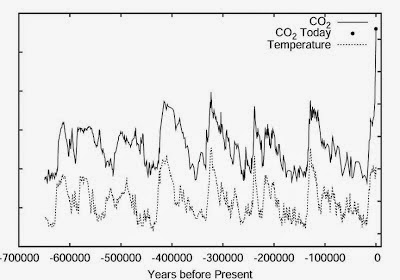
The combination of atmospheric physics and historical geology seems to prove that carbon dioxide in the atmosphere warms the planet. How much may depend on particular circumstances, but the basic effect does not seem in doubt. So the current, historically high level of atmospheric CO2 is reason to worry; we don't know how hot the earth might get over the next century, or how much of the polar ice will melt.

The thing is, compared to most of the past 2 million years, it is already very warm on the earth. We are what geologists call an interglacial era, a time between ice ages. The cycle seems to be driven by wobbles in the orbit of the earth, so the timing ought to be fairly consistent. And if this interglacial were like the last two, the temperature should be falling by now. But it isn't. Some scientists -- including my only close friend who is a climate expert -- feel certain that our warm period is being extended by human CO2 emissions. To these scientists, the "Little Ice Age" that started around 1250 CE ought to have been the start of a new downward trend in the temperature, but coal burning and forest clearing turned things around and made the planet warm again.

A new study just published in Nature Geoscience makes the argument quantitative. The authors believe that a new Ice Age would certainly begin within the next 1,500 years, but high atmospheric CO2 levels are preventing this. Right now the level is about 390 ppm, and these calculations show that it would have to fall below 240 ppm for the glaciers to resume spreading.

I don't mean by this to dismiss worries about climate change or to argue that it is really a good thing. Compare those numbers: right now the CO2 level is vastly higher than it would have to be to prevent another Ice Age, and it is still rising rapidly; scalding seems like a much more immediate threat than freezing. But it is important to remember that the earth's climate is always changing. Compared to most of the past 2 million years, it is warm on the earth, but compared to most of the 100 million years before that we are a frigid era. On the whole the earth seems to be getting colder, too, with recent Ice Ages colder and longer than they were before. What impact our vast experiment in changing the atmosphere will have on this complex system is very hard to predict, but disaster is certainly within the bounds of the possible.

Tuesday, May 26, 2015

The Problem with Family Friendly Laws

American liberals are pushing for laws to mandate "family friendly" corporate policies: extended maternity and paternity leave, flexible time for new parents, subsidized child care. Several European countries have had such policies for a decade or more, allowing sociologists time to assess their effects. And they are not all benign:
Spain passed a law in 1999 giving workers with children younger than 7 the right to ask for reduced hours without fear of being laid off. Those who took advantage of it were nearly all women.

Over the next decade, companies were 6 percent less likely to hire women of childbearing age compared with men, 37 percent less likely to promote them and 45 percent more likely to dismiss them, according to a study led by Daniel Fernández-Kranz, an economist at IE Business School in Madrid. The probability of women of childbearing age not being employed climbed 20 percent. Another result: Women were more likely to be in less stable, short-term contract jobs, which are not required to provide such benefits.
Claire Cain Miller has a bunch more similar examples at the Times. It seems, as some people feared from the beginning, that such laws help push women onto the "mommy track" where they may have more flexibility but pay a high price in terms of salaries and promotions. Some women choose this path and are probably happy with the trade-offs, so there isn't much to complain about there -- you can't have everything. But some studies have found that these laws make corporations less likely to hire or promote any woman. Nothing reinforces a chauvinist's dismissive attitude toward women like a government mandate requiring special treatment of moms.

I, of course, think that we are all too obsessed with work and salaries and promotions, and I am not sure women passed over for promotion have really lost anything. Certainly nothing that compares to a child. But plenty of women do care about these things, and it is only fair to note that laws benefiting less ambitious women with children can end up having major economic impacts, and may exact a particular toll on the lean-in crowd. Ranting about sexist male managers and hoping they all die is not going to help here; it would be nice if we were all more understanding, but there isn't any way to mandate that, and for the foreseeable future we are stuck with a lot of sexist jerks in leadership roles.

Etruscan Art, Part I: before 500 BCE

The Etruscans lived in the part of Italy that we still call Tuscany, from Rome northward along the west coast and inland to the mountains. They emerged around 800 BCE, joined the Roman state in the 3rd century and had largely lost their distinctiveness by 100 BCE. Their civilization was centered in about a dozen towns, some of them on top of high hills. By the time they entered into recorded history those towns had formed a league that annually elected a single leader to represent their interests, although we have little idea what powers he held and what remained with the towns. (Bronze cauldron, 7th century BCE)

Etruscan civilization was always much entwined with the Greek. They used the Greek alphabet, worshiped some of the same gods, and the stories of Troy figure prominently in their art. Their art is divided by scholars according to the same scheme used for Greek art: geometric, archaic, classical, and finally Hellenistic. We have many surviving examples of their art because they had a habit of burying anyone of prominence in a lavishly appointed tomb; in fact much of our best Greek metalwork and pottery also comes from Etruscan tombs. For 300 years now, looting those tombs has been a successful industry in Italy; quite likely every object displayed here was removed from a tomb. (Horse bit, detail 7th century BCE)

Gold and glass fibula, c. 700 BCE.

Winged lion, stone, c. 550 BCE.

Drinking cup, c. 670 BCE.

Bronze horses, 7th century BCE.


The Etruscans seem to have been very fond of marriage, and several examples survive of sarcophagi that show husbands and wives reclining together. This is a famous example from Cerveti, c. 520 BCE, now in Rome.

Earring disk, 6th century BCE.

Jar, 540-530 BCE. Etruscan pottery was very much influenced by the Greeks, but it retained its own flavor.


Terracotta cup, 565 to 550 BCE.

Gold ring showing a lion, 6th century BCE.


Two small bronze status, a danger and a warrior c. 500 BCE.


Jewelry from a tomb at Vulci, 5th century BCE.


And perhaps the most spectacular example of early Etruscan Art, the bronze chariot now in the Met, c. 575-550 BCE. Such wonderful things -- almost makes me wish I were an Italian tomb robber. Later Etruscan art is here.

Original Sin, Human Wickedness, and the Western World

James Boyce, an obscure professor of geography at the University of Tasmania, has written a book on original sin that Michael Dirda calls "brilliant and exhilarating." For Boyce, original sin has been one of the key ideas of the western tradition ever since Augustine, with profound effects on our culture:
Boyce stresses that the principal tenet of Christianity in the West isn’t, as many believe, the Judeo-Christian moral code. “Salvation did not come from being ‘good’ or worthy.” From the beginning, Christianity “was grounded in a deeply personal emphasis on the broken self, and a corresponding reliance on an external divinity to provide salvation.”
In recent years theological sin may have faded in the western consciousness, but to Boyce the same idea keeps resurfacing in other ways: Hobbes' grim view of humanity outside civilization, Freud's subconscious, the selfish gene. A sense that we are rotten at our cores is a key part of both our psychology and our worldview.

I wonder. It is certainly true that in the Christian tradition a sense of the sinful self is a key religious trope, and from Augustine to Martin Luther to Oscar Wilde personal religious narratives are often saturated with a deep sense of sin. But is this notion universally relevant? On the surface, I don't see any major impacts to our civilization from the wrestling with personal sin. Of course a self-searching Christianity has been a major part of life for millions of people, and I don't want to dismiss that as irrelevant; I am looking for an impact on the broader outlines of our civilization.

The only way I can see original sin casting a broader spell is through Christianity's impact on western individualism. As I have written before, some historians now see the origin of the west's extreme individualism in Christian meditation. Whereas paganism and Confucianism put their emphasis on ritual acts, within Christianity there has always been a strong tradition of intense internal reflection, especially reflection on sin. I am intrigued by the notion that this contributes to western individualism; after all, it is quite extreme within the range of human variation, so it needs some explanation. Could it be original sin?

Monday, May 25, 2015

The Irish Constitution

To underscore the magnitude of the cultural shift that has taken place in Ireland, here is the preamble to the Irish Constitution, enacted in 1937:
In the Name of the Most Holy Trinity, from Whom is all authority and to Whom, as our final end, all actions both of men and States must be referred,
We, the people of Éire,
Humbly acknowledging all our obligations to our Divine Lord, Jesus Christ, Who sustained our fathers through centuries of trial, Gratefully remembering their heroic and unremitting struggle to regain the rightful independence of our Nation, And seeking to promote the common good, with due observance of Prudence, Justice and Charity, so that the dignity and freedom of the individual may be assured, true social order attained, the unity of our country restored, and concord established with other nations, Do hereby adopt, enact, and give to ourselves this Constitution.

Paradiso

As I drew nearer to the end of all desire,
I brought my longing's ardor to a final height,
Just as I ought. My vision, becoming pure,

Entered more and more the beam of that high light
That shines on its own truth. From then, my seeing
Became too large for speech, which fails at a sight

Beyond all boundaries, at memory's undoing --
As when the dreamer sees and after the dream
The passion endures, imprinted on his being

Though he can't recall the rest. I am the same:
Inside my heart, although my vision is almost
Entirely faded, droplets of its sweetness come

The way the sun dissolves the snow's crust --
The way, in the wind that stirred the light leaves,
The oracle that the Sibyl wrote was lost.

Dante, Paradiso, XXXIII:46-48, 52-66
Translated by Robert Pinsky

Bringing Back California Oaks

Here's a delightful local movement to think about, the plan to bring more oak trees back to California.

California was once home to several different types of oak forest, including the famous live oak savannahs that once covered much of the central coast and gave their name to Oakland, Encino, and many other places. The oaks were both the main support of local wildlife and a key food of the Indians. The native trees are highly drought tolerant, so are not threatened by the grim forecasts of long-lasting drought. These days a multifaceted movement has sprung up devoted to preserving the remaining oak forests and planting more oak trees.

Oakland has been a particular center of oak planting. Here environmental concerns have come together with worries over inequality. Oakland is divided into the wealthy hills, where there are big houses and lots of trees, and the flatlands, where many poor people live, the air quality is often the worst in the state, and tree cover is as little as 1%. Planting trees in the flatlands may improve the air, raise property values, and generally make life a little better for everybody. (More at Urban Releaf)

Working together, people can achieve a lot, if they care.

Sunday, May 24, 2015

In Which the DC Archaeologist Receives an Atl Atl

In the center holding the atl atl (spear thrower) is Ruth Trocolli, the Washington, DC city archaeologist. She just won a very prestigious public service award, funded by a foundation that supports good governance in the city. She completely deserves it; she has transformed the office from one of the hardest to work with in the region to one of the best  So Friday afternoon her staff organized a surprise after work party for her, and it came off perfectly -- there were about 30 archaeologists in attendance, and she was completely surprised. And what gift could be more appropriate?

As a side note, the event was held at a bar on the DC waterfront, another area that has been transformed from miasmic to happening since the passage of the Clean Water Act.

Gay Marriage in Ireland

Ireland's voters have approved gay marriage by 62 to 38 percent, becoming the first country ever to do so in a nationwide vote. The rate of change is astonishing; homosexuality remained a crime in Ireland down to 1993, and now Ireland is one of the world's most gay-friendly countries.

The change has a lot to do with the collapse of Ireland's Catholic church. The secularization that in most of Europe took places gradually over the whole period from 1900 to now was compressed in Ireland into a single generation. I think this had two causes. First, a general opening of Ireland to the world, driven by the economic boom of the 90s and EU membership; and second, the catastrophic child abuse scandals of the Irish church. But whatever the reason, Ireland has shed the gloomy, repressive Catholicism that accompanied its independence and become very quickly much more like the rest of Europe

The Beaker Folk and the Genetic History of Europe

One of the most intriguing episodes in European prehistory is the spread of the Beaker Culture across the western half of the continent in the third millennium BCE. Above is a typical example of a "bell beaker;" you can see that both the shape and the decoration are highly distinctive, and although there are minor variations they are remarkable uniform across hundreds of kilometers and centuries of time. Study of their contents shows that many of them were used for drinking beer, and the whole complex has sometimes been said to represent the spread of beer drinking in Europe. The beaker people made much use of copper, and then they were involved in the introduction of bronze to many areas, so they have also been seen as pioneering metalsmiths. Certainly some of their high-status burials included metal-working tools.

The range of the beaker culture. In most places the beakers appeared without precedent, obviously intruding into pre-existing cultures. However, there were two places where archaeologists claimed to see the beakers evolving from earlier forms: Portugal, and the Netherlands. These days the Portuguese coast around Lisbon seems to be winning out as the beaker homeland, because the radiocarbon dates for the first beakers there are coming out at 2900 to 2800 BCE, 250 years earlier than the first dates in the north. The oldest beaker burial yet found is actually in Morocco, so it may be that the culture originated in Africa and spread into Europe.

The "beaker phenomenon" has always been a little strange, archaeologically, because it seemed to overlap with older, unchanged local cultures, existing side-by side; in some places it has been found only in burials, with the nearby settlements showing no trace of beaker influence. To account for these peculiarities it is still sometimes asserted that the heart of the beaker phenomenon was a religion. We see this most clearly in the burial ritual and the cultic drinking, but no doubt there were also gods and heroes that went along with them.

It is certainly in its burial rituals that Beaker culture is most recognizable. The burials are highly gendered; men, at least higher status men, were buried with a distinctive set of masculine artifacts, women with an equivalent feminine set. Men got boar's tusks, flint arrowheads, stone wrist guards, stone and copper axes, smithing tools; women got amber jewelry, grinding stones, copper awls; both got beakers, although in some places there may have been distinctive male and female patterns of decoration on the pots. In general, men faced east and women west, although there are plenty of exceptions. There are also a couple of women buried with archery gear; opinions differ as to whether these were female warriors or whether the bow and arrow had become a symbol of authority, so that a woman might be buried with a bow as a sign that she wielded great power while alive.


This is the Amesbury Archer, a rich beaker burial found near Stonehenge in southern Britain. This man was buried around 2300 BCE with a full suite of male Beaker gear: carefully made flint arrowheads, a stone wrist guard, three copper axes, gold ear cuffs. (Many more interesting beaker burials here and here.)

The beaker people have been in the news lately because of their possible connections to new discoveries in European genetics. The most widely distributed Y-chromosome haplogroup in western Europe is R1b, as mapped above. It used to be assumed that this represented the genetic legacy of the Mesolithic inhabitants, but apparently this can't be so; recent studies argue that it must have spread within the past 10,000 years. Also, two of the spectacularly successful male lineages I just wrote about, which expanded dramatically around 5,000 years ago, are within R1b. So it may well be that at least some the clades of R1b that dominate western Europe spread with the beaker folk. Evidence was recently published proving that at least some beaker men were R1b, in the form of DNA from two beaker burials at Kromsdorf in southern Germany.

The same is being asserted about one mitochondrial DNA clade, H1; if so, this would mean that the beaker expansion included many women, not just men.

Right now a sort of proto-history of late Neolithic Europe is developing, based on archaeology and genetics, that goes like this:

In the 3500 to 2000 BCE period, the genetic dominance of Europe by the first farmers, people who migrated from the Middle East, was broken. There was a major disruption in the genetic pattern of the continent at this time, which implies major migrations and an influx of new people. At around the same time the cultures of the earlier Neolithic were replaced by more advanced cultures that used animals for plowing and pulling carts and had other improved technologies: better looms, better beer, copper tools, etc. In northern and western Europe the two most important cultures are the Beaker folk in the west and the Corded Ware culture in the center. In the map above, the beaker culture is light green, the corded ware culture is blue, and the rather large region of overlap is dark green.

Genetically, the men of the Beaker culture were mainly R1b, while those of the Corded Ware culture were mainly R1a. R1a clearly comes from the steppes. One interpretation of the Corded Ware culture has always been that it derived from certain cultures on the steppes, especially the Yamnaya culture (red on the culture map), and the genetic data supports this hypothesis. This seems the most likely time for the Indo-European languages to spread into Europe, carried by the R1a men of the Corded Ware culture. But notice that west of the Rhine the prevalence of R1a is low; the direct genetic contribution of the steppes to Italy and Iberia was very small. It seems likely that the Italic tribes formed in central Europe, in one of those regions that was only 30 percent R1a, so that after they entered Italy the genes that came from the steppes were further diluted. The new science suggests that the movements of people and the movement of languages were linked, but it does not show that they were the same thing.

Since those major disruptions, there do not seem to have been any comparable genetic changes in Europe until the major immigrations of the post-1960 period. Down to World War II, the European population had genes from three sources: the Mesolithic inhabitants who moved northward after the Ice Age retreated, the Neolithic farmers, and the new groups that came in around 5,000 years ago. Movements since then have mostly been within Europe, so they have had local significance but have not changed the continental pattern. Above is one possible later migration, the spread of a Y DNA clade called R1b-S21 that some people think represents the early Germans, expanding after 500 BCE.

I want to emphasize that this is a very simple schema, not a detailed picture. All modern populations are genetic mixtures, and this seems to have been true about all important European groups in the past. I expect to see a lot of simplistic crap over the next decade connecting this gene to that people, moving from here to there, etc. Most of it should not be taken very seriously. But it is amazing to think that we have learned so much so quickly about events that took place 5,000 years ago.

Roses in the Garden

The glory of perfect days at the beginning of summer, yesterday and today.