





_(31799454186)%201892%20La%20Favorite.jpg)


_-_Esquisse_pour_la_salle_des_mariages_de_la_mairie_du_1er_,_Le_Printemps_ou_le_matin_de_la_vie_-_PPP3867_-_Petit_Palais.jpg)
_-_Esquisse_pour_la_salle_des_mariages_de_la_mairie_du_1er_,_L'Hiver,_ou_Le_Soir_de_la_vie_-_PPP3869_-_Petit_Palais.jpg)


New Nazca lines and figures.
Wildlife photography contest winners and top entrants, from the Natural History Museum (London)
Matt Yglesias calls out the good news on water quality in America and complains that nobody wants to hear good news.
Foot of small mammal found inside dinosaur's stomach, the first proof of dinosaur on mammal predation.
The Leaning Tower of Pisa is slowly untilting itself.
Democracy must defend itself like a battleship.
What do we actually know about Representative-elect George Santos? And given that he was broke in 2017, where did his money come from?
Study claims that pottery making spread across Europe at a rate of 250 km (155 miles) per generation, crossing boundaries between agriclutural peoples and hunter-gatherers. Since the pots were used for cooking, that means new ways of cooking also crossed cultural boundaries and spread quite rapidly.
This study claims that in the US, the main driver of racial segregation in neighborhoods is choice: "We provide evidence that many Black households prefer low-SES (socio-econoimc status) neighborhoods with Black residents to high-SES neighborhoods without Black residents."
Interesting summary of what is happening with AI.
In Manhattan, car theft fell 96% from 1990 to 2013. Some problems have technical solutions.
Ukraine Links
LPR volunteer Murz unloads on the Russian Army, says they are completely unready for any Ukrainian winter offensive.
Grim short video of a Russian trench overrun by Ukrainian soldiers, lots of bodies.
Somebody raised a Ukrainian flag on a tall tower in Crimea. There are military experts who say that Russia may be abel to hold onto the DPR and LPR but they can't possibly hold Crimea because it is too easy for Ukraine to cut it off and starve its people out.
Another Ukrainian politician who collaborated with Russia is killed in a car bombing.
Up-close view of fighting in Marinka.
Over the course of the 300-day war, by the Oryx count, Russia has lost on the average day 5 tanks, 6 infantry fighting vehicles, 2 armored fighting vehicles, one armored personnel carrier, one self-propelled artillery piece, and 7 trucks. Throw in fractional amounts of other systems like multiple rocket launchers, helicopters, and ships, and you get about 28 major systems lost per day, more than 8,500 in total. And those are minimum losses; the real total is likely to be at least 20% more. Yes, Russia has a lot of gear, but these losses, along with their staggering expenditure of artillery ammunition and missiles, leave their military with very little remaining offensive potential. Daily artillery fires in the ongoing Bakhmut fighting are 1/5 or less what they routinely expended in May and June, which right there explains why their offensive has stalled. One of the major questions is whether they can rebuild a serious attacking force by spring. I am thinking not, but I suppose history tells us never to underestimate Russian capacity to fight on.
Richard Hanania is a sort of libertarian-leaning grouch, one of the people who thinks the right thing to do is obvious but other people don't see it because of their ignorance, stupidity, or ideological blinders. I read him because he is smart and willing to call out anybody who is being foolish, regardless of their party or belief system.
From his 2022 wrap-up I discovered that he is also willing to change his mind in public:
In February, I argued that Russia’s imminent successful invasion of Ukraine was a sign heralding in a new era of multipolarity. By October, I declared every challenge to liberal democracy dead and Fukuyama the prophet of our time. It’s embarrassing to have two contradictory pieces written seven months apart. But it would’ve been more embarrassing to persist in believing false things. If there’s any time to change one’s mind, it’s in the aftermath of large, historical events that went in ways you didn’t expect. Russia’s failure in Ukraine and China’s Zero Covid insanity provided extremely clear and vivid demonstrations of what democratic triumphalists have been saying about the flaws of autocracy. Nothing that the US or Europe have done – from the Iraq War to our own overly hysterical response to the coronavirus – have been in the same ballpark as these Chinese and Russian mistakes. Perhaps the war on terror comes close in terms of total destruction and lives lost, but we could afford to be stupid and it didn’t end up hurting Americans all that much.
This shows, I would say, that one of the problems with the grouchy loner worldview can be short-sightedness. Such people can be so focused on attacking the folly of the moment that they lose sight of the big picture. As far as I am concerned, you have to forget a lot of history to think that dictatorship has a better record than democracy on anything. A dictatorship may maintain order and promote growth for a while by shutting down ugly political battling and sweeping aside foolish objections to development, but in the long run the imperatives of power usually screw things up for everyone but the dictator. No modern dicatatorship has created a state that rivals the rich democracies in either order or dynamism.
Hanania built a Substack following, and got a reputation as a conservative, by waging war on woke culture in pieces like "Why Do I Hate Pronouns More Than Genocide?" But he is not any kind of orthodox or reliable conservative, and in his latest piece he explains his gripe with the contemporary Republic Party:
For reasons I’ll expand on below, I’m becoming more alienated from conservatives, and therefore less interested in trying to promote total victory for one side in the culture war. The continuing and growing power of the anti-vaxx movement is perhaps the clearest demonstration that something has gone horrifyingly wrong on the Right. And yes, I know the smarter among them say they’re just “anti-mandate,” but the culture is clearly anti-vaxx, with Trump getting booed at rallies for telling his old and overweight fans to do the responsible thing and conservative influencers proudly talking about how they avoided the jab and making fun of those that didn’t.
Republicans may be generally preferable, but when the next great technological breakthrough comes, I’m confident that if it turns into a salient political issue it’ll be the Right that wants to ban it. On the vaccine issue specifically, the odds of us having another Operation Warp Speed if a Republican is in office when the next pandemic hits are low. There’s no way to justify this – it is simply a tragedy, and reveals that when you build a movement that caters to low IQ and paranoid people you can’t hope to control the results. If the next pandemic is even worse than covid, those who’ve promoted anti-vaxx could be responsible for millions of lives lost.
He is also shifting his views on some social issues, because he thinks Republicans are being crazy about euthanasia and especially abortion:
I still have contempt for the pronoun people, but I’ve found that there are a lot of people, like actual adults, who call things “Satanist” or “demonic” unironically and my instinctual reaction to them is similar. Aside from annoyances on Twitter, two big events from 2022 pushed me in a more liberal direction on social issues. First, there was the Dobbs decision. I always knew that conservatives wanted to overturn Roe and many of them hoped to ban abortion, and that this would be horrible, but it didn’t hit home until it happened. All the things that feminists have been saying about men wanting to take away women’s freedoms and controlling them are starting to sound more reasonable, and I’m glad there’s been a lot of electoral pushback against the anti-choice position. I now stand with women.I find this interesting partly because I think Trump got a lot of important support from people with Hanania's mindset; not very ideological, just sick of liberals, grouchy about the state of the country, and hoping that a tough guy could clean things up. It seems to me that the grouches who have not fallen into conspiracy theories are a lot less into Trump than they were in 2016, and maybe less enraged at the Democrats. Not that they necessarily think any more of liberal ideology than they did, but with power the Republicans have demonstrated that their own ideology can also lead to actions that strike such people as crazy. Hanania now divides his time between attacking the woke and attacking the anti-vaxx, Q-believing crowd, leaving his vote, and those of his follwers, up for grabs, likely going to whoever can come across as toughest and most sensible.




.jpg)

Zelensky:
I wish you peace. And I think that is the main thing, and you understand it only when the war is in your country. when somebody like these terrorists from Russia come to your houses. And I wish you to see your children alive and adult. And I wish you to see your children when they will go to universities, and to see their children. I think that is the main thing.
And from the address to Congress:
Against all odds and doom-and-gloom scenarios, Ukraine didn’t fall. Ukraine is alive and kicking. Thank you. And it gives me good reason to share with you our first, first joint victory: We defeated Russia in the battle for minds of the world. We have no fear, nor should anyone in the world have it. Ukrainians gained this victory, and it gives us courage which inspires the entire world.
Americans gained this victory, and that’s why you have succeeded in uniting the global community to protect freedom and international law. Europeans gained this victory, and that’s why Europe is now stronger and more independent than ever. The Russian tyranny has lost control over us. And it will never influence our minds again. . . .
I know that everything depends on us, on Ukrainian armed forces, yet so much depends on the world. So much in the world depends on you. When I was in Bakhmut yesterday, our heroes gave me the flag, the battle flag, the flag of those who defend Ukraine, Europe and the world at the cost of their lives. They asked me to bring this flag to you, to the U.S. Congress, to members of the House of Representatives and senators whose decisions can save millions of people.
So, let these decisions be taken. Let this flag stay with you, ladies and gentlemen. This flag is a symbol of our victory in this war. We stand, we fight and we will win because we are united — Ukraine, America and the entire free world.
And this from Biden:
You will never stand alone.





Lidar has added yet more detail to our picture of the classic Maya. Their civilization was extremely impressive: dozens of cities, thousands of towns, all connected by roads as impressive as those built by Rome, all supported by a vast network of water systems and farming done in former swamps. And then, for reasons that remain mysterious, it all fell apart and reverted to a vast jungle inhabited by villagers living by slash and burn farming.

.jpg)

But in the 1850s Virginius Island was a factory town, part of a wider industrial zone that had grown up around the US Armory in Harpers Ferry. In its early days the Armory was one of America's most important industrial enterprises, not just turning out muskets but pioneering new techniques in manufacturing. The rifle works on Hall Island was the first plant in the Americas to use interchangeable parts on a large scale. When it was first set up the Armory used a craft production model, with workers being paid by the piece, but in the 1830s it was converted to rigid factory discipline with clocks and whistles and pay by the hour. It also completed dominated the town of Harpers Ferry, so much so that nobody else could readily buy land or set up a business there.


Then came the war, which wrecked Harpers Ferry. The Armory and the rifle works were destroyed. Virginius Island was taken over the by army, its buildings used as barracks and storehouses. After the war the government decided not to rebuild the armory, which pretty much doomed Harpers Ferry to decline.

But Virginius Island bounced back after the war. A new owner purchased the old cotton mill and made it into a modern flour mill, with turbines and steel rollers. In 1870 about 103 people lived on the island, down from the 183 of 1850 but still a community. Photographs show the island dotted with ruins, which makes me wonder how people felt about them; did they often remember the old days when the place was bursting with activity, and bemoan that so much had been lost?
But then came the floods.

Floods were nothing new to the people of Harpers Ferry, or to anyone who lived in the pre-modern world. The Sumerians personified the annual floods of the Tigris River as Ningirsu, god of destruction, but they still built their cities on the river's banks. Access to water was too valuable to move away just because the rivers flooded and killed a few people every now and then.
Nineteenth-century industrialists understood perfectly the trade-off between water power and the danger of flooding; flooding probably wrecked a mill somewhere in America every day. Harpers Ferry and the Armory were damaged by floods about once a decade throughout the nineteenth century, and until the Civil War everything was always rebuilt. But it turned out that Virginius Island was subject to two kinds of floods, depending on which river was running higher. When their flow was equal, or the Potomac was higher, water backed up into the lower Shenandoah, forming a sort of lake that dumped huge amounts of sand and silt, as much as two feet (60 cm) from some floods. But if the Shenandoah was running higher the river raged across the island with terrible force. This happened in 1870, apparently for the first time since Harpers Ferry was founded. The flood destroyed or badly damaged almost every building on the island. Archaeologists digging on the island in the 1990s found hardly any soil that dated to before 1870, so it looks like the flood scoured the island bare. Which explains why the island is so low even though a single flood can dump two feet of soil; what the river gives, the river also takes away.

One of the few buildings that survived was the old cotton mill turned flour mill, and its owners rebuilt with newer machinery and forged on. But then another major flood hit in 1889, and they gave up. The equation had been changed by coal and steam, which provided alternative sources of both power and transportation. After eighty years, industry disappeared from Virginius Island.

However a new factory was built just upriver on Hall Island, the Shenandoah Pulp and Paper Mill. Paper mills are still built on rivers today, because the process takes, not just power, but huge amounts of water. That factory lasted until around 1936. People continued to live in the old millworkers' houses on Virginius Island, many working at the paper mill, others in Harpers Ferry. Incidentally the mill was the site of two noteworthy labor disputes; in 1888 the workers struck when the company asked them to work under a black foreman, and in 1909 they struck again for higher wages.
Most folks left after the destructive 1924 flood, which shut down the paper mill for nearly a year, and the rest were gone by 1935. The island was empty.
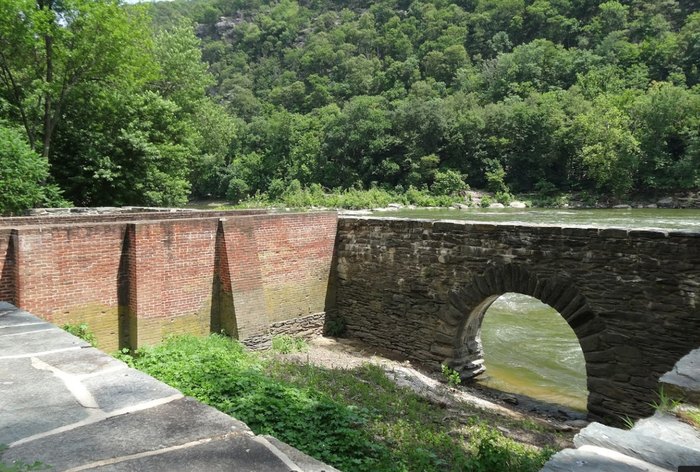

When you do environmental impact statements you talk about "temporary" impacts and "permanent" impacts. "Temporary" means things that happen during construction but go away afterwards, like noise, dust, and traffic interruptions. "Permanent" means everything else.
But what is really "permanent'? A few years ago I sat in a meeting where people talked about "permanent impacts" to a wooded area near Washington, DC. But I know that the site was a factory just 80 years ago, and the oldest tree growing there now is no older than I am. Whatever is built there now will, I feel certain, be no more "permanent" than the factory that lasted about fifty years. How I feel about this depends on my mood. Sometimes it gets me down that a community can exist and be home to hundreds or thousands of people and then just disappear, their lives and homes vanished and forgotten. But sometimes I am moved by the healing power of the earth. Surely Virginius Island was once a grimy, smoky, dangerous place, where screaming saws and pounding hammers filled the air with the cacophony of manufacture. Now it is quiet, gentle, and lovely, covered with bluebells every spring.


