The Wari Empire dominated the south-central highlands and the west coastal regions of what is now Peru from 500–1000 AD. Their capital was in the dry coastal lands, and many cloth and wooden artifacts have been found in tombs there, besides the wonderful pottery vessels in the shape of humans and animals.


The Rediscovery of America (2023) is a bold attempt to retell American history with a focus on Indians: what they did, what they suffered, and how their choices shaped their own lives and those of the broader nation. Blackhawk (a professor at Yale) makes no attempt to be comprehensive, which is a good thing given how enormous a comprehensive accounty would have to be. Instead he picks certain events, tribes, or invidivudals to receive attention, hoping to convey the overall story through these examples. Most of the time it works quite well – I have already written three posts based on these narratives (1, 2, 3) – and I recommend this book to the curious. It is clearly written, full of fascinating information, and well supported with citiations. For me the most interesting sections come at the end, since many histories of Indians peter out after Wounded Knee, leaving the impression that nothing much has happened to Indians since then. Actually a whole lot has happened, and Blackhawk gives it good coverage.
What really gets my attention, though, is the ambivalence and contradiction that surrounds such a book, and, beyond that, the ambivalence and contradiction that characterizes Indian life in the 21st century.
To begin with, this kind of scholarship is a European invention. Native Americans had their own ways of narrating the past, their own stories. What does it say that Ned Blackhawks thinks the best way to tell the story of his people is in a Germanic language, following the conventions of German scholarship?
This kind of ambivalence suffuses the text, especially the post-1890 chapters. If there is a theme to these chapters it is Indian resistance to "assimilation." Often Blackhawk has a specific kind of resistance in mind, which is the maintenance of Indian nations as separate governmental indentities with defined territories and bodies of citizens; the converse would be Indians giving up their tribal identities, moving to cities and becoming regular Americans, which is what various US government officials and bodies actively sought. But as I said in my post on Elizabeth Bender Roe Cloud, the Indians who were most effective in fighting this kind of assimilation were those who had gone far in a different kind, acquiring western-style educations and learning the intricacies of the American legal and political systems. To write this book, which is itself an act of resistance, Blackhawk assimilated himself deeply into European ways.
Like most Indian activists, Blackhawk devotes much attention to "poverty" on Indian reservations. But this is a western concept, and the measures generally proposed to fight it (jobs, development) are western solutions.
Blackhawk gives some attention to political changes on reservations, and the conflicts these have posed. On the enormous Colville Reservation in eastern Washington, several bands that had never been politically unified were thrown together. Their leaders eventually formed a "confederated" tribe and held an election for reservation leaders. But half the people didn't bother to vote, and several sent letters to the Bureau of Indian affairs protesting this usurpation of their own chiefs' power. The conflict between traditional tribal governance and Americn-style elected leaders has played out across Indian country, and while there is much sentimental attachment to tribal chiefs, whenever people get the chance to vote on this they opt for elected officials. Democracy is one part of American culture that most Indians seem to love. (Pickup trucks seem to be another.)
I also protest the framing that "assimilation" is something that whites have done to Indians. Step back and you see the same process taking place all over the world. Modernity destroys traditional cultures. Everywhere, without exception. Europe's peasant cultures are gone, as are those of Japan and Korea. Especially when we are talking about the Progressive era in the early 1900s, those folks were bent on assimilating everybody: poor whites, poor blacks, immigrants, you name it.
I am also on record several places arguing that sovereignty is a red herring, far less important than broader concerns like democracy, freedom, and money. If Indians really care about tribal sovereignty, I suppose they have a right to it, and they are welcome to it. But I do not see it as a solution to any problem I care about.
Here's another question to ponder: what alternative history of American Indians would have led to a better outcome than what we have now?
I find it hard to think of one. I am not a fan of Neolithic tribal life, and I feel confident that as soon as they met Europeans, millions of Indians would have tried to give it up and join the modern world. Given that Indian nations were always at war with each other, the need to buy guns and then canons would have driven them into the global economy. The vulnerability of Indians to Old World diseases would have wreaked its awful destruction regardless of what anybody did; especially given that collapse in population, Indians would have had a very hard time preventing mass European immigration. Nobody has been able to keep modernity out. You can think that making that choice for themselves would have been an important step right there, and maybe so, but modernization in Japan and China did not exactly come off without issues.
Which is not to say that the European conquest of the Americas was not an awful act, rife with atrocity; it was. But history is an awful act, rife with atrocity, and all the alternative paths I can imagine for Native America are also studded with awfulness and atrocity.
I have no interest in judging the choices made by American Indians. Many Americans envy their determination to maintain their own identities rather than being subsumed into the suburban masses. They can, if they wish, go to college and move to cities and get regular jobs, or they can stay attached to their reservations and throw themselves into whatever bits of their traditions remain. In one sense it is enviable, to have that choice.
But in another sense, to be neither wholly within or entirely outside western culture is a kind of curse, one that in the case of Indians leads to poverty, alcoholism, divorce, and sundry other woes. I am not aware of any people anywhere in the world that is making this work well for them.
Against the forces of history, technology, and culture, all of our choices are limited, and there are no perfect outcomes for anyone. I wish the best to all the Indians trying to make their way in our world, but I am dubious of Blackhawk's supposition that independent Indian nations and strong tribal identities are the right path for all Indians.

Ned Blackhawk:
Within most reservation communities, opportunities for travel, employment, and autonomy were so circumscribed that thousands sought work within staged human exhibitions at world's fairs, Wild West-themed traveling shows, and related tourist sites. . . .
The St. Louis World's Fair of 1904 was only the biggest of a long series of grand exhibitions focusing on the American west:
Each held permanent displays of Indians living within the fiar grounds or within "midway" spectacles led by the famed showman William "Buffalo Bill" Cody. Omaha's "Indian Congress" attracted over five hundred Native people from approximately three dozen tribes who spent three months living in a four-acre section within the exposition grounds. . . . While these performers were presented as primitives, complex adaptions characterized their lives. Some came willingly. Other were compelled by government officials or by economic need. As the Apache leader Geronimo recalled about his time selling handmade arrows at the 1904 Louisiana Purchase Fair in St. Louis, "I had plenty money — more than I had ever owned." . . .
While performers like Cody and Geronimo attracted attention, many Native participants used their time in these urban spaces to publicize their community's concerns, to critique government policies, and to couteract public misconceptions. Lakota leader Henry Standing Bear, for example, wrote to the commissioner of Indian Affairs that members of his community wanted to attend the fair but "they want to come as men and not like cattles driving to a show . . . they do not wish that anyone will misrepresent our race." Similarly, Medicine Horse, who performed with Cody in Chicago, remained committed to ensuring that fairgoers developed a positive impression of Native people. According to one acount, he displayed "an apparent eagerness to talk. He is very interesting to listen to, and the information he gives . . . is of much interest and value.

One of the people determined to make the best use of the opportunities presented by the fairs was Potawatomi author Simon Pokagon:
In his manifesto, The Red Man's Rebuke, which he issued in birch-bark binding, Pokagon wrote pointedly, "We have no spirit to celebrate with you."
Pokagon tried to use the attention generated by the Columbian Expostion of 1893 to agitate for the return of Potawatomi lands; he failed in this, but he did succeed in generating much sympathetic press for Indian causes.
The image of Indians performing traditional dances for fair audiences but spending their spare time lobbying for their causes is quite wonderful. The ties they developed with white liberals led to Indians joining the protests against the wave of American imperialism launched by the Spanish American War, putting themselves forward as spokesmen for imperialism's victims.
Unfortunately nobody seems to know if the Indians who performed at the St. Louis World's Fair ever met and talked to the Filipino tribesmen who were also there, in a separate compound. But what an encounter that would have been.
Quotations are from Ned Blackhawk, The Rediscovery of America, 2023.
I'm still working my way through Ned Blackhawk's The Rediscovery of America, learning bits and pieces about Native American history. Today I discovered a very interesting person, Elizabeth Bender Roe Cloud (1887-1965). She was a big-time activist for Native American causes, one of the founders of a pan-tribal group called the Society of American Indians, an advocate for tribal sovereignty and Indian rights. She was put on a national advisory body by FDR and in 1952 some collective of American women's clubs named her the "Mother of the Year."
What made Roe Cloud such an effective advocate for Indian causes? Her education in government boarding schools and Indian colleges.
Wikipedia has a detailed article on Roe Cloud, from which I glean the following: She began attending a Catholic boarding school in Minnesota at the age of nine. From 11 to 13 she studied at the Pipestone Boarding School, one of those "industrial schools" where students studied half a day and then labored the other half. Then she attended the Hampton Institute, from which she graduated in 1903. She stayed on for two more years to complete training as a teacher.
From there she went on to become a teacher at an Indian boarding school in South Dakota. She then went back to school for two more years to get a nursing certificate, then back to the reservations to work in a series of boarding schools. In 1916 she went to Wichita, Kansas and co-founded the American Indian Institute, a college preparatory school for Indian men. The curriculum, according to wikipedia, included both regular academic studies and "courses on indigenous cultures." While running the school Roe Cloud found time to take additional courses at Wichita State and complete her own BA. She also pushed her own children to pursue western education; one of her daughters was the first American Indian to graduate from Wellesley, while another claimed that honor at Vassar. Her "Mother of the Year" citation prominently mentioned her daughters' educational success.
Meanwhile, we have this weird ongoing tirade in both the US and Canada about Indian boarding schools as an insidious assault on Native culture and identity, if not outright genocide. What do people like former Interior Secratary Deb Haaland think about Elizabeth Bender Roe Cloud? Was she some kind of race traitor? Or did she pursue her own education and push it on others because she saw that it was the only way forward for Native Americans?
Could it be that one reason many American tribes are now thriving, reclaiming lost lands and so on, is that they now have college-educated leaders? That the reason we have powerful Native American national associations, and an Indian press to push their point of view, is that so many Indians have been to boarding schools and universities?
As I wrote before about Indian boarding schools, I'm sure some of them were miserable places. Yes, the forced edication they carried out did much to undermine traditional Native cultures. But I, for one, do not think that Neolithic revanchism would be a good path for Indians in our time. I think Elizabeth Bender Roe Cloud was right: that the solution to a problematic boarding school system was, not to abandon it, to for educated Indians to take it over and run it in their own interests.


The American Revolution was no exception. Our national narrative mainly focuses on east coast elites who saw British rule as tyrannous and complained about violations of their rights. Many of these people were plugged into political debates going on in Britain, and some in Britain supported their cause.
But there was at least one more important group in the rebel coalition: backwoods farmers who were mainly mad that the British were, as they saw it, supporting Indians against them. Notice the vast area marked Lands Reserved for the Indians in the map at the top, made in 1767 for British General Thomas Gage.
I'm reading Ned Blackhawk's The Rediscovery of America (2023), which narrates North American history from a Native point of view. It's is a pretty good book despite some overblown rhetoric about how people have ignored the Indian part in hitorical events. (Almost all of Blackhawk's sources are books by white men.) Anyway Blackhawk has an excellent section on events on the Pennsylvania frontier in 1765-1766, which presaged the revolution in many ways.
This is right after the Seven Years War and then Pontiac's War had led to great violence all along the Appalachian frontier, and many settlers were mad about that. The British plan for controlling this violence was to rebuild the situation that had existed before war broke out in 1754, which included guaranteeing Indians their rights to land and trading with them extensively. The goods that British traders carried west included guns and ammunition.
It was this last that triggered the revolt of the "Black Boys" along the Pennsylvania and Virginia frontiers. They began stopping the caravans of merchants heading west and searching them for weapons. Sometimes they just seized any weapons they found, but other times they seized or burned all the other goods as well. In March, 1765, six of their number were arrested by the British and imprisoned in Fort Loudoun. Several hundred Black Boys then besieged the fort, demanding the release of their comrades. The British tried to negotiate with them, but one of their leaders, James Smith, threatened to kill everyone in the fort if the men were not released. Eventually they captured some British scouts and forced the British to make an exchange of prisoners.
These border ruffians kept up their violence right down to 1776, whereupon many of them joined the Revolution. Black Boy leader James Smith was elected to the special assembly that wrote Pennsylvania's new, post-independence constitution.
As I have written here before, I do not believe that questions around slavery had any part in the American Revolution. But questions around Indians absolutely did. Some of the most ardent revolutionaries mainly wanted to get the British out of the way so they could seize more Indian land and respond with unlimited violence to any threat of danger from Indians. Of course the Revolutionary coalition also included men like Benjiman Franklin and John Adams who wanted to respect Indian rights, but Indian-hating backwoodsmen made up a good part of the fighting force.


.jpg)


Then last month the remains of Typhoon Halong slammed into the coast, eating 60 feet into the land and washing away most of the site. People began finding artifacts all along the shore, like the wooden mask at the top of the post. In the NY Times, Sachi Kitajima Mulkey has a good article about the effort to recover artifacts from the beach and the ongoing debate among the Yu'pik over whether they should move their village even farther from the sea. Climate change has not yet had much impact across most of the world, but in the arctic the impact has already been profound.

Before and After Jamestown (2002) is a popular book written at a pretty basic level, but it is full of good information. It is particularly strong on how we know what we know about the Indians of 1607. The sources are: English narratives, especially those of John Smith, William Strachey, and (three generations later) Robert Beverly; archaeology; ethnographic comparison with other Native American communities; and "living history," i.e., modern attempts to re-create past technologies. Rountree makes no use of supposed Native "traditions" until a much later period, when she refers to oral histories recorded in the late 1800s to reconstruct the movements of tribal communities in the reservation era. Rountree is a fan of the English narratives, and while she thinks they misunderstood much, she generally defers to specific claims they made.
For example, John Smith tells us that Powhatan (the person) received the English seated among a dozen of his wives, who were all decked out in their finery. Historians of a feminist bent have challenged this, asserting that the women Smith saw must really have been the Women's Council. But none of our sources mention that Virginia Indians ever had women's councils on the Iroquois model, and even among the Iroquois women's councils had nothing to do with receiving foreign ambassadors, which was entirely managed by the men. Rountree follows Smith's version.
When it comes to archaeology, Rountree is also – how to put this? – pro Eurocentric scholarship. She makes much use of evidence that comes from excavating human burials, including demographic data and chemical analysis that can document diets and movement between regions. Some modern Indians regard information gleaned from looting graves the way others see the work of Nazi scientists, and think it should never be cited. Virginia's Indian communities have until recently been officially on board with Rountree's approach, and have insisted only on reburial of remains after study. One of the biggest Indian events in Virginia in my lifetime was the reburial of the skeletons from the Great Neck Site in Virginia Beach. I think this probably stems in part from the struggles Virginia's Indians have gone through to establish their identity as Indians, which has made them value historical information over purity. I have the sense, though, that this is changing, and younger generations of Native leaders will try to block any excavation of Indian graves.

Rountree has a good eye for issues that are interesting in both the scholarly and general senses. She devotes quite a few pages in Before and After Jamestown to the great difference between men's and women's lives. She has the same impression I have, that certain Indians considered men and women to be separate species that had to come together to make babies but otherwise avoided each other. We have descriptions of Indian women treating their husbands as little more than sources of meat and hides, and mocking or even divorcing them if they failed to provide enough. As for the men, when they entered adulthood they went through a rite that comes down to us under the name of Huskanaw. This was a verion of the standard Woodland Indian initiation rite, in which adolescent boys were taken into the woods and made to hallucinate through some combination of hunger, thirst, pain, exhaustion, and drugs. In the Powhatan version they were supposed to imagine themselves being reborn and emerging with everything they learned in their childhoods forgotten. They even had to be retaught to eat and drink. It's hard to know how seriously to take that claim, but William Strachey wrote it down, so Rountree and I both believe some Indian told him that. Anyway the newborn young men were supposed to forget all childish things and everything else about the years they spent in the company of their mothers.

That leaves us with the burials. From them we learn that Virginia's Indians had a harsh age pyramid, with many people dying young and very few living past 50. We learn that they traded for copper from the Great Lakes region and used it to make ornaments. We learn that they had several different ways of treating the dead, which is honestly one of North American archaeology's more puzzling discoveries. Every Indian a white man ever asked said, "Among my people we treat the dead like this," without any qualifications about different approaches for different kinds of people, but the archaeology shows this was not so.
It is humbling for an archaeologist to consider that there is more information in any one of the three main English accounts of Powhatan life than we have ever been able to learn or could learn by any technology we have or could imagine.
What archaeology can do is push the story very far back in time. So far as we can tell, after AD 900 Indians in eastern North America were living in pretty much the way that Smith and Strachey described. They were also ethnically the same people, speaking similar languages. Which is why Turner and Rountree started their book at that time. Rountree in particular has been a great advocate for Virginia's Indians, which had led to her being made an honorary member of two tribes, which I think is yet another reason why she chose this framework of dates.
Because so far as archaeologists can tell, the cultures that formed across the eastern seaboard when Central American agriculture arrived – the triad of corns, beans, and squash – were not ancient. Before that Indians practiced a limited sort of agriculture with native North American plants such as sumpweed and sunflowers, but without corn their lives seem to have been quite different. Tracing the story back 10,000 years we can see people living as hunters and gatherers with low population densities, a world Powhatan people would have found very strange.
Linguistics also tells a story. The Powhatans spoke Algonquian languages that anthropologists are pretty certain came from the Great Lakes region within the past 2,000 years. The archaeology points to c. 500-700 AD as the most likely time. And this is, after the issues of burials, the place where scholars and Indians have lately come into the most stubborn conflicts. After having been shoved out of one place after another, many Indians have taken to insisting that their peoples have lived in their current homelands "forever." For eastern North America, this is not true. Archaeology tells a story of repeated migrations and replacements going back thousands of years. As in Europe and Asia, the spread of agriculture seems to have been accompanied by large scale migrations and conflicts. Of course that never means total replacement, and the Indians who lived in Virginia presumably had some genes from people who had lived in the region 5,000 years ago. But archaeologists don't do "forever."
By starting in AD 900 Turner and Rountree avoided all this controversy. Which is fine, their book is about the Powhatan people, who can't really be said to have existed before then. As I said, as a book about the ethnography and history Virginia's Indians it is very fine. It is also highly accessible, even for students, which is a real achievement. So if you are curious about that time and place I recommend it. I wonder, though, if the historical consensus represented by this book can long endure, or if it exists even in the 2020s. The agendas of Indian activists and people who want to science the past have lately been moving ever farther apart, and I expect that will continue.

The first is called Map of the Founding of Tetepilco, and is a pictographic map which contains information regarding the foundation of San Andrés Tetepilco, as well as lists of toponyms to be found within Culhuacan, Tetepilco, Tepanohuayan, Cohuatlinchan, Xaltocan and Azcapotzalco. The second, the Inventory of the Church of San Andrés Tetepilco, is unique, as Oudijk remarks, since it is a pictographic inventory of the church of San Andrés Tetepilco, comprising two pages. Sadly, it is very damaged.
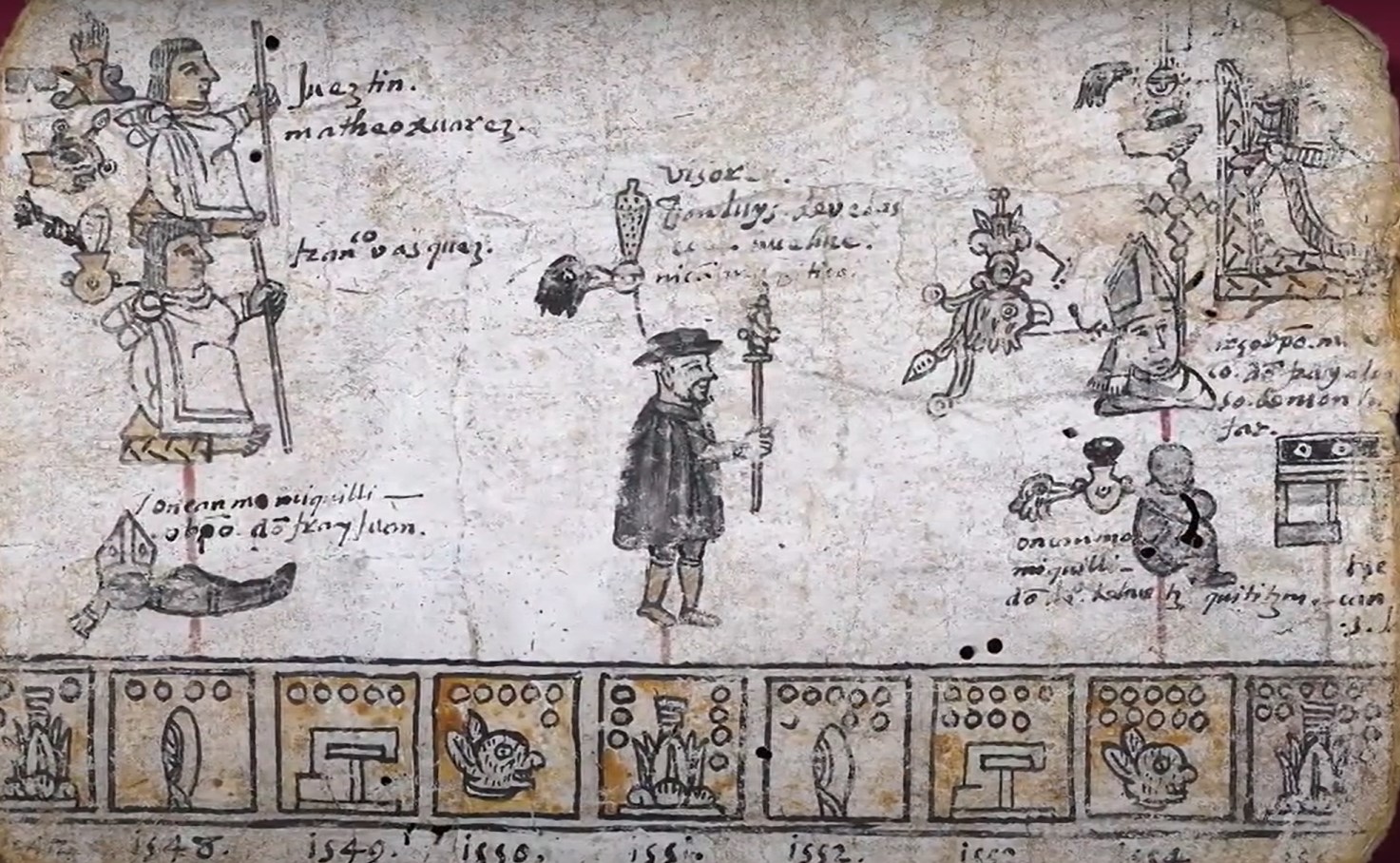
Finally, the third document, now baptised as the Tira of San Andrés Tetepilco, is a pictographic history in the vein of the Boturini and the Aubin codices, comprising historical information regarding the Tenochtitlan polity from its foundation to the year 1603.