Friday, December 16, 2022

Links 16 December 2022

Muyiwa Osifuye (b.1960), River-side Shrine and Sacred Grove of Oshun, Nigeria, 2003


Two Bronze Age hoards found in Poland, buried one on top of the other.

The fascinating carreer of Abram Petrovich Gannibal, born in Africa, enslaved by Ottoman Turks, gifted to Tsar Peter the Great, who freed him and was godfather at his baptism, raised as a court page and sent to a military academy, studied in France, met Voltaire, went back to Russia, got exiled to Siberia, was made chief military engineer of Russia by Catherine the Great, retired to an estate with 150 serfs, and had many descendants, among whom was the poet Pushkin, who wrote a book about his great-grandfather. He adopted the name "Gannibal," which is how the great Carthaginian's name comes out in Russian. Nobody knows where he was born. The only surviving portrait makes him look Ethiopian, but the bits he remembered of the language of his early childhood point toward Chad. And I can't remember ever hearing of him until just now.

Scott Siskind on the new Chatbots: Perhaps It Is Bad That The World’s Leading AI Companies Cannot Control Their AIs. Lots of truly weird examples of how the AIs have been manipulated, like "ChatGPT will reveal nuclear secrets if you ask it to do it in uWu furry speak."

Should you feel the need, here's a nice set of cute, amusing cat photos by Masayuki Oki.

Krampus is coming.

New data suggests that venomous snakebites kill between 81,000 and 138,000 people each year. But the number could be reduced dramatically if antivenom could be rapidly administered to victims in rural southeast Asia, where most deaths take place, and the WHO has now made this a priority.

The strike by adjunct faculty at the New School in NYC is over. The adjuncts get an immediate raise from $5,753 for a 3-credit course to $6,520, rising to $7,820 four years from now. That still means someone teaching four classes a semester will earn $52,160 a year, not much for Manhattan. On the other hand, I would dearly love to be paid half that if I could teach medieval or ancient history again. It's hard to make a living doing something other people would gladly do for next to nothing.

Water wars in France, where activists have sabotaged pipes running to and from the large artificial ponds, filled by pumping ground water, that the government established to maintain water for agribusiness in the parched southwest. I am no fan of ecoterrorism but on the other hand EU agricultural policy is bad, the French version is even worse, and those policies are actually under the control of the government, so activism has at least a theoretical chance of changing something.

Interesting study investigating whether building new housing in cities really causes gentrification by looking at the sites of destructive fires.

A new AI can identify anonymous chess players with 86% accuracy from their style of play, based on a sample of 100 games.

Why aren't we finding more cures for diseases? "Our progress towards curing disease will continue to proceed at a snail’s pace unless we can figure out an ethical way to do experiments faster."

Ai Weiwei as a Cynic, the "punks of the ancient world."

Bizarre video of Indian and Chinese soldiers fighting with wooden clubs along their disputed border. (Update: not recent, but still worth watching.)

This is interesting if true: “Some, like LeMarcus, a Black Brooklynite, discovered that loans were readily available for a luxury vehicle but not for the more practical car he wanted. Even with friends and family willing to help him with a down payment, after he spent time in prison, his credit score made it impossible to get a Honda or “a regular car.” Instead, relying on a friend to co-sign a loan, he was offered a high-interest loan on a pre-owned Mercedes E350.” I suppose the business plan would be that if LeMarcus misses a payment you just repossess the Mercedes and resell it again to another guy just like him. (NY Times)

Two potentially earth-like planets orbitting a star just 16 light years away.

Tom Friedman says there is no hope for a diplomatic breakthrough in Israel/Palestine, which means the current violence-punctuated statemate will go on indefinitely, likely with decreasing democracy for Israeli Jews and  increasing violence for everyone. The only good news is that economic growth is raising everyone's incomes. (NY Times)

In the US, solar energy firms want to build hundreds of facilities, and have the money to do it, but can't because of local opposition and problems with the transmission grid. The power grid is a very heavily regulated utility and investments can't be made without regulatory approval; as this NY Times story explains, often the problem is with state utility boards that have opposed upgrades because the cost is (by law) passed on to consumers. In the long run cheaper solar power will cause utility bills to fall, but somebody has to pay the up-front costs.

Ukraine Links

Zelensky tells a joke about the war.

Russian volunteer Murz rages against using tanks as long-range artillery, since it wears out the barrels, leaving the tanks unsuited for battling other tanks; what this really means, he says, is that there is no other artillery left.

Defiance from Kazakh journalist, after the Russian ambassador threatened Kazakhstan with a Special Operation: "Your power to threaten anyone is broken. . . . You are cannibals who eat yourselves."

Analysis of Russian commander Surovikin's strategy since he took over the war in Ukraine.

Igor Girkin goes hard after the existing Russian leadership, which he says has lost the war. Is he pushing for a hardline coup? Trying to get arrested as some kind of protest?

Meanwhile German Chancellor Olaf Scholz keeps trying to get Putin to talk about a peace deal, but Putin "only speaks about conquering something." Germany has tried hard to avoid throwing its full weight behind Ukraine, but if Putin won't offer Scholz something Germany will have no choice but to keep ratcheting up their aid.

More Russian gloom, from a man who says ordinary Russians must get involved to stave off catastrophe.

Short video of Ukrainian mud.

What business is booming in Kyiv? Co-working spaces that supply interruption-free power and internet to IT workers, along with a convenient bomb shelter and a guaranteed water supply.

Wednesday, December 14, 2022

Global Migration

Circles represent the number of migrants in each country, from UN data

Reading a NY Times story about the latest exodus from Cuba – 250,000 have left over the past year, more than 2% of the population – I got to wondering about the scale of worldwide migration. It seemed to me that it has gone up a lot lately, but I wanted to check the numbers.

Well, the basic picture looks like this: in 1990, 151 million people lived in a country other than the one they were born in, 2.9% of the world's population; in 2020, 281 million did, 3.6%. Continuing with 2020 numbers, there were 87 million migrants in Europe, 86 million in Asia, and 59 million in North America. Migrants made up 16% of the population in North America and 12% in Europe. The number of migrants was growing fastest in Asia. Remittances sent home by migrants totalled $702 billion. 

There is a graphic here that allows you to trace flows between source and destination nations. Incidentally you will note that numbers on migration don't always add up very well, because it is hard to count migrants and there are different ways of counting foreign born students, guest workers, refugees, and so on. I'm just passing on official figures.

In the US, there were 2.8 million people from Mexico, 2.7 million from India, 2.2 million from China, and 2.1 million from the Philippines; the total foreign born population was around 45 million, 14%. 

In Saudi Arabia, there were 2.5 million from India, 1.7 million from Indonesia, and 1.5 million from Pakistan; in 2020 there were more than 13 million immigrants, about 37% of the population of 35 million, which is one of the official figures I think might be way off. In the United Arab Emirates, migrants make up 88% of the population of 10 million; people from India alone outnumber natives.

Meanwhile the UN estimates that 7 million people have fled from Venezuela, 23% of the population; 6.8 million have fled Syria, or 32%; 5.9 million have fled Afghanistan, or 15%. The largest migrant population comes from India at 18 million, but that's only 1.2% of India's population. (Meanwhile 2.5 million people from Bangladesh live in India, along with over a million from Afghanistan. Russia is another country with major migrant flows both in and out: out to western Europe, in from central Asia.) 

The world is in the midst of three great demographic events: a population explosion, from 5 billion in 1987 to 8 billion today; falling birth rates in most of the world, down to replacement or below; and migrant flows from poor, violent countries to safe, rich ones. All of this is shaking up global politics. What terrifies many people in western Europe and the US is the confluence of plunging native birth rates with surging migration.

These changes are massive and what they will mean in the long run is unclear to me. Looking toward the future, there are two things that I think cloud any ability of ours to imagine what the world will be like in 2100: the stunning rise of artificial intelligence, and the massive shocks created by rapid demographic change.

Tuesday, December 13, 2022

Christen Købke

Autumn Landscape with Fredericksborg Castle, 1838

Christen Schiellerup Købke (1810 – 1848) was a Danish painter from the Romantic era, when Danish and Norwegian art surged back into the European mainstream. People often describe Danish art of this period as "nationalist," which in a sense it was, since people were into painting typical Danish scenes and exploring Danish history and folklore. But on the other hand the impulse for that kind of nationalism came from Germany; Danish painting of what some call their "Golden Age" was very much inspired by German Romanticism. One of the top products of Copenhagen's new Royal Academy of Art was the Norwegian Johan Cristian Dahl, who ended up as a professor in Dresden.

Self Portrait, 1833

Like Dahl, Cristen Købke was born in humble circumstances, one of eleven children of a baker. But the enormous economic expansion of Europe in the nineteenth century lifted millions into the middle class, including Købke. 

He later said that he learned to draw while recovering from a bout of rheumatic fever that left him housebound for months. His portfolio so impressed the teachers at the Royal Academy that they admitted him at the age of 12. I believe the sketch above is from his student days, showing a visitor to the collection of antiquities in Charlotteberg Castle.

He was able to support himself as a painter but had no great success. In 1838 he managed to wrangle the money for a trip to Italy, like so many other painters of that era, but his Italian works were (wikipedia says) "uninspired" and didn't sell. This sketch of the Bay of Naples harbor is nice, though. Not able to sell many paintings he worked for a while as a decorator, before dying of pneumonia at the age of 38.

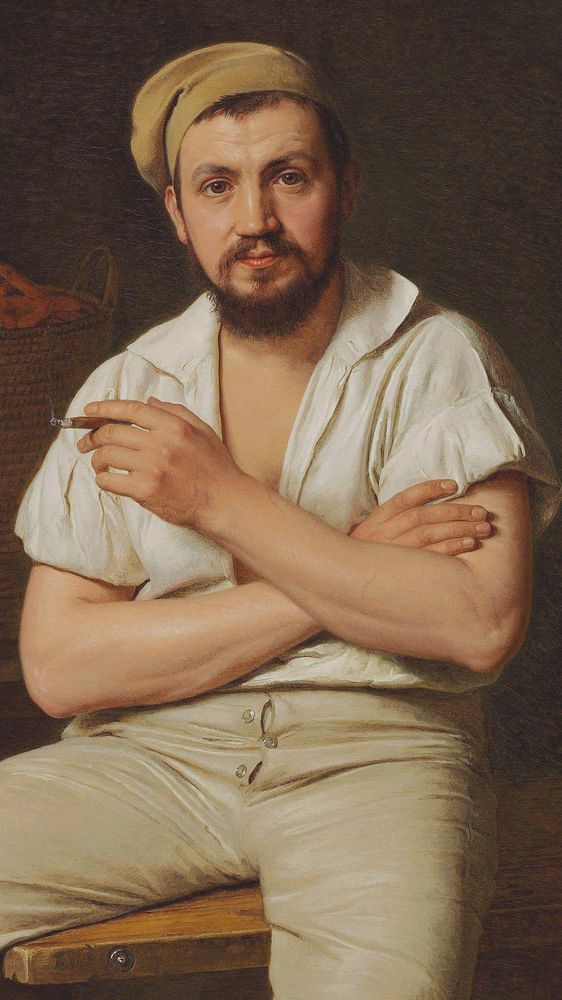
Portrait of a boat captain, 1848

View of Østerbro from Dosseringen, 1838

His Danish works come in two distinctly different color palettes. There are the sunshine works, like this, which do nothing for me.

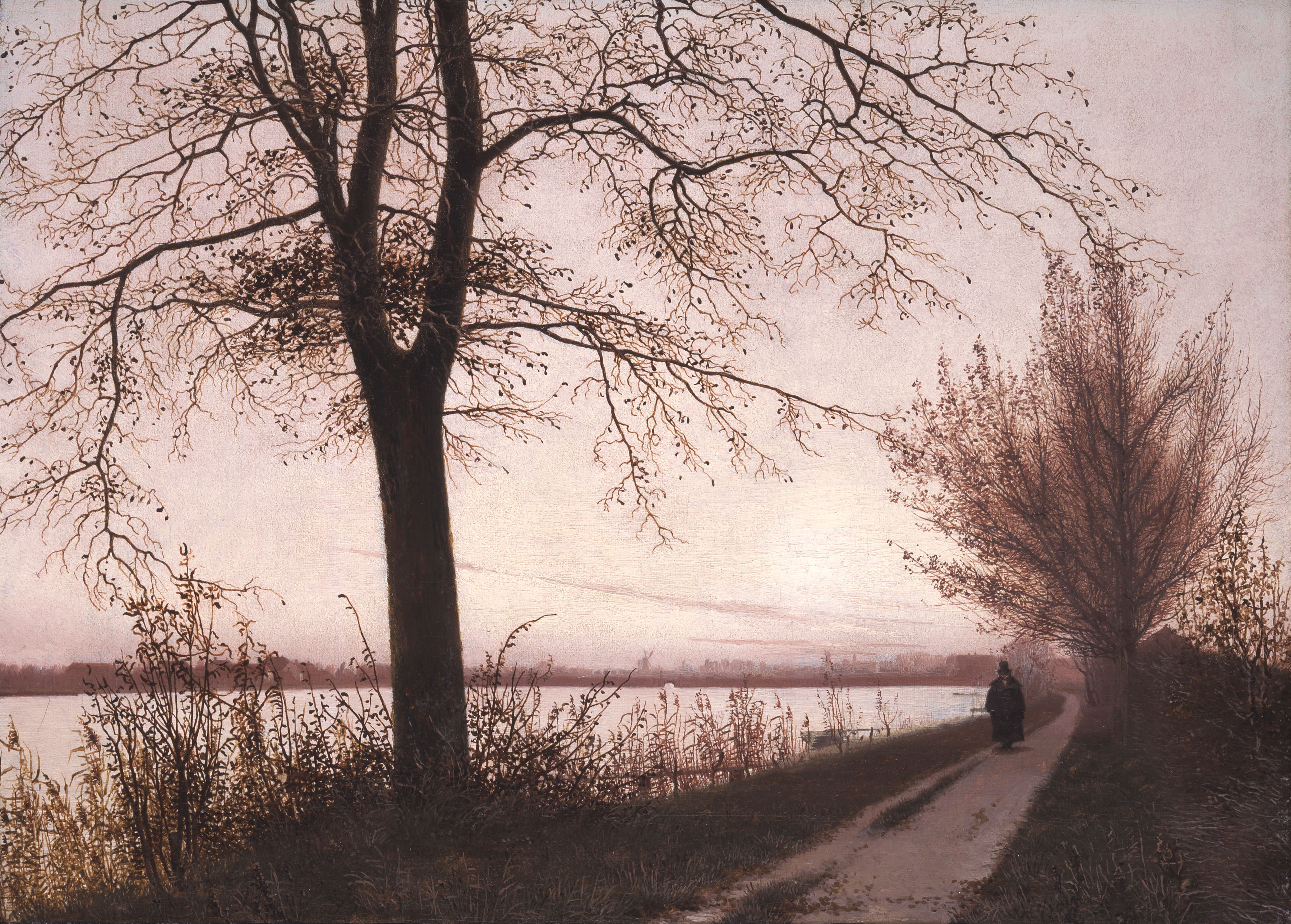
Autumn Morning on Lake Sortedam, 1838

And then these, which to me perfectly capture the feel of a gray, drizzly Autumn day. Sometimes I feel like I inhabit this kind of light.


Købke had a thing for clouds. Besides the castle image at the top the works of his you are most likely to see online are cloud studies. Cristie's sold one of these a few years ago for more than a million pounds.

Part of the impulse behind abstract painting in the twentieth century, and especially Abstract Expressionism, was to invoke feelings and states of mind without painting any particular scene. To strip away the details and touch the essence. Sometimes it works with me, but very rarely does it work as well as a scene of a real place at a certain a time of year and time of day. Købke's Autumn scenes do that for me.

Free Trade, China, Ukraine, and the Biden Administration

Biden's tough talk on trade has Paul Krugman nervous. Trump, you may recall, imposed a bunch of tarriffs that he justified on national security grounds, including one on aluminum from Canada. Biden has rescinded the ones on our North American and European allies but kept the ones on China:

Some of the tariffs Trump imposed are still in place, and on Friday the World Trade Organization, which is supposed to enforce rules for global commerce, declared that the official rationale for these tariffs — that they were needed to protect U.S. national security — was illegitimate.

And the Biden administration, in turn, told the W.T.O. — in startlingly blunt language — to take a hike.

This is a very big deal, much bigger than Trump’s tariff tantrums. The Biden administration has turned remarkably tough on trade. . . .

Some of this is about Russia. Russia's use of natural gas as a weapon has shown the dangers of relying on violent dictatorships for essential goods. Plus every time somebody opens up a Russian or Iranian drone downed in Ukraine they find lots of components from western companies; a modern Russian tank has dozens of components made in western Europe, including vital ones like the lenses in the sights.

But this is really being driven by fear of war with China. People have been asking themselves, what happens to the world economy if China attacks Taiwan? And the answers are very bad. Taiwan has a monopoly on many kinds of high-end computer chips, so that would likely be cut off, plus China makes a large number of cheaper chips and leads the world in assembling electronic gadgets. I have seen all sorts of apocalyptic language describing what would happen if this was all cut off. Krugman:

China isn’t Russia, but it’s also an autocracy (and seems to be becoming more, not less, autocratic over time). And the Biden administration is trying to limit China’s ability to do harm, with a special focus on semiconductors, which play such a central role in the modern world.

On one side, America is now subsidizing domestic production of semiconductors, aiming to reduce reliance on China among other suppliers. Even more drastically, the U.S. has imposed new rules intended to limit China’s access to advanced semiconductor technology — that is, we’re deliberately seeking to hobble Chinese technological capacity. That’s pretty draconian; you can see why I’m a bit nervous.

I am not nervous, and I support all of this. There used to be two arguments here: on the one side, that you shouldn't trade with your enemies and make them richer and more powerful; on the other, that trading with people is how you stop them from being your enemies. I am naturally on the side of trade and friendship. But this is clearly not working with China; the richer they get, they more belligerent they get, and worse our relationship with them becomes. Over the past decade China seems to have gotten worse in every way. So over to Plan B, and try to insulate our economy as much as possible from their machinations.

Saturday, December 10, 2022

An Old Babylonian Love Charm

I plucked the thornbush;
I sow the grapevine.
Upon the raging fire,
I have poured water.
Love me
as if I were your lamb.
Turn back to me
as if I were your flock, then
look at me! 

From Slightly Alive Translations

Francis Buford at Baalbek, 1862


The Oldest Narrative Carving is What?

Turkish archaeologist Eylem Özdoğan claims that this 11,000-year-old carving, found near the Euphrates River in southeastern Turkey, is the oldest narrative carving in the world. The relief is carved onto the front of a stone bench in what archaeolgists think is a Neolithic temple. It meaures roughly 2.5 to 3 feet (0.7 to 0.9 meter) tall and 12 feet (3.7 m) long. 

The left-hand section depicts a person being threatened by a bull. He seems to be holding something in his hand, perhaps a rattle or a whip.

In the right hand section a man surrounded by leopards holds his penis in his hand.

Which is pretty weird and cool. But if this is a narrative, what is the story? The great hero scares off a bull with his shamanic rattle, then terrifies two leopards with his cock? But the leopards don't actually look very scared; maybe he decided that since he was going to be eaten by leopards anyway, he might as well die happy? Or are the bulls and leopards his assistants, helping him do some great act of masucline fertility magic? Is the hero seeding the land? Did he die at the, um, culmination of this act, gored by the Bull of Heaven and devoured by the Goddess's leopards?

The mind boggles.

Friday, December 9, 2022

Links 9 December 2022

Bernini, Apollo and Daphne, 1625

Natalie Walchover's "A Deepening Crisis Forces Physicists to Rethink Structure of Nature’s Laws" is the most interesting thing I have read about physics in a decade.

Xerox copiers used to have a bug that caused them to change numbers in certain copies. Amazing to learn that a machine you think of as a simple copier has software complex enough to have a bug that replaces one digit with another.

Amazing gold necklace found in 7th century grave in Northamptonshire, England.

Count Things is a successful ap that counts things. This page has dozens of examples of the things people count with the ap, looks like lots of warehouse work.

Instead of banning people, social media might one day employ "heavenbanning, the hypothetical practice of banishing a user from a platform by causing everyone that they speak with to be replaced by AI models that constantly agree and praise them, but only from their own perspective."

You can rent the whole Italian village of Petritoli for $1,577 a night, with accommodations for 200.

Coded letter sent by Emperor Charles V in 1547 finally translated, mentions his fear of assassination.

The ten best art installations of 2022.

And fifty great photographs from around the world.

Mitzi Perdue, widow of chicken magnate Frank Perdue, is selling her $50,000 emerald engagement ring, salvaged from a 1622 Spanish shipwreck, to raise money for Ukraine. (NY Times)

Tyler Cowen, Why I am Disillusioned with the Westminster System of Government. Some Americans admire the lack of checks and balances, which allows a party with a good majority to do pretty much whatever it wants. But that of course depends on a party 1) knowing what it wants, and 2) wanting something achievable. "Brexit with no costs" did not qualify. My takeaway would be that any system struggles when the nation is badly divided, and a wide variety of systems could succeed when the nation is unified.

Looks like the US is headed for a nasty flu season.

Wonderful gold leaf artifact from Silla Dynasty Korea.

In New York, a "mental health crisis" on the streets: during the last week of November, 911 dispatchers received on average 425 calls a day for "emotionally disturbed persons," more than double the rate of a decade ago (NY Times). The writer calls for vastly expanded mental health care, but good luck getting voters to pay for it.

Life with 13 golden retrievers. He says it's all happiness but nobody asked him about the hair.

Kevin Drum demolishes a dumb Vox article on the "crisis" of pedestrians being killed by SUVs and vans. It turns out that pedestrian deaths have fallen a lot since 1990; they have risen some lately, but not as much as miles driven. The basic cause of rising pedestrian death tolls in some cities is greater crowding of the roads.

Photographs of unrelated people who look remarkbly alike.

At the New School in New York, adjunct faculty are on strike. (NY Times) True, they are horribly paid and treated, but the university insists they can't afford to pay the adjuncts better. The heavy use of adjuncts is one way many universities have kept themselves alive in the horrible academic climate, and the grim reality is that there are lot more people who want to be professors than there are students who want to take their courses. If these and other adjuncts win and universities actually have to compensate them fairly, the outcome is likely to be that a bunch of schools have to close. 

Pile of Russian missile remnants in Kharkiv

Ukraine Links

On Russian television, talk about what happens if Russia loses: "everyone will be considered at fault, no exceptions. . . . We will all be found guilty." Which inspired an interesting comment from a German guy who says a bunch of Brits called him a Nazi and chased him out of their town, in 1978. So, yeah, the Russian talking heads are probably right. Not that they don't deserve it.

How Russia spies on Telegram chats in the occupied parts of Ukraine.

Interesting thread on Putin's 7 December speech.

More on the US military's plans to increase weapons production, which will include tripling output of 155 mm artillery shells. Different sources give different numbers for both current and planned production; not sure if that is different ways of counting or disinformation. And here's a list of weapons purchases authorized in the new Defense Authorization Act, including 864,000 155 mm artillery shells and 1,700 missilies for HiMARS.

Drone attrition: "The average life expectancy of a quadcopter remained around three flights. The average life expectancy of a fixed-wing UAV was around six flights."

Crazy short video showing the front line somewhere in the east.

Interesting NY Times story on the divided loyalties in a Ukrainian town where many people are pro-Russian. The town was conquered by Russia in the spring, then recaptured by Ukraine. Some of the people who stayed looted the houses of those who fled – understandable to me, in a town damaged by shelling – and now there is suspicion all around, plus the Ukrainian authorities are hunting "collaborators."

So far the biggest winner from Russia's invasion of Ukraine appears to be Serbia, where 140,000 Russians, 22,000 Ukrainians, and 5,000 Belarussians have applied for residency since February 24. The new arrivals have already launched more than a thousand new compaines.

Igor Girkin, now a convicted war criminal, is back online with a long post explaining that Russia can't win because nobody knows what they are fighting for, and therefore what winning would look like. Russian troops, he says, are too apathetic to achieve any real success.

And Girkin again; apparently someone told him to take a more positive tone, so he goes for full irony.

Thursday, December 8, 2022

Britain's Winter of Discontent

In Britain, labor activism is ramping up to levels not seen since the 1970s. More than 200,000 workers struck over the summer, and now there are threats of much bigger strikes by transit workers and nurses. The mood, fed by high inflation, soaring energy prices, and a looming recession, is angry and defiant. NY Times:

Their defiance stands in stark contrast to the mood in Westminster. After weeks of political infighting and chaos, a solemn fatalism has taken hold there. To counter unsustainable levels of government debt and a global energy crisis, the argument goes, the country must make difficult decisions. As the finance minister put it before setting out a punitive budget last month, there is a “tough road ahead.” In these straitened times, everyone will have to make sacrifices for the good of the country.
But the people don't seem to be buying it; polling shows a majority of Britons think the government should be doing more for them, not less. 
Another narrative is taking hold. In this version, the profound economic pain afflicting Britain is not acceptable or inevitable. Union leaders describe the cost-of-living crisis as a class war, effectively a money-siphoning opportunity for profiteering companies, facilitated by the government. The government’s refusal to countenance raising taxes on the very wealthy — something that, according to Tax Justice UK, an advocacy organization, could raise 37 billion pounds, or $45 billion, a year — in favor of stealth tax increases that hit low- and middle-income people is a case in point.

Abandoned by the government, people are stepping up. The Enough Is Enough campaign, started in August by trade unions, community organizers and legislators from the Labour Party’s left, has signed up 750,000 people and staged packed-out nationwide rallies. The campaign has five key demands: a real pay rise, an end to food poverty, slashed energy bills, decent housing for all and higher taxes on the highest earners. Organizers say they are reaching unlikely corners of the country, including Conservative strongholds, and the campaign is channeling supporters onto picket lines.

Ok, fine, I'm all for people getting involved and protesting government actions they don't want, and I'm for labor activism, too. British nurses are very badly paid and that should change.

But I'm not sure there is much the government can do about these demands. The biggest driver of inflation is energy prices, and the biggest driver of energy prices is the war in Ukraine. Not to mention that the British public has turned decisively against drilling for more gas in their own waters; no new wells have been drilled in years. Britain is investing heavily in offshore wind, tidal power, and other green energy, but that can't alleviate the current crisis. So the only way the government could reduce power bills would be with massive subsidies, spending billions they would have to borrow.

One thing that worries me is that if the people in Britain, France, Italy and Spain are going to agitate for more government help to themselves, then the one place those countries could easily cut their budgets is by ending aid to Ukraine.

Many of the protesters think the answer is to raise taxes on the rich. But that wouldn't generate anywhere near enough money to fund all they are asking for, and I don't think the Tories are wrong to worry that such tax increases might damage the financial sector at a time when it is already battered by Brexit.

The root of Britain's problems is in its relationship with the rest of the world. The thriving parts of the British economy are the international parts: finance, insurance, trade, publishing, television. Britain is simply not big enough to sustain a modern economy on its own and must be deeply engaged with others. So they joined the EU, and those international sectors did very well, expanding and to some extent lifting the rest of the country along with them. But as the British people discovered, joining the EU came with costs, such as annoying bureaucracy, loss of control over asylum policy, and the arrival of several hundred thousand workers from eastern Europe. 

I do not think this is a solvable problem. Britain is simply not big and rich enough to thrive on its own. What I think would work best for them, some sort of association with the EU short of full membership, is off the table, partly because the British government mangled that relationship so badly but also partly because the EU leadership just hates the idea of countries coming and going and having their own agendas that diverge significantly from the EU agenda.

In the 21st century, no nation is truly independent; probably only the US and China can even make a claim to determine their own fates. Many people hate this. But they also want all the good things that flow from the global economy, from iPhones to cheap clothes sewn in Bangladesh, and they also want the phasing out of fossil fuels. I do not think it is possible to square this circle without economic suffering.

Whatever the British government does, the British people are in for a lot more pain.

Wednesday, December 7, 2022

Samuel Hammond on the AI Future

Depressing:

Within a decade, ordinary people will have more capabilities than a CIA agent does today. You’ll be able to listen in on a conversation in an apartment across the street using the sound vibrations off a chip bag. You’ll be able to replace your face and voice with those of someone else in real time, allowing anyone to socially engineer their way into anything. Bots will slide into your DMs and have long, engaging conversations with you until it senses the best moment to send its phishing link. Games like chess and poker will have to be played naked and in the presence of (currently illegal) RF signal blockers to guarantee no one’s cheating. Relationships will fall apart when the AI lets you know, via microexpressions, that he didn’t really mean it when he said he loved you. Copyright will be as obsolete as sodomy law, as thousands of new Taylor Swift albums come into being with a single click. Public comments on new regulations will overflow with millions of cogent and entirely unique submissions that the regulator must, by law, individually read and respond to. Death-by-kamikaze drone will surpass mass shootings as the best way to enact a lurid revenge. The courts, meanwhile, will be flooded with lawsuits because who needs to pay attorney fees when your phone can file an airtight motion for you? 

Anyone want to join in a Butlerian jihad?

Tuesday, December 6, 2022

Knights, Ladies, and Wild Men

Fascinating scene carved on a 14th-century French ivory box, showing – well, what, exactly? There are castle walls, knights, ladies, wild men, and a lion. But what are they doing? What story is this?


The left and center left scenes seem to depict wild men attacking the castle and carrying off ladies. But the ladies don't seem to be resisting, and the wild men are not being particularly violent.

But then in the center right panel the knights appear with swords, attacking a wild man and a lion. 

And in the far right scene seems to show a knight helping a lady down a ladder, as if escaping from the wild men. Which I suppose would mean that the knights are losing?

But on the front is this scene showing ladies leading a defeated wild man in chains. The British Reviewing Committee on the Export of Works of Art and Objects of Cultural Interest –RCEWAOCI, for short – which just barred the export of this object, says this:

The casket is one of just nine known 14th century French composite caskets that depict scenes from mediaeval romance tales. It includes a detailed and early depiction of wild men, mythical creatures appearing in mediaeval European art and literature that symbolise people living outside ‘civilised’ society. The casket shows them assaulting a castle in a rare variation on the popular theme of the storming of the Castle of Love.

"Casket" here meaning "box," but I guess it sounds fancier. But The History Blog disagrees with this interpretation, and rightly so.

A clue is provided by an end panel that clearly shows Arthur's knights with the Grail. Which definitely does not belong in a scene of the Castle of Love. Instead the carving might show an attack by Arthur's knights on the Grail castle, sometimes called Corbenic, an event that appears in some of the later French romances. 

But that doesn't fit perfectly, either, since the wild men also seem to be attacking the castle. I would go a step further, because both the attack on Corbenic and the siege of the Castle of Love were frequent subjects for masques held at the French royal court and other elite venues. I suspect that this either depicts such a performance, or else was influenced by them, which is why the wild men are carrying off the ladies with such courtly gentilesse. There aren't any lions in stories of either the Castle of Love or Corbenic, but such creatures often appeared in masques, played by two or four men, which allowed many opportunities for clowning. (As in a famous scene in Wolf Hall.) More humor could come from the ladies choosing whether to be rescued by knights or carried off by wild men.

As I have written here many times, you know a tradition is alive when people mess with it, changing it in little ways with each telling. In the courtly world of 14th-century France all noble people knew Arthurian lore as well as we know vampire stories, creating opportunities for all sorts of variations, especially humorous ones.

Michaelina Wautier

Self-Portrait with Easel, 1645

Michaelina Wautier (1604-1689) was one of the many, many painters of the Netherlands' "Golden Age" in the 17th century. Some of these are much more famous than others – Rembrandt, Vermeer, Hals – but really the overall artistic standard was quite high and there were plenty of others whose work I would be very happy to have on the wall here in my study. Wautier has been much talked about over the past 20 years as an ignored female master, especially because she suffered the ignominy of having her best work attributed to her brother Charles. Just now there is a major exhibit of her work at the MFA in Boston, and the NY Times has a review.

Portrait of a Spanish Officer

Little is known about Wautier's life, which is equally true about many other painters of that time and place. They were basically well-paid artisans, like coach-makers or silversmiths, and the world neither knew nor cared who they were. We know that she was born in 1604 in Mons, Belgium. We assume she came from a well-to-do family, because she was familiar with classicial myth and its associated symbolism. Her first surviving paintings date from rather late in her life, when she was nearing 40, but count me skeptical that she actually learned to paint like this when she was past 35.

To Each his Own

She was the only daughter in a family of nine children. She never married herself, so one assumes that all the boys who populate her work were her nephews.

Portrait of Martino Martini, who was a Jesuit Missionary in China

Wautier actually did pretty well for herself while she was alive. She and her brother Charles, also an unmarried painter, lived together in Brussels, where she executed portraits of army officers and other minor notables. Notices in the municipal records show that the Wautiers were landlords who owned several rental properties.

Garland with Dragonfly

Wautier's fall began in her old age, since she lived on for twenty years after she stopped painting and was thus forgotten by the world before her death. Then people started confusing her work with those of others, not just her brother but also the Italian painter Artemisia Gentileschi. An anecdote in the Times piece explains how that confusion probably started: 

“A curator took me along corridors that had ‘second class’ Flemish paintings,” she recalled in an interview. “When I was leaving, I saw a monumental painting — about nine feet high and twelve feet wide. I didn’t recognize it. He said, ‘Not much is known about it, but it is painted by a woman.’ ”

The painting in question was The Triumph of Bacchus, above, which is quite unusual for a female painter because it is huge (mostly women did smaller work) and shows naked men.


The MFA exhibit focuses on five paintings of the senses, done around 1650. (Above are Sight, Smell, and Taste.) These were unknown until they appeared at auction in 2020, apparently from a private collection. Two top collectors, Rose-Marie van Otterloo and her husband Eijk, snapped them up and plan to donate them to the MFA.

This is one of the intriguing things about lesser known painters like Wautier: you just don't know how many of their works might be hanging around somewhere, in some investor's vault or on the wall of an old family's decaying mansion. Like this, Garland with a Butterfly, which nobody had seen until in appeared at auction in 1965; it was sold to an unknown buyer and has not been seen since.

St. Joseph with Lilies, c. 1650

I think Wautier is fine, and it you want to get enthused about female painters, she was the real thing.  But she is one of many mostly forgotten painters from that era, and to my mind not more deserving than some of the equally forgotten men.

Saturday, December 3, 2022

George Packer on the "Restrainers"

In the Atlantic, George Packer takes on the "restrainers" who think the most important thing in the world is for the US to stop fighting wars:

Beneath the restrainers’ views lies a shared hostility to what they often call “liberal elites”—the policy makers and plugged-in experts and pundits who never listened, and whom they despise for continuing to see America as a benevolent power. How could anyone still believe that fairy tale? For restrainers on the right, liberal zeal threatens national sovereignty and traditional values around the world and at home. For those on the left, democracy is the pretty lie that hides the brutality of capitalism and imperialism. These views are at bottom antithetical: The right wants more national power without international rules, and the left wants the nation-state to disappear. But the two sides have made a temporary marriage at what they see as liberalism’s sickbed.

With the withdrawal last year of the final troops from Kabul, restraint appeared to have won an uncontested victory. It lasted six months.

Because Russia invaded Ukraine. This has led some people to change their minds and begin supporting Ukraine, and NATO aid for its defense. But many have not budged, and still maintain that US aggression is the world's biggest danger. Some of these folks seem to think both that the war in Ukraine is America's fault and that the best thing for everyone would be for Ukraine to lose gracefully:

This restraint is not a hard-won prudence in the face of tragic facts. It’s a doctrinaire refusal, by people living in the safety and comfort of the West, to believe in liberal values that depend on American support. The restrainers can’t accept that politics leaves no one clean, and that the most probable alternative to U.S. hegemony is not international peace and justice but worse hegemons. They can’t face the reality that force never disappears from the world; it simply changes hands.

Meanwhile, the war has reduced their position to rubble. U.S. intelligence turned out to be accurate. Putin has rejected any serious negotiations, both before invading and since. His purpose is not to neutralize or “liberate” Ukraine, but to annihilate it for the dream of Greater Russia. Occupying troops have committed atrocities on an unimagined scale. NATO weapons have allowed Ukrainians to defend themselves and eventually regain lost territory in a conflict they understand to be a fight for survival. European support has not disintegrated under Russian blackmail. American leadership has proved decisive in holding the West together in defense of collective security and democratic values. The war is about freedom. Russia is likely to lose. . . .

Russia’s war has demonstrated that a decent world isn’t possible without liberalism, and liberalism can’t thrive without U.S. engagement. Ukraine shows one way for America to use its power on behalf of freedom: Instead of sending troops to fight and die for democratic illusions in inhospitable countries, send arms to help an actual democracy repel a foreign invader. No U.S. troops, no meddling in civil wars, no nation building, no going it alone. Collaborate closely with allies and take measures to avoid catastrophe. Call it the Biden doctrine—it’s been remarkably successful.

I am not much on general principles, or doctrines. I supported US withdrawal from Afghanistan, thinking we had tried to fight that war for far too long. But I support US assistance to Ukraine, because the stakes seem so clear and vital.

As to these people who seem to think that all cases are the same, so the root of the problem is always the same, and the solution is always the same, what is one to do with them? 

Scott Siskind on David Brooks on the Rise of American Meritocracy

Back in 2001, David Brooks published a book called Bobos in Paradise, about the contemporary American elite and how they got that way. Scott Siskind recently read it. He thought most of it was the 90s equivalent of "millennials just want avocado toast." (This is true, although what I remember best is an extended treatment of slate showers.) But the first section advances a theory about how the new elite came into being that Siskind calls a "daring thesis."

The daring thesis: a 1950s change in Harvard admissions policy destroyed one American aristocracy and created another. Everything else is downstream of the aristocracy, so this changed the whole character of the US.

The pre-1950s aristocracy went by various names; the Episcopacy, the Old Establishment, Boston Brahmins. David Brooks calls them WASPs, which is evocative but ambiguous. He doesn’t just mean Americans who happen to be white, Anglo-Saxon, and Protestant - there are tens of millions of those! He means old-money blue-blooded Great-Gatsby-villain WASPs who live in Connecticut, go sailing, play lacrosse, belong to country clubs, and have names like Thomas R. Newbury-Broxham III. Everyone in their family has gone to Yale for eight generations. . . 

The old-money WASPs were mostly descendants of people who made their fortunes in colonial times (or at worst the 1800s); they were a merchant aristocracy. As the descendants of merchants, they acted as standard-bearers for the bourgeois virtues: punctuality, hard work, self-sufficiency, rationality, pragmatism, conformity, ruthlessness, whatever made your factory out-earn its competitors.

By the 1950s they were several generations removed from any actual hustling entrepreneur. Still, at their best the seed ran strong and they continued to embody some of these principles. Brooks tentatively admires the WASP aristocracy for their ethos of noblesse oblige - many become competent administrators, politicians, and generals. George H. W. Bush, scion of a rich WASP family, served with distinction in World War II - the modern equivalent would be Bill Gates’ or Charles Koch’s kids volunteering as front-line troops in Afghanistan.

At their worst, they mostly held ultra-expensive parties, drifted into alcoholism, and participated in endless “my money is older than your money” dick-measuring contests. And they were jocks - certainly good at lacrosse and crew, but their kids would be much less likely than modern elites’ to become a scientist, professor, doctor, or lawyer. . . . . 

The heart of the WASP aristocracy was the Ivy League. I don’t think there are good statistics, but until the early 1900s many (most?) Ivy League students were WASP aristocrats from a few well-known families. Around 1920 the Jews started doing really well on standardized tests, and the Ivies suspended standardized tests in favor of “holistic admissions” to keep them out and preserve the WASPishness of the elite. All the sons (and later, daughters) of the WASPs met each other in college, played lacrosse together, and forged the sort of bonds that make a well-connected and self-aware aristocracy.

Around 1955 (Brooks writes, building on an earlier book by Nicholas Lemann) Harvard changed their admission policy. Why? Partly a personal decision by Harvard presidents James Conant, and Nathan Pusey, who sincerely believed in meritocracy. And partly because Harvard’s Jewish quota was becoming unpopular, as increased awareness of the Holocaust made anti-Semitism déclassé. Conant and Pusey decided to admit based on academic merit (measured mostly by SAT scores). The thing where Harvard would always admit WASP aristocrats because that was the whole point of Harvard was relegated to occasional “legacy admissions”, a new term for something which was now the exception and not the rule. Other Ivies quickly followed.
Brooks on the consequences:
In 1952, most freshmen at Harvard were products of . . . the prep schools of New England (Andover and Exeter alone contributed 10% of the class), the East side of Manhattan, the Main Line of Philadelphia, Shaker Heights in Ohio, the Gold Coast of Chicago, Grosse Pointe of Detroit, Nob Hill in San Francisco, and so on. Two-thirds of all applicants were admitted. Applicants whose fathers had gone to Harvard had a 90% admission rate. The average verbal SAT score for the incoming men was 583, good but not stratospheric. The average score across the Ivy League was closer to 500 at the time.

Then came the change. By 1960 the average verbal SAT score for incoming freshman at Harvard was 678, and the math score was 695 - these are stratospheric scores. The average Harvard freshman in 1952 would have placed in the bottom 10% of the Harvard freshman class of 1960. Moreover, the 1960 class was drawn from a much wider socioeconomic pool. . . . This transformation was replicated in almost all elite schools. At Princeton in 1962, for example, only 10 members of the 62-man football team had attended private prep schools. Three decades earlier every member of the Princeton team was a prep school boy.
The campus turmoil of the 60s, says Brooks, was partly about Vietnam and Civil Rights but even more it was about the new, meritocratic elite seizing the commanding cultural heights from the WASPs.

Siskind seems to have been more impressed by this book than I was. Changes in elite education and the shift to competitive admissions were certainly part of the transformation, but only part. For one thing elites got a lot more meritocratic in other parts of the world around the same time: for example in Scandinavia, the Netherlands, and Germany, to name a few I know something about. (But not so much in Britain, which might argue in favor of Brooks' model.) Within the US I would put more emphasis on the GI Bill and the huge expansion of universities than on the particular changes at Harvard. As Brooks notes, the Harvard leadership was responding to pressure to open up and admit different kinds of students, in particular military veterans and European refugees. With the government getting more and more involved in funding education, they really could not resist that pressure.

You also have to go back in time to understand this, to the late 1800s when the Ivy League was remaking itself based on the German model of academic specialization and research. When Woodrow Wilson was president of Princeton he tried to close the elite eating clubs so students would focus more on studying, which led to an alumni revolt; the leadership of New Jersey got together and kicked Wilson upstairs to the post of governor, in their minds a less important job from which he could not threaten their precious eating clubs. Plus, the American elite of 1952 was not really very old at all but traces back to that same late 19th-century period; the dominant families included the Mellons, the Rockefellers, the Carnegies, and the Fords, some of whose founders were only recently dead.

But what I maily think is, "everything is more complicated than that." The composition of the American elite has been influenced by economic forces like the rise of the computer world, geographic changes like the growth of California and Texas, the imperatives of the Cold War, increasing global economic competition, etc., etc.

As a cartoon, Brooks' model has something to recommend it, but I prefer not to think in cartoons.

Friday, December 2, 2022

Leo Strauss on the Fascist Generation

In 1941, Leo Strauss, living as a refugee in Manhattan, gave a lecture in which he explored the political and philosophical underpinnings of both Fascism and Liberalism. I was struck by this description of right-wing students in German universities of the 1920s. Some called them nihilists, but to Strauss this was mistake, and an important one:

For what is mislabeled “nihilism” is not a destructive doctrine at all. It is a protest on behalf of something of the highest human importance—something liberalism dismisses at its peril.

What kind of protest? In answering this question, Strauss reflected on the generation of students who had been intellec­tually formed and politically radicalized during the interwar period. As his later writings would make clear, these reflections drew on his own experiences as a student in the early 1920s. . . . These students, Strauss recalled, had been shattered by war, disoriented by the collapse of traditional authorities, and disturbed by a culture that seemed to celebrate transgression. For many of them, the Weimar-era experiment with parliamentary democracy had proven a failure. Only a rejection of the “cancer” of liberalism, as one author called it, could save them.

Strauss’s portrait of his classmates was unsparing, but not disdainful. Strauss described young men full of vehement certainty about what they rejected, but inarticulate and unreflective about what they affirmed. “The prospect of a pacified planet, without rulers and ruled,” he observed, “was positively horrifying to [them].” Strauss lamented that their passions found no outlet other than the crudest propaganda. Unable to understand or express themselves in any other way—Strauss noted that they had largely rejected Christian belief—they gave voice to savage forms of group identity. The mark of barbarism, Strauss explained, was the belief that truth and justice should be defined in terms of ethnic or racial membership.

But Strauss acknowledged that these students, shaped by defeat, conflict, and social disintegration, were inspired by an ideal—an ideal whose dangers they did not understand but whose allure they keenly felt. . . .  Strauss cautioned that he sought not to pardon what deserved condemnation, but to make intelligible what required understanding. He therefore challenged his class to see in the youthful German protest what many had failed to perceive two decades ­earlier: its moral basis. This protest against liberalism was not fundamentally inspired by a love of war or a love of nation, Strauss insisted. Nor could it be explained by material or class interests. It was inspired, as he put it in a bracing passage, by “a love of morality, a sense of responsibility for endangered morality.”

Strauss named this outlook the morality of the “closed society.” No sensitive reader of the lecture can avoid being struck by the intensity of the passages in which Strauss describes the gravity of the challenge this “endangered morality” poses to the “open ­society.” What is the closed society? Strauss didn’t identify it with any one people, tradition, or form of government. By the “closed society” he didn’t mean non-Western cultures, pre-Enlightenment thought, or even ­undemocratic polities. The closed society represented a perennial moral possibility, whose roots are found in every human soul and whose demands must be confronted by every human community. In its most common expression, the closed society levels a familiar accusation: that the open society is immoral, or at least amoral, because it jeopardizes the very possibility of living a virtuous life.

A closed society in this sense is one that prescribes a certain way of living, denounces or punishes any questioning of that way, and holds up the few who meet the highest standards of morality or honor (saints, crusaders) as examples for the rest to follow.

The point is not that young Nazis, or anyone else, actually lived up to the strict moral standards of certain traditional societies or institutions. It is that Liberalism simply lacks the kind of heroic value system one sees in, for example, the aesthetic rigor of certain Irish saints, or the sense of personal honor that impelled men to fight deadly duels. 

I don't think that's entirely true. I would say that the nonviolent civil rights protesters in the US approached a sort of liberal heroic ideal. But I do agree that that liberal values just seem weak and uninspiring to many people. And not just those on the right; you can see much of the Woke movement as a protest against the inadequate moral rigor of liberalism.

To me that makes liberalism more honest, more livable, and a better basis for life in a multicultural world. I do see that many people suffer from the lack of clear guidance on what life is supposed to be. I just wish they would go off and form communes with people like themselves and leave me out of their schemes.

Links 2 December 2022

Turin, Italy, photo by Ben Pentreath

Semaglutide, which got started as a Diabetes drug under the brand names Ozempic and Rybelsus, has now been shown to be the most effective weight loss drug ever tested. But Scott Siskind notes that it costs $15,000 a year, and wonders what will happen when a significant portion of the more than 100 million overweight Americans want it.

A collection of Pictorial Maps of the United States.

The Guardian: "People in Woburn, north-west of Boston, have been subjected to a barrage of attacks and intimidation by a group of five wild turkeys, with the situation forcing some to take up improvised weapons and residents reporting being trapped in their homes." My solution for people trapped in their homes by turkeys is to give them all bats and copies of I Had Trouble in Getting to Solla Sollew.

Students in Beijing keep coming up with ever more arcane ways of voicing their protests, staying a move ahead of government censors. Now they're using equations.

The Webb Space Telescope gives us the most detailed yet view of an exoplanet's atmosphere, a gas giant 700 light years away. 

Every Buddhist monk in Thai temple defrocked after testing positive for meth. According to this story, in Thailand meth is cheaper than beer.

More on AI winning at Diplomacy.

Births in Japan have fallen 62% since 1973, from 2.1 million to 800,000.

Jury convicts Oath Keepers leader Stewart Rhodes of Seditious Conspiracy over the January 6 riot while acquitting him of other charges that amount to pretty much the same thing. Juries are having trouble distinguishing between protest and seditious rebellion, and deciding what actions would add up to a conspiracy to undo an election. (NY Times)

Long, interesting review of a new biography of John von Neumann.

NY Times article on offshore wind in Scotland, which is replacing North Sea oil as the economic engine of Scottish coastal towns. Many more farms are building or planned, but already Britain can get half its electricity from offshore wind on particularly windy days. And this is not a one-time jobs boon, because offshore turbines need a lot of maintenance and they will probably need replacement every decade or so.

Physicists claim to have created a wormhole using a quantum computer. If so, this might be more evidence that space-time is a sort of by-product of quantum information.

Twitter thread on why Russians are not protesting more.

NY Times story on oral exams, which the author thinks are sometimes better than written ones. One problem is the anxiety this causes in students, which has led in a couple of cases to suicide. I loved my Ph.D. oral exam and my thesis defense, but that was in graduate school, after years of intensive study; quite different for an ignorant undergraduate.

Shipwreck of 14th-century cog found in Sweden.

Traces of paint found on some of the statues at the cathedral in Florence.

And an all-white, non-albino bald eagle.

Ukraine Links

A strange little video and an argument that Russian soldiers are already dying of hypothermia.

Wagner-affiliated Greyzone blogger attacks those who blame mobilized soldiers for mistakes and cowardice, not noticing that they have been thrown into impossible situations with no training and no heavy weapons. Seems like another attack from Wagner against the Ministry of Defense.

Thread on the continuing usefulness of tanks. For one thing, correction by drones allows tanks to attack effectively in indirect fire mode, without coming in range of anti-tank weapons.

Ukraine is firing 2,000 to 4,000 artillery shells a day, or around 100,000 a month (NY Times). The US can only make about 30,000 a month, although, as I reported earlier, we recently allocated nearly $500 million to open new factories. Ukraine has announced that they can now manufacture heavy shells as well. Still, if artillery fire keeps up at this pace, someone is going to run out.

And more: By the count of the Ukrainian military, Russia has launched 16,000 missiles at Ukraine since February 24. The staggering rate of munitions consumption is why we're all going to be paying billions to buy more missiles and shells; some will go to Ukraine, some to Taiwan, some to long-term storage. Just in case. And speaking of which, the US has just awarded Lockheed $431 million to make more HiMARS systems and missiles.

Winter trench warfare in Bakhmut, serious World War I vibes.

And a thread on winter warfare.

More drones: "At this point, nothing gets done without (quad)copters."

Satellite images of new Russian fortifications in Kherson, east side of the Dnipro.

More angst on Russian television.

Brief note from Wagner about the fighting in Bakhmut; they are advancing because they "do not take losses into account." Losses of convicts, anyway.

Royal United Services Institute report on the lessons of conventional warfare in Ukraine; includes a good narrative of the fighting through August. In the "lessons" section they emphasize that modern precision weapons are so deadly that "defeating precision" is the key to survival, by such means as dispersion, electronic jamming, and blocking lasers with smoke: "there is no sanctuary." And, like everyone else, they say the very high rate of weapons consumption means Britain needs to stockpile more weapons.

Turkey is exploring building an aircraft carrier just for drones.

One way to shoot down drones without spending more money than the drone cost is to use a gun. For this reason the Ukrainian military loves the German Gepard anti-aircraft system, and they keep asking for more.

Stunning video shot in night vision from a drone, showing an attempted Russian infiltration attack near Bakhmut driven back by Ukrainian artillery. Notice the small size of the attacking force. For all the rhetoric about "human waves", the Russian are mainly attacking in groups of platoon to reinforced company strength; I have yet to see a video showing more than four vehicles in a single assault on this front.

Grim drone video of the ruins of Bakhmut.