Saturday, March 21, 2020

Procession of Artifacts to the New Naples Museum, 1781

Ah, the Neapolitans knew how to move artifacts around; none of that sneaking them around by night or crating them up so nobody could see them. These are objects that had been excavated from Herculaneum and the Villa de Papyri over the previous 20 years, being moved to the new museum that had been built to display them.


At the head of the procession is the Drunken Satyr.

The royals watch an equestrian statue go by

Voyage pittoresque, ou, Description des royaumes de Naples et de Sicile by Jean Claude Richard de Saint Non, 1781.

Wenzel Jamnitzer's Lifecast Writing Box

This remarkable object was made around 1570 by Wenzel Jamnitzer, goldsmith to the emperors.

The creatures that adorn it are remarkably lifelike because they were cast from actual organisms by a method something like the lost wax process. The body was carefully enclosed in plaster, which was then heated in a kiln until all the organic matter burned away. Then silver was poured in.

This method was very common in the 16th century. Most of the models were ordinary animals the artists found in their own gardens.

Extraordinary. You can read more about the method here.

Erté's Alphabet

A bit of design whimsy. Erté' first created these in 1927 but toyed with them over the years, so you often see dates for them as late as 1967. They look like the 20s to me.


Friday, March 20, 2020

Restoring the Wolsey Closet Ceiling

Hampton Court Palace was mostly built by Cardinal Wolsey before his inability to get Henry VIII a divorce led to his fall. After Wolsey was out of the way the king took over the place and completed the construction. This particular room has Wolsey's motto (DOMINVS MICHI ADIVTOR) running around the frieze and it has always been associated with him; these days it is known as the Wolsey Closet.
As this video explains, the conservation staff at Hampton Court have recently been working on the ceiling.

They discovered that it is mostly original to the Tudor period, and that is made of sawdust mixed with glue, pressed into molds and then painted, which is a technique I never heard of until just now. There's something to ponder next time you're in a Renaissance palace; the gorgeous paneling might be made of sawdust and glue.

Panic and Complacency

From an interview with Ido Erev, Israeli professor of behavioral science:
When does precaution turn to panic in the midst of a threat?

What we find is that there are large differences between individuals in terms of how they respond to threats like this. Everyone tends to overreact somewhat at the beginning. But then, a little experience reverses that sense in most people, and they begin to believe that “it won’t happen to me.”

A minority of people — 10 to 30 percent, depending on the situation — continues to overestimate the risk and behave more hysterically, or overreact. These are the people who are causing much of the rush on supplies like toilet paper and emptying the shelves. This is a problem, of course, because it can prompt the same kind of behavior in others. But the important point is that this is a minority. Most people have the opposite problem.

So the overall effect, over time, is more complacency than panic?

Yes. I returned to Israel from sabbatical in the U.S. during the second Intifada, in 2002. Officials were saying that it was extremely dangerous to be in coffee shops, and my wife and I bought a fancy coffee maker and stayed inside. For a few days, the coffee shops were nearly empty, and the tourists certainly stopped coming. But the locals came out, and soon the places were full again. We knew it was still dangerous; we just began to underweight the risk, with time.

The same thing is likely to happen with the coronavirus. People will self-isolate for a time and then, when nothing happens, they don’t get sick, they’ll begin to go out again — taking more risks than they had planned to.

World Happiness Survey 2019

Just published World Happiness Rankings from surveys done in 2019. The top countries are all the ones in Northern Europe that always lead: Finland, Denmark, Norway, etc. The reason the US lags down in 18th place is basically that we are angry and distrustful and think our country is messed up. As the Times points out about Finland, "91 percent of survey respondents reported being satisfied with their president and 86 percent said they trust the police."

Links 20 March 2020

Topsail of HMS Victory, from the Battle of Trafalgar, now in the Royal Navy Museum

Amusing Slate feature on the products left in otherwise picked over grocery stores.

Albert Camus and Simone Weil.

Five hour tour of the Hermitage Museum, shot as an iPhone ad. I mean, if you're self quarantining and really bored, why not?

The 960-pound (440 kg) Smilodon.

Understanding how bird's nests hold together turns out to be a hard problem of engineering and applied physics.

Emily Dickinson and Charles Darwin.

Could we strengthen the immune systems of Covid-19 patients by transfusing blood serum from recently recovered people? Maybe.

Scott Alexander's long review of an adulatory biography of Herbert Hoover, quite fascinating.

Spread of coronaviruses is inhibited by temperature and humidity, so we should all stop running air conditioners immediately.

Another company tries to extract the Lithium in California's dying Salton Sea, this one with backing from Bill Gates and Mike Bloomberg.

Thursday, March 19, 2020

Medieval Cluster Brooch

Found by a metal detectorist in 2017 in a former royal hunting preserve near Brigstock, England, likely made between 1420 and 1600, recently acquired by the Victoria and Albert.

Wednesday, March 18, 2020

The Timebomb of the Theranos Patents Goes Off

Theranos, the blood testing company founded by Elizabeth Holmes, was a fraud. It never built anything that really worked. Along the way toward its inevitable and much deserved collapse, however, it accumulated hundreds of patents. As far as I am concerned, this points to the problem with our patent system, which awards patents for the ideas of things to people who have no idea how to actually create that thing. For example, Richard Feynman held a patent on nuclear-powered aircraft simply by offering the idea that it ought to be possible.

When Theranos went bankrupt its patents were bought up by Fortress Investment Group, which is a major patent troll. People warned at the time that this might lead to trouble down the road, since some of the Theranos patents are broad enough to cover all sorts of medical testing.

Now that fear has been realized, as Mike Masnick explains:
Honestly, I wasn't sure how to begin this story or how to fit all the insanity into the title. It's a story involving patents, patent trolling, Covid-19, Theranos, and even the company that brought us all WeWork: SoftBank. Oh, and also Irell & Manella, the same law firm that once claimed it could represent a monkey in a copyright infringement dispute. You see, Irell & Manella has now filed one of the most utterly bullshit patent infringement lawsuits you'll ever see. They are representing "Labrador Diagnostics LLC" a patent troll which does not seem to exist other than to file this lawsuit, and which claims to hold the rights to two patents (US Patents 8,283,155 and 10,533,994) which, you'll note, were originally granted to Elizabeth Holmes and Theranos -- the firm that shut down in scandal over medical testing equipment that appears to have been oversold and never actually worked. Holmes is still facing federal charges of wire fraud over the whole Theranos debacle. . . .

So, this SoftBank-owned patent troll, Fortress, bought up Theranos patents, and then set up this shell company, "Labrador Diagnostics," which decided that right in the midst of the Covid-19 pandemic it was going to sue one of the companies making Covid-19 tests, saying that its test violates those Theranos patents, and literally demanding that the court bar the firm from making those Covid-19 tests. The company they're suing, BioFire, recently launched three Covid-19 tests built off of the company's FilmArray technology. And that's what "Labrador" (read: SoftBank) is now suing over. . . .

The lawyers filing this lawsuit on behalf of "Labrador" should remember what they've done -- filing a bullshit patent trolling lawsuit, on behalf of a shell company for a notorious giant patent troll, using patents from a sham company, and using them to try to block the use of Covid-19 diagnostic tests in the middle of a pandemic. I wonder how they sleep at night.
Via Marginal Revolutions

Green Backlash

This Times story about rural people upset over solar farms can stand for many:
“You’ll have people that get up and say, ‘I am green,’ and ‘I’m for the environment,’ and ‘I’m pro this whole green agenda,’ but then all of a sudden whenever one comes in, it changes,” Mr. Masters said. “What I notice is people have ideals and values that they will put forth — until it comes maybe around their house.”
Exactly. It's one thing to support solar and wind power in the abstract, quite another to have a vista you love covered with mirrored panels or giant windmills.

To get the amount of solar and wind power we need, we are going to have to get creative about incorporating the sources into our lives: solar panels in parking lots, solar panels on warehouse roofs, windmills in cities. And this is incidentally why I do not think we will ever get to 100% solar and wind power; it would just take up too much space. We need either some kind of nuclear power (fusion?) or major increases in the efficiency of everything that draws power.

Tuesday, March 17, 2020

The Effigy Mounds of North America

In southern Wisconsin – and, since ancient Indians did not know about state boundaries, a little into Iowa, and a little into Illinois – are dozens of strange mounds shaped like beasts and birds.

The most common shapes are birds and bears. These maps made by pioneering archaeologists are important, because since their time many mounds have been lost to plowing, road building, and the growth of towns, and most have suffered erosion and other damage. These days most are 3 to 6 feet tall (0.9-1.8 m).

They are difficult to date because later people sometimes dug burials into them, placing their own dead in ground consecrated by the ancients. But modern thinking is that they were built between 600 and 1200 AD, with some experts opting for a more constricted range of 700 to 900. Archaeologists call the builders the Effigy Mound Culture, and they were not at all related to the Mississippian "Mound Builders" of Cahokia and Etowah.

Lidar map of Effigy Mounds National Monument, Iowa

As to what they mean or why they were built, nobody knows. It is possible to connect the images to Native American legends, but it is possible to connect them to many different legends that have no special unified theme.

Here is what I think: for some people, in many different times and places around the world, spirituality becomes attached to moving dirt. Building mounds and earthworks becomes the defining holy act. So when these people wanted to honor the gods or honor a great human leader or define some place as sacred, they reached for the baskets and the digging sticks.

Other people had the habit of honoring the gods with stone or wood, or music and dancing.


So to the extent that they have a meaning, it is that people want to put effort into their faith. They want to labor for the gods, for their heroes, for their community.

The Effigy-building people left their mark on the landscape in a dramatic way, and it is marvelous that we can see their works and feel some of the awe and wonder that hangs about these sacred places.


The Dreams of Kings

The dreams of kings are not the dreams of other men. They are susceptible to visions, in which the figures of their ancestors come to speak to them of war, vengeance, law, and power. Dead kings visit them: they say, 'Do you know us, Henry? We know you.' There are places in the realm where battles have been fought, places where, the wind in a certain direction, the moon waning, the night obscure, you can hear the thunder of hooves and the creak of harness and the screams of the slain; and if you creep close–if you were thin air, suppose you were spirit who could slide between blades of grass– then you would hear the aspirations of the dying, you would hear them cry to God for mercy. And all these, the souls of England, cry to me, the king tells him, to me and every king; each king carries the crimes of other kings, and the need for restitution rolls forward down the years.

–Hilary Mantel, The Mirror & the Light

The Spread of COVID-19 in the West

Interesting series of charts from Kevin Drum, based on data collected by Johns Hopkins. You may have to enlarge or download to read it correctly. It compares other nations to Italy, which was the first western nation with a widespread epidemic. The zero point is the day when the official number of reported infections reached 100. You can see that most nations are closely tracking the Italian example. The exceptions are Spain, which is doing worse, and Sweden and the UK, which are doing better. I know American Democrats want to think that Trump is much worse than the leaders of France and Germany and this is important, but so far the data suggest that the difference is not material. Drum is updating his charts every day, so I will report any changes.

The Mantis Man of Teymareh

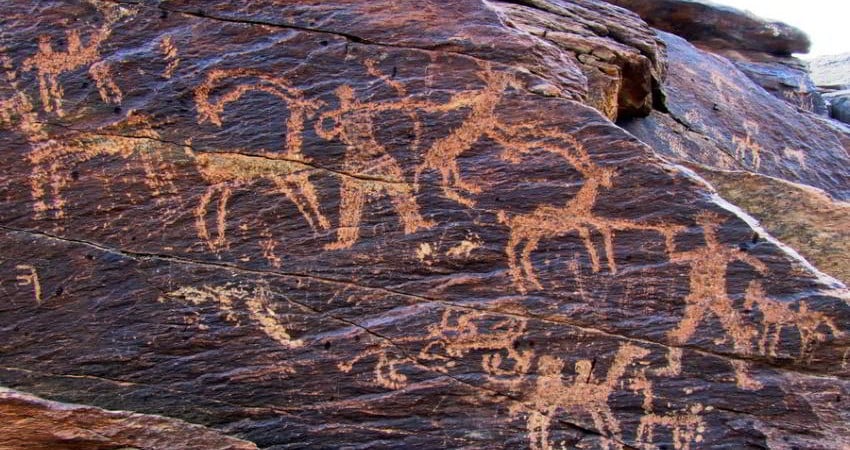
Perusing the images from a major photographic survey of rock art in central Iran, archaeologists noted this figure. The pose is a common one called the "squatting man", except that this particular figure has extra limbs, two of which are hooked like those of a praying mantis. So they call this a Mantis Man. That's a bold claim because images that combine humans with insects are vanishingly rare before modern times. Still, could be. Scale in centimeters. The carving was likely done between 7,000 and 4,000 years ago. Below, more images of rock art in the Teymareh Mountain locale, from this site:


How Flies Make Decisions

Abstract of a new paper offers a little glimpse of how decision-making works at the cellular level:
Computations in the brain are broadly assumed to emerge from patterns of fast electrical activity. Challenging this view, we show that a male fly's decision to persist in mating, even through a potentially lethal threat, hinges on biochemical computations that enable processing over minutes to hours. Each neuron in a recurrent network measuring time into mating contains slightly different internal molecular estimates of elapsed time. Protein Kinase A (PKA) activity contrasts this internal measurement with input from the other neurons to represent evidence that the network's goal has been achieved. When consensus is reached, PKA pushes the network toward a large-scale and synchronized burst of calcium influx, which we call an eruption. The eruption functions like an action potential at the level of the network, transforming deliberation within the network into an all-or-nothing output, after which the male will no longer sacrifice his life to continue mating. We detail the continuous transformation between interwoven molecular and electrical information over long timescales in this system, showing how biochemical activity, invisible to most large scale recording techniques, is the key computational currency directing a life-or-death decision.

Monday, March 16, 2020

Santiago de Agüero

Not far from the town of Agüero in Huesca, Spain, is the "enigmatic and unfinished" church or hermitage of Santiago de Agüero. There is no record of who built it or when or why. Architectural historians have dated it to the mid 12th century.

The builders started out with large ambitions, a basilica with three naves. But then they stopped, walled off the building less than half way done, and moved the main entrance to what would have been the side. One theory is that the church was begun as a monastic retreat for Ramiro II of Aragon, who retired from rulership in 1137 and handed his realm over to his son-in-law, Count Ramón Berenguer IV of Barcelona. Ramiro died in 1157, and perhaps what we have is what was built while he was still alive. After his death, no one saw the need for such a grand monastery in this place, so they stopped.


The most famous thing about the church is the Romanesque sculpture of the entrance.


The stones have many delightful mason's marks. I'm working from home this week, a retreat of a different sort, thinking about the men who withdrew from the world to this strange and delightful place. Some of these are from the wonderful Juliana Lees.