Saturday, October 7, 2017

Today's Place to Daydream About: Nahuel Huapi National Park, Argentina

Nahuel Huapi National Park surrounds surrounds Nahuel Huapi Lake in the foothills of the Patagonian Andes. It is Argentina's oldest national park, founded in 1916 and given its current name in 1934.


The first Spaniards to see the lake wandered into the mountains in 1552 searching for "el Ciudad de Los Cesares," a South American version of el Dorado. Instead they found this amazingly beautiful place; do you suppose they appreciated it?

In the second half of the 1800s Argentina boomed, an expansion driven by railroads and massive European immigration. Some of those immigrants rode the railroad into Patagonia and decided that the lakes and mountains looked like Switzerland. The resolved to make the lake district a tourist hub.

In 1902 they built a town at the lower end of the lake, called Barriloche. As you can see, they tried to make it look Swiss; they even established chocolate factories. These still endure and the town hosts an annual chocolate festival.

Barriloche remains the gateway to the National Park and the rest of the district, which also includes ski resorts and the other paraphernalia of mountain tourism.

So you can visit Nahuel Huapi on the civilized track, staying in the town and venturing out for day hikes, or on a cruise around the lake.


Or you can leave civilization behind on a trek of up to a week into the wild mountains.

Either way the park is immense and gorgeous, with an area of 7,050 km2 (2,720 sq mi), or nearly 2 million acres.. It spans several different biomes, from dry pampas at the low end

through forests that rival New England's for autumn color


to high mountains and glaciers.


Animals include condors and the endangered Huillin or South American river otter.

One of the notable sights in the forests is the strange parasitic fungus known as llao llao, after which the oldest hotel in Barioche is named. One species of this, Cyttaria darwinii, was first described by Charles Darwin during his voyage on the Beagle.


On one peninsula in the lake is a separate national park known as Los Arrayanes which protects a grove of 300-year-old arrayanes trees.

In you can kayak the lake, raft down one of the wild rivers, and climb tall mountains with names like el Tronador.


Of course there are plenty of waterfalls.


And extraordinary scenery everywhere.

Friday, October 6, 2017

More Evidence that Life Gets Better after 50

The amount of stress that Americans report experiencing declines "precipitously" after 50. This graph shows the fraction of respondents in a very large study who report experiencing stress "daily," but the same pattern holds for other measures of stress.

A Viking Face

From the handle of a wooden tool called a weaver's sword, 11th century. Recently excavated in Cork.

Tuition in Britain

British universities used to be tuition-free for British citizens. Then, starting in 1998, they phased in tuition at a high level, accompanied by fairly generous grant and loan programs for students who couldn't afford the tab. A new study says the effects were generally benign:
Despite increasing financial pressures on higher education systems throughout the world, many governments remain resolutely opposed to the introduction of tuition fees, and some countries and states where tuition fees have been long established are now reconsidering free higher education. This paper examines the consequences of charging tuition fees on university quality, enrollments, and equity. To do so, we study the English higher education system which has, in just two decades, moved from a free college system to one in which tuition fees are among the highest in the world. Our findings suggest that England’s shift has resulted in increased funding per head, rising enrollments, and a narrowing of the participation gap between advantaged and disadvantaged students. In contrast to other systems with high tuition fees, the English system is distinct in that its income-contingent loan system keeps university free at the point of entry, and provides students with comparatively generous assistance for living expenses. We conclude that tuition fees, at least in the English case supported their goals of increasing quality, quantity, and equity in higher education.
Tuition in and of itself does not keep poor kids from going to college, so long as there is financial aid. In fact one thing universities in England have done is to offer poor students grants for living expenses, funded by tuition on wealthier students. This may explain why even though Scotland has abolished tuition for its universities, English universities have more poor students and a generally more diverse student body.

The main beneficiaries of abolishing universities tuition would be upper middle class college students and their families. This is why I think we should keep university tuition high but make community college free; that way we would be subsidizing people who are much more likely to need the help.

In England leftists have generally left off complaining about tuition, since lowering it would mainly benefit people who don't need help, and suggested that the money be spent instead on secondary schools.

Thursday, October 5, 2017

Nikon Small World Photomicrography Competition

Teresa Zgoda, everted scolex (head) of a Taenia solium (tapeworm), magnified 200x. I don't think those are eyes, but wow.

Dr. Ryo Egawa, individually labeled axons in an embryonic chick ciliary ganglion magnified 30x. #

Charles Krebs, the eye of an Opiliones (daddy longlegs) magnified 20x

Havi Sarfaty, Senecio vulgaris (groundsel, a flowering plant) seed head, magnified 2x; these are annoying weeds in my garden but this is lovely.

Walter Piorkowski, moth eggs in spider silk, magnified 16x

Laurie Knight, simple eyes of an Ectemnius (digger wasp), with condensation, magnified 20x.

Jan Rosenboom, the face of a small moth magnified 5x. These are big image files worth clicking on. Many more at the competition web site.

The Hard Problem of Gun Control

Leah Libresco is a statistician who used to write for FiveThirtyEight. While she was with FiveThirtyEight she was part of a major statistical study on the effects of gun laws that changed her mind about the politics:
Before I started researching gun deaths, gun-control policy used to frustrate me. I wished the National Rifle Association would stop blocking common-sense gun-control reforms such as banning assault weapons, restricting silencers, shrinking magazine sizes and all the other measures that could make guns less deadly.

Then, my colleagues and I at FiveThirtyEight spent three months analyzing all 33,000 lives ended by guns each year in the United States, and I wound up frustrated in a whole new way. We looked at what interventions might have saved those people, and the case for the policies I’d lobbied for crumbled when I examined the evidence.
This is the thing I keep coming back to. While I personally hate guns and wish there were many fewer of them around, I have never thought that any of the gun control measures seriously proposed in my lifetime would have a real effect on gun violence.

I don't mean there aren't things we could do; it seems like there is an actual chance of banning the "bump stock" that Stephen Paddock used to make his semi-automatic rifles fire faster. That might have saved lives in Las Vegas. But only a small percentage of gun deaths are caused by rapid-fire rifles, so the effect on the big numbers would be tiny.

Many of the regulations gun opponents have proposed are downright silly:
When I looked at the other oft-praised policies, I found out that no gun owner walks into the store to buy an “assault weapon.” It’s an invented classification that includes any semi-automatic that has two or more features, such as a bayonet mount, a rocket-propelled grenade-launcher mount, a folding stock or a pistol grip. But guns are modular, and any hobbyist can easily add these features at home, just as if they were snapping together Legos.

As for silencers — they deserve that name only in movies, where they reduce gunfire to a soft puick puick. In real life, silencers limit hearing damage for shooters but don’t make gunfire dangerously quiet. An AR-15 with a silencer is about as loud as a jackhammer. Magazine limits were a little more promising, but a practiced shooter could still change magazines so fast as to make the limit meaningless.
The main effect of some of these proposals is to make gun owners think that legislators are too ignorant about guns to be trusted with the regulation of them.

To my mind, the only gun laws that would have any real impact on the rate of firearms violence would be the sort of near-total bans in place in some European countries. And in America that is not going to happen. Even if such a law could be passed, resistance to it across much of the country would render it impossible to enforce. America has a lot of gun violence not just because we have lax laws, but because we have a gun culture, and I can't imagine what might change those very deep-seated attitudes.

Wednesday, October 4, 2017

The Oral History of the Trump Administration

I very much enjoyed the New Republic's Oral History of the Trump Administration, composed entirely of quotes from insiders. Much is mocking  but some represents a real attempt to understand what is happening in the White House.

Here's a "Republican close to the Senate leadership" on the second health care failure: Unpopular presidents pushing unpopular proposals usually fail.

Or a "Top Trump adviser": We chose to hire a lot of alphas. People in politics are insecure and will either adapt to the fact that this is an entrepreneurial White House and survive, or they won't. The cream will rise and the shit will sink.

Or a "White House official": I kind of pooh-poohed the experience stuff when I got here but this shit is hard.

A Forgotten Graveyard in the Virginia Woods

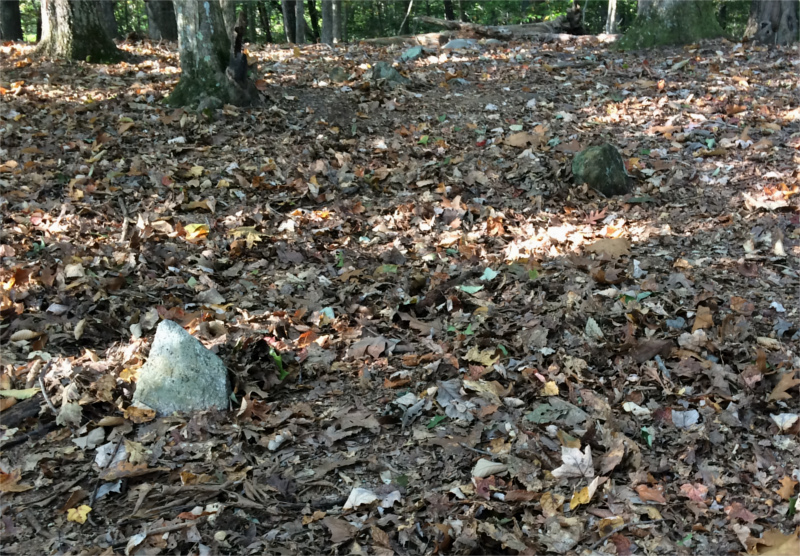
I spent a day last week helping to record this old cemetery. It doesn't look like much because the stones are all natural fieldstones, but the pattern tells the story: pairs of stones (head and foot stones) about six feet apart, with a depression in between. These have been disturbed and are not quite in the right places, but it's clear enough. And sorry about the photographs, but it was harsh sunshine through trees, and all I had was my phone.

Here is a classic grave for this sort of cemetery: two stones seven feet apart, depression in between. The depression is there because amateur gravediggers never got all the dirt back into the grave, just enough to level the surface, so when the coffin collapsed the top of the grave sank with it.

Carved headstones were and still are expensive, so most ordinary folks in the 18th and 19th centuries got either wooden boards or uncarved stones.

Tuesday, October 3, 2017

Voters are Not Persuadable

The results of a major study of different techniques for persuading America voters to change their minds:
The best estimate for the persuasive effects of campaign contact and advertising—such as mail, phone calls, and canvassing—on Americans’ candidate choices in general elections is zero. Our best guess for online and television advertising is also zero, but there is less evidence on these modes.
I can think of at least two ways to interpret this: either voters have gotten so sophisticated or cynical about campaigns that they tune out all the ads, or they are so set in their partisan identities that nothing in hell has a chance of changing their minds.

Monday, October 2, 2017

RIP Tom Petty

One of my favorite musicians is gone. But the music endures.

Jeremy Irons at Kilcoe Castle

In 1997, Jeremy Irons was bored:
A few years earlier, he and his wife, the actress Sinéad Cusack, had bought a modest getaway cottage that sits along the river Ilen, which winds through the western part of Ireland’s County Cork. They fixed up the cottage and named it Teach Iasc, Irish for Fish House. (The couple make their main home in Oxfordshire, England.) With their two young sons, Sam and Max, they spent many a day exploring nearby islands and waterways by boat. The ruin of Kilcoe, about 10 minutes away, became a favorite picnicking spot, where Irons and the boys enjoyed scampering up the walls to view the bay from perilous heights.

Around 1997 the thought occurred to him that he might look into buying Kilcoe and bringing it back to life. Doing so would present precisely the sort of challenge that he craved. Furthermore, he had just completed Lolita, Adrian Lyne’s film adaptation of Vladimir Nabokov’s ever radioactive novel of a teacher’s affair with a pubescent girl, “so,” Irons dryly told me, “I knew things would be slower.”
So he went ahead and bought it.

Kilcoe Castle is on an islet in Roaringwater Bay, south east of the village of Ballydehob in County Cork in Ireland. It was built in the 1450s by the Clan of Dermod MacCarthy. For the next century it led a peaceable existence, but in the intense fighting of Elizabeth I's reign it was besieged three times. The last time, in 1603, it was taken and sacked by the infamous Captain George Flower. (Who reported of this expedition, "We burned all those parts, and had the killing of many of their churls and poor people, and left them not any one grain of corn within ten miles of our way.") After that attack the castle was mostly abandoned and slowly moldered away.

It took ten years for Irons to make the place livable. He won't say what he spent but it must have been millions.

Irons comes across in interviews as an aristocrat with antisocial tendencies, disdainful of public opinion because he is so certain of his own identity and worth. Some locals protested when Irons had the tower painted that peachy gold color, but Irons of course ignored them. (Originally the castle would have been whitewashed, like most Irish tower houses in that period. Think about how garish that would seem now.)

More opinions, from the Independent's 2008 piece on the castle:
On abortion: "It's evil."
On the Catholic Church: "I love its intransigence."
On the gender of his castle: "It's feminine. I felt hugged by it when I arrived last night."
On 30 years of marriage: "I take it a day at a time."
On modern Ireland: "I'm saddened by how everyone is chasing worldly goods and the churches are empty."
The restoration is not supposed to be authentic; Irons says "It's a jazz riff on the medieval." Above, the Great Room.

The lord and lady's bedchamber.


More. What an amazing place. More pictures at Vanity Fair.

Kilian Schönberger: the Earth Pyramids of South Tyrol


Yes, these are real, a strange and modestly famous local phenomenon causes by water erosion in valleys protected from the wind. More here.

A Truly Great Silly Hat

From one of the frozen Scythian graves in the Altai, southern Siberia. One of the objects in the new Scythian show at the British Museum.

And consider this fake beard, made of human hair and found in the grave of a clean-shaven man. In fact, all the corpses in the Altai tombs were clean shaven, but the Greeks always depicted Scythians with beards. Ponder that.

Coercive Assimilation Works

A new study has come out on the long-term effects of sending Americans Indians to government boarding schools (which notoriously tried to bully and beat their Indian identity out of them). It finds that the more students a reservation sent to boarding schools, the more fully it is assimilated into mainstream American society:
higher high school graduation rates, higher per capita income, lower poverty rates, a greater proportion of exclusively English speakers, and smaller family sizes.
This reminds me of East Timor. This was a Portuguese colony within mostly Dutch Indonesia, and when Indonesia became independent, they tried to become their own country. However, then dictator-run Indonesia sent in its army and conquered the place with ease. The East Timorese never gave up, though, and they kept agitating for independence. In 1999 by then democratic Indonesia let them go. The basis of East Timorese identity, I have read, is that they are fanatical Catholics and Indonesia is mostly Muslim. And if you're wondering how they got to be Catholics, well, remember what you know about Mexico and Peru.

Sometimes coercion works very well.

Sunday, October 1, 2017

New Mars Ship Designs Look Familiar

Here is Lockheed Martin's concept design for its Mars lander.

And here is an illustration from the talk Elon Musk recently gave about his Mars plans.

I looked at these and thought, those look like the cover illustrations from paperback sci-fi of the 50s and 60s.


So I'm wondering, are Elon Musk and Lockheed's designers being influenced by all the illustrations they saw as kids? Or is this actually a very sensible to design planetary landers that was just lost in the Apollo era?