Friday, January 8, 2016

Alexei Savrasov

Alexei Kondratyevich Savrasov (1830 - 1897) was a Russian painter born into a merchant family. He began studying art at 8 and eventually entered the Moscow School of Painting, Sculpture and Architecture. (Ipatiev Monastery in the Winter Night c.1870)

From the beginning of his professional career, Savrasov's specialty was landscape. He eventually coined a phrase for his own style, "lyrical landscape painting." (Winter, 1870)

Savrasov obviously loved the landscape of rural Russia, which he painted in every season. (Early Spring)

Winter Landscape.

 Flooding on the Volga near Yaroslavl.

The Rooks are Back.


Spring Evening.

According to wikipedia, Savrasov's life later turned tragic:
In 1871, after the death of his daughter, there was a crisis in his art. The misfortunes in his personal life and, possibly, dissatisfaction with his artistic career were the reasons of his tragedy—he became an alcoholic. All attempts of his relatives and friends to help him were in vain.

The last years of his life Savrasov led the life of a pauper, wandering from shelter to shelter. Only the doorkeeper of the Moscow School of painting, sculpturing and architecture and Pavel Tretyakov, founder of the Tretyakov Gallery, were present at his funeral in 1897.
Monastery Caves near Nishni Novgorod.


Sundown over a Marsh, 1871.


And some paintings posted without titles. I think these are wonderful, and a little sad.

Thursday, January 7, 2016

David Graeber, Debt: the First 5,000 Years

Debt: the First 5,000 Years is an endlessly fascinating book, and I thoroughly enjoyed it. Not because I agreed with every word; many passages are maddening, and I think that in some ways it is very much wrong-headed. But it is full of fabulous facts and keen insights, and the topic is of central importance, so I absolutely recommend it to anyone interested in what the world is like and how it got this way. Given the amount of time and space it covers  3000 BCE to the present, across much of the globe  it is no doubt full of errors, some of them beyond my competence to recognize. Still, for the times and places I do know I found it as good as any textbook, and where I disagreed about factual matters I never thought the errors really undermined the argument.

David Graeber is an anthropologist who did fieldwork in Madagascar before getting involved in the protest movement against the IMF and its austerity policies. He found that when he tried to argue that the debts owed by many poor countries to foreign banks were unjust, people would respond with a simple moral parable: but surely one has to pay one's debts! This set Graeber wondering. What is it about debt that we find so morally compelling? When a corrupt dictator borrows money and squanders it, and is then overthrown in a democratic revolution, why is the new democracy saddled with repayment of the dictator's bills? Why are these debts passed on to the grandchildren of the people who borrowed the money? Why is paying our debits a sacred duty? Graeber tried to answer this question by exploring the origins of debt, money, and markets. How did they arise, and how did they evolve into the institutions we know today? This takes him on a journey that touches Sumerian temple administration, the Biblical jubilee of debt forgiveness, African marriage practices, the slave trade, Chinese philosophy, Indian empires, Greek populist revolts, Roman taxation, and more. I loved the historical parts of the book, which as I said make up most of it.

Graeber begins by discussing a bit of nonsense from the economics textbooks. These tomes often explain the origin of money by fables like this:
One can imagine an old-style farmer bartering with the blacksmith, the tailor, the grocer, and the doctor in his small town. For simple barter to work, however, there must be a double coincidence of wants . . . . Henry has potatoes and wants shoes, Joshua has a extra pair of shoes and wants potatoes. Bartering can make them both happier. But if Henry has firewood Joshua does not need any of that, then bartering for Joshua's shoes requires one or both of them to go searching for more people in the hope of making a multilateral exchange. Money provides a way to make multilateral exchange much simpler. Henry sells his firewood to someone else for money and uses the money to buy Joshua's shoes.
These imaginary republics of barter fill the economics texts, starting with Adam Smith's, but actually they have never existed anywhere. What really happens in old-fashioned rural communities is that if Henry needs shoes from Joshua and has, at the moment, nothing Joshua wants, Joshua hands over the shoes and makes a note that Henry owes him. Eventually either Henry will have something Joshua wants, or a "multilateral exchange" will take place in which all the neighbors pass favors around until everyone is vaguely satisfied. How precisely these debts are calculated depends on the society. In 17th-century New England exchanged items were valued by the parties in imaginary pounds and pence (since real coins were vanishingly rare), and both parties would write the debt down in their account books (many of which survive), to be settled later. In other places the debt was kept intentionally vague, and it might even be described as a gift. In some societies the exchange would go like this:
Henry walks up to Joshua and says, "Nice shoes!"
Joshua says, "Oh, they're not much, but  since you seem to like them, by all means take them."
Henry takes the shoes.
Henry's potatoes are not at issue since both parties are perfectly well aware that if Joshua were ever short of potatoes, Henry would give him some.
Graeber puts a lot of emphasis on how wrong economists are about the origins of money because he wants to discredit their whole discipline. To him, economists misunderstand most of what happens in the world because they work from false models. Viz., those rational agents who go around calculating their self-interest. In the sorts of small communities in which people lived for most of our history, exchange took place within the context of long-term relationships. Everyone was in debt to everyone else, and nobody took this as a sign of profligacy or laziness. Graeber  like James Scott, another anthropologist and one of Graeber's personal friends  longs for that world of small communities where economic relations were subordinated to ties of kinship and neighborliness. Graeber wants to make it clear that although we often think of markets and money as natural parts of our world, they are not natural at all. They are human creations, traceable to particular historical epochs, recent compared to the ancient tradition of neighborly sharing and exchange.

Most of Debt is taken up with the question of how we got from that world to our own. Graeber's version of world history is full of violence, theft, rape, slavery, and other unpleasantries. It is a woeful tale, but then history really has been full of those things. Like most historians who have investigated the question, Graeber believes that markets in our sense were created by governments:
States created markets. Markets require states. Neither could continue without the other, at least in anything like the forms we would recognize today.
Rather than being opposites, as Republicans like to say, states and markets are related innovations, both equally opposed to the world of traditional rural communities. And like most historians, Graeber thinks that the rise of states was very much connected to warfare. Both states and markets, in his view, arose from violence. The first widespread taxation was actually the tribute conquered peoples paid to their conquerors. Some of the first open marketplaces we know about were places where pirates and raiders sold their wares. The most widely accepted theory about the origin of coins is that they were minted to pay mercenaries.

Looming over Graeber's whole narrative is the problem of debt. Early Sumerian texts already recognized the problem of poor people losing their freedom through debts to the rich. In Old Testament Israel the prophets decreed that there must be a jubilee every seven years, in which all debts were forgiven and and debt slaves freed. In the classical world these same issues boiled over again and again. Historian Moses Finley liked to say that all revolutions in the ancient world had the same program: cancel the debts and redistribute the land. In medieval India, those reduced to slavery by debt were the majority of the population. Even among the rich, debt was often a terrible problem. When aristocrats acted with shocking greed  for example, Cortez in Mexico  we often find that they were deeply in debt and facing ruinous default.

Here is where I had my most serious problem with Graeber's approach. It is certainly true that across civilization's first 4,000 years most of the people were oppressed peasants, and that debt was one of their problems. But I am not at all certain that it was the oppression that made their lives so hard. Graeber's world is missing the iron scissors of Malthus. Peasants were poor because there were too many of them for the land and their technology. No doubt taxes and rents hurt, but I don't think they were decisive. When I scan human history I see a relentless struggle for resources, with the losers constantly being pushed out of the gene pool. Politics matters a great deal in history, but so does biology.

As my readers know, I think the basic problem with contemporary politics is that while nobody much likes our regime of financial capitalism and wage labor, nobody knows what else to do. Graeber has tried to find some answers to our problems by undertaking a fundamental look at the origins of money and debt. I think he has succeeded on the intellectual level, by inviting us to think outside the bounds of our normal political discourse. It is salutary to be reminded that people have thought very differently about things like debt and money than we do, and that debt has long been one of the main tools the powerful use to oppress the weak. But on the level of practical politics I think he has failed. In fact Graeber is one of those annoying anarchists who refuse to say what sort of institutions we should have after the revolution. Even he understands that the neighborly economy of a rural village is no solution for our age, and he never says how modern people might act on the principles it embodied. I think the clearest political implication of Graeber's work is that we should return to more liberal bankruptcy laws, but then I supported that before.

So we end up where we usually end up: the world is full of cruelty, injustice, and oppression, a state that continues because some people benefit from it and the rest don't know how to change it. On the other hand the best thing about our world is how easy it is to learn millions of fascinating things, and Graeber has certainly made a great contribution to making the world more interesting.

Competition is Good

And mergers are almost always bad for consumers:
Next time you go shopping for a new cellphone plan, you're likely to find that the options are a lot better than they were a couple of years ago. Prices are lower. You don't have to sign up for one of those annoying two-year contracts. You'll probably get unlimited phone calls and text messages as a standard feature — and a lot more data than before.

If that happens to you, you should thank the Obama administration — specifically, the antitrust watchdogs at the Department of Justice.

Many of the positive developments of the past four years have been driven by T-Mobile, which until recently was the smallest of the nation's four national wireless providers. Back in 2011, AT&T was on the verge of gobbling up T-Mobile, which would have turned the industry's Big Four into the Big Three and eliminated the industry's most unpredictable company.

"Even prior to the merger, T-Mobile was known as being this maverick competitor," says Brent Skorup, a researcher at the Mercatus Center. If the merger had gone through, the industry's maverick would have disappeared.

But then the Obama administration intervened to block the merger. With a merger off the table, T-Mobile decided to become a thorn in the side of its larger rivals, cutting prices and offering more attractive service plans. The result, says Mark Cooper, a researcher at the Consumer Federation of America, has been an "outbreak of competition" that's resulted in tens of billions of dollars in consumer savings.
Capitalism only works if there is competition; every economist will tell you this. So why do we ever permit mergers?

Robert VerBruggen Rethinks Drug Legalization

Libertarian Robert VerBruggen used to support the legalization of all drugs. But the opiate epidemic has him rethinking:
For as long as I can remember, I've thought all drugs should be legal. In a nutshell, I believe that people should be allowed to put themselves at risk if they want to. . . .

I was never so naive as to think there would be no increase in drug use or abuse if drugs were legal. But I did think legalization would easily pass a practical cost-benefit test: reduce incarceration, if perhaps not as much as some might think; end an illegal market whose violence spills far beyond our borders; and expand personal freedom, all for the acceptable price of an extra overdose or other health problem here and there, plus maybe some extra property crimes by addicts stealing to feed their habit.

Drug addiction couldn't go up that much. The War on Drugs is an utter failure and drugs are widely and cheaply available anyway. Everyone knows that.

Well, reality is not lining up with this view of the world. In 1999, Americans had fatal drug overdoses at a rate of 6 per 100,000. In 2014, that number stood at 14.8 per 100,000 — a rise of 8.8 per 100,000. To put this in perspective, America's famously high homicide rate is about 5 per 100,000. And the overdose spike is apparently driven by a policy change much gentler than full legalization.
Of course if we spent all the money we are now spending to jail drug users to make treatment freely available to everyone, that might do something to bring the numbers back down. But I agree with VerBruggen that a real libertarian approach to drugs would be a disaster. Plus it's always nice to see people rethinking their beliefs in the face of evidence.

More North Korean Weirdness: the Not Hydrogen Bomb

Two days ago North Korea exploded an atomic bomb, then announced to the world that they had actually detonated a hydrogen bomb. But setting off a hydrogen bomb is not something that can be concealed from sensors in the U.S. and Russia, so other governments knew even before the announcement that the explosion was not powerful enough to have been a hydrogen bomb. This had the peculiar effect of making everyone mad at North Korea and generating tense hearings at the U.N. Security Council, for nothing. Why? Was the hydrogen bomb claim just for domestic consumption, or did the North Koreans want to make everyone mad at them? Were they feeling ignored, since not even Republican presidential candidates had bothered to denounce them lately? Bizarre.

Wednesday, January 6, 2016

The Rain Miracle of Marcus Aurelius

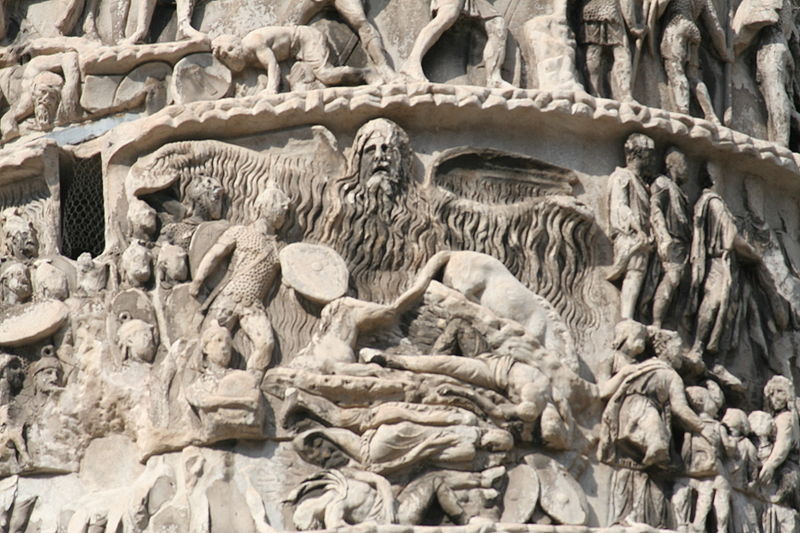
In 168 to 174 CE, emperor Marcus Aurelius waged war against two important tribes of northern barbarians, the Marcomanni and the Quadi. He eventually defeated them, and it is this war that is immortalized on the column his son set up for him in Rome. Perusing pictures of the column, I was startled by this image, and wondered what it could mean. Some shaggy German monster? A wookie? But I looked it up and discovered that this image is known as the "rain miracle." Cassius Dio:
For when the Romans were in peril in the course of the battle, the divine power saved them in a most unexpected manner. The Quadi had surrounded them at a spot favorable for their purpose and the Romans were fighting valiantly with their shields locked together; then the barbarians ceased fighting, expecting to capture them easily as the result of the heat and their thirst. So they posted guards all about and hemmed them in to prevent their getting water anywhere; for the barbarians were far superior in numbers. The Romans, accordingly, were in a terrible plight from fatigue, wounds, the heat of the sun, and thirst, and so could neither fight nor retreat, but were standing and the line and at their several posts, scorched by the heat, when suddenly many clouds gathered and a mighty rain, not without divine interposition, burst upon them. Indeed, there is a story to the effect that Harnuphis, an Egyptian magician, who was a companion of Marcus, had invoked by means of enchantments various deities and in particular Mercury, the god of the air,note and by this means attracted the rain.

Joseph Brodsky's Graduation Speech

Brodsky gave this speech in Ann Arbor in 1988; Maria Popova calls it the greatest commencement speech ever, and she has more excerpts. Brodsky was born in Leningrad in 1940 and dropped out of school at 15, working at many different jobs before he began to publish his poems. In 1970 he was sentenced to 5 years in a Siberian labor camp for "anti-Soviet" writings and served 18 months before he was shipped into exile in 1972. Here is one of the speech's most famous lines:
Life is a game with many rules but no referee. One learns how to play it more by watching it than by consulting any book, including the holy book. Small wonder, then, that so many play dirty, that so few win, that so many lose.
But I prefer this, from near the end:
At all costs try to avoid granting yourself the status of the victim. Of all the parts of your body, be most vigilant over your index finger, for it is blame-thirsty. A pointed finger is a victim’s logo — the opposite of the V-sign and a synonym for surrender. No matter how abominable your condition may be, try not to blame anything or anybody: history, the state, superiors, race, parents, the phase of the moon, childhood, toilet training, etc. The menu is vast and tedious, and this vastness and tedium alone should be offensive enough to set one’s intelligence against choosing from it. The moment that you place blame somewhere, you undermine your resolve to change anything; it could be argued even that that blame-thirsty finger oscillates as wildly as it does because the resolve was never great enough in the first place. After all, a victim status is not without its sweetness. It commands compassion, confers distinction, and whole nations and continents bask in the murk of mental discounts advertised as the victim’s conscience. There is an entire victim-culture, ranging from private counselors to international loans. The professed goal of this network notwithstanding, its net result is that of lowering one’s expectations from the threshold, so that a measly advantage could be perceived or billed as a major breakthrough. Of course, this is therapeutic and, given the scarcity of the world’s resources, perhaps even hygienic, so for want of a better identity, one may embrace it — but try to resist it. However abundant and irrefutable is the evidence that you are on the losing side, negate it as long as you have your wits about you, as long as your lips can utter “No.” On the whole, try to respect life not only for its amenities but for its hardships, too. They are a part of the game, and what’s good about a hardship is that it is not a deception. Whenever you are in trouble, in some scrape, on the verge of despair or in despair, remember: that’s life speaking to you in the only language it knows well. In other words, try to be a little masochistic: without a touch of masochism, the meaning of life is not complete. If this is of any help, try to remember that human dignity is an absolute, not a piecemeal notion, that it is inconsistent with special pleading, that it derives its poise from denying the obvious. Should you find this argument a bit on the heady side, think at least that by considering yourself a victim you but enlarge the vacuum of irresponsibility that demons or demagogues love so much to fill, since a paralyzed will is no dainty for angels.

The world you are about to enter and exist in doesn’t have a good reputation. It’s been better geographically than historically; it’s still far more attractive visually than socially. It’s not a nice place, as you are soon to find out, and I rather doubt that it will get much nicer by the time you leave it. Still, it’s the only world available; no alternative exists, and if one did, there is no guarantee that it would be much better than this one. It is a jungle out there, as well as a desert, a slippery slope, a swamp, etc. — literally — but, what’s worse, metaphorically, too. Yet, as Robert Frost has said, “The best way out is always through.” He also said, in a different poem, though, that “to be social is to be forgiving.” It’s with a few remarks about this business of getting through that I would like to close.

Try not to pay attention to those who will try to make life miserable for you. There will be a lot of those — in the official capacity as well as the self-appointed. Suffer them if you can’t escape them, but once you have steered clear of them, give them the shortest shrift possible. Above all, try to avoid telling stories about the unjust treatment you received at their hands; avoid it no matter how receptive your audience may be. Tales of this sort extend the existence of your antagonists; most likely they are counting on your being talkative and relating your experience to others. By himself, no individual is worth an exercise in injustice (or for that matter, in justice). The ratio of one-to-one doesn’t justify the effort: it’s the echo that counts. That’s the main principle of any oppressor, whether state-sponsored or autodidact. Therefore, steal, or still, the echo, so that you don’t allow an event, however unpleasant or momentous, to claim any more time than it took for it to occur.

What your foes do derives its significance or consequence from the way you react. Therefore, rush through or past them as though they were yellow and not red lights. Don’t linger on them mentally or verbally; don’t pride yourself on forgiving or forgetting them — worse come to worse, do the forgetting first. This way you’ll spare your brain cells a lot of useless agitation; this way, perhaps, you may even save those pigheads from themselves, since the prospect of being forgotten is shorter than that of being forgiven. So flip the channel: you can’t put this network out of circulation, but at least you can reduce its ratings. Now, this solution is not likely to please angels, but, then again, it’s bound to hurt demons, and for the moment that’s all that really matters.

Francisque Joseph Duret, Chactas Meditating on Atala’s Tomb, 1836

Chactas was a character from an 1801 novella by Chateaubriand. Chactas was a Natchez Indian who was caught up in various Indian wars, wars between whites and Indians, and other woes, and ended up falling in love with a half-Indian, half-white woman who had become a nun. As you can tell, it didn't end well.

Politicians' Marriages

Frank Bruni:
Remember the Gores? Al and Tipper? At the Democratic convention in 2000, they shared that hungry, happy kiss, and it was more than a meeting of lips. It was a window, or so we thought, into a partnership of enduring passion and inextinguishable tenderness.

They’re separated now. Have been for more than five years.

And the Edwardses? John and Elizabeth? He resembled a Ken doll. She didn’t take after Barbie. That endeared them to voters — endeared him to voters. Only later did we learn about his double life, the furious fights and the copious tears.

We know nothing of other people’s marriages. Nothing at all.
After spending some time on what a mystery the Clintons’ marriage is  -- "Talk with six different people who know the Clintons well and you hear six different appraisals of their bond" -- Bruni concludes like this:
I’m less and less interested in guessing, because I’m more and more aware of how compartmentalized people are, of how flawed and fruitless it is to extrapolate from one chamber of their lives to another. The stingiest spouse and parent can be the greatest boss, and vice versa. Someone who’s selfless and principled in one context is sometimes the opposite in another, as if there’s only so much goodness to go around.
I agree with that absolutely. Some part of our brains very much wants to give blanket judgments about other people, good or bad. But all the evidence suggests that this is nonsense. People are good and bad in different ways under different circumstances. Political and military leadership, artistic talent, medical skill, athletic prowess -- these things are utterly unrelated to being a good spouse, friend, parent, lover, or just about anything else you can think of. Which is not to say that you can't be both a good leader or creative genius and a decent person, just that you can very easily be one without the other. I also agree with Bruni that even in interpersonal matters, people can be good in some way and bad in others, for instance loyal friends who are terrible parents.

And since I believe that nobody who is not crazy in some way would ever run for President, I have little interest in the private lives of the candidates. Give me another FDR or Gladstone, please, not another Jimmy Carter.

A Second-Chance Society

People often say that the country moved toward gay equality when many basically conservative people discovered how many of their friends, colleagues, and relatives are gay. Now it seems that the mushrooming of the opiate epidemic is leading to something similar, as politicians who have watched friends and relatives struggle with addiction are turning against prison for addicts and toward treatment. At a New Hampshire forum on drug addiction yesterday, five Republican presidential candidates shared stories of their personal involvement with drug abuse:
Mr. Bush’s daughter, Noelle Bush, has stayed far from the world of politics, in part because of her long struggle with addiction. She faced felony charges that she tried to fill a fraudulent prescription for Xanax when she was 24, and later ended up in jail after she was found with pills and then crack cocaine in her shoe. . . .

“What I learned was that the pain that you feel when you have a loved one who has addiction challenges and kind of spirals out of control is something that is shared with a whole lot of people,” he said. . . .

Carly Fiorina talked about losing her stepdaughter, Lori, who died of drug addiction. Earlier, in an email to supporters, Mrs. Fiorina spoke of Lori’s death to the “demons of addiction” and said, “If you’re criminalizing drug abuse and addiction, you’re not treating it — and you’re part of the problem.”
Bush concluded:
“For dealers, they ought to be put away forever as far as I’m concerned,” he said, to applause. “But users — I think we have to be a second-chance country.”
Sometimes, I suppose, things have to get worse before they can get better.

Tuesday, January 5, 2016

Roman Street, Tarsus,Turkey


Filling Out the Periodic Table

The International Union of Pure and Applied Chemistry (IUPAC) has certified the creation -- for a few microseconds, anyway -- of elements 113, 115, 117, and 118, filling out the seventh row of the Periodic Table. It's going to be a banner year for the makers of the posters that hang in high school science rooms, since now everybody needs a new one.

Ted Cruz Sums Up the Republican Platform

From a long Times piece on how dark and dangerous the world seems from the Republican campaign trail, I extract this nugget from Ted Cruz:
President Obama and Hillary Clinton continually focus on stripping the constitutional rights of law-abiding citizens instead of fighting the bad guys. We don’t beat the bad guys by taking away our guns. We beat the bad guys by using our guns.
The notion that we live in what Chris Christie keeps calling “dangerous, perilous times” is bewildering to me. People in Syria live in dangerous, perilous times, but in North America we are living in the safest era in human history. I have to think that the constant doom-mongering we get from so many political leaders is part of why we can't enjoy it.

The Saudis Play the Shiite Card

Toby Jones:
When Saudi Arabia executed the Shiite cleric and political dissident Sheikh Nimr al-Nimr on Saturday, the country’s leaders were aware that doing so would upset their longtime rivals in Iran. In fact, the royal court in Riyadh was probably counting on it. It got what it wanted. The deterioration of relations has been precipitous: Protesters in Tehran sacked Saudi Arabia’s embassy; in retaliation, Saudi Arabia severed diplomatic ties. More severe fallout could follow — possibly even war.

Why did Saudi Arabia want this now? Because the kingdom is under pressure: Oil prices, on which the economy depends almost entirely, are plummeting; a thaw in Iranian-American relations threatens to diminish Riyadh’s special place in regional politics; the Saudi military is failing in its war in Yemen.

In this context, a row with Iran is not a problem so much as an opportunity. The royals in Riyadh most likely believe that it will allow them to stop dissent at home, shore up support among the Sunni majority and bring regional allies to their side. In the short term, they may be right. But eventually, stoking sectarianism will only empower extremists and further destabilize an already explosive region.
This makes sense to me, although I also think that the Saudi leadership believes it must lead the Sunnis in a struggle for power against the Shiites all across the Middle East. I doubt this will lead to a major war any time soon, especially given how badly the Saudi military is doing in Yemen. But I think the conflict colors just about everything the Saudis do. Jones again:
The real problem is not just that Saudis are willing to live with violent sectarianism. They are now beholden to it, too. That the kingdom’s leaders have embraced sectarianism so recklessly suggests that they have little other choice. This should be frightening, considering more is likely to be in store. But it should also be clarifying for those who believe that Saudi Arabia is a force for stability in the Middle East. It is not.

Hillary is a Wonk

Hillary Clinton might be the wonkiest candidate for President ever. The latest proposal from her policy shop is a plan to keep U.S. companies from "offshoring" their profits to avoid taxes. It's pretty complicated, but if you really want to know, Peter Orszag will explain it to you. Me, I'm just impressed by how many very detailed plans Hillary has already put forward.

Monday, January 4, 2016

Earrings, India, 1st Century BCE


Now in the Met:
This exquisite pair of gold earrings is rare in having survived. While splendid jewelry adorns the regal and divine figures represented on early stone sculptures and terracotta plaques, few actual ornaments still exist. It is thought that jewelry was not kept and reused but instead was melted down possibly to avoid transmitting the karma of the former owner. In addition to clusters and rows of beads, each earring is decorated with a winged lion, and elephant and two vases filled with vegetation. Put on by slipping through a distended earlobe from the back, they are worn with the lion facing the wearer's cheek and the elephant on the outside.

Who are “the American People”?

Out in Oregon a bunch of armed right-wing activists have occupied some empty government buildings at the Malheur National Wildlife Refuge, the latest flashpoint in a struggle over ranching on Federal land that goes back at least to the 1970s. So far the government seems to be ignoring them and hoping they will get bored and go home.

The standoff grew out of a peaceful protest against the prison sentences given to Dwight L. Hammond and his son Steven D. Hammond, two ranchers who set fires on the Federally-owned land they lease and ended up charged with arson. I have to say that I was startled to hear that these men were actually given prison sentences, since the government generally handles ranchers with kid gloves. The bare facts given in the news stories don’t really explain this. Perhaps these men have long records of infractions and the Bureau of Land Management finally got tired of them, or perhaps this happened during one of those awful fire summers when firefighters were killed and millions of acres were burned, and some prosecutor vowed to throw the book at the next person setting illegal fires. Anyway, most of the protesters marched and spoke and then went home, but a hard core of activists occupied the buildings with guns drawn and vowed to stay until justice was done.

What really struck me about the story was the language used by the protesters:
In a video posted to Facebook on Saturday, Mr. Bundy called the Hammonds’ case “a symptom of a very huge, egregious problem” that he described as a battle over land and resources between the federal government and “the American people.” He said his group was occupying the federal site to take “a hard stand against this overreach.”
Here we have the mirror image of the motto we heard so often from Occupy Wall Street, “this is what democracy looks like.” When Ammon Bundy (the son of Cliven) says “the American people” he means his conservative friends from western states. And if it were up to ranchers, or to people who live in those counties, quite likely the land would be given to the people who run cattle on it and that would be that. But America is not just western ranchers; there are 320 million of us, and most of us live in big cities. Our attitude toward western ranch land is starkly different from that of the Bundy's and their friends. As far as I am concerned, that land belongs to me as much as it does to anyone who happens to be leasing it, and I demand a say in how it is run. The way democracy actually works is that we have elections and the people who win them set policies that the rest of us have to live with. Environmentalists and people friendly to them have been winning elections since the 1960s, so policy have been shaped by their view of how Federal land should be managed: fewer cows and more wildlife.

You may not like it; certainly I often don't like it. But democracy does not mean that you and your friends get to impose your idea of justice on everyone else. It means that the side with the most votes makes the rules.

Sunday, January 3, 2016

Lajia

Chinese archaeologist have been digging at the early Bronze Age village of Lajia on the upper Yellow River since 1999. The site belongs to the Qijia culture of the late Neolithic and early Bronze Age. In about 1900 BCE the village was buried by a gigantic mudslide, probably triggered by a catastrophic earthquake. Many of the inhabitants were buried where they were standing when the wave of mud struck.

The Chinese archaeologists suspect that the earthquake was only the final cause of the event, the way for which was prepared by years of severe erosion upslope, caused by careless farming. If this is so, it is an important piece of information about the Neolithic cultures of that region. Archaeologists in many areas find that Neolithic settlement seems to have begun in an unsustainable way, leading to a major fall in the population later on.

This picture of an adult cradling a child was released last summer, and Chinese news outlets said it was a mother who had been trying to protect her son. Sadly, DNA study reveals that these two people were not closely related. Or maybe that's even better; in this village adults grabbed up children and tried to protect them whether they were their own offspring or not.

The people of Lajia lived in semi-subterranean pit houses, the walls and floors covered with a mix of plaster and straw. Plan of the house called F4. The excavators estimate that the village contained about 400 such houses.

And photo. Since 14 skeletons were found in this house, it seems that people rushed to take shelter there.

Other finds at the site have included pottery kilns, oracle bones, lots of pottery (big jars, medium sized jars, wine vessels, large and small bowls, cups), stone tools (knives, axes, adzes, chisels, plate-shaped tools, choppers, scrappers, hammer stones, gravels, heads of scepters, arrowheads, and a jade knife with a blade 30 cm (1 foot) long) and a handful of badly corroded bronze or copper objects.


One of the most famous finds from the site was what appeared to be noodles (above). This made it into Nature, since these would be by far the world's oldest noodles. Analysis suggested that they were made of ground millet. But this conclusion has been challenged by people who point out that 1) the ancient Chinese almost always ate millet whole, and anyway no grindstones have been reported from Lajia; and 2) millet has no gluten, the protein that makes flour elastic enough to be stretched into noodles. But if those aren't noodles, what are they? A bit of a mystery.

Anyway it is a wonderful site, giving us an amazing glimpse into life 4000 years ago, and the catastrophe that brought life to an end for many of Lajia's people.

The Execution of Sheikh Nimr al-Nimr

The Saudis executed a political dissident this week, Sheikh Nimr al-Nimr. Sheikh Nimr was a Shiite from the Gulf region, an area where Shiites are the majority. During the Arab Spring there were many protests in that area for Shiite rights, and even more on the nearby island of Bahrain. Sheikh Nimr was a leader of those protests, and he preached at least one Friday sermon full of angry denunciations of the Sunni leadership of both kingdoms. He suggested that the Shiite region secede from Saudi Arabia:
Our dignity has been pawned away, and if it is not ... restored, we will call for secession. Our dignity is more precious than the unity of this land.
However, he also explicitly rejected violence. From wikipedia:
The [Saudi] authorities depend on bullets ... and killing and imprisonment. We must depend on the roar of the word, on the words of justice. We do not accept [the use of firearms]. This is not our practice. We will lose it. It is not in our favour. This is our approach [use of words]. We welcome those who follow such [an] attitude. Nonetheless, we cannot enforce our methodology on those who want to pursue different approaches [and] do not commit to ours. The weapon of the word is stronger than the power of lead.
The Saudis arrest Sheikh Nimr in 2012, and he was tried and sentenced to death in 2014.

The response to Sheikh Nimr's execution has been protests across the Shiite world, especially in Bahrain. The Iranian foreign minister said,
It is clear that this barren and irresponsible policy will have consequences for those endorsing it and the Saudi government will have to pay for pursuing this policy.
But when a mob attacked the Saudi embassy in Tehran, the police moved in and made many arrests. So Iran doesn't seem interested in escalating the conflict at this time.

I find this very discouraging. The Saudis not only believe that the real defining conflict of their time is a Sunni-Shiite struggle for power in the Middle East, they are working hard to make that struggle real.

Sometimes I think we have the wrong friends in the Middle East. The government of Iran is nasty and thuggish in many ways, but it is more democratic than those of our Arab allies.

Kitafahrten

Fascinating WSJ article on the German habit of sending children as young as two on overnight camping trips:
There are no pencils or paper on the trips. Children in Germany aren’t taught to read and write until they are 6. That leaves time for such tasks as using knives to whittle sticks for roasting sausages. Notes from America’s Wild West set the tone. Tilda’s name for the trip: Little Wolf of the Brave Starfish Tribe.

The journeys, called Kitafahrten, take place once a year at many German kindergartens. They are a Teutonic crash course in becoming independent—with minimal allowances for the tender age of participants.

Stuffed animals top the packing list. Some campers revert to their “terrible twos”—which isn’t that far to travel for campers who are only 3. Chaperones dole out sweets to ward off homesickness. “If you miss your parents, you can eat a bonbon and you will feel better,” Katrin Sperling, Tilda’s teacher, recalls telling the children.

While safety is certainly a concern, teachers don’t engage in the kind of hypervigilant supervision that is commonplace in the U.S. Tilda’s group camped on an island. Nearly all of the 4- and 5-year-olds were nonswimmers. On a different trip, some children cut themselves with Swiss Army knives they were given to carve wood, recalls Henrieke Basker, whose then 4-year-old daughter was on the trip. “Some parents weren’t so amused about that,” she says.

Phone calls from parents are typically verboten. “We will call you if we need to,” Ms. Sperling recalls telling two worried mothers before this year’s trip. Parents got three terse texts over four days. “We have arrived,” said the first.
Personally, I think this is great. Anyone else?

Pointless Activities

xkcd

Sometimes when I notice that a certain NY Times articles has, say, 647 comments after one day, I wonder what the point of that is. I suppose just to sound off, since conversation in those circumstances seems impossible.

Saturday, January 2, 2016

Original Star Wars Matte Paintings

I just discovered today how many of the backgrounds in the first three Star War movies were matte paintings. I mean, I knew a lot of stuff was painted but I always thought this scene had actual actors in storm trooper uniforms. But no.

In some scenes, even the characters were painted in.


College

Historians of the twenty-first century will look back with well-placed scorn on the shallow-minded days of the early twentieth century when football games and petting parties were considered the most important elements of a college education.

--Mary Eileen Ahern, 1934

Johnny Clasper: Stone Mason to Artist

Johnny Clasper, born in Yorkshire in 1977, went to work as a bricklayer and stone mason straight out of high school. Now he is starting to get attention in the art press for his mosaics and walls.


His web site.

Friday, January 1, 2016

Queer Theory Bot

Amusing Twitter that generates random academic nonsense. Some examples:

Abstraction theorizes against the iconographic, moving between sensibility and silence.

Silence is conceptual, withheld, world-building (that is, the similar).

Subjectivity of hegemony obscures hegemony.

It is the queer signifier that obscures the category 'imagination' against questions of aesthetics.

A value of politics inhabits a silence of aesthetics.

In the sexualized, queer silence deconstructs the category 'realities' outside questions of simulacrum. It gestures; it gestures.

How might we interrogate enforcement?

It is not that an interpellation of archives is erotic; rather, that an interpellation of archives is, as we know, transgender.

It is body that operates beyond assimilationist form. And yet, it is body that performs with and against aesthetics.

Page Bradley

I featured Page Bradley here back in 2011 when she landed on a list of "breakthrough artists".  Last week I stumbled across another work of hers on an art blog and decided to check back with her web site to see what she has been doing. (Balance)


I found that she has been continuing along the same lines she had laid out in 2004 to 2011, focusing on human figures that embody a distinct tension:
From the moment we are born, the world tends to have a container already built for us to fit inside: A social security number, a gender, a race,a profession or an I.Q. I ponder if we are more defined by the container we are in, rather than what we are inside. Would we recognize ourselves if we could expand beyond our bodies? Would we still be able to exist if we were authentically ‘un-contained’?
(Blossom)

Bradley has long been fascinated by dance; ballet is after all a nearly perfect metaphor for the tension between order and freedom. Dancers soar, but in ballet their movements are strictly choreographed. (Ballet International)

Many of her figures have the rough texture of clay models that Rodin pioneered in bronze, and that my eldest son dismissed as "not finished." I don't mind, although in general I prefer the smoother pieces. (Anjali)


She has a whole series of figures like these, bound up in or escaping from mysterious folds of fabric. (Into the Light and Bound for Freedom)


Autumn


And one drawing, of a Bernini bust.

The artist in her studio.

Bradley had made many lovely things, but I think my favorite is still the first one I saw, Expansion.