Wednesday, April 13, 2022

NY Times Focus Group with Conservative Men

My first reaction to this is that these men are certainly conservative, in that their complaints are age-old:

The men didn’t see themselves fitting into American society today. They didn’t feel free to be themselves in the culture. Seven of them said they felt like a stranger in their own country. At a time when democratic institutions are under pressure — and even under attack — and the United States feels so ununited, what causes these Americans to feel so alienated from America? . . .

Most said they believed society is headed toward increased rule breaking and a “me, me, me” culture. Crime and a sense of lawlessness came up a lot; our focus group leader, Kristen Soltis Anderson, was surprised by how much they used examples of poor road etiquette as emblematic of broader societal decay.

To that end, safety was a major theme: concern about being physically attacked and also concern about being verbally attacked for what they say. Several felt the cost of saying what they really think is sometimes just not worth it, evoking worries among some Americans about free speech and cancel culture. And they had strong views about masculinity and gender; they seemed aware that their views are out of step with modern culture and will offend some but still felt their views were obviously correct. 

Here's a good sample line from "Danny": 

Nobody follows rules or laws. Stop signs are voluntary. Red lights are voluntary. Nobody gets punished for doing the wrong thing anymore. We reward mediocrity.

And more:

Michael: I live in Orlando, and when we moved here, it was a beautiful place. Now, right down the street, people are stealing stuff, breaking into cars. And it’s difficult to engage, because you’re afraid that no matter what you say, somebody’s going to take offense to it, even though you may just be wanting to ask a valid question and understand something.

Kristen Soltis Anderson: Can you think of examples?

Michael: It’s almost anything. You can’t mention Trump. You can’t mention Biden.

Joe: I feel that social media destroyed a lot of the culture that we had. Things used to be private, or people just said things, and then they regret it after.

Obviously the problem with this group is that the men were being very careful what they said, for all the reasons they said they had to be very careful what they said. You can sense racial tensions under the surface. But not, it seems to me, in a "let's have a race war" sort of way, but in a "My god it's the 21st century why do we still have race problems" kind of way.

To me, the most interesting part of this is how much of it mirrors the worries of liberals. After all, what are "micro-aggressions" but a worry about civility? One man says that after he got into an argument with an Asian woman at a homeowners' association meeting she posted a review of his business that says he's a racist, and he can't get it removed. 

There is a sense of conflict in the air, and a worry that the internet gives other people nasty ways to attack us. 

To me the mistrust, the suspicion that other people are out to get us, the worry that one mistake or random event could ruin your life, is a big part of the mood in America right now, no matter what your faction.

Tuesday, April 12, 2022

In France, Ongoing Political Realignment

Results from the first round of presidential balloting in France:

Emmanuel Macron (Centrist)                          28%
Marie le Pen (Far Right)                                   23%
Jean-Luc Mélenchon (Far Left)                       22%
Éric Zemmour (Cranky Intellectual Right)      8%
Valérie Pécresse (Gaullist)                                  5%
Janick Jadot (Green)                                           5%
Jean Lassalle (Shepherds)                                  2%
Fabien Roussel (Communist)                             2%
Nicolas Dupont-Aignan (Genuine Gaullist)     2%
Anne Hidalgo (Socialist)                                      2%

So we have Macron vs. le Pen, again. Neither one of the parties that dominated French politics from 1960 to 2000, the Gaullists and the Socialists, even made the 5% threshold to get partial government funding; the Socialist candidate lost to the shepherd who ran as the candidate of the Mountain People's Party.

The incumbent Macron came out ahead but I think that is simply from process of elimination. Even though I am a centrist I despise him. He presents himself as the only one who can save France from ruin under the crazies of the left or the right, which, ok, might be true, but "I am normal" isn't really much of a platform. His rhetoric promises "bold solutions" but his policies are bland neo-liberalism. He didn't really campaign for this round because, he said, he was too busy trying to resolve the crisis in Ukraine, and you see how well that is going. I think he's a slimy narcissist who lucked into a situation where he could pose as the only sane man in French politics, and it is quite possible that his awful personality and weak policies will bring him down.

That le Pen still leads the right despite her continued strong support for Vladimir Putin is deeply disturbing. I hope this will cause many French voters to decide that Macron is the less bad option, but you never know. Millions of people around the world are fed up with their own situations and in no mood to care about anyone else, and if they think things are so bad we desperately need a change, le Pen might win.

Monday, April 11, 2022

Purple Martins at the Nashville Symphony

Like several other species of birds, purple martins return to North America in the spring with mating on their minds. So they disperse to nesting sites to raise their babies, living in pairs or in small colonies of up to a dozen nests. Then in the summer or early fall, the babies raised, they gather together into huge migratory flocks. These flocks hang together until time for the fall migration southward. Sometimes they wander around, but other times they pick one spot to be their collective home until time to push off.

Over the past few years a congregation of 150,000 purple martins have made the Nashville Symphony their summer home. They roost every night in a stand of mature elm trees next to the symphony's concert hall. When the first huge flock showed up, in 2020, people were excited; here's a news story from that year titled "Purple Martins Delight Downtown Nashville." But birds do what birds do, and 150,000 birds do a lot of it. The Tennessee Wildlife Foundation launched a fund to help and raised more than $25,000 to clean up the mess and otherwise "keep the migration safe." (Video here)

But the birds seem to find the concert hall to their liking, and they came back again in 2021. Over two years the symphony has spent more than $100,000 cleaning up droppings, at a time when the pandemic has it near bankruptcy anyway. On some nights concert-goers have to pass through a rain of droppings to reach the front doors; there are pictures of people using umbrellas. The birds are also damaging, or some say slowly killing, the elm trees. 

So the symphony just announced that they are going to pre-empt the birds' return by cutting down the 41 trees where they have been roosting. Margaret Renkl, the "southern culture" writer at the NY Times, investigated the resulting uproar. The tree people are outraged at the loss of mature trees from a city that, they say, doesn't have enough, and they also ask the reasonable question of whether we will keep cutting down any trees the birds choose to roost in until downtown Nashville doesn't have any suitable groves left. They proposed covering the trees with netting instead. But the bird people countered that this would be even more stressful for the birds than removing the trees, and they summoned images of hundreds of poor martins tangled in the huge nets. And of course the symphony is worried about any sort of bad publicity; what symphony can afford to alienate either bird lovers or tree lovers?

As Renkl points out, the birds probably started summering at the symphony because the trees they used to summer in were cut down for development, which happens every day in booming Nashville, and if they lose the trees by the symphony they will have to find a new home. There is no simple solution to the problems that result when people and wildlife make their homes together.

Saturday, April 9, 2022

Heteropessimism and the Trouble with Freedom

From an article about sex and dating in the NY Times:

Navigating our love lives has always been difficult. But today, the general outlook among heterosexual daters has come to take on a less playful, more depressive tone — manifesting in what the writer Asa Seresin calls “heteropessimism,” a mode of feeling “usually expressed in the form of regret, embarrassment and hopelessness about the straight experience.” (Queer relationships, being less beholden to male-female gender dynamics, may present fewer issues — but they aren’t perfect either.) It’s an anesthetic posture, one that young people use to avoid fully feeling a sense of sorrow for their lack of control and repeated disappointment or fully acknowledging the pervasive awfulness of a sexual culture that’s not suited to their happiness.

This pessimism comes at a moment when we might expect the opposite. After all, one could say that we’re living in a golden age of sexual freedom. The average age of first marriage is rising; it’s more acceptable than ever to remain single or pursue a wide variety of relationship styles. A majority of the public finds premarital sex acceptable; birth control for women is widely available and, with health insurance, often free. Sex positivity is celebrated in progressive circles, with sexual adventurousness championed and inhibition often looked down on. We have breached the ramparts of repression, and the wall of silence that prevented us from expressing our sexuality has, for the most part, fallen.

Getting rid of the old rules and replacing them with the norm of consent was supposed to make us happy. Instead, many people today feel a bit … lost.

In the immortal words of the Hagakure, “this understanding extends to all things.”

For two hundred years, many Europeans and then Americans believed that sexual repression was at the root of all our problems, and the improvement of the human condition had to start with free love. I believe that this is now the most thoroughly refuted idea in the history of ideas.

Friday, April 8, 2022

Links 8 April 2022

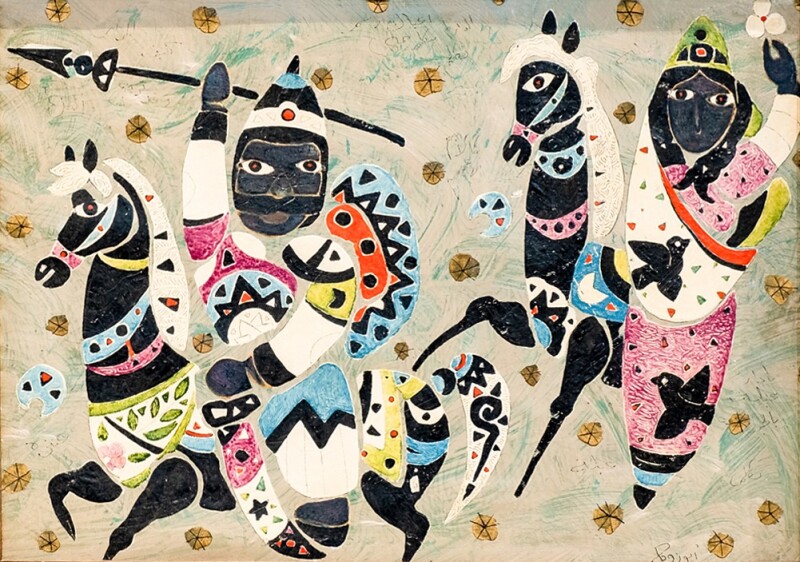
Parliament of Birds from a 16th-Century Persian Manuscript

Interesting bamboo building in Vietnam.

Here's something I did not know about, British ceramics with patterns based on fossils, from the 1760s.

Silly pictures and gifs of pallas cats.

Spring in Ben Pentreath's England.

Ezra Klein takes a serious look at what liberalism means, shadowed by Putin's power play and Ukrainian desire to join the west. (NY Times)

LA Times story on the feral pig menace in California. I did not know that feral pigs have killed five Americans since 1825.

Photographs of Putin's mistress's St. Petersburg apartment. Bad taste doesn't begin to cover it.

At Uruk, one of the world's oldest cities, archaeologists unearth a 4,000-year-old boat made of reeds coated with bitumen (unrefined tar).

In some industries, companies can now hire robots by the hour instead of buying them. "I’m paying $10 to $12 an hour for a robot that is replacing a position that I was paying $15 to $18 plus fringe benefits."

New genetic evidence suggests that the leadership of the Avars, who dominated Hungary and the surrounding area in the 6th-8th centuries, migrated from Mongolia just a few years before their empire appears in the historical record. The rest of the population seems highly mixed.

Ohio appeals courts upholds $30 million verdict against Oberlin College for making false charges of racism against the owners of a bakery. To my mind this is a sordid tale with sins on both sides, besides being an act of class grievance by townsfolk against a rich, uppity university, which is a very old story indeed. But the verdict is correct in that some Oberlin officials encouraged and participated in protests accusing the bakery of racism without trying to find out if the charges were true. Instead of acting as grownups and, I don't know, maybe talking to the bakers to hear their side of the story, they tried to out-radicalize their students. Another case of the desire to fight against our supposed enemies rather than solve our problems that I see as America's biggest problem.

Major study finds that patients with heart disease get little benefit from a low-salt diet.

After reading some of Serge Schmemann's recent reporting on Russia during the war, I was led to this excellent NY Times essay on "Havana Syndrome." Schmemann got his start as a reporter in the Soviet Union and he developed physical and psychological symptoms because of stress and (largely justified) paranoia. That is his explanation of Havana Syndrome. He also points out that US government scientists deny the existence and practicality of the beam weapons supposed to be causing these problems. We used to blame weird health problems on demons or witches, but now we rely on pseudoscience.

And another photography contest, this one for storms.

Interesting Scythian burial excavated in Tuva, Russia, in those long-ago peaceful days when Russian and Polish archaeologists worked happily side-by-side, like, last summer.

Is this Bronze Age figurine from Germany an idol, a weight, or both?

Designs for Ukrainian Easter Eggs.

David Brooks says that "globalization" in the old senses – trade, migration, interconnection, social and economic convergence – are fading, and the only thing globalizing now is the culture war. (NY Times)

Ukraine Links

Interesting map of Russia's initial plan in the Ukraine war. I've now seen several commentators base their idea of Russian plans on the positioning of the 1st Guards Tank Army, which has the reputation of being Russia's foremost armored formation. (Looks like they were place to cut across Ukraine and surround their forces fighting in the east.)

As of April 3, the Russians are losing tanks in Ukraine faster than the German lost tanks during the Battle of Kursk. (In 1943 the Germans lost about 500 tanks in in 49 days; Russia has lost more than 410 tanks in 39 days. For those not up on this history, Kursk is usually regarded as a catastrophic defeat for Germany, with losses so high that they prevented the Germans from ever going on the offensive against the USSR again.)

Michael Kofman on whether Russia can find enough soldiers to finish the Ukraine war.

The Trump wing of the Republican Party is dead-set against intervention in Ukraine, and not interested in a fight with Putin.

Article about the air war based on an interview with a Ukrainian fighter pilot. More emphasis on both the experience of combat flying over the Donbas and training with the US as explanations for good Ukrainian performance.

Phillips O'Brien, a Professor of Strategic Studies, has a theory that battles aren't very important to wars, and what matters are production and communication. He explains how this applies to World War II here. And, he says, Russia is losing in Ukraine, not because they are being outfought, but because they cannot "operate the systems they would need to succeed." This seems to mean logistics and what the US calls "command and control." He says flat out that Russian equipment losses "are not sustainable."

NY Times article on the political opposition in Belarus and a certain mural that keeps being repainted, very long but interesting. One poll mentioned in western media found that only 4% of Belarussians want to join the war.

What you get when you let Google translate the work of this Russian nationalist is strange and brutal: "Denazification can only be carried out by the winner." And "Russia enters the fight with the west for the future of the world."

Comparing a tabletop wargaming exercise held before the invasion to the actual course of events as of March 2. And continuing the game a year into the future, reaching a 1915 scenario with both sides too depleted for offensive operations.

Anti-interventions on the left (Glenn Greenwald, Freddie DeBoer, etc.) and right (Patrick Deneen, Sohrab Ahmari, etc.) sign a letter urging de-escalation in Ukraine. Nothing wrong with that, but they portray Ukrainians as victims of an "attempt to bog down Moscow in a long, devastating insurgency," as if the West bullied them into fighting for their own independence. There is a will in some quarters to believe that every bad thing in the world has Washington's fingerprints on it.

Short video from the Russian city of Mikhaylovsk showing fresh graves decorated with military flags. Military funerals seem to be a Russian specialty.

US Secretary of State Blinken: "for every Russian tank in Ukraine, we have provided or will soon provide 10 anti-tank systems. . . it may take time,  but there is no scenario in which Ukraine does not win."

Dmitry Peskov, Putin's press secretary: "We have significant losses of troops. And it's it's it's a huge tragedy for us."

List of material given to Ukraine by the US.

A Jewish Ukrainian soldier speaks to a dead Buryat tankman who came to denazify him.

Once again some of the western press is dominated by gloom; I just saw a video titled "Why Russia Shifting to the East is Worse than You Think." I read an article yesterday that mentioned Russian troops "redeploying from their encirclement of Kyiv," even though they never came close to encircling Kyiv, accompanied by a map that showed Russian forces still advancing toward Odessa, when they have in fact been driven back 50 miles from that direction and may be withdrawing their whole force back over the Dnipro River. The notion that Russian forces that were just soundly beaten in one part of Ukraine will prove decisively victorious in a different part seems very odd to me. I expect a lot of horror to come, but I think Secretary Blinken was correct when he said their is no scenario in which Ukraine does not preserve its independence and most of its territory.  Meanwhile this Washington Post story quotes some analysts who think the Russian army is spent: "I just don’t see how, given the materiel constraints, they could hope to prosecute a long war with these large objectives, It’s just not sustainable. … They’ll run out of troops."

Speaking of which, Ukraine claims to have the bodies of 7,000 Russian troops in its morgues. (Washington Post)

Wednesday, April 6, 2022

Ireland's Entry in the Suffering Sweepstakes

From a review of Fintan O’Toole's history of Ireland since his birth in 1958:

O’Toole was lucky enough to attend a relatively normal school run by the Christian Brothers, if normality can be stretched to accommodate unrestrained physical violence meted out with leather straps or bamboo canes, and much enforced propaganda; the Brothers published such texts as Courtesy for Boys and Girls and a Catechism of the History of Ireland, which asserted that “in the martyrology of history, among crucified nations, Ireland occupies the foremost place. The duration of her torture, and the ferocity of her executioner, are as revolting as the power of the victim is astonishing.” 

Interview with Sergey Karaganov about the Ukraine War

Very interesting interview with Sergey Karaganov, a Russian foreign policy intellectual once very close to Putin. He oozes contempt for western Europe but is very worried about China. He also seems worried about the course of the war, because he views it as absolutely essential that Russia emerge with some kind of victory.

BM What do you think would be the final goal for the Kremlin at this point? What would be considered a successful outcome for the invasion?

SK I don’t know what the outcome of this war will be, but I think it will involve the partition of Ukraine, one way or another. Hopefully there would still be something called Ukraine left at the end. But Russia cannot afford to “lose”, so we need a kind of a victory. And if there is a sense that we are losing the war, then I think there is a definite possibility of escalation. This war is a kind of proxy war between the West and the rest – Russia being, as it has been in history, the pinnacle of “the rest” – for a future world order. The stakes of the Russian elite are very high – for them it is an existential war.

Karaganov alludes more than once to the possibility of escalation:

BM You talked about demilitarisation of Ukraine, but it seems that such a goal would not be achieved if the West continues to provide Ukraine with weapons. Do you think Russia will be tempted to stop that flow of arms, and does this risk a direct clash between Nato and Russia?

SK Absolutely! There is a growing probability of a direct clash. And we don’t know what the outcome of this would be.
And this from near the end, about the long-term repercussions of the war:
BM One argument is that Russia will fall under Chinese control, and this war does not help – because by isolating Russia from the West, it turns Russia into easy prey for Chinese economic influence. Are you worried that this could be the beginning of a “Chinese century” for Russia?

SK There are two answers to your question. One is that China’s economic influence in Russia and over Russia will grow. China has most of the technologies we need, and it has a lot of capital, so there is no question about that. Whether Russia would become a kind of a satellite country, according to the Chinese tradition of their Middle Kingdom, I doubt it.

If you asked me how I would describe Russia in one word, it is “sovereignty”. We defeated those who sought to rule us, starting with the Mongols, and then Carl [Charles XII] of Sweden, then Napoleon and Hitler. Also, recently, we had years of Western domination here. It was almost overwhelming. And nevertheless, you see what has happened: Russia revolted against all that. So I am not afraid of Russia becoming a part of a great China. The other reason I’m not afraid is because Chinese civilisation is very different. We have our Asian traits in our genes, and we are in part an Asian country because of this. And Siberia is at the core of the Russian empire: without Siberia, Russia wouldn’t have become a great country. And the Tatar and Mongol yoke left many traits in our society. But culturally, we are different, so I don’t think it is possible that we will become a subsidiary country.

But I am very concerned about the overwhelming economic predominance of China over the next decade. People like me have been saying precisely [that] we have to solve the Ukraine problem, we have to solve the Nato problem, so that we can be in a strong position vis-à-vis China. Now it will be much more difficult for Russia to resist Chinese power. 

BM Do you think the US is benefiting from this war?

SK At this juncture, yes, because the big losers are, in addition to Ukraine, Europe, especially if it continues with this mysterious zest for independence from Russian energy. But China is clearly the victor of this whole affair… I think the biggest loser will be Ukraine; a loser will be Russia; a great loser will be Europe; the United States will lose somewhat, but still it could very well survive as a huge island over the ocean; and the big victor is China.

Monday, April 4, 2022

Compost

About 28 gallons this year, dug in on Saturday before I came down with a miserable cold. And some flowers below.


Coercive Diplomacy Gone Wrong

Joe Biden said Russia was "bent on violence from the start," but James Siebens asks if may be that wasn't so. Maybe the best explanation for Russia's strange invasion is that the buildup was intended as a threat, and the actual invasion was only ordered in frustration after the threat failed to have its desire effect:

Putin’s failure to win concessions through intimidation alone meant that he had to either demobilize his forces or follow through on the tacit threat to invade. The first several days of the invasion demonstrated Russia’s lack of preparedness for “Plan B,” and the initial intention to achieve its aims without large-scale combat. Instead, Putin appears to have hoped for a rapid coup de main by attacking the Ukrainian capital and decapitating the government, apparently relying more on a Ukrainian mutiny and the psychological impact of a sudden attack than on force of arms. He sought to attack Kyiv with a relatively small number of unseasoned and unsupported mechanized forces, and little more than a few hundred paratroopers.

On Feb. 24, a few dozen Russian helicopters and at least 100 airborne forces attacked the Gostomel airfield outside Kyiv, and three helicopters were allegedly shot down. Ukrainian forces led a counterattack to retake the airfield, and after an intense battle, Russian forces eventually secured an airfield that was damaged beyond use. Paratroopers were also sent to capture Kharkiv, along with some light armored vehicles and infantry formations, but without adequate support they were quickly overwhelmed and captured. Russian light vehicles assaulting Kyiv shared a similar fate.

This delusional opening attack, and the apparent lack of preparation for major combat operations across the theater afterwards, evinces a lack of serious consideration of an invasion plan beforehand. Considering the evidence that Russian forces failed to adequately account for the significant practical challenges of equipment maintenance, command and control, operational security, reconnaissance, and intelligence, Russia’s initial invasion verged on lackadaisical. This likely indicates an overconfident expectation that Ukraine would quickly capitulate when faced with an invasion and that Russia would achieve its political goals without serious fighting. While the military capabilities assembled in plain view over the past year ensured that Putin would have the option of invading Ukraine, and persuaded some that he intended to do so, it is difficult to explain away the evident lack of serious planning and preparation for actually executing such a major operation. Attacking Ukraine with less than 200,000 troops may have seemed feasible, but it strains credulity that any military leaders would have agreed to order and execute a major invasion and occupation without having planned for combined-arms support and logistical sustainment beyond the first few days. Instead, the conduct of Russia’s invasion indicates a half-cocked effort to make Ukraine flinch, the culmination of a failed strategy of coercion, rather than a calculated plan for conquest.

In February I said that it looked like a bluff to me, so I was certainly surprised when the invasion actually happened. But US intelligence, which seems to have been nearly perfect in those days, reported that Putin had ordered the invasion weeks before, and various Putin regime figures and surrogates had been predicting the invasion since November. Maybe there was a concerted program of mixed messages to make the threat real while keeping options open. But the result, from the Russian perspective, probably shows that more people within the military should have known more about the plan much earlier on.

Sunday, April 3, 2022

Ukraine Links Update 3 April 2022

Wikipedia now lists the Battle of Kyiv (2022) as a Ukrainian victory

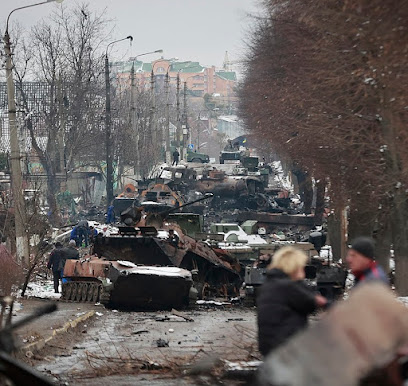
BBC video shot mostly in Bucha and Hostomel, includes a walk through of the scene of devastation on the Bucha road (above) that inspired my poem, as well as what look like dozens of civilian murder victims.

Interesting intercepted call from a Russian soldier. And one who describes killing civilians. And another featuring two men scheming to get home alive.

The scene in liberated Trostyanets.

Military analysts contacted by the Washington Post say that of the 120 battalion tactical groups Russia had at the start of the invasion, at least 20 are too whipped to fight any longer, "a figure likely to be higher since the Ukrainian advances of recent days." The Ukrainian MOD is saying 16 Russian BTGs "destroyed," 34 more badly damaged.

At a courier service in Belarus, a steady stream of Russian soldiers shipping looted goodies home to their families and girlfriends. Also rumors of flea markets set up in Belarusian towns.

Michael Kofman, thread on the state of the war, 2 April 2022.

Discussion of the way the US and Britain have used secret intelligence during the war. As I suspected, US now confirms that they alerted Ukraine to the Russian plan to seize Hostomel airport and fly in reinforcements at the start of the war, helping Ukraine to blunt that attack.

Institute for the Study of War Battle Assessment for 3 April.

Hardly anyone in the west believes that the Russians never intended to take Kyiv, or that their goal all along was to expand the territory they control in the south and east; but, asks Bret Stephens at the NY Times, what if that was true, and what they really want is to seize Ukraine's energy resources, especially natural gas? If so, I would say, then what the west has to do is ban all Russian energy imports. Which we should do anyway.

The Ukrainian-made laser-guided artillery shells they have used to destroy many Russian tanks.

The guys who usually identify destroyed and abandoned weaponry have a go at identifying the washing machines Russian soldiers were trying to steal when their truck was hit. I guess they are worn down by the sheer volume of destruction and need some levity.

Pro-Russia rally in Berlin, just a short video but the western media seems not to be covering this.

Speaking of the guys who count destroyed vehicles, their totals are soaring as they work through images from the Russian retreat. As of right now they show Russian losses as 405 tanks, 763 infantry fighting vehicles, armored personnel carriers, etc., 71 self-propelled artillery, 45 multiple rocket systems, 42 surface-to-air missile systems, 19 jet aircraft, 38 helicopters, and 687 trucks and jeeps, plus sundry others for a total of 2,239 major pieces of equipment, which is about 25 battalion tactical groups worth of gear; the tank total is about 1/3 of what the Russians started with invasion with. If other areas of intense fighting are anything like Bucha, Hostomel and Irpin, the counts of armored vehicles, artillery and trucks are way low, and the total Russian loss is likely over 3,000 systems.

Friday, April 1, 2022

The House with Chimaeras

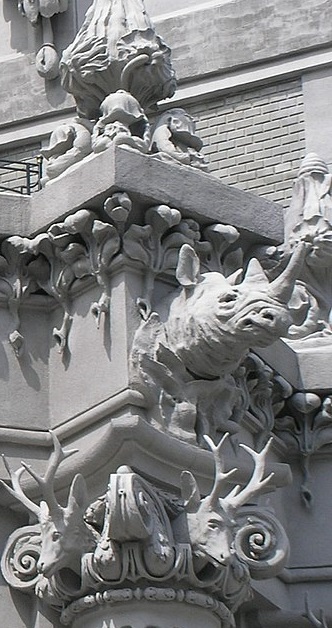
Reading a stunningly nerdy article about the President of Ukraine's phones, I discovered that he has three official residences, all in Kyiv. One of them is this house, known as The House with Chimaeras. 

This very strange structure was built in 1901-1903 by an architect known in his native Poland as Władysław Horodecki but in Ukraine as Vladislav Gorodetsky. A bit thick of me I know but it took me fifteen minutes to figure out they were the same person. Anyway Horodecki/Gorodetsky was a passionate hunter whose great dream was to go on safari in Africa. This is an apartment building with five separate residences, and the plan was to make the thing cost-free by living in one residence and renting out the other four.


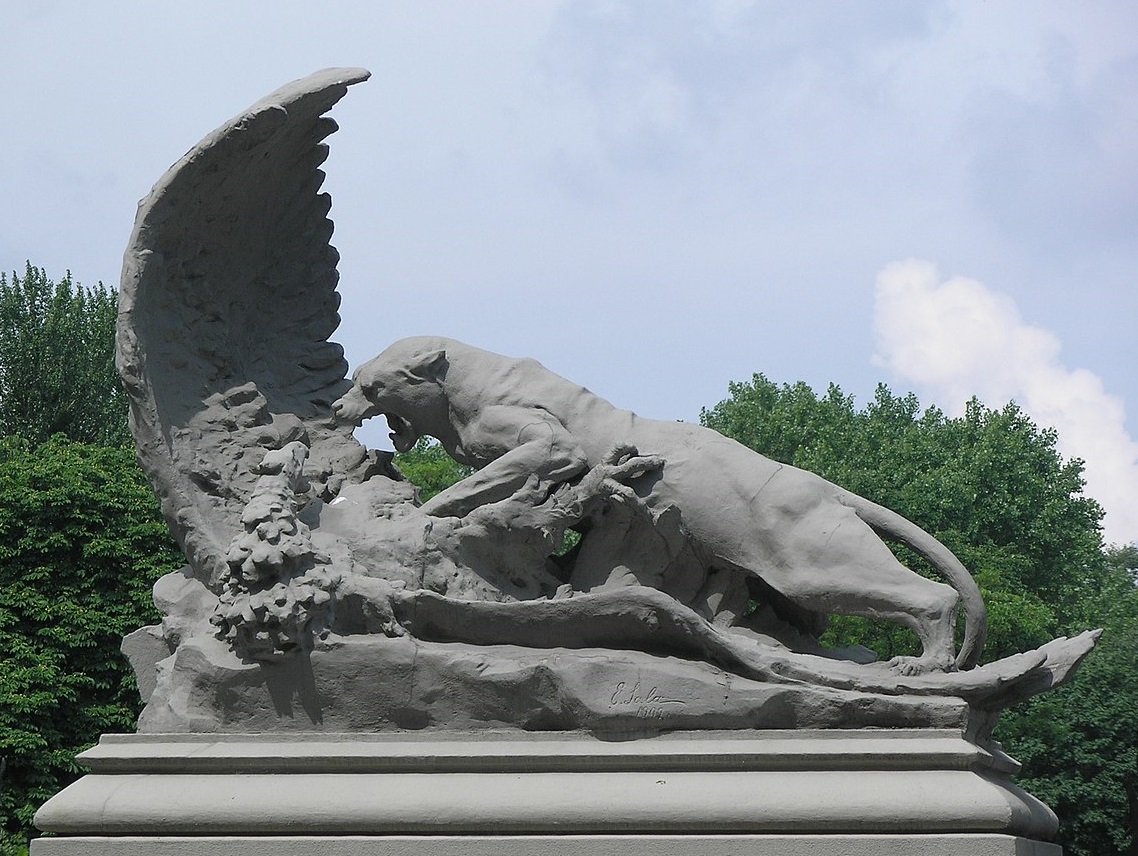
Gorodetsky never made it to Africa, but he did cover his house with exotic animals.


According to not-very-authoritative-seeming internet sources, Gorodetsky's excessive interest in hunting was one reason his business failed, but anyway he had to sell his house in 1913. It passed through a couple of other owners before the Bolsheviks seized it and made it into a state office building.

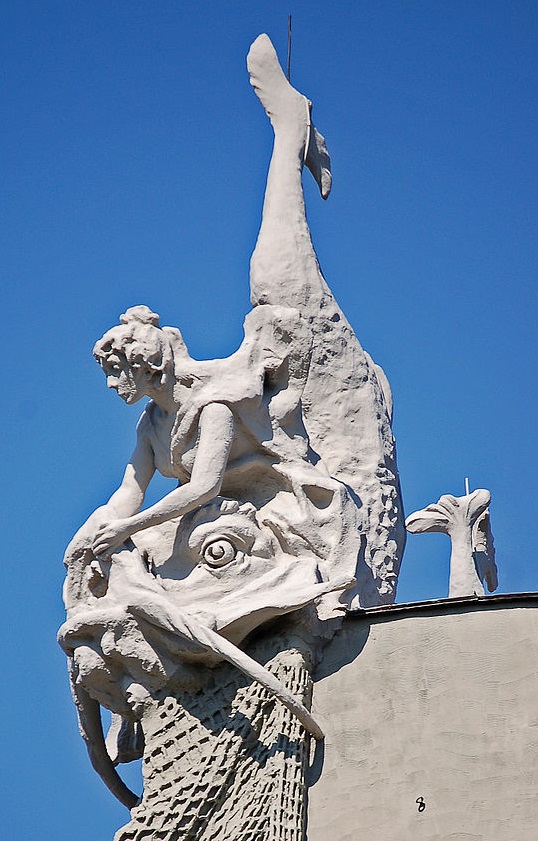
The most striking feature of the design is the nymphs riding Renaissance sea monsters, which give the roof its spiky profile.

The thing is completely crazy, but I would say the world is richer for it.


Links 1 April 2022

Fragment of a relief depicting Daniel in the Lion's Den, southern Scotland, c. 800 AD

Lovely black and white photographs of ancient baobab trees by Beth Moon.

The quest to build aircraft powered by liquid hydrogen.

One of the most amusing squirrel/bird feeder videos ever.

Thousand-year-old surgical kit found in Peruvian tomb.

Fascinating discoveries in the genetics of the classical Maya, who were largely descended from South American migrants.

A Nebraska state senator finally identifies the real threat to American culture, goes off on a rant about furries and litter boxes in elementary school bathrooms.

Last piece of a stolen 17th-century tapestry returned after 40 years.

The "People's Convoy" gives up after three weeks of driving around the DC Beltway and accomplishing nothing.

You can destroy coronaviruses with safe ultraviolet light.

Staggering aerial photographs of the extremely extensive greenhouses of Almeria, Spain.

MIT reinstates its SAT requirement, says test scores help them identify disadvantaged students who still have a chance at MIT. But they're sorry for stressing people out.

Since American politicians are back to being "tough on crime," it's time to remind everyone that longer prison sentences do not deter crime, but hiring more police to raise the rate of solving crimes does deter crime. The US leads the world in the ratio of prison guards to police, and that is a mistake.

Review of a new, global history of science between 1500 and 2000; on the basis of the review the book sounds factually interesting but theoretically silly.

“Isn’t the art scene today revolting?” Warhol asked Cecil Beaton; “I wish I could find a way of making it worse.” Well, he did.

In today's conspiracy theory news, the Rothschilds paid Charles Darwin to devise his theory of evolution. If you tried to satirize these people you would fail, because you can't come up with anything crazier than what they already believe.

Wringing out a towel in space.

What happens when you adjust medical inflation for improved quality?

Pew study finds that "Multigenerational living has grown sharply in the U.S." The announcement was accompanied by rhetoric about turning away from the nuclear family, but it turns out this mostly means childless people 25-35 still living with their parents. Couples with children still mostly live out on their own.

New CDC data on adolescent mental health in 2021, dire. (CDC, Washington Post)

Ukraine Links:

On every day of the past week, Ukraine has recaptured more territory than it lost. Map of recaptured areas here, keeping in mind that much of this territory was not so much held by Russia as driven through. 

Early on April 1, two Ukrainian helicopters crossed the Russian border to launch a rocket attack on a fuel storage facility in Belgorod. Another morale-boosting bit of heroism for Ukraine, and another kink in the already snarled Russian supply chain. Local residents wonder how this happened, since the military had announced that all of Ukraine's helicopters were destroyed on the first day of the war.

Thread on the current mood in Moscow.

Pentagon spokesman John Kirby says Putin is not being given the full picture of fighting in Ukraine because people are afraid to tell him the truth. As several commentators have pointed out, this is a really harsh insult for a former intelligence operative; is the Pentagon just trolling at this point? Somebody said, about a briefing last week, "that wasn't a situation update, it was a slap in the face."

Ukraine's drone warriors. And a grainy video of their work.

President Zelensky's phones, weirdly fascinating in a post-Soviet way.

Makeup of a typical Russian battalion tactical group (Washington Post)

Baffled by former US Representative Tulsi Gabbard's pro-Putin rhetoric, a panelist on Russian TV asks if she is a Russian agent. I regard American support for the heinous Russian invasion as a sign of something very disturbing in our society, something broken at a deep level. Same goes even more so for Russian support of the heinous Russian invasion.

Russia is becoming more like the Donetsk People's Republic, and Putin is becoming more like its founder Igor Strelkov.

Statement from the Ukrainian Azov battalion, which contains a lot of far-right characters, about whether they are Nazis.

European governments are seeing interest among their hardline nationalist groups in fighting in Ukraine, for one side or the other. Not many have gone yet, but police worry that fighting in Ukraine will become for radical nationalists what jihad in Afghanistan was for Muslim extremists. (Washington Post)

Ninety-second video from the Ukrainian side depicting the recapture of Trostyanets near Sumy. And a news report. The Russian defenders were from the 4th Guards Tank Division, another elite formation that has taken heavy losses, including more than half its tanks. Visually confirmed Russian vehicle losses now amount to more than two complete US armored divisions.

Debating the war on Russian television, short video with English subtitles: the speaker says Russia must win to survive, because a treaty with Zelensky would be the end: "win this operation or start the final countdown." 

Another example of Russian soldiers refusing to go to Ukraine, allegedly 137 from one regiment this time. Not sure what will happen but captured soldiers in Ukraine have said that their comrades who refused to cross the border got 13-year prison terms. Meanwhile, Ukrainian border control says 460,000 men of fighting age have returned to the country since the war started. There are rumors that some are training in Poland, with Polish and US help, before crossing.

Intercepted call from Russian soldier: "It's hard as hell here."

Nightclubs are back open in Odessa; "music is life."

ISW statement about Russian "withdrawal" around Kyiv: "The Russian high command may have decided to stop its previous practice of forcing units that have already taken devastating losses to continue hopeless offensive operations."

According to this Washington Post piece, transfer of air-defense systems to Ukraine is being held up by caution in Washington about what moves would be "escalatory."

Keeping Ukraine's trains running. Great look at Ukrainian attitudes..

Interesting argument that the unresolved "problem of Donbas" drove Putin to invade Ukraine.

Head of the Ukrainian Orthodox Church clarifies that killing Russian invaders is not a sin.

Wednesday, March 30, 2022

Major New Meta-Study of Social Media and Mental Health

From the NY Times summary of this study:

While a few researchers have claimed that digital technology is a powerful, causal factor in the rising rates of mental health problems, others have countered that the risk of harm for most teenagers is tiny — about the equivalent influence on well-being as wearing eyeglasses or regularly eating potatoes, one group calculated.

Now, the authors of the eyeglass paper have published a large, multiyear study providing what independent experts said was an unusually granular and rigorous look at the relationship between social media and adolescents’ feelings about life.

Analyzing survey responses of more than 84,000 people of all ages in Britain, the researchers identified two distinct periods of adolescence when heavy use of social media spurred lower ratings of “life satisfaction”: first around puberty — ages 11 to 13 for girls, and 14 to 15 for boys — and then again for both sexes around age 19.

Like many previous studies, this one found that the relationship between social media and an adolescent’s well-being was fairly weak. Still, it suggested that there were certain periods in development when teenagers may be most sensitive to the technology.

I don't know what to make of this debate. This paper, it seems to me, accurately summarizes the science we have on the issue: social media use can't be shown to have major impacts on mental health. But given that the mental health of teenagers has gotten a lot worse, what else could be causing it? Have maybe phones and social media gotten so ubiquitous that we can't actually tease out their effects? Or is there something else going on we can't put our fingers on?

Kerkouane, a Carthaginian Town

I found a book in the public library that lists all the UNESCO World Heritage Sites, and have been perusing it in search of treasures. I have bookmarked several interesting-sounding places I had never heard of, so expect some blogging about these in the coming weeks. One that caught my eye was Kerkouane in Tunisia.

Kerkouane is noteworthy, says UNESCO, in that it is a Carthaginian town not overlaid by later Roman, medieval, or modern settlement, hence very well preserved. The site was discovered in 1952 by a French archaeologist who was surf fishing when he noticed potsherds eroding from the shore. (I have been scanning eroding banks for similar discoveries all my life but sadly have none to report.) After independence in 1956, Tunisian archaeologists looking for a suitable project decided to mount a major dig here, perhaps as a gesture against European imperialism. 

These overhead views show the extent of the excavation. 

You can see that the layout included wide streets and public squares. Which seems obvious to us, but they had after all to be invented; Neolithic towns did not have them. One of the unsung achievements of Middle Eastern civilization.

The ancient historian Polybius tells us that during the First Punic War, around 255-250 BC, the Romans attacked the city of Apsis not far from Kerkouane:

Landing there and beaching their ships, which they surrounded with a trench and palisade, they set themselves to lay siege to the town, the garrison of which refused to surrender. (..) The Romans, after making themselves masters of Aspis (..) hastily advanced with their whole force and set about plundering the country. As nobody tried to prevent them, they destroyed a number of handsome and luxuriously furnished dwelling-houses, possessed themselves of a quantity of cattle, and captured more than twenty thousand slaves, taking them back to their ships.
It seems that Carthaginian coinage changed drastically in the 240s BC, and during the excavations at Kerkouane no coins were found of the later type.  So the theory is that Kerkouane was abandoned because of this Roman attack or something else that happened during the war. The dates line up but archaeology produced no evidence that the town was sacked, so it remains a theory.

Kerkouane was a small town, probably home to around 1,200 people. Most of them would have been fishermen and craftsmen. Middens of murex shells suggest they made the famous purple dye, and there is also evidence for making salt, pottery, and garum, the infamous Mediterranean fish sauce. There was at least one temple (the thing with columns), but no ceremonial center was found.

The public baths.

And what is claimed to be a private bathtub but is more likely a cistern. (One of my hobbies is reconstructing what tour guides say about ancient sites from the captions tourists put on their photos.)

This ship ramp was the only evidence of the harbor.

The shape of the larger houses was the one familiar to us from all around the Mediterranean, with the rooms grouped around a central atrium. There are three on the small snippet of the site plan I reproduce above.

The biggest and most famous house. The House of the Sign of Tanit, had mosaic floors that were mostly just patterns but with the emblem of the goddess Tanit picked out (above and top).

A cemetery of the same period was discovered nearby, and most of the artifacts in the local museum came from there. These are tombstones.


There was a time in my youth, I think in high school, when I hated the Romans for conquering everyone and imposing their standardized culture on so many diverse people. So I made the Carthaginians into my heroes for opposing Romanitas, cheered their victories and mourned their eventual defeat. I soon figured out, though, that the Carthaginian Empire was every bit as brutal as the Roman – maybe more so, since the Romans' Italian allies mostly stayed loyal during the Punic Wars, while the Carthaginians' subjects rebelled whenever they got a chance. But I retain an interest in their ways as a different side of the Mediterranean world, and a different future that came within a few storms and battles of becoming real.


Tuesday, March 29, 2022

Refugees and the Difficulty with Having a Country

The New York Times brought some of their people together to talk about Ukraine, and the interesting thing that came out of it for me was their consensus that the Russians are intentionally creating millions of refugees as a way to put pressure on Europe:

Lulu Garcia-Navarro: I want to turn to the refugee crisis, because as you have mentioned — all three of you — this is the third front of this war, where people are being killed and displaced by Russia in order to change the course of the war. It’s estimated that nearly a quarter of Ukraine’s population has been displaced by the invasion, including half of all Ukrainian children, and three and a half million of those people have left the country entirely. And we know that in recent years immigration has been a really fraught topic in Europe.

Tom, you have talked about the pressure this influx of refugees will put on European countries and how it might be part of Putin’s strategy to fracture NATO’s response to the invasion. Do you think that Europe can continue to absorb these numbers? The United States has said that they are going to be admitting 100,000 Ukrainian refugees, but that’s a drop in the bucket.

Thomas L. Friedman: It’s a real problem. We live in an age where it’s just harder and harder to be a country, to hold together as a country. And we see the stresses and strains on weak and frail states now and in places like the Middle East. I point to Lebanon, which has received a huge influx of refugees from the Syrian war, which the Russians were also involved in. These kinds of pressures on countries at a time of climate change, at a time of economic stress, they make it very hard just to be a country in general. Then add on that suddenly the pressure of having to absorb not 100,000 but several million refugees all at once, many of them women, children and elderly — not working males, because they’ve stayed behind in Ukraine. And you have just enormous pressure.

Lulu Garcia-Navarro: At the same time, though, there is massive public support of Ukrainian refugees right now. Farah, what was the sense you got from your recent trip to Poland about the continuing appetite to support them? Do you sense that there’s a sell-by date?

Farah Stockman: I saw a huge outpouring that was in many ways unexpected. A lot of Ukrainians living in Poland have experienced discrimination. They tend to work low-wage jobs. And they said Polish people tended to look down on them.

But all of a sudden, as soon as Russia invades, they were welcomed. And they were seeing Ukrainian flags flying from the Warsaw city hall. C.E.O.s and software developers were taking off work and going to the border and offering people rides and putting people up in their homes. So there has been this extraordinary outpouring, partly out of gratitude. I think Polish people know what it’s like to be invaded by Russians. And they were happy that the Ukrainians were putting up such a fight.

But I do think there could be a sell-by date. The mayor of Warsaw told me that he’d been getting calls from people who said, I put these Ukrainians up for a couple of days. Where should I take them now? What should I do with them now? So it’s going to require a huge effort. And in Poland, it’s very polarized there, just like it is here. The city of Warsaw is liberal, and the government itself has historically been very anti-immigrant and more far right.

So it’s going to be a challenge for Poland to navigate this. Right now they’re holding it together and putting on a united front to face the crisis. But a year from now, or two years from now, I wonder what it’s going to look like.

Monday, March 28, 2022

Poem: A Road Near Bucha, Ukraine, March 1, 2022

Foreshortened in the harsh late winter light
the blackened wrecks seem smashed together,
burned out nose to blasted tail,
tanks and trucks and broken men
strewn litter-like across the buckled road to Kyiv.
The stench of burning rubber overlays the smell of human blood.

No helpful witness tells the story, who won the battle, who lost the war.
But look, all is written out for you to read,
a tale set down by Satan's scribe in hell's unholy alphabet;
your nightmares can read them if your day eyes cannot.
Turretless tanks stand for pride undone,
blackened metal for the cleansing fire.
Dead men stand for dead men.
The signifier is the signified, and both are infamy.

Listen—someone's coming down the road.
Take shelter here behind this corpse
hanging halfway out the hatch of an upturned IFV,
and we will see if this is enemy or friend. 

But nothing one expects to see in Bucha shows its face,
not a soldier or a stunned civilian,
not a cameraman who wants our reactions
for human interest on the six o'clock news.
A pale horse picks its careful way along the blacktop,
Calm and stately, patient as time. It rider's face is cloaked in gray.
It makes no sign of noting or caring
as it steps through history
past severed legs and shards of shattered iron.

Nearer and nearer, slow and relentless,
stalker of battlefields, angel of death. 
Who will ask questions
when answer was given
long before any
who died here were born?

Once upon this very road other tanks fought other men,
sickle and swastika, battles like earthquakes.
Behind them trace the hoofprints back
to men with muskets wreathed in smoke,
cannons roaring, horses rearing;
behind them yet farther to Tatars and Rus,
to nameless steppes riders who conquered the westlands
leaving their languages sweet on our tongues.

The gray-covered rider raises its standard,
showing its symbol to living and dead.
Not a skull, not a sword, but Ouroboros, tail in mouth.

Master of serpents, circle unending,
lord of oblivion, king of the deep.
Long have we seen you, woven in woolen,
painted on velvet, tattooed on skin.
Now yet again we write your story,
this time with javelins, stingers and drones,
this time with Slavic men in tanks and rockets like meteors.

The letters are new but the words are unyielding.

Life devours itself.

–John Bedell, 3/27/2022

20th-Century Middle Eastern Art at Sotheby's

Fahrelnissa Zeid, The Blue Tree, 1943

Inji Efflatoun, The Harvest, 1966

Etel Adnan, Untitled, 1980s

Salah Yousri, The Time of the Laborers, 1966

Asaad Zakari, Untitled, 1970s

Peybak, Orient #1, 2015