Sunday, May 23, 2021

Greek Paleogenetics and the Desire for Continuity

Across the world there are many societies that pride themselves on connections to their ancient past and hate it when archaeologists suggest that they are really the descendants of more recent immigrants: Japan, Ireland, India, etc. One of those places is Greece. Modern Greeks are constantly dreaming up new ways to connect themselves to the classical past, for example calling their officials Ephors or Archons. (Sometimes they do this in ways that make classicists laugh, for example when the flight school for the Greek Air Force was named the Icarus Academy.)

But are modern Greeks the descendants of classical Athenians and Spartans? After all a lot has happened in Greece since then: Celtic invasions, Alexander the Great and his empire, the Romans, the arrivals of the Slavs all across the Balkans, the Turks, the vast displacement of 1923, when Greece and Turkey exchanged a million people. The controversy over this began in the 19th century, when German and English visitors to Greece decided that the contemporary people did not look like ancient statues or act like classical nobles, so they must be Slavs or something. They were not very polite about this, which put Greek backs up against the wall.

For going on twenty years now Greek geneticists have proclaimed that every new advance in genetics confirms their continuity with the classical past; for going on twenty years non-Greek geneticists have been shaking their heads.

Now another bunch of Greek geneticists is at it again, claiming that 

Present-day Greeks share ~90% of their ancestry with Middle Bronze Age northern Aegeans, suggesting continuity between the two time periods.

The blogger at Eurogenes says he regarded this claim as so bizarre that he wasn't even going to comment on it, except that people keep asking him for his opinion. He offers this graph of what statisticians call the cline, the gradient of distance between numerical groups:

If you click on that to view it at a legible scale you can see that modern Greeks fall in between Bronze Age Greeks and south Slavs, but closer to modern Bulgarians than to anyone in the ancient world. Note also that some individuals fall a long way from the average, which is a sign of a mixed population. Our blogger thinks the way some modern Greeks are pulled toward Cyprus is significant, representing  migration from Cyprus or eastern Anatolia, perhaps in the Roman period.

The data is not really good enough to make percentile claims, but the simplest way to interpret this graph is to say that modern Greeks are a mix of ancient Greeks with immigrant groups, including Middle Easterners who came during the Roman or Byzantine Empire and medieval Slavs. 

The degree to which some modern people, even archaeologists, get upset about these numbers just baffles me. The Japanese case is especially weird, since the genetics shows the Japanese people mostly  migrated to the islands more than 2,000 years ago. That isn't long enough for you? 

But for some people it is not. They want to have emerged from a hole in the earth right where they now live – an actual claim made in court by Native American nations – and do not wish to hear about migrations or mixing. But human history pretty much *is* migration and mixing, along with conquest, plague, and sundry others breaks in continuity. Wishing for local roots that stretch back to the dawn of time will not make it so.

Saturday, May 22, 2021

To Reduce Partisanship in America, Maybe We Need to Reform Prophecy

Fascinating article by David French arguing that much of the political mess in America today springs from the misuse of prophecy. French says he believes in the possibility of prophecy in our time. But:

There is a difference between believing that God can provide a person with insight into the future and believing that God has spoken to any given self-proclaimed prophet. There is also a danger that people who are desperate for certainty in an uncertain world will fall under the sway of grifters and charlatans.

That brings us to the present day. You wouldn’t know it from the Christian debates on Twitter or the dueling Christian op-eds in most of the media, but many millions of Americans spent the Trump era deeply loyal to Trump not because of policy arguments or political debate, but in large part because “prophets” told them he was specifically and specially anointed by God for this moment. These Americans were resistant to the election outcome because they were told—again and again—by voices they trusted that God promised Trump would win.

Put simply, when a person believed these prophecies, arguments over the election had little to do with the details of absentee ballots or the nuances of state law. They had everything to do with the (presumed) revealed will of God. . . .

Well, 2020 and 2021 have turned out to be a disaster for American prophecy. It was also a disaster for segments of the American Pentecostal church. Many, many prophets predicted Trump would win. He lost. And while virtually no prophets predicted the coronavirus catastrophe, many of them predicted a quick end to the pandemic. They were wrong.

And then, compounding the disaster, when a few honest voices presented sincere apologies for failed prophecies, they were subjected to an avalanche of hate and threats. . . .

All of this leads French to call for a sort of regulation of prophecy. He quotes a Pentecostal leader:
Prophets who err must be willing to receive correction from peer leaders with whom they are in accountable relationship. Those refusing such accountability should not be welcomed for ministry. . . . It is our hope that this statement will both honor and encourage prophetic ministry while at the same time calling for greater accountability, since unaccountable prophecy has been a bane on the modern Pentecostal-charismatic movement for decades.

We also urge prophetic ministers posting unfiltered and untested words purportedly from the Lord to first submit those words to peer leaders for evaluation.
Which is amusing for anyone who knows the history of prophecy in the Catholic Church. The church early on claimed the power to decide which prophets were legitimate and which were not; those not approved sometimes ended up at the stake. Radical Protestants, earlier analogs of the people who founded Pentecostalism in the early 1900s, denounced this. The persecution of prophets was one of their most severe indictments against the old established churches, and one of their most widely read books was George Fox's Book of Martyrs, which listed hundreds of prophets and other free-speaking believers killed by the Catholic and Anglican Churches.

Reading French's essay, Catholic theologians might say, "We told you so." If you let just anybody prophesize, you're going to get all kinds of madness spouted in the name of the Lord, and those most widely heard will be the ones who best flatter the desires of their audience. You will get demagogues. not prophets. In a political age like ours, you will get people dragging the church into every sort of politics. I think French and the concerned Pentecostal leaders he quotes have no chance of changing this. Pentecostalism relies too much on raw spiritual energy rising up from prophets who thrive outside the bounds of bourgeois propriety, and too many Americans would reject any religion that did not connect the events immediately before them to the Bible and God's will.

Songlines and Memory Palaces

Before the encyclopedia, the index, the note card, and other modern aids to memory, people who had to know a lot often worked hard at making their memories better. Some Europeans used a memory training technique called the "memory palace", developed by the classical Greeks and widely used in the Renaissance. Practitioners constructed a detailed building in their minds, either a real one they knew well or completely imaginary. When they wanted to remember something, they would imagine themselves walking into their memory structure and placing the information in a particular place. When they wanted to recall it, they would imagine walking into the building and going to that particular place. It has been shown by modern research that this can work very well for some people, greatly improving their recall of new information.

I don't know how many people still do this, but a quick search shows hundreds of web sites with instructions on how to do it, so I guess somebody does.

Australian Aborigines have an entirely oral culture; they still won't, themselves, write down their important myths and social rules. The similarity of some of their oral stories across thousands of miles suggests that they are very old; a good case can also be made that some Aboriginal tribes preserve stories about sea level rise that took place 9,000 years ago. Their lore is very extensive and the top masters know hundreds of hours of songs and stories.

To remember all of this lore, Aborigines use a technique called in English "Songlines." The Songlines are the paths the Ancestors walked during the Dreamtime, and some of the most sacred Aboriginal songs describe those journeys and the marks left by the ancestors' passage.  Wikipedia has a good description of these:

Songlines connect places and Creation events, and the ceremonies associated with those places. Oral history about places and the journeys are carried in song cycles, and each Aboriginal person has obligations to their birthplace. The songs become the basis of the ceremonies that are enacted in those specific places along the Songlines. A songline has been called a "dreaming track", as it marks a route across the land or sky followed by one of the creator-beings or ancestors in the Dreaming. A knowledgeable person is able to navigate across the land by repeating the words of the song, which describe the location of landmarks, waterholes, and other natural phenomena. In some cases, the paths of the creator-beings are said to be evident from their marks on the land, such as large depressions which are said to be their footprints.

At least two parts of this help in preserving memories: the rhythm of the songs, and the connection to the physical world, either the landscape or the constellations in the sky. 

There is a whole school of modern psychology devoted to storytelling, with the idea that the way we narrate our lives to ourselves shapes the state of our minds. The Aborigines believed this very much, and placing themselves in their old stories was key to their identity.

I was reminded of all this by a recent study that compared European and Australian methods of enhancing memory. A team of Australian researchers took a bunch of medical students, presented them with a list of butterfly species names to memorize, and divided them into three groups: one was trained to construct a memory palace, one to create songlines across a familiar landscape, and the third was left to study however they wanted. They found that both groups that received memory training did better than the controls, but those who used songlines did best. The training only lasted 30 minutes so to me it is not a particularly valid comparison of the techniques, but it certainly suggests that the songlines method can have the same sorts of results as memory palace training.

Friday, May 21, 2021

Links 21 May 2021

In a letter to Science, a group of eminent virologists urge more investigation of the origins of Covid-19, saying that in the absence of good evidence,  "theories of accidental release from a lab and zoonotic spillover both remain viable."

The religion of the Yazidis teaches that the forbidden fruit offered to Adam in the Garden of Eden was grain. Which is a fascinating way to think about the evolution of human civilization.

Amusing xkcd comic about how we know some things don't work.

The study of body lice, which live in our clothes, suggests that we have been wearing clothes for 70,000 to 100,000 years.

A few years ago AT&T spent $100 billion to acquire Warner Media, despite critics asking why it was sensible to merge a phone company with a media company. Now they are moving to undo the merger and spin off Warner Media.

In Peru, using ancient water management techniques to resolve modern water problems; the general name for this approach is "slow water."

In 1965 there was a blow-up over whether Vivian Liberto Cash, Johnny Cash's first wife, was black. She and Cash insisted she was white, but she certainly looked mixed race. Modern DNA analysis shows that Vivian's great-grandmother was indeed black, and genealogy shows she was a slave. (Washington Post, PBS)

Smithsonian cruises with "expert historians" on board, making me wonder once again how I get the job as historian for a North Sea or Baltic cruise. I have many faults but I can give great lectures about the Vikings, and I would love to take on the flooding of Doggerland, the Dutch Revolt, the Northern Crusades, etc.

New Art Deco hotel in Miami looks, as they said, absolutely fabulous.

Performative outrage over Asians being "Absent" in popular films led someone to count; turns out 5-8% of speaking parts in Hollywood films over the past few years were played by Asians or Pacific Islanders, who make up 5.0-6.5% of the population.

In Texas, ongoing fights about what to teach in school history classes take over the legislature. Both sides present their proposals as reasonable and the other side's as extreme. Besides the usual human tendency to paint complex things as good or evil, what I mainly see is an utter lack of trust. (New York Times)

Canada is enormous and comparatively empty, but soaring housing prices around the cities where everyone wants to live have people talking about "running out of land."

People evolve: Justice John Marshall Harlan, who wrote a famous, fiery dissent against the US Supreme Court's 1896 decision in Plessy v. Ferguson – "Our Constitution is colorblind and neither knows nor tolerates classes among citizens" – owned slaves before the Civil War and in 1863 resigned from the Union Army to run for Attorney General of Kentucky on a platform of opposing the Emancipation Proclamation. To me the worst thing about woke history is the refusal to give credit to people like Washington, Franklin, and Harlan for the great moral distance they traveled over the course of their lives.

Incidentally Justice Harlan had a mixed-race half brother named Robert who was raised together with the all-white siblings, another glimpse into the weird permutations of family life on the plantation. Robert Harlan was already a successful businessman while still a slave, and after becoming free he went to Gold Rush California and came back even richer; after the war he owned a string of businesses in Cincinnati and dabbled in Republican politics.

Thursday, May 20, 2021

Little Island

Among the casualties of Hurricane Sandy was Pier 54 in Manhattan, where the Carpathia brought the survivors of the Titanic to land. The pier had not seen a ship in many years but it was used for concerts and rallies and the like. Sandy damaged it so badly that it had to be torn down. Adjacent Pier 55 was equally derelict.

Thinking about what to put in place of the crumbled piers, somebody from the Hudson River Park Trust decided to approach magnate Barry Diller, who was rumored to be looking for a civic project on which to spend some of his ill-gotten gains. Diller was intrigued, and when he saw preliminary designs by English architect Thomas Heatherwick he fell in love. 

Heatherwick's design envisaged a combination of outdoor concert venue and park.

Supported on a forest of tulip-shaped concrete columns.

But, of course, people objected. Opponents branded the project "Diller Island" and said that this billionaire's playground would draw funding from completing the broader project of Hudson River Park, harm fish, shut ordinary people off from the waterfront, and so on. It turned out that the funding for these harassing lawsuits came from a rival mogul who hated Diller and had an old grudge against the Hudson River Park Trust. Environmental review found no impact to fish, and since all the funding was coming from Diller you would think the financial angle wouldn't hold water. But with no end to lawsuits in sight Diller backed out in 2017. 

At that point Governor Andrew Cuomo stepped in and brokered a deal, offering $100 million in state funding to complete the rest of Hudson River Park and a promise to protect fish breeding zones in the Hudson estuary. The opponents of the project accepted and the project was revived.

It is now complete, at a cost of $260 million, and set to open soon. 

Which brings me back to one of my favorite topics, why it is so hard to build anything in our society. In a mechanical sense there are two parts to the problem: first, there are many points at which pressure may be brought to stop a project, because of the many approvals and reviews that area needed: zoning boards, local governments, state agencies, Federal agencies, environmental review. Second, there are lots of organizations which will eagerly step up to oppose anything that violates their vision of their own communities. That vision might have many parts, but some of the most common are: preservation of historic neighborhoods and buildings, public access, public parks, traffic reduction, discouraging fossil fuel use, keeping rents low, and preventing change in general.

Is that a good thing or a bad thing? Anarchists like to fantasize about a world in which nothing happens until neighbors have hashed it out in meetings where everyone gets his or her say, and the approval process in many American cities has a big element of that. Many highways etc. that I think would have been disastrous have been blocked in this way; in the 1970s Maryland planned to build a giant spaghetti bowl bringing together Interstates 95 and 70 in downtown Baltimore, right where the Inner Harbor now is, destroying the wonderful Fells Point neighborhood as well. 

On the other hand all of this makes it very difficult to build housing, especially affordable housing; you can count on bitter neighborhood opposition to any plan for affordable apartments. Also public transportation; there is no Metro stop in DC's Georgetown neighborhood because the neighbors raised hell about this open door to riffraff from the rest of the city. And the cost is often staggering. When the US military began doing its BRAC (Base Realignment and Closure) process they counted on getting a lot of money from selling valuable properties like the Presidio in San Francisco and, closer to my home, the Naval Academy Dairy Farm. But the neighbors in all these places raised such a ruckus that none of this valuable land was actually sold for development, costing us taxpayers $500 million or so.

Sometimes I think the biggest loss is all the time and effort people put into getting these projects built; thousands of hours of human talent went into overcoming objections to the new light rail line in suburban Washington. What could we do, if our planners, engineers, and politicians did not spend so many years of their lives fighting these battles?

If we could build things as quickly as we once did, would that lift our spirits out of our angry malaise? Would that be worth the inevitable losses, including the loss of a sense of control over our own communities?

Monday, May 17, 2021

Fern Flowers

Ferns, of course, don't have flowers. Nor do they have seeds. So I was fascinated to discover that Europeans have a vast folklore about fern flowers and fern seeds, in which these mythical plant parts figure as magical objects of great power.

The English word fern comes from the Anglo-Saxon fearn, which is just the regular word for "feather." This is true across Germanic and some other Indo-European languages, including Sanskrit; the identity of ferns and feathers seems to go back to proto-Indo European on the Bronze Age steppes. The name is the first step in our journey, connecting ferns to a whole world of things that ferns are not: lightning, demons, lightning demons, firebirds, ghosts, witches, the devil himself.

The mad folklorist at Old European Culture has this:

Ferns are non flowering plants. But, according to the lore found in Slavic, Baltic and Germanic folklore from Russia to England and from Estonia to Serbia, people once believe that ferns did flower. But only once a year, on the eve of the Summer Solstice (St John's Eve). The flower appeared and disappeared almost instantly, so the gatherer had to be lucky in order to be at the right place at the right time, and quick in order to pick the flower before it vanished.

The fern flower was believed to bring fortune to the person who finds it. In various versions of the tale, the fern flower brought luck, wealth, ability to defeat demons, fulfill wishes, unlock secrets, and understand the language of animals and trees. 

But getting this flower was not easy. As a matter of fact it was an almost impossible task. And very very dangerous...Because the flower was closely guarded by evil spirits, or devil himself. They did all they could to prevent the gatherer from obtaining these "fiery blossoms."

The demons' most common ruse was to throw mist over the searchers' eyes, so they could not see their prize; or, in another common variant, they put the searchers to sleep so they would wake in the morning, too late.

Ferns have an ancient association with lightning, which comes in various forms. Some traditions have held that ferns grow where lightning has struck, while others that it deters lightning, so that lightning will not strike a house around which ferns grow. In Serbia they were sometimes called Perun's Flower, after Perun the old thunder god. In northern England fern was sometimes known as lightning plant. This is from Charles Hardwick's Traditions, Superstitions, and Folklore (1872):

Besides the powers already mentioned, fern has others which distinctly mark its affinity with thunder and lightnings. "In places where it grows the devil rarely practises his glamour. He shuns and abhors the house and the place where it is, and thunder, lightning and hail rarely fall there." This is in apparent contradiction with the Polish superstition, according to which the plucking of fern produces a violent thunderstorm; but it is a natural superstition, that the hitherto rooted and transformed-thunderbolt resumes its pristine nature, when the plant that contained it is taken from the ground. In the Thuringian forest fern is called irrkracety or bewildering weed (from irren, to err, go astray), because whoever treads on it unawares loses his wits, and knows not where he is. In fact, he is in that condition of mind which we English call 'thunderstruck,' and which Germans, Romans, and Greeks have agreed in denoting by exactly corresponding terms. He has been crazed by a shock from the lightning with which the fern is charged like a Leyden jar.
The lore of fern flowers is bound up with another branch of old plant lore, which concerns St. John's Wort. I always thought St. John’s Wort was a particular plant, Hypericum perforatum, and that is how it appears in modern herbals. But in some of the older lore, St. John's Wort is a semi-mythical or completely mythical plant that only blooms on Midsummer's Eve:
The summer solstice is a favourite season for gathering plants of the lightning tribe, and particularly the springwort and fern. It is believed in the Oberpfalz that the springwort, or St. John's wort (johanniswurzel) as some call it, can only be found among the fern on St. John's night. It is said to be of a yellow colour, and to shine in the night like a candle; which is just what is said of the mandrake in an Anglo-Saxon manuscript of the tenth or eleventh century. Moreover, it never stands still, but hops about continually, to avoid the grasp of men. Here, then, in the luminosity and power of nimble movement attributed to the springwort, we have another remarkable tradition signifying the transformation of the lightning into the plant.

And some traditions make this one-night-blooming St. John's Wort to be the fabled fern flower.

Fern seed was also fabulously difficult to obtain, and also possessed great powers. Two in particular show up in many stories: invisibility and love magic. The Grimm Brothers printed the tale of a man who accidentally got some fern seed in his shoe, and when he got home his family shrieked with terror at the sound of his voice; it took him some time to figure out that he was invisible and then yet more to realize that the annoying thing in his shoe must be the cause.

Hardwick passes on the story of a certain Bangle of Lancashire, who fell in love with a neighbor girl but was spurned by her. He fell into despair.

Doctors had been applied to, but he was no better; philters and charms had been tried to bring down the cold hearted maid, but all in vain. ... At length sorcerers and fortunetellers were thought of, and 'Limping Billy,' a noted seer, residing at Radcliffe Bridge, having been consulted, said the lad had no chance of gaining power over the damsel, unless he could take St. John's fern seed; and if he could but secure three grains of that, he might bring to him whatever he wished, that walked, flew, or swam.

(The motif of powerful wizards having a limp or other physical deformity is so old as to be found worldwide, and here we have it again in 19th-century Lancashire.)

Two friends, Plant, a country botanist, and Chirrup, a bird catcher, agreed to accompany Bangle in his expedition in search of the potent fern seed. Plant said he knew where the finest specimens of the herb grew, and led the way to the Boggart Ho' Clough, referred to in the preceding chapter. The three worthies assembled on the Eve of St. John, at midnight, in this then thickly wooded glen.

As a part of the necessary cabalistic implements. Plant brought an earthen dish, "brown and roof " [rough], Chirrup a pewter platter, which he regarded as "breet enough" for their purpose; Bangle's contribution, which he described as "teed wi' web an' woof," and "deep enough," was  "a musty dun skull, with the cap sawn off above the eyes, and left flapping like a lid by a piece of tanned scalp, which still adhered. The interior cavities had also been stuffed with moss and lined with clay, kneaded with blood from human veins, and the youth had secured the skull to his shoulders by a twine of three strands made of unbleached flax, of undyed wool, and of woman's hair, from which also depended a raven black tress, which a wily crone had procured from the maid he sought to obtain." A silence, like that of death, was around them, as they entered the open platting. Nothing moved either in tree or brake. Through a space in the foliage the stars were seen pale in heaven, and a crooked moon hung in a bit of blue, amid motionless clouds. All was still and breathless, as if earth, heaven, and the elements were aghast. . . . Gasping, and with cold sweat oozing on his brow. Plant recollected that they were to shake the fern with a forked rod of witch hazel, and by no means must touch it with their hands. . . . Plant drew his knife, and stepping into a moonlighted bush, soon returned with what was wanted, and then went forward. The green knowe [knoll], the old oaks, the encircled space, and the fern were now approached; the latter stiff and erect in a gleamy light. . . . Plant knelt on one knee and held his dish under the fern. Chirrup held his broad plate next below, and Bangle knelt and rested the skull directly under both on the green sod, the lid being open. Plant said,

Good St. John, this seed we crave;
We have dared; shall we have?

A voice responded,

Now the moon is downward starting,
Moon and stars are now departing; 
Quick, quick; shake, shake;
He whose heart shall soonest break, let him take.

They looked, and perceived at a glance that a venerable form, in a loose robe, was near them.

Darkness came down like a swoop. The fern was shaken; the upper dish flew into pieces; the pewter one melted; the skull emitted a cry, and eyes glared in its sockets; lights broke; beautiful children were seen walking in their holiday clothes, and graceful female forms sung mournful and enchanting airs. The men stood terrified and fascinated; and Bangle, gazing, bade 'God bless 'em.' A crash followed as if all the timber in the wood was being splintered and torn up; strange and horrid forms appeared from the thickets; the men ran as if sped on the wind. They separated and lost each other.

Plant lay unconscious at home for three days and Chirrup was found at White Moss, raving mad and chasing the wild birds. As for poor Bangle, he found his way home over hedge and ditch, running with supernatural and fearful speed, the skull's eyes glaring at his back, and the lower jaw grinning and jabbering frightful and unintelligible sounds. He had preserved the seed, however, and having taken it from the skull, he buried the latter at the crossroads whence he had taken it. He carried the spell out, and his proud love stood one night beside his bedside in tears. But he had done too much for human nature, and three months later she walked in his funeral procession.

Sunday, May 16, 2021

Brood X

The 17-year cicadas are here; they started emerging all over the yard by the dozens yesterday afternoon. None in the woods yet; I guess it is a little cooler there. So the pileated woodpeckers flew out into the neighborhood to gorge themselves on suburban bugs; we had one in our yard not 30 feel from where we were sitting. I know some people are creeped out by cicadas but I find them fascinating.


Jack London, Dog-Man

From Peter Kemp's old TLS review of Jack London's letters, published in 1989:

For, as these letters frequently remind you, London identified fiercely with wild – and wolf-like – dogs. Singing himself "Wolf" to close friends, he built a home called Wolf House. Packing dogs into his fiction, he wrote four novels with hounds as heroes: The Call of the Wild, White Fang, Jerry of the Islands, and Michael, Brother of Jerry. London's fictional self-portrait, Martin Eden – at one time prone to "bark and whine" – is said to be a "bulldog." "Bastard," one of London's most ferocious short stories, unleashes his animosity in animal guise; illegitimate and rejected by his father, London depicts a dog vengefully killing the man who has called it "Bastard" and maltreated it. This kind of mutation isn't restricted to London's fiction. Correspondents are informed that he has "fought like a wolf" or decided "never again to howl on your doorstep." One idiom recurs with particularly curious frequency. Constantly announcing that he will "stand up on my two hind legs," he often exhorts others to do the same ("Now is the time for us to get right up in meeting on our hind legs"), as if the usual posture would be to be on all fours.

Today's Place to Daydream About: Tallinn, Estonia

Tallinn is a beautiful old city on the Gulf of Finland, now the capital of Estonia. It has lately become a tourist destination mostly thanks to the boom in Baltic Sea cruises, which make Tallinn a key stop along with Copenhagen, Stockholm, and St. Petersburg. The population is about 440,000, including 230,000 Estonians and 160,000 Russians.

Tallinn has a long history of being passed back and forth between empires – Danish, Swedish, Russian, besides various crusading orders – so it has always been a multicultural place. These days it faces in one direction toward the Scandinavian world and in the other toward eastern Europe. When Estonia declared independence from the Soviet Union in 1991 many people thought the presence of a large Russian minority would lead to big trouble, but so far at least that hasn't happened, and Estonia has no more than the usual assortment of national crises. 

Tallinn harbor in 1853

The Estonian language is sister to Finnish, but a strange sister indeed, with 16 case endings and eight dialects even though there are only a million speakers. Ask how this was possible, linguist John McWhorter said it's because the community is small and no outsider ever learns the language, so it has grown inward into intense complexity. Since nobody else speaks Estonian, Estonian education places a heavy emphasis on learning foreign languages, especially Russian, English, and Swedish.

Archaeologists say the site has been occupied since Mesolithic times, but the city's history really begins in the 1200s with the Northern Crusades. The Northern Crusades have mostly been forgotten by westerners but they were a huge deal in the 1200s and 1300s, drawing in many young nobles from Germany and England and forcibly converting hundreds of thousands to Christianity. Several different crusading orders were founded, most famously the Teutonic Knights. 

The Teutonic Knights controlled huge territories and fought wars against the kings of Denmark and Poland, among others. They seem to have been thoroughly obnoxious people, which may partly explain why pagans in Prussia, Latvia and Estonia resisted Christianization so stubbornly for so long. (There were five Prussian uprisings, for example. I can't resist mentioning that Prussian paganism is one of my arcane hobbies, the sort of thing I love because it is extremely weird and known only from late, fragmentary sources of dubious authenticity. I have a strange fondness for topics that can only been seen through a glass darkly.)

Founded by crusading knights –probably the Brethren of the Sword, which is a real thing and not from a bad video game– Tallinn was taken over by the King of Denmark in 1219. In 1285 it became the northernmost member of the Hanse, an association of trading cities, and it prospered as the connection point between the Hanse and Russia. The oldest structures in the town date to around 1300, including the foundations of the wonderful walls. In this period it was known to non-Estonians as Reval. In 1346 the King of Denmark sold the city to the Teutonic Knights, which made little difference to the townspeople since they mostly governed themselves like other Germanic trading cities; now they paid their taxes to German-speaking knights instead of Danish royal officials. Documents recording the sale say the population of the town was 8,000.

St. Olaf's Church, dating mainly to the 14th century, the central church for the Danish community. Tallinn was bombed by the Soviets during World War II, but I have not been able to find out much about how much of the city was destroyed. I did learn that while two of the other churches in the old city were destroyed, this one was not. So the destruction was not total. 

The old Guild Hall, now the Museum of Estonian History.

This figure, known as Old Thomas, was part of a weather vane installed on the Tallinn Town Hall in 1530 and became one of the symbols of the city.

The townspeople were early converts to Lutheranism, so the great old churches are all Lutheran. A series of wars in the 1500s destroyed the Teutonic Knights, and in 1561 Reval became a dominion of Sweden. Tallinn's wonderful Old Town, the center of the tourist experience, grew up mostly in the 1350 to 1600 period, and contains many late medieval buildings. The layout of the streets and squares also dates to this time.

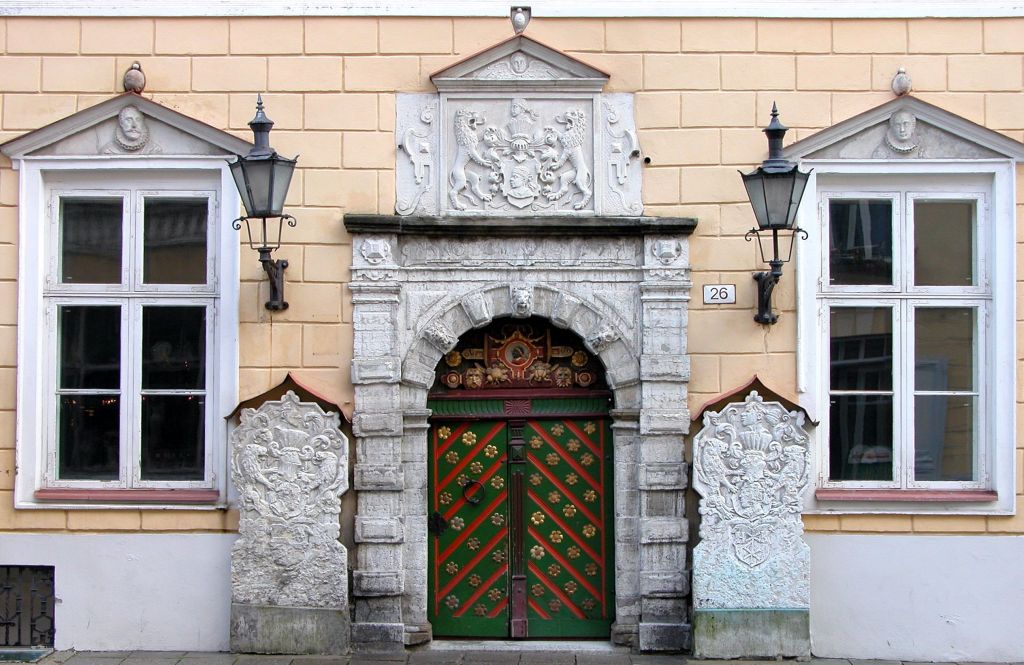
Here's an interesting structure, the Black Head House, 16th-century headquarters of an association of merchants and ship owners that lasted long enough for the last Tsar to be an honorary member. I wonder, were they the Black Heads to distinguish themselves from yellow-haired Swedes? 

Tallinn actually has two distinct historic districts: the Old Town, which was the mercantile center, and Toompea or Cathedral Hill (above), the traditional seat of government. The hilltop palace once used by Swedish and Russian governors now houses the Estonian Parliament. (Actually in the 1700s Tallinn had three distinct districts: Old Town, which was mostly German or Swedish speaking, Toompea where the foreign governor and his minions resided, and a large suburb where the Estonians who had migrated in from the countryside lived. If any of that suburb survives, I haven't found any pictures of it.)

After the Great Northern War, Estonia passed under Russian control. Peter the Great and subsequent modernizing Tsars liked Tallinn, regarding it as a useful window to the west, and patronized harbor improvements and so on. They built this palace for the imperial governor.


The 19th century brought industrialization, and Tallinn spread far beyond its old limits. Should you get tired of quaint old things you could always take a detour to the modern heart of the city just a kilometer away, which boasts several striking buildings in a Scandinavian modern style.

Some tourist sites advise you to visit in the winter, when the town is most beautiful (they also say this about St. Petersburg); as with most cities in northern Europe it hosts a grand Christmas Market all through December. On the other hand it is cold, snowy, and gets only 5 hours of daylight.

Estonia declared its independence from Russia in 1918, only to be conquered soon thereafter by the Soviets. Today the city has a Museum of Occupation covering the period from 1918 to 1991, with alternating exhibits on atrocities by Soviets and Nazis. Eastern Europe had a tough 20th century.


But so far the 21st is going well for Tallinn, and thousands of visitors have loved this city and sung its praises. I hope I get there some day.


Why People Hate the Media

 Tyler Cowen from 2016, recently called out as one of his best posts:

Haven’t you noticed this? I have a simple hypothesis. No matter what the media tells you their job is, the feature of media that actually draws viewer interest is how media stories either raise or lower particular individuals in status. That’s even true for this blog, though that is never my direct intention.

But now you can see why people get so teed off at the media. The status ranking of individuals implied by a particular media source is never the same as yours, and often not even close. You hold more of a grudge from the status slights than you get a positive and memorable charge from the status agreements.

In essence, (some) media is insulting your own personal status rankings all the time. You might even say the media is insulting you. Indeed that is why other people enjoy those media sources, because they take pleasure in your status, and the status of your allies, being lowered. It’s like they get to throw a media pie in your face.

In return you resent the media.

A good rule of thumb is that if you resent the media “lots,” you are probably making a number of other emotional mistakes in your political thought.

Saturday, May 15, 2021

Bad Poetry, Mathilde Blind, and the Purpose of Literary Scholarship

Mathilde Blind (1841-1896) was an English poet. I never heard of her until I read a little essay by Margaret Drabble in the TLS titled "Scholarship Girls." This begins with an interesting meditation on class, money, and scholarships in British higher education; it turns out that among other honors Drabble once won a scholarship endowed by Mathilde Blind. 

Blind (which rhymes with "twinned") was a child refugee from the tumultuous Europe of 1848, and her brother later tried to assassinate Bismarck. She led a life of feminist politics and so on, traveled to Egypt, seems like an interesting person. Drabble writes,

Her poetry, like all poetry by once famous and neglected women, is in the process of being rediscovered.

There is a recent scholarly biography by an American academic, James Diedrick. But

It has been reproached for taking a male point of view, and Diedrick has had to defend himself against allegations of suppressing her supposed sexual orientation: see his online essay, "Queering Mathilde Blind."

All of this interested me enough to look up Blind's poems; there are a lot online these days. You can peruse a wide selection here, should you be in the mood, but here is what I swear is a representative passage:

I am athirst, but not for wine;
The drink I long for is divine,
Poured only from your eyes in mine.

I hunger, but the bread I want,
Of which my blood and brain are scant,
Is your sweet speech, for which I pant.
Which leads me to ask why various academics would devote their attention to restoring the reputation of an awful poet. What does one say about this:

OH haste while roses bloom below,
Oh haste while pale and bright above
The sun and moon alternate glow,
To pluck the rose of love.

Yea, give the morning to the lark,
The nightingale its glimmering grove,
Give moonlight to the hungry dark,
But to man’s heart give love!

I suppose it depends on what you think literary scholarship is about. If you think it has something to do with proclaiming the greatest works of human imagination to the ages, Mathilde Blind hardly belongs.

But if what you are doing is a sort of social history, maybe the most mediocre of mediocrities is exactly what you should be reading. After all the Victorians wrote, published, and read tens of thousands of poems like these. Blind took on many of the commonplace themes of the day: love, motherhood, the fleeting nature of human life and happiness, the mystery beyond, etc. She could turn a wide variety of feelings into terrible verse, as in "Nuit":

The all upholding,
The all enfolding,
The all beholding,
Most secret Night;
From whose abysses,
With wordless blisses,
The Sun’s first kisses,
Called gods to light.
Maybe we learn something about the age by thinking on these words, the same way you could learn something about America from bad pop songs.

And if what you want is to read about people of ambiguous sexuality, who were rumored to be involved with both women and men, fine, go ahead. 

But is there something missing from this approach? Is literature something more than just what happened to be popular at some past time? Should we not care whether art is good or bad? Shouldn't literature professors be able to tell a good poem from a bad one, or is that a bit of outdated snobbery? 

Me, I can't imagine devoting so much attention to a bad poet, and the notion that one of Blind's poems recently appeared in an anthology of English poetry turns my stomach. True, equally bad poems by straight men have also appeared in anthologies, but that's hardly an excuse to reprint this:

OH, beloved, come and bring
All the flowery wealth of spring!
Though the leaf be in the sere,
Icy winter creeping near;
Though the trees like mourners all
Standing at a funeral,
Black against the pallid air
Toss their wild arms in despair,
With their bald heads sadly bowed
O’er dead summer in her shroud.
Yea, though golden days be o’er,
If you enter at my door,
Spring, dear spring, will come once more.
There will break upon the night.

Maxmilian Pirner


Czech artist Maxmilian Pirner (1853-1924) – he spelled his name without an i after the x, but in English you are just as likely to see Maximilian – was pretty obscure until recently, when images of his later work started circulating on the internet. Works like this one, The Birth of Hans Helling, fit perfectly into the apocalyptic gothic style that so many of us post-modernist types enjoy. What could be finer to contemplate that the launching of a hellish infant from the darkness onto the unsuspecting world?


Pirner started off as an ordinary 19th-century academic artist. He studied in prestigious academies, moved to Vienna, did lots of portraits

and romantic scenes

and designed some stained glass.

Already in this period he did have a certain interest in the macabre, as you see in The Sleepwalker (1878).

Then in the early 1890s something happened to him. What happened is much disputed. He claimed to have become a visionary mystic, and from then on said all his paintings were images that had come to him in visions. Others said he had become a fraud. This work, as I said, was not much admired or seen at the time; according to this web site, which seems authoritative because it's in academic German, he was rediscovered in the 1980s and his oeuvre was not fully published until the 1990s.

Hecate (1901)

Epilogue

An unfished work of the 1890s titled Frenzy, Hatred, Death.

His most famous work these days is probably this one, End of All Things.

You can buy this as a pillow (above) or even an End of All Things Yoga Mat, which, I don't know, does this seem very meditative to you? Is that the point our civilization has reached, the apocalyptic yoga mat?

Above, Homo Homini Lupus, 1904. Below, St. Wenceslas.