Wednesday, December 23, 2015

Knights vs. Snails

For reasons nobody can now fathom, the margins of fourteenth-century illuminated manuscripts are full of knights battling snails. This one is from a manuscript of Brunetto Latini’s Li Livres dou Tresor,  c. 1315-1325, now in the British Museum.


Medievalists have been wondering what this is about since at least 1850, when
the magnificently named bibliophile the Comte de Bastard theorised that a particular marginal image of a snail was intended to represent the Resurrection, since he discovered it in two manuscripts close to miniatures of the Raising of Lazarus
Alas, he failed to convince anyone else. (Two from the Gorleston Psalter, made in Suffolk, England c. 1310-1320.

The Queen Mary Psalter, c. 1310-1320.

In 1962 Lilian Randall published a detailed analysis titled ‘The Snail in Gothic Marginal Warfare’ (Speculum 37, no. 6, pp. 358-367). She considered the theory that the snails represented heretics, but rejected it partly because some of the knights are clearly losing. In the end she decided that snails just represented jovial monks' notions of heavily armored knights. (From the Macclesfield Psalter, made in East Anglia, c. 1330.)

Most of the examples I have found have been English, but this one is the Smithfield Decretals, said to have been made in southern France, most likely Toulouse, between 1300 and 1340.

And this is from a Bible made in Spain around 1320, now in Toulouse. I found this on Hunting for Snails, a blog devoted to snails in art. Really.

And one more, from a manuscript made in Picardy, France.

That's enough amusement for now. Go do something serious and important.

Not Many Teen Moms Left

Ponder the amazing decline of teenage parenthood in America; the birth rate for teenage girls is down by more than 50% just since 1990. This has something to do with the overall decline in the birth rate, but as the graph shows the decline in the overall rate is much, much less.

Incidentally, the source for this data is the Centers for Disease Control and Prevention. What does it mean that in America the birth rate is tracked by Centers for Disease Control?

HH 24

Hubble infrared photo of twin jets shot out of a newly forming star.

Trump as Revenge on the Elite

One of Rod Dreher's readers sent him this email:
Rod: “Trump is not my guy, and Trumpism not a credible answer.”

On an intellectual level, I agree. The visceral level is another matter. I am an atheist white Southerner who has always voted a straight Democratic ticket because I found the Republicans to be repulsive. But even I feel the appeal of Trumpism. I lost all hope for a better future when I completed an advanced degree and found that I had not improved my job prospects a bit. I am sick to death of hearing politicians bleat on about how wonderful America is, when it is demonstrably not working for millions and millions of middle and working class (and poor) citizens. Working class people are seeing their life expectancy decrease, welfare programs and Social Security are supposed to be cut, with us working until we’re 70 to make up the difference, but there’s always money to fight another stupid, counterproductive war. Practically every public and private institution has lost its legitimacy.

Trump appeals to the nihilism that the elites in this country have let us fall into. I tried to fight against it. I did what they said. I had no college degree, so I studied hard while working hard and got two of them. Instead of this making any kind of a positive difference for my family, I am right where I was before.

So while the logical part of my brain says that Trump is a self-aggrandizing charlatan, I find it hard to think through the abiding sense of anger and despondency that I have developed and most of my friends and family have developed. We are governed by people that we have come to hate, and at the moment, Trump looks like the only way to even have a shot at making them hurt like they’ve made us hurt. That is a tough proposition to turn down.

The Politics of Teaching Math

Remember New Math? Christopher Phillips thinks the debate was all about politics:
The new math was widely praised at first as a model bipartisan reform effort. It was developed in the 1950s as part of the “Cold War of the classrooms,” and the resulting textbooks were most widely disseminated in the 1960s, with liberals and academic elites promoting it as a central component of education for the modern world. The United States Chamber of Commerce and political conservatives also praised federal support of curriculum reforms like the new math, in part because these reforms were led by mathematicians, not so-called progressive educators.

By the 1970s, however, conservative critics claimed the reforms had replaced rigorous mathematics with useless abstractions, a curriculum of “frills,” in the words of Congressman John M. Ashbrook, Republican of Ohio. States quickly beat a retreat from new math in the mid-1970s and though the material never totally disappeared from the curriculum, by the end of the decade the label “new math” had become toxic to many publishers and districts.

Though critics of the new math often used reports of declining test scores to justify their stance, studies routinely showed mixed test score trends. What had really changed were attitudes toward elite knowledge, as well as levels of trust in federal initiatives that reached into traditionally local domains. That is, the politics had changed.

Whereas many conservatives in 1958 felt that the sensible thing to do was to put elite academic mathematicians in charge of the school curriculum, by 1978 the conservative thing to do was to restore the math curriculum to local control and emphasize tradition — to go “back to basics.”
I suspect Phillips is right about the politics, but I think that debates about teaching math are about more than right vs. left or elites vs. populists. Mathematicians find math beautiful and fascinating and it bothers them that most Americans hate it. They keep searching for ways to convey the power and fascination of math, to make it interesting, to create a world in which Barbie dolls don't say "Algebra is soooooo hard." Approaches like New Math and some of the recent Common Core math are supposed to show students that math isn't just the multiplication table and the quadratic formula, but something flexible and powerful, and that understanding math at a more fundamental level opens up a world of both practical uses and amazing discoveries. But most Americans, including most middle school math teachers, don't care enough to bother.

Most people just aren't interested in abstract thought, and they never will be.

Tuesday, December 22, 2015

The Sickle Burials of Early Modern Poland

Polish archaeologists have uncovered four 17th- and 18th-century burials with sickle blades around their necks. To keep them from rising? Or to protect them from demons? The gesture seems like a threat to the corpse -- putting a sharp blade to someone's throat is hardly a friendly act. But consider the burial above, a woman who also had a copper band on her head and a copper coin nearby. Both of these copper objects might be protective magic. So quite a mystery.

Pond Scum

Kathryn Schulz has a terrific essay in the New Yorker about what a misanthropic jerk Henry David Thoreau was, with the amazing title “Pond Scum.”
The real Thoreau was, in the fullest sense of the word, self-obsessed: narcissistic, fanatical about self-control, adamant that he required nothing beyond himself to understand and thrive in the world. From that inward fixation flowed a social and political vision that is deeply unsettling. It is true that Thoreau was an excellent naturalist and an eloquent and prescient voice for the preservation of wild places. But Walden is less a cornerstone work of environmental literature than the original cabin porn: a fantasy about rustic life divorced from the reality of living in the woods, and, especially, a fantasy about escaping the entanglements and responsibilities of living among other people.
I agree completely. If Thoreau managed on occasion to be right about things like slavery and the wilderness, this was mainly because of his indifference to his fellow humans and contempt for their pretensions.

As Schulz explains, when Thoreau settled in the cabin at Walden Pond he wanted to find out what was essential in life and what extraneous:
As it turns out, very little counted as life for Thoreau. Food, drink, friends, family, community, tradition, most work, most education, most conversation: all this he dismissed as outside the real business of living. Although Thoreau also found no place in life for organized religion, the criteria by which he drew such distinctions were, at base, religious. A dualist all the way down, he divided himself into soul and body, and never could accept the latter. “I love any other piece of nature, almost, better,” he confided to his journal. The physical realities of being human appalled him. “The wonder is how they, how you and I, can live this slimy, beastly life, eating and drinking,” he wrote in Walden. Only by denying such appetites could he feel that he was tending adequately to his soul.

Walden, in consequence, is not a paean to living simply; it is a paean to living purely, with all the moral judgment that the word implies. In its first chapter, “Economy,” Thoreau lays out a program of abstinence so thoroughgoing as to make the Dalai Lama look like a Kardashian. (That chapter must be one of the highest barriers to entry in the Western canon: dry, sententious, condescending, more than eighty pages long.) Thoreau, who never wed, regarded “sensuality” as a dangerous contaminant, by which we “stain and pollute one another.” He did not smoke and avoided eating meat. He shunned alcohol, although with scarcely more horror than he shunned every beverage except water: “Think of dashing the hopes of a morning with a cup of warm coffee, or of an evening with a dish of tea! Ah, how low I fall when I am tempted by them!” Such temptations, along with the dangerous intoxicant that is music, had, he felt, caused the fall of Greece and Rome.
I have always despised Thoreau and his book; in fact I think the only work in the American canon as overrated as Walden Pond is that of Thoreau's friend Emerson, which never made the slightest bit of sense to me. I have no interest in the pursuit of purity, of life as a process of paring down; I want to live a life of richness and connection. Thoreau's most famous line is “The mass of men lead lives of quiet desperation.” But this is wrong, and how would Thoreau have known anyway, since he refused to have anything to do with the mass of men?

Anyway, I loved Schulz's article, and it absolutely deserves the Sidney Award that David Brooks just bestowed on it.

Cold Fusion Rumblings

Cold fusion refuses to go away, and reports of positive results continue to trickle in. Most recently, impressive claims are being made for a device developed by Italian engineer Andrea Rossi:
While it is fair to say that the jury is still out, there has been a lot of good news in the past couple of years. There were two reports (in 2013 and 2014) on tests of Rossi’s device by teams of Swedish and Italian physicists whose scientific credentials are not in doubt, and who had access to one of his devices for extended periods (a month for the second test). Both reports claimed levels of excess heat far beyond anything explicable in chemical terms, in the testers’ view. (The second report also claimed isotopic shifts in the composition of the fuel.) Since then, there have been several reports of duplications by experimenters in Russia and China, guided by details in the 2014 report.

More recently, Rossi was granted a US patent for one of his devices, previously refused on the grounds that insufficient evidence had been provided that the technique worked as claimed. There are credible reports that a 1MW version of his device, producing many times the energy that it consumes, has been on trial in an industrial plant in North Carolina for months, with good results so far. And Rossi’s US backer and licensee, Tom Darden – who has a long track record of investment in pollution-reducing industries – has been increasingly willing to speak out in support of the LENR technology field. (Another investor, the UK-based Woodford Funds, reports that it conducted ‘a rigorous due-diligence process that has taken two and half years’.)

Finally, very recently, there’s a paper by two senior Swedish physicists, Rickard Lundin and Hans Lidgren, proposing a mechanism for Rossi’s results, inspired in part by the second of two test reports mentioned above. Lundin and Lidgren say that the ‘experimental results by Rossi and co-workers and their E-Cat reactor provide the best experimental verification’ of the process they propose.
Most physicists still don't take any of this seriously. But who knows?

Happy Solstice

Driving to work yesterday I was startled by a spectacular sunrise that burst forth in a heartbeat. One moment there was nothing but a dim gray glow, the next the sky was lit with bands of gold. I took this picture a few minutes later with my phone, back over my shoulder as I crossed the Patuxent River bridge. It made me thoughtful about the solstice and the light and power of a beauty to make an ordinary day into a celebration.

May you have many such moments in the year to come.

Monday, December 21, 2015

At the Rodin Show in Richmond

While I was in Richmond for Christmas with my natal family this weekend we went to the blockbuster Rodin show at the Virginia Museum of Fine Arts. I really liked it, as did my sister the art history professor. But I took two children, my eldest son and youngest daughter -- above, in front of a huge photograph of the Gates of Hell --  and my son hated it. He came out thinking Rodin was a complete fraud. C'est l'art.

The exhibit included lots and lots of plaster casts. Rodin made tons of these, at many different scales; this is a figure group designed for the Gates of Hell. What the exhibit really brings home is how experimental Rodin's approach was. He made dozens of models of every piece before he settled on a final form. Rodin was selected to prepare a statue for a monument to novelist Honoré de Balzac in 1891, and the show includes half a dozen different versions of the statue that Rodin experimented with before he settled on one. This final version was not actually installed until 1939, 22 years after Rodin was dead. Pretty much all of his work was like that.

My son contemplates The Thinker. This was also made in many different versions and scales and materials.

Sadly, many of the pieces are behind glass, I suppose because they are very fragile. But the glass did create some interesting effects in the dramatically lit rooms.

The final room, with many complete bronze works, mostly cast after Rodin was dead. I could have spent hours in here.

My children with three of the Burghers of Calais. I love this work and I very much enjoyed being able to see these three figures up close. For me, this was a great experience.

More on Rodin here, including much better pictures.

Sunday, December 20, 2015

Saturday, December 19, 2015

Alcohol and Agriculture

One of the great puzzles of human history is the rise of agriculture. So far as we can tell, peasants had lives no better than those of hunter gatherers, at least in the sorts of rich environments where agriculture began. And farming is hard work. So why did they do it?

Maybe for alcohol. Detailed work on Middle Eastern cultures shows that growing barley was as much about beer as bread. And now comes a new book on the history of corn in the Americans -- Maize for the Gods by Michael Blake -- arguing that corn or maize was grown first for alcohol and only later for food. From the October 2 TLS:
Maize, suggests Michael Blake, an archaeologist who specializes in agriculture, may have been one of the earliest sources of alcohol in the region. This, at least, is his solution to a puzzle revealed by the past half-century's ingenious research into plant domestication. . . .

The early history of maize, these scientists have shown, is quite different from that of Old World wheat and barley. Before farming, wheat and barley had grains that were worth harvesting. And because humans quickly mastered techniques for transforming raw grains into porridges, breads and beer with mortars, grindstones, pots and ovens, wheat and barley became dietary staples. By contrast, maize's wild ancestor, teosinte, a bushy grass that still grows in west central Mexico, has grains so tightly sheathed that they are impossible to turn into food. A mutant proto-maize appeared around 7000 BC, and, mile by mile, farmers spread it north and south. . . .

Why did they do this? Not until round 3,000 to 4,000 years ago did societies have the complete set of tools -- cooking pots, colanders, flat grindstones and griddles -- to cook maize in an alkaline solution, the necessary preliminary to preparing nutritious pounded grains or flexible dough. If maize was not a staple food, what then was its appeal? Undoubtedly, a treat of fresh ears at harvest time was enjoyed, but that does not explain its spread. Blake's suggestion is that it was not the grains, but the sugary sap of the stalks, which people were after. This could be turned into alcohol, an easier process than turning grains into beer. The brew he and his friends concocted from chopped and pressed maize stalks was, if not delicious, refreshing and inebriating.
I find this persuasive, at least as a partial explanation. All the evidence shows that people will work harder for drugs that change what it feels like to be alive than we will for anything else. Mild drugs like beer, wine and coffee are especially prized, and have been the most widely traded substances in many economic systems. I would like to see some good evidence that corn really was used in this way, but in the mean time I think Blake's theory is better than any other explanation I have seen for the early spread of maize.

Friday, December 18, 2015

At What Age Can Kids Go Out Alone?

Via Kevin Drum, a fascinating table from Pew's latest survey of American parents. If this is right, American parents really don't want their kids to spend much time alone. Ten years old to spend time in the front yard alone? Fourteen to spend time in a park? Argh.

The Cult of Leadership

Richard Cohen gives voice to one of the most irritating commonplace ideas about politics and history:
Without leadership, every problem is insurmountable. With it, no problem is unsolvable.
Oh, sure, if we just had the right leadership we would know what to do about work-life balance for parents, inequality, autism, malaria, declining biodiversity, terrorism, unemployment, drug addiction, climate change, cancer, and the Israel/Palestine mess (the actual subject of the essay). We would have fusion power, free internet without ads, affordable non-polluting cars with unlimited range, scheduled flights to Mars, and better pop music. And columnists who make sense.

Dawn Walden, Cedar Baskets


Dawn Walden is an Ojibway artist from the Upper Peninsula of Michigan. Above, one of a series titled Restless, 2015.

Another Restless piece. Walden says, "The maker becomes infused with the materials, and then the materials make the basket."


These are titled Random Order, which sounds more Brooklyn than Ojibway. She certainly can do amazing things with tree bark and roots.

Cancer and Cellular Respiration

When they are healthy, your cells -- and those of all other animals and plants -- power themselves using cellular respiration, which requires oxygen. But cancer cells, like many bacteria, use a completely different process called fermentation. Fermentation is much less efficient at extracting energy from fuel like sugar molecules; so why do cancer cells do it?

Back in 2009, a team of Dutch biologists suggested a possible explanation. Respiration is more efficient, but it requires a more elaborate set of enzymes and other factors to make it work. So a cell using fermentation can be built more simply and cheaply. Therefore, cells using fermentation can make copies of themselves more easily and thus divide more rapidly. So if cells "want" to divide very quickly, switching to fermentation might make sense.

Now some experimental biologists have confirmed that this is the case:
although oxygen-based metabolism is a more efficient means of energy production, the costs required to produce the molecular machinery that drives respiration are twice those needed to ferment the sugar glucose.
This provides more evidence for the theory that cancer may be at its heart a crisis of cellular respiration and therefore mainly a disease of mitochondria:
Thomas Seyfried, a biologist at Boston College who was not part of this study, feels that cancer is a metabolic disorder, citing the large body of evidence implicating mitochondrial dysfunction in cancer. Mitochondria—or the “powerhouses” of our cells—are where cellular energy production takes place. “There is now substantial evidence from a broad range of disciplines showing some degree of defect in the number, structure or function of mitochondria in all types of tumor cells. These mitochondrial defects cause the enhanced glucose uptake and the fermentation seen in tumor cells,” Seyfried explains.
There is, says Seyfried,
ample evidence to support his claim, including showing that a cell’s tumor potential is suppressed if it is transplanted with normal mitochondria; and conversely that transferring mitochondria from tumor cells into the cytoplasm of normal cells increases the chances that those once normal cells will become cancerous. He also points out the large body of work connecting the etiological dots: Many of the mutated genes associated with cancer seem to exert their effects by impairing cellular respiration. It is also possible, Seyfried strongly feels, that transitioning from respiration to fermentation produces free radicals that cause genetic mutations associated with cancer.
All very interesting, although who knows where it will lead.

Congress Funds the Europa Mission

Among the details that has leaked out from the new budget deal is that NASA's funding has been increased by $1 billion, including $175 million for the mission to study Europa's subsurface ocean. (See here and here.)

Thursday, December 17, 2015

The Wonders of Technology

Business Insider:
Netflix has built socks that read your body to understand when you fall asleep, and then automatically pause your Netflix show.

Names for Stars and Exoplanets

The International Astronomical Union has announced the results of its internet poll on the names for new exoplanets and the stars they circle. The bodies to be named were parceled out among countries that wanted to participate. One of these was Thailand, where the people named a star Chalawan and its two confirmed planets Taphao Thong and Taphao Kaew. I know you're wondering what that could possibly mean, so I looked it up. The star in question is in Ursa Major, which the Thais call the Crocodile, and Chalawan is a crocodile from a famous Thai folk tale. Taphao Thong and Taphao Kaew were two sisters taken captive by Chalawan. Who was of course slain in the end by a hero who then married both sisters.

On the other hand maybe those words actually mean something totally different and Thais are just trolling us. Who would know?

The star formerly known as 42 Draconis has become Fafnir, thanks to Americans, which I think  is cool, and its planet is Orbitar, which sounds like something from a cheesy Star Trek episode. They couldn't have picked something else from the Siegfried cycle? Hagen? Brunhilde?

Spaniards renamed mu Arae "Cervantes," and its planets Quijote, Dulcinea, Rocinante, and Sancho.

The Italians were assigned the task of coming up with better names than PSR 1257+12 (the star) and  PSR 1257+12b, PSR 1257+12c, and PSR 1257+12d. They voted for Lich, Draugr, Poltergeist, and Phobetor. Planet Lich sounds like the title of an old paperback sci-fi novel like the ones I bought for 25 cents out of a bin at the used book store back in Rolla.

The Mexicans named a star Tonatiuh, for the Aztec sun god, and its planet Meztli, for the moon goddess.

If you don't like these names, relax, there are still about 2,000 more exoplanets to name.

Eric Richards, The Highland Clearances

I have long known about the Highland Clearances as something bad that happened in the eighteenth and nineteenth centuries -- bad, that is, except that they drove many Highlanders out of their impoverished Scottish homes to new lives in North America, Australia, and Glasgow. But I have never had a very firm grasp on what actually happened or when or why, and a few weeks ago I decided I wanted to know more. After a bit of internet review hopping I settled on Eric Richards' 2002 book as a good place to start, since people praised his evenhandedness and great knowledge of the subject.

Evenhandedness is important here because the clearances have inspired a much extreme rhetoric. People regularly speak of the clearances as one of the great crimes of British history, as a cultural genocide, and even as a genocide plain and simple. As Richards puts it,
The Highland Clearances is one of the sorest, most painful, themes in modern Scottish history. The events have now receded into the distant past, beyond the direct memory of any living person or even their parents. But the passionate indignation lives on, swollen rather than weakened by the passage of time. A rage against past iniquities has been maintained, fed by popular historians and every variety of media construction. A line of denunciation flows from the oral tradition of the early nineteenth century -- the samizdat of an oppressed and angry people -- to the electronic graffiti of the present day in the webs of retrospective indignation. The latter orchestrates the uninhibited passions and prejudices of a worldwide network of Highland sympathisers, many desperate to right past wrongs, some wanting the reverse the steps of their immigrant forbears and regain a foothold in their former clanlands. They see the Highlands as a potential escape from the anomie of modern society, a beckoning prospect of pre-industrial renewal on ancestral lands. And, somehow, the story of the High Clearances also provides fuel to the cause of Scottish nationalism. (3)
The last item is weird because while the people being cleared from the land were Scottish, so were most of the people doing the clearing -- but then anyone who knows working class Scots knows that to them wealthy Scots are honorary Englishmen.

So what were the clearances? In the classic type, a Highland landowner evicted all of his tenants from a large block of land so that the whole district could be turned into a sheep farm. Some of the clearances were very large; the Duchess of Sutherland, who owned most of a county in Scotland's far north, evicted more than 10,000 people from their homes in just two years. Clearances were done with varying degrees of concern for the evicted people. Some landowners worked hard to find new homes for their tenants, either on other parts of their own estates or elsewhere; others offered to pay for the tenants to emigrate. Some did nothing. Sometimes clearances happened suddenly, whole communities uprooted with less than a year's notice; in other places they happened gradually over many years. Most of the clearances took place between 1790 and 1855, although the first was recorded in the 1680s. The clearances were undoubtedly traumatic for many of the people involved. These were peasants, people rooted in their own soil, with little knowledge of the outside world. They were desperately poor, and famine remained a regular threat down into the 1850s, but this was the life they knew and most of them wished to keep it. When people had been evicted from their homes, the homes were always destroyed to keep them from coming back. At a minimum, the roofs were knocked in, and often the buildings were burned. The image of the clearances came to be a village of burned-out houses in an empty landscape now given over to sheep, their former inhabitants driven off to who knows where.

Over the course of this period, tens of thousands of Highlanders were driven from their homes by their landlords, who were sometimes also their own clan chiefs. Some of the evicted were over 80 years old, or sick, or pregnant. Many had never known any other home. Some saw the eviction notices but refused to believe them until the land agents and their men showed up to demolish their houses, tossing them and their meager furniture onto the high road. Pathetic encampments were set up in church yards, often the only land for miles around not under the control of the almighty landlords, and there the refugees huddled in tents until they drifted away to seek new homes.

The clearances were a great tragedy, but from a more removed perspective it is hard to see them as evil. This is the point that Richards keeps coming back to. Yes, the scenes of old women and men weeping as they are driven from the only homes they had known are awful. But the clearances did not happen because the landowners were wicked. They happened because peasant societies are always destroyed by modernization; in fact modernization pretty much means the destruction of peasant society and its replacement by something very different. Of all the job categories rendered obsolete by modernity, peasant was the most common and the most culturally significant. The great folk cultures of Eurasia were peasant cultures, created and sustained by centuries of peasant life. Their loss was a great one -- but on the other hand none of the gains of modernity, from dentistry to gay rights, would have been possible in a peasant society. Nor were peasants the only victims of modernization; from 1837 onward the people evicted from their homes by Highland landowners were far outnumbered by the tens of thousands of Britons uprooted to make way for new railroads. This is not to say that the transformation of the Highlands might not have happened more gradually and with less violence, because it certainly could have. But the anguish of American farmers driven off their land by falling wheat prices in our own lifetimes should remind us that these changes are always painful, no matter how they happen.

One interesting fact about the clearances is that while they involved driving people off the land, and we associate them with vast, empty districts, the population of the Highlands was rising rapidly throughout this period. In some Highland counties the population tripled between 1790 and 1860. Although certain districts had indeed been emptied to make way for sheep, widespread population decline only set in after the clearances had ended. In fact some clearances were a response to a burgeoning population. In some districts population growth led to the subdivision of farms into pieces so small that they could barely feed their residents, who as a consequence could no longer pay their rent. These overcrowded villages of hungry people were a sight that cultivated Victorians could not bear, and many very liberal people sought desperately for some solution to the "Highland problem." The life that the Highlanders defended so fiercely struck outsiders as a desperate plight that needed to be redressed. Many of the clearance schemes were intended, in part, to help the Highlanders find some other kind of life -- fishing, collecting and burning kelp, tending sheep -- that would make them more secure than farming their tiny plots. The good intentions of reformers were part of the story.

When we think about terrible things done to the poor, we tend to assume that the rich must have been profiting. But for the clearances this is not really so. As the old Highland economy creaked into the industrial era, most landlords were not doing any better than their tenants. Hundreds went bankrupt, including some of the greatest lords. Switching to sheep farming was for many a matter of survival, not enrichment; for some it was the only alternative to debtors' prison. The last Lord Macdonnell of Glengarry emigrated to Australia in a desperate attempt to rebuild his family's fortune, but he failed at ranching there and came home in 1842 to die at his family seat. The following year the tenants were cleared and the estate was sold to a Glasgow ironmonger. In 1850 the Macleod of Macleod, the greatest clan chief on Skye, handed all his ancestral lands to his creditors and went to London to get a job. One close look at the dismal economics comes from a clearance carried out at Straithard on Skye in 1851. The 620 people of the community paid only £150 a year in rent, on an estate for which the owner paid £275 a year in taxes. By 1851, after years of potato failures, the tenants were £450 in arrears. Their landlord offered to forgive their back rent and subsidize their emigration with a grant of £1200. Think about that; the landlord's situation was so bad he was willing to pay his tenants 8 years' rent to go away (200-203).

The only reason the landlord class survived at all in the nineteenth century was a continual influx of outside money. Many Scots went overseas during the great years of empire, and some of them brought back fortunes that they invested in Highland estates. James Matheson of the Canton trading firm Jardine and Matheson was perhaps the most famous, but there were many others. Wealthy foreigners like Andrew Carnegie also bought Highland estates; even the queen got involved, building her own Highland castle. To summer in Scotland was the thing to do, and for the rich that meant summering on their own manors. Some of these new proprietors invested heavily in their Highland estates. The Duchess of Sutherland's great clearances were financed by her marriage into one of England's wealthiest families; she invested more than £250,000 of her husband's money in re-arranging her estates, to achieve in increase in rent from £10,000 to £22,000 a year. These huge inflows of capital did much to sustain the Highland economy, providing jobs in construction and caring for all of the new manors and so on, but on the other hand they accelerated the decline of traditional ways.

Besides these long-term investments by new landlords, the rest of Britain heavily subsidized the Highlands during the major famines of 1836-1837 and 1846-1851. Many Highlanders were as dependent on potatoes as the Irish, and the potato crops failed just as absolutely in Scotland as in Ireland. Yet in Scotland, no one starved. Literally; the government was not able to document a single case of starvation in Scotland in 1846-1851. No one starved because the rest of Britain, mainly Highland landowners and the commercial classes of Edinburgh and Glasgow, subscribed hundreds of thousands of pounds for famine relief. This part of the story seems to be missing from the angry narratives of Highlanders driven from their homes by landlords and their agents. One of the reasons that the traditional economy of the Highlands had to disappear was that the rest of the sensitized, Victorian nation, kept informed by a sensationalizing press, was not willing to let Highlanders starve, even if that meant destroying their way of life to preserve their bodies.

As to what happened to the people driven from the Highlands, it is hard to generalize. Many emigrated, but more went south to Glasgow or even England; at least at first a majority just went to some other part of rural Scotland. Some never got over the loss of their homes, but others prospered in new settings. One group of families evicted from North Uist in 1849 went to Australia much against their will, but a few years later they sent a bank draft to their former landlord repaying him for all the expenses of their emigration, along with a bit extra that they asked him to spend on a gold ring for his wife, in token of their thanks for starting them on a new life (235). It is true that they were not typical, but the most embittered and impoverished were not typical, either. Richards presents cases of whole glens and islands that were depopulated without any strife or evictions, the entire population opting to emigrate rather than hang on. Sometimes there was conflict among the tenants over whether to take a landlord's offer of subsidized emigration. If the landlord's aim was to clear his land for a sheep farm, it was no good to remove only some of the tenants; it was all or none. So if a majority opted to take the offer, the minority was not able to stay. The scenes of people forced onto ships bound for Canada mostly come from these cases, the forcing being done as much by the other tenants as by the landlord.

Many people cleared from Highland farms were settled in coastal villages like this one

There was an interesting coda to the clearances. In the early 1880s, more than twenty years after the last significant clearance, the poor people of the Highlands began to demand their land back. There had been scattered resistance to clearances over the years, most famously a 1792 incident in which the people of several villages in Inverness and Ross herded together all the sheep recently brought by big sheep farmers into their districts and drove them back across the Great Glen. But by and large the Highlanders submitted to their evictions with more grumbling than violence. In the 1880s that changed. The Crofter Movement sprang into being, and people who had submitted to power for generations began to organize and resist. They even elected five members to Parliament from the Crofters' Party. Of course this new activism was driven partly by modernization, in particular mandatory schooling, the spread of literacy and newspapers, and the acceptance by Highlanders of the Victorian habit of organizing to demand change. The government responded by sending the Napier commission, as it is now called, to conduct a thorough investigation of conditions for poor Highlanders. Their multi-volume report is a fabulous document on social and economic conditions of the time. The end result was the Crofters' Holdings Act of 1886, which made it pretty much impossible for landowners to evict farming tenants thereafter, so long as the tenants were up to date on their rent. Of course, this happened just as the population of the Highlands was beginning its rapid decline, and the act did nothing to reverse the decline, but at least the remaining crofters could feel secure in their homes. For as long as they wanted them, which in many cases was not very long.

That people fled the Highlands in droves after their right to stay there had finally been established says much to me about the underlying historical forces. The process was cruel, sometimes much more cruel than it needed to be. Until the 1850s the law was uniformly on the side of the proprietors, who could count on the help of soldiers if necessary; London regarded any trouble among the Highland peasantry as a possible Jacobite resurgence and responded accordingly. The wonderful culture of the Highlands really was hastened into a sharp decline. This decline was celebrated by some Englishmen and especially lowland Scots, who found the Highlanders a national embarrassment.

For the evicted, clearance was awful. But look at places where this did not happen, such as large districts of Ireland. The people left anyway, the language has nearly disappeared, the culture is fading, the landscape is dotted with abandoned houses and villages. The notion that any political change could have or will change the economic imperatives of modernity strikes me as bizarrely naive. If we care about great inequalities of wealth and power, about the dignity of poor people, about the overturning of lives by distant economic forces, then we should stop obsessing about long past injustices and figure out how to make things better for poor people now.

The Scotsman's summary article on the clearances is short but much better than wikipedia's, which bears the traces of clashing interpretations from "the clearances were genocide" and "lets be reasonable" factions.

My historian friends may be interested to hear that Parliament passed the Crofters' Acts partly because they were persuaded to a new view of Scottish history. The historians, led by Karl Marx, argued that the absolute authority wielded by Highland landlords in the 18th and 19th centuries was a historical mistake. In medieval Scotland, they argued, all the members of the clan had some rights to the land, which belonged to the whole community. As the clan structure declined and the Highlands were legally and economically integrated into the rest of Britain, it was decided that the clan chief was the owner of the land. But this was, the historians said, an inappropriate, foreign notion. Gladstone in particular laid much stress on this argument. So Parliament acted to reverse the changes of the 18th century and restore what they believed was the actual tradition of the Highlands.

Wednesday, December 16, 2015

Antidepressants, Pregnancy, and Autism

A possible blockbuster article was published today in JAMA Pediatrics:
Women in a new study who took antidepressants during their second and third trimesters of pregnancy showed an 87 percent increased risk of having a child with an autism spectrum disorder, compared with women who did not take medications for depression while expecting.

The researchers also found that mothers who used a certain class of antidepressants, known as selective serotonin reuptake inhibitors (SSRIs), had more than double the risk of having a child with autism spectrum disorder (ASD).
If this turns out to be true, it might explain a lot. But of course it is only one study, and since autism is not common, the numbers are not really very big:
In the new study, the researchers analyzed data collected from all 145,500 pregnancies that occurred in the Canadian province of Quebec over the 10-year period between January 1998 and December 2009, in which mothers had a full-term pregnancy and gave birth to only one baby. The researchers followed up with the children until age 10; there were 1,054 children who were diagnosed with ASD. . . .

The analysis found that about 4,700 infants, or 3.2 percent of babies, were exposed to antidepressants at some point during their mothers’ pregnancies. Among these babies, 46 developed autism.
So while this is an important finding, and follows up on other hints in this direction, it is not really proof of a causal link. For one thing the evidence is quite strong that women with serious depression are more likely to have autistic children. The size of this effect is disputed; one study showed a 20% increase in autism among the children of women who had ever been treated for depression. If, as some doctors think, the risk rises with more severe depression, and the most severely depressed women are the ones most likely to stay on an SSRI while pregnant, that might explain a lot of the finding. Stay tuned.

When Lisa was pregnant we were told at every turn to avoid antidepressants and many other drugs because there simply wasn't any evidence on whether they were safe or not. Nonetheless, studies have found that many pregnant women do take antidepressants, with different studies returning numbers from 3 to 13% of American mothers. (In the Canadian sample the number is 3.2%.)

As my readers know I am extremely skeptical about the findings of epidemiological studies like this one. On the other hand, something about 21st century life really seems to be making autism more common, and for me the evidence is too iffy for the risk to be worth it.

Trump Tells the Truth

In a debate dominated by paranoia and incoherent rage, Trump sailed through easily. After all, who can beat him at xenophobia? So long as the conversation stays on fear of refugees and the need to be tough, he wins without lifting a finger. Not only that, but he really does tell truths that other Republicans won't go near:
What do we have now? We have spent $3 trillion and probably much more. Thousands and thousands of lives, we have nothing. Wounded warriors all over the place, who I love, we have nothing for it. . . .

We have spent $4 trillion trying to topple various people that frankly if they were there and if we could have spent that $4 trillion in the United States to fix our roads, our bridges and all of the other problems, our airports and all the other problems we have we would have been a lot better off I can tell you that right now. We have done a tremendous disservice not only to the Middle East but to humanity, the people that have been killed, the people that have been wiped away and for what? It's not like we had victory. It's a mess. The Middle East is totally destabilized, a total and complete mess. I wish we had the $4 trillion or $5 trillion.
The escalation from $3 trillion, a number that could be defended with enough compound accounting, to the completely imaginary $5 trillion is typical Trump. But who else is telling the truth about how we got to this place? Certainly none of the other Republicans. The backers of Rubio, Christie and Bush seem to think that because their guys have lots of former assistant secretaries among their advisers and have been to lots of conferences with establishment military gurus, the turn to security should help them. But the voters don't see it, and Trump has put his finger on their sore spot: their crowd really did get us into this mess.

If toughness is what we need, Trump has that in spades. If what we need is a new approach, as everybody in the debate says, then only Trump has anything to offer. And if what we need is something very different from Trump's blustering style, something like experience and subtlety, then none of them can compete with Hillary and everybody knows it.

This is Trump's race to lose.

The New America

Maryland governor Larry Hogan married for the first time in his 40s, to a Korean woman with three daughters, now grown. As he recently said,
We’re the first not-white family to ever live in the governor’s mansion. My son-in-law is Puerto Rican. I have a beautiful little granddaughter who is half Korean and half Latina. I’m the only white guy in the house.
It is people like the governor's half Korean, half Puerto Rican granddaughter who will define much of America's future: how they choose to see themselves, and how others choose to see them.

Auguste Clésinger

Auguste Clésinger (1814-1883) was a French sculptor, the son of another sculptor. He catapulted himself to fame in 1847 by scandalizing the Salon with the work above, Woman Slain by a Serpent.


This was based on a life cast of Apollonine Sabatier, a famous beauty who was novelist Charles Baudelaire's mistress.

Clésinger also created this bust of Sabatier.


Woman slain by a serpent was pretty much the high point of Clésinger's career; certainly you see more pictures of it online than all the rest of his work put together.

The one other really famous work Clésinger completed was Frederic Chopin's tomb.

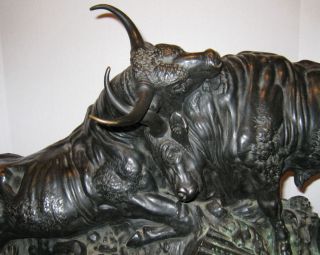
One reason you don't see much of Clésinger's other work is that a lot of it was a genre we might call animal combat art, which was big in the nineteenth century. European museums are full of bulls battling bulls, bulls battling lions, dogs bringing down stags, and so on. But we sensitive moderns don't care much for this stuff.


But based on what I have found he seems to have a fair amount of other nice pieces. But nothing else with the raw sensuous impact of his masterpiece.

Tuesday, December 15, 2015

Today's Hypothetical

If your only choices for President were Donald Trump, Ben Carson, and Ted Cruz, who would you vote for?

The Georgetown Waterfront in 1865

I just discovered this wonderful image in the online collection of the Library of Congress. It's a glass plate photograph taken in 1865 by William Morris Smith. The brick buildings on the hill are Georgetown University. You can download a huge file of the image here, should you really be curious. Details below.