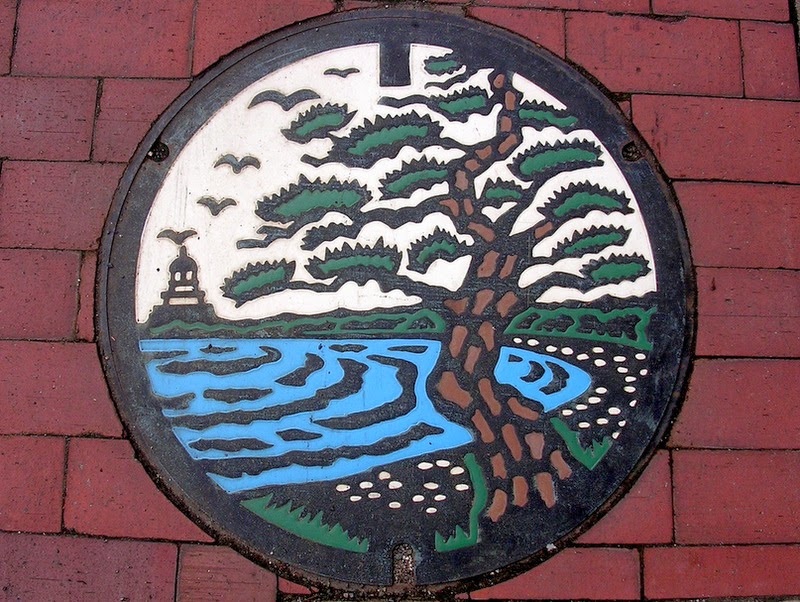
Singaporean photographer Ernest Goh is fascinated by Malaysia's chicken beauty pageants. More at his web site.
Thursday, March 27, 2014
Wednesday, March 26, 2014
What Writers Care About
Writers don't care what they eat, they only care what you think of them.
--Louise Fitzhugh, Harriet the Spy
Anarchism for Children
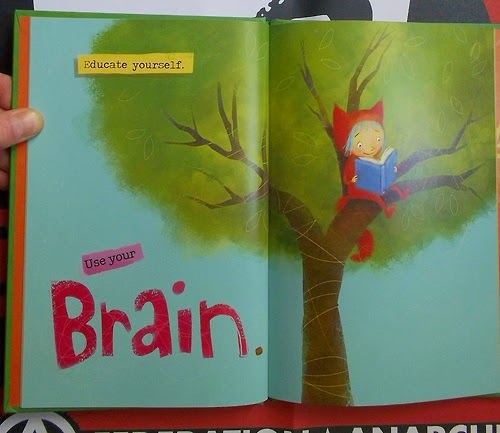
Just in case you weren't having enough problems with discipline in your house, you can teach your children about anarchism!
Somehow my sons picked this one up without anybody teaching it to them.
Here's one I can wholeheartedly endorse.
For six year olds, shouldn't this one come with some caveats?
To this one I say, Why?
Somehow my sons picked this one up without anybody teaching it to them.
Here's one I can wholeheartedly endorse.
For six year olds, shouldn't this one come with some caveats?
To this one I say, Why?
Geophysical Sensing in Patterson Park
My Searching for the War of 1812 in Patterson Park project is finally under way in Baltimore. The first part of the fieldwork is geophysical sensing, using magnetometry and ground-penetrating radar to search for traces of the 1814 earthworks, thrown up during the British attack on the city. I am hoping to be in the Baltimore Sun tomorrow; we had a reporter and photographer on site today.
You can see the remains of the earthworks in this photograph; the Pagoda was built within one of the bastions. As Johns Hopkins of Baltimore Heritage (our client) explained to the Sun yesterday, for at least a hundred years this spot was maintained as a memorial to the battle and the defense of the city. The cannons were set up for the centennial in 1914. But since then the association of the park with the battle has been broken as waves of immigrants have passed through the neighborhood -- Italians, Hispanics, gentrifying whites -- and people in the neighborhood no longer think of Patterson Park as having anything to do with the war or the Star Spangled Banner. One of the main goals of this project is to make people in the city and the neighborhood aware of the connection again.
The technical part of our job is to find the remains of the earthworks, map them, and dig out sections to find out what is in them. We are starting with the visible earthworks around the Pagoda, hoping that these are actually the remains of the originals and not later reconstructions. This morning we were using ground-penetrating radar in an attempt to map cross-sections of the buried earthworks. That's our geophysical expert, Dr. Tim Horsley, with his GPR unit above.
Yesterday in the snow we were trying magnetometry, a different technique. Sadly, where there isn't metal above ground there is metal below ground, so it was hard to find the weak magnetic signature of the 1814 trench amidst the strong signatures of cannons and electrical lines. We may have better luck farther away from the Pagoda.
Dr. Tim with his magnetometer.
The digging part of the project starts on April 15 and runs for four weeks. We will be working Tuesday through Saturday and we welcome volunteers and visitors; more information for volunteers at this page, set up by Baltimore Heritage.
You can see the remains of the earthworks in this photograph; the Pagoda was built within one of the bastions. As Johns Hopkins of Baltimore Heritage (our client) explained to the Sun yesterday, for at least a hundred years this spot was maintained as a memorial to the battle and the defense of the city. The cannons were set up for the centennial in 1914. But since then the association of the park with the battle has been broken as waves of immigrants have passed through the neighborhood -- Italians, Hispanics, gentrifying whites -- and people in the neighborhood no longer think of Patterson Park as having anything to do with the war or the Star Spangled Banner. One of the main goals of this project is to make people in the city and the neighborhood aware of the connection again.
The technical part of our job is to find the remains of the earthworks, map them, and dig out sections to find out what is in them. We are starting with the visible earthworks around the Pagoda, hoping that these are actually the remains of the originals and not later reconstructions. This morning we were using ground-penetrating radar in an attempt to map cross-sections of the buried earthworks. That's our geophysical expert, Dr. Tim Horsley, with his GPR unit above.
Yesterday in the snow we were trying magnetometry, a different technique. Sadly, where there isn't metal above ground there is metal below ground, so it was hard to find the weak magnetic signature of the 1814 trench amidst the strong signatures of cannons and electrical lines. We may have better luck farther away from the Pagoda.
Dr. Tim with his magnetometer.
The digging part of the project starts on April 15 and runs for four weeks. We will be working Tuesday through Saturday and we welcome volunteers and visitors; more information for volunteers at this page, set up by Baltimore Heritage.
The Open Office
The Atlantic has a little feature on the "research" that shows the downside to the open office plans that are proliferating across corporate America:
A 2002 longitudinal study of Canadian oil-and-gas-company employees who moved from a traditional office to an open one found that on every aspect measured, from feelings about the work environment to co-worker relationships to self-reported performance, employees were significantly less satisfied in the open office. One explanation for why this might be is that open offices prioritize communication and collaboration but sacrifice privacy. In 1980, a group of psychology researchers published a study suggesting that this sacrifice might have unintended consequences. They found that “architectural privacy” (the ability to close one’s door, say) went hand in hand with a sense of “psychological privacy” (feeling “control over access to oneself or one’s group”). And a healthy dose of psychological privacy correlated with greater job satisfaction and performance.It seems clear that people prefer private offices -- I know I do. But that doesn't mean corporations will rush back to putting up walls. For one thing, personal offices take up a lot more space, which in a place like Washington or New York costs a lot of money. I also wonder if one reason people prefer their own offices is so they can get away with doing more goofing off on company time. Not that there is necessarily anything wrong with a little goofing off, but I have a feeling the crowded, zero-privacy open office is going to be around for a while.
With a lack of privacy comes noise—the talking, typing, and even chewing of one’s co-workers. A 1998 study found that background noise, whether or not it included speech, impaired both memory and the ability to do mental arithmetic, while another study found that even music hindered performance.
An Old Game: Two Sides of the Road
As a child I was familiar with a game played by two people on long car trips, involving points for things you saw on your own side. One version was the "animal game," which assigned points to birds, dogs, cats, cows, horses, and so on, with the proviso that if you passed a graveyard on your side you lost all your points. So I was much amused, to read in an 1811 Dictionary of the Vulgar Tongue, this description of a game:
TRAVELLING PIQUET. A mode of amusing themselves, practised by two persons riding in a carriage, each reckoning towards his game the persons or animals that pass by on the side next them, according to the following estimation:Do such things still survive, or have they been entirely replaced by hand-held games and portable video players?
A parson riding a grey horse, without furniture; game.
An old woman under a hedge; ditto.
A cat looking out of a window; 60.
A man, woman, and child, in a buggy; 40.
A man with a woman behind him; 30.
A flock of sheep; 20.
A flock of geese; 10.
A post chaise; 5.
A horseman; 2.
A man or woman walking; 1.
Tuesday, March 25, 2014
"Levels of Inequality Never Before Seen"
French economist Thomas Piketty's new book is already the talk of the town, and it hasn't even been published in English yet. Piketty is an expert on inequality in capitalist systems, which he has been studying for twenty years. John Cassidy discusses Piketty's work at The New Yorker:
Piketty believes that the rise in inequality can’t be understood independently of politics. . . . There are circumstances, he concedes, in which incomes can converge and the living standards of the masses can increase steadily—as happened in the so-called Golden Age, from 1945 to 1973. But Piketty argues that this state of affairs, which many of us regard as normal, may well have been a historical exception. The “forces of divergence can at any point regain the upper hand, as seems to be happening now, at the beginning of the twenty-first century,” he writes. And, if current trends continue, “the consequences for the long-term dynamics of the wealth distribution are potentially terrifying.”Pilkenny rejects the notion that this is caused by the superstar effect, that is, huge rewards flowing to star entertainers because of enormous, unified markets:
In the nineteen-fifties, the average American chief executive was paid about twenty times as much as the typical employee of his firm. These days, at Fortune 500 companies, the pay ratio between the corner office and the shop floor is more than two hundred to one, and many C.E.O.s do even better. . . .
Eventually, Piketty says, we could see the reëmergence of a world familiar to nineteenth-century Europeans; he cites the novels of Austen and Balzac. In this “patrimonial society,” a small group of wealthy rentiers lives lavishly on the fruits of its inherited wealth, and the rest struggle to keep up. For the United States, in particular, this would be a cruel and ironic fate. “The egalitarian pioneer ideal has faded into oblivion,” Piketty writes, “and the New World may be on the verge of becoming the Old Europe of the twenty-first century’s globalized economy.”
What are the “forces of divergence” that produce enormous riches for some and leave the majority scrabbling to make a decent living? Piketty is clear that there are different factors behind stagnation in the middle and riches at the top. But, during periods of modest economic growth, such as the one that many advanced economies have experienced in recent decades, income tends to shift from labor to capital. Because of enmeshed economic, social, and political pressures, Piketty fears “levels of inequality never before seen.”
The main factor, he insists, is that major companies are giving their top executives outlandish pay packages. His research shows that “supermanagers,” rather than “superstars,” account for up to seventy per cent of the top 0.1 per cent of the income distribution. (In 2010, you needed to earn at least $1.5 million to qualify for this élite group.) Rising income inequality is largely a corporate phenomenon.What to do about it? Pikenny proposes much higher taxes:
Given that inequality is a worldwide phenomenon, Piketty aptly has a worldwide solution for it: a global tax on wealth combined with higher rates of tax on the largest incomes. How much higher? Referring to work that he has done with Saez and Stefanie Stantcheva, of M.I.T., Piketty reports, “According to our estimates, the optimal top tax rate in the developed countries is probably above eighty per cent.” Such a rate applied to incomes greater than five hundred thousand or a million dollars a year “not only would not reduce the growth of the US economy but would in fact distribute the fruits of growth more widely while imposing reasonable limits on economically useless (or even harmful) behavior.”This kind of thinking makes me queasy, but I can't think of any other answer, and I think the growing concentration of wealth in the hands of billionaires really does pose threats to democracy.
A Dictionary of the Vulgar Tongue, 1811
Some selections from A Dictionary in the Vulgar Tongue, by Francis Grose, 1811. Just the thing for spicing up the dialogue in your next Regency novel, perhaps while the lovers are slumming, or while the heroine is being held captive by pirates.
APPLE DUMPLIN SHOP. A woman's bosom.
ARBOR VITAE. A man's penis.
ARCH ROGUE, DIMBER DAMBER UPRIGHT MAN. The chief of a gang of thieves or gypsies.
ARCH DELL, or ARCH DOXY, signifies the same in rank among the female canters or gypsies.
ARTHUR, KING ARTHUR, A game used at sea, when near the line, or in a hot latitude. It is performed thus: A man who is to represent king Arthur, ridiculously dressed, having a large wig made out of oakum, or some old swabs, is seated on the side, or over a large vessel of water. Every person in his turn is to be ceremoniously introduced to him, and to pour a bucket of water over him, crying, hail, king Arthur! if during this ceremony the person introduced laughs or smiles (to which his majesty endeavours to excite him, by all sorts of ridiculous gesticulations), he changes place with, and then becomes, king Arthur, till relieved by some brother tar, who has as little command over his muscles as himself.
ARTICLE. A wench. A prime article. A handsome girl.
BAGGAGE. Heavy baggage; women and children. Also a familiar epithet for a woman; as, cunning baggage, wanton baggage, etc.
BALDERDASH. Adulterated wine.
BENE. Good—BENAR. Better.
BENE BOWSE. Good beer, or other strong liquor.
BENE COVE. A good fellow.
BENE DARKMANS. Goodnight.
BENESHIPLY. Worshipfully.
NORWAY NECKCLOTH. The pillory, usually made of Norway fir.
OWLERS. Those who smuggle wool over to France.
QUEER, or QUIRE. Base, roguish, bad, naught or worthless. How queerly the cull touts; how roguishly the fellow looks. It also means odd, uncommon.
QUEER AS DICK'S HATBAND. Out of order, without knowing one's disease.
QUEER BIRDS. Rogues relieved from prison, and returned to their old trade.
QUEER COVE. A rogue.
QUEER CUFFIN. A justice of the peace; also a churl.
QUEER KEN. A prison.
QUEER KICKS. A bad pair of breeches.
QUEER MORT. A diseased strumpet.
QUEER NAB. A felt hat, or other bad hat.
QUEER PLUNGERS. Cheats who throw themselves into the water, in order that they may be taken up by their accomplices, who carry them to one of the houses appointed by the Humane Society for the recovery of drowned persons, where they are rewarded by the society with a guinea each; and the supposed drowned persons, pretending he was driven to that extremity by great necessity, also frequently sent away with a contribution in his pocket.
QUEER ROOSTER. An informer that pretends to be sleeping,and thereby overhears the conversation of thieves in night cellars.
QUEER STREET. Wrong. Improper. Contrary to one's wish. It is queer street, a cant phrase, to signify that it is wrong or different to our wish.
SPICE ISLANDS. A privy.
SURVEYOR OF THE HIGHWAYS. One reeling drunk.
WAGTAIL. A lewd woman.
WATER BEWITCHED. Very weak punch or beer.
WATER-MILL. A woman's private parts.
APPLE DUMPLIN SHOP. A woman's bosom.
ARBOR VITAE. A man's penis.
ARCH ROGUE, DIMBER DAMBER UPRIGHT MAN. The chief of a gang of thieves or gypsies.
ARCH DELL, or ARCH DOXY, signifies the same in rank among the female canters or gypsies.
ARTHUR, KING ARTHUR, A game used at sea, when near the line, or in a hot latitude. It is performed thus: A man who is to represent king Arthur, ridiculously dressed, having a large wig made out of oakum, or some old swabs, is seated on the side, or over a large vessel of water. Every person in his turn is to be ceremoniously introduced to him, and to pour a bucket of water over him, crying, hail, king Arthur! if during this ceremony the person introduced laughs or smiles (to which his majesty endeavours to excite him, by all sorts of ridiculous gesticulations), he changes place with, and then becomes, king Arthur, till relieved by some brother tar, who has as little command over his muscles as himself.
ARTICLE. A wench. A prime article. A handsome girl.
BAGGAGE. Heavy baggage; women and children. Also a familiar epithet for a woman; as, cunning baggage, wanton baggage, etc.
BALDERDASH. Adulterated wine.
BENE. Good—BENAR. Better.
BENE BOWSE. Good beer, or other strong liquor.
BENE COVE. A good fellow.
BENE DARKMANS. Goodnight.
BENESHIPLY. Worshipfully.
NORWAY NECKCLOTH. The pillory, usually made of Norway fir.
OWLERS. Those who smuggle wool over to France.
QUEER, or QUIRE. Base, roguish, bad, naught or worthless. How queerly the cull touts; how roguishly the fellow looks. It also means odd, uncommon.
QUEER AS DICK'S HATBAND. Out of order, without knowing one's disease.
QUEER BIRDS. Rogues relieved from prison, and returned to their old trade.
QUEER COVE. A rogue.
QUEER CUFFIN. A justice of the peace; also a churl.
QUEER KEN. A prison.
QUEER KICKS. A bad pair of breeches.
QUEER MORT. A diseased strumpet.
QUEER NAB. A felt hat, or other bad hat.
QUEER PLUNGERS. Cheats who throw themselves into the water, in order that they may be taken up by their accomplices, who carry them to one of the houses appointed by the Humane Society for the recovery of drowned persons, where they are rewarded by the society with a guinea each; and the supposed drowned persons, pretending he was driven to that extremity by great necessity, also frequently sent away with a contribution in his pocket.
QUEER ROOSTER. An informer that pretends to be sleeping,and thereby overhears the conversation of thieves in night cellars.
QUEER STREET. Wrong. Improper. Contrary to one's wish. It is queer street, a cant phrase, to signify that it is wrong or different to our wish.
SPICE ISLANDS. A privy.
SURVEYOR OF THE HIGHWAYS. One reeling drunk.
WAGTAIL. A lewd woman.
WATER BEWITCHED. Very weak punch or beer.
WATER-MILL. A woman's private parts.
Monday, March 24, 2014
1 January 1965
The Wise Men will unlearn your name.
Above your head no star will flame.
One weary sound will be the same—
the hoarse roar of the gale.
The shadows fall from your tired eyes
as your lone bedside candle dies,
for here the calendar breeds nights
till stores of candles fail.
What prompts this melancholy key?
A long familiar melody.
It sounds again. So let it be.
Let it sound from this night.
Let it sound in my hour of death—
as gratefulness of eyes and lips
for that which sometimes makes us lift
our gaze to the far sky.
You glare in silence at the wall.
Your stocking gapes: no gifts at all.
It's clear that you are now too old
to trust in good Saint Nick;
that it's too late for miracles.
—But suddenly, lifting your eyes
to heaven's light, you realize:
your life is a sheer gift.
--Joseph Brodsky
Above your head no star will flame.
One weary sound will be the same—
the hoarse roar of the gale.
The shadows fall from your tired eyes
as your lone bedside candle dies,
for here the calendar breeds nights
till stores of candles fail.
What prompts this melancholy key?
A long familiar melody.
It sounds again. So let it be.
Let it sound from this night.
Let it sound in my hour of death—
as gratefulness of eyes and lips
for that which sometimes makes us lift
our gaze to the far sky.
You glare in silence at the wall.
Your stocking gapes: no gifts at all.
It's clear that you are now too old
to trust in good Saint Nick;
that it's too late for miracles.
—But suddenly, lifting your eyes
to heaven's light, you realize:
your life is a sheer gift.
--Joseph Brodsky
14 in a Row for Gay Marriage
In Michigan, a Reagan-appointed judge writes that the state's ban on gay marriage
impermissibly discriminates against same-sex couples in violation of the Equal Protection Clause because the provision does not advance any conceivable legitimate state interest.There it is again, the same argument: the state cannot discriminate between different classes of people without some "legitimate interest." The "legitimate interest" standard is the lowest bar the courts have for defensible legislation, but gay marriage opponents can't cross it. Michigan tried to do so by producing four conservative scholars who say their research raises questions about whether all this is good for children. Judge Friedman waved these "experts" away. Of one he wrote,
The Court finds Regnerus’s testimony entirely unbelievable and not worthy of serious consideration.So that makes fourteen courts in a row that have overturned gay marriage bans.
Liang Yuanwei
Sometimes I am puzzled by what seems to me a great contrast between the art I see and what the artist says about it. Consider Liang Yuanwei, a Chinese, Beijing-based artist born in 1977.
She paints canvases covered with flowers, and canvases that are meticulous copies of bolts of antique silk, and I find them rather attractive in a mild-mannered sort of way.
But when she talk to people about her work she says things like
And as for the artists who have influenced her the most,
She paints canvases covered with flowers, and canvases that are meticulous copies of bolts of antique silk, and I find them rather attractive in a mild-mannered sort of way.
But when she talk to people about her work she says things like
In my own creative practice I imitate the world, thereby understanding the world, in order to create the world. In the process of creating this body of work, the end product remains unrealized, only when the painting is finished can one comprehend its final state.Or
Liang says she has always been something of a rebel, living ‘in the margins’ in a rock and roll culture.Which is amusing in that there can't possibly be anything more mainstream than rock and roll.
And as for the artists who have influenced her the most,
During our conversation Liang refers to artists who have been of great significance to her, such as the pioneering sculptor Eva Hesse, Mark Rothko, and also Wolfgang Tillmans, Sigmar Polke and Gerhard Richter. The most profound influence, however, which I immediately identify and understand when I see her recent minimalist and beautiful installation pieces, was the German artist Joseph Beuys.Beuys was part of the ‘Fluxus’ group, a cadre of experimental artists in the 60s who did things like this:
In the basement of the floor of the Rene Block Gallery in Berlin, Beuys positioned himself on the floor wrapped in a large felt blanket. Emerging from either end of the blanket were two dead hares, often seen in his performances. Around him was an instillation of copper rod, felt and fat. Inside a blanket he held a microphone and for a period of eight hours grunted into the microphone as viewers watched from the doorway. The grunts are compared to those of a stag, as the stag is a symbol of something like a chief. The performance directly relates and even includes elements of the Fluxus movement that Beuys was a part of. The grunting is seen in part of a composition as a reflection of suffering. Being wrapped in a felt blanket mirrors the story of his suffering and rescue by the Tartars after his plane crashed in the war. (The Chief, 1965)I have to say that the connection between Liang Yuanwei's delicate canvases and the sort of Happenings where artists rolled around on the floor wrapped in felt escapes me. But perhaps the genius who tossed off this description of her new show could explain it to us:
The title of the exhibition, The Tension between a Bow and an Elephant elicits Liang Yuanwei’s profound preoccupation with the constants and variables of creative production and the pressures that these exert on the artist. Like a hunter armed with a bow and arrow ready to target his or her prey, Liang views the process of painting as intensely pressure-fueled, highly contingent on both governable and ungovernable forces, conscious decisions and natural phenomena.Yes, it's hard to write about art. But really.
Sunday, March 23, 2014
In Rhode Island, the Gay Politicians are as Crooked as the Straight Ones
Associated Press:
Rhode Island House Speaker Gordon Fox is resigning from his leadership post and will not run for re-election, he said Saturday, a day after federal and state authorities raided his Statehouse office and home as part of a criminal investigation that they would not detail. "Because of the respect I have for all members of the House of Representatives, I am resigning as Speaker," Fox said in a written statement emailed to reporters. "The process of governing must continue and the transition of leadership must be conducted in an orderly manner."Meet the gay boss, same as the straight boss.
The 52-year-old Providence Democrat, who became the nation's first openly gay House speaker in 2010, said he planned to serve out the remainder of his term through the end of the year, but that "my personal focus going forward will be on my family and dealing with the investigation." It is unclear when Fox will officially resign, but the next scheduled meeting of the House is Tuesday.
That Goat Only Respects One Man
From the Daily News:
A police officer who encountered the animal on the roof of a home in Gresham, Ore., Thursday night was advised not to get too close. "The goat will charge you," he was reportedly told, according to KPTV. The officer was also warned, "that goat only respects one man" — its owner. Lucky for police, the goat's owner arrived at the house and got the 35-pound animal down safely.Here's what I find puzzling about this story. Why did somebody call the police to report a goat on the roof? And why did they come?
Nasir al Mulk Mosque, Shiraz, Iran
Built in 1876 to 1888, the mosque is known as the Pink Mosque or the Colorful Mosque. It is perhaps best known for the use of stained glass windows in the prayer hall, unusual in a Muslim building, and for the riotous effects created by the colored light spilling across colored carpets and tiles. Perhaps not the most meditative decoration scheme, but certainly spectacular.
Shang Dynasty Ritual Wine Vessel sold for $2.4 Million
Sotheby's in New York broke more records with its latest auction of Chinese art. Among the highlights was this small (9 3/8 inches or 24 cm tall) Shang Dynasty ritual wine vessel, c. 1200 to 1000 BCE:
Dr. Tao Wang, Head of Chinese Ceramics and Works of Art at Sotheby’s New York said: “This was an extraordinary week in New York. Time and time again, we saw multiple bidders – sometimes as many as ten on a single lot - drive prices for the very best Chinese Works of Art far over the estimates. Collectors both in China and elsewhere continue to seek pieces that have been hidden in private collections, such as the Barbed Rim Dish which has never appeared on the market and went on to sell for $4.2 million. The other story this week was the ever-growing appeal of Archaic Bronzes such as those in our special auction, and the distinguished Tian Mian Fu Yi Jiao which fetched $2.4 million.”The rise of Chinese billionaires continues to reshape the world in interesting ways.
Was the Bombing Campaign against Nazi Germany Worth the Cost?
From Jonathan Yardley's review of The Bombers and the Bombed by Richard Overy:
Was aerial bombing — “strategic bombing” — worth the cost, not merely in civilian lives but in those of pilots and support crews, where the attrition rate was unusually high, and in the cost of researching and manufacturing a vast, modern aerial force? Obviously there can be no conclusive answer, and to this day powerful forces inside governments around the world argue for the ostensibly sanitary strategy of bombing — these days, by drones — as opposed to ground warfare employing human troops, but we have good reason to believe that at least in World War II, the bombing campaign cost more than it earned.To understand the question it helps to know that the Allies devoted gigantic resources to the bombing effort; the British were devoting 40% of their military budget to the building and flying heavy bombers. Yes, the bombing damaged German industry, but it did even more damage to British industry by taking up so large a share of productive capacity.
Saturday, March 22, 2014
Finally, Something Blooming
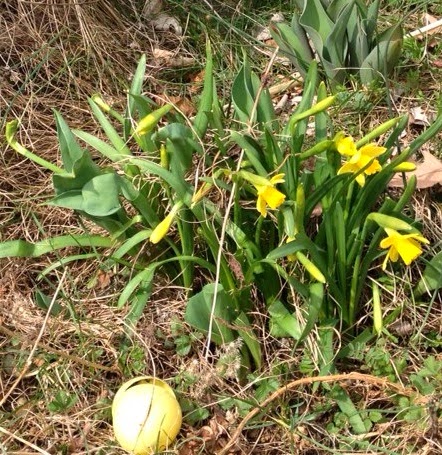
My first daffodils finally bloomed today.
And a bonus, an Easter Egg that turned up during garden clean-up. We never find them all on Easter.
No Such Thing as the Silk Road
From David Morgan's review of Valerie Hansen's The Silk Road in the TLS, Dec. 20, 2013:
. . . considered as a route which ran all the way from China, across Central Asia and to Persia, the Silk Road did not really exist at all. Some goods, though probably no individuals, did find their way from one end to the other. But we should note that the western terminus seems to have been Persia, not the Roman Empire (no Roman imperial coins have been found in China, which must be a significant pointer). As the author puts it, "The Silk Road was one of the least traveled routes in human history." She points out that scholars who have studied the individual Silk Road sites have asserted that in their particular case, there is little or not surviving evidence of long-distance trade, whatever may be true of the others. . . .Incidentally, the phrase Silk Road was coined in 1877 by German geographer Ferdinand von Richtofen.
So is the Silk Road no more than a mirage? Not entirely: it is perhaps the refugees who are key to what its real significance was, in Hansen's view: "While not much of a commercial route, the Silk Road was important historically -- this network of routes became the planet's most famous cultural artery for the exchange between east and west of religions, art, languages, and new technologies." It is the people who traveled, and what they brought with them -- in terms of culture rather than commerce -- which lends the Silk Road its permanent historical significance.
Scrap Metal Dealer Buys Fabergé Imperial Egg at Midwestern Antiques Stall
The latest astonishing story of lucky finds amidst the bric-a-brac begins in the 1880s, when jeweler Carl Fabergé made the first of 50 eggs for the Russian imperial family. The first was given by Tsar Alexander III to his wife on Easter 1885. People who love this sort of royal memorabilia have of course spent much time trying to track them all down, but eight have remained stubbornly lost. One of the missing eggs was the third, made in 1887:
History Blog has the whole story.
The Third Egg was photographed at the 1902 exhibition of Tsarina Alexandra’s and Dowager Empress Maria’s Fabergé treasures at the Von Dervis mansion in St. Petersburg, but it wasn’t until 2011 that it was identified in the Imperial Egg display vitrine thanks to the discovery of a more recent picture from 1964. It turns out that sometime after it was inventoried by Soviet curators in 1922, the Third Egg traveled west. In March of 1964 it was lot 259 in a Parke Bernet auction in New York, but it was not identified as an Imperial Egg. It wasn’t even identified as a Fabergé. . . .Interesting that Fabergé was using low purity gold; was that to make the eggs harder and more durable, or was he cheating the Tsar and pocketing the money? Eventually the metals dealer, disappointed in his attempts to recoup his investment by melting down the egg, started to google around and realized that he might have something valuable. He flew to London -- his first trip out of the U.S. -- where specialists from Wartski identified the egg and arranged for its sale to an undisclosed buyer for an undisclosed sum. The buyer was probably a Russian oligarch, and the sum surely in the tens of millions.
The disinherited Imperial Egg was purchased at that auction by a Southern lady for $2450. After her death in the early 2000s, her estate was sold and the egg, still unrecognized, made its way to a midwestern antiques stall where it was spotted by a scrap metal dealer. He planned to quickly resell it to be melted down for its gold value, but all of the prospective buyers who tested it thought he had overpaid. Blessedly stubborn, he refused to sell it at a loss and so for years he just kept the egg at home.
History Blog has the whole story.
The Segesser Hide Paintings
In the early 1700s, the French and Spanish were competing for spheres of influence on the North American plains. French traders working from Canada and New Orleans had reached the Rockies to the west and the Arkansas River to the south. This alarmed the Spanish authorities in New Mexico, who considered the plains a natural extension of their own empire. In the summer of 1720 they sent an expedition northward to what is now Nebraska to offer friendship to the Pawnee and Oto Indians, run off any Frenchmen they encountered, and scout out possible locations for a permanent fort. Instead, they were ambushed by Indians, possibly with French help, and nearly wiped out.
This minor frontier skirmish would have been long forgotten had not unknown artists in New Mexico created the wonderful record now called the Segesser Hide Paintings. Painted on tanned buffalo hides, the two works show many marvelous scenes of life on the eighteenth-century plains.
The centerpiece of the first hide is a battle between Indians.
The second hide depicts the 1720 skirmish in great if somewhat fanciful detail. Both were probably painted by American Indian artists who had some experience of or training in European-style art.
The expedition was led by New Mexico Lieutenant Governor Pedro de Villasur, who commanded 43 royal troops, three Spanish civilians, and 60 Pueblo Indians. (Above, the Spanish at bay in the center of the painting.) According to the Museum of New Mexico,
What an astonishing thing to survive after so much time. You can explore both paintings in detail here.
This minor frontier skirmish would have been long forgotten had not unknown artists in New Mexico created the wonderful record now called the Segesser Hide Paintings. Painted on tanned buffalo hides, the two works show many marvelous scenes of life on the eighteenth-century plains.
The centerpiece of the first hide is a battle between Indians.
The second hide depicts the 1720 skirmish in great if somewhat fanciful detail. Both were probably painted by American Indian artists who had some experience of or training in European-style art.
The expedition was led by New Mexico Lieutenant Governor Pedro de Villasur, who commanded 43 royal troops, three Spanish civilians, and 60 Pueblo Indians. (Above, the Spanish at bay in the center of the painting.) According to the Museum of New Mexico,
The Villasur expedition headed north from Santa Fe to Taos, turned east, then northeast into present-day Kansas. They followed a Pawnee route to the Platte River, moving north into eastern Nebraska. Beyond the junction of the Platte and Loup rivers, they encountered a large Pawnee Indian encampment. Villasur initiated a dialogue and asked Juan de Archibeque (Jean l’Archévêque), a Frenchman and expedition interpreter, to write a letter in French to a European within the Pawnee camp. The efforts failed and sensing a potentially hostile situation, the expedition retreated and camped at the confluence of the Loup and Platte rivers.The paintings were in Switzerland for over a century -- nobody knows hot they got there -- but then in 1983 the owners sold them to the State of New Mexico.
The Segesser II painting can be pinpointed to the August 13, 1720, skirmish at the expedition camp. After daybreak, the Pawnee and their Oto Indian allies—illustrated throughout the painting by their painted and unclothed bodies and shaved or close-cropped heads—ambushed the Villasur party. The painting also includes 37 French soldiers, identified by their European-style clothing—conical hats, coats, breeches, cuffs and leggings—firing long arms at the Spanish military expedition.
Te Villasur expedition was caught off guard, and the pitched battle left many of them for dead in the tall prairie grass. The attack was a major catastrophe for New Mexico and casualties amounted to a third of the province’s best soldiers. The center of the painting portrays French soldiers with Pawnee and Oto supporters surrounding the camp. At the right of the painting, Villasur expedition members who were guarding the animals are shown running to assist their Spanish comrades.
Interestingly, oral and written accounts of the battle do not mention French soldiers in the area of the encounter. Several Villasur survivors reported a volley of musket fire, but in the confusion of the battle, they did not know who was attacking them. It is possible that French traders took part in the ambush. Governor Valverde y Cosio, perhaps in an effort to defend the actions of Villasur, reported “two hundred Frenchmen had fired, supported by a countless number of Pawnee allies.”
Subscribe to:
Posts (Atom)