
Saturday, September 18, 2010

Masturbation and the Moral Order
Absurd as it is in most ways, Christine O'Donnell's senate campaign has performed the good service of calling attention to the Catholic church's insane view of masturbation. Most American Catholics don't pay any more attention to this teaching than they do the church's views on birth control, but officially the church still thinks masturbation is "an intrinsically and gravely disordered action." The church used to say that the only acceptable reason to have sex was to conceive a child, so enjoying it in any way was a sin. Over the past 150 years they have liberalized their view to the extent that they accept sex as part of married love, endorsing "the sexual relationship which is demanded by the moral order and in which the total meaning of mutual self-giving and human procreation in the context of true love is achieved."
This business of "the moral order" creeps me out.
The church holds to a vision of human life that has its fullest expression in a monastery, where every action conforms to a careful plan. Every time of day has its allotted task, and one should only walk to get from one task to another. One should only speak purposeful words, to make the tasks easier or to acquire knowledge that will lead toward salvation. Waste is offensive and forbidden; laughter dubious. The church's genius for ritual springs from this same love of order and the measured passage from one task to the next. Outside the convent, these theologians imagine a world where people obey the laws, work hard at the tasks their bosses assign them, marry sensibly, love the people they should love, and never make trouble.
It is this side of the church's teaching that has made it a good partner for fascist dictators and dictatorial kings. Again and again in human history we have seen rulers who were appalled by the riotous disorder that prevailed among their subjects. The people, they said, should stop goofing off, stop getting drunk, stop fornicating, and do what they are told. They should work harder and stay where they can be counted and be observed. They should shun fripperies and be happy with the essentials of life. They should avoid waste and stay on task.
As far as I am concerned, the correct religious term for a perfectly ordered world would be "hell." I find this vision of an ordered, purposeful, tightly controlled world horrifying. It is true that a world of chaos is equally frightening, but that is no excuse for totalitarianism. To live, we must maintain order of a sort. But the life force is a force of chaos, a riotous upwelling of energies that push and pull in every direction. Life is violent, sexual, torn by powerful emotions, full of conflict, and given to waste in extravagant proportions. To live fully, we must embrace some of the chaos, waste, and violence that is our animal birthright. It is our task as thinking beings to find a balance between the order we need and the chaotic forces that gave birth to us and surge through us.
To imagine that masturbation is a "grave" force for disorder is to desire a world that would be far toward the rigid and puritanical end of life's possibilities. If masturbation is gravely disordered, then I am a chaos agent of satanic magnitude. And so is everyone else I know. Masturbation is something like bungie jumping: pointless and wasteful, at least of time, perhaps tacky, but also absolutely unimportant. People who worry about such things have their minds in the wrong place: fretting about disorder when they should be concerned about something that matters, like justice, or when, perhaps, they should be off doing something pointless, wasteful, and fun themselves.
This business of "the moral order" creeps me out.
The church holds to a vision of human life that has its fullest expression in a monastery, where every action conforms to a careful plan. Every time of day has its allotted task, and one should only walk to get from one task to another. One should only speak purposeful words, to make the tasks easier or to acquire knowledge that will lead toward salvation. Waste is offensive and forbidden; laughter dubious. The church's genius for ritual springs from this same love of order and the measured passage from one task to the next. Outside the convent, these theologians imagine a world where people obey the laws, work hard at the tasks their bosses assign them, marry sensibly, love the people they should love, and never make trouble.
It is this side of the church's teaching that has made it a good partner for fascist dictators and dictatorial kings. Again and again in human history we have seen rulers who were appalled by the riotous disorder that prevailed among their subjects. The people, they said, should stop goofing off, stop getting drunk, stop fornicating, and do what they are told. They should work harder and stay where they can be counted and be observed. They should shun fripperies and be happy with the essentials of life. They should avoid waste and stay on task.
As far as I am concerned, the correct religious term for a perfectly ordered world would be "hell." I find this vision of an ordered, purposeful, tightly controlled world horrifying. It is true that a world of chaos is equally frightening, but that is no excuse for totalitarianism. To live, we must maintain order of a sort. But the life force is a force of chaos, a riotous upwelling of energies that push and pull in every direction. Life is violent, sexual, torn by powerful emotions, full of conflict, and given to waste in extravagant proportions. To live fully, we must embrace some of the chaos, waste, and violence that is our animal birthright. It is our task as thinking beings to find a balance between the order we need and the chaotic forces that gave birth to us and surge through us.
To imagine that masturbation is a "grave" force for disorder is to desire a world that would be far toward the rigid and puritanical end of life's possibilities. If masturbation is gravely disordered, then I am a chaos agent of satanic magnitude. And so is everyone else I know. Masturbation is something like bungie jumping: pointless and wasteful, at least of time, perhaps tacky, but also absolutely unimportant. People who worry about such things have their minds in the wrong place: fretting about disorder when they should be concerned about something that matters, like justice, or when, perhaps, they should be off doing something pointless, wasteful, and fun themselves.
Friday, September 17, 2010
The Reaganites vs. Bush and Cheney
Ronald Reagan took a strong stand against torture, and it is good to see that some of his people are coming forward now to denounce the criminal regime of Bush and Cheney. Reuters:
Torture sanctioned by President George W. Bush to fight terrorists was illegal and wrong and America has yet to confront the topic to avoid future abuses, the U.S. Solicitor General for President Ronald Reagan argues in a new book."Because it is Wrong: Torture, Privacy and Presidential Power in the Age of Terror" by Harvard Law scholar Charles Fried, a Republican, and his son Gregory Fried -- a philosophy professor who votes Democrat -- asks if it is permissible to torture in order to safeguard Americans.
Despite the differing politics of the father-son authors, they agreed it was never morally right to torture and therefore never permissible to do so.
"I think that (the Bush administration) broke the law and what they did was disgusting and terrible and degrading," Charles Fried told Reuters in an interview.
This Week in the Drug War
Via Andrew Sullivan:
Administrators at Byron Nelson High School in Trophy Club suspended a 16-year-old boy on Tuesday because his eyes were bloodshot and they thought he might have been smoking marijuana. The teen said he was not high. Instead his eyes were red because he had been grieving the loss of his murdered father. Kyler Robertson’s father was stabbed to death on Sunday. His mother honored his wishes and let him go to school on Tuesday to be with his friends.
Piling On
Christine O'Donnell on O'Reilly Factor in 2007:
They are -- they are doing that here in the United States. American scientific companies are cross-breeding humans and animals and coming up with mice with fully functioning human brains. So they're already into this experiment.
Reconstructing the Lee Fendall Garden
 We have just submitted the draft report for our archaeological project in the Lee Fendall Garden, which I already posted about here, here and here. When we started this project I thought we would have to be very lucky to learn much about the 1850s garden in three weeks of fieldwork, but as it turns out we learned a great deal without any particular windfalls. Using a handful of nineteenth-century photographs like the one above and the results of our excavations, we were able to reconstruct the garden's basic outlines and even show which theories of garden design Louis Cazenove employed in building it. When I say "we" I mean mostly my colleague Jason, who did the bulk of the research and writing.
My most important contribution turned out to be a stray thought that occurred to me one day in the field. We were tracing a scatter of brick rubble along the north side of the garden, with the idea that it was the remains of an early outbuilding that was knocked down when the garden was built. We found that some of the rubble was in a trench, which we thought at first was a builder's trench in which a brick wall had once been set. But as we followed the trench it started to curve. Then we found a place in which a layer of pea gravel lay directly across the top of the rubble. The gravel seemed to be a garden path, so I wondered out loud if maybe the rubble-filled trench was a sort of foundation for the path, to provide it with stability and drainage. Some time later Jason found, in Edward Kemp's 1850 gardening manual, this instruction on how to construct a path:
A walk should have from nine to twelve inches of material upon it, and a drive rather more. Only about three inches of this on the surface need be of fine gravel. The rest may be rubblestone, flints, coarse gravel, cinders, or any other angular and irregularly shaped substance that will remain porous and dry.This clinched it; the main garden path had been built by digging a ditch about a foot deep and then filling it with nine inches of rubble and three of gravel. With this information we were able to identify the garden path from the presence of brick rubble and thus to trace it around the yard with a series of very small tests. We had already found the foundations of the small building shown in the background of the photograph above, and our excavations in the center of the garden revealed that it had been a yard, as it is now. Our excavations along the outer walls of the garden suggested that these areas had been planting beds, and we had also identified a planting bed along the west side of the yard, in front of the kitchen. The plan below is a bit sketchy, but on the other hand we have a high degree of confidence in this reconstruction. There were probably other garden elements that we did not identify in our limited time, but we are fairly certain that everything shown on this plan was in the yard in the 1850s. (click to enlarge) All in all it was a very successful project, fun to do and producing some real knowledge about the past.

I Fear No Man
 RIP John Freeborn, one of the heroes of the Battle of Britain. A Spitfire pilot and wing commander, Freeborn was credited with shooting down 12 German planes, including three in one 8-hour period when he went into combat four times. In the summer of 1940 his 74th squadron flew with "I Fear No Man" written across the sides of their planes.
John Freeborn was no fanatic, no militarist. He had no particular political beliefs other than patriotism. In later years when he spoke about the war he most often mentioned, not the Germans he had shot killed, but an RAF pilot he shot down by mistake. “I’ve had a good life,” he told his biographer, “and he should have had a good life, too.” And yet he and millions like him stood up to Nazism.
Follies
 The NY Times has a feature today on a 150-foot-long replica of the Golden Gate Bridge built by Larry Richards in Mulvane, Kansas. This put me in mind of Maryland's own, much older bridge folly, at the Roop Mill near Westminster. The Roop Mill belonged for more than a century to the same family of tinkerers. Built in the 1790s, it was the first mill in the county to have the Ellicott system for using water power to raise the grain to the upper story and feed in down into the mill, and then a century later the Roops' home was the first house in the county to have electricity, powered by their own mill. In between it was one of the first mills in the state to install turbines in place of the old water wheel. For a while they operated a separate sawmill, and the power for that was transfered from the mill using a series of ten 20-foot-long iron drive shafts that sat on wooden blocks. The property is full of barns, sheds, sheds attached to barns to which are attached silos to which are attached other sheds. The whole site is a great testimony to the inventive spirit of nineteenth-century America.
Some time around 1870 the Roops built their own steel-cable suspension bridge across the creek that flows between their house and the mill, a little trickle you can usually hop across. But why hop when you can cross in the latest high-tech style?
Thursday, September 16, 2010
Hanzi Smatter
 A blog "dedicated to the misuse of Chinese characters in western culture." A recurrent theme: "Hi, I got this tattoo when drunk many years ago and they told me it means 'strength,' can you tell me what it really means?" My favorite is the woman who thought her arm said "beautiful" when really it says "catastrophe."
Woody Allen on Faith
Still struggling with what he lacks:
I was interested in the concept of faith in something. This sounds so bleak when I say it, but we need some delusions to keep us going. And the people who successfully delude themselves seem happier than the people who can’t.
Murder at Vindolanda
 Digging under the floor of a Roman barracks at Vindolanda, a post near Hadrian's Wall, archaeologists found the bones of an 8- to 10-year-old girl:
Her burial place is reckoned to be almost certain evidence of a crime, according to specialists at the Vindolanda Trust, which has made thousands of finds at the town and its associated fort since the 1920s.
Human burials were strictly forbidden within built-up areas in Roman times, and Vindolanda followed regulations requiring cemeteries to be laid out on the settlement's outskirts. The bones, initially thought to have been those of a large dog, were in a shallow pit dug in a corner of the garrison's living quarters at the heart of the fort.
Patricia Birley, director of the Vindolanda Trust, said: "This definitely looks like a case of foul play. It has been very sad to find a child in this shallow grave under the barrack floor. It would have been very difficult to get a body out of the barracks, through the wider fort and out of the gate, but we may never know if the burial took place with or without the collusion of the men who shared the barracks."
Wednesday, September 15, 2010
Sea Women
 American-Korean photographer Brenda Paik Sunoo took top honors from the International Museum of Women in their contest for a call for visual media that told the story of women and their lives from all over the world. The Museum says:
The women divers of Jeju Island (known as haenyeo) are unique and rare workers. For centuries, they have harvested seaweed and shellfish at depths of 20 meters, holding their breath for as long as two minutes without any equipment other than their rubber suits, masks and nets.The Korean women divers of Jeju Island have faced the tempestuous tides of history and struggle for economic survival. Their intimate relationship to the land and sea, their shaman beliefs, and their communal village life have kept them protected from modern pressures. In return, many of the haenyeo live a life of purpose and resilience well into their 90s. They illuminate a steady, fearless course and most of all, an enduring legacy.
A Roman Victory in the North German Woods
The remains of a battle fought between Romans and Germans, far beyond the Roman frontier, are being interpreted as evidence of a punitive campaign waged by a usurping emperor named Maximinus Thrax in AD 235:
The Roman historian Herodian says that Maximinus laid waste to the whole country, destroying crops, burning down villages after allowing the army to plunder them, and stealing cattle from the Germanic 'barbarians.' . . .
An archeological dig there this summer turned up 1,800 artefacts. A single spot on the hill had been pounded by torsion catapults, one of the most advanced weapons in the Roman arsenal, and 70 bolts from these armour-piercing weapons were still lying in the ground.The catapults, mounted on wagons, had a range of up to 200 metres, said Michael Moosbauer, an archaeology professor at the Harzhorn site. The iron points weighed 200 grams apiece.
Among the techniques used by the archaeologists to sketch a map of the battle is tracking the studs that fell off Roman sandals as the troops climbed the Harzhorn on foot. They are believed to have overcome their opponents before continuing on their way. That belief is partly based on the absence from the soil of buckles, which were typically left behind on battlefields when victors ripped armour off slaughtered Roman legionaries. If any imperial troops did fall on the Harzhorn, they were buried elsewhere, since there has been no sign of dead Romans. . . .
Nine coins that have been found - one minted in AD 228 - also fit the date.

Criminal Confessions are Not Reliable
Not only do people regularly confess to crimes they did not commit, they sometimes do so using details that, it is then asserted in court, they could only have known if they had been the criminal. They learn those details from the police in the course of their interrogations:
But more than 40 others have given confessions since 1976 that DNA evidence later showed were false, according to records compiled by Brandon L. Garrett, a professor at the University of Virginia School of Law. Experts have long known that some kinds of people — including the mentally impaired, the mentally ill, the young and the easily led — are the likeliest to be induced to confess. There are also people like Mr. Lowery, who says he was just pressed beyond endurance by persistent interrogators. . . .
New research shows how people who were apparently uninvolved in a crime could provide such a detailed account of what occurred, allowing prosecutors to claim that only the defendant could have committed the crime.
Professor Garrett said he was surprised by the complexity of the confessions he studied. “I expected, and think people intuitively think, that a false confession would look flimsy,” like someone saying simply, “I did it,” he said.
Instead, he said, “almost all of these confessions looked uncannily reliable,” rich in telling detail that almost inevitably had to come from the police. “I had known that in a couple of these cases, contamination could have occurred,” he said, using a term in police circles for introducing facts into the interrogation process. “I didn’t expect to see that almost all of them had been contaminated.”
The New York Governor's Primary
In New York, my favorite whipping boy, Rick Lazio, was defeated in the Republican primary for governor by nearly 2 to 1 by Carl Paladino, a millionaire who ran as a Tea Party Populist:
Mr. Paladino, 64, energized Tea Party advocates and social conservatives with white-hot rhetoric and a damn-the-establishment attitude, promising to “take a baseball bat to Albany” to dislodge the state’s entrenched political class. He also outspent Mr. Lazio, pouring more than $3 million of his fortune into the race, while Mr. Lazio spent just over $2 million.“We are mad as hell,” Mr. Paladino said in a halting but exuberant victory speech in Buffalo shortly after 11 p.m. “New Yorkers are fed up. Tonight the ruling class knows. They have seen it now. There is a people’s revolution. The people have had enough.”
So often in politics one has to choose between the corrupt establishment and the populist nut jobs. I'm counting on popular Democrat Andrew Cuomo to stop this guy.
St. Radegund
For last night I assigned my students the Life of St. Radegund. Radegund was one of several early medieval queens who became saints. She founded a nunnery and persuaded the Empress of Byzantium to send her a piece of the True Cross and several other relics, which put the place on the map. I chose her life because her story intersects several times with the story of Gregory of Tours, whose book we have been reading -- Gregory knew her and preached at her funeral -- and because Gregory tells the story of a revolt that took place among the nuns of Radegund's monastery just 20 years after she died.
Radegund was an athlete of asceticism who starved and otherwise tortured herself, and she liked to stage public scenes of self-humiliation, by washing lepers and the like. There is a funny line in the life, saying that whenever any holy abbot or bishop visited her she insisted on humbly washing his feet – “there was no resisting her.”
Radegund was an athlete of asceticism who starved and otherwise tortured herself, and she liked to stage public scenes of self-humiliation, by washing lepers and the like. There is a funny line in the life, saying that whenever any holy abbot or bishop visited her she insisted on humbly washing his feet – “there was no resisting her.”
Good Sir, may wash your feet?
No, thank you.
Please, Sir?
Really, it’s not necessary.
But Sir, it is my custom and my dearest wish to humbly wash your feet.
My lady, I really do not wish to have my feet washed.
(Grabs cloth, lunges for bishop’s feet.) I must wash your feet!
Please stop!
I must! I must!
I insist that you stop molesting my feet!
YOU WILL SUBMIT TO MY HUMBLE FOOT WASHING! NUNS, SEIZE HIM AND HOLD HIM STILL!
Christine O'Donnell
I suppose most of my liberal friends are celebrating the results from Delaware's senate primary, where lunatic-fringe conservative Christine O'Donnell defeated Republican stalwart Mike Castle. Republicans had been counting on winning this seat in their plan to take the senate, and now the Democrat, Chris Coons, is favored.
I'm not celebrating. First, I don't take it as a given that O'Donnell will lose in the general election. A wide swath of Americans casts their votes without giving much thought at all to who they are voting for, and those who want to vote against Obama will vote for O'Donnell no matter how crazy she seems. I am not sure that trading the near certainty of having Mike Castle, a moderate Republican and a reasonable man, for even a 10% chance of Christine O'Donnell is a good risk. And I would put her chance of winning at much higher than that, at least 25%. People are angry and scared, and angry, scared people cannot be counted on to act rationally.
Second, I think wins by people like Christine O'Donnell are signs of something very wrong with America. A lot of us took the election of Obama as a sign of positive changes in America: the decline of racism and nativism, a desire for rational government by intellectuals with ideas, revulsion with mideast wars, a preference for a man of calm temperment over firebrands. The surge of angry paleo-Republicanism over the past year shows that Obama's election was the product of particular circumstances -- war fatigue, Bush fatigue, the Wall Street crisis -- and that the forces of racism, nativism, fear, and unreason are still very strong in America. The Tea Party movement is stoking the siege mentality among white Americans, and every victory only encourages these people to think that they truly are the "Real Americans." One of O'Donnell's supporters told the Times,
Celebrating O'Donnell's victory because it will help the Democrats hold the Senate is, I think, short-sighted and narrow-minded. The anger that drove her candidacy, the sense that the world is arrayed against hard-working white people, is the real danger in America now, and we should try to defeat it at every turn.
I'm not celebrating. First, I don't take it as a given that O'Donnell will lose in the general election. A wide swath of Americans casts their votes without giving much thought at all to who they are voting for, and those who want to vote against Obama will vote for O'Donnell no matter how crazy she seems. I am not sure that trading the near certainty of having Mike Castle, a moderate Republican and a reasonable man, for even a 10% chance of Christine O'Donnell is a good risk. And I would put her chance of winning at much higher than that, at least 25%. People are angry and scared, and angry, scared people cannot be counted on to act rationally.
Second, I think wins by people like Christine O'Donnell are signs of something very wrong with America. A lot of us took the election of Obama as a sign of positive changes in America: the decline of racism and nativism, a desire for rational government by intellectuals with ideas, revulsion with mideast wars, a preference for a man of calm temperment over firebrands. The surge of angry paleo-Republicanism over the past year shows that Obama's election was the product of particular circumstances -- war fatigue, Bush fatigue, the Wall Street crisis -- and that the forces of racism, nativism, fear, and unreason are still very strong in America. The Tea Party movement is stoking the siege mentality among white Americans, and every victory only encourages these people to think that they truly are the "Real Americans." One of O'Donnell's supporters told the Times,
I think people are smart enough now to know the world we are living in is going wrong and we need people like her to make it right.Note, once again, the lack of any concrete grievances or particular policy recommendations. Things are just going wrong, because the wrong people are in charge. To people who think this way, O'Donnell's incoherence on every issue just doesn't matter. What matters is that she is one of them and shares their anger at how things are.
Celebrating O'Donnell's victory because it will help the Democrats hold the Senate is, I think, short-sighted and narrow-minded. The anger that drove her candidacy, the sense that the world is arrayed against hard-working white people, is the real danger in America now, and we should try to defeat it at every turn.
Tuesday, September 14, 2010
Sentence of the Day
"The scientific literature is pretty scant on studies in which researchers douse bat caves in athlete's foot powder."
More here.
More here.
Roman Shipboard Medicine
A Roman shipwreck off the coast of Italy was excavated in this 1990s, yielding a cargo of Rhodian wine amphorae, Syrian glass, and other typically Roman things:
A little disappointing that the height of Roman medicine was carrot and radish pills, but they may at least have contained some vitamins.But the most interesting part of the cargo was a sort of medical chest possibly belonging to a physician on board the ship.
Within the kit, the archaeologists found a bleeding cup, a surgery hook and a mortar. They also recovered 136 drug vials made of boxwood and several tin containers carrying circular, flat green tablets -- each about three centimeters wide and half a centimeter thick. Because they were sealed, the pills were completely dry even though they had been laying on the sea floor for millennia.
"We obtained some samples in 2004, but only recently a next generation sequencing technology has allowed us to identify their ingredients," Alain Touwaide, an international authority on medicinal plants of antiquity at the Smithsonian Institution and the Institute for the Preservation of Medical Traditions in Washington , D.C., told Discovery News.
Geneticist Robert Fleischer of the Smithsonian's National Zoological Park, who presented the findings last week at the Fourth International Symposium on Biomolecular Archaeology in Copenhagen, Denmark, was able to analyze DNA fragments in two of the pills.
After comparing the sequences to the GenBank genetic database maintained by the US National Institutes of Health, he identified many plants typical of a vegetable garden, including carrot, radish, parsley, celery, wild onion and cabbage. Alfalfa, yarrow and the more exotic hibiscus were also part of the mix.
What Do You Know. . . .
Glenn Beck denounces burning the Koran:
As much as I detest those who threaten violence to silence those who draw cartoons, I am equally disgusted and condemn the reckless actions of those who try to silence voices by burning books. . . .
Our founders understood how important freedom of speech is to the freedom of man. They managed to defeat the most powerful tyrant on earth in their day without burning or banning a single book. The American experiment was based on mutual respect, acceptance of differing religious beliefs and common decency. Burning anyone’s sacred scripture is an affront to all of these.
Freedom and Security
David Foster Wallace in the Atlantic, three years ago:
If it were up to me, I would choose to live in a world with more freedom and less security, even if we had to face a 9-11 every year.
Are some things still worth dying for? Is the American idea one such thing? Are you up for a thought experiment? What if we chose to regard the 2,973 innocents killed in the atrocities of 9/11 not as victims but as democratic martyrs, “sacrifices on the altar of freedom”? In other words, what if we decided that a certain baseline vulnerability to terrorism is part of the price of the American idea? And, thus, that ours is a generation of Americans called to make great sacrifices in order to preserve our democratic way of life—sacrifices not just of our soldiers and money but of our personal safety and comfort?I want to put myself down here as agreeing with this 100 percent. I have no wish to be kept alive at the price of torture, indefinite imprisonment without charge, unconstitutional wiretapping, the kidnapping of terrorist suspects, or any of the other awful things that are being done in the name of my safety. I oppose all attacks on people who have not attacked us first, no matter what they might be planning.
In still other words, what if we chose to accept the fact that every few years, despite all reasonable precautions, some hundreds or thousands of us may die in the sort of ghastly terrorist attack that a democratic republic cannot 100-percent protect itself from without subverting the very principles that make it worth protecting?
If it were up to me, I would choose to live in a world with more freedom and less security, even if we had to face a 9-11 every year.
Security Landscaping
 The new frontier for landscape architects: creating truck-stopping security barriers that don't create "the feel of a warzone." I think this one is kind of nice.

More from Qatna
 Excavation continues in crypt under the Bronze Age palace at Qatna, Syria, where spectacular finds have already been made. This year's finds include the Egyptian gold and lapis bangle (above) and a pile of bones -- presumably servants, possibly sacrificed to accompany their masters to the afterlife -- mixed with pottery (below). You can see two stone statues from the Qatna tomb here.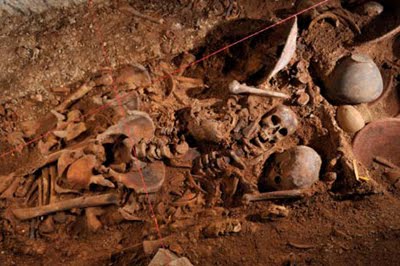
Hybrids
 Genetic studies are increasingly allowing biologists to determine which species are, in fact, hybrids of two other species. One successful hybrid is the Puzzle Sunflower, above, a cross of the Common Sunflower and the Prairie Sunflower. Which raises the question: is the Puzzle Sunflower a species, or not? I would say, yes, but the absence of any rigorous way to make this determination is another consequence of evolution. Living things are always changing, and things in motion are hard to pin down and name. The question of whether a hybrid is a species has also been a legal question for the red wolf, since the animals that were re-introduced into North Carolina as "red wolves" seem to be hybrids of wolves and coyotes, possibly of gray wolves and coyotes, and therefore not related to the ancient red wolf -- unless "red wolves" were never anything but a hybrid population or even just a population of gray wolves with a tendency toward small size and reddish color.
Monday, September 13, 2010
The Stone of Secrets
 The tombstone of alchemist Nicholas Flamel (ca. 1333-1418), Paris. The stone is decorated with alchemical symbols, the meaning of which is much debated among contemporary alchemists. By the seventeenth century it was widely rumored that Flamel had developed an "elixir of life" that made him immortal, and you can still find discussion on alchemical websites of whether Flamel might still be alive. In The Hunchback of Notre Dame Victor Hugo wrote that amateur archaeologists had repeatedly dug up the site of Flamel's house looking for the Philosopher's Stone, but I can't find any confirmation of this, and a house said to be Flamel's is still standing.

Subscribe to:
Posts (Atom)


