


You do not have to be good.
You do not have to walk on your knees
For a hundred miles through the desert, repenting.
You only have to let the soft animal of your body
love what it loves.
Tell me about despair, yours, and I will tell you mine.
Meanwhile the world goes on.
Meanwhile the sun and the clear pebbles of the rain
are moving across the landscapes,
over the prairies and the deep trees,
the mountains and the rivers.
Meanwhile the wild geese, high in the clean blue air,
are heading home again.
Whoever you are, no matter how lonely,
the world offers itself to your imagination,
calls to you like the wild geese, harsh and exciting —
over and over announcing your place
in the family of things.
1986




The secret to the fossils’ preservation is up for debate, but McCurry thinks it would have happened over hundreds of years rather than in a sudden event.
Iron-rich water, maybe from nearby outcrops, could have flowed into a shallow billabong, periodically deoxygenating the water, killing the organisms or encasing flora and fauna in sediment that turns into the rocks found in the field.


Interesting NY Times focus group, bringing Democrats together to talk about January 6. While the participants are angry with or disgusted by the Republican leadership, many of them are somewhat sympathetic to the rioters, because they think the system is so broken that rioting is at least an understandable response:
Susan (from Texas): I’ve gained a more nuanced view of what led to that. So all of this stuff that’s happening — what Harold refers to as all the lawlessness. It’s an inevitable boiling point of flawed systems that were put into place and have only gotten worse over the years. And with all these flawed systems that are put into place, everybody’s got to find an enemy. And some people might realize that the true enemy is the system which keeps us all in a harsh place unless you’re the top of the top. But some people, they buy into these lies that they’re told by people in order to keep their power, such as, oh, it’s the immigrants coming in and stealing jobs. It’s the blue-haired liberals and all that. It’s like, no, that’s not who the enemy is. The enemy is the system that needs either a complete makeover or severe reform in order to protect the livelihoods of the people, not the rich who are just gonna run the planet into the ground and move on to the next one.
And this:
Tracy: I think it was the frustration of the American people. I’m not saying it was right, but I believe it was more of the American people fed up. People are fed up with politics, telling you lies, and this, that, and the other. They stormed the Capitol for different reasons. But it was mainly the frustration of the American people.
Right vs. left divisions obscure it, but there is a sense in which the dominant theme in American politics is a populist revolt against the system.
Peter Bogdanovich (1939-2022) had a Hollywood life in several senses. Growing up, he loved one thing: movies. They consumed his childhood. He then turned his passion into a career, first by interviewing and writing about famous directors, than by becoming one: The Last Picture Show (1971), What's Up Doc? (1972), Paper Moon (1973). What an incredible story, to go from a poor kid who loved movies to an adolescent who idolized great directors to a director at the top of his profession.
Then everything went wrong. He divorced his wife and took up with Cybill Shepherd. He somehow lost his touch as a director, made a bunch of failures. He left Shepherd for a Playboy model, Dorothy Stratten, and made a film so she could appear in it, but then her estranged husband murdered her before killing himself; Bogdanovich is supposed to have spent hours alone watching Stratten's scenes over and over. The movie flopped. Upset with how the studio handled its promotion, he bought the rights and tried to promote it himself, lost a pile of money and went bankrupt.
After disappearing for a while he resurfaced in the 1990s as a television actor, appearing in several TV shows and The Sopranos, but he never again came close to the roaring success he enjoyed in the 1970s.
It makes me wonder, again, what a good life is: one that is safe and happy, or one that takes you to the heights, and the depths? Is the kind of passion that drove Bogdanovich to the top of Hollywood a good thing, or ultimately a catastrophe for the people it touches? And should we feel any regret about loving the art that such people produce on their way to personal Armageddon?
Scott Siskind turns a review of the new film "Don't Look Up" into a meditation on narratives, the pursuit of truth, and the ambiguity of "Trust Science" or "Believe Experts."
Dark and fascinating photographic Tarot deck by Nicolas Bruno. And more here.
A new way of dividing people politically: bulldozer vs. vetocracy.
Year-end posts from Kevin Drum: Why 2021 was better than 2020, the Ten Most Interesting Charts of 2021, and the Top Ten Worst Trends.
Alana Newhouse, "Everything is Broken," a cry from the heart against our crumbling world. Winner of one of David Brooks' Sydney Awards. I disagree with a lot of it; eg., Newhouse is especially upset that things can now be changed by decree overnight, but that has been a complaint of conservatives since the Reformation and probably longer. Still, it is a good expression of that sort of worldview, and meshes with some of my complaints about competence.
Reviewing advances in green energy, batteries, biotech, and other fields, Noahpinion says "The 2020s are going to be a very cool decade."
Sadeck Waff's choreography for the paralympics, 3 minute video.
The vaccine used to eradicate smallpox in the 20th century was actually made using a virus called vaccinia, which is related to smallpox and cowpox but not the same as either; nobody knows where it came from (best guess is horse pox) or how it came to be the strain used in inoculation. (Wikipedia)
The best coin and other hoards of 2021.
The NY Times thinks Doris Lee (1904-1983) is an "Unjustly Forgotten Artist," but after looking at her work I think she is remembered about as much as she deserves.
German artist Jörg Gläscher made some interesting waves by piling up sticks in a forest.
At the Wara Art Festival in Japan, people make giant animals out of rice straw. Definitely a tradition we should bring to the US. We have plenty of straw and tons of frustrated artists.
In 1957, Los Angeles banned backyard trash burning, part of its efforts to fight "smog." Predictably, this led to protests by people waving American flags and shouting about freedom.
At the Washington Post, a round-up of recent doings in QAnon land: infighting, fund-raising mania, and accusations that the movement itself may be a Deep State operation.
Kevin Drum asked his readers to list things that might become "can you believe it used to be like this" memes on TikTok, and about a hundred responded. Many of their memories focus on the trials of television watching, like having to get up to physically turn the knob to change channels, and having to futz with the antenna to get a clear picture. One that resonated with me was how much dog poop there used to be in cities before cleaning up after your pet became the norm, something I really hated.
Review of a big new book on the culture of dueling.
Among other things, Scott Sumner is a highbrow film buff; here is his extensive ranking of the all films he has reviewed, including his all-time bests. With comments.
A North Korean who risked his life crossing the DMZ to reach the South, in 2020, just risked it again crossing back in the other direction. (NY Times) Several others have done the same, feeling like they were treated horribly in the South. A glimpse of why most Koreans have doubts about reunification.
In Poland, policies came into effect on January 1 that raise already existing cash payments to families that have a second, third, or fourth child, as well as bigger tax breaks for large families. This program will consume about 17% of Poland's GDP. The version in place since 2015 has greatly reduced child poverty, but on the other hand it has not budged the birth rate.
Long, strange NY Times piece about Britney Spears, emphasizing that during her conservatorship she used dance to establish a semblance of freedom. Ok, but there is not a word in this piece about the mental health issues that led to the conservatorship being set up in the first place. If Spears was fighting for control, maybe her own demons were an issue? I emphasize this because I feel strongly that mental health issues are a big part of everything that happens in the world, and I find it baffling when they are left out.
The Washington Post has a long article on the events of last January 6, focusing on the experience of Capitol Police officers caught up in the riot. We get very detailed descriptions of the incidents in which officers were killed or seriously wounded, along with a summary of their worries before the fact and the pleas that, in their telling, they made in the run-up for reinforcements, only to be ignored. The distinctively 21st-century theme is the long-term trauma suffered by the officers:
It is widely known that about 150 officers from the Capitol and Metropolitan Police Departments and local agencies were injured during the violence, more than 80 from the Capitol Police alone. Less understood is how long-lasting the damage, physical and psychological, to the Capitol Police force has been, damage that informs many officers’ outrage about what they perceive as a lack of accountability for those responsible. Interviews over many months with more than two dozen officers and their families (some of whom requested not to use their full names to speak frankly without permission from the department or to protect future employment prospects in the federal government), as well as a review of internal documents, congressional testimony and medical records, reveal a department that is still hobbled and in many ways dysfunctional. Among those still on the force and those who have left, many significant injuries and psychological disorders remain, including serious traumatic brain injuries and neurological impairment, orthopedic injuries requiring surgery and rehabilitation, post-traumatic stress disorder and heightened anxiety.
There are two things I wanted to mention here. The first is that trauma among the police is a widespread and growing theme in America. Suicide is the leading cause of death among active duty officers; the suicide rate among police officers is about three times the national average. Three officers who were at the Capitol on January 6 have taken their own lives.
The cause of this are of course complex, but I think one factor specific to police work is the sense among many officers that we have sent them out a long limb to do a dirty, dangerous job and are perfectly willing to saw off the branch behind them if they mess up. The bitterness coming from the Capitol Police has been directed almost entirely at their own bosses, who they feel ignored them and let them down, stranding them in a situation they could not control. When people do dangerous work that is supposed to benefit the public, it matters a great deal to them that the public vociferously supports what they do. They need backing. I think the crisis among the contemporary American police stems exactly from this: they can't handle, psychologically, doing their jobs and simultaneously feeling that the people despise them. The armchair liberal solution – well, if you want public support, stop shooting people, and start turning in your comrades who shot, beat, or frame people – is hard when cops feel that they are in a war, and only other cops understand and empathize with them.
The second is the overall theme we have been discussing here for years, the prominent place of trauma in our models of psychology. In much of what I read it seems like processing trauma is pretty much the only thing in psychology. And not to dismiss that, but it does feel strange to me to read a long, anniversary piece about a violent attempt to reverse a presidential election that focuses mainly on the trauma suffered by people caught up in the riot. All I can guess is that the Post's editors think focusing on personal trauma will get people to care about these events that political analysis will not.
1688: The First Modern Revolution is one of those strange double books, combining an impressive, thoroughly researched account of England’s “Glorious Revolution” with a maddening argument about how the event should be interpreted. Pincus has worked himself into a rage over the contempt that, he thinks, the rest of the historical world feels toward his chosen subject of study. He is determined to convince his readers both that the revolution of 1688 is the most important event in the history of the world, and that everyone who has ever written about it before is utterly and completely wrong. There is, he says, a “scholarly consensus” that the overthrow of James II was a sort of non-event, not a “real revolution” but merely a change of regimes engineered by an aristocratic cabal. “This book,” he writes, “challenges every element of this established account.” (5) This matters more than your average historical spat because, to Pincus, 1688 was a sort of pivot on which the whole history of the modern world turns:
All of these interpretations derive their power from a deeply held and widely repeated narrative of England’s Revolution of 1688-89. Unfortunately, that narrative is wrong. Replacing that historical narrative with a new one will necessarily force us to revise many of the basic historical, political, moral, and sociological categories we use to make sense of the modern world. (3)Pincus’ denunciations of every other historian on the planet are so shrill that I kept hearing maniacal supervillain laughter in the background: You fools! You fools! Only I understand the vast power of my ideas, and I will make you all pay!
James’s actions were not insane, stupid, or perverse. Nor did James pursue policies typical of later seventeenth-century monarchs. Instead he carefully, methodically, and above all bureaucratically promoted a series of centralizing policies that were both modern and proven to be successful. (162)Pincus searches the historical literature for slights on James’s sanity like an eager duelist strutting through Shakespearean Verona, his hand on his rapier, seeing insults everywhere: You laughed, Sir. But while James’s policies were rational in the sense that they were modeled on measures that worked for Louis XIV, James was king of England, and in England the result of these policies was that James was chased into exile by an armed rebellion led by almost the entire political elite of the realm. I am not sure what words Pincus thinks are appropriate for such a policy, for me insane, stupid, and perverse work quite well.
From his base of Derbyshire the Earl of Devonshire had no trouble mobilizing an armed force to oppose James II and support a free Parliament. He arrived in Derby on 21 November with five hundred men who declared ‘that they would, to their utmost, defend the protestant religion, the laws of the kingdom, and the rights of liberties of the subject.’ Though Derby itself proved cautious, more Derbyshire men poured into augment Devonshire’s force that day. . . . (239)To Pincus the readiness of the “Derbyshire men” to join the Earl’s force means that the revolution was “popular.” To me it means they were happy to be led by aristocrats against a popish tyrant. Not only does Pincus seem oblivious to the aristocratic nature of seventeenth-century society, he also seems not to understand the historians he wants to argue against. The Marxists who dismiss 1688 as a counterfeit revolution are not going to be impressed by these accounts of aristocrats raising the countryside against the king. If your idea of a real revolution is the Russian or the Chinese – the entire ruling class slaughtered or sent to Siberia – then you will never believe that a rebellion led by Lord Lovelace and the Earl of Devonshire, bent on restoring the ancient liberties of the realm, is revolutionary.
The Revolution of 1688-89 was not a self-contained event lasting only a few months. To understand it in such narrow chronological terms is to miss the radical significance of the revolution. Instead, it is best to understand the revolution as a process set in motion in the wide-ranging crisis of the 1620s, which unleashed an opposition movement deploying modern polemical strategies and coming to an end only when the Whig prime minister Sir Robert Walpole chose to consolidate his power by guaranteeing that revolutionary change would go no further. (483)We have thus a “revolutionary century” stretching from the 1620s to the 1720s. Phrased in this way, Pincus’s argument becomes banal; who doesn’t agree that, in political terms at least, England was transformed between 1620 and 1720? On the other hand the change was, I would argue, less significant than what took place between 1820 and 1920; which is the real beginning of the “modern world”?


Tyler Cowen put up a post on his blog saying that Malcolm Gladwell asked him to put this question to his readers: “What’s the best example of an experiment or trial that could be scientifically useful and informative but which can’t be done for legal, ethical or logistical reasons?”
The responses I found interesting fell into two categories: child rearing and education. Here is one on child rearing:
Parenting Styles. Compare strict v. permissive. Do a group with physical punishment and yelling etc. to find out just how bad and harmful these practices are. And also do a hippie-dippy group where the kids can do whatever they want. Seems like so much of our knowledge on this is hopelessly confounded.
Others specifically called out breast feeding, having your infant sleep in your bed or not, and parental separation. Because everything we think we know about this stuff is indeed confounded by the problem that people who raise their kids in different ways are different from each other in a million other ways. The same might be true for people who get divorced, although nobody really knows that, either.
One of the education experiments people asked for involved taking 10,000 children and randomly assigning them to different kinds of school systems, or to home schooling, and seeing what happens. Another was to randomly send half a group of 18-year-olds to college and prevent the other half from doing so, then checking on how they were doing ten years later.
It seems that doubt over whether formal education does any good is rampant in America these days.
From Dan Wang's long, interesting letter on the year in China:
While it’s too soon to say that regulatory actions have snuffed out entrepreneurial dynamism in China, it’s easier to see that a decade of continuous tightening has strangled cultural production. I expect that China will grow rich but remain culturally stunted. By my count, the country has produced two cultural works over the last four decades since reform and opening that have proved attractive to the rest of the world: The Three-Body Problem and TikTok. Even these demand qualifications. Three-Body is a work of genius, but it is still a niche product most confined to science-fiction lovers; and TikTok is in part an American product and doesn’t necessarily convey Chinese content. Even if we wave nuances aside, China’s cultural offering to the world has been meager. Never has any economy grown so much while producing so few cultural exports. Contrast that with Japan, South Korea, and Taiwan, which have made new forms of art, music, movies, and TV shows that the rest of the world loves.
The reason for China’s cultural stunting is simple: the deadening hand of the state has ground down the country’s creative capacity. The tightening has been continuous. Consider that the Three-Body trilogy had been published in Chinese by 2010, which was a completely different era. I think it’s quite impossible to imagine that this work can be published or marketed today. It’s not just the censorship related to direct depictions of the Cultural Revolution. A decade ago, the CEO of Xiaomi went on Weibo to share his thoughts on the book; today, few personalities speak up to say anything except the patriotic or the mundane. Therefore I’m not terribly optimistic about the future of Chinese science fiction, which today has almost as many people studying the field as actual practitioners.
Throughout the last decade, Xi and the rest of the leadership have proved successful at convincing or coercing elites that it’s not worth their while to ponder such abstractions as whether the country is on the right path. These elites should keep their heads down and make money. . . . .
There’s little prospect of loosening in sight. Writer friends say that there’s no way that they can publish interesting work in 2022, given that the 20th party congress will be held at the end of the year. We have to accept that the direction of travel is towards still-more tightening. Just as a house can never be too clean, a city can never be too protected against Covid-19, and the country can never be too free of spiritual pollution. One of Xi’s legacies has been to push officials to err on the side of implementing controls too tightly, such that party officials are now trying to prove themselves to be more Marxist than the general secretary. It’s a safe bet that the government will control too much rather than too little.


Born in Kenya, the son of a chief, Asalache studied architecture in Nairobi, and art in Rome, Geneva and Vienna. He produced poetry and novels, and - after a spell with BBC Africa - took a job at the Treasury in London. In 1981, he moved into a dilapidated house at 575 Wandsworth Road. Confronted with a damp patch that resisted treatment, he opted to cover it instead, producing the first of his wooden carvings. Twenty years later, he was still at work.


I think the house really stands for the power of human endeavour, and for what can be created with time and dedication and love.


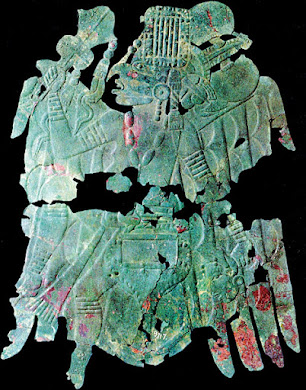
I think it unlikely that there was anything in Hopewell that cannot be explained by the workings of processes known from eyewitness knowledge of historic North American Indian customs, the geological doctrine of 'uniformitarianism' applied to culture history, if you will. (156)Hall's starting point is the rituals associated with the Calumet, or ceremonial pipe. These rituals combined adoption ceremonies with mourning for the dead. Our first descriptions come from French explorers who were adopted in this way, and in the early days they commented with surprise on the weeping that preceded their welcome into the tribe. Before they could welcome new members, the Indians explained, they had to mourn those who had been lost. When their knowledge of local customs was better they used these rituals for their own purposes. In 1681 La Salle made a formal visit to the Miami tribe, who had recently lost many men in a raid by the Iroquois. He gave them many gifts, including a piece of blue cloth which he said would cover the dead bodies of their men, and a piece of red cloth which he said would hide their spilled blood. Our French source tells us,
In this wise M. de La Salle made use of all these first gifts to gain the good will of the Miamis, for nothing touches their hearts sooner than respect shown to their dead, just as nothing arouses them to vengeance more surely than outrage done to the dead. Then he continued in the following terms:
"We have thus, my brothers, performed our duty to the dead, who must be satisfied, who now ask nothing except to be left in peace, and who desire us to dry our tears, and to think of caring for their children left here in their places. But I mean to do more – I will bring them to life again. You daily mourn the loss Ouabicolcata, the greatest of your chiefs. Think him not dead. I have his mind and soul in my own body; I am going to revive his name and be another Ouabicolcata; I shall take the same care of his family that he took in his life; and that no one may mistake, I declare that my name is not Okimao [his former Miami name]. My name is Ouabicolcata; he is not dead; he lives still, and his family shall want for nothing, since his soul in entered into the body of a Frenchman, who can provide his kinsmen abundantly with all things needful." (11)
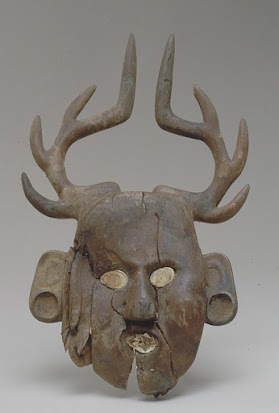
It has often been said that the dead were brought back to life by making the living bear their names. This is done for several reasons -- to revive the memory of a brave man, and to incite him who shall bear his name to imitate his courage; to take revenge upon the enemies, for he who takes the name of a man killed in battle binds himself to avenge his death; to assist the family of the dead man, because he who brings him back to life, and who represents him, assumes all the duties of the deceased, feeding his children as if he were their own father -- in fact, they call him father, and he calls them his children . . . .Hall extends this analysis through many different versions of many different rituals, including the Sun Dance of the plains and the sacrificial ball games of the Aztecs.

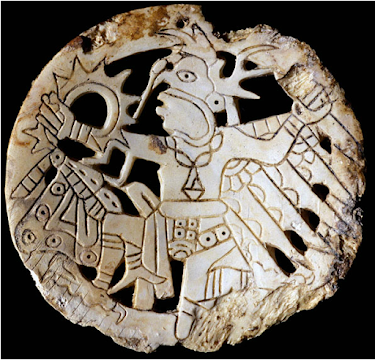
Hall has much more to say than this simple formula. For example, he explains the piles of marsh mud found in some tombs by the legend of the Earth Diver, a figure of many Indian mythologies who created the earth from mud retrieved from the bottom of the sea. He has a particularly neat explanation for the human face earrings, or "maskettes", that have been found at several Mississippian burial sites. The one place these earrings have conspicuously not been found is the greatest of all Mississippian sites, Cahokia. "He-who-wears-human-heads-as-earrings" was a culture hero to various Midwestern Indian tribes in historic times, and he was usually the son of the Morning Star. We have iconographic evidence that the ruler of Cahokia claimed to be the reincarnation of the Morning Star. So what better way for him to accept other chiefs as his vassals than by adopting them as his sons and proclaiming them to be reincarnations of Morning Star's son, "He-who-wears-human-heads-as-earrings"?
I felt on finishing The Archaeology of the Soul that I understood things I had never understood before, and what higher praise can one give to an academic book than that?
The Oneota cemetery (Norton Farms 36) delivers a message that almost screams to us from the graves. . . . This record speaks not only of tender love but also of warfare. Of almost three hundred individuals buried in the cemetery the skeletons of fifty show evidence of violent death over a period of years. The message is that of intermittent raids upon the village until it was abandoned following a final devastating attack that culminated years of stressful insecurity.
Sixteen individuals showed evidence of scalping, as indicated by cutmarks incised in locations on the bone around the crowns of the skulls. Twenty-six additional individuals were buried without heads at all, and of these twenty-six, eleven exhibit cutmarks somewhere on the first four cervical vertebrae, showing that the heads had actually been severed from the spine. These figures would attest to trophies of war being taken from the bodies of forty-two victims without regard to age or sex. Of the scalped individuals, ten were adult females, three were adult males, one was an adolescent male and two were children. . . .
We can never know their names, but like those immortalized by Edgar Lee Masters and Nelly Sachs, death has not erased their memories completely. Burial 200: female, age thirty-five to forty, hand fractured, possibly while trying to ward off the blow of a stone ax, skull crushed with a stone ax, scalped, bones subsequently gnawed by animals, recovered, and buried. Burial 230: infant age twenty-four to thirty-two months, died from a blow to the head, subsequently scalped. Burial 62: male age thirty to thirty-fve, four stone ax blows to the head, two arrows in the chest, two arrows through the back and embedded in the sternum, scalped. Burial 91: Female age thirty to forty, healed fracture of the left forearm from an earlier injury, stone ax wound on the shoulder, cuts on the neck vertebrae, head missing, skeleton gnawed by animals before burial. . . . (142)The sad tale of this doomed people touches us, thanks to the efforts of archaeologists. Later on, Hall describes an infant burial from the same cemetery:
Few stories allow us to penetrate the very soul of those Oneota villagers as well as that of Burial 197. This was a three-to-nine-month-old infant buried as though held within the grasp of a pair of adult human hands – the hands alone. This was not a child buried with an adult. There was just a pair of skeletal human hands with the infant nestled between them. Other things were found in the same grave – a shell bead bracelet, a strand of beads, and a set of hawk legs – but nothing that would explain the hands. We can infer, however, that the hands had some special symbolic value.Hall has given what I think is the only possible response to the accusation that archaeologists unfeelingly desecrate tombs. The point is not, or ought not to be, just the thrill of discovery and the wonder of finding beautiful, ancient thing in the ground. The point is to make the dead live again. The point is to tell their stories, as far as we can understand them, so they will not be forgotten.
Gene Weltfish has said of the Pawnee that when “a chiefly infant was born to two high-ranking parents, he was wrapped in a wildcat skin symbolizing the heavens with its panoply of stars and planets.” Knowing these things – knowing that a chiefly child might be cradled at birth in a wildcat skin, knowing that the starry night sky had a metaphor in the spotted fur of a wildcat, and knowing that the dome of the night sky could have a metaphor in the cup formed by a pair of human hands, as we know it did for the Zuni – how can we not suspect that the infant of burial 197 was itself a ‘chiefly infant’, found as it was, cradled within a pair of human hands? (151)


