Herbivorous pests often turn on each other when their food is of poor quality or it runs out. And some plants are known to affect the behaviour of their pests by making them more predatory towards other species. But until now it was unclear whether plants could directly cause caterpillar cannibalism.
Integrative biologist John Orrock and his colleagues at the University of Wisconsin in Madison triggered a defensive reaction in tomato plants (Solanum lycopersicum) by exposing them to various amounts of methyl jasmonate (MeJA). This is an airborne chemical that plants release to alert each other to danger from pests. When cued with MeJA, tomato plants respond by producing toxins that make them less nutritious to insects.
The researchers then allowed caterpillars of a common pest, the small mottled willow moth (Spodoptera exigua), to attack the crop. Eight days later, they observed that plants more strongly cued with MeJA had lost less biomass compared with control plants or with ones that had received a weaker induction. This showed that the reaction was somehow effective at protecting the plants.
Next, the team wanted to test whether the plants’ response was triggering cannibalistic behaviour in the caterpillars. So they cued tomato plants with MeJA and then fed leaves from cued plants and non-cued control plants to single caterpillars in containers that also contained a set number of dead caterpillars. Two days later, the team observed that caterpillars fed with leaves from the treated plants had turned onto the dead larvae earlier, and had eaten more of them, than those fed with leaves from control plants. The results are published in Nature Ecology & Evolution1.
The caterpillars will always eat each other eventually, but the difference in timing is critical, says Orrock, “if plants can induce pests to eat each other earlier, there will be more of the plant left untouched”. However, he also cautions that the cost to the plant of activating its defences is very high. “It is very possible that the plants will strike a balance and decide if the attack is serious enough to activate the defences.”
Wednesday, July 12, 2017
Plants Can Turn Caterpillars into Cannibals
Nature News:
Tuesday, July 11, 2017
Is Turning Out the Base or Appealing to Moderates more Important?
The latest political science on how to win American elections:
Political observers, campaign experts, and academics alike argue bitterly over whether it is more important for a party to capture ideologically moderate swing voters or to encourage turnout among hardcore partisans. We speak to this debate by examining the link between the ideology of congressional candidates and the turnout of their parties’ bases in U.S. House races, 2006–2012. Combining a regression discontinuity design in close primary races with survey and administrative data on individual voter turnout, we find that extremist nominees suffer electorally, largely because they decrease their party’s share of turnout in the general election, skewing the electorate towards their opponent’s party. Along with shedding light on questions concerning the interplay of parties, voters, and candidates, the results help address the debate over swing voters and turning out the base. For our sample of elections, turnout appears to be the dominant force in determining election outcomes, but it advantages ideologically moderate candidates because extremists activate the opposing party’s base more than their own.Right now the Democratic Party is full of rhetoric about needing more progressive candidates to fire up the base, but the evidence remains strong that the winning candidate is usually the one closest to the median ideology of the district. Yes there are lots of people who say they don't vote because the candidates are all the same and nobody is offering them real help, but in real elections nobody can turn out enough of those disaffected voters to make appealing to them a winning strategy.
FBI Headquarters Not Moving
Here's one for all those people who think we should help troubled cities by moving government agencies to places like Cleveland or Birmingham:
But I don't think that line about "a pit of government dysfunction" is fair; as the second paragraph says, the plan is being canceled because Congress refused to appropriate the money, which is actually the main reason government construction projects get canceled or delayed.
And that was just to move it to the suburbs.Federal government cancels decade-long plan to replace crumbling FBI headquarters
The federal government is canceling the search for a new FBI headquarters, according to officials familiar with the decision, putting a more than decade-long effort by the bureau to move out of the crumbling J. Edgar Hoover Building back at square one.
The decision follows years of failed attempts by federal officials to persuade Congress to fully back a plan for a campus in the Washington suburbs paid for by trading away the Hoover Building to a real estate developer and putting up nearly $2 billion in taxpayer funds to cover the remaining cost. . . .
For years, bureau officials have raised alarms that decrepit conditions at the J. Edgar Hoover building constitute serious security concerns. But the plan to move to a new site in the Washington suburbs grew mired in a pit of government dysfunction and escalating costs with no end in sight.
But I don't think that line about "a pit of government dysfunction" is fair; as the second paragraph says, the plan is being canceled because Congress refused to appropriate the money, which is actually the main reason government construction projects get canceled or delayed.
David Brooks Wigs Out over Inequality
David Brooks is so depressed these days that it has stopped being fun to pick on him. Today's column, titled "How We Are Ruining America," dwells on what some people say are our increasingly rigid class distinctions. He has three arguments. The first is about education:
The second argument is about real estate, specifically the zoning restrictions that prevent the construction of new housing in places like San Francisco and Brooklyn. Brooks seems to think that by keeping people from moving to these places we keep them from joining the upper middle class. Brooks cites an academic paper by economists Chang-Tai Hsieh and Enrico Moretti that suggests these restrictions have reduced overall American economic growth by 50 percent over the past 45 years. I find this preposterous. It is based on the main fallacy that I want to attack here, the notion that the upper middle class could be infinitely expanded: that is, if we had let ten million more people move into those exclusive areas they would have ended up with the same incomes as the people living there now.
I think that is just wrong. This was the same idea that led us to massively expand our university system, and that didn't work very well, either. So far as I can tell there are just a limited number of slots in the elite, and nothing you can do in the way of expanded education or better housing policy is going to change that very much.
I can't think of any way out of this. We have a meritocratic society in which the best careers are open to anyone, which means that the good jobs go to the people with the most talent, the best preparation, and the most brutal work ethic. Would you prefer that places in medical school be assigned randomly?
I think we are stuck with the prestige pyramid we have. What we could do, if we wanted to, is to flatten the economic pyramid. By means of very high taxes on the rich (80%, say) and more spending on the poor and middle class (income subsidies, national health insurance, free community college) we could arrange things so that economically it would not make as much difference what class you end up in. This is the approach I prefer. Rather than try to restructure society, let's just make life better at the bottom and less awesome at the top.
You thought I forgot the third point, but no; it's just so strange to me that I had to set it aside.
And second, I think the importance of this kind of crap is horribly exaggerated. I brazened my way through Yale with with very limited knowledge of things like how to eat artichokes, ignoring attempts to snob me off by quotations in Greek or yachting references. (What happened to that guy, the Andover poet? Watching the waves off Piraeus, we idly hoped that none of the Naiads was pregnant as the surf rolled over the Aegean strand. . . ? Did he end up on Wall Street?) Yes, I got left out of many conversations about things like skiing and trips to Europe, but who cares? None of that matters unless you let it. Sure, every group has its own code and shared body of knowledge; if you want to be, say, a hip hop producer, you're going to have to learn a vocabulary and a lot of stuff about musicians and bands. So? If you need to learn it, learn it. When I worked summers on the maintenance crew I used to follow baseball so I would have something to talk to the other guys about. Nobody knows all of it; only a handful of the most arrogant are certain that they fit in anywhere. One good thing about the upper middle class is that it is a much bigger and more diverse group than the producers of hip hop, so there are lots of ways to fit in. If you think you are being kept out of the upper middle class by the names of sandwiches, learn the names of the sandwiches. I don't have any idea what Padrino and Pomodoro mean, and this bothers me not one slight tiny bit. If it ever matters, I will ask.
I simply do not believe that these cultural "barriers" to entering the upper middle class are creating our class distinctions. We have growing inequality because we let executives pay themselves a hundred times as much as they pay their workers. And no matter how we arrange things, we just can't all be executives. The only real answer is wealth redistribution.
It’s the pediacracy, stupid. Over the past few decades, upper-middle-class Americans have embraced behavior codes that put cultivating successful children at the center of life. As soon as they get money, they turn it into investments in their kids.To some extent this is true, but I am not sure how wide that extent is. Some of the educational stratification is just heredity, and there's not much we can do about that. As for the rest, what does Brooks propose? Closing down the elite schools? That seems absurd to me. As long as we have a meritocracy, only some people can make it to the top, and yes those are going to be the people with the most advantages of birth and circumstance. Solution?
Upper-middle-class moms have the means and the maternity leaves to breast-feed their babies at much higher rates than high school-educated moms, and for much longer periods.
Upper-middle-class parents have the means to spend two to three times more time with their preschool children than less affluent parents. Since 1996, education expenditures among the affluent have increased by almost 300 percent, while education spending among every other group is basically flat. . . . As life has gotten worse for the rest in the middle class, upper-middle-class parents have become fanatical about making sure their children never sink back to those levels.
The second argument is about real estate, specifically the zoning restrictions that prevent the construction of new housing in places like San Francisco and Brooklyn. Brooks seems to think that by keeping people from moving to these places we keep them from joining the upper middle class. Brooks cites an academic paper by economists Chang-Tai Hsieh and Enrico Moretti that suggests these restrictions have reduced overall American economic growth by 50 percent over the past 45 years. I find this preposterous. It is based on the main fallacy that I want to attack here, the notion that the upper middle class could be infinitely expanded: that is, if we had let ten million more people move into those exclusive areas they would have ended up with the same incomes as the people living there now.
I think that is just wrong. This was the same idea that led us to massively expand our university system, and that didn't work very well, either. So far as I can tell there are just a limited number of slots in the elite, and nothing you can do in the way of expanded education or better housing policy is going to change that very much.
I can't think of any way out of this. We have a meritocratic society in which the best careers are open to anyone, which means that the good jobs go to the people with the most talent, the best preparation, and the most brutal work ethic. Would you prefer that places in medical school be assigned randomly?
I think we are stuck with the prestige pyramid we have. What we could do, if we wanted to, is to flatten the economic pyramid. By means of very high taxes on the rich (80%, say) and more spending on the poor and middle class (income subsidies, national health insurance, free community college) we could arrange things so that economically it would not make as much difference what class you end up in. This is the approach I prefer. Rather than try to restructure society, let's just make life better at the bottom and less awesome at the top.
You thought I forgot the third point, but no; it's just so strange to me that I had to set it aside.
Recently I took a friend with only a high school degree to lunch. Insensitively, I led her into a gourmet sandwich shop. Suddenly I saw her face freeze up as she was confronted with sandwiches named “Padrino” and “Pomodoro” and ingredients like soppressata, capicollo and a striata baguette. I quickly asked her if she wanted to go somewhere else and she anxiously nodded yes and we ate Mexican.First, there is nothing new about this; it is as old as civilization, and people who write about the 18th and 19th centuries think it was greatly expanded then as a way to distinguish the upper class in a world of rapid economic change. What did you think the six forks were for?
American upper-middle-class culture (where the opportunities are) is now laced with cultural signifiers that are completely illegible unless you happen to have grown up in this class. They play on the normal human fear of humiliation and exclusion. Their chief message is, “You are not welcome here.”
In her thorough book “The Sum of Small Things,” Elizabeth Currid-Halkett argues that the educated class establishes class barriers not through material consumption and wealth display but by establishing practices that can be accessed only by those who possess rarefied information.
And second, I think the importance of this kind of crap is horribly exaggerated. I brazened my way through Yale with with very limited knowledge of things like how to eat artichokes, ignoring attempts to snob me off by quotations in Greek or yachting references. (What happened to that guy, the Andover poet? Watching the waves off Piraeus, we idly hoped that none of the Naiads was pregnant as the surf rolled over the Aegean strand. . . ? Did he end up on Wall Street?) Yes, I got left out of many conversations about things like skiing and trips to Europe, but who cares? None of that matters unless you let it. Sure, every group has its own code and shared body of knowledge; if you want to be, say, a hip hop producer, you're going to have to learn a vocabulary and a lot of stuff about musicians and bands. So? If you need to learn it, learn it. When I worked summers on the maintenance crew I used to follow baseball so I would have something to talk to the other guys about. Nobody knows all of it; only a handful of the most arrogant are certain that they fit in anywhere. One good thing about the upper middle class is that it is a much bigger and more diverse group than the producers of hip hop, so there are lots of ways to fit in. If you think you are being kept out of the upper middle class by the names of sandwiches, learn the names of the sandwiches. I don't have any idea what Padrino and Pomodoro mean, and this bothers me not one slight tiny bit. If it ever matters, I will ask.
I simply do not believe that these cultural "barriers" to entering the upper middle class are creating our class distinctions. We have growing inequality because we let executives pay themselves a hundred times as much as they pay their workers. And no matter how we arrange things, we just can't all be executives. The only real answer is wealth redistribution.
Atanas Matsoureff
Bulgarian painter born 1975. The Coat and Bag painting is part of a whole series of similar works that fascinate me; they are visually striking and they make it great fun to imagine the owner.
Monday, July 10, 2017
A Debate about God
If you're interested in a brief but serious argument over the existence of God and how we should feel about this question, take a look at this "debate" that Ross Douthat constructed between himself and Tyler Cowen.
Conceptions of Time, Ancient and Modern
Canadian writer Rupert Ross on his struggles to understand the thinking of traditional peoples:
We see ourselves on a road, moving forward, progressing down some linear track that promises constant improvement and discovery, from cancer cures to life on Mars. Our eyes are forward, the past is of largely academic interest, the present only an instant we race through to arrive at a different tomorrow. In our belief system we dedicate ourselves to a single task: creating change.And this:
But what if we did not have that conviction underlying our every thought, the conviction that tomorrow, for each of us, if we all work hard, there will be more and better everything? What if our conviction was not that we were born to continue travelling down an infinitely changing road, but instead, that our destiny was to repeat what had been done before, to walk in the footsteps of all who had gone before, to think the same thoughts they had already thought; to take, in effect, their place on the slowly revolving wheel of eternally repeating existence? What if we defined our lives not as occupying the new ground of our own discoveries but as revisiting ground already occupied by all our ancestors? … Each generation’s turn at the wheel might include performances better or worse than those of the last, but they would be essentially the same performances, with the same set and script and plotting.
Man, we think, is by definition a restless soul always in search of new frontiers, new challenges. We suspect we would go mad doing only what our fathers and mothers did, repeating their lives. How, we ask ourselves, can Native people lament the passing of a time when they lived under those limits?Indeed one of the things that strikes me most about our age is that even conservative politicians run on a platform of “change.” Nobody ever says that what we need to be is exactly what we are and what we have been, and that our task is not to change things but to experience them more fully.
I suspect, however, that they had no such sense of limits. In fact, they may have perceived their lives as holding a virtually limitless scope for challenge and accomplishment. We don’t see this, if only because we don’t share the same definition of accomplishment. As I suggested in the last chapter, their lives did not centre on building things but upon discerning things. Life’s challenge lay in observing and understanding the workings of the dynamic equilibrium of which they were a part, then acting so as to sustain a harmony within it rather than a mastery over it. One aspired to wisdom in accommodating oneself to that equilibrium, and that pursuit quite clearly promised unlimited scope for exploration and self-development.
Further, I suspect that they sought that wisdom not only to better ensure survival but also as an end in itself, as something in itself exhilarating. I recall how I felt after accurately predicting that violent hail-storm, and it was exactly that: exhilarated. It was not just that I was thankful to have side-stepped its full, destructive force. More significant by far was the excitement I felt at being able to say to myself “I was right! I am learning! I am becoming more open and discerning, more in tune with the workings of this universe around me!” Even that one, small accomplishment was thrilling. I’m not certain why, but I do know that the feeling far surpassed what I have felt in other endeavours, such as getting good grades or delivering a well-received speech. The sense of achievement seemed to come not because I had done something, but because I had become something. In some way, I felt that I had become more a part of our vibrant universe in that I had grown more attuned to it.
Forest Kindergarten
"Forest Kindergarten" is a sort of pre-school (3- to 5-year-olds) common in Germany and Scandinavia. Instead of receiving lessons, the kids mostly run around doing whatever they want, outside as much as possible. In some such programs there is a farm theme, with goats and bit of gardening or apple picking, while others go for a wilderness vibe. In none of them is there any sort of book learning. From a description of a German "Waldkita":
The kids do at least as well in school as kids who spend preschool being forced to sit quietly and do lessons. I just don't understand why we want to make babies act that way.
Within a few minutes, the children were spread out over an expanse of at least 10 acres. Some were jumping from boulders; others were dragging logs through marshland. Most were sucking on filthy icicles that had fallen from the eave of a greenhouse. At Robin Hood, the children are allowed to be out of eyesight of their minders, but not out of earshot. “Being secretive is good for child development,” Peters said. But whenever an adult called out “cuckoo,” the children all dutifully returned from whatever dangerous thing they were doing, which on the day I spent with them included climbing at least 10 feet up a tree and sliding unsupervised across a frozen pond.This sort of program is connected to the old Germanic belief that children should be outside as much as possible, in every sort of weather, and also to Romantic notions of free play and exploration. The first organized programs were created in Germany and Sweden in the early 1900s.
The kids do at least as well in school as kids who spend preschool being forced to sit quietly and do lessons. I just don't understand why we want to make babies act that way.
Fear of Resurgent Racism
Today's headline:
KKK Charlottesville Rally of Around 50 People Met by More Than 1,000 Protesters
Yes, racism is still a problem, but people who deny that things have gotten better are delusional.The Aztec Wolf Sacrifice
Archaeologists in Mexico City have uncovered the burial of a young wolf laden with gold and other goods.
Reuters:
Reuters:
Held in a stone box, the cache was discovered in April near the capital city's bustling main square, the Zocalo, behind the colonial-era Roman Catholic cathedral and off the steps of what was once the most important Aztec ceremonial temple, now known as the Templo Mayor. . . .The peak of Aztec power was blood-soaked to an alarming and probably unsustainable degree, and this wolf seems to be related to that violence:
Not long after the roughly eight-month-old wolf was killed, it was likely dressed with golden ornaments as well as a belt of shells from the Atlantic Ocean, then carefully placed in a stone box by Aztec priests above a layer of flint knives, according to Lopez.
The west-facing wolf represented Huitzilopochtli, the Aztec war god and solar deity. Wolves were believed to help guide fallen warriors across a dangerous river in the netherworld.
The golden wolf was buried during the 1486-1502 reign of King Ahuitzotl, the most feared and powerful ruler of the Mexica, who extended the empire as far south as present-day Guatemala. The reign of Ahuitzotl was particularly brutal, which may also explain the fate of the young wolf.This location is in the middle of the city and the stone box survived by a lucky chance: a sewer line installed in the 19th century clipped the box and came within inches of breaking it open.
Lopez said tests on its ribs will be needed to confirm his theory that the animal's heart was torn out as part of the sacrifice, just as captured warriors were ritually killed on blood-soaked platforms of Aztec temples.
Sunday, July 9, 2017
Victory in Mosul
Today's best news is from Iraq, where the government has announced victory over the Islamic State in Mosul.
Moderate, mainstream sort of people often fear fanatics too much. Every once in a while a movement appears with the strength and cleverness to take advantage of a chaotic situation and seize power. More often, fanatics marginalize themselves and fall to infighting and are easily beaten by the forces of any competent state. If post-Saddam Iraq is now a competent state, that will be a huge boon for the stability of the region.
Dressed in a military uniform, Prime Minister Haider al-Abadi arrived here in Mosul on Sunday to congratulate Iraq’s armed forces on its victory over the Islamic State and mark the formal end of a bloody campaign that lasted nearly nine months, left much of Iraq’s second-largest city in ruins, killed thousands of people and displaced nearly a million more.I am personally very impressed by this victory because I was worried that it might not happen. I found it easy to imagine government forces bogged down indefinitely in the suburbs, unwilling to take the casualties necessary to reach the Old City, blaming each other for the impasse. That this did not happen says something important about the Iraqi army and, by extension, the Iraqi nation. A country whose army can fight and win such a long, difficult campaign is not about to be swept away by a small fanatical movement.
While Iraqi troops were still mopping up the last pockets of resistance and Iraqi forces could be facing suicide bombers and guerrilla attacks for weeks, the military began to savor its win in the shattered alleyways of the old city, where the Islamic State, also known as ISIS or ISIL, put up a fierce last stand.
Hanging over the declaration of victory is the reality of the hard road ahead. The security forces in Mosul still face dangers, including ISIS sleeper cells and suicide bombers. And they must clear houses rigged with explosive booby-traps so civilians can return and services can be restored. Nor is the broader fight over: Other cities and towns in Iraq remain under the militants’ control.
Moderate, mainstream sort of people often fear fanatics too much. Every once in a while a movement appears with the strength and cleverness to take advantage of a chaotic situation and seize power. More often, fanatics marginalize themselves and fall to infighting and are easily beaten by the forces of any competent state. If post-Saddam Iraq is now a competent state, that will be a huge boon for the stability of the region.
Masterpieces of World Building
Ever since I posted Junot Diaz's syllabus for a course on World Building I have been thinking about what I would assign in such a course and, more broadly, what I think are the best worlds in fantasy and science fiction. Diaz's list:
J.R.R. Tolkien, “The Lord of the Rings”It's hard to argue with the first two, and they would also head my list. Otherwise I think only “Perdido Street Station” would be on both his list and mine. Other worlds I love:
Star Wars
“A Princess of Mars” by ER Burroughs
“Dracula” by Bram Stoker
“Batman: The Dark Knight Returns” by Frank Miller
“Sunshine” by Robin McKinley
“V for Vendetta” by Alan Moore
“The Hunger Games” by Suzanne Collins
“The Hundred Thousand Kingdoms” by NK Jemisin
“Lilith’s Brood” by Octavia Butler
“Perdido Street Station” by China Miéville
“Snow Crash” by Neal Stephenson
Frank Herbert, “Dune”Too many of those are long books for this to work as a course, but they are the worlds I remember most powerfully right now.
Ursula LeGuin, “The Left Hand of Darkness”
J.K. Rowling, “Harry Potter and the Sorcerer's Stone”
Star Trek
George R.R. Martin, “The Game of Thrones”
Neal Stephenson, “Anathem”
Susanna Clarke, “Jonathan Strange and Mr. Norrell”
Alastair Reynolds, “Revelation Space”
Neil Gaiman, “Neverwhere”
Knotted Dragon Pendant
Jade 2 by 3 inches (8x5 cm)
From China, Eastern Zhou dynasty, Warring States period, 3rd century B.C.
In the Met.
In Person and Online, In and Out of Politics
Joshua Rothman describes his Long Island town in the run-up to a bitterly contested local election:
To me the point of politics is to help us fashion a good society to live in. A society in which we are always at our neighbors' throats is not a good one to live in. Since we are not all going to agree, we have to tolerate disagreement. How much disagreement we can tolerate while still remaining a viable democracy is a very important question to which we have no clear answer, but my guess is, quite a lot. How much anger directed against their own identities and beliefs we can ask other people to tolerate is another hard question, but my basic feeling is that to get along in the world we have to grow a thick skin against hurtful opinions.
As election day approached, life in the village seemed to have divided into two streams—a neighborly stream, which ran pure and clear, and a political stream, which was muddied and turbulent. When you met a neighbor in line at the pharmacy, it was easy to get along. But at home, contemplating his political position—or, worse, reading about it online—you were filled with contempt and disbelief. People were friendly on the street but angry in their heads; they chatted amiably in person but waged war online. They liked and loathed one another simultaneously, becoming polarized not just politically but emotionally. As the weeks passed, we were doubly in suspense. We wanted to know which party would win, but also whether our town could return to normal. Feelings had been aroused that seemed incompatible with neighborly life. Where would they go?As Rothman says, following political scientist Nancy Rosenblum, these two worlds can co-exist peacefully most of the time. I'm personally quite comfortable with this sort of thing; I have several friends whose politics are pretty much opposite to mine, and really it has never occurred to me to think that most people agree with me or ought to. But is that really sustainable, socially or morally?
Pluralism feels good in practice. It’s in theory that it’s hard to accept. In Contingency, Irony, and Solidarity, published in 1989, the philosopher Richard Rorty placed the yearning for ethical consistency at the root of Western thought. From Plato onward, Rorty wrote, moral philosophers have attempted “to bring together the public and the private, the parts of the state and the parts of the soul, the search for social justice and the search for individual perfection.” The goal was, in effect, to create a universal list of virtues, which applied equally to children, parents, spouses, citizens, and generals. No such list exists. The qualities that make you a good boss won’t necessarily make you a good parent; the qualities we value in a romantic partner may not be the ones we value in a friend. The word “good” means different things in different spheres. Our values aren’t conveniently unified. They’re discontinuous.These are, I submit, fundamental questions. Can someone really be a good person while having awful political opinions? When are your neighbor's political views so dangerous that it becomes wrong to say "hi" on the sidewalk? I lean pretty far toward the tolerant side, because I think anything else is just unrealistic. We don't live in a village, but in a nation of 300 million, and that of necessity means we have fellow citizens with every shade of opinion. Beyond that I am just very uncomfortable judging people for the content of their beliefs. To me prosecution for heresy was one of the most awful things about medieval and early modern society, and I have no interest in bringing back such persecution. It is only what people do that we have any right to judge.
And yet a variety of forces push us toward holism. Transparency is one of them: when your e-mails are leaked, or your hot-mike blunders are unearthed, your “protean” personality becomes a vulnerability. Social media, too, tend to make us more holistic, because they construe the airing of political views as an act of friendship. And the moral arguments in favor of holism are powerful. Activists seek to live holistic lives, and we often admire them for it.
To me the point of politics is to help us fashion a good society to live in. A society in which we are always at our neighbors' throats is not a good one to live in. Since we are not all going to agree, we have to tolerate disagreement. How much disagreement we can tolerate while still remaining a viable democracy is a very important question to which we have no clear answer, but my guess is, quite a lot. How much anger directed against their own identities and beliefs we can ask other people to tolerate is another hard question, but my basic feeling is that to get along in the world we have to grow a thick skin against hurtful opinions.
Saturday, July 8, 2017
Today's Place to Daydream about: the Brecon Beacons
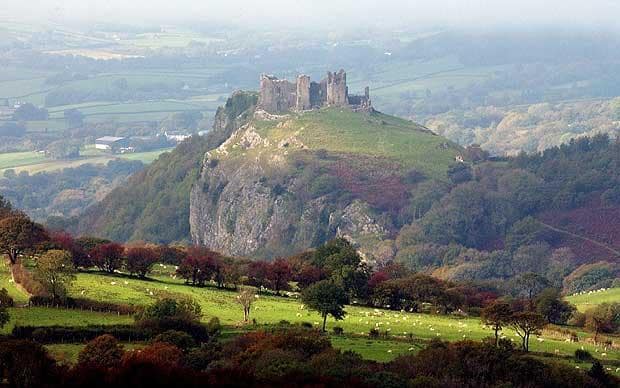
Since two of my favorite things are visiting castles and hiking in the mountains, I love Wales.
I have visited the north but never the south, so today I imagine South Wales and especially the South's highest hills, the Brecon Beacons.
The Brecon Beacons are not very tall – the tallest is Pen Y Far at 2907 feet (884 m) – but they are rugged in parts and include spectacular scenery.
There are bunch of lovely waterfalls, which have marvelous Welsh names like Sgwd Gwladys and Sgwd Isaf Clun-Gwyn.
And an amazing array of castles. Here and at the top is Carreg Cennen. What you see was mostly built in the late 1200s by the Giffard family, but there was an earlier wooded fort on the site built by Rhys Ap Gryffydd around 1200. The castle was attacked by Welsh rebels during Owain Glyndwr's rebellion.
This is Castle Dinefwr, which is just four miles from Carreg Cennen. It was also an old wooden fort turned into a stone fortress in the 13th century, in this case by Llywelyn the Great of Gwynedd. Llywelyn's castle was then enlarged and remodeled by Edward I.
There are about a dozen medieval stone castles in the Brecon Beacons.
There are also several Iron Age hillforts and the only crannog in Wales, in Llangorse Lake. A crannog was a small, human-made island built in a lake or marsh to provide security in violent times; they were common in Ireland from the Bronze Age until the 17th century and not rare in Scotland. This one dates to around 800 CE.
Not far from the actual crannog, they have built a round house like what they think once stood on it.
This area was a major center of industrialization in the eighteenth and early nineteenth centuries and you can still see old limestone mines, iron mines, hauling roads, railroad grades, and the Brecon Canal.
There are many great hikes, including some along the ridge tops and others through the valleys with the waterfalls. It would be a marvelous place to be on this fine summer evening.
I have visited the north but never the south, so today I imagine South Wales and especially the South's highest hills, the Brecon Beacons.
The Brecon Beacons are not very tall – the tallest is Pen Y Far at 2907 feet (884 m) – but they are rugged in parts and include spectacular scenery.
There are bunch of lovely waterfalls, which have marvelous Welsh names like Sgwd Gwladys and Sgwd Isaf Clun-Gwyn.
And an amazing array of castles. Here and at the top is Carreg Cennen. What you see was mostly built in the late 1200s by the Giffard family, but there was an earlier wooded fort on the site built by Rhys Ap Gryffydd around 1200. The castle was attacked by Welsh rebels during Owain Glyndwr's rebellion.
This is Castle Dinefwr, which is just four miles from Carreg Cennen. It was also an old wooden fort turned into a stone fortress in the 13th century, in this case by Llywelyn the Great of Gwynedd. Llywelyn's castle was then enlarged and remodeled by Edward I.
There are about a dozen medieval stone castles in the Brecon Beacons.
There are also several Iron Age hillforts and the only crannog in Wales, in Llangorse Lake. A crannog was a small, human-made island built in a lake or marsh to provide security in violent times; they were common in Ireland from the Bronze Age until the 17th century and not rare in Scotland. This one dates to around 800 CE.
Not far from the actual crannog, they have built a round house like what they think once stood on it.
This area was a major center of industrialization in the eighteenth and early nineteenth centuries and you can still see old limestone mines, iron mines, hauling roads, railroad grades, and the Brecon Canal.
There are many great hikes, including some along the ridge tops and others through the valleys with the waterfalls. It would be a marvelous place to be on this fine summer evening.
Friday, July 7, 2017
Jill Lepore, The Secret History of Wonder Woman
The Secret History of Wonder Woman (2014) is a weirdly fascinating book, bent on showing that any subject you can think of is as much a piece of history as any other, and the oddest can be made to shed light on its own age and probably ours as well. The story of Wonder Woman may be the oddest work of history I have read in this century. It involves bigamy, birth control, feminism, the invention of the lie detector, the rise of comic books, World War II, and much more besides. The fascination comes not so much from the subject matter as from Jill Lepore's way of writing about it. She has a great gift for setting scenes: Harvard's psychological laboratory in the early 1900s, with Doktor Professor Munsterberger and his assistants subjecting undergraduates to pseudo-scientific experiments; rallies by suffragettes; the strange domestic world of William Moulton Marston, Wonder Woman's creator.
Marston was a pioneering experimenter in psychology and responsible for the first physiological "lie detector," based on blood pressure. He was fired from several universities for his unorthodox views and excessive curiosity about sorority initiations, and his publications were mostly ignored. To the rather common (at the time) psychological view that people mainly needed to get over their hangups about sex he added strange theories about dominance and submission that extended those categories to such a broad range of human behavior that they lose most of their surface meanings. (For example, he thought that we all have to submit to living in society and abiding by its rules.) I never understood what he was getting at, and I don't think Lepore does, either.
Marston continued to teach when he could, but without a professorship he needed some other way to support himself. He tried writing movie scripts and served for a while as a consulting psychologist in Hollywood; he got a law degree and tried to practice law. Nothing took.
Fortunately for Marston he married a woman who was much better at earning a living than he was, Elizabeth Holloway. The two had been high school sweethearts and their marriage seemed pretty much inevitable to everyone who knew them. But circumstances of their careers led to their often living apart, and during one of their times apart Marston fell in love with one of his students, Olive Byrne. Marston presented Holloway with an ultimatum: let Byrne move in with them or he would leave. Holloway accepted. According to Lepore, she did so partly because she wanted to have children and keep her career, and the world of the 1920s provided few ways to make that happen. Holloway's strategy was that she would work and her husband's lover would raise her children.
Somehow it worked reasonably well. Not perfectly, but then Byrne was a troubled soul who was suicidal when she met Marston, not the sort of person who lives happily ever after under any circumstances, and Marston was a high-functioning lunatic. Each of Marston's wives had two children, and they were all raised together. They told the census taker that Byrne was Marston's widowed sister-in-law, and she created an imaginary husband who died just after her second child was conceived; her children never found out that Marston was their biological father as well as their adoptive one until decades later. Moulton died in 1947 but Byrne and Holloway continued to live together until their deaths, eventually moving together to a condominium in Florida, known to their descendants as "the ladies." It's a little lesson in how people can sometimes find companionship and happiness where you wouldn't expect.
Byrne was, among other things, the niece of Margaret Sanger, advocate for birth control and in the 1930s the world's most famous feminist. This ties the story to the feminist world of the early 20th century, which Lepore sketches in some excellent passages. Marston and Holloway were both also feminists, and all got to know Sanger well. Marston once said of his famous creation, “Frankly, Wonder Woman is psychological propaganda for the new type of woman who, I believe, should rule the world.”
After a lifetime of failed schemes, Marston finally hit it big with Wonder Woman in 1942. Wonder Woman was a huge success, quickly becoming the third best-selling comic in America after Superman and Batman. She was a strange character, raised among Amazons, armed with a lasso that forced everyone caught in it to tell the truth, so strong as to be almost invincible unless she could be bound or placed in chains, which rendered her weak.
Marston (and Wonder Woman's) obsession with bondage flowed from two sources: his strange psychology and feminist iconography. Suffragettes and feminists were always appearing in public in chains or gagged or both, to symbolize the oppression they hoped to throw off. That's Margaret Sanger above, who was banned from speaking at Harvard and then appeared on stage gagged while a male friend made a speech on her behalf.
This kind of imagery was everywhere.
And yet Marston's obsession with ropes and chains seems to go far beyond necessary to make the political point; in his instructions to his artists he lovingly detailed exactly how Wonder Woman should be bound in each of these scenes.
But anyway that didn't keep Wonder Woman from being a huge hit, especially with girls. Among the girls who grew up loving Wonder Woman was Gloria Steinem, which is how WW ended up on the cover of the first regular issue of Ms. Magazine.
It is, as I said, a strange story, not especially important but interesting nonetheless. Thinking back on it, what strikes me most is what it says about creativity. Fantasy and science fiction writers are always being asked, "Where do you get your ideas?" In the case of William Moulton Marston, Lepore has been able to track down the origin of almost every piece of the Wonder Woman saga. Some of it comes from classical literature as reinterpreted in novels of the 1920s, including pulp novels about Amazons; some comes from early 20th-century feminism; some from Marston's strange psychology and obsession with chains; some from his lie detector experiments; some comes from the politics of 1942; some from his time as a college professor with too much interest in sorority girls. Many of the characters are obviously based on real people; the villain Dr. Psycho was based on Marston's old instructor Munsterberger. Lepore shows how much Wonder Woman owes to other stories of Amazons, other comic books, other female superheroes. By the time she is done there isn't much left to explain, except for the hard to explain gift of style that sets successful writers apart from the ones whose very similar stories never get read. Lepore has it, which is why her books, including this one, are such a pleasure to read.
Marston was a pioneering experimenter in psychology and responsible for the first physiological "lie detector," based on blood pressure. He was fired from several universities for his unorthodox views and excessive curiosity about sorority initiations, and his publications were mostly ignored. To the rather common (at the time) psychological view that people mainly needed to get over their hangups about sex he added strange theories about dominance and submission that extended those categories to such a broad range of human behavior that they lose most of their surface meanings. (For example, he thought that we all have to submit to living in society and abiding by its rules.) I never understood what he was getting at, and I don't think Lepore does, either.
Marston continued to teach when he could, but without a professorship he needed some other way to support himself. He tried writing movie scripts and served for a while as a consulting psychologist in Hollywood; he got a law degree and tried to practice law. Nothing took.
Fortunately for Marston he married a woman who was much better at earning a living than he was, Elizabeth Holloway. The two had been high school sweethearts and their marriage seemed pretty much inevitable to everyone who knew them. But circumstances of their careers led to their often living apart, and during one of their times apart Marston fell in love with one of his students, Olive Byrne. Marston presented Holloway with an ultimatum: let Byrne move in with them or he would leave. Holloway accepted. According to Lepore, she did so partly because she wanted to have children and keep her career, and the world of the 1920s provided few ways to make that happen. Holloway's strategy was that she would work and her husband's lover would raise her children.
Somehow it worked reasonably well. Not perfectly, but then Byrne was a troubled soul who was suicidal when she met Marston, not the sort of person who lives happily ever after under any circumstances, and Marston was a high-functioning lunatic. Each of Marston's wives had two children, and they were all raised together. They told the census taker that Byrne was Marston's widowed sister-in-law, and she created an imaginary husband who died just after her second child was conceived; her children never found out that Marston was their biological father as well as their adoptive one until decades later. Moulton died in 1947 but Byrne and Holloway continued to live together until their deaths, eventually moving together to a condominium in Florida, known to their descendants as "the ladies." It's a little lesson in how people can sometimes find companionship and happiness where you wouldn't expect.
Byrne was, among other things, the niece of Margaret Sanger, advocate for birth control and in the 1930s the world's most famous feminist. This ties the story to the feminist world of the early 20th century, which Lepore sketches in some excellent passages. Marston and Holloway were both also feminists, and all got to know Sanger well. Marston once said of his famous creation, “Frankly, Wonder Woman is psychological propaganda for the new type of woman who, I believe, should rule the world.”
After a lifetime of failed schemes, Marston finally hit it big with Wonder Woman in 1942. Wonder Woman was a huge success, quickly becoming the third best-selling comic in America after Superman and Batman. She was a strange character, raised among Amazons, armed with a lasso that forced everyone caught in it to tell the truth, so strong as to be almost invincible unless she could be bound or placed in chains, which rendered her weak.
Marston (and Wonder Woman's) obsession with bondage flowed from two sources: his strange psychology and feminist iconography. Suffragettes and feminists were always appearing in public in chains or gagged or both, to symbolize the oppression they hoped to throw off. That's Margaret Sanger above, who was banned from speaking at Harvard and then appeared on stage gagged while a male friend made a speech on her behalf.
This kind of imagery was everywhere.
But anyway that didn't keep Wonder Woman from being a huge hit, especially with girls. Among the girls who grew up loving Wonder Woman was Gloria Steinem, which is how WW ended up on the cover of the first regular issue of Ms. Magazine.
It is, as I said, a strange story, not especially important but interesting nonetheless. Thinking back on it, what strikes me most is what it says about creativity. Fantasy and science fiction writers are always being asked, "Where do you get your ideas?" In the case of William Moulton Marston, Lepore has been able to track down the origin of almost every piece of the Wonder Woman saga. Some of it comes from classical literature as reinterpreted in novels of the 1920s, including pulp novels about Amazons; some comes from early 20th-century feminism; some from Marston's strange psychology and obsession with chains; some from his lie detector experiments; some comes from the politics of 1942; some from his time as a college professor with too much interest in sorority girls. Many of the characters are obviously based on real people; the villain Dr. Psycho was based on Marston's old instructor Munsterberger. Lepore shows how much Wonder Woman owes to other stories of Amazons, other comic books, other female superheroes. By the time she is done there isn't much left to explain, except for the hard to explain gift of style that sets successful writers apart from the ones whose very similar stories never get read. Lepore has it, which is why her books, including this one, are such a pleasure to read.
Justice John Roberts' Middle School Commencement Address
Terrific:
Now the commencement speakers will typically also wish you good luck and extend good wishes to you. I will not do that, and I’ll tell you why. From time to time in the years to come, I hope you will be treated unfairly, so that you will come to know the value of justice. I hope that you will suffer betrayal because that will teach you the importance of loyalty. Sorry to say, but I hope you will be lonely from time to time so that you don’t take friends for granted. I wish you bad luck, again, from time to time so that you will be conscious of the role of chance in life and understand that your success is not completely deserved and that the failure of others is not completely deserved either. And when you lose, as you will from time to time, I hope every now and then, your opponent will gloat over your failure. It is a way for you to understand the importance of sportsmanship. I hope you’ll be ignored so you know the importance of listening to others, and I hope you will have just enough pain to learn compassion.On the other hand all the 9th-graders I know think the whole world heaps massively unfair misfortunes on them every day, so they may not be the best audience for this sentiment.
Whether I wish these things or not, they’re going to happen. And whether you benefit from them or not will depend upon your ability to see the message in your misfortunes.
The Arab Spring, Failed Hopes, and Self Doubt
The Arab Spring, a great movement for democracy, human rights, and hope, has crashed and burned. Outside Tunisia it has led only to some combination of civil war and renewed repression. Algerian writer and activist Kamel Daoud wrote a moving essay about these events for a French newspaper that has now been translated and published in the Times. It makes me wonder.
Daoud admits that the dreams of the protesters and the rebels are dead or dying, but he does not attribute this to any sort of natural disease. He believes that those dreams were murdered. They were murdered by dictators like Assad with their airplanes and poison gas, by cynical foreign governments, by lies. The liars claim that attempts to establish Arab democracy only empower radicals like the Islamic state and lead to chaos and foreign intervention:
Consider events in Iraq and Egypt. In Iraq the US removed the dictator and his whole apparatus, and so far the result has been corruption, conflict, terrorism, the rise of the Islamic state, a devastating civil war, and the effective secession of Kurdistan. Consider the still smoldering ruins of Mosul, once one of the Arab world's great cities, as collateral damage from this experiment. In Egypt democracy was established and an election held, but the winner was from the Muslim Brotherhood. The secular, western-oriented people who began the protests and launched the revolution recoiled in horror from what their countrymen had chosen and allied with the military to overthrow the Morsi government and return Egypt to dictatorship. The hard, rational part of my brain says this all proves that most of the Arab world is simply not suitable for democracy.
But even as I reach that conclusion I doubt it. Americans always used to say that Latin America was unsuitable for democracy and pointed to the numerous failures, but right now most of the region is democratic, and some of those democratic nations are thriving. Am I just being smug and indifferent when I write off the dreams of Daoud and millions of others? Is my resignation just an excuse for the west's clumsy combination of military meddling and moral indifference? For my refusal to endorse spending American dollars and soldiers overthrowing Assad? I don't know.
I would never tell Daoud or an other citizen of a dictatorship to give up hope; hope is a precious thing in any circumstances. But I am not myself optimistic that things will get better in the Middle East any time soon.
Daoud admits that the dreams of the protesters and the rebels are dead or dying, but he does not attribute this to any sort of natural disease. He believes that those dreams were murdered. They were murdered by dictators like Assad with their airplanes and poison gas, by cynical foreign governments, by lies. The liars claim that attempts to establish Arab democracy only empower radicals like the Islamic state and lead to chaos and foreign intervention:
For President Abdelaziz Bouteflika of Algeria, the Arab springs were “devastating conspiracies.” According to a private Egyptian television channel, even ‘‘The Simpsons’’ contained proof of untoward foreign designs in Syria. The political chaos in Libya has fanned distrust as well.I want to agree with Daoud that the dream of Arab democracy remains alive, and that things might have gone differently. But I am not sure. I am not much of a believer in luck or genius. I think most of what happens in history is driven by vast, long-term forces that we only partially understand and can rarely control. It seems to me that people who point out what happened in Libya when the dictator was overthrown are onto something. The situation did not degenerate into chaos for no reason at all; it degenerated because Libyans are deeply divided among themselves by region, tribe, class, attitudes toward Europe, and their interpretations of Islam, so much so that once the heavy hand of dictatorship was removed the situation spontaneously combusted. Can democracy flourish in such circumstances? Assad has held onto power in Syria not just because he has airplanes and poison gas, but because he has the support of many Syrians. Foreign powers meddle in Arab conflicts not just for their own nefarious purposes but because various Arab factions are always begging them to.
The foreign-intervention theory is used as a weapon against local dissenters. In 2016 Bouteflika, ailing and immobilized, announced that he would seek yet another term, after having the Constitution amended so that he could stay in office for the rest of his life. When his opponents countered his proposals by invoking democratic values, government media accused them of being traitors, Western agents or Zionists.
The case of Syria — subject to alliances with Iran or Russia and playing against Saudi Arabia, Qatar or the United States — gives weight to such propaganda. It seems to demonstrate that any demand for democracy eventually translates into chaos, and chaos invites the return of colonialism. The same goes for Libya. Better then to submit to one’s dictators than compromise oneself with foreigners.
Consider events in Iraq and Egypt. In Iraq the US removed the dictator and his whole apparatus, and so far the result has been corruption, conflict, terrorism, the rise of the Islamic state, a devastating civil war, and the effective secession of Kurdistan. Consider the still smoldering ruins of Mosul, once one of the Arab world's great cities, as collateral damage from this experiment. In Egypt democracy was established and an election held, but the winner was from the Muslim Brotherhood. The secular, western-oriented people who began the protests and launched the revolution recoiled in horror from what their countrymen had chosen and allied with the military to overthrow the Morsi government and return Egypt to dictatorship. The hard, rational part of my brain says this all proves that most of the Arab world is simply not suitable for democracy.
But even as I reach that conclusion I doubt it. Americans always used to say that Latin America was unsuitable for democracy and pointed to the numerous failures, but right now most of the region is democratic, and some of those democratic nations are thriving. Am I just being smug and indifferent when I write off the dreams of Daoud and millions of others? Is my resignation just an excuse for the west's clumsy combination of military meddling and moral indifference? For my refusal to endorse spending American dollars and soldiers overthrowing Assad? I don't know.
I would never tell Daoud or an other citizen of a dictatorship to give up hope; hope is a precious thing in any circumstances. But I am not myself optimistic that things will get better in the Middle East any time soon.
Thursday, July 6, 2017
Damien Hirst, Demon with Bowl
Critics are mostly panning Damien Hirst's new exhibit in Venice, Treasures from the Wreck of the Unbelievable. ArtNews called it "undoubtedly one of the worst exhibitions of contemporary art staged in the past decade." But this Colossus, titled Demon with Bowl, is cool.
Junot Diaz's Syllabus for "World Building"
Junot Diaz is a highly regarded young novelist who also teaches at MIT. This is from one of his syllabi:
World-BuildingThoughts? Anyone care to offer a different reading list? Remember that for purposes of undergraduate teaching length matters, so a list that goes Dune, The Left Hand of Darkness, Anathem, etc. would likely not work. Although I suppose you are free to fantasize about a course for super readers if you like.
Description: “This class concerns the design and analysis of imaginary (or constructed) worlds for narrative media such as roleplaying games, films, comics, videogames and literary texts. … The class’ primary goal is to help participants create better imaginary worlds – ultimately all our efforts should serve that higher purpose.”
Prerequisites: “You will need to have seen Star Wars (episode four: A New Hope) and read The Lord of the Rings by JRR Tolkien.”
Reading List:
“A Princess of Mars” by ER Burroughs
“Dracula” by Bram Stoker
“Batman: The Dark Knight Returns” by Frank Miller
“Sunshine” by Robin McKinley
“V for Vendetta” by Alan Moore
“The Hunger Games” by Suzanne Collins
“The Hundred Thousand Kingdoms” by NK Jemisin
“Lilith’s Brood” by Octavia Butler
“Perdido Street Station” by China Miéville
“Snow Crash” by Neal Stephenson (Recommended)
Some things to consider always when taking on a new world: What are its primary features—spatial, cultural, biological, fantastic, cosmological? What is the world’s ethos (the guiding beliefs or ideals that characterize the world)? What are the precise strategies that are used by its creator to convey the world to us and us to the world? How are our characters connected to the world? And how are we the viewer or reader or player connected to the world?
North Korea is not Collapsing
So far as anybody can tell, the economy of North Korea is growing. In the 1990s North Koreans endured devastating famines after the withdrawal of Soviet support, and many experts in South Korea and the US thought the regime might collapse at any moment. But the country seems to have recovered from that crisis and entered an era of modest but real growth and real improvement in living standards. Opinions about this vary a lot, but at least one economist consulted by the Times thought that recent growth might be as high as 5%.
Today the Times is running a set of aerial photos that show North Korean investment in infrastructure: new dams, markets, schools, even a ski resort and a tree plantation that grows seedlings to replant the forests cut down for firewood during the crisis years.
How? We're talking about a country crippled by energy shortages, dominated by a bizarre dictatorship, suffused with a siege mentality that leads to enormous investments in missiles, nuclear weapons, and a vast network of artillery and rocket emplacements designed to rain destruction on South Korea in the event of war.
A concerted long-range plan to improve electricity supplies has probably helped. But most economists – that is, the ones who believe that this growth is happening – credit the loosening of state economic control that began in the famine. When the government could not feed people or pay their wages at state jobs, they allowed the development of markets and small private farms. Once the famine was over the government of Kim Jong-Il intermittently cracked down on private markets, attempting to keep them within tight limits. But over the past five years Kim Jong-un has, people say, embraced the markets and helped them to flourish.
But to get back to where I started: North Korea is not exactly thriving, but conditions have improved a lot since 1995. An American strategy of refusing to talk to them and occasionally making ominous noises about war will not force their government to capitulate. They can go on like this pretty much indefinitely. Nor will they be overthrown in some sort of revolution, since their complete control of the media, the military, education, and all other levers of power will keep any alternative power center from developing.
To broaden the picture: the resurgence of markets in North Korea is yet another argument in favor of capitalism and against strict socialism. One thing we have learned from the past century of socialist experiments is that business – markets, exchange, the pursuit of profit – is quite fundamental to human life and aspiration, popping up wherever it is allowed. It takes a Bolshevik or Maoist level of repression to stamp out markets. And as long as there are markets, some people will become successful businessmen and make lots of money. In any large-scale society there will therefore be rich people, and inequality will become an issue. I don't see any way around this. Any society free enough for me to want to live there will have business, and in business there are always winners and losers. Since strict socialism can only be created by grim oppression, and raw capitalism leads to a world of billionaires and paupers that I find deeply unappealing, that leaves a mixed economy with progressive taxation as the only route we know of to a decent world.
Today the Times is running a set of aerial photos that show North Korean investment in infrastructure: new dams, markets, schools, even a ski resort and a tree plantation that grows seedlings to replant the forests cut down for firewood during the crisis years.
How? We're talking about a country crippled by energy shortages, dominated by a bizarre dictatorship, suffused with a siege mentality that leads to enormous investments in missiles, nuclear weapons, and a vast network of artillery and rocket emplacements designed to rain destruction on South Korea in the event of war.
A concerted long-range plan to improve electricity supplies has probably helped. But most economists – that is, the ones who believe that this growth is happening – credit the loosening of state economic control that began in the famine. When the government could not feed people or pay their wages at state jobs, they allowed the development of markets and small private farms. Once the famine was over the government of Kim Jong-Il intermittently cracked down on private markets, attempting to keep them within tight limits. But over the past five years Kim Jong-un has, people say, embraced the markets and helped them to flourish.
Since 2010, the number of government-approved markets in North Korea has doubled to 440, and satellite images show them growing in size in most cities. In a country with a population of 25 million, about 1.1 million people are now employed as retailers or managers in these markets. . . .I suspect that the example of China is key here. North Koreans used to follow the Stalinist model, but lately they have seen that China's Communist Party has held onto political power despite the booming market economy. As long as they insist on confrontation with the US, they will never achieve China's spectacular growth, which was jump-started by exports and foreign investment. But they can certainly get improved results domestically.
Unofficial market activity has flourished, too: people making and selling shoes, clothing, sweets and bread from their homes; traditional agricultural markets that appear in rural towns every 10 days; smugglers who peddle black-market goods like Hollywood movies, South Korean television dramas and smartphones that can be used near the Chinese border.
At least 40 percent of the population in North Korea is now engaged in some form of private enterprise, a level comparable to that of Hungary and Poland shortly after the fall of the Soviet bloc, the director of South Korea’s intelligence service, Lee Byung-ho, told lawmakers in a closed-door briefing in February.
But to get back to where I started: North Korea is not exactly thriving, but conditions have improved a lot since 1995. An American strategy of refusing to talk to them and occasionally making ominous noises about war will not force their government to capitulate. They can go on like this pretty much indefinitely. Nor will they be overthrown in some sort of revolution, since their complete control of the media, the military, education, and all other levers of power will keep any alternative power center from developing.
To broaden the picture: the resurgence of markets in North Korea is yet another argument in favor of capitalism and against strict socialism. One thing we have learned from the past century of socialist experiments is that business – markets, exchange, the pursuit of profit – is quite fundamental to human life and aspiration, popping up wherever it is allowed. It takes a Bolshevik or Maoist level of repression to stamp out markets. And as long as there are markets, some people will become successful businessmen and make lots of money. In any large-scale society there will therefore be rich people, and inequality will become an issue. I don't see any way around this. Any society free enough for me to want to live there will have business, and in business there are always winners and losers. Since strict socialism can only be created by grim oppression, and raw capitalism leads to a world of billionaires and paupers that I find deeply unappealing, that leaves a mixed economy with progressive taxation as the only route we know of to a decent world.
Wednesday, July 5, 2017
Conservatives, Trump, and the Future
My Democratic friends often wonder why conservatives, especially intellectuals who claim to care about public morality, support Trump's presidency. In an essay titled "What if Trump Fails?" Robert Merry, editor of The American Conservative, lays it out for us. First, he says, the old Republican Party is finished:
This seems to me to be a clear explanation of how many Trump-dubious conservatives see the national situation. They may not like Trump, but he's all that's standing between them and Bernie Sanders.
Politicians are always the last to get it when the status quo crumbles because they have so much at stake in it. But citizens get it, as they did last year when they used Trump as a blunt instrument to pummel the Republicans’ status quo leaders. . . . The voters got it also when they used Vermont’s Bernie Sanders to bludgeon Hillary Clinton in the Democratic primaries. These weren’t idle actions on the part of the electorate. They represented a stark statement that the old ways weren’t working and they wanted politicians willing to lead the country in new directions, capable of addressing the polity’s festering problems—the hollowing out of the working class, the lack of sufficient economic growth, expanding economic inequality, the lingering immigration problems, the infrastructure crisis, the debt crisis.Second, the old Democratic Party is finished, too, and we can expect the new version to turn hard toward the left:
Many Republicans seem to think that, as soon as Trump is out of the way, Republicans can go back to being Republicans, and the party of Reagan will rise again. It isn’t going to happen. The era of Reagan is long gone, as Trump proved, and whatever happens to Trump, the GOP will have to craft something new for a new era. Politics is always about the future, not the past.
The Democratic Party is in serious trouble, largely because it clung too long to the status quo politics of Hillary Clinton and her enablers in the party establishment. Now with four post-November congressional election defeats, and with nary a victory of any kind to tout, the party is headed for a raucous time of reassessment and redefinition. It seems inevitable that the party will fall back on the time-tested rubric of liberal populism.So in Merry's view, either Trump is somehow successful in leading America from his weird but generally conservative perspective, or he fails – possibly spectacularly – handing the country to a Democratic Party that has been taken over by its left-wing activists. Plus in a broader sense, if Republicans can't make at least some progress fighting the economic problems of middle America, they open the field for a much more left-wing approach.
The central cry of the populist is the need to smash institutions of entrenched power that, in the populist view, distort the American system to benefit themselves at the expense of the broad mass of citizens. The central target of liberal populism is the wealthy—in today’s political lexicon, the so-called 1 percent. Large financial institutions and big corporations also are found in the crosshairs of these populists. Their main goal is to redistribute wealth, which means they must enlist government as their ally. And they evince few concerns about powerful labor unions. They want to enlarge federal transfer payments, increase income taxes on the wealthy, make payroll taxes progressive, increase estate taxes, and bolster business regulation. All this would lead the nation, under Democratic leadership, toward European-style socialism.
This seems to me to be a clear explanation of how many Trump-dubious conservatives see the national situation. They may not like Trump, but he's all that's standing between them and Bernie Sanders.
Tuesday, July 4, 2017
Was the American Revolution a Mistake?
I'm seeing lots of essays and posts this July 4 arguing that the American Revolution was a mistake. Here's a fairly typical version of the argument from Dylan Mathews:
I think the assertion that the British Empire would have been better to the Indians is just wrong. The British were fairly decent to the Indians in Canada because by 1800 the Canadian Indians didn't have any land that white people wanted. By contrast the "civilized tribes" of the American southeast controlled large territories with millions of acres of fertile land. Neither the British Empire nor any other power on earth could have kept white settlers from taking it.
As for the assertion that Parliamentary systems are better than the American mishmash, maybe so, but so far very few Parliaments have lasted as long or endured through as much as the American Republic has.
So I do not believe that staying in the empire would have necessarily prevented the horrors of the Civil War or the ethnic cleansing of the eastern Indians. But that is just the start of my criticism. There is a much more important problem with all of these arguments, which is that they completely miss the philosophical issues that were at issue in the Revolution. The Revolution was an outgrowth of the Enlightenment. It was founded on the rejection of old ideas about humanity and god, and especially on the rejection of inherited hierarchies in state or church. People like Dylan Mathews seem not to understand that they are attacking the Revolution using criteria that did not exist until the Revolution established them: human rights, equality, government by elected representatives.
When he is complaining about American treatment of Indians, Mathews makes a telling mistake. He quotes historian Ethan Schnmidt as saying.
Of course the American revolutionaries did not originate these ideas. Europeans had been fighting over them for decades, and the Revolution drew strength from a strong party of English and Scots who also believed in representative government and equal rights. But until 1776 the opposition had defended aristocracy partly on the basis that democracy had never been shown to work. The American example remained crucial for a century: after the French Revolution collapsed into tyranny, bloodshed, and military dictatorship, all the conservatives said, "we told you so." But their opponents could and did point to the United States as a place where democracy worked. When Lincoln called the United States "the last, best hope of earth" he received nods and thanks from radicals around the world. It is true that Britain and Scandinavia continued to evolve toward democracy and human rights throughout the nineteenth century, so that by its end they were farther along that road than America was. But nobody in 1776 knew that would happen, and indeed there is no reason to suppose it was inevitable. The American Revolution was part of the struggle for human freedom and equality, and it success drove those ideals forward. I used to think the triumph of modern politics was inevitable, but now I am not sure. After all, aristocracy worked pretty well for centuries.
The American Revolution was a radical experiment. Like all such experiments, it was not wholly successful. It has taken a long, long time to come close to the promise of our founding vision. But that, you know, is how history works: nothing changes all at once. It may be true that equality for white Americans was for a century or two worse for both Indians and blacks than aristocracy would have been. I have written here several times about the great difficulty humans have had making democracy work in multi-ethnic societies. But just the creation of a mono-ethnic, all-male democracy was an astonishing achievement, one that most of Europe's elite considered impossible.
Criticism of the Revolution as not sufficiently democratic and not sufficiently devoted to human rights are a sign of its success. We are all children of the Enlightenment, and we believe what George Washington and Benjamin Franklin believed. Dylan Mathews believes in those things so strongly that he cannot even imagine that they were once opposed by other beliefs; all he can see is that the early American Republic fell far short of its own ideals. He should learn something about history, so he could understand how strange and radical it was to see farmers and shopkeepers rising up to drive out the paid soldiers of their king so that they might replace him with a Constitution.
UPDATE
Abraham Lincoln, speaking on July 4, 1858, made the connection between the Revolutionary doctrine of equality and the eventual freedom of America's slaves:
This July 4, let's not mince words: American independence in 1776 was a monumental mistake. We should be mourning the fact that we left the United Kingdom, not cheering it.I have been asking myself this same question for twenty years, mainly because of slavery and the Civil War. In 1833 the British Empire abolished slavery with minimal violence, which seems like a shining star of an alternative outcome compared to what we endured in the United States. After years of turning this over, I am not convinced that staying in the Empire would have solved this problem. I think there is no guarantee that Britain would have succeeded in freeing the slaves of Mississippi and Alabama with anything like the easy success they encountered in Jamaica and Barbados. In the Caribbean, whites were a tiny minority absolutely dependent on the British crown to keep the slaves down; once the support of the empire was withdrawn, they had no alternative but to accept manumission. Southerners not only believed they could keep their slaves down without British help, they had proved quite equal to the task for decades. If the decree had come down from London to free the slaves, they would instantly have rebelled, and the outcome would have been a bloody disaster. The British had been unable to conquer North America in 1776 when it had a fraction of the population and wealth it commanded in 1833, so I suspect the slaveholders would have won their revolution. As to what the North would have done, who knows?
Of course, evaluating the wisdom of the American Revolution means dealing with counterfactuals. As any historian would tell you, this is a messy business. We obviously can't be entirely sure how America would have fared if it had stayed in the British Empire longer, perhaps gaining independence a century or so later, along with Canada.
But I'm reasonably confident a world in which the revolution never happened would be better than the one we live in now, for three main reasons: Slavery would've been abolished earlier, American Indians would've faced rampant persecution but not the outright ethnic cleansing Andrew Jackson and other American leaders perpetrated, and America would have a parliamentary system of government that makes policymaking easier and lessens the risk of democratic collapse.
I think the assertion that the British Empire would have been better to the Indians is just wrong. The British were fairly decent to the Indians in Canada because by 1800 the Canadian Indians didn't have any land that white people wanted. By contrast the "civilized tribes" of the American southeast controlled large territories with millions of acres of fertile land. Neither the British Empire nor any other power on earth could have kept white settlers from taking it.
As for the assertion that Parliamentary systems are better than the American mishmash, maybe so, but so far very few Parliaments have lasted as long or endured through as much as the American Republic has.
So I do not believe that staying in the empire would have necessarily prevented the horrors of the Civil War or the ethnic cleansing of the eastern Indians. But that is just the start of my criticism. There is a much more important problem with all of these arguments, which is that they completely miss the philosophical issues that were at issue in the Revolution. The Revolution was an outgrowth of the Enlightenment. It was founded on the rejection of old ideas about humanity and god, and especially on the rejection of inherited hierarchies in state or church. People like Dylan Mathews seem not to understand that they are attacking the Revolution using criteria that did not exist until the Revolution established them: human rights, equality, government by elected representatives.
When he is complaining about American treatment of Indians, Mathews makes a telling mistake. He quotes historian Ethan Schnmidt as saying.
The British government remained willing to conceive of Native Americans as subjects of the crown, similar to colonists. American colonists … refused to see Indians as fellow subjects.Which is true. But the radical idea was not that white people and Indians could be subjects in the same way; there had been multi-ethnic empires for three thousand years. The radical idea was that a person should not be a subject at all, but a citizen. The British elite was indeed willing to treat Indians in much the same way they treated white colonists, because they viewed the whole lot as troublesome serfs. The idea that either an Indian or a Massachusetts farmer was the equal of a Duke never entered their wildest dreams. The American Revolution was about demanding that equality in theory, and about building a system that could work toward making it real in practice.
Of course the American revolutionaries did not originate these ideas. Europeans had been fighting over them for decades, and the Revolution drew strength from a strong party of English and Scots who also believed in representative government and equal rights. But until 1776 the opposition had defended aristocracy partly on the basis that democracy had never been shown to work. The American example remained crucial for a century: after the French Revolution collapsed into tyranny, bloodshed, and military dictatorship, all the conservatives said, "we told you so." But their opponents could and did point to the United States as a place where democracy worked. When Lincoln called the United States "the last, best hope of earth" he received nods and thanks from radicals around the world. It is true that Britain and Scandinavia continued to evolve toward democracy and human rights throughout the nineteenth century, so that by its end they were farther along that road than America was. But nobody in 1776 knew that would happen, and indeed there is no reason to suppose it was inevitable. The American Revolution was part of the struggle for human freedom and equality, and it success drove those ideals forward. I used to think the triumph of modern politics was inevitable, but now I am not sure. After all, aristocracy worked pretty well for centuries.
The American Revolution was a radical experiment. Like all such experiments, it was not wholly successful. It has taken a long, long time to come close to the promise of our founding vision. But that, you know, is how history works: nothing changes all at once. It may be true that equality for white Americans was for a century or two worse for both Indians and blacks than aristocracy would have been. I have written here several times about the great difficulty humans have had making democracy work in multi-ethnic societies. But just the creation of a mono-ethnic, all-male democracy was an astonishing achievement, one that most of Europe's elite considered impossible.
Criticism of the Revolution as not sufficiently democratic and not sufficiently devoted to human rights are a sign of its success. We are all children of the Enlightenment, and we believe what George Washington and Benjamin Franklin believed. Dylan Mathews believes in those things so strongly that he cannot even imagine that they were once opposed by other beliefs; all he can see is that the early American Republic fell far short of its own ideals. He should learn something about history, so he could understand how strange and radical it was to see farmers and shopkeepers rising up to drive out the paid soldiers of their king so that they might replace him with a Constitution.
UPDATE
Abraham Lincoln, speaking on July 4, 1858, made the connection between the Revolutionary doctrine of equality and the eventual freedom of America's slaves:
Those arguments that are made, that the inferior race are to be treated with as much allowance as they are capable of enjoying; that as much is to be done for them as their condition will allow. What are these arguments? They are the arguments that kings have made for enslaving the people in all ages of the world. You will find that all the arguments in favor of king-craft were of this class; they always bestrode the necks of the people, not that they wanted to do it, but because the people were better off for being ridden. That is their argument, and this argument of the Judge [Senator Douglas] is the same old serpent that says you work and I eat, you toil and I will enjoy the fruits of it. Turn in whatever way you will—whether it come from the mouth of a King, an excuse for enslaving the people of his country, or from the mouth of men of one race as a reason for enslaving the men of another race, it is all the same old serpent, and I hold if that course of argumentation that is made for the purpose of convincing the public mind that we should not care about this, should be granted, it does not stop with the negro. I should like to know if taking this old Declaration of Independence, which declares that all men are equal upon principle and making exceptions to it where will it stop. If one man says it does not mean a negro, why not another say it does not mean some other man? If that declaration is not the truth, let us get the Statute book in which we find it and tear it out!
Subscribe to:
Posts (Atom)