Friday, November 7, 2014

Another Day in the Field

In the field all day today, still on the Potomac in Maryland. Alternating dark clouds and bright sunshine created some dramatic lighting.

Our friendly bald eagle sitting on a tree by the creek. He's the black and white dot.


The Library of Congress under Construction, 1894


Thursday, November 6, 2014

ALMA Captures Planets in Formation

Astronomers testing a new radiotelescope have captured this amazing image of a "planetary disk" around a very young star called HL Tau:
Astronomers have captured the best image ever of planet formation around an infant star as part of the testing and verification process for the Atacama Large Millimeter/submillimeter Array’s (ALMA) new high-resolution capabilities.

This revolutionary new image reveals in astonishing detail the planet-forming disk surrounding HL Tau, a Sun-like star located approximately 450 light-years from Earth in the constellation Taurus.
This had to be done with radio telescopes because HL Tau, like all new stars, is surrounded by a cloud of gas that blocks visual and infrared light.

In case you were wondering, ALMA is an array of 66 giant radiotelescopes in Chile, built by a worldwide consortium of countries. They work by interferometry, combining the signals received by telescopes up to 15 km apart into a single image:
To operate properly, ALMA must have its 66 antennas and electronics working in perfect synchrony, with a precision of one millionth of a millionth of a second. In addition, the signals from the different antennas must be combined in a way that the path followed from each antenna until it is combined at the central computer (the correlator) must be known with an accuracy equal to the diameter of a human hair (hundredths of a millimeter).
Amazing, the things we can do when we put our minds to them.

A Country Graveyard

St. John's Churchyard, Prince Georges County, Maryland.


ISIS Loses Ground in Iraq

Helped by air strikes, Iraqi and Kurdish forces have made substantial gains in their battle against the Islamic State:
In recent weeks, combinations of Iraqi government units, Kurdish pesh merga forces, Shiite militias and armed Sunni tribesmen have seized the Rabia crossing with Syria; taken back the area of Zumar in the north and Jurf al-Sakr south of Baghdad; opened crucial roads in the country’s center; and held off Islamic State advances elsewhere. Continue reading the main story For the first time since the jihadists seized Mosul and much of northwestern Iraq in June, an Iraqi military vehicle can drive from Baghdad to the northern city of Erbil on a main highway. Hisham Alhashimi, an Iraqi researcher and an expert on the Islamic State, said those changes had broken up the group’s territory, making it harder for it to move its forces and for its couriers to relay messages among the leadership and the field commanders.
I never thought ISIS was much of a real strategic danger; they have prospered only because of the power vacuum created by the Syrian civil war and the incompetent bigotry of Iraq's Shiite leadership.

But I might note that our "strategy" of supporting the "moderate rebels" in Syria took a big blow last week when one of the groups we were counting on surrendered to ISIS and handed over all the weapons we had given them. I don't think there are any meaningful forces in Syria other than the Assad regime and the various Sunni fanatics, and eventually we will have to choose between them.

Wednesday, November 5, 2014

Hummingbirds Sword Fight with their Bills

Cool video at Science.

On the Potomac

Yesterday was my 20th anniversary with my employers, the Louis Berger Group. Or that's what they call themselves now; there have been three or four  reorganizations and name changes during my time here. Since my top field guy just resigned, I am celebrating the event by going back to working as field supervisor, which I haven't done in about a decade. Stomping around in thick woods with a bunch of 25-year-olds. I'm working in a gorgeous place, on an arm of the Potomac River just south of Washington. While I wait for permission from the Park Service to blog about the archaeology, I will pass along some images of the scenery. Above, ducks started by the intrepid archaeologist rise from the marshes of Broad Creek.

A tiny frog comes to visit us at lunch.


Trees.

An egret on the marsh.

An osprey nest in the top of a beech tree.

Shelf fungus on a log.

Hawthorn tree. There has been much more -- woodpeckers, hawks, a great horned owl, a bald eagle, a flock of wild turkeys, herds of deer, and all around the sights and smells of the woods in fall.

What a Depressing Election

You may have noticed that I have said almost nothing about the election that took place yesterday. This is because I considered the result a foregone conclusion, and because I consider that result to be a distillation of all that is wrong with democracy in America. The Republicans won even though the electorate is more liberal than it has been in decades; we had two states that voted for both Republican senate candidates and an increase in the minimum wage that those candidates opposed. Marijuana legalization won in three states. One thing that came through clearly in the exit polls was that voters want Republicans and Democrats to work together to solve the country's problems. But one of the victors was Mitch McConnell, architect of the Republican strategy of blocking everything Obama does, and pretty much every new Republican has vowed to repeal the Affordable Care Act and fight any attempt to reduce carbon emissions. Whatever is in store for us, it is not cooperation. It frustrates me that people do not understand this. If people really want something to happen, they have to vote for candidates who support that something, not those who have vowed to keep it from happening.

The mood in America is lousy -- the latest poll I saw showed "on the wrong track" with a big lead at 66%. The President always takes the blame for this, whether it is his fault or not. It bugs me that voters have not seemed to register that for the last four years Obama has been trying to solve some of those problems voters worry about, but that Republicans have opposed him at every turn. Nearly half of voters cannot even say who controls the House of Representatives. This leaves us vulnerable to the strategy that Republicans have applied so diligently: screw up Washington however they can, knowing that the President will take the blame. The political wisdom used to be that politicians needed "accomplishments" to run on, but now that has been reversed, and a vote for any bill the President is willing to sign counts against Republican office seekers. The top Republicans are the ones who oppose everything Obama does.

Meanwhile almost all the Democrats in competitive races have run away from their own accomplishments; one reason I haven't blogged more about the election is that I haven't seen a single stalwart defense of things I believe in from any Democratic candidate.

In democratic politics, identity counts for more than reason. Millions of Americans cast their votes yesterday for candidates who will support policies those voters claim to oppose. They did so because they are angry at Obama, unhappy with the national mood, and feel more solidarity with a conservative, moralistic, patriotic mindset than with progressive experimentation. To me this result goes some distance toward explaining why the world is not a better place.

UPDATE: Matt Yglesias sums up politics over the past few years for me: "American politics is descending into a meaningless, demographically driven seesaw."

Tuesday, November 4, 2014

Victoria Crowe

Victoria Crowe is a British artist born in Surrey in 1945. She studied at Kingston School of Art from 1961-65 and then at the Royal College of Art, London, from 1965-68. From there she went to teach at Edinburgh College of Art, where she worked part time for 30 years while developing her own artistic practice. She settled in a Scottish town and worked her way into the community, and these days she is often described as a "Scottish artist," which if you ask me points out the folly of trying to make England and Scotland into separate countries. (From 2007 to 2010 she was an artist in residence in Cambridge.) Her work is diverse, and I love a lot of it. Above is one of her most famous paintings, The Large Tree Group,1975.


She continues to paint images of trees and sky or snow; above are two recent works, Luminous Snow and The Blue Thaw.

 She is fabulous at flowers: Orchid Drawing, 2012.

Many of her works are rendered as collages or scrapbook pages, although everything is painted on the same surface. Above, Echo Trace.

Known and Imagined World, 2012.

She has done many formal portraits, some of which hang in major galleries, but I find them clumsy. This is rather interesting, with its multiple images: Kathleen Raine.

Lilac Trees, Rooks, Snowdrifts.

Morning Reflections across the Water.

Considered Silence. More at her web site.

Stop Worrying about What Other People Do

Here we have a perfect example of we might call the "my culture belongs only to me" whine:
Dear White People (or should I say Queridos Gringos/Gabachos),

Let me begin by saying it is completely natural that you would find yourself attracted to The Day of The Dead. This indigenous holiday from Mexico celebrates the loving connection between the living and our departed loved ones that is so deeply missing in Western culture. Who wouldn’t feel moved by intricately and lovingly built altars, beautifully painted skull faces, waterfalls of marigold flowers, fragrant sweet breads and delicious meals for those whom we miss sharing our earthly lives. I understand. . . .

Like the Pilgrims, you have begun to take over, to gentrify and colonize this holiday for yourselves. I was shocked this year to find Day of the Dead events in my native Oakland Bay Area not only that were not organized by Chicanas or Mexicanas or Latinas, but events with zero Latina artists participating, involved, consulted, paid, recognized, acknowledged, prayed with.

Certain announcements of some of this year’s celebrations conjured visions of hipsters drinking special holiday microbrews and listening to live music by white bands and eating white food in calavera facepaint and broken trails of marigolds. Don’t bother to build an altar because your celebration is an altar of death, a ceremony of killing culture by appropriation. Do you really not know how to sit at the table? To say thank you? To be a gracious guest?
Let me respond to this by quoting my favorite advice to all human beings in all peaceful circumstances: stop worrying what other people do.

How can it possibly make any difference to you whether hipsters in Oakland want to celebrate the Day of the Dead by drinking microbrews in face paint? How does that hurt you? What could possibly be more harmless to anyone?

I find this sort of grousing intensely frustrating. The Day of the Dead does not belong to anyone, any more than harvest festivals or fireworks or sledding in the snow or bike riding or choral singing or tennis belong to anyone. Celebrate it however you like. Or don't. And forget about everyone else.

Monday, November 3, 2014

The Masks of Auteuil


Auguste Rodin created these masks between 1895 and 1898. They adorn the retaining wall of a terrace built by Jean Camille Formigé in the Garden of Auteuil, Paris. Galvanized cast iron. Photographs from wikipedia, by 9jules9.

ADHD and the Thirst for Novelty

Richard Friedman has an interesting essay about Attention Deficit/Hperactivity Syndrome in the Times:
Recent neuroscience research shows that people with A.D.H.D. are actually hard-wired for novelty-seeking — a trait that had, until relatively recently, a distinct evolutionary advantage. Compared with the rest of us, they have sluggish and underfed brain reward circuits, so much of everyday life feels routine and understimulating.

To compensate, they are drawn to new and exciting experiences and get famously impatient and restless with the regimented structure that characterizes our modern world. In short, people with A.D.H.D. may not have a disease, so much as a set of behavioral traits that don’t match the expectations of our contemporary culture. . . .
Setting aside the questionable brain science and evolutionary fables, this is pretty much what I think. My wife and I always joked that our eldest son is the one we would have kicked out of the house and sent to watch the sheep in the summer pasture. We have what looks like an epidemic of ADHD because we are pushing ever harder to get every child to finish high school, even those for whom sitting in class all day is torture. Friedman continues:
I think another social factor that, in part, may be driving the “epidemic” of A.D.H.D. has gone unnoticed: the increasingly stark contrast between the regimented and demanding school environment and the highly stimulating digital world, where young people spend their time outside school. Digital life, with its vivid gaming and exciting social media, is a world of immediate gratification where practically any desire or fantasy can be realized in the blink of an eye. By comparison, school would seem even duller to a novelty-seeking kid living in the early 21st century than in previous decades, and the comparatively boring school environment might accentuate students’ inattentive behavior, making their teachers more likely to see it and driving up the number of diagnoses.
Except for the "gone unnoticed" line, this also makes sense to me. A vast swath of the internet caters to people with minute attention spans; my sons are fans of a web site where comedians are given six seconds to do something funny, which sort of boggles my aged brain.

But if this is true, what can we do about it? Friedman tosses off some ill-thought-out notions about changing schools to accommodate ADHD students --
In school, these curious, experience-seeking kids would most likely do better in small classes that emphasize hands-on-learning, self-paced computer assignments and tasks that build specific skills.
which are never going to happen. His advice about careers is quite good -- ADHD people should seek out jobs that keep them on the move and regularly expose them to new situations. The problem with this advice is that most of the jobs I can think of that fit this description require either a college degree or other extensive training, or else they pay terribly. Archaeological field supervisor, for example, is a good job for a smart young person who needs to be on the move, but it requires a BA and increasingly a master's degree. (Which explains why we have trouble finding good field supervisors -- people with both the educational aptitude and the energy to succeed can make a lot more money doing something else.)

So I fear that in our credential-obsessed age people who can't succeed in school are going to fall ever farther behind, and that ADHD sufferers will become yet another swath of our population that sinks toward poverty as those with the right sort of ambition and energy pull farther away.

Sunday, November 2, 2014

The Ford of the Biscuits, 1594

In 1594 yet another war began between the English and the Irish, this one sometimes called the Nine Years' War. One of the first major actions was an Irish siege of Enniskillen Castle. In August an English force was sent to break the siege and relieve the castle's hard-pressed defenders; since part of their mission was to resupply the castle they were carrying large amounts of provisions. As they tried to cross a ford over the River Arney they were ambushed by an Irish force under the command of Hugh Maguire. The Irish had no guns, only axes and arrows, but the English were not able to get their artillery into the battle and suffered a severe check; according to Irish sources, 400 English soldiers were killed. Carts full of provisions were over turned in the river and lost their contents, because of which the ford has been known ever since as the Ford of the Biscuits (Ath na mBrioscai).

The battle is in the news because metal detectorists have settled an old argument about the battle's location, I turns out that local oral tradition was right and the books wrong; the battle was in a place the locals call Red Meadow. Once again I marvel at the density of local lore in Ireland, a place where every field and meadow has a name, some of them preserving memory of events from centuries ago.

Fred Tomaselli: Birds from Another World

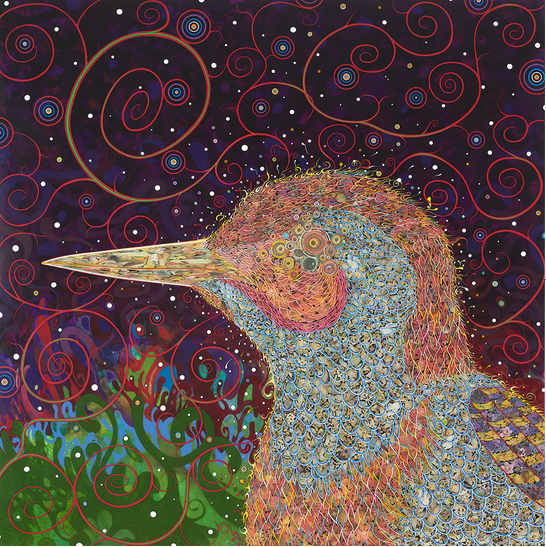
Fred Tomaselli is an American artist born in 1956. Various web sites place him in either California or Brooklyn, so I suppose he is one of those bi-coastal people who refers to the Midwest as "flyover country." I just discovered his work from an exhibit at the Smithsonian on birds in contemporary art, and I just love these images of birds. Migrant Fruit Thugs, 2006.

These works are hybrids of paintings and collages: acrylic on board, but with leaves, bits of printed matter and other things, including both legal and illegal drugs, all covered in clear resin. Starling, 2010.

The presence of embedded psychoactive substances is a clue to where Tomaselli is pointing with these images. The images themselves are full of other clues, including the sorts of starbursts that accompany hallucinatory experiences and a resemblance to the art of Australian Aborigines. This work -- Avian Flower Serpent, 2006 -- resembles the Aztec symbol that now sits in the middle of Mexico's flag but originated in a shaman's vision.

Birds are also strongly associated with shamanism in many cultures, and I think they are here. Woodpecker, 2008.
There is nothing else in magic but the wild thought of the bird as it casts itself into the void.

--Susanna Clarke

Not that all of Tomaselli's work depicts birds -- he has a diverse body of work that includes some highly political stuff and much straight abstraction. Abductor, 2006.

Hang Over, 2005, which is quite striking.

But what I love is the brilliantly colored images of birds as messengers from the other world. Penetrators, 2013. More at his web site.

Ghost Shark

From a video shot by a remotely operated submersible on the ocean floor near Grenada in the Caribbean.

Saturday, November 1, 2014

Today's Sad Political Fact

Non-voters are much more likely to be Democrats than Republicans.

This is largely due to demography: rich people vote much more than poor people, and old people more than young people. But even among people of the same age and income, those who lean Republican are more likely to vote. There are various theories as to why this is so. The one that resonates with me is that people lean Democratic because they want things to change in some dramatic way -- this would be especially true of those who pay little attention to politics -- but no matter who wins the election, things never change in the way that they want. So they say voting makes no difference.

It seems to me that if the Congress actually matched the ideological profile of the nation as a whole, as opposed to the voting part, the mandate would be there for a bunch of big changes: single payer health care, for example. But since poor people don't think their votes make any difference, they don't bother to vote, and the things that would help them don't happen.

Commercial Space Flight Goes Boom

Virgin Galactic's Spaceship 2 crashed in the desert yesterday, killing one of the two pilots and pushing back their plans to start offering flights to paying customers next spring.

Earlier this week a commercial rocket headed for the International Space Station exploded. So not a great week for commercial space flight.

Let me say that I have never personally understood the hype around commercial rocketry.

NASA has been hoping that switching to commercial launch companies would save money, and in the short term it has. These incidents make people wonder, though, if the money has been saved by reducing safety and whether that is sustainable in the long run. NASA also has vaguely grandiose ideas about sparking some kind of commercial space industry. But doing what? Except for communications satellites, what does any commercial entity need in space? The space industry has always been driven by the needs of governments (spy satellites, launching astronauts, etc.) and I don't see why or how that would change. Right now celebrities and billionaires are willing to pay huge sums for brief trips to space -- Brad Pitt and Angelina Jolie are said to hold $200,000 tickets for Virgin Galactic's first commercial flight -- but once that gets old, then what? Sure, people would pay big money for trips to the moon, but is that really a viable business model? I just don't get it; I don't see how there is enough money to be made in space to sustain capitalism there.

It feels to me like another libertarian fantasy -- if we can pry space out of the cold, clammy hands of government and turn loose individual initiative, something great will happen. I doubt it.

Richard Adams, Watership Down

I just finished listening to Watership Down by Richard Adams, and I really enjoyed it. I thought I had read it before when I was about 12, but I remembered nothing, not even the vague deja vu feelings I usually get from books of my distant past, so I think maybe I never did. The writing is fine, the story is interesting, there are some good characters, and it is highly original. The reading, by Ralph Cosham, was excellent. My only complaint was that it wasn't tough enough -- rabbits lead short lives set about with dangers, and I thought more of them should have died. That was the only way in which I thought it was clearly for children rather than adults.

I especially liked the stories the rabbits tell each other, about the great hero El-ahrairah, the Prince with a Thousand Enemies. He is a trickster, and the stories are much like those of B'rer Rabbit and Anansi. But they are original and funny and I thought added a lot to the picture of how the rabbits see their world. In one El-ahrairah tricks a farm dog by offering him the chance to abase himself before the queen of all the dogs -- Dripspittle, her name is -- and the dog begins to wag his tail uncontrollably and say, "Oh, how I will grovel! I will grovel like no dog has ever grovelled before!"

If you have a long car trip coming up, especially one you have to share with children, consider it.